
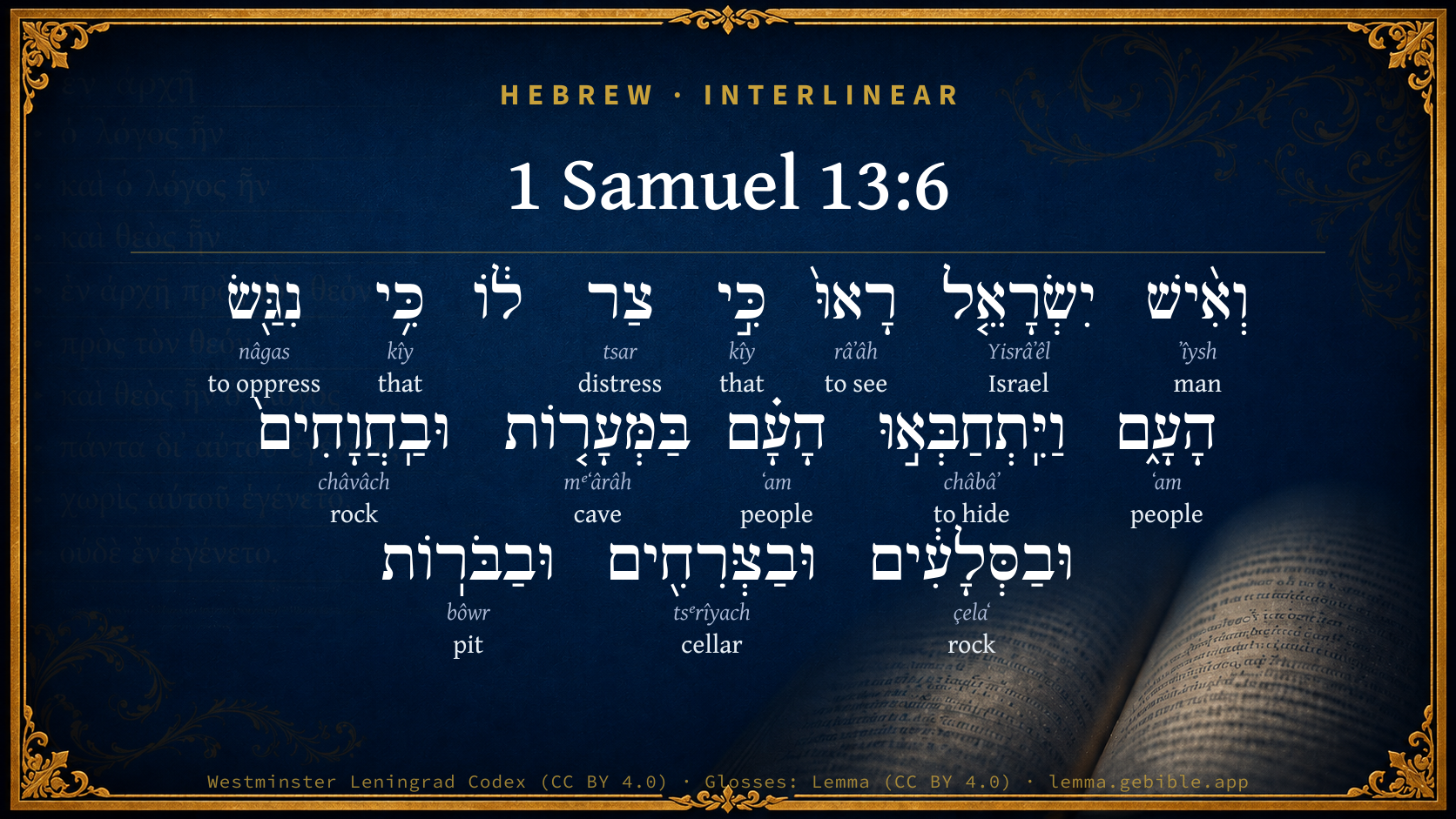
1 Samuel 13:6

Hebrew (Westminster Leningrad Codex) 1 Samuel 13:6 appears in the Hebrew Old Testament. The text above is from the Westminster Leningrad Codex. Each word links to its Strong’s number, a concise gloss, and parsing drawn from the Open Scriptures Hebrew Bible morphology. Click any word for its full Brown-Driver-Briggs (BDB) entry.
Download image
Cite this verse

1 Samuel 13:6 (World English Bible). Public Domain. Lemma interlinear Bible study tool, https://lemma.gebible.app/v/1-samuel/13/6.

Show BibTeX & RIS
BibTeX
RIS
English Translation
When the men of Israel saw that they were in a strait (for the people were distressed), then the people did hide themselves in caves, and in thickets, and in rocks, and in coverts, and in pits.
World English Bible · Public Domain
Highlights
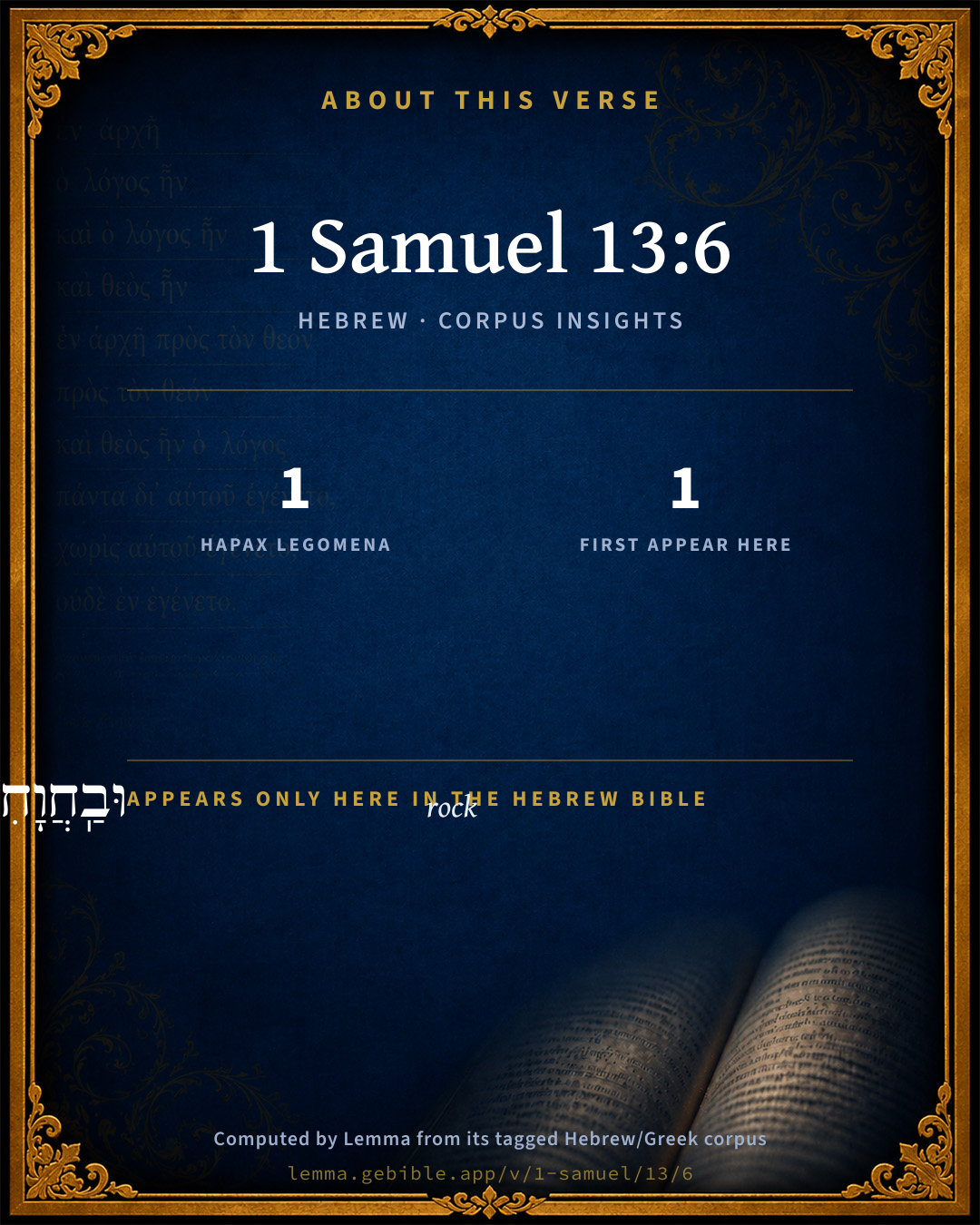
  • 1 hapax legomenon — only here in the Hebrew Bible
  • 1 first appearance in the Hebrew Bible
Full analysis ↓
Download a study sheet

One document with this verse’s original text, its word-by-word gloss line, the meaning frame, cross-references with their text, attributed commentary, and full source and license credits — printable, and it pastes into notes with its structure intact.

This verse Autodidact and up

Study sheet (.html) Plain text (.txt)

A passage Seminary Student

Up to 50 verses in one chapter. A passage sheet keeps up to 6 commentary sources and 12 cross-references per verse, in the order this page ranks them, and says so on the sheet whenever that leaves anything out. Ask for a single verse and you get the Autodidact verse sheet above.

Everything on this page stays free to read, with no account — the sheet is a download of what is already on screen, not access to it.

Want to remove ads? Support Godless Engineer
Compare translations 3

The same verse in 3 English versions, stacked beneath the original-language interlinear above. Click any original word for its lexicon entry.

Each is an independent rendering of the whole verse — the interlinear is not word-aligned to these translations.

Highlighted words mark where these versions differ — a whole-verse word diff, not a word-by-word alignment.

  • World English Bible Public Domain
    When the men of Israel saw that they were in a strait (for the people were distressed), then the people did hide themselves in caves, and in thickets, and in rocks, and in coverts, and in pits.
  • King James Version Public Domain
    When the men of Israel saw that they were in a strait, (for the people were distressed,) then the people did hide themselves in caves, and in thickets, and in rocks, and in high places, and in pits.
  • unfoldingWord Literal Text CC BY-SA 4.0
    And a man of Israel saw that it was narrow to him, for the people were distressed. And the people hid themselves in caves and in thickets and in cliffs and in pits and in cisterns.

unfoldingWord Literal Text — © unfoldingWord, licensed CC BY-SA 4.0. Word-aligned USFM3 via Door43 (git.door43.org/unfoldingWord/en_ult).

Versions to compare (up to 4)

3 of 4 selected

Show all 18 translations

Every available English version of this verse, each an independent rendering of the whole verse.

  • World English Bible Public Domain
    When the men of Israel saw that they were in a strait (for the people were distressed), then the people did hide themselves in caves, and in thickets, and in rocks, and in coverts, and in pits.
  • Berean Standard Bible Public Domain
    Seeing that they were in danger because their troops were hard-pressed, the men of Israel hid in caves and thickets, among the rocks, and in cellars and cisterns.
  • Majority Standard Bible Public Domain
    Seeing that they were in danger because their troops were hard-pressed, the men of Israel hid in caves and thickets, among the rocks, and in cellars and cisterns.
  • King James Version Public Domain
    When the men of Israel saw that they were in a strait, (for the people were distressed,) then the people did hide themselves in caves, and in thickets, and in rocks, and in high places, and in pits.
  • American Standard Version (1901) Public Domain
    When the men of Israel saw that they were in a strait (for the people were distressed), then the people did hide themselves in caves, and in thickets, and in rocks, and in coverts, and in pits.
  • Revised Version (1885) Public Domain
    When the men of Israel saw that they were in a strait, (for the people were distressed,) then the people did hide themselves in caves, and in thickets, and in rocks, and in holds, and in pits.
  • Geneva Bible (1599) Public Domain
    And when the men of Israel saw that they were in a strait (for the people were in distresse) the people hid themselues in caues, and in holdes, and in rockes, and in towres, and in pittes.
  • Douay-Rheims (1899) Public Domain
    And when the men of Israel saw that they were straitened, (for the people were distressed,) they hid themselves in caves, and in thickets, and in rocks, and in dens, and in pits.
  • Young's Literal Translation Public Domain
    And the men of Israel have seen that they are distressed, that the people hath been oppressed, and the people hide themselves in caves, and in thickets, and in rocks, and in high places, and in pits.
  • Literal Standard Version CC BY-SA 4.0
    And the men of Israel have seen that they are distressed, that the people have been oppressed, and the people hide themselves in caves, and in thickets, and in rocks, and in high places, and in pits.
  • Unlocked Literal Bible CC BY-SA 4.0
    When the men of Israel saw that they were in trouble—for the people were distressed, the people hid in caves, in the underbrush, in rocks, in wells, and in pits.
  • unfoldingWord Literal Text CC BY-SA 4.0
    And a man of Israel saw that it was narrow to him, for the people were distressed. And the people hid themselves in caves and in thickets and in cliffs and in pits and in cisterns.
  • Darby Bible Public Domain
    And the men of Israel saw that they were in a strait (for the people were distressed); and the people hid themselves in caves, and in thickets, and in cliffs, and in strongholds, and in pits.
  • World Messianic Bible Public Domain
    When the men of Israel saw that they were in trouble (for the people were distressed), then the people hid themselves in caves, in thickets, in rocks, in tombs, and in pits.
  • Webster's Bible Public Domain
    When the men of Israel saw that they were in a strait (for the people were distressed) then the people hid themselves in caves, and in thickets, and in rocks, and in high places, and in pits.
  • Free Bible Version CC BY-SA 4.0
    When the Israelite men realized the tough situation they were in, and that the army was taking a beating, they hid themselves in caves, holes, rocks, pits, and cisterns.
  • Bible in Basic English Public Domain
    When the men of Israel saw the danger they were in, (for the people were troubled,) they took cover in cracks in the hillsides and in the woods and in rocks and holes and hollows.
  • JPS Tanakh (1917) Public Domain
    When the men of Israel saw that they were in a strait — for the people were distressed — then the people did hide themselves in caves, and in thickets, and in rocks, and in holds, and in pits.

Literal Standard Version (2020), Covenant Press — licensed CC BY-SA 4.0. Text via the HelloAO Bible API (eBible.org). Unlocked Literal Bible (unfoldingWord) — licensed CC BY-SA 4.0. Text via the HelloAO Bible API (eBible.org). unfoldingWord Literal Text — © unfoldingWord, licensed CC BY-SA 4.0. Word-aligned USFM3 via Door43 (git.door43.org/unfoldingWord/en_ult). Free Bible Version, Dr. Jonathan Gallagher — licensed CC BY-SA 4.0. Text via the HelloAO Bible API (eBible.org).

Word by word

More ways to search: Search by grammar → Find every occurrence → Compare this word →

Practice this passage: Drill this verse → Learn its vocabulary →

וּבַֽחֲוָחִים֙
châvâch
H2337
“and · in/at the · rocks”
Conjunction + Preposition, Determined + Noun, Common, Masculine, Plural, Absolute
Part of Speech
Conjunction + Preposition + Noun
Type
Common
Gender
Masculine
Number
Plural
State
Absolute
Full BDB Definition

Origin: perhaps the same as H2336

TWOT: 620a ?

rock, crevice (a hiding place)
  1. וְאִ֨ישׁ ʼîysh H376 “and · man of” Conjunction + Noun, Common, Masculine, Singular, Construct
  2. יִשְׂרָאֵ֤ל Yisrâʼêl H3478 “Israel” Noun, Proper
  3. רָאוּ֙ râʼâh H7200 “to see” Verb, Qal, Perfect, 3rd Person, Common, Plural
  4. כִּ֣י kîy H3588 “that” Conjunction
  5. צַר tsar H6862 “distress” Verb, Qal, Perfect, 3rd Person, Masculine, Singular
  6. כִּ֥י kîy H3588 “that” Conjunction
  7. נִגַּ֖שׂ nâgas H5065 “to oppress” Verb, Niphal, Perfect, 3rd Person, Masculine, Singular
  8. הָעָ֑ם ʻam H5971 “the · people” Particle, Definite Article + Noun, Common, Masculine, Singular, Absolute
  9. וַיִּֽתְחַבְּא֣וּ châbâʼ H2244 “and · to hide” Conjunction + Verb, Hithpael, Sequential Imperfect, 3rd Person, Masculine, Plural
  10. הָעָ֗ם ʻam H5971 “the · people” Particle, Definite Article + Noun, Common, Masculine, Singular, Absolute
  11. בַּמְּעָר֤וֹת mᵉʻârâh H4631 “in/at the · caves” Preposition, Determined + Noun, Common, Feminine, Plural, Absolute
  12. וּבַסְּלָעִ֔ים çelaʻ H5553 “and · in/at the · rocks” Conjunction + Preposition, Determined + Noun, Common, Masculine, Plural, Absolute
  13. וּבַצְּרִחִ֖ים tsᵉrîyach H6877 “and · in/at the · cellars” Conjunction + Preposition, Determined + Noun, Common, Masculine, Plural, Absolute
  14. וּבַבֹּרֽוֹת bôwr H953 “and · in/at the · pits” Conjunction + Preposition, Determined + Noun, Common, Masculine, Plural, Absolute

About this verse

These counts appear in no published source. They are computed here, from the morphology-tagged text and Lemma’s own curated glosses. What Lemma adds →

16
words
13
distinct lemmas
Historical
section

Notable vocabulary

1 hapax legomenon — a word that appears only here in the entire Hebrew Bible:

  • וּבַֽחֲוָחִים֙ rock H2337

First appearance in Scripture

This word makes its first canonical appearance in the Hebrew Bible here:

  • וּבַֽחֲוָחִים֙ rock H2337

Shared distinctive vocabulary

וּבַצְּרִחִ֖ים cellar H6877 occurs in 3 verses of the Hebrew Bible. Also found in:

Grammatical profile

  • 4 verbs
  • 9 nouns
  • 1 preposition
  • 2 conjunctions

Verb forms

  • רָאוּ֙ Qal · Perfect
  • צַר Qal · Perfect
  • נִגַּ֖שׂ Niphal · Perfect
  • וַיִּֽתְחַבְּא֣וּ Hithpael · Sequential Imperfect

Repetition

Words recur within this verse — often emphatic in Hebrew:

  • הָעָ֑ם people H5971 ×2
  • כִּ֣י that H3588 ×2

Hebrew & Septuagint length

In English translation the verse runs 37 words from the Hebrew and 34 from the Septuagint (LXX English) — closely comparable.

A rough comparison of the two English renderings, which tokenize alike — not a word-level alignment.

Word counts can differ between the Hebrew and the Greek without any difference in meaning — e.g. the Hebrew direct-object marker אֵת has no separate Greek word, and Greek often adds the article ὁ.

Cross-references

12

Topical passages linked to 1 Samuel 13:6 in the Treasury of Scripture Knowledge — connected by theme and wording, ordered by reader-vote popularity; previews shown in the World English Bible.

  • Judges 6:2 The hand of Midian prevailed against Israel; and because of Midian the children of Israel made them the dens which are in the mountains, and the caves, and the strongholds.
  • Hebrews 11:38 (of whom the world was not worthy), wandering in deserts, mountains, caves, and the holes of the earth.
  • Exodus 14:10–12 When Pharaoh drew near, the children of Israel lifted up their eyes, and behold, the Egyptians were marching after them; and they were very afraid. The children of Israel cried out to Yahweh.
  • Joshua 8:20 When the men of Ai looked behind them, they saw, and, behold, the smoke of the city ascended up to heaven, and they had no power to flee this way or that way: and the people who fled to the wilderness turned back on the pursuers.
  • Judges 10:9 The children of Ammon passed over the Jordan to fight also against Judah, and against Benjamin, and against the house of Ephraim; so that Israel was sore distressed.
  • Judges 20:41 The men of Israel turned, and the men of Benjamin were dismayed; for they saw that evil had come on them.
  • 1 Samuel 14:11 Both of them disclosed themselves to the garrison of the Philistines: and the Philistines said, Behold, the Hebrews come forth out of the holes where they had hid themselves.
  • 1 Samuel 23:19 Then came up the Ziphites to Saul to Gibeah, saying, Doesn't David hide himself with us in the strongholds in the wood, in the hill of Hachilah, which is on the south of the desert?
  • 1 Samuel 24:3 He came to the sheep pens by the way, where was a cave; and Saul went in to cover his feet. Now David and his men were abiding in the innermost parts of the cave.
  • 2 Samuel 24:14 David said to Gad, I am in a great strait: let us fall now into the hand of Yahweh; for his mercies are great; and let me not fall into the hand of man.
  • Isaiah 42:22 But this is a people robbed and plundered; they are all of them snared in holes, and they are hid in prison-houses: they are for a prey, and none delivers; for a spoil, and none says, Restore.
  • Philippians 1:23 But I am in a dilemma between the two, having the desire to depart and be with Christ, which is far better.

Cross-references courtesy of OpenBible.info (CC BY 4.0).

Hebrew and Greek witnesses Masoretic Hebrew ↔ Greek Septuagint

The same verse in the two great witnesses to the Old Testament, shown verse-for-verse.

These are two independent witnesses, not word-aligned to each other, and the Septuagint is shown in lemma (dictionary) form.

Hebrew 1 Samuel 13:6 Masoretic · Westminster Leningrad Codex

וְאִ֨ישׁ יִשְׂרָאֵ֤ל רָאוּ֙ כִּ֣י צַר ל֔וֹ כִּ֥י נִגַּ֖שׂ הָעָ֑ם וַיִּֽתְחַבְּא֣וּ הָעָ֗ם בַּמְּעָר֤וֹת וּבַֽחֲוָחִים֙ וּבַסְּלָעִ֔ים וּבַצְּרִחִ֖ים וּבַבֹּרֽוֹת

When the men of Israel saw that they were in a strait (for the people were distressed), then the people did hide themselves in caves, and in thickets, and in rocks, and in coverts, and in pits.

World English Bible · Public Domain

Greek LXX 1 Samuel 13:6 Septuagint · lemma form

καί ἀνήρ ἰσραήλ ὁράω ὅτι στενῶς αὐτός μή προςἄγω αὐτός καί κρύπτω ὁ λαός ἐν ὁ σπήλαιον καί ἐν ὁ μάνδρα καί ἐν ὁ πέτρα καί ἐν ὁ βόθρος καί ἐν ὁ λάκκος

And the men of Israel saw that they were in a strait so that they could not draw near, and the people hid themselves in caves, and sheepfolds, and rocks, and ditches, and pits.

LXX2012 (modern English Septuagint) · Public Domain

On this verse, Haydock's Catholic Bible Commentary discusses the Septuagint’s reading. Read the note in Commentary ↓

Hebrew: Westminster Leningrad Codex (CC BY 4.0). Greek: Septuagint (public domain); English from LXX2012 (modern English Septuagint) (Public Domain). How the Septuagint differs from the Hebrew →

Targum (Aramaic paraphrase)

1

The Targum is the ancient Jewish Aramaic paraphrase of the Hebrew Scriptures — an interpretive translation, not the Hebrew text itself. Onkelos (literal) and Pseudo-Jonathan (expansive) render the Torah, and Jonathan the Prophets. Coverage is partial: where no permissively-licensed English translation exists for a verse, only the Aramaic is shown. This is verse-level text, not a word-by-word alignment to the Hebrew.

  1. Targum Jonathan Prophets (Joshua–Malachi)
    וֶאֱנַשׁ יִשְׂרָאֵל חֲזוֹ אֲרֵי עָקַת לְהוֹן אֲרֵי אִידְחַק עַמָא וְאִטַמָרוּ עַמָא בִּמְעָרָתָא וּבִמְצָדָתָא וּבִשְׁקִיפֵי כֵיפַיָא וּבִמְעָרַת טִינָרָא וּבְגוּבַיָא:

    (no public-domain English translation for this verse)

    Targum Jonathan — Aramaic: “Mikraot Gedolot” (public domain). English: “Sefaria Community Translation” (CC0 1.0 (public-domain dedication)); “London "Chaldee Paraphrase," 1871” (public domain). Text via Sefaria.

Commentary

Notes on 1 Samuel 13:6 from classic Christian and Jewish commentators (each source and its license shown beneath its notes). The classic Christian expositions comment on the surrounding passage and are grouped to its opening verse, so a note may address several verses; the Jewish commentaries on the Tanakh (Rashi and others) are per-verse, so they appear only where the commentator wrote on this verse.

Lemma curates 59 commentaries, every one of them public domain or Creative Commons licensed, each selected and text-cleaned for this edition rather than reprinted as found. About our sources →

Jamieson, Fausset & Brown

Robert Jamieson, A. R. Fausset & David Brown

THE ISRAELITES' DISTRESS. (Sa1 13:6-8)

When the men of Israel saw that they were in a strait--Though Saul's gallantry was unabated, his subjects displayed no degree of zeal and energy. Instead of venturing an encounter, they fled in all directions. Some, in their panic, left the country (Sa1 13:7), but most took refuge in the hiding-places which the broken ridges of the neighborhood abundantly afford. The rocks are perforated in every direction with "caves," and "holes," and "pits"--crevices and fissures sunk deep in the rocky soil, subterranean granaries or dry wells in the adjoining fields. The name of Michmash ("hidden treasure") seems to be derived from this natural peculiarity [STANLEY].

Jamieson, Fausset & Brown — Commentary Critical and Explanatory on the Whole Bible (1871) — public domain (CC PDM 1.0). Text via the HelloAO Bible API.

Trapp's Complete Commentary

John Trapp

1Sa 13:6 When the men of Israel saw that they were in a strait, (for the people were distressed,) then the people did hide themselves in caves, and in thickets, and in rocks, and in high places, and in pits.

Ver. 6. For the people were distressed.] Notwithstanding their having a king to save them. God will make the strongest sinew in the arm of flesh to crack, when once he taketh men to do. See 1Sa 13:3.

John Trapp, A Commentary or Exposition upon All the Books of the Old and New Testament (1647–1656) — public domain. Text from a community e-Sword module.

Joseph Benson's Commentary

1Sa 13:6. Israel saw that they were in a strait — Though their wonderful success against the Ammonites had encouraged them to obey the summons of such a prosperous leader as Saul had been; yet when they saw the vast army of the Philistines, how well they were appointed, and themselves unprovided, their hearts failed them, and they slunk away from him as fast as they had flocked to him. The people were distressed — Notwithstanding their former presumption, that if they had a king they would be free from all such difficulties and distresses. Hereby God intended to teach them the vanity of confidence in men; and that they did not one jot less need his help now than they did when they had no king. And probably they were the more discouraged, because they did not find Samuel with Saul. Sooner or later men will be made to see that God and his prophets are their best friends.

Joseph Benson's Commentary on the Old and New Testaments (1811–1818) — public domain. Text from a community e-Sword module.

Whedon's Commentary on the Bible

Daniel D. Whedon

THE PEOPLE’S DISTRESS, AND SAUL’S UNTIMELY SACRIFICE, 1Sa_13:6-15.

6. The people were distressed — They were vexed, harassed, and alarmed by the bold and sudden advance of the Philistine hosts, and despaired being able to stand before them.

Thickets — חוחים, thorns, or thorn bushes.

High places — צרחים, strongholds, as pits or cellars, as at Jdg_9:46; Jdg_9:49.

Daniel D. Whedon (gen. ed.), Commentary on the Old and New Testaments (1874–1909) — public domain. Text from a community e-Sword module.

Adam Clarke's Commentary

Verse 6. The people did hide themselves] They, being few in number, and totally unarmed as to swords and spears, were terrified at the very numerous and well-appointed army of the Philistines. Judea was full of rocks, caves, thickets, &c., where people might shelter themselves from their enemies. While some hid themselves, others fled beyond Jordan: and those who did cleave to Saul followed him trembling.

Adam Clarke's Commentary on the Bible (1810–1826) — public domain. Text from a community e-Sword/MySword module.

Ellicott's Commentary for English Readers

(6) Saw that they were in a strait.—It was evidently no ordinary Philistine foray or invasion which the Israelites had to make head against. The tradition preserved by Josephus tells us that a host of foreign allies had joined the Phœnician armies in this war. This accounts for the great numbers alluded to in the text: “People as the sand which is on the sea shore in multitude” (1Sa_13:5). The hearts of the as yet undisciplined Hebrews sank at the tidings of such an invasion. And in high places.—The word in the original Hebrew is not the same as the one usually rendered “high places” for prayer and sacrifice. The word here signifies towers. It is the same word which in Jdg_9:46; Jdg_9:49 is translated “a hold.” In the Speaker’s Commentary it is suggested that it was applied to a particular kind of tower which was the work of the old Canaanite inhabitants, and which remained as ruins in the time of Saul.

A Bible Commentary for English Readers, edited by Charles John Ellicott (1878–1897) — public domain. Text from a community e-Sword module.

The Cambridge Bible for Schools and Colleges

gen. ed. J. J. S. Perowne

6. in a strait] In distress and danger: as it were, hemmed in and unable to turn in any direction.

the people did hide themselves] Cp. Jdg_6:2.

in high places] The word thus translated occurs elsewhere only in Jdg_9:46; Jdg_9:49 (E. V. hold), and is supposed to mean “a fortified tower,” like the “peels” of the border counties, possibly the work of the old Canaanite inhabitants. But the context rather points to some natural hiding-place.

The Cambridge Bible for Schools and Colleges (gen. ed. J. J. S. Perowne; Cambridge University Press, 1878–1918) — public domain. Text from a community e-Sword module.

John Gill's Exposition

When the men of Israel saw they were in a strait, for the people were distressed,.... By reason of the vast army that the Philistines brought into the field, greatly superior to theirs, and were likely to be encompassed by them on every side; so that nothing but destruction was expected, which gave them the utmost anxiety and uneasiness; though Abarbinel refers this last clause, not to the people of Israel, but to the people of the Philistines, and takes it in this sense:

for the people drew nigh; the army of the Philistines was approaching, and got near to them; and so they were in great danger of being quickly attacked by them, and destroyed, their numbers being so great:

then the people did hide themselves in caves; of which there were many in the land of Judea, capable of receiving a large number, as the cave of Adullam, the cave of Engedi, &c. and such as the Israelites made to hide themselves when oppressed by the Midianites, Jdg 6:2.

and in thickets; woods and forests, or among thorns, as Jarchi; where there was a very great number of brambles and thorn bushes; some, as Kimchi, interpret the word of munitions, garrisons, and fortified places, to which they betook themselves:

in rocks, and in high places, and in pits; in the holes of rocks and mountains, particularly in Mount Ephraim; see Sa1 14:22 and where there were any pits or ditches, high or deep places, where they might be out of sight, and be sheltered from their enemies.

John Gill's Exposition of the Whole Bible (1746–1763) — public domain (CC PDM 1.0). Text via the HelloAO Bible API.

Albert Barnes' Notes on the Bible

In thickets - literally, “among thorns.”

High places - Not the high places for worship, but holds or towers Jdg 9:46, Jdg 9:49; that particular kind of tower which was the work of the old Canaanite inhabitants, and which remained as ruins in the time of Saul.

Albert Barnes' Notes on the Bible (1834–1885) — public domain. Text from a community e-Sword/MySword module.

Haydock's Catholic Bible Commentary

Straitened, the people form the northern provinces, and provisions being cut off, by the immense army of the Philistines. (Calmet) --- Providence was pleased to convince the people that, though they had been able to muster so large a force against the Ammonites, at so short a warning, they must not depend on the efforts of their new king. (Haydock) --- He suffered any of the army to retire, as he sent away most of Gedeon’s soldiers, that the whole glory of the victory might be attributed to him. (Salien) --- Dens. So the Chaldean. Some explain the Hebrew, "high places (Haydock) or towers." (Calmet) --- Septuagint, "ditches or holes." (Menochius) --- Greek: Bothrois. In that country there are many spacious caverns, chap. xxiv., and Josue x. (Haydock)

George Leo Haydock (1774–1849), Haydock's Catholic Family Bible and Commentary, 1859 edition — public domain. Excludes Psalms (Douay-Rheims chapter numbering differs from Protestant) and Deuterocanonical books (Catholic canon only).

Matthew Poole's English Annotations

They were in a strait, notwithstanding their former presumption, that if they had a king they should be free from all such straits. And hereby God intended to teach them the vanity of all carnal confidence in men; and that they did not one jot less need the help and favour of God now than they did before, when they had no king.

The people were distressed; they were not mistaken in their apprehensions of danger, as men oft are, for they were really in great danger, their enemy’s host far exceeding theirs, both in number, and order, and courage, and arms.

The people did hide themselves in caves; whereof there were divers in those parts for this very use, as we read in Josephus, and in the Holy Scripture.

Matthew Poole's English Annotations on the Holy Bible (1683–1685) — public domain. Text from a community e-Sword/MySword module.

The Pulpit Commentary

The people were distressed. Literally, were squeezed, pressed together, were in difficulties. The Philistines had so promptly answered Saul"s challenge, that the Israelites, forgetting their victory over Nahash, whose men, however, had probably very inferior arms to those worn by the Philistines, lost courage; and even the picked band of 2000 men dwindled to 600. As for the mass of the people, they acted with the most abject cowardice, hiding themselves in caves, of which there are very many in the limestone ranges of Palestine. David subsequently found safety in them when hunted by Saul. Also in thickets. The word as spelt here occurs nowhere else, nor do the versions agree as to its meaning. Most probably it signifies clefts, rifts or fissures in the rocks. The next word, rocks, certainly means precipitous cliffs; and thickets or thorn bushes would scarcely be placed between caverns and cliffs, both of which belong to mountains. In high places. This word occurs elsewhere only in Jdg_9:46, 49, where it is rendered hold. But this meaning is not supported by the ancient versions, and it more probably signifies a vault or crypt, which better suits the hiding place next mentioned, pits, i.e. tanks, artificial reservoirs for water, with which most districts were well supplied in Palestine, even before its conquest by Israel. They were absolutely necessary, as the rains fall only at stated periods, and the chalky soil will not hold water; when dry they would form fit places for concealment.

The Pulpit Commentary (1880–1919), ed. H.D.M. Spence-Jones & Joseph S. Exell — public domain. Text from a community e-Sword module.

John Wesley's Explanatory Notes

Strait - Notwithstanding their former presumption that if they had a king, they should be free from all such straits. And hereby God intended to teach them the vanity of confidence in men; and that they did not one jot less need the help of God now, than they did when they had no king. And probably they were the more discouraged, because they did not find Samuel with Saul. Sooner or later men will be made to see, that God and his prophets are their best friends.

John Wesley, Explanatory Notes Upon the Whole Bible (1754–1765) — public domain. Text via the GEBible commentary corpus.

unfoldingWord translationNotes

Door43 World Missions Community

General Information:

The Philistines had gathered together to fight against Israel.

the people

This phrase refers to the nation of Israel.

the people were distressed

"the people worried greatly"

followed him trembling

The people were greatly afraid.

translationWords

trouble

people group

pit

Jordan River

Gad

Gilead

unfoldingWord translationNotes — © Distant Shores Media and the Door43 World Missions Community, licensed CC BY-SA 4.0. Source: git.door43.org/Door43/en_tn.

Rashi

Rabbi Shlomo Yitzchaki (Rashi)

In thorn bushes. A place where thorns are concentrated; espineid in O.F.

In the towers. Pleisiz in O.F.

And in pits. Cisterns.

Rashi on the Tanakh — English translations: “The Judaica Press complete Tanach with Rashi, translated by A. J. Rosenberg” (CC BY 4.0); “Pentateuch with Rashi's commentary by M. Rosenbaum and A.M. Silbermann, 1929-1934” (public domain); “The Metsudah Tanach series, Lakewood, N.J” (CC BY 4.0); and “The Book of Joshua, Metsudah Publications, 1997” (CC BY 4.0). Text via Sefaria.

Lesson kit

Teaching starters — assembled from the data on this page, not authored interpretation. Every prompt links to the verse data it draws on. Edit before teaching.

1 Samuel, in the Historical, opens this verse with 16 words (13 distinct Hebrew lemmas). Its most distinctive word is châvâch (“rock”). A historical commentator’s framing appears above. Read the whole chapter for the surrounding context.

Discussion questions

  1. How does “rock” (châvâch) shape what this verse is saying?
  2. This verse holds 1 word here found nowhere else in the Hebrew Bible. What might the rare word draw attention to?
  3. The word “rock” first appears here in Scripture. What is being introduced at this debut?
  4. Judges 9:46 shares the word «cellar» with this verse. How do the two illuminate each other?
  5. “people” occurs 2× in this one verse. What is the effect of the repetition?
  6. The translations on this page render this verse differently — a whole-verse word diff, not a word-by-word alignment. What might account for the different wordings?
  7. The verb «רָאוּ֙» is Qal Perfect. How does its form color the action?
  8. Reading how Jamieson, Fausset & Brown and Trapp's Complete Commentary read this verse, where do the two commentators agree and where do they part?

Things to notice

  • 1 word in this verse appears nowhere else in the Hebrew Bible.
  • 1 word makes its first canonical appearance in Scripture here.
  • These translations choose different wording for 15 words in this verse.
  • “people” occurs 2× in this single verse.
  • 13 distinct Hebrew lemmas span 16 words in this verse.

Reading settings

Reading text

Shown beneath each verse's original-language words.

Old Testament
Old Testament edition

Read the OT as the Masoretic Hebrew (MT) or the Greek Septuagint (LXX).

English shown for the Greek Septuagint (in the Hebrew ↔ Greek comparison).

Comparing translations? Open the Compare panel on any verse page to stack up to four side by side.