
Proverbs 30:26

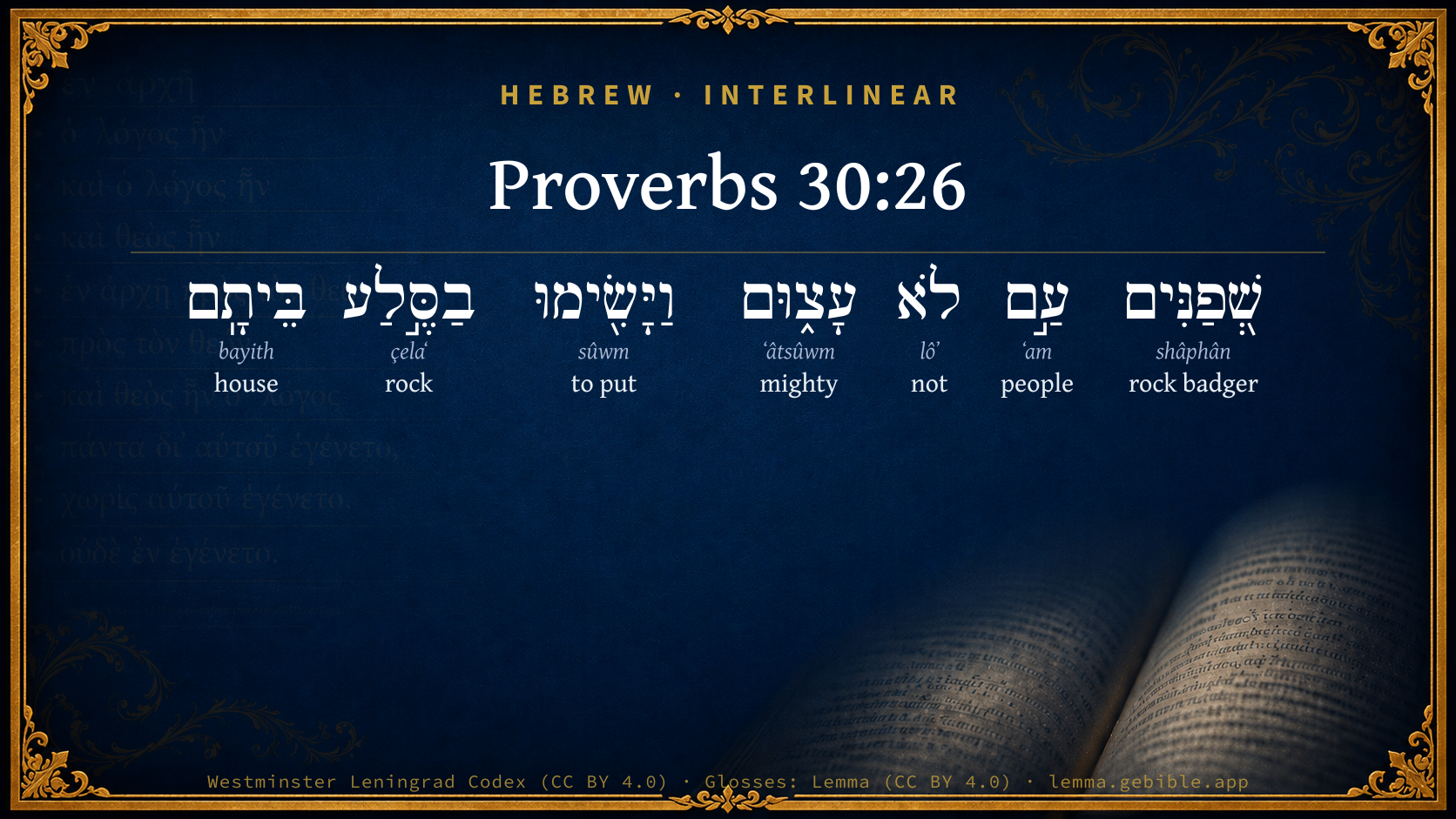
Hebrew (Westminster Leningrad Codex) Proverbs 30:26 appears in the Hebrew Old Testament. The text above is from the Westminster Leningrad Codex. Each word links to its Strong’s number, a concise gloss, and parsing drawn from the Open Scriptures Hebrew Bible morphology. Click any word for its full Brown-Driver-Briggs (BDB) entry.
Download image
Cite this verse

Proverbs 30:26 (World English Bible). Public Domain. Lemma interlinear Bible study tool, https://lemma.gebible.app/v/proverbs/30/26.

Show BibTeX & RIS
BibTeX
RIS
English Translation
The conies are but a feeble folk, Yet make they their houses in the rocks;
World English Bible · Public Domain
Download a study sheet

One document with this verse’s original text, its word-by-word gloss line, the meaning frame, cross-references with their text, attributed commentary, and full source and license credits — printable, and it pastes into notes with its structure intact.

This verse Autodidact and up

Study sheet (.html) Plain text (.txt)

A passage Seminary Student

Up to 50 verses in one chapter. A passage sheet keeps up to 6 commentary sources and 12 cross-references per verse, in the order this page ranks them, and says so on the sheet whenever that leaves anything out. Ask for a single verse and you get the Autodidact verse sheet above.

Everything on this page stays free to read, with no account — the sheet is a download of what is already on screen, not access to it.

Want to remove ads? Support Godless Engineer
Compare translations 3

The same verse in 3 English versions, stacked beneath the original-language interlinear above. Click any original word for its lexicon entry.

Each is an independent rendering of the whole verse — the interlinear is not word-aligned to these translations.

Highlighted words mark where these versions differ — a whole-verse word diff, not a word-by-word alignment.

  • World English Bible Public Domain
    The conies are but a feeble folk, Yet make they their houses in the rocks;
  • King James Version Public Domain
    The conies are but a feeble folk, yet make they their houses in the rocks;
  • unfoldingWord Literal Text CC BY-SA 4.0
    Rock badgers a people not mighty, but they set their house in the cliff.

unfoldingWord Literal Text — © unfoldingWord, licensed CC BY-SA 4.0. Word-aligned USFM3 via Door43 (git.door43.org/unfoldingWord/en_ult).

Versions to compare (up to 4)

3 of 4 selected

Show all 18 translations

Every available English version of this verse, each an independent rendering of the whole verse.

  • World English Bible Public Domain
    The conies are but a feeble folk, Yet make they their houses in the rocks;
  • Berean Standard Bible Public Domain
    the rock badgers are creatures of little power, yet they make their homes in the rocks;
  • Majority Standard Bible Public Domain
    the rock badgers are creatures of little power, yet they make their homes in the rocks;
  • King James Version Public Domain
    The conies are but a feeble folk, yet make they their houses in the rocks;
  • American Standard Version (1901) Public Domain
    The conies are but a feeble folk, Yet make they their houses in the rocks;
  • Revised Version (1885) Public Domain
    The conies are but a feeble folk, yet make they their houses in the rocks;
  • Geneva Bible (1599) Public Domain
    The conies a people not mightie, yet make their houses in the rocke:
  • Douay-Rheims (1899) Public Domain
    The rabbit, a weak people, which maketh its bed in the rock:
  • Young's Literal Translation Public Domain
    Conies `are' a people not strong, And they place in a rock their house,
  • Literal Standard Version CC BY-SA 4.0
    hyraxes [are] a people not strong, || And they place their house in a rock,
  • Unlocked Literal Bible CC BY-SA 4.0
    the rock badgers are not mighty creatures, but they make their homes in the rocks.
  • unfoldingWord Literal Text CC BY-SA 4.0
    Rock badgers a people not mighty, but they set their house in the cliff.
  • Darby Bible Public Domain
    the rock-badgers are but a feeble folk, yet they make their house in the cliff;
  • World Messianic Bible Public Domain
    The hyraxes are but a feeble folk, yet make they their houses in the rocks.
  • Webster's Bible Public Domain
    The conies are but a feeble people, yet they make their houses in the rocks;
  • Free Bible Version CC BY-SA 4.0
    Hyraxes —they don't have much power, but they make their homes in the rock.
  • Bible in Basic English Public Domain
    The conies are only a feeble people, but they make their houses in the rocks;
  • JPS Tanakh (1917) Public Domain
    The rock-badgers are but a feeble folk, yet make they their houses in the crags;

Literal Standard Version (2020), Covenant Press — licensed CC BY-SA 4.0. Text via the HelloAO Bible API (eBible.org). Unlocked Literal Bible (unfoldingWord) — licensed CC BY-SA 4.0. Text via the HelloAO Bible API (eBible.org). unfoldingWord Literal Text — © unfoldingWord, licensed CC BY-SA 4.0. Word-aligned USFM3 via Door43 (git.door43.org/unfoldingWord/en_ult). Free Bible Version, Dr. Jonathan Gallagher — licensed CC BY-SA 4.0. Text via the HelloAO Bible API (eBible.org).

Word by word

More ways to search: Search by grammar → Find every occurrence → Compare this word →

Practice this passage: Drill this verse → Learn its vocabulary →

About this verse

These counts appear in no published source. They are computed here, from the morphology-tagged text and Lemma’s own curated glosses. What Lemma adds →

7
words
7
distinct lemmas
Wisdom
section

Shared distinctive vocabulary

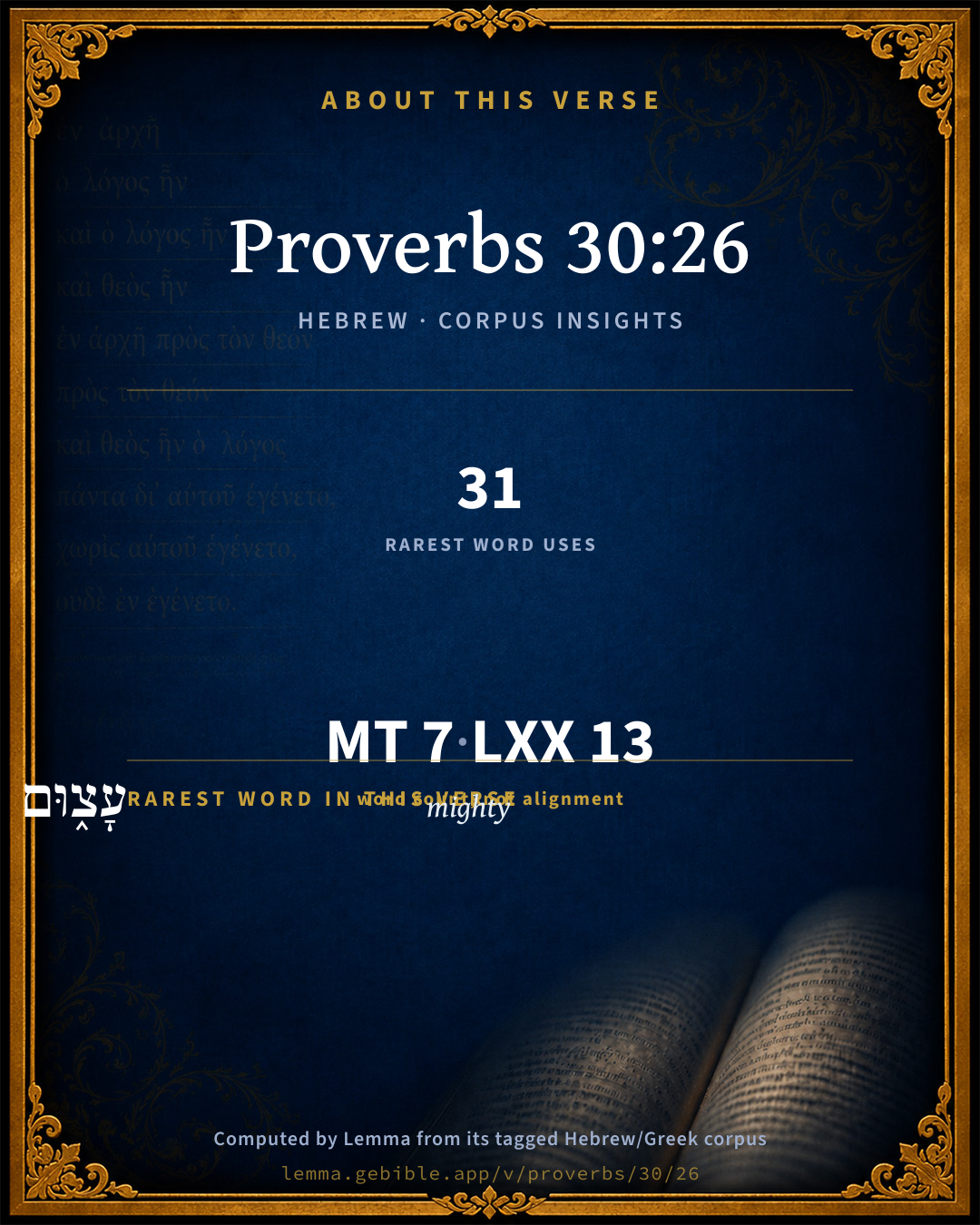
עָצ֑וּם mighty H6099 occurs in 31 verses of the Hebrew Bible. Also found in:

Grammatical profile

  • 1 verb
  • 4 nouns
  • 1 adjective
  • 1 particle

Verb forms

  • וַיָּשִׂ֖ימוּ Qal · Sequential Imperfect

Hebrew & Septuagint length

In English translation the verse runs 15 words from the Hebrew and 14 from the Septuagint (LXX English) — closely comparable.

A rough comparison of the two English renderings, which tokenize alike — not a word-level alignment.

Word counts can differ between the Hebrew and the Greek without any difference in meaning — e.g. the Hebrew direct-object marker אֵת has no separate Greek word, and Greek often adds the article ὁ.

In the original languages it is 7 Hebrew tokens and 13 Greek tokens — but the two are counted differently (Hebrew bundles its prefixes and suffixes into one token; the Greek is in lemma form), so that isn’t a like-for-like length.

Cross-references

2

Topical passages linked to Proverbs 30:26 in the Treasury of Scripture Knowledge — connected by theme and wording, ordered by reader-vote popularity; previews shown in the World English Bible.

  • Psalms 104:18 The high mountains are for the wild goats. The rocks are a refuge for the rock badgers.
  • Leviticus 11:5 The coney, because he chews the cud but doesn't have a parted hoof, he is unclean to you.

Cross-references courtesy of OpenBible.info (CC BY 4.0).

Hebrew and Greek witnesses Masoretic Hebrew ↔ Greek Septuagint

The same verse in the two great witnesses to the Old Testament, shown verse-for-verse.

These are two independent witnesses, not word-aligned to each other, and the Septuagint is shown in lemma (dictionary) form.

Hebrew Proverbs 30:26 Masoretic · Westminster Leningrad Codex

שְׁ֭פַנִּים עַ֣ם לֹא עָצ֑וּם וַיָּשִׂ֖ימוּ בַסֶּ֣לַע בֵּיתָֽם

The conies are but a feeble folk, Yet make they their houses in the rocks;

World English Bible · Public Domain

Greek LXX Proverbs 30:26 Septuagint · lemma form

καί ὁ χοιρογρύλλιος ἔθνος οὐ ἰσχυρός ὅς ποιέω ἐν πέτρα ὁ ἑαυτοῦ οἶκος

the rabbits also are a feeble race, who make their houses in the rocks.

LXX2012 (modern English Septuagint) · Public Domain

On this verse, The Pulpit Commentary discusses the Septuagint’s reading. Read the note in Commentary ↓

Hebrew: Westminster Leningrad Codex (CC BY 4.0). Greek: Septuagint (public domain); English from LXX2012 (modern English Septuagint) (Public Domain). How the Septuagint differs from the Hebrew →

Commentary

Notes on Proverbs 30:26 from classic Christian and Jewish commentators (each source and its license shown beneath its notes). The classic Christian expositions comment on the surrounding passage and are grouped to its opening verse, so a note may address several verses; the Jewish commentaries on the Tanakh (Rashi and others) are per-verse, so they appear only where the commentator wrote on this verse.

Lemma curates 59 commentaries, every one of them public domain or Creative Commons licensed, each selected and text-cleaned for this edition rather than reprinted as found. About our sources →

The Cambridge Bible for Schools and Colleges

gen. ed. J. J. S. Perowne

26. The conies] The Heb. word means the hiders, so called from their “making their houses,” hiding themselves, “in the rocks.”

It is now generally agreed that the animal in question is not, as the name coney, by which it is called also in Lev_11:5; Psa_104:18, implies, a rabbit, but belongs to a different species, being “in its anatomy a true pachyderm, allied to the rhinoceros and the tapir, inferior to them as it is in size.” “It is about the size of a well-grown rabbit, with short ears, round head, long plantigrade feet, no tail, and nails instead of claws. With its weak teeth and short incisors, there seem few animals so entirely without the means of self-defence. But the strong rocks are a refuge for the conies (Pro_30:26, Psa_104:18), and tolerably secure they are in such rocks as these (near Ain Feshkah) on the shore of the Dead Sea. No animal ever gave us so much trouble to secure.” Tristram, Land of Israel, p. 250. Speaker’s Comm. on Lev_11:5. See also Smith’s Dict. of Bible, Art. Coney.

The Cambridge Bible for Schools and Colleges (gen. ed. J. J. S. Perowne; Cambridge University Press, 1878–1918) — public domain. Text from a community e-Sword module.

Trapp's Complete Commentary

John Trapp

Pro 30:26 The conies [are but] a feeble folk, yet make they their houses in the rocks;

Ver. 26. The conies are but a feeble folk.] But what they want in strength they have in wisdom; while they work themselves holes and burrows in the earth. Gaudet in effossis habitare cuniculus antris, {a} secures herself in the rocks and stony places. It shall be our wisdom to work ourselves into the rock Christ Jesus, where we shall be safe from hellish hunters.

{a} Martial.

John Trapp, A Commentary or Exposition upon All the Books of the Old and New Testament (1647–1656) — public domain. Text from a community e-Sword module.

Jamieson, Fausset & Brown

Robert Jamieson, A. R. Fausset & David Brown

conies--mountain mice, or rabbits.

Jamieson, Fausset & Brown — Commentary Critical and Explanatory on the Whole Bible (1871) — public domain (CC PDM 1.0). Text via the HelloAO Bible API.

Ellicott's Commentary for English Readers

(26) The conies are but a feeble folk, being only about as big as a rabbit, with nails instead of claws, and weak teeth. Its Hebrew name (shâphân) signifies a “hider,” from its habit of living in clefts of the rocks; its scientific name is Hyrax Syriacus. The translation “coney,” i.e., rabbit, is a mistake. In general appearance it resembles a guinea-pig or marmot.

A Bible Commentary for English Readers, edited by Charles John Ellicott (1878–1897) — public domain. Text from a community e-Sword module.

John Gill's Exposition

The coneys are but a feeble folk,.... Or "rabbits"; though some think these creatures are not intended, because they are not so little as those with which they are ranked, the ant, the locust, and spider; and because of the places in which they burrow and make their houses, which though in holes and caverns of the earth, yet not in rocky but sandy places; rather therefore it is thought that the mountain mouse, or bear mouse (o), as Jerom calls it, is meant; of which, he says (p), there were great numbers in Palestine, and which had their habitations in the holes of rocks; though if Spain has its name from as some say, because of the multitudes of coneys in it; and hence that part of Spain called Celtiberia is called by Catullus (q) Cuniculosa; the coney may be thought to be meant by this word, and so it is translated in Lev 11:5; the only places where it is elsewhere used; and the word may be derived either from to "cover", by a change of the letters and or from which has the signification both of breaking, and of hiding and covering, Gen 3:15; and this creature breaks the earth and hides itself in it (r);

yet make they their houses in the rocks; it is usual with other writers to call the receptacles of any creatures, beasts, birds, or insects, their houses so we read of the house of the ant, and of the tortoise and snail (s); and which, because it carries its house era its back, it is called by Cicero (t) "domiporta"; see Psa 104:17; the coneys make theirs in the rocks, to cure themselves from their more potent enemies; and thus what they want in strength is made up in sagacity, and by their wise conduct they provide for their safety and protection. These are an emblem of the people of God, who are a weak and feeble people, unable of themselves to perform spiritual duties, to exercise grace, to withstand the corruptions of their nature, resist the temptations of Satan, bear up under afflictive providences, and grapple with spiritual enemies, or defend themselves from them: but such heavenly wisdom is given them, as to betake themselves for refuge and shelter to Christ, the Rock of Israel; the Rock of salvation, the Rock that is higher than they; a strong one, on which the church is built, and against which the gates of hell cannot prevail: and here they are safe from the storms of divine wrath, and the avenging justice of God; from the rage and fury of men, and the fiery darts of Satan; here they dwell safely and delightfully, and have all manner of provision at hand for them; they are the inhabitants of that Rock, who have reason to sing indeed! see Isa 33:16.

(o) , Sept. "choerogryllii", Vatablus; "mures montani", Junius & Tremellius, Cartwright; "arctomyes", Schultens. (p) Epist. ad Sun. & Fretelli, fol. 30, C. tom. 3. (q) Cuniculosa Celtiberia, Epigram. ad Contubernales, 35. v. 18. (r) Gaudet "in effossis habitare cuniculus antris", Martial. Epigr. l. 13. Ep. 58. (s) Phaedri Fab. 37, 80. (t) De Divinat. l. 2. c. 64. and so by Hesiod and Anaxilas in Athenaei Deipnosoph. l. 2. c. 22. p. 63.

John Gill's Exposition of the Whole Bible (1746–1763) — public domain (CC PDM 1.0). Text via the HelloAO Bible API.

Albert Barnes' Notes on the Bible

Conies - See the marginal reference note.

Albert Barnes' Notes on the Bible (1834–1885) — public domain. Text from a community e-Sword/MySword module.

Matthew Poole's English Annotations

In rocky ground, or in the holes of rocks, for their safety against their too potent enemies.

Matthew Poole's English Annotations on the Holy Bible (1683–1685) — public domain. Text from a community e-Sword/MySword module.

The Pulpit Commentary

The conies are but a feeble folk. The term "coney" (cuniculus) is applied to the rabbit, but this is not the animal here intended; and indeed rabbits are not found in Palestine. The word shaphan designates the Hyrax Syriacus, called by some the rock badger (see Hatrt, "Animals of the Bible," pp. 64, etc.). The coney, says Dr. Geikie ("Holy Land and Bible," 2:90), "abounds in the gorge of the Kedron, and along the foot of the mountains west of the Dead Sea. It is of the size of the rabbit, but belongs to a very different order of animals, being placed by naturalists between the hippopotamus and rhinoceros. Its soft fur is brownish-grey over the back, with long black hairs rising through this lighter coat, and is almost white on the stomach; the tail is very short. The Jews, who were not scientific, deceived by the motion of its jaws in eating, which is exactly like that of ruminant animals, fancied it chewed the cud, though it did not divide the hoof, and so they put its flesh amidst that which was forbidden. It lives in companies, and chooses a ready-made cleft in the rocks for its home, so that, though the conies are but a "feeble folk," their refuge in the rocks gives them a security beyond that of stronger creatures. They are, moreover, "exceeding wise," so that it is very hard to capture one. Indeed, they are said, on high authority, to have sentries regularly placed on the look out while the rest are feeding; a squeak from the watchman sufficing to send the flock scudding to their holes like rabbits. The coney is found in many parts of Palestine, from Lebanon to the Dead Sea." In the rocks. This fact is noticed in Psa_104:18. The Septuagint calls them coirogrullioi here and Psa_104:18, also in Lev_11:6 and Deu_14:7. This notion of the animal as a kind of little pig is not more accurate than that of St. Jerome, who renders the term by lepusculus.

The Pulpit Commentary (1880–1919), ed. H.D.M. Spence-Jones & Joseph S. Exell — public domain. Text from a community e-Sword module.

Lesson kit

Teaching starters — assembled from the data on this page, not authored interpretation. Every prompt links to the verse data it draws on. Edit before teaching.

Proverbs, in the Wisdom, opens this verse with 7 words (7 distinct Hebrew lemmas). Its most distinctive word is ʻâtsûwm (“mighty”). A historical commentator’s framing appears above. Read the whole chapter for the surrounding context.

Discussion questions

  1. How does “mighty” (ʻâtsûwm) shape what this verse is saying?
  2. Genesis 18:18 shares the word «mighty» with this verse. How do the two illuminate each other?
  3. The translations on this page render this verse differently — a whole-verse word diff, not a word-by-word alignment. What might account for the different wordings?
  4. The verb «וַיָּשִׂ֖ימוּ» is Qal Sequential Imperfect. How does its form color the action?
  5. Reading how The Cambridge Bible for Schools and Colleges and Trapp's Complete Commentary read this verse, where do the two commentators agree and where do they part?

Things to notice

Reading settings

Reading text

Shown beneath each verse's original-language words.

Old Testament
Old Testament edition

Read the OT as the Masoretic Hebrew (MT) or the Greek Septuagint (LXX).

English shown for the Greek Septuagint (in the Hebrew ↔ Greek comparison).

Comparing translations? Open the Compare panel on any verse page to stack up to four side by side.