
Ezekiel 26:14

Hebrew (Westminster Leningrad Codex) Ezekiel 26:14 appears in the Hebrew Old Testament. The text above is from the Westminster Leningrad Codex. Each word links to its Strong’s number, a concise gloss, and parsing drawn from the Open Scriptures Hebrew Bible morphology. Click any word for its full Brown-Driver-Briggs (BDB) entry.
Download image
Cite this verse

Ezekiel 26:14 (World English Bible). Public Domain. Lemma interlinear Bible study tool, https://lemma.gebible.app/v/ezekiel/26/14.

Show BibTeX & RIS
BibTeX
RIS
English Translation
I will make you a bare rock; you shall be a place for the spreading of nets; you shall be built no more: for I Yahweh have spoken it, says the Lord Yahweh.
World English Bible · Public Domain
Download a study sheet

One document with this verse’s original text, its word-by-word gloss line, the meaning frame, cross-references with their text, attributed commentary, and full source and license credits — printable, and it pastes into notes with its structure intact.

This verse Autodidact and up

Study sheet (.html) Plain text (.txt)

A passage Seminary Student

Up to 50 verses in one chapter. A passage sheet keeps up to 6 commentary sources and 12 cross-references per verse, in the order this page ranks them, and says so on the sheet whenever that leaves anything out. Ask for a single verse and you get the Autodidact verse sheet above.

Everything on this page stays free to read, with no account — the sheet is a download of what is already on screen, not access to it.

Want to remove ads? Support Godless Engineer
Compare translations 3

The same verse in 3 English versions, stacked beneath the original-language interlinear above. Click any original word for its lexicon entry.

Each is an independent rendering of the whole verse — the interlinear is not word-aligned to these translations.

Highlighted words mark where these versions differ — a whole-verse word diff, not a word-by-word alignment.

  • World English Bible Public Domain
    I will make you a bare rock; you shall be a place for the spreading of nets; you shall be built no more: for I Yahweh have spoken it, says the Lord Yahweh.
  • King James Version Public Domain
    And I will make thee like the top of a rock: thou shalt be a place to spread nets upon; thou shalt be built no more: for I the LORD have spoken it, saith the Lord GOD.
  • unfoldingWord Literal Text CC BY-SA 4.0
    I will make you a bare rock, you will become a place where nets are spread out to dry. You will never be built again, for I, Lord Yahweh have spoken—this is the Lord Yahweh’s declaration.

unfoldingWord Literal Text — © unfoldingWord, licensed CC BY-SA 4.0. Word-aligned USFM3 via Door43 (git.door43.org/unfoldingWord/en_ult).

Versions to compare (up to 4)

3 of 4 selected

Show all 18 translations

Every available English version of this verse, each an independent rendering of the whole verse.

  • World English Bible Public Domain
    I will make you a bare rock; you shall be a place for the spreading of nets; you shall be built no more: for I Yahweh have spoken it, says the Lord Yahweh.
  • Berean Standard Bible Public Domain
    I will make you a bare rock, and you will become a place to spread the fishing nets. You will never be rebuilt, for I, the LORD, have spoken, declares the Lord GOD.’
  • Majority Standard Bible Public Domain
    I will make you a bare rock, and you will become a place to spread the fishing nets. You will never be rebuilt, for I, the LORD, have spoken, declares the Lord GOD.’
  • King James Version Public Domain
    And I will make thee like the top of a rock: thou shalt be a place to spread nets upon; thou shalt be built no more: for I the LORD have spoken it, saith the Lord GOD.
  • American Standard Version (1901) Public Domain
    And I will make thee a bare rock; thou shalt be a place for the spreading of nets; thou shalt be built no more: for I Jehovah have spoken it, saith the Lord Jehovah.
  • Revised Version (1885) Public Domain
    And I will make thee a bare rock: thou shalt be a place for the spreading of nets; thou shalt be built no more: for I the LORD have spoken it, saith the Lord GOD.
  • Geneva Bible (1599) Public Domain
    I wil lay thee like the top of a rocke: thou shalt be for a spreading of nets: thou shalt be built no more: for I the Lord haue spoken it, sayth the Lord God.
  • Douay-Rheims (1899) Public Domain
    And I will make thee like a naked rock, then shalt be a drying place for nets, neither shalt thou be built any more: for I have spoken it, saith. the Lord God.
  • Young's Literal Translation Public Domain
    And I have given thee up for a clear place of a rock, A spreading-place of nets thou art, Thou art not built up any more, For I, Jehovah, I have spoken, An affirmation of the Lord Jehovah.
  • Literal Standard Version CC BY-SA 4.0
    And I have given you up for a clear place of a rock, || You are a spreading-place of nets, || You are not built up anymore, || For I, YHWH, have spoken,” || A declaration of Lord YHWH.
  • Unlocked Literal Bible CC BY-SA 4.0
    I will make you a bare rock, you will become a place where nets are spread out to dry. You will never be built again, for I, Lord Yahweh have spoken—this is the Lord Yahweh's declaration.
  • unfoldingWord Literal Text CC BY-SA 4.0
    I will make you a bare rock, you will become a place where nets are spread out to dry. You will never be built again, for I, Lord Yahweh have spoken—this is the Lord Yahweh’s declaration.
  • Darby Bible Public Domain
    And I will make thee a bare rock; thou shalt be [a place] for the spreading of nets; thou shalt be built no more: for I Jehovah have spoken [it], saith the Lord Jehovah.
  • World Messianic Bible Public Domain
    I will make you a bare rock. You will be a place for the spreading of nets. You will be built no more; for I the LORD have spoken it,’ says the Lord GOD.
  • Webster's Bible Public Domain
    And I will make thee like the top of a rock: thou shalt be a place to spread nets upon; thou shalt be built no more: for I the LORD have spoken it, saith the Lord GOD.
  • Free Bible Version CC BY-SA 4.0
    I will turn you into a bare rock, and you will be just a place for fishermen to spread their nets. Tyre won't ever be rebuilt. I, the Lord, have spoken, declares the Lord God.
  • Bible in Basic English Public Domain
    I will make you an uncovered rock: you will be a place for the stretching out of nets; there will be no building you up again: for I the Lord have said it, says the Lord.
  • JPS Tanakh (1917) Public Domain
    And I will make thee a bare rock; thou shalt be a place for the spreading of nets, thou shalt be built no more; for I the LORD have spoken, saith the Lord GOD.

Literal Standard Version (2020), Covenant Press — licensed CC BY-SA 4.0. Text via the HelloAO Bible API (eBible.org). Unlocked Literal Bible (unfoldingWord) — licensed CC BY-SA 4.0. Text via the HelloAO Bible API (eBible.org). unfoldingWord Literal Text — © unfoldingWord, licensed CC BY-SA 4.0. Word-aligned USFM3 via Door43 (git.door43.org/unfoldingWord/en_ult). Free Bible Version, Dr. Jonathan Gallagher — licensed CC BY-SA 4.0. Text via the HelloAO Bible API (eBible.org).

Word by word

More ways to search: Search by grammar → Find every occurrence → Compare this word →

Practice this passage: Drill this verse → Learn its vocabulary →

מִשְׁטַ֤ח
mishṭôwach
H4894
“spreading place of”
Noun, Common, Masculine, Singular, Construct
Part of Speech
Noun
Type
Common
Gender
Masculine
Number
Singular
State
Construct
Full BDB Definition

Origin: from H7849

TWOT: 2372b

spreading place
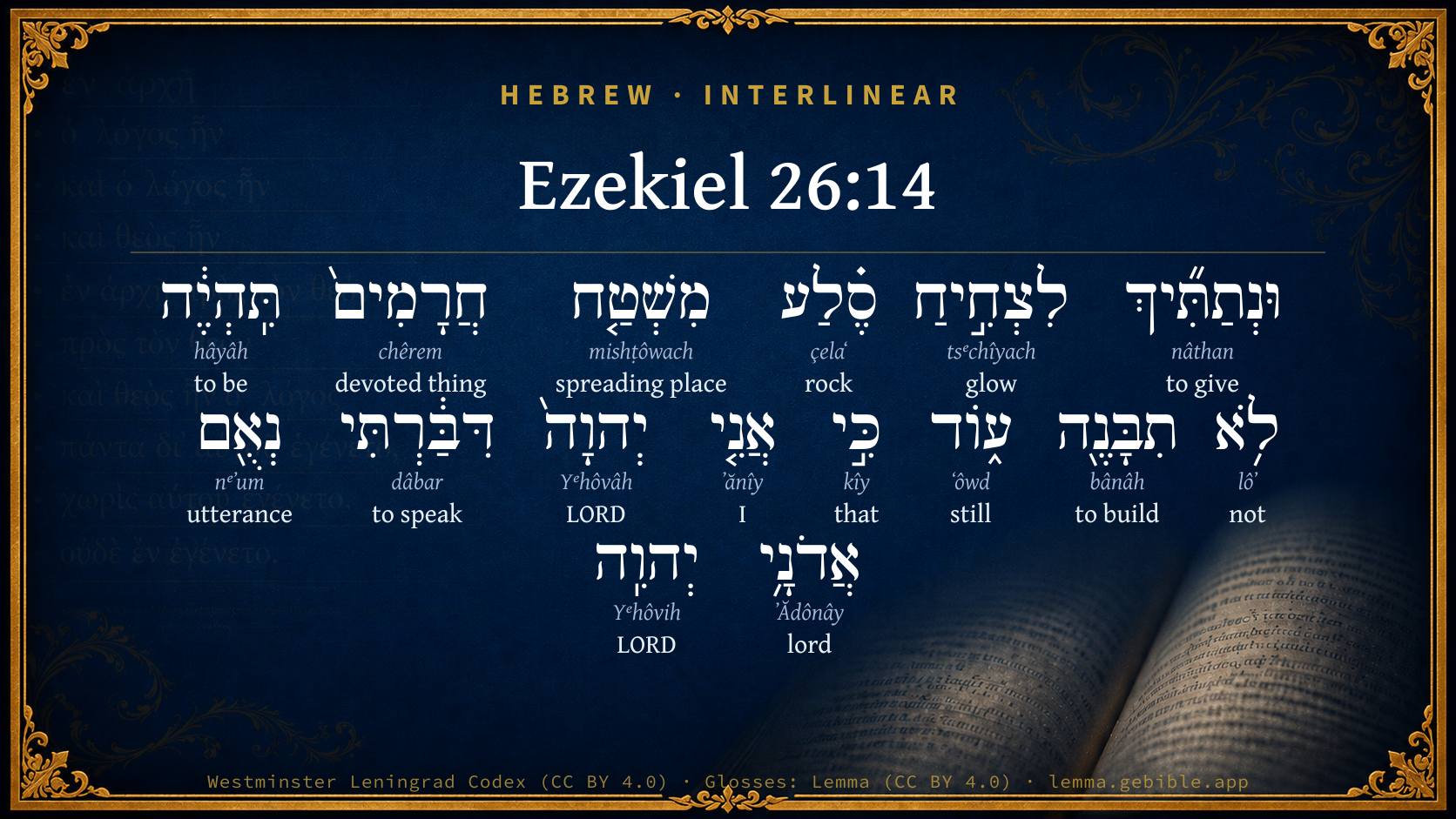
  1. וּנְתַתִּ֞יךְ nâthan H5414 “and · to give · you” Conjunction + Verb, Qal, Sequential Perfect, 1st Person, Common, Singular + Suffix, Personal, 2nd Person, Feminine, Singular
  2. לִצְחִ֣יחַ tsᵉchîyach H6706 “to/for · glow of” Preposition + Noun, Common, Masculine, Singular, Construct
  3. סֶ֗לַע çelaʻ H5553 “rock” Noun, Common, Masculine, Singular, Absolute
  4. חֲרָמִים֙ chêrem H2764 “devoted things” Noun, Common, Masculine, Plural, Absolute
  5. תִּֽהְיֶ֔ה hâyâh H1961 “to be” Verb, Qal, Imperfect, 2nd Person, Masculine, Singular
  6. לֹ֥א lôʼ H3808 “not” Particle, Negative
  7. תִבָּנֶ֖ה bânâh H1129 “to build” Verb, Niphal, Imperfect, 3rd Person, Feminine, Singular
  8. ע֑וֹד ʻôwd H5750 “still” Adverb
  9. כִּ֣י kîy H3588 “that” Conjunction
  10. אֲנִ֤י ʼănîy H589 “I” Pronoun, Personal, 1st Person, Common, Singular
  11. יְהוָה֙ Yᵉhôvâh H3068 “LORD” Noun, Proper
  12. דִּבַּ֔רְתִּי dâbar H1696 “to speak” Verb, Piel, Perfect, 1st Person, Common, Singular
  13. נְאֻ֖ם nᵉʼum H5002 “utterance of” Noun, Common, Masculine, Singular, Construct
  14. אֲדֹנָ֥י ʼĂdônây H136 “Lord · my” Noun, Common, Masculine, Plural, Construct + Suffix, Personal, 1st Person, Common, Singular
  15. יְהוִֽה Yᵉhôvih H3069 “LORD” Noun, Proper

About this verse

These counts appear in no published source. They are computed here, from the morphology-tagged text and Lemma’s own curated glosses. What Lemma adds →

16
words
16
distinct lemmas
Prophets
section

Notable vocabulary

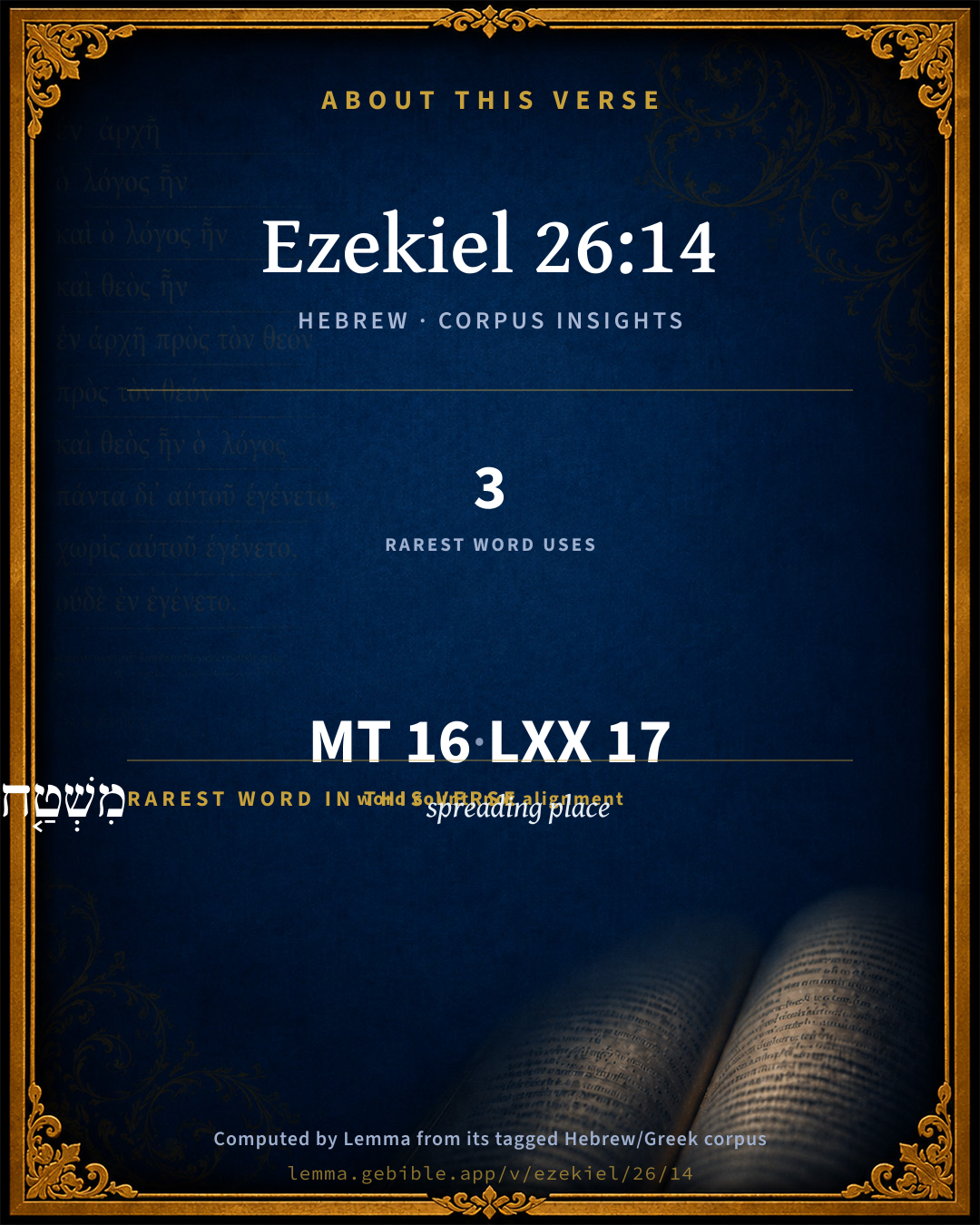
The rarest word here is מִשְׁטַ֤ח spreading place H4894 — appearing just 3 times in the whole Hebrew Bible.

Shared distinctive vocabulary

מִשְׁטַ֤ח spreading place H4894 occurs in 3 verses of the Hebrew Bible. Also found in:

Grammatical profile

  • 4 verbs
  • 8 nouns
  • 1 pronoun
  • 1 conjunction
  • 1 adverb
  • 1 particle

Verb forms

  • וּנְתַתִּ֞יךְ Qal · Sequential Perfect
  • תִּֽהְיֶ֔ה Qal · Imperfect
  • תִבָּנֶ֖ה Niphal · Imperfect
  • דִּבַּ֔רְתִּי Piel · Perfect

Hebrew & Septuagint length

In English translation the verse runs 33 words from the Hebrew and 33 from the Septuagint (LXX English) — the same length.

A rough comparison of the two English renderings, which tokenize alike — not a word-level alignment.

Word counts can differ between the Hebrew and the Greek without any difference in meaning — e.g. the Hebrew direct-object marker אֵת has no separate Greek word, and Greek often adds the article ὁ.

In the original languages it is 16 Hebrew tokens and 17 Greek tokens — but the two are counted differently (Hebrew bundles its prefixes and suffixes into one token; the Greek is in lemma form), so that isn’t a like-for-like length.

Cross-references

16

Topical passages linked to Ezekiel 26:14 in the Treasury of Scripture Knowledge — connected by theme and wording, ordered by reader-vote popularity; previews shown in the World English Bible.

  • Job 12:14 Behold, he breaks down, and it can't be built again; He imprisons a man, and there can be no release.
  • Malachi 1:4 Whereas Edom says, "We are beaten down, but we will return and build the waste places;" thus says Yahweh of Hosts, "They shall build, but I will throw down; and men will call them 'The Wicked Land,' even the people against whom Yahweh shows wrath forever."
  • Numbers 23:19 God is not a man, that he should lie, Neither the son of man, that he should repent: Has he said, and will he not do it? Or has he spoken, and will he not make it good?
  • Deuteronomy 13:16 You shall gather all the spoil of it into the midst of the street of it, and shall burn with fire the city, and all the spoil of it every whit, to Yahweh your God: and it shall be a heap forever; it shall not be built again.
  • Isaiah 14:27 For Yahweh of Hosts has purposed, and who shall annul it? and his hand is stretched out, and who shall turn it back?
  • Ezekiel 26:4–5 They shall destroy the walls of Tyre, and break down her towers: I will also scrape her dust from her, and make her a bare rock.
  • Job 40:8 Will you even annul my judgment? Will you condemn me, that you may be justified?
  • Ezekiel 5:13 Thus shall my anger be accomplished, and I will cause my wrath toward them to rest, and I shall be comforted; and they shall know that I, Yahweh, have spoken in my zeal, when I have accomplished my wrath on them.
  • Ezekiel 5:15 So it shall be a reproach and a taunt, an instruction and an astonishment, to the nations that are round about you, when I shall execute judgments on you in anger and in wrath, and in wrathful rebukes; (I, Yahweh, have spoken it;)
  • Ezekiel 5:17 and I will send on you famine and evil animals, and they shall bereave you; and pestilence and blood shall pass through you; and I will bring the sword on you: I, Yahweh, have spoken it.
  • Ezekiel 17:21–24 All his fugitives in all his bands shall fall by the sword, and those who remain shall be scattered toward every wind: and you shall know that I, Yahweh, have spoken it.
  • Ezekiel 21:32 You shall be for fuel to the fire; your blood shall be in the midst of the land; you shall be no more remembered: for I, Yahweh, have spoken it.
  • Ezekiel 22:14 Can your heart endure, or can your hands be strong, in the days that I shall deal with you? I, Yahweh, have spoken it, and will do it.
  • Ezekiel 26:12 They shall make a spoil of your riches, and make a prey of your merchandise; and they shall break down your walls, and destroy your pleasant houses; and they shall lay your stones and your timber and your dust in the midst of the waters.
  • Ezekiel 30:12 I will make the rivers dry, and will sell the land into the hand of evil men; and I will make the land desolate, and all that is therein, by the hand of strangers: I, Yahweh, have spoken it.
  • Matthew 24:35 Heaven and earth will pass away, but my words will not pass away.

Cross-references courtesy of OpenBible.info (CC BY 4.0).

Hebrew and Greek witnesses Masoretic Hebrew ↔ Greek Septuagint

The same verse in the two great witnesses to the Old Testament, shown verse-for-verse.

These are two independent witnesses, not word-aligned to each other, and the Septuagint is shown in lemma (dictionary) form.

Hebrew Ezekiel 26:14 Masoretic · Westminster Leningrad Codex

וּנְתַתִּ֞יךְ לִצְחִ֣יחַ סֶ֗לַע מִשְׁטַ֤ח חֲרָמִים֙ תִּֽהְיֶ֔ה לֹ֥א תִבָּנֶ֖ה ע֑וֹד כִּ֣י אֲנִ֤י יְהוָה֙ דִּבַּ֔רְתִּי נְאֻ֖ם אֲדֹנָ֥י יְהוִֽה

I will make you a bare rock; you shall be a place for the spreading of nets; you shall be built no more: for I Yahweh have spoken it, says the Lord Yahweh.

World English Bible · Public Domain

Greek LXX Ezekiel 26:14 Septuagint · lemma form

καί δίδωμι σύ εἰς λεωπετρία ψυγμός σαγήνη εἰμί οὐ μή οἰκοδομέω ἔτι ὅτι ἐγώ λαλέω λέγω κύριος

And I will make you a bare rock: you shall be a place to spread nets upon; you shall be built no more: for I the Lord have spoken it, says the Lord.

LXX2012 (modern English Septuagint) · Public Domain

Hebrew: Westminster Leningrad Codex (CC BY 4.0). Greek: Septuagint (public domain); English from LXX2012 (modern English Septuagint) (Public Domain). How the Septuagint differs from the Hebrew →

Targum (Aramaic paraphrase)

1

The Targum is the ancient Jewish Aramaic paraphrase of the Hebrew Scriptures — an interpretive translation, not the Hebrew text itself. Onkelos (literal) and Pseudo-Jonathan (expansive) render the Torah, and Jonathan the Prophets. Coverage is partial: where no permissively-licensed English translation exists for a verse, only the Aramaic is shown. This is verse-level text, not a word-by-word alignment to the Hebrew.

  1. Targum Jonathan Prophets (Joshua–Malachi)
    וְאֶתְּנִינָךְ לִשְׁעִיעוּת כֵּיף גְלֵי מִשְׁטַח צַיָדִין תְּהֵי לָא תִתְבְּנֵי עוֹד אֲרֵי אֲנָא יְיָ גְזָרֵית בְּמֵימְרִי אֲמַר יְיָ אֱלֹהִים:

    (no public-domain English translation for this verse)

    Targum Jonathan — Aramaic: “Mikraot Gedolot” (public domain). English: “Sefaria Community Translation” (CC0 1.0 (public-domain dedication)); “London "Chaldee Paraphrase," 1871” (public domain). Text via Sefaria.

Commentary

Notes on Ezekiel 26:14 from classic Christian and Jewish commentators (each source and its license shown beneath its notes). The classic Christian expositions comment on the surrounding passage and are grouped to its opening verse, so a note may address several verses; the Jewish commentaries on the Tanakh (Rashi and others) are per-verse, so they appear only where the commentator wrote on this verse.

Lemma curates 59 commentaries, every one of them public domain or Creative Commons licensed, each selected and text-cleaned for this edition rather than reprinted as found. About our sources →

Trapp's Complete Commentary

John Trapp

Eze 26:14 And I will make thee like the top of a rock: thou shalt be [a place] to spread nets upon; thou shalt be built no more: for I the LORD have spoken [it], saith the Lord GOD.

Ver. 14. Thou shalt be built no more,] i.e., Not in haste, and not at all by the same inhabitants, nor with the like neatness and celebrity. Some say it was not built in the same place with Palaetyrus, or old Tyre; yet was it a famous city again, near unto which our Saviour wrought miracles, in which Paul abode seven days with the brethren. Here Origen died, {a} Ulpian the great lawyer was born, {b} &c. Of this city read Gul. Tyrius, de Bello Sacro, lib. xiii. cap. 1.

{a} Jerome.

{b} Ulp. Digest. Tit. de Cens.

John Trapp, A Commentary or Exposition upon All the Books of the Old and New Testament (1647–1656) — public domain. Text from a community e-Sword module.

Geneva Bible (1599)

Geneva Bible translators

I will make thee so bare that thou shalt have nothing to cover thee.

Geneva Bible (1599) marginal notes — public domain. Text via Bolls.life.

Jamieson, Fausset & Brown

Robert Jamieson, A. R. Fausset & David Brown

He concludes in nearly the same words as he began (Eze 26:4-5).

built no more--fulfilled as to the mainland Tyre, under Nebuchadnezzar. The insular Tyre recovered partly, after seventy years (Isa 23:17-18), but again suffered under Alexander, then under Antigonus, then under the Saracens at the beginning of the fourteenth century. Now its harbors are choked with sand, precluding all hope of future restoration, "not one entire house is left, and only a few fishermen take shelter in the vaults" [MAUNDRELL]. So accurately has God's word come to pass.

Jamieson, Fausset & Brown — Commentary Critical and Explanatory on the Whole Bible (1871) — public domain (CC PDM 1.0). Text via the HelloAO Bible API.

Adam Clarke's Commentary

Verse 14. Thou shalt be built no more] If this refer to Nebuchadnezzar's capture of the city, old Tyre must be intended: that was destroyed by him, and never rebuilt. But I doubt whether the whole of this prophecy do not refer to the taking of Tyre by Alexander, three hundred years after its capture by Nebuchadnezzar. Indeed it may include more recent conquests of this important city. It went through a variety of vicissitudes till 1289, when it and the neighbouring towns were sacked and ravaged by the Mamelukes. Mr. Maundrell, who visited this place, says, "it is a Babel of broken walls, pillars, vaults, c., there being not so much as one entire house left! Its present inhabitants are only a few poor wretches, harbouring themselves in the vaults, and subsisting chiefly on fishing who seem to be preserved in this place by Divine Providence as a visible argument how God has fulfilled his word concerning Tyre, that it should be the top of a rock, a place for fishers to dry their nets on."

Adam Clarke's Commentary on the Bible (1810–1826) — public domain. Text from a community e-Sword/MySword module.

The Cambridge Bible for Schools and Colleges

gen. ed. J. J. S. Perowne

14. the top of a rock] a naked rock, Eze_26:4.

The Cambridge Bible for Schools and Colleges (gen. ed. J. J. S. Perowne; Cambridge University Press, 1878–1918) — public domain. Text from a community e-Sword module.

John Gill's Exposition

And I will make thee like the top of a rock,.... Smooth and bare; See Gill on Eze 26:4,

and thou shall be a place to spread nets upon; See Gill on Eze 26:5,

thou shalt be built no more: this must be understood with some restriction and limitation; as that it should not be built any more in the same stately manner; or be raised to royal dignity, and be governed in the grand manner it had been; or be built upon the same spot; or after its last destruction, to which the prophecy may have respect; it being usual in Scripture for prophecies to regard what is more remote as well as more near; for, upon the destruction of it by Nebuchadnezzar, it was to be restored after seventy years, according to Isaiah's prophecy, Isa 23:15 and, many years after this, new Tyre was besieged, taken, and destroyed by Alexander; and after this it was rebuilt; we read of it in the New Testament; See Gill on Act 21:3, and in Jerom's time it was a most noble and beautiful city, as he on this passage observes; indeed, as Kimchi says, who lived near a thousand years after Jerom, the city then built in his time called Tyre was built upon the continent near the seashore; whereas Tyre destroyed by Alexander was built in the midst of the sea, and was as the top of a rock. It has since been destroyed by Saladine, in the year 1291; and now quite uninhabited, unless by fishermen, who wash, dry, and mend their nets here:

for I the Lord have spoken it, saith, the Lord God; and therefore it shall be accomplished, as it has been; no more of his returning void, and becoming of no effect. The Targum is,

"because I the Lord have decreed by my word, saith the Lord God;''

it is a determination and resolution of his, and none can disannul it. Abendana thinks that hitherto the prophecy is concerning the first destruction of Tyre by Nebuchadnezzar, and what follows is concerning the destruction of it by Alexander.

John Gill's Exposition of the Whole Bible (1746–1763) — public domain (CC PDM 1.0). Text via the HelloAO Bible API.

Haydock's Catholic Bible Commentary

More, for seventy years, Isaias xxiii. 15. The people returned at the same time as the Jews. (The year of the world 3468.) Soon after, Zacharias (chap. ix.) speaks of Tyre as then subsisting. It was very strong in Alexander’s time, (who took it with difficulty, as Antigonus did eighteen years later) and had a very extensive commerce when St. Jerome wrote. But all this must be understood of New Tyre. The old city never regained much splendour. (Calmet) --- It is still in ruins. A modern traveller was struck with the completion of this prophecy, beholding a few miserable fishermen drying their nets on the spot!

George Leo Haydock (1774–1849), Haydock's Catholic Family Bible and Commentary, 1859 edition — public domain. Excludes Psalms (Douay-Rheims chapter numbering differs from Protestant) and Deuterocanonical books (Catholic canon only).

Matthew Poole's English Annotations

Eze 14:4,5.

Thou shalt be built no more; either not this long time, or else not built in greatness and glory, or not raised to be a kingdom, or not by the inhabitants of old Tyre, or not with the same laws, customs, and usages; indeed, though there was a city of that name built, yet it was built on the continent, and in propriety of speech was another city, not old Tyre.

Matthew Poole's English Annotations on the Holy Bible (1683–1685) — public domain. Text from a community e-Sword/MySword module.

John Wesley's Explanatory Notes

No more - Tho' there was a city of that name built, yet it was built on the continent; and in propriety of speech, was another city.

John Wesley, Explanatory Notes Upon the Whole Bible (1754–1765) — public domain. Text via the GEBible commentary corpus.

Lesson kit

Teaching starters — assembled from the data on this page, not authored interpretation. Every prompt links to the verse data it draws on. Edit before teaching.

Ezekiel, in the Prophets, opens this verse with 16 words (16 distinct Hebrew lemmas). Its most distinctive word is mishṭôwach (“spreading place”). A historical commentator’s framing appears above. Read the whole chapter for the surrounding context.

Discussion questions

  1. The word mishṭôwach carries the sense “spreading place.” How does it shape the verse?
  2. Ezekiel 26:5 shares the word «spreading place» with this verse. How do the two illuminate each other?
  3. The translations on this page render this verse differently — a whole-verse word diff, not a word-by-word alignment. What might account for the different wordings?
  4. The verb «וּנְתַתִּ֞יךְ» is Qal Sequential Perfect. How does its form color the action?
  5. Reading how Trapp's Complete Commentary and Geneva Bible (1599) read this verse, where do the two commentators agree and where do they part?

Things to notice

Reading settings

Reading text

Shown beneath each verse's original-language words.

Old Testament
Old Testament edition

Read the OT as the Masoretic Hebrew (MT) or the Greek Septuagint (LXX).

English shown for the Greek Septuagint (in the Hebrew ↔ Greek comparison).

Comparing translations? Open the Compare panel on any verse page to stack up to four side by side.