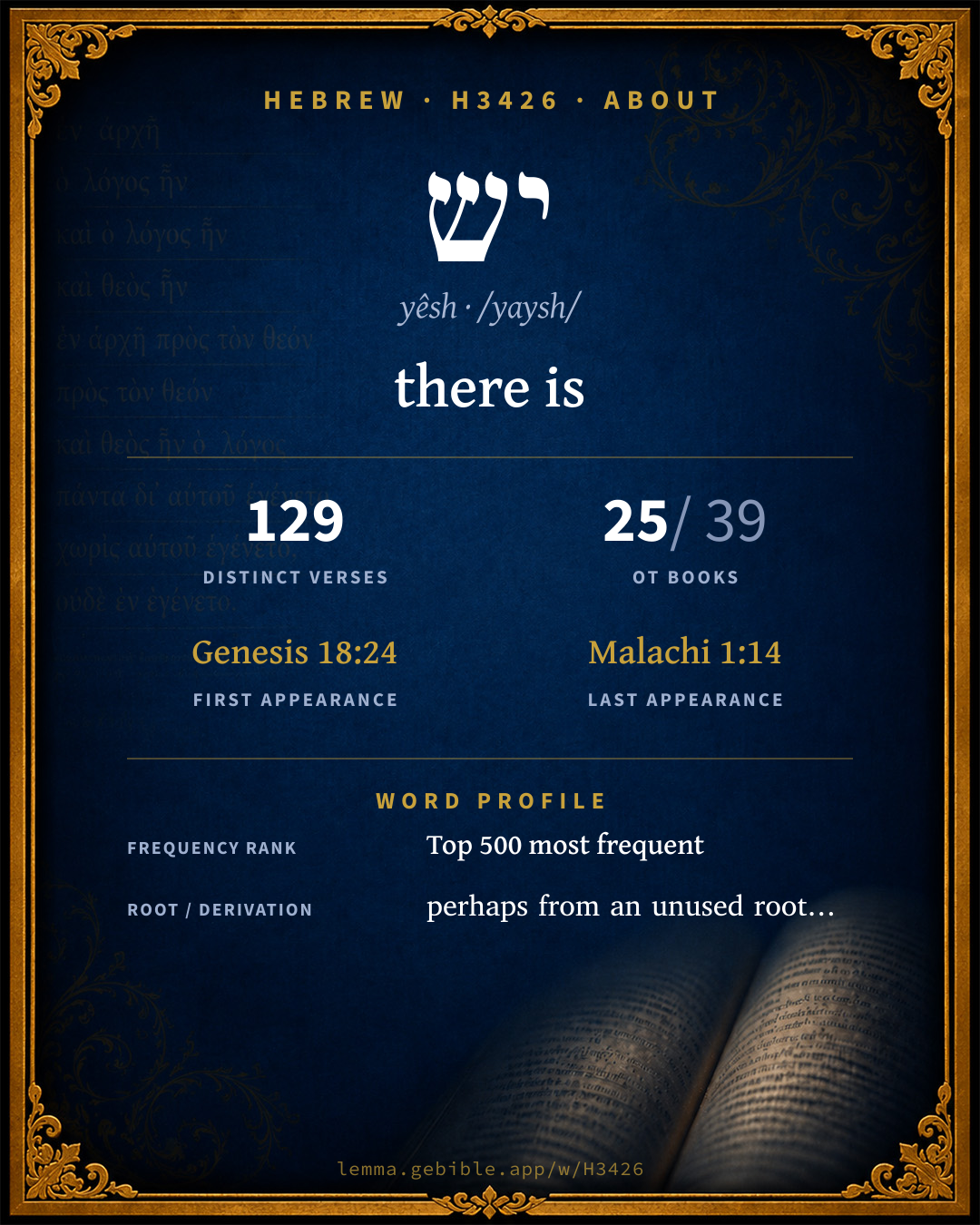
יֵשׁ
there is
‘there is’ is one of 4 main senses fuller range ↓
Full lexicon entry — Brown-Driver-Briggs (BDB)
From Brown-Driver-Briggs (BDB)
Where this word appears
Grammar key — what these labels mean
Part of speech
- Particle
- A short function word — article, negation, interrogative, the sign of the direct object, and the like.
Every verse where H3426 appears in the Book of Jonah — 1 distinct verse. Click any verse to open its interlinear word-by-word view. Verse text shown in the World English Bible for context — . Each verse’s Hebrew form is shown with its reference; the English is not keyword-highlighted, since the data carries no word-level English alignment. Use “Compare translations” on any verse to read it across multiple English versions. This concordance covers the Hebrew Bible; Septuagint (Greek Old Testament) occurrences are not indexed here.
Jonah
About this entry
At a glance — auto-summarized from this page’s data, not written by a person. Every figure links to its source below. This summary describes the numbers; it doesn’t interpret them.
יש — transliterated yêsh — is a Hebrew word carrying the sense “there is.” The lexicon spreads it across several senses; see its full sense range. With 129 verses in 25 books, it is a common word in the Hebrew Bible. Debuting at Genesis 18:24, it then recurs through the corpus. Sharing its root, it stands alongside איתי and ישי. Each statement above links to its evidence; the full detail follows below.
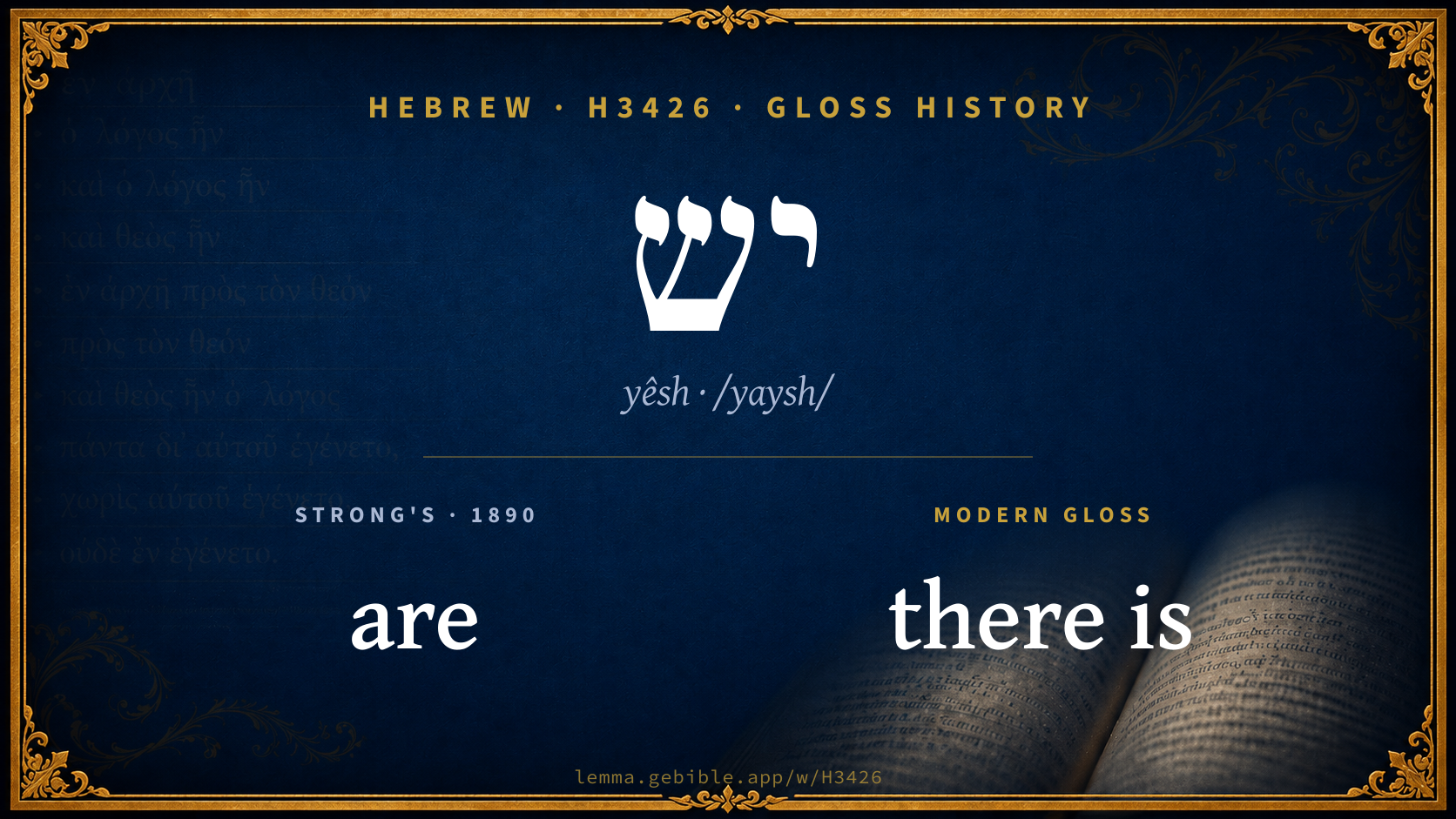
Gloss history
Strong's 1890 vs modern scholarship
About this word
Strong's H3426 catalogs a Hebrew word from the Hebrew Old Testament.
These counts are not copied from any lexicon or concordance. They are computed here, from the morphology-tagged Hebrew Old Testament. What Lemma adds →
- 129
- distinct verses
- The word appears in 129 distinct verses.
- 25 / 39
- OT books
- The word appears in 25 of 39 Old Testament books.
- #327
- by frequency
- Top 500 most frequent Hebrew words (rank 327 of 8,640 Hebrew words by occurrence).
View all 129 occurrences in the concordance →
Most concentrated in
- Genesis 20 verses 16%
- Proverbs 13 verses 10%
- Ecclesiastes 13 verses 10%
By section of the Old Testament
By traditional corpus
Conventional, traditional groupings — biblical authorship is debated, so this is a traditional corpus grouping, not an authorship claim. Each share is this word’s portion of its verses in that division of the Hebrew canon. Each figure is a share of the word’s 129 distinct verses.
- Writings (Ketuvim) 60 verses · 47%
- Prophets (Nevi'im) 41 verses · 32%
- Torah (Pentateuch) 28 verses · 22%
How translations render this word
Counts come from each version’s own published word-to-Strong’s tagging or interlinear alignment — an approximate guide to how each version renders this word, not a word-level alignment the data otherwise carries. Because each total is that version’s own tagged count, the per-version totals vary from one another and need not match the appearance or distinct-verse counts above. These counts may also differ from a printed concordance because Lemma counts each distinctly tagged rendering and does not collapse phrase taggings into a single head-word total. This is a fixed set of word-tagged versions (KJV, ASV, BSB, ULT) and does not change with the reading translation you choose elsewhere. Each version’s license is shown beside its name below (and on Sources).
- King James Version: Is 39×, Be 10×, Is there 8×
- American Standard Version: Is 33×, Be 9×, Is there 5×
- Berean Standard Bible: Is 44×, Is there 12×, Are 4×
- unfoldingWord Literal Text: Is 70×, Is there 14×, Are 13×
King James Version Public Domain
Renders H3426 across 133 tagged occurrences — most commonly:
Plus other, less common renderings. Plus 45 renderings that appear only once — usually multi-word phrases or single function words the recovered tagging swept in, not distinct renderings. Not rendered by a distinct English word in 1 further occurrence.
American Standard Version Public Domain
Renders H3426 across 135 tagged occurrences — most commonly:
Plus other, less common renderings. Plus 57 renderings that appear only once — usually multi-word phrases or single function words the recovered tagging swept in, not distinct renderings.
Berean Standard Bible Public Domain
Renders H3426 across 112 tagged occurrences — most commonly:
Plus other, less common renderings. Plus 23 renderings that appear only once — usually multi-word phrases or single function words the recovered tagging swept in, not distinct renderings. Not rendered by a distinct English word in 23 further occurrences.
unfoldingWord Literal Text CC BY-SA 4.0
Renders H3426 across 138 tagged occurrences — most commonly:
Plus 20 renderings that appear only once — usually multi-word phrases or single function words the recovered tagging swept in, not distinct renderings.
Senses in the full BDB
What do BDB’s symbols mean?
BDB uses these scholarly abbreviations:
| Symbol | Meaning |
|---|---|
| 𝔊 | the Septuagint (the ancient Greek translation, LXX) |
| 𝔙 | the Vulgate (the Latin translation) |
| 𝔖 | the Syriac version (the Peshitta) |
| 𝔗 | the Targum (the Aramaic translation) |
| ψ | the Psalms |
| √ | root (the underlying root or stem) |
| ‖ | parallel passage (a synonymous or contrasted parallel) |
| † | the dagger: every passage where the word occurs is cited |
The 5 senses and sub-senses the full Brown-Driver-Briggs lexicon distinguishes for this word, in lexicon order (not ranked by frequency), with BDB’s own verbatim wording and sub-sense lettering. Shown in Hebrew script with BDB’s own scholarly abbreviations. The condensed entry is in the Lexicon Entry tab. See also the Forms in the corpus table below.
- 1. substance, only Pr 8:21 לְהַנְחִיל אֹהֲבַי יֵשׁ to cause them that love me to inherit substance (so Sir 42:3). e.g. Proverbs 8:21
- 2. elsewhere (proposes as a subst. in the st. c.), it asserts existence, and so corresponds to the verb substantive, is (are, was were, will be), lit. the being, presence of … (so BA אִתַי; Aramaic איתא, אית, ܐܝܺܬ [whence ܐܻܝܬܝܳܐ (self-)existent, ܐܝܺܬܘܽܬܳܐ essence, substance], with לָא contr. לַיִת, לֵית, ܠܰܝܺܬ; Mand. עת, עית, לאיית; Arabic [with irreg. س] لَيْسَ (inflected as a verb, لَيْسَتْ, لَسْتَ, etc.; WAG i. § 182, ii. § 42) is not أَيْسَ is known only in two proverbial sayings, as a secondary form, FlKl.Schr. i. 146 f.); Assyrian išû, be, have DlHWB 310; with affix 1 s. la-a i-ša-a-ku, I have not, TPi. 57 f. On this word, see especially NöM. § 213, who exemplifies its different constructions in Semitic, and shews how it tends to pass into a verb;—(1) in Biblical Aramaic Syriac Bab. 𝔗, with possessive sf.; (2) in later Pal. diall., Jer. 𝔗, Jer. Talm., sometimes also in Bab. 𝔗 and Syriac, with independent pers. pron. (as לית אנא, לית הוא); (3) in Mand. Bab. Talm, sometimes in Syriac and Arabic, and in Heb. יֶשְׁנוֹ, with object. (verbal) sf.; (4) in Arabic, as a true verb. In Ethiopic ቦ lit. therein, Germ. es gibt, is similar in use (DiGr. § 167, 1), though not of course in origin. In Heb. the corresponding neg. is אַיִן, q.v., the construction of which is quite similar)—is, are, was, were, etc., not, however, as a mere copula, but implying existence with emph. (hence in Engl. to be often represented by the subst. verb in italics):
- a. with a pred. following, Gn 28:16 אכן ישׁ י׳ במקום הזה surely Y. is (emph.) in this place! 44:26 אִם יֵשׁ אָחִינוּ אִתְּכֶם; Ex 17:7 הֲיֵשׁ יהוה בְּקִרְבֵּנוּ אִם אַיִן, Nu 22:29 לו ישׁ חרב בידי Oh that there were a sword in my hand! Dt 13:4 הֲיִשְׁכֶם אֹהֲבִים whether you do love, 29:17 פן ישׁ בכם אישׁ, v 18 1 S 9:11f. and they said, Is the seer here? and they said יֵשׁ He is, 20:8; 23:23; Je 27:18. Alone, in answer to a question (asked with יֵשׁ), He (it) is: †1 S 9:12; 2 K 10:15; Je 37:17. But Je 23:26 (where ישׁ has no subst. or sf.) text must be corrupt: cf. Gie. e.g. Genesis 28:16
- b. absolutely, there is (es gibt, il y a), Gn 18:24 אולי ישׁ חמשׁים צדיקים בעיר perhaps there are fifty righteous in the city, 24:23 הישׁ בית אביך מקום לנו ללון, 42:1 כי ישׁ שׁבר במצ׳ that there was corn in Egypt, Ju 4:20 הישׁ פה אישׁ, 2 S 9:1; 2 K 5:8 he shall know that there is (emph.) a prophet in Israel, Ru 3:12 there is a kinsman nearer than I, ψ 58:12 surely there are gods judging on the earth: so in aphorisms, asserting the existence of a partic. character, quality, etc., Pr 11:24 ישׁ מפזר ונוסף עוד, 12:18; 13:7, 23; 14:12; 16:25; 18:24; 20:15; Ec 2:21; 4:8; 5:12; 6:1, 11; 7:15(×2); 8:14(×3); 10:5. In questions, or protestations, יֵשׁ often implies a doubt whether what is asked about is to be found or exists: 1 K 18:10; Je 5:1 and see אם ישׁ אישׁ if there is (emph.) a man doing justice, etc. (cf. ψ 14:2), 14:22 Is 44:8 הישׁ אלהים is there a god beside me? ψ 7:4 אם ישׁ עול בכפי if there is iniquity in my hands! 73:11 is there knowledge in the Most High? Jb 5:1; 6:30 La 1:12. e.g. Genesis 18:24
- c. special phrases:—(a) after אִם and a ptcp., where an abiding intention is to be emphasized, †Gn 24:42 אם־ישׁך־נא מצליח דרכי if thou art (really) prospering my way, v 49; 43:4; Ju 6:36 (cf. II. אין 2 b). (b) יֵשׁ לְ = has (had), especially with prons. יֵשׁ לִי, יֵשׁ לְךָ; etc., Gn 33:9 יֶשׁ־לִי רָב I have plenty, v 11 43:7 הישׁ לכם אח, 44:20 ישׁ לנו אב זקן, 1 S 17:46 that they may know כי ישׁ אלהים לישׂראל that Israel has (emph.) a god, 2 K 4:2 מַה־יֶּשׁ־לָכְי what hast thou? Jb 14:7 for a tree has (emph.) hope (cf. Ru 1:12), 25:3; 28:1; 38:28 הישׁ למטר אב: Gn 39:5(×2), 8 כל אשׁר יֶשׁ־לו all that he had (v 4 without אשׁר, prob. error). (c) with inf. and לְ, is it possible to …? 2 K 4:13 הישׁ לדבר־לך can (I) speak for thee to the king? 2 Ch 25:9; so אִשׁ לְ 2 S 14:19 (cf. אֵין לְ, sub II. אַיִן 5). (d) … יֵשׁ אֲשֶׁר (if) it was that … †Nu 9:20, 21; there were some who … (with ptcp.) †Ne 5:2, 3, 4 (cf. Syriac ܐܝܺܬ ܕ for ὃ μὲν … ὃ δὲ … Mt 13:8; ܐܝܺܬ ܕܐܴܡܪܺܝܢ PS172). (e) יֶשׁ־לְאֵל יָדִי Gn 31:29 al.; v. II. אֵל 7, p. 43. (f) 2 K 10:15 וָיֵשׁ and (if) it be … (cf. וָלֹא 5:17 2 S 13:26); so Ju 6:13 וְיֵשׁ י׳ אִתָּנוּ. (g) pleon. אֵין יֵשׁ †ψ 135:17. (h) לֹא יֵשׁ †Jb 9:33 (cf. لَيْسَ, ܠܰܝܺܬ: but 𝔊 𝔖 Me al. לֻא).—As a rule, יֵשׁ precedes its subst. (from which, however, like אין, it may be separated: Gn 24:23; 43:7 הֲיֵשׁ לָכֶם אָח, 44:19, 20; 1 S 20:8 etc.); but occasionally, for greater emphasis, this is prefixed: 1 S 21:5 כי אם לחם קדשׁ ישׁ but holy bread there is! Is 43:8 the blind people, ועינים ישׁ though it has eyes, Ju 19:19 לחם ויין ישׁ לי (cf. אַיִן 2 c). e.g. Genesis 24:42
Senses from the full Brown-Driver-Briggs lexicon (Brown, Driver, Briggs; Oxford 1906 — public domain), digitized via Sefaria, supplemented by the OpenScriptures HebrewLexicon (CC BY 4.0). Full attribution on Sources.
Word origin
subst. being, substance, existence (on etym. v. 2)—יֵשׁ Gn 18:24 etc.; יֶשׁ־ 31:29 + often; הֲיֵשׁ 24:23 + 18 times (so אִשׁ 2 S 14:19 †, הַאִשׁ Mic 6:10 †, v. p. 78), with sf. יֶשְׁךָ v 42 + 2 times; יֶשְׁכֶם v 49 †; הֲיִשְׁכֶם Dt 13:4 †; יֶשְׁנוֹ (Ol§ 97 b Sta§ 370 b) 29:14; 1 S 14:39 (+ v 41 𝔊 We Dr), 23:23; Est 3:8 †;—
— Brown-Driver-Briggs (Oxford 1906, public domain), digitized via Sefaria, supplemented by the OpenScriptures HebrewLexicon (CC BY 4.0). See Sources.
Origin: perhaps from an unused root meaning to stand out, or exist
Jastrow Dictionary
A second Hebrew/Aramaic lexicon for comparison, covering Aramaic and post-biblical (Talmudic, Targumic, Midrashic) usage that the biblical-Hebrew BDB does not. Matched by lemma rather than by Strong’s number, so a lemma may carry more than one Jastrow headword (shown separately below), and the entries cover usage well beyond the Bible.
יֵשׁ
- 1. being, substance, wealth (of knowledge &c.). Y. Ned. V, end, 39ᵇ; Succ. 28ᵃ; B. Bath. 134ᵃ (Prov. VIII, 21, applied to R. Joh. b. Zaccai). e.g. Proverbs 8:21
- 2. there is, there are, v. אִית. Ber. VI, 4 אם יש ביניהם וכ׳ if there is among them one species &c. Peah VIII, 8 מי שיש לו וכ׳ he who possesses &c. Ḥag. 14ᵇ יש נאה דורש וכ׳ many a one preaches well but does not act well; a. v. fr.—יש אומרים (abbr. י"א) some say (anonymous authority). Hor. 13ᵇ אסיקו … ולר׳ נתן י"א the editors introduced ‘others say’ for R. M. and ‘some say’ for R. Nathan. B. Bath. 93ᵇ וי"א אף הוצאה and some say, he must indemnify him also for carrying the seed out; מאן י"א who is meant by ‘some say’? (v. Tosaf. a. l.). Ab. V, 6; a. v. fr.—יֶשְׁנוֹ he is, it is. Kidd. I, 10 כל שי׳ במקרא וכ׳ whosoever is (engaged) in the study of the Bible &c. Ḥag. 4ᵇ כל שי׳ בביאה י׳ וכ׳ whosoever is bound to visit the Temple, is also bound &c., v. הֲבָאָה; a. fr.—יֶשְׁנָהּ she is, it is. Kidd. 48ᵃ, a. fr. י׳ לשכירות וכ׳ the relation of employment exists from beginning to end, i.e. the employer is under obligation for every portion of the contracted labor, opp. אינה ל׳ … אלא בסוף the obligation takes effect only when the work is finished; a. fr.
A Dictionary of the Targumim, the Talmud Babli and Yerushalmi, and the Midrashic Literature (Marcus Jastrow; London, Luzac, 1903) — Public Domain. Digitized via Sefaria. Digitized via Sefaria. Full attribution on Sources.
Forms in the corpus
The 44 distinct written forms H3426 takes in the Hebrew Bible, most frequent first — each parse links to that state’s occurrences in the concordance. Hebrew forms include their vowel points and cantillation, so a single lemma takes many written forms.
| Form | Parsing | Example | Uses |
|---|---|---|---|
| יֶשׁ | Particle, Demonstrative | Ecclesiastes 8:14 | 30 |
| יֵ֣שׁ | Particle, Demonstrative | Deuteronomy 29:18 | 21 |
| יֵ֥שׁ | Particle, Demonstrative | Ecclesiastes 1:10 | 10 |
| יֵשׁ | Particle, Demonstrative | Ecclesiastes 4:9 | 6 |
| הֲ/יֵ֣שׁ | Particle, Demonstrative | Genesis 43:7 | 5 |
| וְ/יֵ֣שׁ | Particle, Demonstrative | Ecclesiastes 7:15 | 5 |
| יֵ֤שׁ | Particle, Demonstrative | Ecclesiastes 7:15 | 5 |
| הֲ/יֵ֧שׁ | Particle, Demonstrative | Exodus 17:7 | 3 |
| הֲ/יֵשׁ | Particle, Demonstrative | Genesis 44:19 | 3 |
| וְ/יֵשׁ֙ | Particle, Demonstrative | Nehemiah 5:2 | 3 |
| יֵ֛שׁ | Particle, Demonstrative | Genesis 18:24 | 3 |
| הֲ/יֵ֤שׁ | Particle, Demonstrative | 2 Kings 4:13 | 2 |
| הֲ/יֵ֥שׁ | Particle, Demonstrative | 1 Samuel 9:11 | 2 |
| הֲ/יֵֽשׁ | Particle, Demonstrative | Judges 4:20 | 2 |
| וְ/יֵ֞שׁ | Particle, Demonstrative | Numbers 9:20 | 2 |
| וְ/יֵ֤שׁ | Particle, Demonstrative | Judges 6:13 | 2 |
| וְ/יֵ֥שׁ | Particle, Demonstrative | Proverbs 13:23 | 2 |
| יֵ֑שׁ | Particle, Demonstrative | Isaiah 43:8 | 2 |
| יֵ֔שׁ | Particle, Demonstrative | 1 Samuel 21:4 | 2 |
| יֵ֚שׁ | Particle, Demonstrative | Ecclesiastes 5:13 | 2 |
| יֶשְׁנ֣/וֹ | Particle, Demonstrative | Esther 3:8 | 2 |
| יֶּשׁ | Particle, Demonstrative | 2 Kings 4:2 | 2 |
| הֲ/יִשְׁ/כֶ֤ם | Particle, Demonstrative | Deuteronomy 13:3 | 1 |
| הֲ/יֵ֛שׁ | Particle, Demonstrative | Jeremiah 23:26 | 1 |
| הֲ/יֵ֨שׁ | Particle, Demonstrative | Jeremiah 14:22 | 1 |
| וְ/יֵ֖שׁ | Particle, Demonstrative | Psalms 73:11 | 1 |
| וְ/יֵ֨שׁ | Particle, Demonstrative | Nehemiah 5:5 | 1 |
| וְ/יֵשׁ | Particle, Demonstrative | Jeremiah 31:17 | 1 |
| וְ/יֶשׁ | Particle, Demonstrative | Genesis 47:6 | 1 |
| וָ/יֵ֖שׁ | Particle, Demonstrative | 2 Kings 10:15 | 1 |
| יֵ֖שׁ | Particle, Demonstrative | Ecclesiastes 8:6 | 1 |
| יֵ֨שׁ | Particle, Demonstrative | Jeremiah 31:16 | 1 |
| יֵ֪שׁ | Particle, Demonstrative | Job 16:4 | 1 |
| יֵֽשׁ | Particle, Demonstrative | 2 Kings 2:16 | 1 |
| יֵשׁ֩ | Particle, Demonstrative | Genesis 44:26 | 1 |
| יֶשְׁ/ךָ | Particle, Demonstrative | Genesis 24:42 | 1 |
| יֶשְׁ/ךָ֛ | Particle, Demonstrative | Genesis 43:4 | 1 |
| יֶשְׁ/ךָ֞ | Particle, Demonstrative | Judges 6:36 | 1 |
| יֶשְׁ/כֶ֨ם | Particle, Demonstrative | Genesis 24:49 | 1 |
| יֶשְׁנ֛/וֹ | Particle, Demonstrative | 1 Samuel 14:39 | 1 |
| יֶשְׁנ֜/וֹ | Particle, Demonstrative | Deuteronomy 29:15 | 1 |
| יֵּ֖שׁ | Particle, Demonstrative | 1 Samuel 9:12 | 1 |
| יֵּ֧שׁ | Particle, Demonstrative | 1 Samuel 21:3 | 1 |
| שֶׁ/יֵּ֥שׁ | Particle, Demonstrative | Ecclesiastes 2:13 | 1 |
Same root — word family
Other BDB entries built from the same root as H3426, grouped by Strong’s listed origin. These share a root / origin per the lexicon — not necessarily a shared meaning. Each links to that word’s own entry.
Derived from this word
Proper names from this root
People and places named from this root — a name, not an additional meaning of the word.
Compare all same-root words → 1 of the same-root words is a proper name (a person or place). They share a root, not necessarily a meaning.
Septuagint verse parallels
This word appears in 122 verses that also exist in the Greek Old Testament (Septuagint), out of the 129 Hebrew verses it occurs in. You can read those verses in Greek by switching the Old Testament edition to the Septuagint.
Read these verses in the Septuagint
- Genesis 18:24
- Exodus 17:7
- Numbers 9:20
- Deuteronomy 13:3
- Judges 4:20
- Ruth 1:12
- 1 Samuel 9:11
- 2 Samuel 9:1
- 1 Kings 17:12
- 2 Kings 2:16
- 1 Chronicles 29:3
- 2 Chronicles 15:7
This is a verse-level parallel only — the same verses exist in both the Hebrew and Greek Old Testaments. No word-level Hebrew↔Greek correspondence is claimed: the data carries no such alignment, so no Greek word is shown as this Hebrew word’s translation. Coverage is not total — the Septuagint omits the deuterocanon and renumbers the Psalms, so some Hebrew verses have no direct Greek parallel.