
Jeremiah 31:16

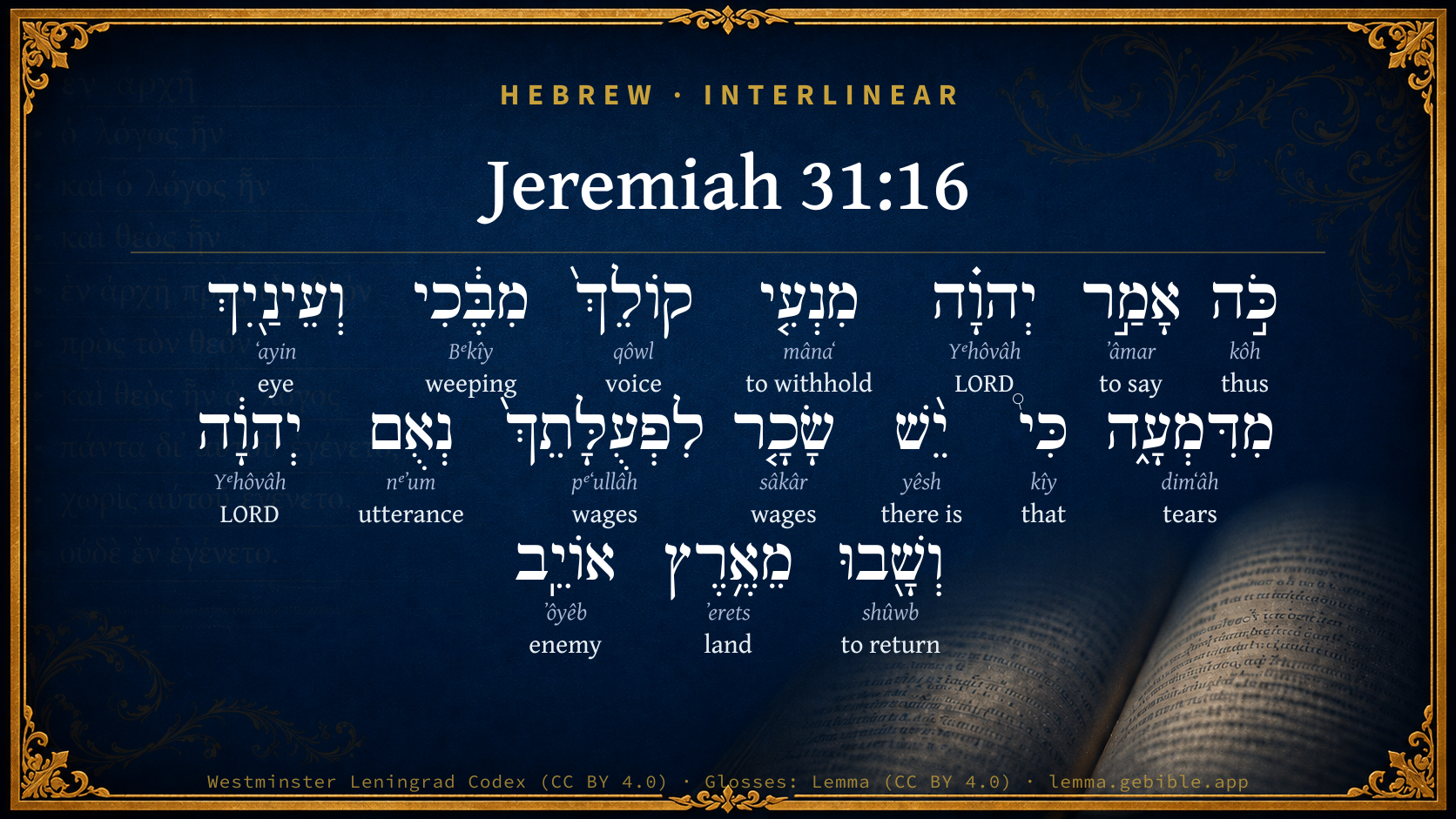
Hebrew (Westminster Leningrad Codex) Jeremiah 31:16 appears in the Hebrew Old Testament. The text above is from the Westminster Leningrad Codex. Each word links to its Strong’s number, a concise gloss, and parsing drawn from the Open Scriptures Hebrew Bible morphology. Click any word for its full Brown-Driver-Briggs (BDB) entry.
Download image
Cite this verse

Jeremiah 31:16 (World English Bible). Public Domain. Lemma interlinear Bible study tool, https://lemma.gebible.app/v/jeremiah/31/16.

Show BibTeX & RIS
BibTeX
RIS
English Translation
Thus says Yahweh: Refrain your voice from weeping, and your eyes from tears; for your work shall be rewarded, says Yahweh; and they shall come again from the land of the enemy.
World English Bible · Public Domain
Download a study sheet

One document with this verse’s original text, its word-by-word gloss line, the meaning frame, cross-references with their text, attributed commentary, and full source and license credits — printable, and it pastes into notes with its structure intact.

This verse Autodidact and up

Study sheet (.html) Plain text (.txt)

A passage Seminary Student

Up to 50 verses in one chapter. A passage sheet keeps up to 6 commentary sources and 12 cross-references per verse, in the order this page ranks them, and says so on the sheet whenever that leaves anything out. Ask for a single verse and you get the Autodidact verse sheet above.

Everything on this page stays free to read, with no account — the sheet is a download of what is already on screen, not access to it.

Want to remove ads? Support Godless Engineer
Compare translations 3

The same verse in 3 English versions, stacked beneath the original-language interlinear above. Click any original word for its lexicon entry.

Each is an independent rendering of the whole verse — the interlinear is not word-aligned to these translations.

Highlighted words mark where these versions differ — a whole-verse word diff, not a word-by-word alignment.

  • World English Bible Public Domain
    Thus says Yahweh: Refrain your voice from weeping, and your eyes from tears; for your work shall be rewarded, says Yahweh; and they shall come again from the land of the enemy.
  • King James Version Public Domain
    Thus saith the LORD; Refrain thy voice from weeping, and thine eyes from tears: for thy work shall be rewarded, saith the LORD; and they shall come again from the land of the enemy.
  • unfoldingWord Literal Text CC BY-SA 4.0
    Yahweh says this, “Hold your voice back from weeping and your eyes from tears; there is a reward for your work—this is Yahweh’s declaration—your children will return from the land of the enemy.

unfoldingWord Literal Text — © unfoldingWord, licensed CC BY-SA 4.0. Word-aligned USFM3 via Door43 (git.door43.org/unfoldingWord/en_ult).

Versions to compare (up to 4)

3 of 4 selected

Show all 18 translations

Every available English version of this verse, each an independent rendering of the whole verse.

  • World English Bible Public Domain
    Thus says Yahweh: Refrain your voice from weeping, and your eyes from tears; for your work shall be rewarded, says Yahweh; and they shall come again from the land of the enemy.
  • Berean Standard Bible Public Domain
    This is what the LORD says: “Keep your voice from weeping and your eyes from tears, for the reward for your work will come, declares the LORD. Then your children will return from the land of the enemy.
  • Majority Standard Bible Public Domain
    This is what the LORD says: “Keep your voice from weeping and your eyes from tears, for the reward for your work will come, declares the LORD. Then your children will return from the land of the enemy.
  • King James Version Public Domain
    Thus saith the LORD; Refrain thy voice from weeping, and thine eyes from tears: for thy work shall be rewarded, saith the LORD; and they shall come again from the land of the enemy.
  • American Standard Version (1901) Public Domain
    Thus saith Jehovah: Refrain thy voice from weeping, and thine eyes from tears; for thy work shall be rewarded, saith Jehovah; and they shall come again from the land of the enemy.
  • Revised Version (1885) Public Domain
    Thus saith the LORD: Refrain thy voice from weeping, and thine eyes from tears: for thy work shall be rewarded, saith the LORD; and they shall come again from the land of the enemy.
  • Geneva Bible (1599) Public Domain
    Thus saith the Lord, Refraine thy voyce from weeping, and thine eyes from teares: for thy worke shalbe rewarded, saith the Lord, and they shall come againe from the land of the enemie:
  • Douay-Rheims (1899) Public Domain
    Thus saith the Lord: Let thy voice cease from weeping, and thy eyes from tears: for there is a reward for thy work, saith the Lord: and they shall return out of the land of the enemy.
  • Young's Literal Translation Public Domain
    Thus said Jehovah: Withhold thy voice from weeping, and thine eyes from tears, For there is a reward for thy work, An affirmation of Jehovah, And they have turned back from the land of the enemy.
  • Literal Standard Version CC BY-SA 4.0
    Thus said YHWH: “Withhold your voice from weeping, and your eyes from tears, || For there is a reward for your work,” || A declaration of YHWH, || “And they have turned back from the land of the enemy.
  • Unlocked Literal Bible CC BY-SA 4.0
    Yahweh says this, “Hold your voice back from weeping and your eyes from tears; there is a reward for your work—this is Yahweh's declaration—your children will return from the land of the enemy.
  • unfoldingWord Literal Text CC BY-SA 4.0
    Yahweh says this, “Hold your voice back from weeping and your eyes from tears; there is a reward for your work—this is Yahweh’s declaration—your children will return from the land of the enemy.
  • Darby Bible Public Domain
    Thus saith Jehovah: Refrain thy voice from weeping, and thine eyes from tears; for there is a reward for thy work, saith Jehovah; and they shall come again from the land of the enemy.
  • World Messianic Bible Public Domain
    The LORD says: “Refrain your voice from weeping, and your eyes from tears, for your work will be rewarded,” says the LORD. “They will come again from the land of the enemy.
  • Webster's Bible Public Domain
    Thus saith the LORD; Refrain thy voice from weeping, and thy eyes from tears: for thy work shall be rewarded, saith the LORD; and they shall come again from the land of the enemy.
  • Free Bible Version CC BY-SA 4.0
    This is what the Lord says: Don't cry anymore, don't weep anymore, because you're going to be rewarded for what you've done, declares the Lord. Your children will return from the country of your enemies.
  • Bible in Basic English Public Domain
    The Lord has said this: Keep your voice from sorrow and your eyes from weeping: for your work will be rewarded, says the Lord; and they will come back from the land of their hater.
  • JPS Tanakh (1917) Public Domain
    Thus saith the LORD: Refrain thy voice from weeping, and thine eyes from tears; for thy work shall be rewarded, saith the LORD; and they shall come back from the land of the enemy.

Literal Standard Version (2020), Covenant Press — licensed CC BY-SA 4.0. Text via the HelloAO Bible API (eBible.org). Unlocked Literal Bible (unfoldingWord) — licensed CC BY-SA 4.0. Text via the HelloAO Bible API (eBible.org). unfoldingWord Literal Text — © unfoldingWord, licensed CC BY-SA 4.0. Word-aligned USFM3 via Door43 (git.door43.org/unfoldingWord/en_ult). Free Bible Version, Dr. Jonathan Gallagher — licensed CC BY-SA 4.0. Text via the HelloAO Bible API (eBible.org).

Word by word

More ways to search: Search by grammar → Find every occurrence → Compare this word →

Practice this passage: Drill this verse → Learn its vocabulary →

לִפְעֻלָּתֵךְ֙
pᵉʻullâh
H6468
“to/for · wages · your”
Preposition + Noun, Common, Feminine, Singular, Construct + Suffix, Personal, 2nd Person, Feminine, Singular
Part of Speech
Preposition + Noun
Type
Common
Gender
Feminine
Number
Singular
State
Construct
Full BDB Definition

Origin: pass part of H6466

TWOT: 1792b

work, recompense, reward - work - wages
  1. כֹּ֣ה kôh H3541 “thus” Adverb
  2. אָמַ֣ר ʼâmar H559 “to say” Verb, Qal, Perfect, 3rd Person, Masculine, Singular
  3. יְהוָ֗ה Yᵉhôvâh H3068 “LORD” Noun, Proper
  4. מִנְעִ֤י mânaʻ H4513 “withhold” Verb, Qal, Imperative, 2nd Person, Feminine, Singular
  5. קוֹלֵךְ֙ qôwl H6963 “voice · your” Noun, Common, Masculine, Singular, Construct + Suffix, Personal, 2nd Person, Feminine, Singular
  6. מִבֶּ֔כִי Bᵉkîy H1065 “from · weeping” Preposition + Noun, Common, Masculine, Singular, Absolute
  7. וְעֵינַ֖יִךְ ʻayin H5869 “and · eyes · your” Conjunction + Noun, Common, Both, Dual, Construct + Suffix, Personal, 2nd Person, Feminine, Singular
  8. מִדִּמְעָ֑ה dimʻâh H1832 “from · tears” Preposition + Noun, Common, Feminine, Singular, Absolute
  9. כִּי֩ kîy H3588 “that” Conjunction
  10. יֵ֨שׁ yêsh H3426 “there is” Particle, Demonstrative
  11. שָׂכָ֤ר sâkâr H7939 “wages” Noun, Common, Masculine, Singular, Absolute
  12. נְאֻם nᵉʼum H5002 “utterance of” Noun, Common, Masculine, Singular, Construct
  13. יְהוָ֔ה Yᵉhôvâh H3068 “LORD” Noun, Proper
  14. וְשָׁ֖בוּ shûwb H7725 “and · to return” Conjunction + Verb, Qal, Sequential Perfect, 3rd Person, Common, Plural
  15. מֵאֶ֥רֶץ ʼerets H776 “from · land” Preposition + Noun, Common, Both, Singular, Absolute
  16. אוֹיֵֽב ʼôyêb H341 “enemy” Verb, Qal, Participle Active, Masculine, Singular, Absolute

About this verse

These counts appear in no published source. They are computed here, from the morphology-tagged text and Lemma’s own curated glosses. What Lemma adds →

17
words
16
distinct lemmas
Prophets
section

Notable vocabulary

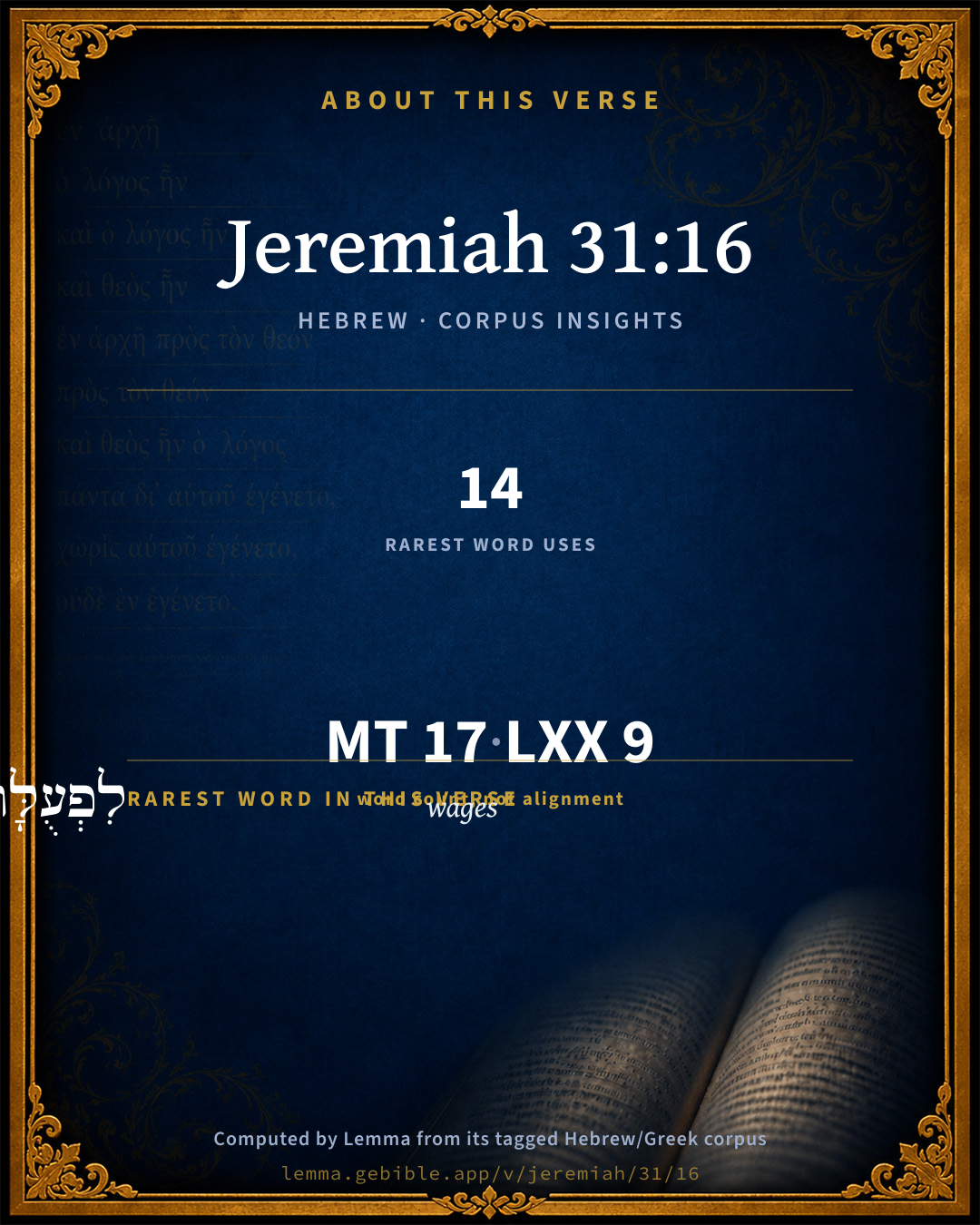
The rarest word here is לִפְעֻלָּתֵךְ֙ wages H6468 — appearing just 14 times in the whole Hebrew Bible.

Shared distinctive vocabulary

לִפְעֻלָּתֵךְ֙ wages H6468 occurs in 14 verses of the Hebrew Bible. Also found in:

Grammatical profile

  • 4 verbs
  • 10 nouns
  • 1 conjunction
  • 1 adverb
  • 1 particle

Verb forms

  • אָמַ֣ר Qal · Perfect
  • מִנְעִ֤י Qal · Imperative
  • וְשָׁ֖בוּ Qal · Sequential Perfect
  • אוֹיֵֽב Qal · Participle Active

Repetition

A word recurs within this verse — often emphatic in Hebrew:

  • יְהוָ֗ה LORD H3068 ×2

Hebrew & Septuagint length

In the original languages it is 17 Hebrew tokens and 9 Greek tokens — but the two are counted differently (Hebrew bundles its prefixes and suffixes into one token; the Greek is in lemma form), so that isn’t a like-for-like length.

Cross-references

24

Topical passages linked to Jeremiah 31:16 in the Treasury of Scripture Knowledge — connected by theme and wording, ordered by reader-vote popularity; previews shown in the World English Bible.

  • Ruth 2:12 Yahweh recompense your work, and a full reward be given you of Yahweh, the God of Israel, under whose wings you are come to take refuge.
  • Jeremiah 30:3 For, behold, the days come, says Yahweh, that I will turn again the captivity of my people Israel and Judah, says Yahweh; and I will cause them to return to the land that I gave to their fathers, and they shall possess it.
  • Hebrews 6:10 For God is not unrighteous, so as to forget your work and the labor of love which you showed toward his name, in that you served the saints, and still do serve them.
  • Hebrews 11:6 Without faith it is impossible to be well pleasing to him, for he who comes to God must believe that he exists, and that he is a rewarder of those who seek him.
  • Jeremiah 33:7 I will cause the captivity of Judah and the captivity of Israel to return, and will build them, as at the first.
  • 2 Chronicles 15:7 But be you strong, and don't let your hands be slack; for your work shall be rewarded.
  • Ecclesiastes 9:7 Go your way--eat your bread with joy, and drink your wine with a merry heart; for God has already accepted your works.
  • Jeremiah 30:18 Thus says Yahweh: Behold, I will turn again the captivity of Jacob's tents, and have compassion on his dwelling-places; and the city shall be built on its own hill, and the palace shall be inhabited after its own manner.
  • Isaiah 30:19 For the people shall dwell in Zion at Jerusalem; you shall weep no more; he will surely be gracious to you at the voice of your cry; when he shall hear, he will answer you.
  • Mark 5:38–39 He came to the synagogue ruler's house, and he saw an uproar, weeping, and great wailing.
  • Psalms 30:5 For his anger is but for a moment; His favor is for a lifetime. Weeping may stay for the night, But joy comes in the morning.
  • Isaiah 25:8 He has swallowed up death forever; and the Lord Yahweh will wipe away tears from off all faces; and the reproach of his people will he take away from off all the earth: for Yahweh has spoken it.
  • Jeremiah 23:3 I will gather the remnant of my flock out of all the countries where I have driven them, and will bring them again to their folds; and they shall be fruitful and multiply.
  • Jeremiah 29:14 I will be found by you, says Yahweh, and I will turn again your captivity, and I will gather you from all the nations, and from all the places where I have driven you, says Yahweh; and I will bring you again to the place from where I caused you to be carried away captive.
  • 1 Thessalonians 4:14 For if we believe that Jesus died and rose again, even so those who have fallen asleep in Jesus will God bring with him.
  • Genesis 43:31 He washed his face, and came out. He controlled himself, and said, "Serve the meal."
  • Ezra 1:5–11 Then rose up the heads of fathers' [houses] of Judah and Benjamin, and the priests, and the Levites, even all whose spirit God had stirred to go up to build the house of Yahweh which is in Jerusalem.
  • Jeremiah 31:4–5 Again will I build you, and you shall be built, O virgin of Israel: again shall you be adorned with your tambourines, and shall go forth in the dances of those who make merry.
  • Jeremiah 33:11 the voice of joy and the voice of gladness, the voice of the bridegroom and the voice of the bride, the voice of those who say, Give thanks to Yahweh of Hosts, for Yahweh is good, for his loving kindness endures forever; [and of them] who bring [sacrifices of] thanksgiving into the house of Yahweh. For I will cause the captivity of the land to return as at the first, says Yahweh.
  • Hosea 1:11 The children of Judah and the children of Israel will be gathered together, and they will appoint themselves one head, and will go up from the land; for great will be the day of Jezreel.
  • John 20:13–15 They told her, "Woman, why are you weeping?" She said to them, "Because they have taken away my Lord, and I don't know where they have laid him."
  • Genesis 45:1 Then Joseph couldn't control himself before all those who stood before him, and he cried, "Cause every man to go out from me!" There stood no man with him, while Joseph made himself known to his brothers.
  • Ezekiel 11:17–18 Therefore say, Thus says the Lord Yahweh: I will gather you from the peoples, and assemble you out of the countries where you have been scattered, and I will give you the land of Israel.
  • Ezekiel 20:41–42 As a sweet savor will I accept you, when I bring you out from the peoples, and gather you out of the countries in which you have been scattered; and I will be sanctified in you in the sight of the nations.

Cross-references courtesy of OpenBible.info (CC BY 4.0).

Hebrew and Greek witnesses Masoretic Hebrew ↔ Greek Septuagint

The same verse in the two great witnesses to the Old Testament, shown verse-for-verse.

These are two independent witnesses, not word-aligned to each other, and the Septuagint is shown in lemma (dictionary) form.

Hebrew Jeremiah 31:16 Masoretic · Westminster Leningrad Codex

כֹּ֣ה אָמַ֣ר יְהוָ֗ה מִנְעִ֤י קוֹלֵךְ֙ מִבֶּ֔כִי וְעֵינַ֖יִךְ מִדִּמְעָ֑ה כִּי֩ יֵ֨שׁ שָׂכָ֤ר לִפְעֻלָּתֵךְ֙ נְאֻם יְהוָ֔ה וְשָׁ֖בוּ מֵאֶ֥רֶץ אוֹיֵֽב

Thus says Yahweh: Refrain your voice from weeping, and your eyes from tears; for your work shall be rewarded, says Yahweh; and they shall come again from the land of the enemy.

World English Bible · Public Domain

Greek LXX Structure differs

In the Septuagint, Jeremiah is about an eighth shorter than the Hebrew and arranges its material differently — the Oracles Against the Nations (Hebrew chapters 46–51) appear in the middle of the Greek book, after 25:13. Because the chapter and verse boundaries do not line up, a verse-for-verse comparison with the Hebrew is not shown.

A verse-for-verse comparison isn’t shown here because the chapters and verses don’t line up. Switch to the LXX edition with the MT / LXX toggle above to read the Greek directly.

Hebrew: Westminster Leningrad Codex (CC BY 4.0). Greek: Septuagint (public domain); English from a public-domain English Septuagint. How the Septuagint differs from the Hebrew →

Targum (Aramaic paraphrase)

1

The Targum is the ancient Jewish Aramaic paraphrase of the Hebrew Scriptures — an interpretive translation, not the Hebrew text itself. Onkelos (literal) and Pseudo-Jonathan (expansive) render the Torah, and Jonathan the Prophets. Coverage is partial: where no permissively-licensed English translation exists for a verse, only the Aramaic is shown. This is verse-level text, not a word-by-word alignment to the Hebrew.

  1. Targum Jonathan Prophets (Joshua–Malachi)
    כִּדְנַן אֲמַר יְיָ מַנְעִי קָלִיךְ מִלְמִבְכֵּי וְעֵינַיִךְ מִלְשַׁגְרָא דִמְעָן אֲרֵי אִית אֲגַר לְעוֹבָדַי אַבְהָתָךְ צַדִיקַיָא אֲמַר יְיָ וִיתוּבוּן מֵאַרַע בַּעֲלֵי דְבָבֵיהוֹן:

    Thus says the Lord: "Keep your voice from weeping and your eyes from tears, for there is reward for the deeds of your righteous fathers, declares the Lord, and they shall come back from the land of the enemy."

    Targum Jonathan — Aramaic: “Mikraot Gedolot” (public domain). English: “Sefaria Community Translation” (CC0 1.0 (public-domain dedication)); “London "Chaldee Paraphrase," 1871” (public domain). Text via Sefaria.

Commentary

Notes on Jeremiah 31:16 from classic Christian and Jewish commentators (each source and its license shown beneath its notes). The classic Christian expositions comment on the surrounding passage and are grouped to its opening verse, so a note may address several verses; the Jewish commentaries on the Tanakh (Rashi and others) are per-verse, so they appear only where the commentator wrote on this verse.

Lemma curates 59 commentaries, every one of them public domain or Creative Commons licensed, each selected and text-cleaned for this edition rather than reprinted as found. About our sources →

Trapp's Complete Commentary

John Trapp

Jer 31:16 Thus saith the LORD; Refrain thy voice from weeping, and thine eyes from tears: for thy work shall be rewarded, saith the LORD; and they shall come again from the land of the enemy.

Ver. 16. Refrain thy voice from weeping.] Take up in time, O Rachel, and the rest; God comforteth the abject, {2Co 7:7} he restoreth comfort to his mourners. {Isa 57:18}

John Trapp, A Commentary or Exposition upon All the Books of the Old and New Testament (1647–1656) — public domain. Text from a community e-Sword module.

The Biblical Illustrator

Joseph S. Exell

Jer_31:16-17

Refrain thy voice from weeping.

Bereaved parents comforted

I. It is not sinful for parents to be grieved and sorrowful for the death of their children. If we do not grieve when we are thus stricken of God, it is an evidence that we do not feel the heavy calamity which His providence hath inflicted, and how can there be any probability that we shall be profited by it? It is by the sadness of the countenance that the heart is made better. It is in consequence of the affliction being for the present not joyous, hut grievous, that, through the Divine blessing, it bringeth forth the peaceable fruits of righteousness in them that are exercised thereby.

II. Parents should refrain from immoderate and excessive grief for the death of their children, when they consider that this event flows from Gods wise and sovereign appointment. If our children be interested in that covenant which is ordered in all things and sure, let no one say that their death is premature or unseasonable. God hath a method, which we cannot explain, of ripening those for heaven whom He gathers into it in the beginning of their days.

III. Disconsolate parents should moderate their grief for the death of their children, when we consider that our loss is their unspeakable gain. Infant children, born as it were into this world only to suffer and to die, are striking evidence of the dreadful effects of sin. They are objects of compassion to the human heart, much more to the Father of mercies. It is natural, when our children are taken away, if their faculties have begun to unfold themselves, to review the little history of their lives, and to reflect with melancholy pleasure on many passages unheeded by others, but carefully marked and remembered by parents; and if any good thing towards the Lord was found in our child, the remembrance is full of comfort. If we found their hearts grateful and affectionate for our care, and submissive to our will, these were the seeds of an amiable and humble spirit. If they had a tenderness of conscience, so far as they knew good and evil, and stood in awe of offending; if they loved and hearkened to instruction; if they had a deep veneration for the Bible, as containing the revelation of Gods mercy and goodness to His children; if they had some views, however faint, of a state of blessedness into which pious and good children enter after death; in a word, if to the last they grew in favour with God and man, this is an anchor of hope to disconsolate and afflicted parents.

IV. Parents should moderate their grief for the death of their children, when they look forward to a joyful and blessed resurrection. Our children shall come again from the land of the enemy. The husbandman doth not mourn when he casteth his seed into the ground, because he soweth in hope. He commits it to the earth with the joyful expectation of receiving it again with great improvement; so when we commit the precious dust of our relations to the earth, we are warranted to exercise a joyful hope that we shall receive them again unspeakably improved at the resurrection.

V. Parents should moderate their grief for the loss of their children, when they consider what beneficial effects this is calculated to produce in their own souls. David thankfully acknowledges it is good for me that I have been afflicted. God deals with us as a wise parent deals with froward and undutiful children. When counsels and admonitions produce no effect, He finds it necessary to correct us with the rod; and when the strokes of providence inflicted on other families have been slightly regarded by us, He finds it necessary to smite us in our own bone and flesh. It would be highly ungrateful, then, to murmur against God when He acts a fathers part toward us, and is chastening and correcting us for our spiritual profit and advantage. The impatience with which we bear the stroke, is an evidence that our affections were rooted many degrees deeper in the creature than we were aware of. Our merciful Father doth not measure out one drop from the cup of affliction, nor inflict one stripe with His correcting rod, more than He sees indispensably necessary for His childrens profit and happiness. We should take in good part every trial with which we are visited, as coming from a parents hand and a parents heart. Conclusion--

1. Let us learn resignation to Divine providence under our affliction.

2. From the death of our children, let us learn to exercise a lively faith on that state of life and immortality which is brought to light by the Gospel.

3. The death of our children should teach us to live mindful of our own death. (J. Hay, D. D.)

There is hope in thine end, saith the Lord.

Good hope

There are some who cannot endure the thought of looking forward to the end; and this in a great variety of particulars. None but Christians contemplate with delight the end of their woes, and the reason is, that they have no well-grounded hope as to the end. If a hope exists, it becomes us closely to examine on what it is founded.

I. If I were asked what constitutes my hope as a child of God, as a Christian, as an heir of glory, I should not hesitate for one moment to state that it consists of three things--the constancy of my Fathers love, the official faithfulness of my Elder Brother to His engagements, and the ministerial operations of the Comforter, pledged for the eternal salvation of my soul

II. Notice how this is owned by Jehovah Himself. Saith the Lord. This is a phrase of personal importance. He hath not only said it here in the volume of inspiration, but He saith it repeatedly, continually, powerfully unto the souls of His people when He speaks to them. What paternal tenderness is here! what paternal condescension! There are numbers of little children in different families who would, in many instances, be disposed to disregard a great deal that a servant might say, or that a stranger or a visitor might say; but when the father speaks, his voice has some weight and authority. Moreover, when Jehovah thus speaks with paternal tenderness, there is hope in His name. Suppose the case of crosses and cares, trials and anxieties, difficulties and perplexities, threatened ruin or discomfort, or the loss of domestic harmony; only let the Lord speak, and there is hope in the end, saith the Lord. In the next place, just mark, that when Jehovah speaks, when Jehovah Himself comes with His Thus saith God, it is by revealing the hope of Israel. This is the express business and ministry of God the Holy Ghost, to reveal the glorious Person of the Redeemer, under the appellation of the hope of Israel, and the Saviour thereof in the time of trouble. I beseech you to mark one more point in connection with the Lords owning this hope to exist in reality in the soul; I refer to the testimony of the internal witness of the Holy Ghost. The Spirit Himself beareth witness with our spirits that we are the children of God. His testimonies have always a sanctifying tendency. (J. Irons.)

The Biblical Illustrator, edited by Joseph S. Exell (c. 1880s–1900s) — public domain. Text from a community e-Sword module.

Tyndale Open Study Notes

Tyndale Open Resources

31:16-17 Rachel should not weep, because the Lord promised to bring her exiled children out of captivity and back to their own land.

Tyndale Open Study Notes — © Tyndale Open Resources, licensed CC BY-SA 4.0. Text via the HelloAO Bible API.

Jamieson, Fausset & Brown

Robert Jamieson, A. R. Fausset & David Brown

thy work--thy parental weeping for thy children [ROSENMULLER]. Thine affliction in the loss of thy children, murdered for Christ's sake, shall not be fruitless to thee, as was the case in thy giving birth to the "child of thy sorrow," Benjamin. Primarily, also, thy grief shall not be perpetual: the exiles shall return, and the land be inhabited again [CALVIN].

come again-- (Hos 1:11).

Jamieson, Fausset & Brown — Commentary Critical and Explanatory on the Whole Bible (1871) — public domain (CC PDM 1.0). Text via the HelloAO Bible API.

Adam Clarke's Commentary

Verse 16. They shall come again from the land of the enemy.] This could not be said of the murdered innocents at Bethlehem; they never came again; but the Jews, who had gone into captivity, did come again from the land of their enemy to their own border.

Adam Clarke's Commentary on the Bible (1810–1826) — public domain. Text from a community e-Sword/MySword module.

John Calvin's Commentaries

Refrain, he says, thy voice from weeping The word is בכה beke: as he had mentioned this word before in the second place, “lamentation, the weeping of bitterness,” so he now repeats the same here, “Refrain thy voice from weeping,” that is, cease to complain and to bewail the death of thy children, and thine eyes from tears The meaning is, that the lamentation of Rachel would not be perpetual. We have said that a dead woman is introduced, but that this is done for the sake of solemnity and effect, so that the Jews, having the matter set as it were before their eyes, might be more touched and moved. But if we wish to understand the meaning of the Prophet without a figure it is this, — that the lamentation would not be perpetual, because the exiles would return, and that the land that had fallen to the lot of the children of Benjamin and of Joseph would again be inhabited.

And he says, for reward shall be to thy work He means that the sorrow of Rachel would at length happily come to an end, so as to produce some benefit. While the faithful, according to Isaiah, were complaining that they were oppressed with grief without hope, they said, “We have been in travail, and brought forth wind:” by these words they meant that they had experienced the heaviest troubles; and then they added, “without fruit,” as though a woman were in travail and suffered the greatest pain and anguish, and brought forth no living, but a dead child, which is sometimes the case. Now a woman who gives birth to a living child rejoices, as Christ says, because a man is born, (John 16:21) but when a woman after long pains brings forth a dead lump or something monstrous, it is an increase of sorrow. So the Prophet says, that the labor of Rachel, that is, of her country, would not be without fruit: there shall then be a reward to thy work The Scripture uses the same way of speaking in 2 Chronicles 15:7, where the Prophet Azariah speaks to the King Asa,

“Act manfully, and let not your hands be weakened, for there shall be a reward to your work.”

Then by work is to be understood trouble or sorrow, and by reward a joyful and prosperous issue. The meaning is, that though the whole country mourned miserably for a time, being deserted and bereaved of its inhabitants, yet the issue would be joyful, for the Lord would restore the exiles, so that the land would be like a mother having a numerous family, and delighting in her children, or in her offspring.

Now, were any one to apply this to satisfactions, he would be doing what is very absurd, as the Papists do, who say that by the punishment which we suffer we are redeemed from eternal death, and that then the vengeance of God is pacified, and satisfaction is made to his justice. But when the Prophet declares that there would be reward to the work, he does not commend the fruits of the punishment by which God chastised his people, as though they were, as they say, satisfactions; but he simply reminds them that their troubles and sorrows would not be useless, for a happier issue than the Jews hoped for would take place. But it is God’s gratuitous gift that there is a reward to our work, that is, when the miseries and calamities which he inflicts on us are made aids to our salvation. For doubtless whatever evils we suffer, they are tokens of God’s wrath; poverty, cold, famine, sterility, disease, and all other evils, are so many curses inflicted by God. When, therefore, there is a reward to our troubles and sorrows, that is, when they produce some benefit or fruit, it is as though God turned darkness into light; for naturally, as I have said, all these punishments are curses. But God promises that he will bless us, so that all these punishments shall turn out for our good and salvation, as Paul tells us in Romans 8:28.

Then he adds, they shall return from the land of the enemy By these words he refers to the restoration of the people, so that Rachel would again see her posterity inheriting the promised land. But there is no reason refinedly to dispute here, whether Rachel rejoiced at the return of her offspring, or whether that calamity was lamented by her; for the Prophet’s object was not to shew whether or not the dead are conscious of our affairs; but he speaks figuratively in order to render what he said more striking and forcible. It follows, —

John Calvin's Commentaries (1540-1563) — public domain. Text from the Calvin Translation Society English edition (1840s-50s) via the Christian Classics Ethereal Library (ccel.org). Calvin's coverage is partial (roughly two-thirds of the Bible); uncommented books and verses are honest gaps, never fabricated. The 19th-century editor's footnotes and remarks are omitted so the notes are faithfully Calvin's own voice.

Ellicott's Commentary for English Readers

(16) Thy work shall be rewarded, saith the Lord.—Literally, there-shall be a reward for thy work. The words are a reproduction of the old prophecy of Azariah, the son of Oded (2Ch_15:7). Rachel, personifying the northern kingdom, perhaps even the collective unity of all Israel, is thought of as labouring in the work of repentance and reformation, as with a mother’s care, and is comforted with the thought that her labour shall not be in vain. This seems a more satisfactory interpretation than that which refers the “work” of the weeping Rachel to the travail of child-birth.

A Bible Commentary for English Readers, edited by Charles John Ellicott (1878–1897) — public domain. Text from a community e-Sword module.

The Cambridge Bible for Schools and Colleges

gen. ed. J. J. S. Perowne

16. thy work shall be rewarded] As children have been in thy life and thy death a subject of pain and grief to thee, and as these thy descendants again have grievously perished, so the recompense for all this trouble now arrives, and thou shalt witness the return of the captives.

The Cambridge Bible for Schools and Colleges (gen. ed. J. J. S. Perowne; Cambridge University Press, 1878–1918) — public domain. Text from a community e-Sword module.

John Gill's Exposition

Thus saith the Lord, refrain thy voice from weeping, and thine eyes from tears,.... Though sorrow on such an occasion may be lawfully indulged, yet it ought to be moderated; and attention should be given to those things which may serve to relieve under it, and especially when they come from the Lord himself; then a stop is to be put to the mournful voice, and wet eyes are to be dried up:

for thy work shall be rewarded, saith the Lord; in bearing these children, and bringing them into the world, and expressing such an affectionate and tender concern for them; signifying, that the trouble of bearing and bringing them into the world, and nursing them the time they did live, should not, as it might seem, be fruitless, and to answer no end; but it should be seen hereafter, that all this was not in vain; nor should they think it so; but that they have an ample recompense of all their sorrow and trouble:

and they shall come again from the land of the enemy; meaning either Joseph, and Mary, and Jesus; who, by the warning of an angel, went into Egypt, the land of the enemy, where the Jewish fathers were once evilly entreated, just before this barbarity was committed; where they stayed till all danger was over, and then returned; see Mat 2:13; compared with Hos 11:1; or rather the murdered children, who, in the resurrection morn, shall return from the grave, the land of that "last enemy", death, which shall be destroyed, Co1 15:26; and so Rachel, and the Jewish mothers she represents, are comforted with the hopes of a better resurrection; see Heb 11:35.

John Gill's Exposition of the Whole Bible (1746–1763) — public domain (CC PDM 1.0). Text via the HelloAO Bible API.

Haydock's Catholic Bible Commentary

Reward. A time fixed for thy tears being dried up, Isaias xvi. 14., and xl. 10.

George Leo Haydock (1774–1849), Haydock's Catholic Family Bible and Commentary, 1859 edition — public domain. Excludes Psalms (Douay-Rheims chapter numbering differs from Protestant) and Deuterocanonical books (Catholic canon only).

Matthew Poole's English Annotations

The prophet in this and the following verses is brought in as one appointed of God to quiet and comfort the Rachel before mentioned, calling to her to quiet herself, and not to mourn so excessively, for God would recompense her for her afflictions, which are here understood by the term

work (as some think); but the Hebrew word פעל is hardly found in Scripture taken for affliction: others therefore apply it to Rachel, for whose piety’s sake God would show mercy to her children, as a reward of grace, though not of debt. The best interpreters think that the terms of work and reward are here used only to express the succession of a comfortable state to their miserable state in captivity, (as the wages use to follow the work,) which should make them amends for their long time of affliction; and so it is expounded by the last words of the verse.

Matthew Poole's English Annotations on the Holy Bible (1683–1685) — public domain. Text from a community e-Sword/MySword module.

Whedon's Commentary on the Bible

Daniel D. Whedon

16. Thy work shall be rewarded — Literally, there is a reward for thy work. Rachel weeps for the loss of her children; hence the reward spoken of must be their restoration.

Daniel D. Whedon (gen. ed.), Commentary on the Old and New Testaments (1874–1909) — public domain. Text from a community e-Sword module.

The Pulpit Commentary

Rachel is admonished to cease from weeping, because her work has not really been in vain; her children shall be restored. Thy work shall be rewarded. Like the Servant of the Lord, Rachel had said (though with the voiceless language of tears), "I have laboured in vain; I have spent my strength for nought and in vain;" and like the ocean mother of Zidon, "I have not travailed, nor brought forth children, neither nourished up young men, nor brought up virgins". (Isa_23:4) Rachel"s work had been that of rearing up the patriarchs, "in whose loins" the tribes themselves were, in a certain sense. From the land of the enemy; i.e. from the countries of Israel"s dispersion. But in the spirit of St. Matthew, we may fill the passage with a higher meaning, of which the prophet (like Shakespeare sometimes) was unconscious, namely, "from death;" and the passage thus becomes an undesigned prophecy of the Resurrection.

The Pulpit Commentary (1880–1919), ed. H.D.M. Spence-Jones & Joseph S. Exell — public domain. Text from a community e-Sword module.

unfoldingWord translationNotes

Door43 World Missions Community

Hold your voice back from weeping and your eyes from tears

The voice and eyes are spoken of as if they were people whom Rachel needed to keep from moving. AT: "Stop weeping aloud and stop crying tears" (See: Personification)

Hold your voice ... your eyes ... your work ... your children ... your future ... your descendants

Yahweh is speaking to the Israelites as if he were speaking to Rachel (Jeremiah 31:15), so all instances of "your" and the commands are singular. (See: Forms of You and Apostrophe)

this is Yahweh's declaration

In both instances of this phrase, Yahweh speaks of himself by name to express the certainty of what he is declaring. See how you translated this in Jeremiah 1:8. AT: "this is what Yahweh has declared" or "this is what I, Yahweh, have declared" (See: First, Second, or Third Person)

translationWords

suffer

adversary

hope

descend

unfoldingWord translationNotes — © Distant Shores Media and the Door43 World Missions Community, licensed CC BY-SA 4.0. Source: git.door43.org/Door43/en_tn.

Lesson kit

Teaching starters — assembled from the data on this page, not authored interpretation. Every prompt links to the verse data it draws on. Edit before teaching.

Jeremiah, in the Prophets, opens this verse with 17 words (16 distinct Hebrew lemmas). Its most distinctive word is pᵉʻullâh (“wages”). A historical commentator’s framing appears above. Read the whole chapter for the surrounding context.

Discussion questions

  1. How does “wages” (pᵉʻullâh) shape what this verse is saying?
  2. Leviticus 19:13 shares the word «wages» with this verse. How do the two illuminate each other?
  3. “LORD” occurs 2× in this one verse. What is the effect of the repetition?
  4. These translations render this verse differently; the difference is in the English rendering, not the original. What questions does that raise?
  5. The verb «אָמַ֣ר» is Qal Perfect. How does its form color the action?
  6. Reading how Trapp's Complete Commentary and The Biblical Illustrator read this verse, where do the two commentators agree and where do they part?

Things to notice

Reading settings

Reading text

Shown beneath each verse's original-language words.

Old Testament
Old Testament edition

Read the OT as the Masoretic Hebrew (MT) or the Greek Septuagint (LXX).

English shown for the Greek Septuagint (in the Hebrew ↔ Greek comparison).

Comparing translations? Open the Compare panel on any verse page to stack up to four side by side.