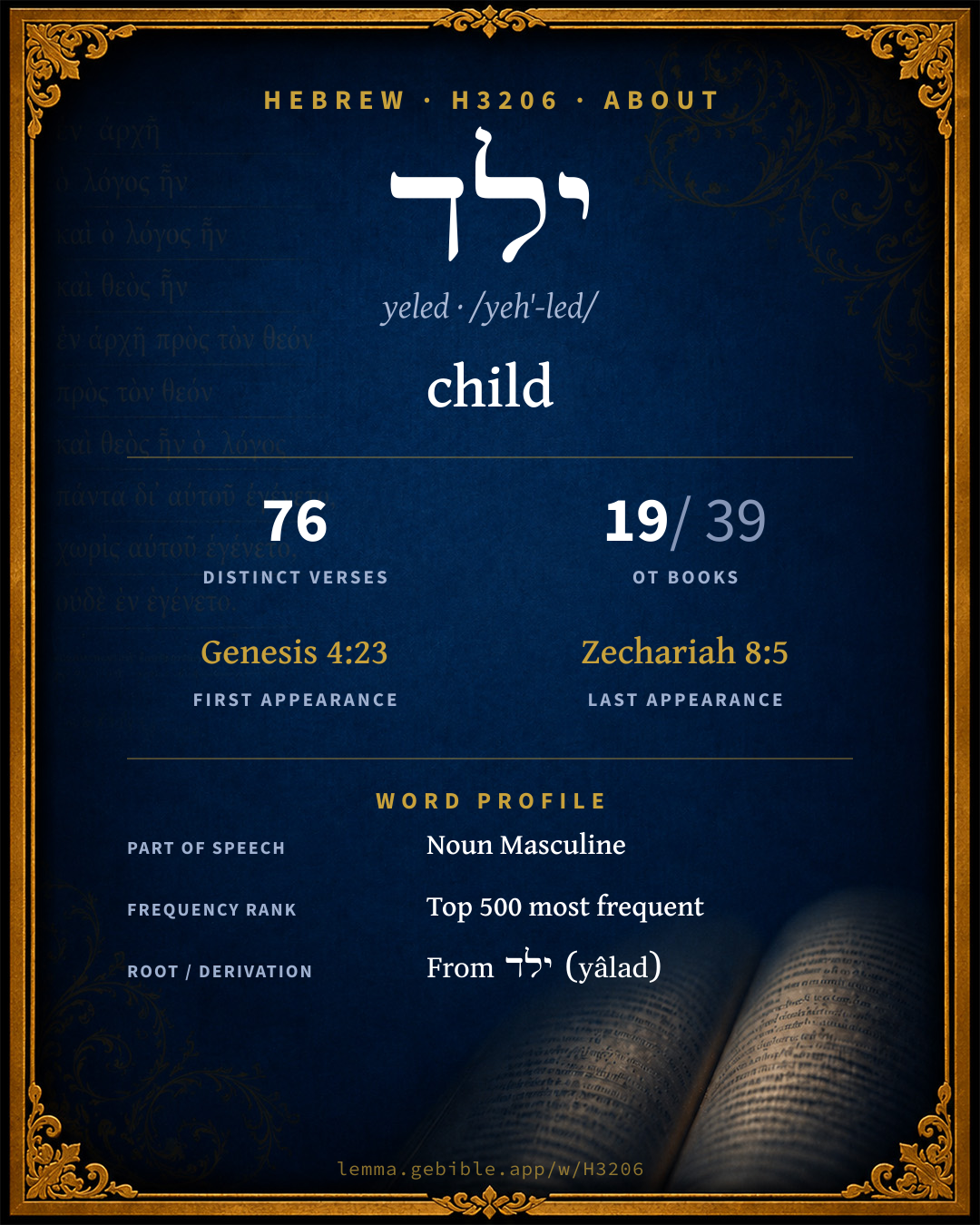
יֶ֫לֶד
child
also: son, boy, offspring, youth fuller range ↓
Full lexicon entry — Brown-Driver-Briggs (BDB)
From Brown-Driver-Briggs (BDB)
Where this word appears
Grammar key — what these labels mean
Part of speech
- Noun
- A naming word — a person, place, thing, or idea.
Noun type
- Common
- A common noun — a general class of person, place, or thing (“king,” “city,” “water”), not a specific name.
State
- Absolute
- The independent form of a noun, not bound to a following word.
- Construct
- A noun bound to a following noun in a possessive / “of” relationship (the construct chain).
Gender
- Masculine
- Grammatically masculine.
Number
- Singular
- One.
- Plural
- More than one (in Hebrew, generally three or more).
Every verse where H3206 appears in the Book of 2 Chronicles — 3 distinct verses. Click any verse to open its interlinear word-by-word view. Verse text shown in the World English Bible for context — . Each verse’s Hebrew form is shown with its reference; the English is not keyword-highlighted, since the data carries no word-level English alignment. Use “Compare translations” on any verse to read it across multiple English versions. This concordance covers the Hebrew Bible; Septuagint (Greek Old Testament) occurrences are not indexed here.
2 Chronicles
- 2 Chronicles 10:8 הַ/יְלָדִים֙ ptcl def.art + n c mp But he forsook the counsel of the old men which they had given him, and took counsel with the young men who had grown up with him, who stood before him.
- 2 Chronicles 10:10 הַ/יְלָדִים֙ ptcl def.art + n c mp The young men who had grown up with him spoke to him, saying, Thus shall you tell the people who spoke to you, saying, Your father made our yoke heavy, but make you it lighter to us; thus shall you say to them, My little finger is thicker than my father's loins.
- 2 Chronicles 10:14 הַ/יְלָדִים֙ ptcl def.art + n c mp and spoke to them after the counsel of the young men, saying, My father made your yoke heavy, but I will add thereto: my father chastised you with whips, but I [will chastise you] with scorpions.
About this entry
At a glance — auto-summarized from this page’s data, not written by a person. Every figure links to its source below. This summary describes the numbers; it doesn’t interpret them.
ילד (yeled) is a Hebrew noun most often rendered “child.” It also covers “son”, “boy”, and “offspring”, alongside “child” — see its full sense range. It turns up in 76 verses across 19 books, a moderately common footprint. It first appears in Genesis 4:23. From the same root come ילד, ילוד and יליד. The sections below give every sense, occurrence, and version rendering.
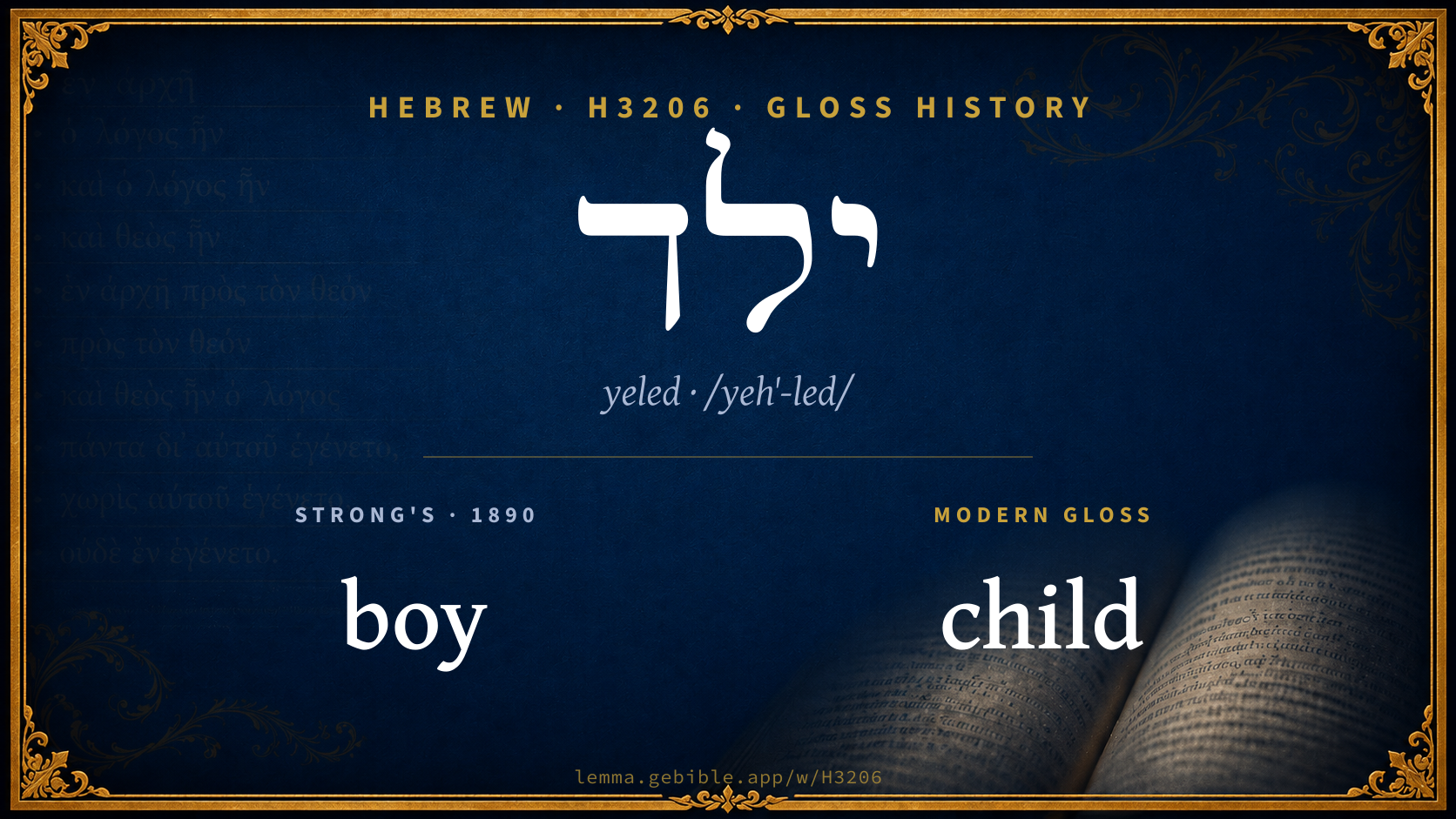
Gloss history
Strong's 1890 vs modern scholarship
About this word
Strong's H3206 catalogs a Hebrew word from the Hebrew Old Testament.
These counts are not copied from any lexicon or concordance. They are computed here, from the morphology-tagged Hebrew Old Testament. What Lemma adds →
- 76
- distinct verses
- The word appears in 76 distinct verses.
- 19 / 39
- OT books
- The word appears in 19 of 39 Old Testament books.
- #462
- by frequency
- Top 500 most frequent Hebrew words (rank 462 of 8,640 Hebrew words by occurrence).
View all 76 occurrences in the concordance →
By section of the Old Testament
By traditional corpus
Conventional, traditional groupings — biblical authorship is debated, so this is a traditional corpus grouping, not an authorship claim. Each share is this word’s portion of its verses in that division of the Hebrew canon. Each figure is a share of the word’s 76 distinct verses.
- Prophets (Nevi'im) 31 verses · 41%
- Torah (Pentateuch) 27 verses · 36%
- Writings (Ketuvim) 18 verses · 24%
How translations render this word
Counts come from each version’s own published word-to-Strong’s tagging or interlinear alignment — an approximate guide to how each version renders this word, not a word-level alignment the data otherwise carries. Because each total is that version’s own tagged count, the per-version totals vary from one another and need not match the appearance or distinct-verse counts above. These counts may also differ from a printed concordance because Lemma counts each distinctly tagged rendering and does not collapse phrase taggings into a single head-word total. This is a fixed set of word-tagged versions (KJV, ASV, BSB, ULT) and does not change with the reading translation you choose elsewhere. Each version’s license is shown beside its name below (and on Sources).
- King James Version: Child 34×, Children 21×, Young men 6×
- American Standard Version: Child 27×, Children 17×, Young men 4×
- Berean Standard Bible: Child 24×, Children 23×, Young men 10×
- unfoldingWord Literal Text: Child 36×, Children 24×, Young men 6×
King James Version Public Domain
Renders H3206 across 88 tagged occurrences — most commonly:
Plus 19 renderings that appear only once — usually multi-word phrases or single function words the recovered tagging swept in, not distinct renderings. Not rendered by a distinct English word in 1 further occurrence.
American Standard Version Public Domain
Renders H3206 across 87 tagged occurrences — most commonly:
Plus 29 renderings that appear only once — usually multi-word phrases or single function words the recovered tagging swept in, not distinct renderings.
Berean Standard Bible Public Domain
Renders H3206 across 88 tagged occurrences — most commonly:
Plus 12 renderings that appear only once — usually multi-word phrases or single function words the recovered tagging swept in, not distinct renderings. Not rendered by a distinct English word in 1 further occurrence.
unfoldingWord Literal Text CC BY-SA 4.0
Renders H3206 across 96 tagged occurrences — most commonly:
Plus 10 renderings that appear only once — usually multi-word phrases or single function words the recovered tagging swept in, not distinct renderings.
Senses in the full BDB
What do BDB’s symbols mean?
BDB uses these scholarly abbreviations:
| Symbol | Meaning |
|---|---|
| 𝔊 | the Septuagint (the ancient Greek translation, LXX) |
| 𝔙 | the Vulgate (the Latin translation) |
| 𝔖 | the Syriac version (the Peshitta) |
| 𝔗 | the Targum (the Aramaic translation) |
| ψ | the Psalms |
| √ | root (the underlying root or stem) |
| ‖ | parallel passage (a synonymous or contrasted parallel) |
| † | the dagger: every passage where the word occurs is cited |
The 5 senses and sub-senses the full Brown-Driver-Briggs lexicon distinguishes for this word, in lexicon order (not ranked by frequency), with BDB’s own verbatim wording and sub-sense lettering. Shown in Hebrew script with BDB’s own scholarly abbreviations. The condensed entry is in the Lexicon Entry tab. See also the Forms in the corpus table below.
- a. child = son, boy, Gn 21:8, 14, 15, 16; 37:30; 42:22 (all E), 32:23 (Dinah not included), cf. 30:26; 33:1, 2(×2), 5(×2), 6, 7, 13, 14; 44:20 (all J); Ex 1:17, 18 (‖ בֵּן v 16), 2:3, 6(×2), 7, 8, 9(×2), 10 (all E), 21:4 (E; app. = sons + daughters, but ‖ בָּנָ֑י v 5); pl. = offspring 21:22 (E; Hex, only Gn & Ex, JE); also Ru 1:5; 4:16; 2 S 12:15, 18(×4), 19(×2), 21(×2) 22(×2) 1 K 3:25 (cf. v 20), 14:12; 17:21(×2), 22, 23; 2 K 4:1 (cf. v 5) v 18, 26, 34(×2) Is 8:18; 9:5 (‖ בֵּן), Jo 4:3 (opp. יַלְדָּה), Zc 8:5 (id.); of young of raven Jb 38:41; of wild goats and hinds 39:3; of cow and bear Is 11:7. e.g. Genesis 21:8
- b. (little) child, children 1 S 1:2(×2) 2 S 6:23; Ezr 10:1 Ne 12:43 Jb 21:11 (‖ עֲוִילִים), Ho 1:2 La 4:10 Is 57:5. e.g. 1 Samuel 1:2
- c. descendants Is 29:23, יַלְדֵי נכרים (cf. בֵּן) 2:6. e.g. Isaiah 29:23
- d. youth Gn 4:23 (J), 1 K 12:8, 10, 14 = 2 Ch 10:8, 10, 14, Dn 1:4, 10, 13, 15, 17 cf. 2 K 2:24 (‖ נְעָרִים קְטַנִּים v 23), Ec 4:13, 15. e.g. Genesis 4:23
- e. fig. of apostate Israelites יִלְדֵי־פֶשַׁע Is 57:4 (‖ זֶרַע שָׁ֑קֶר); cf., in good sense, ילד שַׁעֲשׁוּעִים Je 31:20 of Ephraim (‖ בֵּן יַקִּיר). e.g. Isaiah 57:4
Senses from the full Brown-Driver-Briggs lexicon (Brown, Driver, Briggs; Oxford 1906 — public domain), digitized via Sefaria, supplemented by the OpenScriptures HebrewLexicon (CC BY 4.0). Full attribution on Sources.
Word origin
n.m. Gn 21:8 child, son, boy, youth—יֶ֫לֶד abs. Gn 4:23 +; cstr. Je 31:20; יָ֑לֶד Gn 21:16 +; pl. יְלָדִים 33:1 +; cstr. יַלְדֵי Ex 2:6 + 2 times; יִלְדֵי־ Is 57:4; sf. יְלָדַי Gn 30:26; 2 K 4:1; יַלְדֵיהֶם Jb 21:11; יַלְדֵיהֶן Gn 33:2 + 4 times, etc.;—
— Brown-Driver-Briggs (Oxford 1906, public domain), digitized via Sefaria, supplemented by the OpenScriptures HebrewLexicon (CC BY 4.0). See Sources.
Derived from ילד (yâlad) (H3205) — to bear.
Jastrow Dictionary
A second Hebrew/Aramaic lexicon for comparison, covering Aramaic and post-biblical (Talmudic, Targumic, Midrashic) usage that the biblical-Hebrew BDB does not. Matched by lemma rather than by Strong’s number, so a lemma may carry more than one Jastrow headword (shown separately below), and the entries cover usage well beyond the Bible.
יָלַד
- v. בָּלַט) to bear, bring forth; to beget, v. יוֹלֵד. Yeb. VII, 5 יָלְדָה הימנו בן she had a son from him. Ib. י׳ תאכל וכ׳ after she has given birth, she may eat (T’rumah). Snh. 52ᵃ ארור שזו י׳ cursed he who begot this woman. Yalk. Sam. 146 והיא ילדה מהם and she was with child from them (the male demons); והיו יוֹלְדוֹת ממנו and they (the female demons) were with child from him (Adam); Gen. R. s. 20 מולידות (corr. acc., or מוּלָדוֹת Hof.). Sot. 11ᵇ בשעה שכורעת לֵילֵד when she kneels down to give birth; a. v. fr.—Part. pass. יָלוּד born; יְלוּד אשה born of woman, human being. Sabb. 88ᵇ; a. fr.—V. יוֹלֵד, יוֹלֵדָה, יוֹלֶדֶת.
- to be born, to originate. Bets. I, 1 ביצה שנוֹלְדָה וכ׳ an egg which was laid on a Holy Day. Bekh. II, 3 נ׳ להם מום וכ׳ a permanent blemish appeared on them. Ib. V, 3 כשיִוָּלֵד לו וכ׳ when another blemish shall have appeared. Tosef. Keth. VII, 10 [read:] שדרכן לִיוָּלֵד which ordinarily appear; Y. ib. VII, end, 31ᵈ להִיוָּלֵד. Sabb. 137ᵃ יום הִוָּלְדוֹ his day of birth; a. v. fr.—Pesik. R. s. 15 כל חדש שלא נ׳, v. מוֹלָד.—Part. נוֹלָד forthcoming, future event, result. Ab. II, 9 הרואה את הנ׳ he who considers what may result (from his actions); Tam. 32ᵃ. Ned. III, 9 הנודר מן היִלּוֹדִים מותר בנוֹלָדִים if one foreswears enjoyment of the yillodim (those born), he is permitted to derive benefits from those born after his vow (v. Ib. ib. 30ᵇ).—Esp. a) (in festive ritual) nolad, an object which became available for use on a Holy Day. Bets. 2ᵃ אית ליה נ׳ holds to the opinion that nolad is forbidden to be used on the Holy Day, v. מוּקְצֶה. Sabb. 29ᵃ מעיקרא כלי … והוה ליה נ׳ ואסור before it was broken, it was a vessel (and not designated for fuel), and now it is a broken vessel and, therefore, is a nolad and must not be used as fuel. Erub. 46ᵃ top כ"ש דהוו להו נ׳ וכ׳ so much the more they must be considered as nolad &c.; a. fr.—b) (in votive law) nolad, a novel incident which changes the aspects of a vow and eventually nullifies it. Ned. IX, 2 פותחין בנ׳ the court in trying to absolve him may open the questions by pointing out a circumstance since occurred. Ib. 3 יש … שהן כנ׳ ואינן כנ׳ there are incidents which are and yet are not like nolad, i.e. incidents which may have been anticipated by the vowing person; a. fr.
- 1. to beget. Tosef. Yeb. X, 4 מפני שמוֹלִיד because he is capable of begetting children. Cant. R. beg. את מוצא צדיק מוליד וכ׳ you will find cases of a righteous man having a righteous son &c. Ex. R. s. 1 ולריק ישראל מוֹלִידִים shall Israelites beget in vain?; a. v. fr.—[Gen. R. s. 20 מולידות, v. supra. Keth. 72ᵇ מולידיו, v. יוֹלֵד.]
- 2. to bear living brood, opp. to laying eggs. Bekh. 7ᵇ, v. יָנַק.
- 1. to assist in birth, to deliver. Sabb. XVIII, 3 מְיַלְּדִין את האשה וכ׳ you may deliver a woman on the Sabbath; ib. 129ᵇ מְיַילְּדִים את החיה Ms. M. (ed. מיי׳ את הוולד you may take the child). Ab. Zar. II, 1 (26ᵃ) לא תְיַלֵּד וכ׳ must not deliver a gentile woman; a. fr.
- 2. to rear. Ib. מפני שמְיַלֶּדֶת וכ׳ because she rears a child for idolatry; a. e.
יְלֵד
- , to bear; to beget. Targ. Gen. IV, 1. Ib. 2 למֵילַד. Targ. Jer. XXXI, 7 יָלְדָן women giving birth (h. text יֹלֶדֶת). Targ. Prov. XXIII, 22 יַלְדָּךְ who begot thee. Targ. Gen. XVII, 19 תְּלִיד; usu. תֵּילַד, תֵּלַד. Targ. Ps. XXII, 32 למֵילַד to create; a. v. fr.—B. Bath. 91ᵃ (prov.) בחייך דיַלְדַּת שיתין למה לך דיַלְדַּת Ms. M. (v. Rabb. D. S. a. l. note) by thy life, the sixty (weaklings) thou begottest, what didst thou beget them for? איכפיל ואוֹלִיד וכ׳ (v. infra) marry again and beget one as strong as sixty; Yalk. Jud. 66. Macc. 17ᵇ דִּילִידָא אימיה כר"ש תֵּילוֹד whose mother soever is with child may she bear a son like R. S.; Yalk. Deut. כל דיַלְדָּה אימה כר"ש תְּלִיד; a. v. fr.
- 1. to beget, produce. Targ. Gen. IV, 18; a. fr.—Yeb. 76ᵃ בר אוֹלוּדֵי capable of begetting; ib. בני אולודי. Erub. 104ᵃ is it not because דקמוֹלִיד קלא וכל אולודי וכ׳ he produces a sound, and every production of sound is forbidden (on the Sabbath)?; a. fr.
- 2. as preced. Pi. Targ. Ex. I, 16.—Sot. 11ᵇ לאוֹלוּדָהּ to deliver her.
- 1. to act as midwife. Y. Keth. V, 30ᵃ bot. [read:] דמְיַלְּדָא, v. חֲכַם.
- 2. to give birth. Targ. Ps. CXLIV, 13.
- 1. to be born, to grow, to come forth. Targ. Ps. LXXVIII, 6. Targ. Gen. IV, 26; a. fr.—Sabb. 136ᵃ א׳ ליה וכ׳ a child was born to him. Bets. 2ᵇ כל ביצה דמִתְיַילְּדָא האידנא וכ׳ (some ed. דמִתְיְילִידָא) an egg laid to-day was fully developed yesterday. Ib. הנך דמִתְיְלִידָן וכ׳ those laid on the same day. Ḥull. 9ᵃ אִתְיְלִידָא בה ריעותא (not אתיליד) an accident occurred to it which made the case suspicious. Ned. 30ᵇ (ref. to נולדים, Mish. ib. III, 9, v. preced.) למימרא … דמִתְיַילְּדָן משמע does this mean to say that noladim means ‘things which will be forthcoming’?; אלא מעתה … ה"נ דמִתְיַילְּדִין הוא (v. marginal note) if this be so, does hannoladim in Gen. XLVIII, 5 also mean ‘those to be born’? ואלא מאי דִיְּילִידוּ משמע (= דְּאִיְּילִידוּ Ithpe. contr.) but what else? Does it (always) mean ‘those that have been born’? e.g. Genesis 48:5
- 2. to multiply, grow populous. Targ. O. Ex. I, 7 אִתְיַלָּדוּ ed. Berl. (Y. אִתְיְלִי׳). Targ. Gen. VIII, 17. Ib. IX, 7; a. e.
יֶלֶד
- preced.) child, young man. Nidd. 60ᵇ י׳ וזקן וכ׳ a young man and an old man travelling. Ex. R. s. 1; Sot. 12ᵇ הוא י׳ וקולו כנער he (Moses) was an infant, but his voice was that of a lad.—Y. Meg. III, 74ᵃ bot., v. אֶבְדּוֹקוֹס; a. fr.—Pl. יְלָדִים. Ex. R. l. c. קיימו את (החיו) הו׳ they spared the lives of the new-born. Kidd. 76ᵇ, a. e. ד׳ מאות י׳ וכ׳ David had four hundred young men in his suite; a. fr.—Fem. יַלְדָּה girl, young woman. B. Kam. 60ᵇ אחת י׳ ואחת זקינה one wife was young, the other old. Yeb. 101ᵇ; a. fr.—Pl. יְלָדוֹת. Sabb. 32ᵃ ר"א … מתות י׳ R. El. reports, ‘for three sins women die young’ (in place of יוֹלְדוֹת, v. יוֹלֶדֶת); Y. ib. II, 5ᵇ top.—Trnsf. יַלְּדָּה a young plant. Men. 69ᵇ; Sot. 43ᵇ, a. e. י׳ שסבכה בזקנה a young shoot (subject to the law of Orlah, v. עָרְלָה) which was grafted on an old tree. Ib. י׳ בי׳ a young shoot grafted on a young tree.
A Dictionary of the Targumim, the Talmud Babli and Yerushalmi, and the Midrashic Literature (Marcus Jastrow; London, Luzac, 1903) — Public Domain. Digitized via Sefaria. Digitized via Sefaria. Full attribution on Sources.
Forms in the corpus
The 52 distinct written forms H3206 takes in the Hebrew Bible, most frequent first — each parse links to that state’s occurrences in the concordance. Hebrew forms include their vowel points and cantillation, so a single lemma takes many written forms.
Same root — word family
Other BDB entries built from the same root as H3206, grouped by Strong’s listed origin. These share a root / origin per the lexicon — not necessarily a shared meaning. Each links to that word’s own entry.
Derives from
Shares the same root
- ילוד yillôwd H3209 born
- יליד yâlîyd H3211 born
- מולדת môwledeth H4138 offspring
- תולדה tôwlᵉdâh H8435 generations
Derived from this word
Proper names from this root
People and places named from this root — a name, not an additional meaning of the word.
Compare all same-root words → Showing 4 of 12 — not the complete family. 3 of the same-root words are proper names (people or places). They share a root, not necessarily a meaning.
Septuagint verse parallels
This word appears in 74 verses that also exist in the Greek Old Testament (Septuagint), out of the 76 Hebrew verses it occurs in. You can read those verses in Greek by switching the Old Testament edition to the Septuagint.
Read these verses in the Septuagint
- Genesis 4:23
- Exodus 1:17
- Ruth 1:5
- 1 Samuel 1:2
- 2 Samuel 6:23
- 1 Kings 3:25
- 2 Kings 2:24
- 2 Chronicles 10:8
- Ezra 10:1
- Job 21:11
- Ecclesiastes 4:13
- Isaiah 2:6
This is a verse-level parallel only — the same verses exist in both the Hebrew and Greek Old Testaments. No word-level Hebrew↔Greek correspondence is claimed: the data carries no such alignment, so no Greek word is shown as this Hebrew word’s translation. Coverage is not total — the Septuagint omits the deuterocanon and renumbers the Psalms, so some Hebrew verses have no direct Greek parallel.