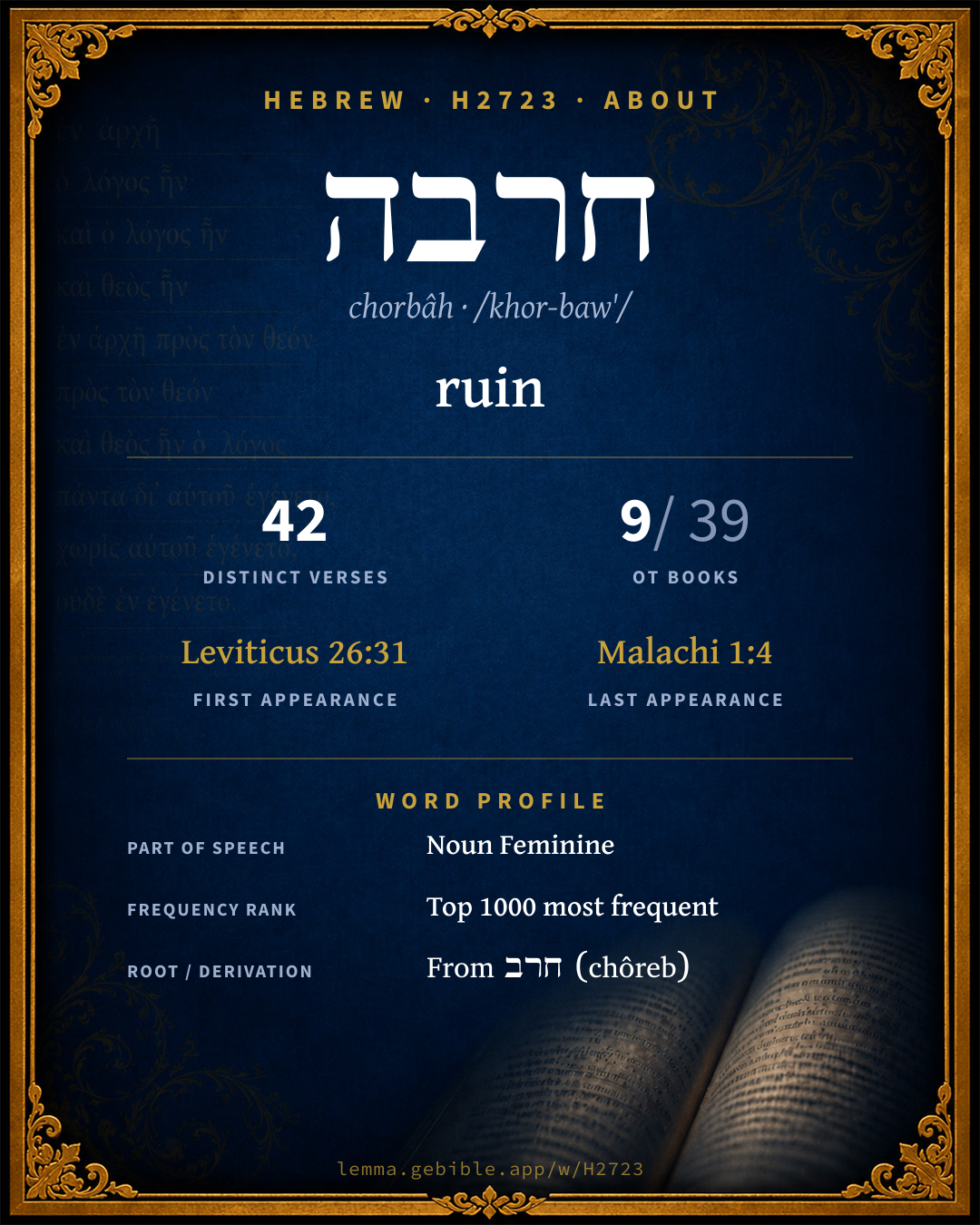
חׇרְבָּה
ruin
Full lexicon entry — Brown-Driver-Briggs (BDB)
From Brown-Driver-Briggs (BDB)
Where this word appears
See every Absolute-state word in the Hebrew Bible →
Grammar key — what these labels mean
Part of speech
- Noun
- A naming word — a person, place, thing, or idea.
Noun type
- Common
- A common noun — a general class of person, place, or thing (“king,” “city,” “water”), not a specific name.
State
- Absolute
- The independent form of a noun, not bound to a following word.
- Construct
- A noun bound to a following noun in a possessive / “of” relationship (the construct chain).
Gender
- Feminine
- Grammatically feminine.
Number
- Singular
- One.
- Plural
- More than one (in Hebrew, generally three or more).
Grammatical forms
- Noun, Common, Feminine, Singular, Absolute 16 times (38%)
- Noun, Common, Feminine, Plural, Absolute 13 times (31%)
- Noun, Common, Feminine, Plural, Construct 13 times (31%)
Parsed forms decoded from the imported morphology (morphhb / Westminster Leningrad Codex — WLC text public domain, morphhb tagging CC BY 4.0), counted across 42 parsed occurrences — not distinct verses.
Every verse where H2723 appears — 42 distinct verses across 9 books. Click any verse to open its interlinear word-by-word view. Verse text shown in the World English Bible for context — . Each verse’s Hebrew form is shown with its reference; the English is not keyword-highlighted, since the data carries no word-level English alignment. Use “Compare translations” on any verse to read it across multiple English versions. This concordance covers the Hebrew Bible; Septuagint (Greek Old Testament) occurrences are not indexed here.
Leviticus 2 verses
- Leviticus 26:31 חָרְבָּ֔ה n c fs I will lay your cities waste, and will bring your sanctuaries to desolation, and I will not take delight in the sweet fragrence of your offerings.
- Leviticus 26:33 חָרְבָּֽה n c fs I will scatter you among the nations, and I will draw out the sword after you: and your land will be a desolation, and your cities shall be a waste.
Ezra 1 verse
Job 1 verse
Psalms 3 verses
- Psalms 9:6 חֳרָב֗וֹת n c fp The enemy is overtaken by endless ruin. The very memory of the cities which you have overthrown has perished.
- Psalms 102:6 חֳרָבֽוֹת n c fp I am like a pelican of the wilderness. I have become as an owl of the waste places.
- Psalms 109:10 מֵ/חָרְבוֹתֵי/הֶֽם prep + n c fp cs + sfx pers 3mp Let his children be wandering beggars. Let them be sought from their ruins.
Isaiah 9 verses
- Isaiah 5:17 וְ/חָרְב֥וֹת conj + n c fp cs Then the lambs will graze as in their pasture, And strangers will eat the ruins of the rich.
- Isaiah 44:26 וְ/חָרְבוֹתֶ֖י/הָ conj + n c fp cs + sfx pers 3fs who confirms the word of his servant, and performs the counsel of his messengers; who says of Jerusalem, She shall be inhabited; and of the cities of Judah, They shall be built, and I will raise up the waste places of it;
- Isaiah 48:21 בָּ/חֳרָבוֹת֙ prep + n c fp They didn't thirst when he led them through the deserts; he caused the waters to flow out of the rock for them; he split the rock also, and the waters gushed out.
- Isaiah 49:19 חָרְבֹתַ֨יִ/ךְ֙ n c fp cs + sfx pers 2fs For, as for your waste and your desolate places, and your land that has been destroyed, surely now shall you be too small for the inhabitants, and those who swallowed you up shall be far away.
- Isaiah 51:3 חָרְבֹתֶ֔י/הָ n c fp cs + sfx pers 3fs For Yahweh has comforted Zion; he has comforted all her waste places, and has made her wilderness like Eden, and her desert like the garden of Yahweh; joy and gladness shall be found therein, thanksgiving, and the voice of melody.
- Isaiah 52:9 חָרְב֖וֹת n c fp cs Break forth into joy, sing together, you waste places of Jerusalem; for Yahweh has comforted his people, he has redeemed Jerusalem.
- Isaiah 58:12 חָרְב֣וֹת n c fp cs Those who shall be of you shall build the old waste places; you shall raise up the foundations of many generations; and you shall be called The repairer of the breach, The restorer of paths to dwell in.
- Isaiah 61:4 חָרְב֣וֹת n c fp cs They shall build the old wastes, they shall raise up the former desolations, and they shall repair the waste cities, the desolations of many generations.
- Isaiah 64:11 לְ/חָרְבָּֽה prep + n c fs Our holy and our beautiful house, where our fathers praised you, is burned with fire; and all our pleasant places are laid waste.
Jeremiah 10 verses
- Jeremiah 7:34 לְ/חָרְבָּ֖ה prep + n c fs Then will I cause to cease from the cities of Judah, and from the streets of Jerusalem, the voice of mirth and the voice of gladness, the voice of the bridegroom and the voice of the bride; for the land shall become a waste.
- Jeremiah 22:5 לְ/חָרְבָּ֥ה prep + n c fs But if you will not hear these words, I swear by myself, says Yahweh, that this house shall become a desolation.
- Jeremiah 25:9 וּ/לְ/חָרְב֖וֹת conj + prep + n c fp cs behold, I will send and take all the families of the north, says Yahweh, and [I will send] to Nebuchadrezzar the king of Babylon, my servant, and will bring them against this land, and against the inhabitants of it, and against all these nations round about; and I will utterly destroy them, and make them an astonishment, and a hissing, and perpetual desolations.
- Jeremiah 25:11 לְ/חָרְבָּ֖ה prep + n c fs This whole land shall be a desolation, and an astonishment; and these nations shall serve the king of Babylon seventy years.
- Jeremiah 25:18 לְ/חָרְבָּ֧ה prep + n c fs [to wit], Jerusalem, and the cities of Judah, and the kings of it, and the princes of it, to make them a desolation, an astonishment, a hissing, and a curse, as it is this day;
- Jeremiah 27:17 חָרְבָּֽה n c fs Don't listen to them; serve the king of Babylon, and live: why should this city become a desolation?
- Jeremiah 44:2 חָרְבָּה֙ n c fs Thus says Yahweh of Hosts, the God of Israel: You have seen all the evil that I have brought on Jerusalem, and on all the cities of Judah; and, behold, this day they are a desolation, and no man dwells therein,
- Jeremiah 44:6 לְ/חָרְבָּ֥ה prep + n c fs Therefore my wrath and my anger was poured forth, and was kindled in the cities of Judah and in the streets of Jerusalem; and they are wasted and desolate, as it is this day.
- Jeremiah 44:22 לְ/חָרְבָּ֨ה prep + n c fs so that Yahweh could no longer bear, because of the evil of your doings, and because of the abominations which you have committed; therefore is your land become a desolation, and an astonishment, and a curse, without inhabitant, as it is this day.
- Jeremiah 49:13 לְ/חָרְב֥וֹת prep + n c fp cs For I have sworn by myself, says Yahweh, that Bozrah shall become an astonishment, a reproach, a waste, and a curse; and all the cities of it shall be perpetual wastes.
Ezekiel 14 verses
- Ezekiel 5:14 לְ/חָרְבָּ֣ה prep + n c fs Moreover I will make you a desolation and a reproach among the nations that are round about you, in the sight of all that pass by.
- Ezekiel 13:4 בָּ/חֳרָב֑וֹת prep + n c fp Israel, your prophets have been like foxes in the waste places.
- Ezekiel 25:13 חָרְבָּה֙ n c fs therefore thus says the Lord Yahweh, I will stretch out my hand on Edom, and will cut off man and animal from it; and I will make it desolate from Teman; even to Dedan shall they fall by the sword.
- Ezekiel 26:20 כָּ/חֳרָב֤וֹת prep + n c fp then will I bring you down with those who descend into the pit, to the people of old time, and will make you to dwell in the lower parts of the earth, in the places that are desolate of old, with those who go down to the pit, that you be not inhabited; and I will set glory in the land of the living:
- Ezekiel 29:9 וְ/חָרְבָּ֔ה conj + n c fs The land of Egypt shall be a desolation and a waste; and they shall know that I am Yahweh. Because he has said, The river is mine, and I have made it;
- Ezekiel 29:10 לְ/חָרְבוֹת֙ prep + n c fp cs therefore, behold, I am against you, and against your rivers, and I will make the land of Egypt an utter waste and desolation, from the tower of Seveneh even to the border of Ethiopia.
- Ezekiel 33:24 הֶ/חֳרָב֨וֹת ptcl def.art + n c fp Son of man, they who inhabit those waste places in the land of Israel speak, saying, Abraham was one, and he inherited the land: but we are many; the land is given us for inheritance.
- Ezekiel 33:27 בֶּֽ/חֳרָבוֹת֙ prep det + n c fp Thus shall you tell them, Thus says the Lord Yahweh: As I live, surely those who are in the waste places shall fall by the sword; and him who is in the open field will I give to the animals to be devoured; and those who are in the strongholds and in the caves shall die of the pestilence.
- Ezekiel 35:4 חָרְבָּ֣ה n c fs I will lay your cities waste, and you shall be desolate; and you shall know that I am Yahweh.
- Ezekiel 36:4 וְ/לֶ/חֳרָב֤וֹת conj + prep det + n c fp therefore, you mountains of Israel, hear the word of the Lord Yahweh: Thus says the Lord Yahweh to the mountains and to the hills, to the watercourses and to the valleys, to the desolate wastes and to the cities that are forsaken, which are become a prey and derision to the residue of the nations that are round about;
- Ezekiel 36:10 וְ/הֶ/חֳרָב֖וֹת conj + ptcl def.art + n c fp and I will multiply men on you, all the house of Israel, even all of it; and the cities shall be inhabited, and the waste places shall be built;
- Ezekiel 36:33 הֶ/חֳרָבֽוֹת ptcl def.art + n c fp Thus says the Lord Yahweh: In the day that I cleanse you from all your iniquities, I will cause the cities to be inhabited, and the waste places shall be built.
- Ezekiel 38:8 לְ/חָרְבָּ֖ה prep + n c fs After many days you shall be visited: in the latter years you shall come into the land that is brought back from the sword, that is gathered out of many peoples, on the mountains of Israel, which have been a continual waste; but it is brought forth out of the peoples, and they shall dwell securely, all of them.
- Ezekiel 38:12 חֳרָב֣וֹת n c fp to take the spoil and to take the prey; to turn your hand against the waste places that are [now] inhabited, and against the people who are gathered out of the nations, who have gotten cattle and goods, who dwell in the middle of the earth.
Daniel 1 verse
Malachi 1 verse
About this entry
At a glance — auto-summarized from this page’s data, not written by a person. Every figure links to its source below. This summary describes the numbers; it doesn’t interpret them.
The Hebrew noun חרבה centers on the idea of “ruin.” Where the King James Version says “waste,” newer translations reach for “ruins” (Berean Standard Bible); the renderings breakdown has the detail. The Hebrew Bible uses it across 42 verses — moderately common. Ezekiel dominates its distribution — 14 of 42 verses. First canonically at Leviticus 26:31, it enters the text early. For the data behind this summary, explore the sense tree and the renderings breakdown below.
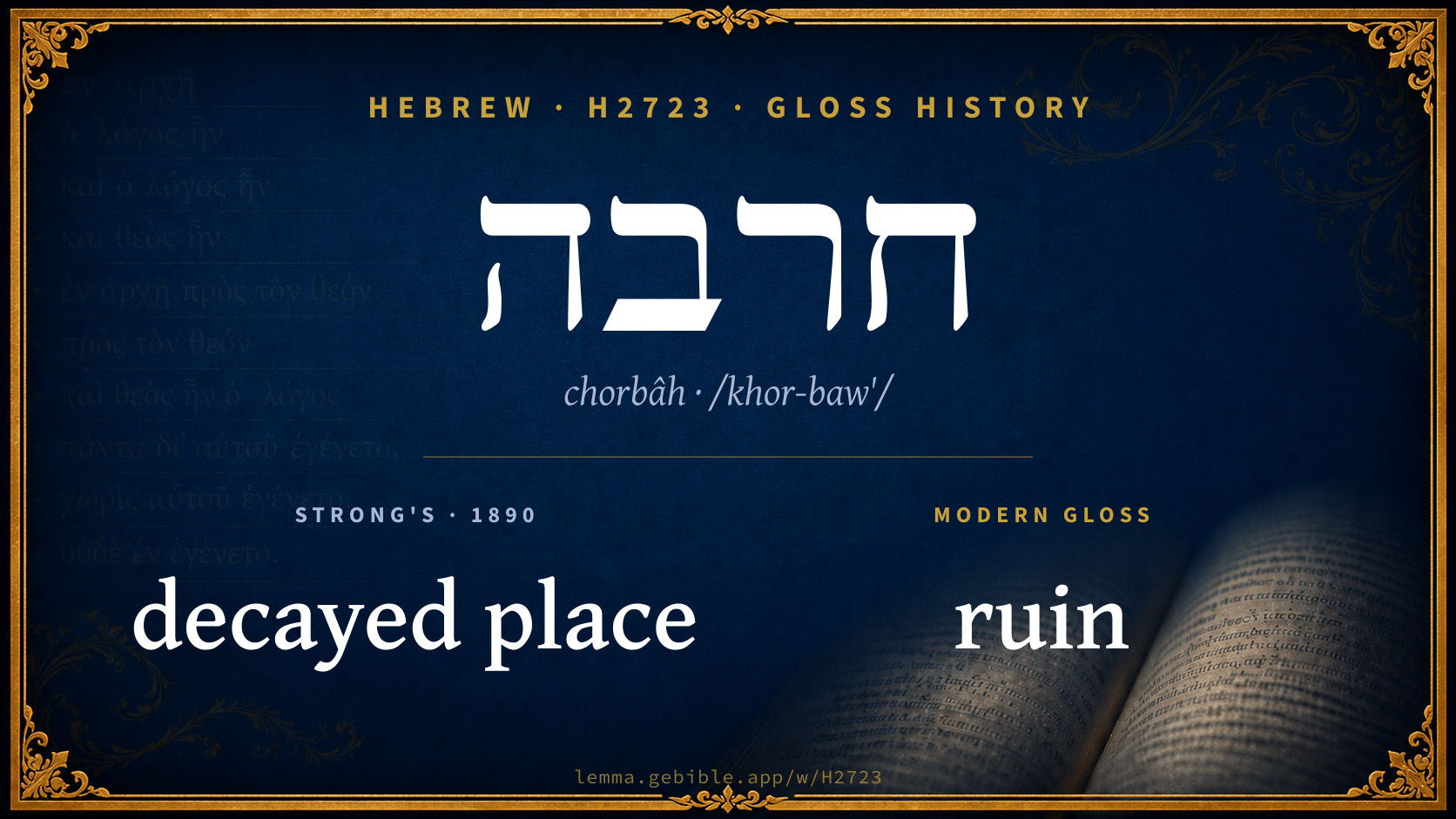
Gloss history
Strong's 1890 vs modern scholarship
About this word
Strong's H2723 catalogs a Hebrew word from the Hebrew Old Testament.
These counts are not copied from any lexicon or concordance. They are computed here, from the morphology-tagged Hebrew Old Testament. What Lemma adds →
- 42
- distinct verses
- The word appears in 42 distinct verses.
- 9 / 39
- OT books
- The word appears in 9 of 39 Old Testament books.
- #864
- by frequency
- Top 1000 most frequent Hebrew words (rank 864 of 8,640 Hebrew words by occurrence).
View all 42 occurrences in the concordance →
By section of the Old Testament
By traditional corpus
Conventional, traditional groupings — biblical authorship is debated, so this is a traditional corpus grouping, not an authorship claim. Each share is this word’s portion of its verses in that division of the Hebrew canon. Each figure is a share of the word’s 42 distinct verses.
- Prophets (Nevi'im) 34 verses · 81%
- Writings (Ketuvim) 6 verses · 14%
- Torah (Pentateuch) 2 verses · 5%
How translations render this word
Counts come from each version’s own published word-to-Strong’s tagging or interlinear alignment — an approximate guide to how each version renders this word, not a word-level alignment the data otherwise carries. Because each total is that version’s own tagged count, the per-version totals vary from one another and need not match the appearance or distinct-verse counts above. These counts may also differ from a printed concordance because Lemma counts each distinctly tagged rendering and does not collapse phrase taggings into a single head-word total. This is a fixed set of word-tagged versions (KJV, ASV, BSB, ULT) and does not change with the reading translation you choose elsewhere. Each version’s license is shown beside its name below (and on Sources).
- King James Version: Waste 7×, Wastes 6×, Desolate places 3×
- American Standard Version: Waste 8×, Waste places 5×, Wastes 3×
- Berean Standard Bible: Ruins 17×, Ruin 4×, Desolate 3×
- unfoldingWord Literal Text: Ruins 9×, Ruin 6×, Desolations 5×
King James Version Public Domain
Renders H2723 across 42 tagged occurrences — most commonly:
Plus 19 renderings that appear only once — usually multi-word phrases or single function words the recovered tagging swept in, not distinct renderings.
American Standard Version Public Domain
Renders H2723 across 42 tagged occurrences — most commonly:
Plus 22 renderings that appear only once — usually multi-word phrases or single function words the recovered tagging swept in, not distinct renderings.
Berean Standard Bible Public Domain
Renders H2723 across 42 tagged occurrences — most commonly:
Plus 10 renderings that appear only once — usually multi-word phrases or single function words the recovered tagging swept in, not distinct renderings.
unfoldingWord Literal Text CC BY-SA 4.0
Renders H2723 across 42 tagged occurrences — most commonly:
Plus 9 renderings that appear only once — usually multi-word phrases or single function words the recovered tagging swept in, not distinct renderings.
Senses in the full BDB
What do BDB’s symbols mean?
BDB uses these scholarly abbreviations:
| Symbol | Meaning |
|---|---|
| 𝔊 | the Septuagint (the ancient Greek translation, LXX) |
| 𝔙 | the Vulgate (the Latin translation) |
| 𝔖 | the Syriac version (the Peshitta) |
| 𝔗 | the Targum (the Aramaic translation) |
| ψ | the Psalms |
| √ | root (the underlying root or stem) |
| ‖ | parallel passage (a synonymous or contrasted parallel) |
| † | the dagger: every passage where the word occurs is cited |
The 2 senses and sub-senses the full Brown-Driver-Briggs lexicon distinguishes for this word, in lexicon order (not ranked by frequency), with BDB’s own verbatim wording and sub-sense lettering. Shown in Hebrew script with BDB’s own scholarly abbreviations. The condensed entry is in the Lexicon Entry tab. See also the Forms in the corpus table below.
- 1. waste, ruin, of cities of Israel Lv 26:31, 33 (H); Judah Is 44:26; 49:19 (‖ שֹׁמְמֹת), 58:12 (בנה), Je 25:18; 27:17; 44:2, 6 Ez 5:14; ruins of Jerusalem Is 52:9 Dn 9:2; also Ez 35:4; cf. Mal 1:4 (c. בנה), Ez 36:10 (c. בנה) v 33 (id.); Egypt Ez 29:9, 10 (in both ‖ שְׁמָמָה; חרבות חֹרֶב in v 10); ruin of temple Ezr 9:9; = ruined dwellings ψ 109:10; cf. 2 Ch 34:6, where read perhaps בְּחָרְבֹתֵיהֶם for בּחר בתיהם (v. חֶרֶב sub III. חרב); Je 22:5; in gen. ruins (si vera l., v. Di; obj. of בנה) Jb 3:14; כוס ח׳ ψ 102:7 an owl of a ruin. e.g. Leviticus 26:31
- 2. of land: waste place amid ruins Is 5:17, cf. 51:3 (‖ מִדְבָּר, עֲרָבָה); land a desolation Je 7:34; 44:22 Ez 25:13 (Edom) Je 25:11 Is 64:10 and Ez 33:24, 27 (of Judah), cf. Ez 13:4, כְּשֻׁעָלִים בח׳ sim. of the prophets; הח׳ הַשֹּׁמֵמוֹת Ez 36:4 (of Israel); of desolation of enemies of Isr. ψ 9:7 (ח׳ לָנֶ֫צַח); ח׳ עולם = old ruins Is 61:4 (c. בנה); elsewhere perpetual ruin, desolation Je 25:9; 49:13 (cities of Bosra); ה׳ מעולם Ez 26:20 (sim. of Tyre) pl. חֲרָבוֹת deserts (?) Is 48:21. e.g. Isaiah 5:17
Senses from the full Brown-Driver-Briggs lexicon (Brown, Driver, Briggs; Oxford 1906 — public domain), digitized via Sefaria, supplemented by the OpenScriptures HebrewLexicon (CC BY 4.0). Full attribution on Sources.
Word origin
n.f. waste, desolation, ruin;—abs. ח׳ Lv 26:31 + 15 times + Ez 38:8 (del. 𝔖 Co) + Ez 38:12 חרבה 𝔊 Co for חרבות; pl. חֳרָבוֹת ψ 9:7 + 11 times (Ez 38:12, cf. supr.); cstr. חָרְבוֹת Is 5:17 + 7 times; sf. חָרְבֹתַיִךְ Is 49:19; חָרְבֹתָיו Ezr 9:9; חָרְבֹתֶיהָ Is 51:3; חָרְבוֹתֶיהָ Is 44:26; חָרְבוֹתֵיהֶם ψ 109:10 + 2 Ch 34:6 (cf. חֶרֶב and infr.); (chiefly mid. and late Heb. Is 2 8 times; Je 10 times Ez 14 times—incl. 38:8, q. del. Co);—
— Brown-Driver-Briggs (Oxford 1906, public domain), digitized via Sefaria, supplemented by the OpenScriptures HebrewLexicon (CC BY 4.0). See Sources.
Derived from חרב (chôreb) (H2721) — dryness.
Jastrow Dictionary
A second Hebrew/Aramaic lexicon for comparison, covering Aramaic and post-biblical (Talmudic, Targumic, Midrashic) usage that the biblical-Hebrew BDB does not. Matched by lemma rather than by Strong’s number, so a lemma may carry more than one Jastrow headword (shown separately below), and the entries cover usage well beyond the Bible.
חַרְבָּה
- (v. חֶרֶב) knife. Shebi. VIII, 6 קוצץ אותם בח׳ (Ar. ed. Koh. בחורבה, R. S. בחרבא) you may cut them with a knife, opp. to מוקצה the tool especially intended for cutting figs.
חָרְבָּה
- ruin, v. חוֹרְבָּה.
A Dictionary of the Targumim, the Talmud Babli and Yerushalmi, and the Midrashic Literature (Marcus Jastrow; London, Luzac, 1903) — Public Domain. Digitized via Sefaria. Digitized via Sefaria. Full attribution on Sources.
Forms in the corpus
The 34 distinct written forms H2723 takes in the Hebrew Bible, most frequent first — each parse links to that state’s occurrences in the concordance. Hebrew forms include their vowel points and cantillation, so a single lemma takes many written forms.
Septuagint verse parallels
This word appears in 40 verses that also exist in the Greek Old Testament (Septuagint), out of the 42 Hebrew verses it occurs in. You can read those verses in Greek by switching the Old Testament edition to the Septuagint.
Read these verses in the Septuagint
- Leviticus 26:31
- Ezra 9:9
- Job 3:14
- Psalms 9:6
- Isaiah 5:17
- Jeremiah 7:34
- Ezekiel 5:14
- Daniel 9:2
- Malachi 1:4
This is a verse-level parallel only — the same verses exist in both the Hebrew and Greek Old Testaments. No word-level Hebrew↔Greek correspondence is claimed: the data carries no such alignment, so no Greek word is shown as this Hebrew word’s translation. Coverage is not total — the Septuagint omits the deuterocanon and renumbers the Psalms, so some Hebrew verses have no direct Greek parallel.