Jeremiah 25:11

Hebrew (Westminster Leningrad Codex) Jeremiah 25:11 appears in the Hebrew Old Testament. The text above is from the Westminster Leningrad Codex. Each word links to its Strong’s number, a concise gloss, and parsing drawn from the Open Scriptures Hebrew Bible morphology. Click any word for its full Brown-Driver-Briggs (BDB) entry.
Download image
Cite this verse

Jeremiah 25:11 (World English Bible). Public Domain. Lemma interlinear Bible study tool, https://lemma.gebible.app/v/jeremiah/25/11.

Show BibTeX & RIS
BibTeX
RIS
English Translation
This whole land shall be a desolation, and an astonishment; and these nations shall serve the king of Babylon seventy years.
World English Bible · Public Domain
Download a study sheet

One document with this verse’s original text, its word-by-word gloss line, the meaning frame, cross-references with their text, attributed commentary, and full source and license credits — printable, and it pastes into notes with its structure intact.

This verse Autodidact and up

Study sheet (.html) Plain text (.txt)

A passage Seminary Student

Up to 50 verses in one chapter. A passage sheet keeps up to 6 commentary sources and 12 cross-references per verse, in the order this page ranks them, and says so on the sheet whenever that leaves anything out. Ask for a single verse and you get the Autodidact verse sheet above.

Everything on this page stays free to read, with no account — the sheet is a download of what is already on screen, not access to it.

Want to remove ads? Support Godless Engineer
Compare translations 3

The same verse in 3 English versions, stacked beneath the original-language interlinear above. Click any original word for its lexicon entry.

Each is an independent rendering of the whole verse — the interlinear is not word-aligned to these translations.

Highlighted words mark where these versions differ — a whole-verse word diff, not a word-by-word alignment.

  • World English Bible Public Domain
    This whole land shall be a desolation, and an astonishment; and these nations shall serve the king of Babylon seventy years.
  • King James Version Public Domain
    And this whole land shall be a desolation, and an astonishment; and these nations shall serve the king of Babylon seventy years.
  • unfoldingWord Literal Text CC BY-SA 4.0
    And all of this land will become a ruin, a desolation, and these nations will serve the king of Babylon seventy years.

unfoldingWord Literal Text — © unfoldingWord, licensed CC BY-SA 4.0. Word-aligned USFM3 via Door43 (git.door43.org/unfoldingWord/en_ult).

Versions to compare (up to 4)

3 of 4 selected

Show all 18 translations

Every available English version of this verse, each an independent rendering of the whole verse.

  • World English Bible Public Domain
    This whole land shall be a desolation, and an astonishment; and these nations shall serve the king of Babylon seventy years.
  • Berean Standard Bible Public Domain
    And this whole land will become a desolate wasteland, and these nations will serve the king of Babylon for seventy years.
  • Majority Standard Bible Public Domain
    And this whole land will become a desolate wasteland, and these nations will serve the king of Babylon for seventy years.
  • King James Version Public Domain
    And this whole land shall be a desolation, and an astonishment; and these nations shall serve the king of Babylon seventy years.
  • American Standard Version (1901) Public Domain
    And this whole land shall be a desolation, and an astonishment; and these nations shall serve the king of Babylon seventy years.
  • Revised Version (1885) Public Domain
    And this whole land shall be a desolation, and an astonishment; and these nations shall serve the king of Babylon seventy years.
  • Geneva Bible (1599) Public Domain
    And this whole land shalbe desolate, and an astonishment, and these nations shall serue the King of Babel seuentie yeeres.
  • Douay-Rheims (1899) Public Domain
    And all this land shall be a desolation, and an astonishment: and all these nations shall serve the king of Babylon seventy years.
  • Young's Literal Translation Public Domain
    And all this land hath been for a waste, for an astonishment, and these nations have served the king of Babylon seventy years.
  • Literal Standard Version CC BY-SA 4.0
    And all this land has been for a desolation, for an astonishment, and these nations have served the king of Babylon seventy years.
  • Unlocked Literal Bible CC BY-SA 4.0
    Then all of this land will become a desolation and a horror, and these nations will serve the king of Babylon for seventy years.
  • unfoldingWord Literal Text CC BY-SA 4.0
    And all of this land will become a ruin, a desolation, and these nations will serve the king of Babylon seventy years.
  • Darby Bible Public Domain
    And this whole land shall become a waste, an astonishment; and these nations shall serve the king of Babylon seventy years.
  • World Messianic Bible Public Domain
    This whole land will be a desolation, and an astonishment; and these nations will serve the king of Babylon seventy years.
  • Webster's Bible Public Domain
    And this whole land shall be a desolation, and an astonishment; and these nations shall serve the king of Babylon seventy years.
  • Free Bible Version CC BY-SA 4.0
    This whole country will become an empty wasteland, and Judah and these other nations will serve the king of Babylon for seventy years.
  • Bible in Basic English Public Domain
    All this land will be a waste and a cause of wonder; and these nations will be the servants of the king of Babylon for seventy years.
  • JPS Tanakh (1917) Public Domain
    And this whole land shall be a desolation, and a waste; and these nations shall serve the king of Babylon seventy years.

Literal Standard Version (2020), Covenant Press — licensed CC BY-SA 4.0. Text via the HelloAO Bible API (eBible.org). Unlocked Literal Bible (unfoldingWord) — licensed CC BY-SA 4.0. Text via the HelloAO Bible API (eBible.org). unfoldingWord Literal Text — © unfoldingWord, licensed CC BY-SA 4.0. Word-aligned USFM3 via Door43 (git.door43.org/unfoldingWord/en_ult). Free Bible Version, Dr. Jonathan Gallagher — licensed CC BY-SA 4.0. Text via the HelloAO Bible API (eBible.org).

Word by word

More ways to search: Search by grammar → Find every occurrence → Compare this word →

Practice this passage: Drill this verse → Learn its vocabulary →

לְשַׁמָּ֑ה
shammâh
H8047
“to/for · desolation”
Preposition + Noun, Common, Feminine, Singular, Absolute
Part of Speech
Preposition + Noun
Type
Common
Gender
Feminine
Number
Singular
State
Absolute
Full BDB Definition

Origin: from H8074

TWOT: 2409d

waste, horror, appalment - a waste (of land, city, etc) - appalment, horror
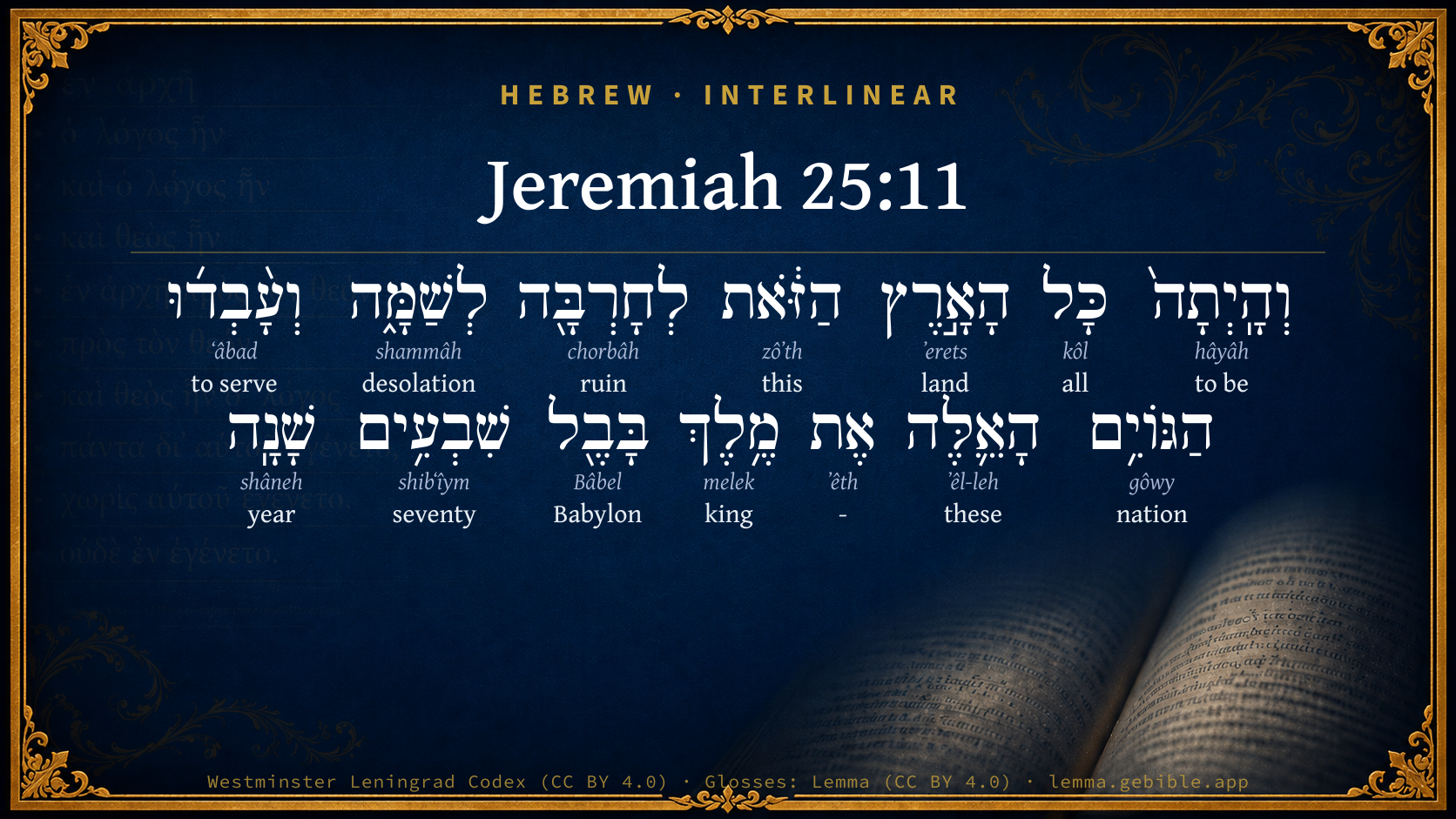
  1. וְהָֽיְתָה֙ hâyâh H1961 “and · to be” Conjunction + Verb, Qal, Sequential Perfect, 3rd Person, Feminine, Singular
  2. כָּל kôl H3605 “all of” Noun, Common, Masculine, Singular, Construct
  3. הָאָ֣רֶץ ʼerets H776 “the · land” Particle, Definite Article + Noun, Common, Both, Singular, Absolute
  4. הַזֹּ֔את zôʼth H2063 “the · this” Particle, Definite Article + Pronoun, Demonstrative, Feminine, Singular
  5. לְחָרְבָּ֖ה chorbâh H2723 “to/for · ruin” Preposition + Noun, Common, Feminine, Singular, Absolute
  6. וְעָ֨בְד֜וּ ʻâbad H5647 “and · to serve” Conjunction + Verb, Qal, Sequential Perfect, 3rd Person, Common, Plural
  7. הַגּוֹיִ֥ם gôwy H1471 “the · nations” Particle, Definite Article + Noun, Common, Masculine, Plural, Absolute
  8. הָאֵ֛לֶּה ʼêl-leh H428 “the · these” Particle, Definite Article + Pronoun, Demonstrative, Common, Plural
  9. אֶת ʼêth H853 “-” Particle, Direct Object
  10. מֶ֥לֶךְ melek H4428 “king of” Noun, Common, Masculine, Singular, Construct
  11. בָּבֶ֖ל Bâbel H894 “Babylon” Noun, Proper
  12. שִׁבְעִ֥ים shibʻîym H7657 “seventy” Adjective, Cardinal number, Both, Plural, Absolute
  13. שָׁנָֽה shâneh H8141 “year” Noun, Common, Feminine, Singular, Absolute

About this verse

These counts appear in no published source. They are computed here, from the morphology-tagged text and Lemma’s own curated glosses. What Lemma adds →

14
words
14
distinct lemmas
Prophets
section

Shared distinctive vocabulary

לְשַׁמָּ֑ה desolation H8047 occurs in 39 verses of the Hebrew Bible. Also found in:

Grammatical profile

  • 2 verbs
  • 8 nouns
  • 1 adjective
  • 2 pronouns
  • 1 particle

Verb forms

  • וְהָֽיְתָה֙ Qal · Sequential Perfect
  • וְעָ֨בְד֜וּ Qal · Sequential Perfect

Hebrew & Septuagint length

In the original languages it is 14 Hebrew tokens and 14 Greek tokens — but the two are counted differently (Hebrew bundles its prefixes and suffixes into one token; the Greek is in lemma form), so that isn’t a like-for-like length.

Cross-references

8

Topical passages linked to Jeremiah 25:11 in the Treasury of Scripture Knowledge — connected by theme and wording, ordered by reader-vote popularity; previews shown in the World English Bible.

  • Daniel 9:2 in the first year of his reign I, Daniel, understood by the books the number of the years about which the word of Yahweh came to Jeremiah the prophet, for the accomplishing of the desolations of Jerusalem, even seventy years.
  • Zechariah 1:12 Then the angel of Yahweh replied, "O Yahweh of Hosts, how long will you not have mercy on Jerusalem and on the cities of Judah, against which you have had indignation these seventy years?"
  • 2 Chronicles 36:21–22 to fulfill the word of Yahweh by the mouth of Jeremiah, until the land had enjoyed its Sabbaths: [for] as long as it lay desolate it kept Sabbath, to fulfill seventy years.
  • Jeremiah 25:12 It shall happen, when seventy years are accomplished, that I will punish the king of Babylon, and that nation, says Yahweh, for their iniquity, and the land of the Chaldeans; and I will make it desolate forever.
  • Zechariah 7:5 "Speak to all the people of the land, and to the priests, saying, 'When you fasted and mourned in the fifth and in the seventh month for these seventy years, did you at all fast to me, really to me?
  • Isaiah 23:15–17 It shall come to pass in that day, that Tyre shall be forgotten seventy years, according to the days of one king: after the end of seventy years it shall be to Tyre as in the song of the prostitute.
  • Jeremiah 4:27 For thus says Yahweh, The whole land shall be a desolation; yet will I not make a full end.
  • Jeremiah 12:11–12 They have made it a desolation; it mourns to me, being desolate; the whole land is made desolate, because no man lays it to heart.

Cross-references courtesy of OpenBible.info (CC BY 4.0).

Hebrew and Greek witnesses Masoretic Hebrew ↔ Greek Septuagint

The same verse in the two great witnesses to the Old Testament, shown verse-for-verse.

These are two independent witnesses, not word-aligned to each other, and the Septuagint is shown in lemma (dictionary) form.

Hebrew Jeremiah 25:11 Masoretic · Westminster Leningrad Codex

וְהָֽיְתָה֙ כָּל הָאָ֣רֶץ הַזֹּ֔את לְחָרְבָּ֖ה לְשַׁמָּ֑ה וְעָ֨בְד֜וּ הַגּוֹיִ֥ם הָאֵ֛לֶּה אֶת מֶ֥לֶךְ בָּבֶ֖ל שִׁבְעִ֥ים שָׁנָֽה

This whole land shall be a desolation, and an astonishment; and these nations shall serve the king of Babylon seventy years.

World English Bible · Public Domain

Greek LXX Structure differs

In the Septuagint, Jeremiah is about an eighth shorter than the Hebrew and arranges its material differently — the Oracles Against the Nations (Hebrew chapters 46–51) appear in the middle of the Greek book, after 25:13. Because the chapter and verse boundaries do not line up, a verse-for-verse comparison with the Hebrew is not shown.

A verse-for-verse comparison isn’t shown here because the chapters and verses don’t line up. Switch to the LXX edition with the MT / LXX toggle above to read the Greek directly.

On this verse, The Cambridge Bible for Schools and Colleges discusses the Septuagint’s reading. Read the note in Commentary ↓

Hebrew: Westminster Leningrad Codex (CC BY 4.0). Greek: Septuagint (public domain); English from a public-domain English Septuagint. How the Septuagint differs from the Hebrew →

Targum (Aramaic paraphrase)

1

The Targum is the ancient Jewish Aramaic paraphrase of the Hebrew Scriptures — an interpretive translation, not the Hebrew text itself. Onkelos (literal) and Pseudo-Jonathan (expansive) render the Torah, and Jonathan the Prophets. Coverage is partial: where no permissively-licensed English translation exists for a verse, only the Aramaic is shown. This is verse-level text, not a word-by-word alignment to the Hebrew.

  1. Targum Jonathan Prophets (Joshua–Malachi)
    וּתְהֵי כָּל אַרְעָא הָדָא לְחָרְבָּא לְצָדוּ וְיִפְלְחוּן עַמְמַיָא הָאִלֵין יַת מַלְכָּא דְבָבֶל שִׁבְעִין שְׁנִין:

    (no public-domain English translation for this verse)

    Targum Jonathan — Aramaic: “Mikraot Gedolot” (public domain). English: “Sefaria Community Translation” (CC0 1.0 (public-domain dedication)); “London "Chaldee Paraphrase," 1871” (public domain). Text via Sefaria.

Commentary

Notes on Jeremiah 25:11 from classic Christian and Jewish commentators (each source and its license shown beneath its notes). The classic Christian expositions comment on the surrounding passage and are grouped to its opening verse, so a note may address several verses; the Jewish commentaries on the Tanakh (Rashi and others) are per-verse, so they appear only where the commentator wrote on this verse.

Lemma curates 59 commentaries, every one of them public domain or Creative Commons licensed, each selected and text-cleaned for this edition rather than reprinted as found. About our sources →

Trapp's Complete Commentary

John Trapp

Jer 25:11 And this whole land shall be a desolation, [and] an astonishment; and these nations shall serve the king of Babylon seventy years.

Ver. 11. And this land shall be a desolation - seventy years.] Which commenced at the deportation of Jeconiah. {2Ki 24:8 Jer 29:1-3 Eze 4:1; Eze 33:21} Avignon in France, was the residence of the Pope for seventy years, which time the Romans yet remember, till this day, by the name of the Babylonian captivity. {a} Luther, when he first began to stir against the Pope, wrote a book bearing title De captivitate Babylonica, which when Bugenhagius, a Pomeranian divine, first read, he pronounced it to be the most heretical piece that ever was written, but afterwards, having better considered the contents of it, he retracted his former censure; he told his colleagues that all the world besides was in deep darkness, and that Luther alone was in the light and in the right, and him he would follow. So he did, and drew many more with him. {b}

{a} Heyl. Cosm., fol. 188.

{b} Scult Annal.

John Trapp, A Commentary or Exposition upon All the Books of the Old and New Testament (1647–1656) — public domain. Text from a community e-Sword module.

Joseph Benson's Commentary

Jer 25:11. These nations shall serve the king of Babylon — That is, Nebuchadnezzar and his successors, collectively considered; seventy years — “This period of the nation’s servitude must be computed from the defeat of the Egyptians at Carchemish, in the same year that this prophecy was given, when Nebuchadnezzar reduced the neighbouring nations of Syria and Palestine, as well as Jerusalem, under his subjection. This was near two years before the heathen chronologers in general begin his reign, his father being still living. After his father’s death, according to Ptolemy’s canon, he reigned forty-three years; Ilverodamus, or Evil-merodach, his son two, Neriglissar four, and Nabonadius, supposed to be Belshazzar, the grandson of Nebuchadnezzar, seventeen; to which, if we add two years of Darius the Mede, who is said, Dan 9:1, to have been made king over the realm of the Chaldeans, we shall find the nations to have continued all that time, nearly seventy years, in subjection, more or less, to the king of Babylon. But after the accession of Cyrus, who put an end to the Babylonish monarchy, the nations could serve the king of Babylon no longer, because there was no longer a king of Babylon to serve; for the kings of Persia were never called kings of Babylon; but Babylon became itself a subject and dependant province, under a subordinate governor, and began from that instant to experience, in some degree, those divine visitations which terminated at length in what is so justly called, in the next verse, perpetual desolations.” — Blaney. See notes on Jer 29:10; and Ezr 1:1.

Joseph Benson's Commentary on the Old and New Testaments (1811–1818) — public domain. Text from a community e-Sword module.

Tyndale Open Study Notes

Tyndale Open Resources

25:11 seventy years: This is the first instance of a specific time period assigned to the Exile. The prediction was fulfilled either from 605 BC (the first exile to Babylon) to around 538 BC (when Cyrus allowed the exiles to return to Judea), or from 586 BC (the destruction of the Temple) to 515 BC (the dedication of the Second Temple). Or, the number can be seen as symbolic: God’s judgment on Jerusalem would last a perfect lifetime, and for the exact length of time that God had determined.

Tyndale Open Study Notes — © Tyndale Open Resources, licensed CC BY-SA 4.0. Text via the HelloAO Bible API.

Jamieson, Fausset & Brown

Robert Jamieson, A. R. Fausset & David Brown

seventy years-- (Jer 27:7). The exact number of years of Sabbaths in four hundred ninety years, the period from Saul to the Babylonian captivity; righteous retribution for their violation of the Sabbath (Lev 26:34-35; Ch2 36:21). The seventy years probably begin from the fourth year of Jehoiakim, when Jerusalem was first captured, and many captives, as well as the treasures of the temple, were carried away; they end with the first year of Cyrus, who, on taking Babylon, issued an edict for the restoration of the Jews (Ezr 1:1). Daniel's seventy prophetic weeks are based on the seventy years of the captivity (compare Dan 9:2, Dan 9:24).

Jamieson, Fausset & Brown — Commentary Critical and Explanatory on the Whole Bible (1871) — public domain (CC PDM 1.0). Text via the HelloAO Bible API.

Adam Clarke's Commentary

Verse 11. Shall serve the king of Babylon seventy years.] As this prophecy was delivered in the fourth year of Jehoiakim, and in the first of Nebuchadnezzar, and began to be accomplished in the same year, (for then Nebuchadnezzar invaded Judea, and took Jerusalem,) seventy years from this time will reach down to the first year of Cyrus, when he made his proclamation for the restoration of the Jews, and the rebuilding of Jerusalem. See the note on Isa 13:19, where the subject is farther considered in relation to the reign of Nebuchadnezzar, and the city of Babylon.

Adam Clarke's Commentary on the Bible (1810–1826) — public domain. Text from a community e-Sword/MySword module.

John Calvin's Commentaries

Here the Prophet mentions the restriction of which I have spoken, and thus he mitigates the severity of their punishment. It is, then, a kind of correction; not that he changes anything, but only by this sort of correction he explains what he before meant by perpetual desolations.

He says, The whole land shall be a waste and an astonishment, or as some render it, “a desolation.” The word שמם, indeed, means to lay desolate, and also to astonish; but as he had lately used the word in the sense of astonishment, I see no reason for changing its meaning here, especially as it is connected with חרבה, charebe. But as to the drift of the passage, there is not much difference whether we say, the land shall be a desolation, or an astonishment; for it was to be a solitude — reduced to a desolation or a wilderness.

And serve shall these nations the king of Babylon seventy years, there the Prophet concludes his prophecy concerning the future calamity of the people, even that the land would be reduced to a solitude, so as to render every one passing through it astonished, or that it was to become a horrid spectacle on account of its desolation. And that a time of seventy years was fixed, it was a testimony of God’s paternal kindness towards his people, not indiscriminately towards the whole multitude, but towards the remnant of whom he had spoken elsewhere. Then the Prophet means, that however grievously the Jews had sinned, yet God would execute only a temporary punishment; for after seventy years, as we shall see, he would restore them to their own country, and repair what they had lost, even the inhabitation of the promised land, the holy city, and the Temple. And this is more fully expressed in the next verse.

John Calvin's Commentaries (1540-1563) — public domain. Text from the Calvin Translation Society English edition (1840s-50s) via the Christian Classics Ethereal Library (ccel.org). Calvin's coverage is partial (roughly two-thirds of the Bible); uncommented books and verses are honest gaps, never fabricated. The 19th-century editor's footnotes and remarks are omitted so the notes are faithfully Calvin's own voice.

Ellicott's Commentary for English Readers

(11) Shall serve the king of Babylon seventy-years.—This is the first mention of the duration of the captivity. The seventy years are commonly reckoned from B.C. 606, the date of the deportation of Jehoiakim and his princes, to B.C. 536, when the decree for the return of the exiles was issued by Cyrus. In 2Ch_36:21 the number is connected with the land “enjoying her Sabbaths,” as though the long desolation came as a retribution for the people’s neglect of the law of the Sabbatical year, and, perhaps, also for their non-observance of the weekly Sabbaths. (Isa_56:4; Jer_17:21-22.) For the apportionment of the reigns of the Babylonian kings that made up the seventy years, see the Chronological Table in the Introduction. Symbolically the number, as the multiple of seven and ten, represents the highest measure of completeness (comp. Mat_18:22).

A Bible Commentary for English Readers, edited by Charles John Ellicott (1878–1897) — public domain. Text from a community e-Sword module.

The Cambridge Bible for Schools and Colleges

gen. ed. J. J. S. Perowne

11. and these nations shall serve the king of Babylon] LXX have, “and they shall be servants among the heathen,” thus omitting “these,” and “the king of Babylon,” and probably indicating the original form of the Hebrew, which, however, they render inaccurately, as the construction of the verb here gives the sense not serve, but make to serve. The meaning is that “the families of the north” shall bring the Jews and the other nations into bondage.

seventy years] the approximate length of the Jewish captivity in Babylon as is clearly shewn by Jer_29:10. It will have to be reckoned, not from the deportation of Jehoiachin’s time (2Ki_24:14-16), but from (604 b.c.) the 4th year of Jehoiakim to (537 b.c.) the return. It is quite sufficient to make an approximation to the number seventy. The Jewish love for round numbers and especially for one so significant in symbolism, as having for its elements seven and ten, would cause the number seventy to their ears when used in such a connexion to stand for any number not differing by much from that amount.

The Cambridge Bible for Schools and Colleges (gen. ed. J. J. S. Perowne; Cambridge University Press, 1878–1918) — public domain. Text from a community e-Sword module.

John Gill's Exposition

And this whole land shall be a desolation,.... Not only the city of Jerusalem, but all Judea, without inhabitants, or very few, and shall be uncultivated, and become barren and unfruitful:

and an astonishment; to all other nations, and to all persons that pass through, beholding the desolations of it:

and other nations shall serve the king of Babylon seventy years; both the Jews, and other nations of Egypt, reckoning from the date of this prophecy, the fourth year of Jehoiakim's reign, when Daniel and others were carried captive, Dan 1:1; to the first year of Cyrus.

John Gill's Exposition of the Whole Bible (1746–1763) — public domain (CC PDM 1.0). Text via the HelloAO Bible API.

Albert Barnes' Notes on the Bible

Seventy years - The duration of the Babylonian empire was really a little short of this period. But the 70 years are usually calculated down to the time when the Jews were permitted to return to their country (compare Jer 29:10).

Albert Barnes' Notes on the Bible (1834–1885) — public domain. Text from a community e-Sword/MySword module.

Haydock's Catholic Bible Commentary

Years. Ver. 1. The neighbouring nations were also involved in this calamity, and were to be sent back by Cyrus. (Calmet) --- Another period of 70 years is specified, (chap. xxix. 10.) during which the city and temple should remain in ruins, till the second of Hystaspes, the year of the world 3485. (Usher) --- This system is not without difficulties. The present prediction seems rather to refer to the desolation, (Vatable; Aggeus i. 2.) as appears from Zacharias i. 12., or the prophet speaks of the same event in both places, dating from the year preceding the capture of Jerusalem, (the year 3415), till Darius gave entire liberty to the Jews, the year 3485. We differ from Usher in the years allotted to Cyrus, who began to restore the Jews, 1 Esdras i. 5. (Calmet) --- These 70 years are dated from the 11th of Sedecias. (Worthington)

George Leo Haydock (1774–1849), Haydock's Catholic Family Bible and Commentary, 1859 edition — public domain. Excludes Psalms (Douay-Rheims chapter numbering differs from Protestant) and Deuterocanonical books (Catholic canon only).

Matthew Poole's English Annotations

This prophecy is a famous prophecy in regard of its fixing the particular space of time in which the Jews abode in the captivity of Babylon, viz.

seventy years. When they determined we are plainly enough told, Ezr 1:1, in the first year of Cyrus the king of Persia, but when they commenced is more disputed; for we read of three carryings into that captivity: the one in the third and fourth year of Jehoiakim, when it should seem that Nebuchadrezzar only carried away some few persons to be bred in his court, amongst whom were Daniel and the three children, Dan 1:1,2, &c.; a second seven years after, in Jeconiah’s time, 2Ki 24:15,16; the last and most general eleven years after, in the eleventh year of Zedekiah: it seemeth most probable that the seventy years must be reckoned from the second; for Jeremiah, Jer 29:1, &c., writing to those then in captivity, tells them, that when seventy years should be accomplished, God would bring them back. This is confirmed by Ezekiel, Eze 40:1, where the fourteenth year after the taking of the city is expressly said to be the twenty-fifth year of their captivity.

Matthew Poole's English Annotations on the Holy Bible (1683–1685) — public domain. Text from a community e-Sword/MySword module.

Whedon's Commentary on the Bible

Daniel D. Whedon

11. Seventy years — Used not as a round number, nor primarily for its symbolical import, but with chronological exactness. The accuracy of this number is attested by both sacred and profane chronology. It begins with the fourth year of Jehoiakim, 606 B.C., and extends to the first year of Cyrus, 536 B.C. The whole period of the Babylonian empire after the fall of Nineveh was about sixty-seven years. Add the two years of Darius the Mede, (Dan_6:1,) and we have about sixty-nine years for the captivity before the accession of Cyrus, near the beginning of whose reign came the decree of release and restoration. See an excellent resume of the chronological data in Keil’s Commentary.

Daniel D. Whedon (gen. ed.), Commentary on the Old and New Testaments (1874–1909) — public domain. Text from a community e-Sword module.

The Pulpit Commentary

Shall serve the king of Babylon seventy years. Widely different opinions are held as to the meaning of this prophecy. The most probable view is that "seventy" is an indefinite or round number, (as in Isa_23:17) equivalent to "a very long time." This is supported by the analogy of Jer_27:7, where the captivity is announced as lasting through the reigns of Nebuchadnezzar, his son, and his grandson a statement evidently vague and indefinite (see ad loc.), and in any case not answering to a period of seventy years. Besides, we find the "seventy years" again in Jer_29:10, a passage written probably eleven years later. Others think the number is to be taken literally, and it is certainly true that from B.C. 606, the fourth year of Jehoiakim, to the fall of Babylon, B.C. 539, sixty-seven years elapsed. But is it desirable to press this against the internal evidence that Jeremiah himself took the number indefinitely?

The Pulpit Commentary (1880–1919), ed. H.D.M. Spence-Jones & Joseph S. Exell — public domain. Text from a community e-Sword module.

Keil & Delitzsch

C. F. Keil & F. Delitzsch

The land of Judah shall be made waste and desolate, and these peoples shall serve the king of Babylon for seventy years. The time indicated appertains to both clauses. "This land" is not, with Ng., to be referred to the countries inhabited by all the peoples mentioned in Jer 25:9, but, as in Jer 25:9, to be understood of the land of Judah; and "all these peoples" are those who dwelt around Judah. The meaning is unquestionably, that Judah and the countries of the adjoining peoples shall lie waste, and that Judah and these peoples shall serve the king of Babylon; but the thought is so distributed amongst the parallel members of the verse, that the desolation is predicated of Judah only, the serving only of the peoples - it being necessary to complete each of the parallel members from the other.

The term of seventy years mentioned is not a so-called round number, but a chronologically exact prediction of the duration of Chaldean supremacy over Judah. So the number is understood in Ch2 36:21-22; so too by the prophet Daniel, when, Dan 9:2, in the first year of the Median king Darius, he took note of the seventy years which God, according to the prophecy of Jeremiah, would accomplish for the desolation of Jerusalem. The seventy years may be reckoned chronologically. From the 4th year of Jehoiakim, i.e., 606 b.c., till the 1st year of the sole supremacy of Cyrus over Babylon, i.e., 536 b.c., gives a period of 70 years. This number is arrived at by means of the dates given by profane authors as well as those of the historians of Scripture. Nebuchadnezzar reigned 43 years, his son Evil-Merodach 2 years, Neriglissor 4 years, Labrosoarchad (according to Berosus) 9 months, and Naboned 17 years (43 + 2 + 4 + 17 years and 9 months are 66 years and 9 months). Add to this 1 year - that namely which elapsed between the time when Jerusalem was first taken by Nebuchadnezzar, and the death of Nabopolassar and Nebuchadnezzar's accession - add further the 2 years of the reign of Darius the Mede (see on Dan 6:1), and we have 69 3/4 years. With this the biblical accounts also agree. Of Jehoiakim's reign these give 7 years (from his 4th till his 11th year), for Jehoiachin's 3 months, for the captivity of Jehoiachin in Babylon until the accession of Evil-Merodach 37 years (see Kg2 25:27, according to which Evil-Merodach, when he became king, set Jehoiachin at liberty on the 27th day of the 12th months, in the 37th year after he had been carried away). Thus, till the beginning of Evil-Merodach's reign, we would have 44 years and 3 months to reckon, thence till the fall of the Babylonian empire 23 years and 9 months, and 2 years of Darius the Mede, i.e., in all 70 years complete. - But although this number corresponds so exactly with history, it is less its arithmetical value that is of account in Jeremiah; it is rather its symbolical significance as the number of perfection for God's works. This significance lies in the contrast of seven, as the characteristic number for works of God, with ten, the number that marks earthly completeness; and hereby prophecy makes good its distinguishing character as contrasted with soothsaying, or the prediction of contingent matters. The symbolical value of the number comes clearly out in the following verses, where the fall of Babylon is announced to come in seventy years, although it took place two years earlier.

Keil & Delitzsch — Biblical Commentary on the Old Testament (1861–1891) — public domain (CC PDM 1.0). Text via the HelloAO Bible API. (Old Testament only.)

Scofield Reference Notes

C. I. Scofield

seventy years

Cf. Lev 26:33-35; 2Ch 36:21; Dan 9:2 The 70 years may be reckoned to begin with the first deportation of Judah to Babylon. 2Ki 24:10-15. B.C. 604 according to the Assyrian Eponym Canon, or B.C. 606 according to Ussher; or from the final deportation; 2Ki 25:1-30; 2Ch 36:17-20; Jer 39:8-10. B.C. 586 (Assyr. Ep. Canon), or B.C. 588 (Ussher). In the first case the 70 years extend to the decree of Cyrus for the return Ezr 1:1-3 B.C. (Assyr. Ep. Canon), or B.C. 536 (Ussher). In the second case the 70 years terminate B.C. 516 (Assyr.Ep. Canon) with the completion of the temple. The latter is more probable reckoning in the light of Dan 9:25.

The Scofield Reference Bible (1917 edition), notes by C. I. Scofield — public domain. Text from a community e-Sword module.

Lesson kit

Teaching starters — assembled from the data on this page, not authored interpretation. Every prompt links to the verse data it draws on. Edit before teaching.

Jeremiah, in the Prophets, opens this verse with 14 words (14 distinct Hebrew lemmas). Its most distinctive word is shammâh (“desolation”). A historical commentator’s framing appears above. Read the whole chapter for the surrounding context.

Discussion questions

  1. The word shammâh carries the sense “desolation.” How does it shape the verse?
  2. Deuteronomy 28:37 shares the word «desolation» with this verse. How do the two illuminate each other?
  3. These translations render this verse differently. What is at stake in choosing one wording over another?
  4. The verb «וְהָֽיְתָה֙» is Qal Sequential Perfect. How does its form color the action?
  5. Reading how Trapp's Complete Commentary and Joseph Benson's Commentary read this verse, where do the two commentators agree and where do they part?

Things to notice

Reading settings

Reading text

Shown beneath each verse's original-language words.

Old Testament
Old Testament edition

Read the OT as the Masoretic Hebrew (MT) or the Greek Septuagint (LXX).

English shown for the Greek Septuagint (in the Hebrew ↔ Greek comparison).

Comparing translations? Open the Compare panel on any verse page to stack up to four side by side.