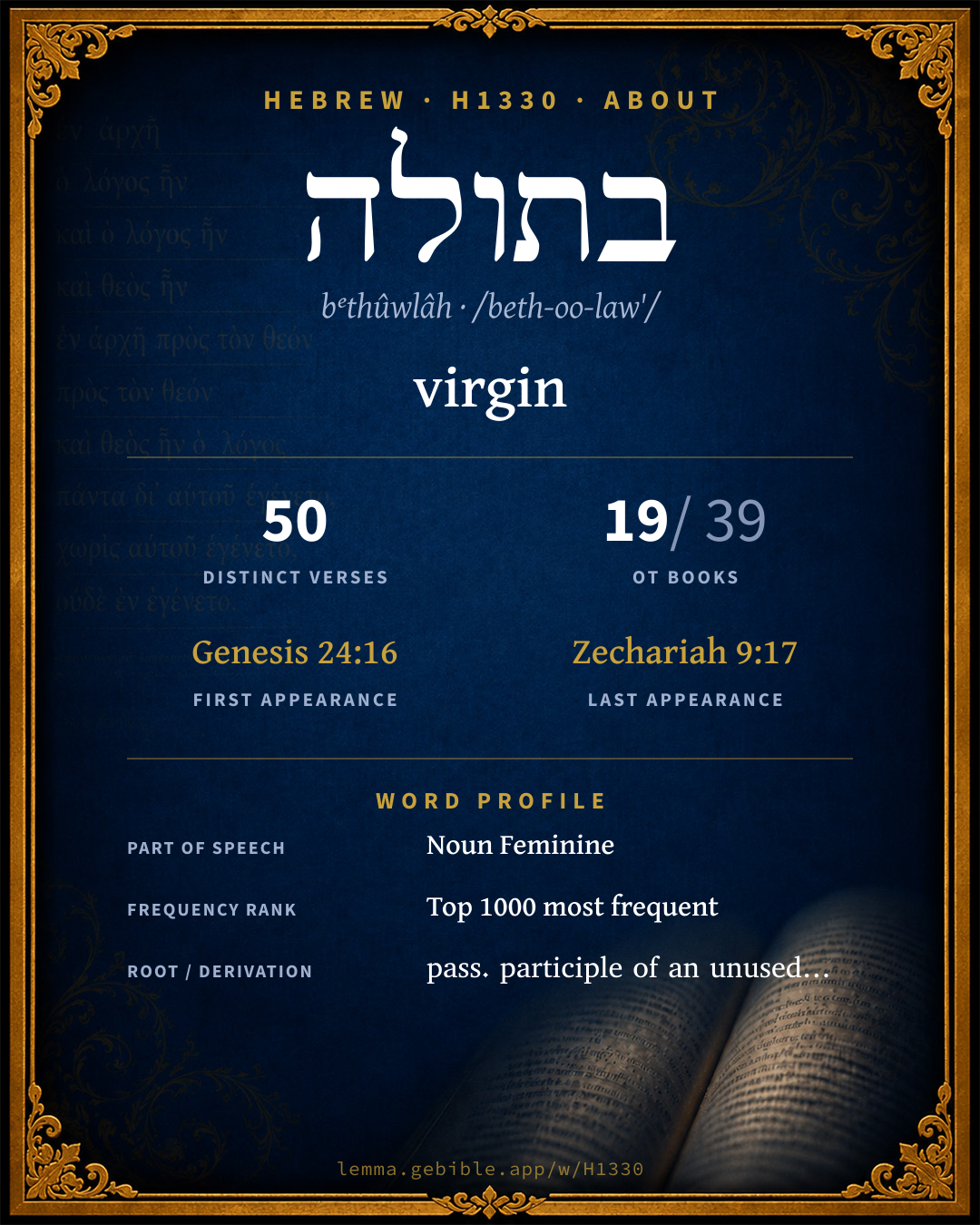
בְּתוּלָה
virgin
Full lexicon entry — Brown-Driver-Briggs (BDB)
From Brown-Driver-Briggs (BDB)
Where this word appears
See every Absolute-state word in the Hebrew Bible →
Grammar key — what these labels mean
Part of speech
- Noun
- A naming word — a person, place, thing, or idea.
Noun type
- Common
- A common noun — a general class of person, place, or thing (“king,” “city,” “water”), not a specific name.
State
- Absolute
- The independent form of a noun, not bound to a following word.
- Construct
- A noun bound to a following noun in a possessive / “of” relationship (the construct chain).
Gender
- Feminine
- Grammatically feminine.
Number
- Singular
- One.
- Plural
- More than one (in Hebrew, generally three or more).
Grammatical forms
- Noun, Common, Feminine, Singular, Absolute 20 times (40%)
- Noun, Common, Feminine, Singular, Construct 13 times (26%)
- Noun, Common, Feminine, Plural, Absolute 12 times (24%)
- Noun, Common, Feminine, Plural, Construct 5 times (10%)
Parsed forms decoded from the imported morphology (morphhb / Westminster Leningrad Codex — WLC text public domain, morphhb tagging CC BY 4.0), counted across 50 parsed occurrences — not distinct verses.
Every verse where H1330 appears — 50 distinct verses across 19 books. Click any verse to open its interlinear word-by-word view. Verse text shown in the World English Bible for context — . Each verse’s Hebrew form is shown with its reference; the English is not keyword-highlighted, since the data carries no word-level English alignment. Use “Compare translations” on any verse to read it across multiple English versions. This concordance covers the Hebrew Bible; Septuagint (Greek Old Testament) occurrences are not indexed here.
Genesis 1 verse
Exodus 2 verses
- Exodus 22:16 בְּתוּלָ֛ה n c fs "If a man entices a virgin who isn't pledged to be married, and lies with her, he shall surely pay a dowry for her to be his wife.
- Exodus 22:17 הַ/בְּתוּלֹֽת ptcl def.art + n c fp If her father utterly refuses to give her to him, he shall pay money according to the dowry of virgins.
Leviticus 2 verses
- Leviticus 21:3 הַ/בְּתוּלָה֙ ptcl def.art + n c fs and for his virgin sister who is near to him, who has had no husband; for her he may defile himself.
- Leviticus 21:14 בְּתוּלָ֥ה n c fs A widow, or one divorced, or a woman who has been defiled, or a prostitute, these he shall not marry: but a virgin of his own people shall he take as a wife.
Deuteronomy 4 verses
- Deuteronomy 22:19 בְּתוּלַ֣ת n c fs cs and they shall fine him one hundred [shekels] of silver, and give them to the father of the young lady, because he has brought up an evil name on a virgin of Israel: and she shall be his wife; he may not put her away all his days.
- Deuteronomy 22:23 בְתוּלָ֔ה n c fs If there be a young lady who is a virgin pledged to be married to a husband, and a man find her in the city, and lie with her;
- Deuteronomy 22:28 בְתוּלָה֙ n c fs If a man find a lady who is a virgin, who is not pledged to be married, and lay hold on her, and lie with her, and they be found;
- Deuteronomy 32:25 בְּתוּלָ֔ה n c fs Outside shall the sword bereave, In the chambers terror; [It shall destroy] both young man and virgin, The suckling with the man of gray hairs.
Judges 2 verses
- Judges 19:24 הַ/בְּתוּלָ֜ה ptcl def.art + n c fs Behold, here is my daughter a virgin, and his concubine; them I will bring out now, and humble you them, and do with them what seems good to you: but to this man don't do any such folly.
- Judges 21:12 בְתוּלָ֔ה n c fs They found among the inhabitants of Jabesh Gilead four hundred young virgins, who had not known man by lying with him; and they brought them to the camp to Shiloh, which is in the land of Canaan.
2 Samuel 2 verses
- 2 Samuel 13:2 בְתוּלָ֖ה n c fs Amnon was so vexed that he fell sick because of his sister Tamar; for she was a virgin; and it seemed hard to Amnon to do anything to her.
- 2 Samuel 13:18 הַ/בְּתוּלֹ֖ת ptcl def.art + n c fp She had a garment of various colors on her; for with such robes were the king's daughters who were virgins dressed. Then his servant brought her out, and bolted the door after her.
1 Kings 1 verse
2 Kings 1 verse
2 Chronicles 1 verse
Esther 4 verses
- Esther 2:2 בְּתוּל֖וֹת n c fp Then said the king's servants who ministered to him, Let there be beautiful young virgins sought for the king:
- Esther 2:3 בְ֠תוּלָה n c fs and let the king appoint officers in all the provinces of his kingdom, that they may gather together all the beautiful young virgins to Shushan the palace, to the house of the women, to the custody of Hegai the king's chamberlain, keeper of the women; and let their things for purification be given them;
- Esther 2:17 הַ/בְּתוּלֹ֑ת ptcl def.art + n c fp The king loved Esther above all the women, and she obtained favor and kindness in his sight more than all the virgins; so that he set the royal crown on her head, and made her queen instead of Vashti.
- Esther 2:19 בְּתוּל֖וֹת n c fp When the virgins were gathered together the second time, then Mordecai was sitting in the king's gate.
Job 1 verse
Psalms 3 verses
- Psalms 45:14 בְּתוּל֣וֹת n c fp She shall be led to the king in embroidered work. The virgins, her companions who follow her, shall be brought to you.
- Psalms 78:63 וּ֝/בְתוּלֹתָ֗י/ו conj + n c fp cs + sfx pers 3ms Fire devoured their young men; Their virgins had no wedding song.
- Psalms 148:12 בְּתוּל֑וֹת n c fp Both young men and maidens; Old men and children:
Isaiah 5 verses
- Isaiah 23:4 בְתוּלֽוֹת n c fp Be ashamed, Sidon; for the sea has spoken, the stronghold of the sea, saying, I have not travailed, nor brought forth, neither have I nourished young men, nor brought up virgins.
- Isaiah 23:12 בְּתוּלַ֣ת n c fs cs He said, You shall no more rejoice, you oppressed virgin daughter of Sidon: arise, pass over to Kittim; even there shall you have no rest.
- Isaiah 37:22 בְּתוּלַת֙ n c fs cs this is the word which Yahweh has spoken concerning him: The virgin daughter of Zion has despised you and ridiculed you; the daughter of Jerusalem has shaken her head at you.
- Isaiah 47:1 בְּתוּלַת֙ n c fs cs Come down, and sit in the dust, virgin daughter of Babylon; sit on the ground without a throne, daughter of the Chaldeans: for you shall no more be called tender and delicate.
- Isaiah 62:5 בְּתוּלָ֔ה n c fs For as a young man marries a virgin, so shall your sons marry you; and as the bridegroom rejoices over the bride, so shall your God rejoice over you.
Jeremiah 8 verses
- Jeremiah 2:32 בְּתוּלָה֙ n c fs Can a virgin forget her ornaments, or a bride her attire? yet my people have forgotten me days without number.
- Jeremiah 14:17 בְּתוּלַת֙ n c fs cs You shall say this word to them, Let my eyes run down with tears night and day, and let them not cease; for the virgin daughter of my people is broken with a great breach, with a very grievous wound.
- Jeremiah 18:13 בְּתוּלַ֖ת n c fs cs Therefore thus says Yahweh: Ask you now among the nations, who has heard such things; the virgin of Israel has done a very horrible thing.
- Jeremiah 31:4 בְּתוּלַ֖ת n c fs cs Again will I build you, and you shall be built, O virgin of Israel: again shall you be adorned with your tambourines, and shall go forth in the dances of those who make merry.
- Jeremiah 31:13 בְּתוּלָה֙ n c fs Then shall the virgin rejoice in the dance, and the young men and the old together; for I will turn their mourning into joy, and will comfort them, and make them rejoice from their sorrow.
- Jeremiah 31:21 בְּתוּלַ֣ת n c fs cs Set up road signs, make guideposts; set your heart toward the highway, even the way by which you went: turn again, virgin of Israel, turn again to these your cities.
- Jeremiah 46:11 בְּתוּלַ֖ת n c fs cs Go up into Gilead, and take balm, virgin daughter of Egypt: in vain do you use many medicines; there is no healing for you.
- Jeremiah 51:22 וּ/בְתוּלָֽה conj + n c fs and with you will I break in pieces the chariot and him who rides therein; and with you will I break in pieces man and woman; and with you will I break in pieces the old man and the youth; and with you will I break in pieces the young man and the virgin;
Lamentations 7 verses
- Lamentations 1:4 בְּתוּלֹתֶ֥י/הָ n c fp cs + sfx pers 3fs The ways of Zion do mourn, because none come to the solemn assembly; All her gates are desolate, her priests do sigh: Her virgins are afflicted, and she herself is in bitterness.
- Lamentations 1:15 לִ/בְתוּלַ֖ת prep + n c fs cs The Lord has set at nothing all my mighty men in the midst of me; He has called a solemn assembly against me to crush my young men: The Lord has trodden as in a winepress the virgin daughter of Judah.
- Lamentations 1:18 בְּתוּלֹתַ֥/י n c fp cs + sfx pers 1cs Yahweh is righteous; for I have rebelled against his commandment: Please hear all you peoples, and see my sorrow: My virgins and my young men are gone into captivity.
- Lamentations 2:10 בְּתוּלֹ֖ת n c fp cs The elders of the daughter of Zion sit on the ground, they keep silence; They have cast up dust on their heads; they have girded themselves with sackcloth: The virgins of Jerusalem hang down their heads to the ground.
- Lamentations 2:13 בְּתוּלַ֖ת n c fs cs What shall I testify to you? what shall I liken to you, daughter of Jerusalem? What shall I compare to you, that I may comfort you, virgin daughter of Zion? For your breach is great like the sea: who can heal you?
- Lamentations 2:21 בְּתוּלֹתַ֥/י n c fp cs + sfx pers 1cs The youth and the old man lie on the ground in the streets; My virgins and my young men are fallen by the sword: You have killed them in the day of your anger; you have slaughtered, [and] not pitied.
- Lamentations 5:11 בְּתֻלֹ֖ת n c fp They ravished the women in Zion, The virgins in the cities of Judah.
Ezekiel 2 verses
- Ezekiel 9:6 וּ/בְתוּלָה֩ conj + n c fs kill utterly the old man, the young man and the virgin, and little children and women; but don't come near any man on whom is the mark: and begin at my sanctuary. Then they began at the old men that were before the house.
- Ezekiel 44:22 בְּתוּלֹ֗ת n c fp Neither shall they take for their wives a widow, nor her who is put away; but they shall take virgins of the seed of the house of Israel, or a widow who is the widow of a priest.
Joel 1 verse
Amos 2 verses
Zechariah 1 verse
About this entry
At a glance — auto-summarized from this page’s data, not written by a person. Every figure links to its source below. This summary describes the numbers; it doesn’t interpret them.
בתולה — transliterated bᵉthûwlâh — is a Hebrew noun carrying the sense “virgin.” Debuting at Genesis 24:16, it then recurs through the corpus. With 50 verses in 19 books, it is a moderately common word in the Hebrew Bible. Sharing its root, it stands alongside בתולים. See the sense tree, 50-verse concordance, and the renderings breakdown below.
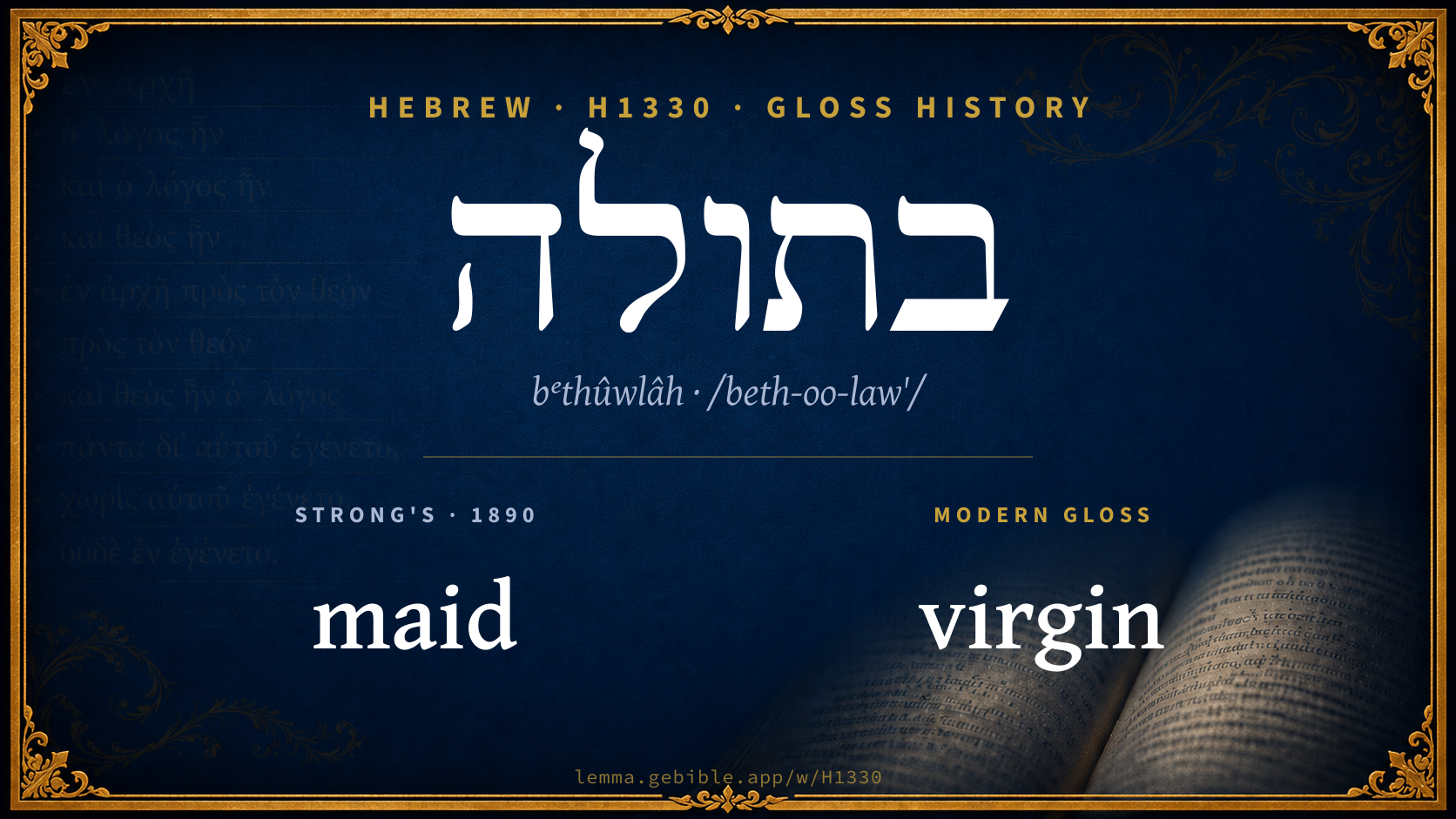
Gloss history
Strong's 1890 vs modern scholarship
About this word
Strong's H1330 catalogs a Hebrew word from the Hebrew Old Testament.
These counts are not copied from any lexicon or concordance. They are computed here, from the morphology-tagged Hebrew Old Testament. What Lemma adds →
- 50
- distinct verses
- The word appears in 50 distinct verses.
- 19 / 39
- OT books
- The word appears in 19 of 39 Old Testament books.
- #739
- by frequency
- Top 1000 most frequent Hebrew words (rank 739 of 8,640 Hebrew words by occurrence).
View all 50 occurrences in the concordance →
Most concentrated in
- Jeremiah 8 verses 16%
- Lamentations 7 verses 14%
- Isaiah 5 verses 10%
By section of the Old Testament
By traditional corpus
Conventional, traditional groupings — biblical authorship is debated, so this is a traditional corpus grouping, not an authorship claim. Each share is this word’s portion of its verses in that division of the Hebrew canon. Each figure is a share of the word’s 50 distinct verses.
- Prophets (Nevi'im) 25 verses · 50%
- Writings (Ketuvim) 16 verses · 32%
- Torah (Pentateuch) 9 verses · 18%
How translations render this word
Counts come from each version’s own published word-to-Strong’s tagging or interlinear alignment — an approximate guide to how each version renders this word, not a word-level alignment the data otherwise carries. Because each total is that version’s own tagged count, the per-version totals vary from one another and need not match the appearance or distinct-verse counts above. These counts may also differ from a printed concordance because Lemma counts each distinctly tagged rendering and does not collapse phrase taggings into a single head-word total. This is a fixed set of word-tagged versions (KJV, ASV, BSB, ULT) and does not change with the reading translation you choose elsewhere. Each version’s license is shown beside its name below (and on Sources).
- King James Version: Virgin 15×, Virgins 12×, Maid 3×
- American Standard Version: Virgin 17×, Virgins 17×, Concerning him 2×
- Berean Standard Bible: Virgin 25×, Maidens 7×, Young women 5×
- unfoldingWord Literal Text: Virgin 20×, Virgins 10×, Young women 4×
King James Version Public Domain
Renders H1330 across 50 tagged occurrences — most commonly:
Plus 11 renderings that appear only once — usually multi-word phrases or single function words the recovered tagging swept in, not distinct renderings.
American Standard Version Public Domain
Renders H1330 across 50 tagged occurrences — most commonly:
Plus 12 renderings that appear only once — usually multi-word phrases or single function words the recovered tagging swept in, not distinct renderings.
Berean Standard Bible Public Domain
Renders H1330 across 50 tagged occurrences — most commonly:
Plus 6 renderings that appear only once — usually multi-word phrases or single function words the recovered tagging swept in, not distinct renderings.
unfoldingWord Literal Text CC BY-SA 4.0
Renders H1330 across 47 tagged occurrences — most commonly:
Plus 10 renderings that appear only once — usually multi-word phrases or single function words the recovered tagging swept in, not distinct renderings.
Senses in BDB
The 1 sense BDB distinguishes for this word, in lexicon order (not ranked by frequency or importance). The full entry — with sub-senses — is in the Lexicon Entry tab.
- virgin
Word origin
n.f. virgin (cf. Arabic بَتُولٌ, بَتِيلٌ, Assyrian batultu (also batûlu of young man) 5 R 42:56 v. Jer ZA 1886, 399; NH בְּתוּלָא, ܒܬܽܘܠܴܐ )—Gn 24:16 + 19 times; cstr. בְּתוּלַת Dt 22:19 + 12 times; pl. בְּתוּלוֹת Est 2:2 + 7 times; בְּתֻלוֹת Zc 9:17; בְּתוּלֹת Ex 22:16 + 2 times; בְּתֻלֹת La 5:11; sf. בְּתוּלֹתָיו ψ 78:63 + 3 times;—one living apart in her father’s house as a virgin Gn 24:16 (J); Ex 22:15 (E); Lv 21:3, 14 (P); Dt 22:19; Ju 19:24; 2 S 13:2; Jb 31:1; Is 62:5; Je 2:32; 31:13; Jo 1:8; נערה בתולה a virgin damsel Dt 22:23, 28; Ju 21:12; 1 K 1:2; Est 2:3; בחור ובתולה Dt 32:25 2 Ch 36:17 Je 51:22 Ez 9:6; personification of nations בתולת ישׂראל Je 18:13; 31:4, 21 Am 5:2; ב׳ בת ציון 2 K 19:21 (= Is 37:22; on double st. cstr. v. Ges§ 130.5 Phi St Cstr. 63) La 2:13; ב׳ בת עמי Je 14:17; ב׳ בת יהודה La 1:15; ב׳ בת צידון Is 23:12; ב׳ בת בבל Is 47:1; ב׳ בת מצרים Je 46:11; pl. virgins Ex 22:16 2 S 13:18 Est 2:2, 17, 19 ψ 45:15; 78:63 La 1:4; 2:10; 5:11 Ez 44:22 Am 8:13; בחורים ובתולות ψ 148:12 Is 23:4 Zc 9:17 La 1:18; 2:21.
— Brown-Driver-Briggs (Oxford 1906, public domain), digitized via Sefaria, supplemented by the OpenScriptures HebrewLexicon (CC BY 4.0). See Sources.
Origin: pass. participle of an unused root meaning to separate
Jastrow Dictionary
A second Hebrew/Aramaic lexicon for comparison, covering Aramaic and post-biblical (Talmudic, Targumic, Midrashic) usage that the biblical-Hebrew BDB does not. Matched by lemma rather than by Strong’s number, so a lemma may carry more than one Jastrow headword (shown separately below), and the entries cover usage well beyond the Bible.
בְּתוּלָה
- [retired, untouched,]
- 1. virgin. — Pl. בְּתוּלוֹת. Tosef. Shebi. III, 14 sq. שלש ב׳ הן b’thulah is used in three ways, בְּתוּלַת אדם וכ׳ of a human being (virgin), of soil (unbroken), and of sycamores (untrimmed); Nidd. 8ᵇ; Y. ib. I, 49ᵃ. Yeb. 61ᵇ אין ב׳ אלא נערה under b’thulah (in a legal sense) a girl between twelve and twelve and a half years is meant, v. בַּגְרוּת. Ohol. XVI, 4 עד שמגיע … לב׳ until he reaches a rock or unbroken ground. Sabb. 90ᵃ בתולת הוורד a closed rose (Var. quot. in Ar., a. Ms. O. פְּתִילַת). Y. Sot. III, 19ᵃ ב׳ ציימנית an ascetic maid (retired from social pleasures); Sot. 22ᵃ (צליינית) ב׳ ציילנית a prayerful (bigoted) maid; a. fr.
- 2. (only in pl.) the two posts supporting the beam in the wine-press (Lat. gemelli, sorores). B. Bath. IV, 5 (67ᵇ), expl. כלונסות.
- 3. Virgo, sign of the Zodiac. Yalk. Ex. 418. Ib. I Kings 185. Pesik. R. s. 20.
A Dictionary of the Targumim, the Talmud Babli and Yerushalmi, and the Midrashic Literature (Marcus Jastrow; London, Luzac, 1903) — Public Domain. Digitized via Sefaria. Digitized via Sefaria. Full attribution on Sources.
Forms in the corpus
The 35 distinct written forms H1330 takes in the Hebrew Bible, most frequent first — each parse links to that state’s occurrences in the concordance. Hebrew forms include their vowel points and cantillation, so a single lemma takes many written forms.
Same root — word family
Other BDB entries built from the same root as H1330, grouped by Strong’s listed origin. These share a root / origin per the lexicon — not necessarily a shared meaning. Each links to that word’s own entry.
Derived from this word
Compare all same-root words → They share a root, not necessarily a meaning.
Septuagint verse parallels
This word appears in 47 verses that also exist in the Greek Old Testament (Septuagint), out of the 50 Hebrew verses it occurs in. You can read those verses in Greek by switching the Old Testament edition to the Septuagint.
Read these verses in the Septuagint
- Genesis 24:16
- Exodus 22:16
- Leviticus 21:3
- Deuteronomy 22:19
- Judges 19:24
- 2 Samuel 13:2
- 1 Kings 1:2
- 2 Kings 19:21
- 2 Chronicles 36:17
- Esther 2:2
- Job 31:1
- Psalms 148:12
This is a verse-level parallel only — the same verses exist in both the Hebrew and Greek Old Testaments. No word-level Hebrew↔Greek correspondence is claimed: the data carries no such alignment, so no Greek word is shown as this Hebrew word’s translation. Coverage is not total — the Septuagint omits the deuterocanon and renumbers the Psalms, so some Hebrew verses have no direct Greek parallel.