Psalms 45:14

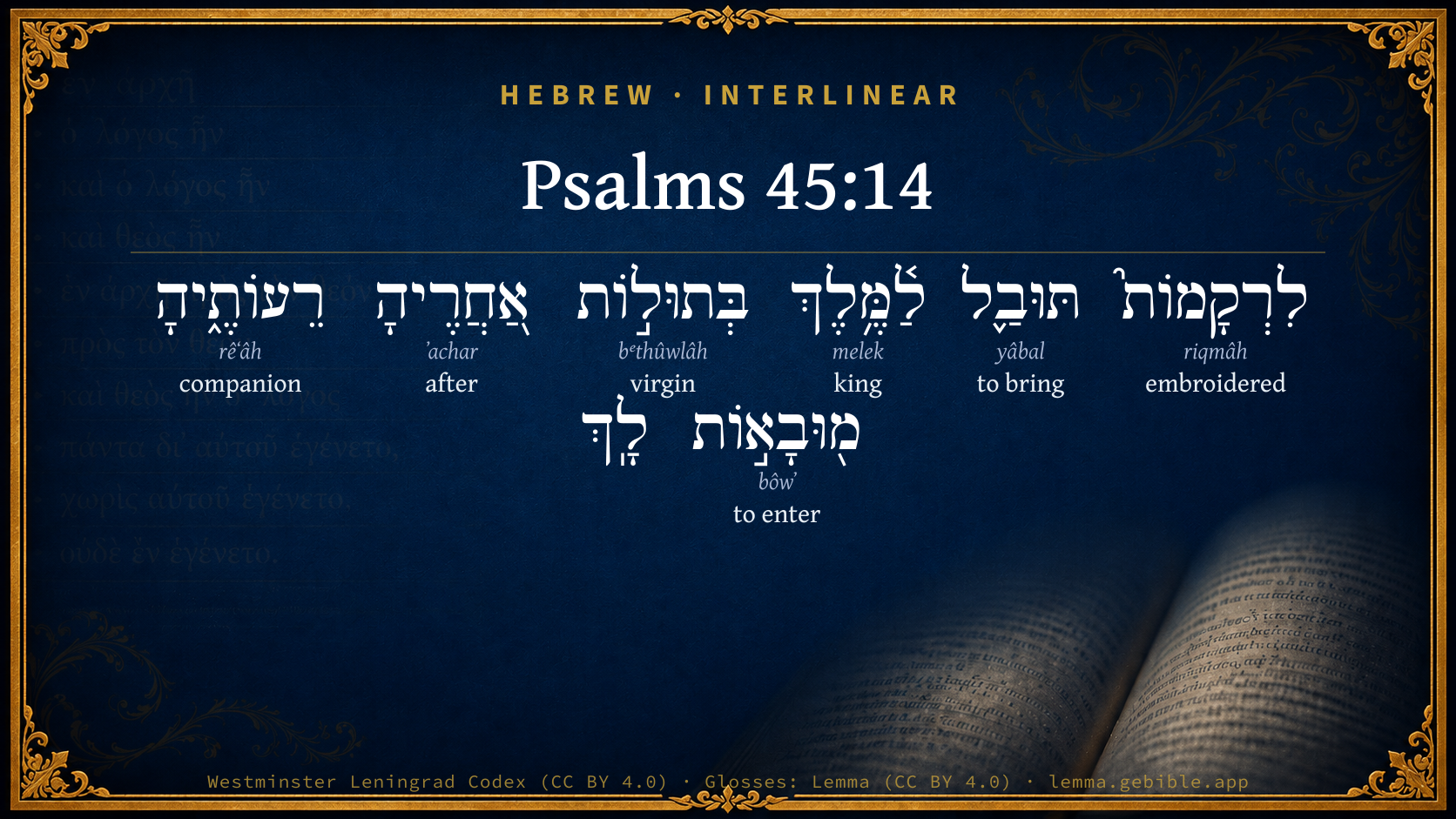
Hebrew (Westminster Leningrad Codex) Psalms 45:14 appears in the Hebrew Old Testament. The text above is from the Westminster Leningrad Codex. Each word links to its Strong’s number, a concise gloss, and parsing drawn from the Open Scriptures Hebrew Bible morphology. Click any word for its full Brown-Driver-Briggs (BDB) entry.
Download image
Cite this verse

Psalms 45:14 (World English Bible). Public Domain. Lemma interlinear Bible study tool, https://lemma.gebible.app/v/psalms/45/14.

Show BibTeX & RIS
BibTeX
RIS
English Translation
She shall be led to the king in embroidered work. The virgins, her companions who follow her, shall be brought to you.
World English Bible · Public Domain
Download a study sheet

One document with this verse’s original text, its word-by-word gloss line, the meaning frame, cross-references with their text, attributed commentary, and full source and license credits — printable, and it pastes into notes with its structure intact.

This verse Autodidact and up

Study sheet (.html) Plain text (.txt)

A passage Seminary Student

Up to 50 verses in one chapter. A passage sheet keeps up to 6 commentary sources and 12 cross-references per verse, in the order this page ranks them, and says so on the sheet whenever that leaves anything out. Ask for a single verse and you get the Autodidact verse sheet above.

Everything on this page stays free to read, with no account — the sheet is a download of what is already on screen, not access to it.

Want to remove ads? Support Godless Engineer
Compare translations 3

The same verse in 3 English versions, stacked beneath the original-language interlinear above. Click any original word for its lexicon entry.

Each is an independent rendering of the whole verse — the interlinear is not word-aligned to these translations.

Highlighted words mark where these versions differ — a whole-verse word diff, not a word-by-word alignment.

  • World English Bible Public Domain
    She shall be led to the king in embroidered work. The virgins, her companions who follow her, shall be brought to you.
  • King James Version Public Domain
    She shall be brought unto the king in raiment of needlework: the virgins her companions that follow her shall be brought unto thee.
  • unfoldingWord Literal Text CC BY-SA 4.0
    She will be led to the king in embroidery. The virgins after her, her companions, will be brought to you.

unfoldingWord Literal Text — © unfoldingWord, licensed CC BY-SA 4.0. Word-aligned USFM3 via Door43 (git.door43.org/unfoldingWord/en_ult).

Versions to compare (up to 4)

3 of 4 selected

Show all 18 translations

Every available English version of this verse, each an independent rendering of the whole verse.

  • World English Bible Public Domain
    She shall be led to the king in embroidered work. The virgins, her companions who follow her, shall be brought to you.
  • Berean Standard Bible Public Domain
    In colorful garments she is led to the king; her virgin companions are brought before you.
  • Majority Standard Bible Public Domain
    In colorful garments she is led to the king; her virgin companions are brought before you.
  • King James Version Public Domain
    She shall be brought unto the king in raiment of needlework: the virgins her companions that follow her shall be brought unto thee.
  • American Standard Version (1901) Public Domain
    She shall be led unto the king in broidered work: The virgins her companions that follow her Shall be brought unto thee.
  • Revised Version (1885) Public Domain
    She shall be led unto the king in broidered work: the virgins her companions that follow her shall be brought unto thee.
  • Geneva Bible (1599) Public Domain
    She shalbe brought vnto the King in raiment of needle worke: the virgins that follow after her, and her companions shall be brought vnto thee.
  • Douay-Rheims (1899) Public Domain
    All the glory of the king's daughter is within in golden borders,
  • Young's Literal Translation Public Domain
    In divers colours she is brought to the king, Virgins -- after her -- her companions, Are brought to thee.
  • Literal Standard Version CC BY-SA 4.0
    In various colors she is brought to the King; Afterward, virgins, her companions, || Are brought to You.
  • Unlocked Literal Bible CC BY-SA 4.0
    She will be led to the king in embroidered dress; the virgins, her companions who follow her, will be brought to you.
  • unfoldingWord Literal Text CC BY-SA 4.0
    She will be led to the king in embroidery. The virgins after her, her companions, will be brought to you.
  • Darby Bible Public Domain
    She shall be brought unto the king in raiment of embroidery; the virgins behind her, her companions, shall be brought in unto thee:
  • World Messianic Bible Public Domain
    She shall be led to the king in embroidered work. The virgins, her companions who follow her, shall be brought to you.
  • Webster's Bible Public Domain
    \\45:13\\The king's daughter is all glorious within: her clothing is of wrought gold.
  • Free Bible Version CC BY-SA 4.0
    Wearing her beautiful clothes she is brought to the king, followed by her bridesmaids.
  • Bible in Basic English Public Domain
    She will come before the king in robes of needlework; the virgins in her train will come before you.
  • JPS Tanakh (1917) Public Domain
    (45-15) She shall be led unto the king on richly woven stuff; the virgins her companions in her train being brought unto thee.

Literal Standard Version (2020), Covenant Press — licensed CC BY-SA 4.0. Text via the HelloAO Bible API (eBible.org). Unlocked Literal Bible (unfoldingWord) — licensed CC BY-SA 4.0. Text via the HelloAO Bible API (eBible.org). unfoldingWord Literal Text — © unfoldingWord, licensed CC BY-SA 4.0. Word-aligned USFM3 via Door43 (git.door43.org/unfoldingWord/en_ult). Free Bible Version, Dr. Jonathan Gallagher — licensed CC BY-SA 4.0. Text via the HelloAO Bible API (eBible.org).

Word by word

More ways to search: Search by grammar → Find every occurrence → Compare this word →

Practice this passage: Drill this verse → Learn its vocabulary →

About this verse

These counts appear in no published source. They are computed here, from the morphology-tagged text and Lemma’s own curated glosses. What Lemma adds →

8
words
7
distinct lemmas
Wisdom
section

Notable vocabulary

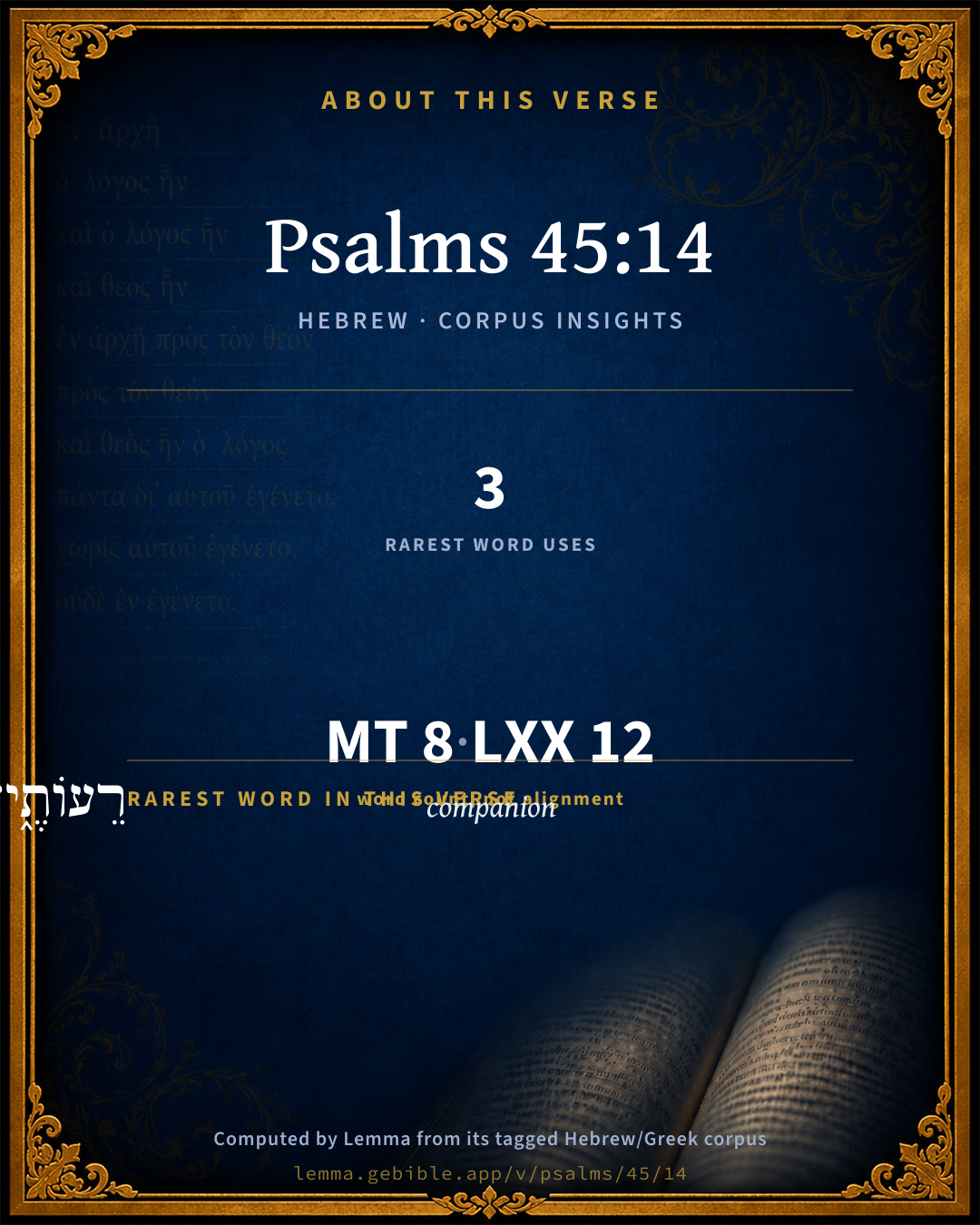
The rarest word here is רֵעוֹתֶ֑יהָ companion H7464 — appearing just 3 times in the whole Hebrew Bible.

Shared distinctive vocabulary

רֵעוֹתֶ֑יהָ companion H7464 occurs in 3 verses of the Hebrew Bible. Also found in:

Grammatical profile

  • 2 verbs
  • 4 nouns
  • 2 prepositions

Verb forms

  • תּוּבַ֪ל Hophal · Imperfect
  • מ֖וּבָא֣וֹת Hophal · Participle Passive

Hebrew & Septuagint length

In English translation the verse runs 22 words from the Hebrew and 19 from the Septuagint (LXX English) — closely comparable.

A rough comparison of the two English renderings, which tokenize alike — not a word-level alignment.

Word counts can differ between the Hebrew and the Greek without any difference in meaning — e.g. the Hebrew direct-object marker אֵת has no separate Greek word, and Greek often adds the article ὁ.

In the original languages it is 8 Hebrew tokens and 12 Greek tokens — but the two are counted differently (Hebrew bundles its prefixes and suffixes into one token; the Greek is in lemma form), so that isn’t a like-for-like length.

Cross-references

12

Topical passages linked to Psalms 45:14 in the Treasury of Scripture Knowledge — connected by theme and wording, ordered by reader-vote popularity; previews shown in the World English Bible.

  • Song of Solomon 8:13 You who dwell in the gardens, with friends in attendance, Let me hear your voice! Beloved
  • 2 Corinthians 11:2 For I am jealous over you with a godly jealousy. For I married you to one husband, that I might present you as a pure virgin to Christ.
  • Exodus 28:39 You shall weave the coat in checker work of fine linen, and you shall make a turban of fine linen, and you shall make a sash, the work of the embroiderer.
  • Song of Solomon 1:3–5 Your oils have a pleasing fragrance. Your name is oil poured forth, Therefore the virgins love you.
  • Song of Solomon 2:7 I adjure you, daughters of Jerusalem, By the roes, or by the hinds of the field, That you not stir up, nor awaken love, Until it so desires.
  • Song of Solomon 6:1 Where has your beloved gone, you fairest among women? Where has your beloved turned, that we may seek him with you? Beloved
  • Song of Solomon 6:8 There are sixty queens, eighty concubines, And virgins without number.
  • Song of Solomon 6:13 Return, return, Shulammite! Return, return, that we may gaze at you. Lover Why do you desire to gaze at the Shulammite, As at the dance of Mahanaim?
  • Judges 5:30 Have they not found, have they not divided the spoil? A lady, two ladies to every man; To Sisera a spoil of dyed garments, A spoil of dyed garments embroidered, Of dyed garments embroidered on both sides, on the necks of the spoil?
  • Song of Solomon 5:8–9 I adjure you, daughters of Jerusalem, If you find my beloved, That you tell him that I am faint with love. Friends
  • John 17:24 Father, I desire that they also whom you have given me be with me where I am, that they may see my glory, which you have given me, for you loved me before the foundation of the world.
  • Revelation 14:1–4 I saw, and behold, the Lamb standing on Mount Zion, and with him a number, one hundred forty-four thousand, having his name, and the name of his Father, written on their foreheads.

Cross-references courtesy of OpenBible.info (CC BY 4.0).

Hebrew and Greek witnesses Masoretic Hebrew ↔ Greek Septuagint

The same verse in the two great witnesses to the Old Testament, shown verse-for-verse.

You’re reading Greek Psalm 44 (Hebrew Psalm 45). The Septuagint counts the superscription, so verse numbers can differ from the Hebrew — chapter-level alignment, not verse-by-verse. Numbering follows Rahlfs.

These are two independent witnesses, not word-aligned to each other, and the Septuagint is shown in lemma (dictionary) form.

Hebrew Psalms 45:14 Masoretic · Westminster Leningrad Codex

לִרְקָמוֹת֮ תּוּבַ֪ל לַ֫מֶּ֥לֶךְ בְּתוּל֣וֹת אַ֭חֲרֶיהָ רֵעוֹתֶ֑יהָ מ֖וּבָא֣וֹת לָֽךְ

She shall be led to the king in embroidered work. The virgins, her companions who follow her, shall be brought to you.

World English Bible · Public Domain

Greek LXX Greek Psalm 44:14 Septuagint · lemma form

πᾶς ὁ δόξα αὐτός θυγάτηρ βασιλεύς ἔσωθεν ἐν κροσσωτός χρυσοῦς περιβάλλω ποικίλλω

in embroidered clothing: virgins shall be brought to the king after her: her fellows shall be brought to you.

LXX2012 (modern English Septuagint) · Public Domain

Hebrew: Westminster Leningrad Codex (CC BY 4.0). Greek: Septuagint (public domain); English from LXX2012 (modern English Septuagint) (Public Domain). How the Septuagint differs from the Hebrew →

Commentary

Notes on Psalms 45:14 from classic Christian and Jewish commentators (each source and its license shown beneath its notes). The classic Christian expositions comment on the surrounding passage and are grouped to its opening verse, so a note may address several verses; the Jewish commentaries on the Tanakh (Rashi and others) are per-verse, so they appear only where the commentator wrote on this verse.

Lemma curates 59 commentaries, every one of them public domain or Creative Commons licensed, each selected and text-cleaned for this edition rather than reprinted as found. About our sources →

Trapp's Complete Commentary

John Trapp

Psa 45:14 She shall be brought unto the king in raiment of needlework: the virgins her companions that follow her shall be brought unto thee.

Ver. 14. She shall be brought] {See Trapp on "Psa 45:13"} she shall be presented to Christ a glorious Church, not having spot, wrinkle, or any such thing, Eph 5:27 Rev 21:2.

John Trapp, A Commentary or Exposition upon All the Books of the Old and New Testament (1647–1656) — public domain. Text from a community e-Sword module.

Joseph Benson's Commentary

Psa 45:14-15. She shall be brought unto the king — He alludes to the custom of conducting the bride to the bridegroom’s house; in raiment of needlework — The image of God, the divine nature, the robe of righteousness, the garment of salvation. The virgins, her companions — Her bride-maidens, attending upon her, called the honourable women, Psa 45:9. (where see the note,) and here virgins, because of their spiritual purity and chastity, 2Co 11:2. With gladness and rejoicing shall they be brought — Full of joy, for the glory and felicity of the bride and bridegroom, and for the comfort and benefit which redound to themselves therefrom.

Joseph Benson's Commentary on the Old and New Testaments (1811–1818) — public domain. Text from a community e-Sword module.

J. A. Alexander on Psalms

Joseph Addison Alexander

15. (Psa 45:14). With (or on) variegated cloths shall she be conducted to the king; virgins behind her, her companions, brought unto thee. The lively picture of an oriental wedding is now completed by a view of the procession to the bridegroom's house. The customary train of female friends is not forgotten, but with this peculiar feature added, that the bridesmaids are themselves described as brides, being brought (or made to come) to the king, precisely as the queen was. This departure from the usages of real life, which would have been revolting in a mere epithalamium, is peculiarly appropriate to the design of the allegory, as it enables the writer to include in his description a striking figurative representation of the eventful accession of the Gentiles to the spiritual privileges and prerogatives which for ages were confined to Israel. The ancient church or peculiar people is the chief bride or queen of the Messiah, chosen from among the nations; but these very nations are the virgins, her companions, not her servants or attendants merely, who are brought to the king afterwards as she was brought before, to be united with him in an honourable marriage, not as the inferiors but the equals of his first and chosen consort. The noun at the beginning of the verse has been variously explained as meaning needle work, embroidery, and variegated stuffs; but the essential idea is sufficiently clear, to wit, that of rich and highly ornamented fabrics. As the dress ofthe bride has been twice described already, in Psa 45:10; Psa 45:14 (9, 13), some suppose that these words have allusion to the practice of spreading rich and costly cloths or carpets on the ground where royal personages walk. (Compare Mat 11:8.) Others refer the clause to the embroidered coverings of the nuptial couch. The preposition here used is the one denoting relation in the most indefinite manner, and may be translated in, upon, or to, according to these different hypotheses respectively. See above, on Psa 30:2 (1), Psa 35:19; Psa 35:24; Psa 38:17 (16). Conducted, or escorted in procession, as the Hebrew word denotes, being applied both to nuptial and funeral pomps. Compare Job 10:19; Job 21:32. The king is first mentioned in the third person, and then in the second, by which insensible transition the way is prepared for the direct address with which the psalm concludes, although the third person is resumed for a moment in the next verse.

Joseph Addison Alexander, The Psalms Translated and Explained (1850) — public domain. Text from a community e-Sword module.

Jamieson, Fausset & Brown

Robert Jamieson, A. R. Fausset & David Brown

The progress of the procession is described; according to the usual custom the bride and attendants are conducted to the palace. Some for the words--

in raiment of needlework--propose another rendering, "on variegated (or embroidered) cloths"--that is, in the manner of the East, richly wrought tapestry was spread on the ground, on which the bride walked. As the dress had been already mentioned, this seems to be a probable translation.

Jamieson, Fausset & Brown — Commentary Critical and Explanatory on the Whole Bible (1871) — public domain (CC PDM 1.0). Text via the HelloAO Bible API.

Adam Clarke's Commentary

Verse 14. She shall be brought unto the king] When an Asiatic princess is brought to her spouse, she is inclosed in a palakee, and no part of her person is visible. She is attended by her principal friends and companions, who follow the palakee, and the ceremony is accompanied with great rejoicing; and thus they enter into the palace of the king.

This part of this parabolical Psalm may refer to the glories of a future state. The Christian Church shall be brought to the KING eternal in the great day, adorned with the graces of the Divine Spirit; and thus shall all the redeemed of the Lord enter into the king's palace - into the everlasting joy of their Lord.

Adam Clarke's Commentary on the Bible (1810–1826) — public domain. Text from a community e-Sword/MySword module.

Ellicott's Commentary for English Readers

(14) In raiment of needlework.—This is now more generally understood of rich tapestry carpets spread for the procession. (Comp. Æsch. Agam. 908-910.)

A Bible Commentary for English Readers, edited by Charles John Ellicott (1878–1897) — public domain. Text from a community e-Sword module.

The Cambridge Bible for Schools and Colleges

gen. ed. J. J. S. Perowne

14. In raiment of embroidery shall she be conducted to the king, in solemn and stately procession, accompanied by a train of attendants such as befits a king’s daughter. Cp. Est_2:9. For mention of embroidery cp. Exo_28:39; Jdg_5:30; &c. Other but less probable renderings are, on tapestry or carpets of divers colours, or, into tapestry-curtained chambers.

The Cambridge Bible for Schools and Colleges (gen. ed. J. J. S. Perowne; Cambridge University Press, 1878–1918) — public domain. Text from a community e-Sword module.

John Gill's Exposition

She shall be brought unto the King in raiment of needlework,.... Not in her sins, and trader the sense and guilt of them; as souls are brought to Christ, at first conversion, under the drawings of the Father's grace; nor in the rags of her own righteousness; but in the robe of righteousness, and garments of salvation, the change of raiment Christ has put upon her, having before this caused her iniquities to pass from her; or in the shining robes of immortality and glory: for this introduction of the church to Christ, her King, Head, and Husband, will be upon the first resurrection; when she being as a bride adorned and prepared for her husband, will be brought unto him, and presented to him by himself, a glorious church, without spot or wrinkle, or any such thing: and she will be introduced, either by the angels, who will be employed in gathering the elect from the four winds; or by the ministers of the Gospel, who, at the general harvest, in the end of the world will bring their sheaves with them; those souls they have been the instruments of converting, comforting, and ripening for glory; who will be their joy and crown of rejoicing then; these will be brought in several companies, which joining together, will make up the general assembly and church of the firstborn, that will then be presented to Christ: or by Jehovah the Father, who, as he brought Eve to Adam, when he had formed her of his rib, and had prepared her as a helpmeet for him; so when all the elect of God are formed by divine grace, and are prepared as a bride for the bridegroom, he will then bring them unto him, and they shall be with him where he is, and behold his glory; which is what he prays his father for, Joh 17:24;

the virgins her companions that follow her shall be brought unto thee; such who are betrothed as chaste virgins to Christ, who strictly and chastely adhere unto him, love him in the singleness of their hearts; are incorrupt in faith and worship, and of pure and upright conversations; see Rev 14:4; these are the "companions" of the church, who are partakers of the same grace, enjoy the same privileges, and share in the common salvation; and, as they are partners together in sufferings, they will be in glory: these "follow" the footsteps of the flock, walk after the church in the path of doctrine and duty; are followers of her, as she is of the Lord, in the word and ordinances, and in the exercise of faith and patience; these, even everyone, shall be brought unto the King, not one shall be lost, or left behind: whither they shall be brought, and the manner in which, are expressed in Psa 45:15.

John Gill's Exposition of the Whole Bible (1746–1763) — public domain (CC PDM 1.0). Text via the HelloAO Bible API.

Albert Barnes' Notes on the Bible

She shall be brought unto the king - She shall be conducted to the king in the marriage procession, and be presented to him, clad in this magnificent raiment. The entire imagery is that of an Oriental marriage procession, where the bride is conducted forth to her future husband, attended by her virgin companions, or (as we should say) “bridesmaids.”

In raiment of needlework - The word used here means properly “something variegated” or “versicolored,” and would here denote a garment of divers colors, or “versicolored raiment.” The word - רקמה riqmâh - occurs in the following places: Jdg 5:30, twice, where (as here) it is rendered “needlework;” 1Ch 29:2; Eze 17:3, rendered “divers colors;” and Eze 16:10, Eze 16:13, Eze 16:18; Eze 26:16; Eze 27:7, Eze 27:16, Eze 27:24, where it is rendered “broidered work.” It has reference probably to embroidery or needlework, though the particular idea is rather that of the variegated “appearance” of the garment than to the manner in which it is made.

The virgins her companions that follow her shall be brought unto thee - literally, “virgins after her, her companions, brought unto thee.” That is, they will be brought to the king. They will come in the same state as the queen herself; they, her companions, will be of so illustrious rank and birth, and apparelled with so much richness, that even “they” will be regarded as worthy to be treated as queens, or in the manner of queens. The design of the whole is to show the rank, the dignity, the splendor of the bride; herself gorgeously apparelled, and attended with companions so exalted as to he worthy of being treated as queens themselves. If this is to be regarded as applicable to the church, “the Lamb’s wife” Rev 21:9, it is designed to describe that church as beautiful and glorious, and as worthy of the affection of its Saviour. Compare Eph 5:27.

Albert Barnes' Notes on the Bible (1834–1885) — public domain. Text from a community e-Sword/MySword module.

Matthew Poole's English Annotations

He alludes to the custom of conducting the bride to the bridegroom’s house.

Her companions, i.e. her bridemaidens attending upon her, called her honourable women, Psa 45:9, See Poole "Psa 45:9", and here

virgins, because of their spiritual purity and chastity, 2Co 11:2.

Matthew Poole's English Annotations on the Holy Bible (1683–1685) — public domain. Text from a community e-Sword/MySword module.

The Treasury of David

Charles H. Spurgeon

Ver. 14. She shall be brought unto the king in raiment of needlework. The day comes when the celestial marriage shall be openly celebrated, and these words describe the nuptial procession wherein the queen is brought to her royal Husband attended by her handmaidens. In the latter-day glory, and in the consummation of all things, the glory of the bride, the Lamb's wife, shall be seen by all the universe with admiration. While she was within doors, and her saints hidden ones, the church was glorious; what will be her splendour when she shall appear in the likeness of her Lord in the day of his manifestation? The finest embroidery is but a faint image of the perfection of the church when sanctified by the Spirit. This verse tells us of the ultimate rest of the churchthe King's own bosom; of the way she comes to it, she is brought by the power of sovereign grace; of the time when this is donein the future, she shall be, it does not yet appear; of the state in which she shall comeclad in richest array, and attended by brightest spirits. The virgins her companions that follow her shall be brought unto thee. Those who love and serve the church for her Lord's sake shall share in her bliss "in that day." In one sense they are a part of the church, but for the sake of the imagery they are represented as maids of honour; and, though the figure may seem incongruous, they are represented as brought to the King with the same loving familiarity as the bride, because the true servants of the church are of the church, and partake in all her happiness. Note that those who are admitted to everlasting communion with Christ, are pure in heartvirgins, pure in companyher companions, pure in walkthat follow her. Let none hope to be brought into heaven at last who are not purified now.

Ver. 14. The virgins, her companions that follow her, shall be brought unto thee. The highest and most excellent Christian cannot say, I have no need of thee: the queen will not be without any of her true companions. As it is in the body natural, so it is in the church of Christ, or body mystical; all the members being fitly joined together and compacted by that which every joint supplieth, according to the effectual working in the measure of every part, maketh increase of the body to the edifying of itself in love. Eph 4:16 Col 2:19. William Troughton.

Ver. 14. The virgins her companions that follow her. These are members of the church, but the figure of a bridal train is employed to sustain the allegory. What bright train the Royal Bride will have as she goes forth to meet the Bridegroom! King's daughters will be there, for every crowned head on earth shall one day bow at the foot of the cross. The daughter of Tyre shall be thereTyre, the ancient emporium of the nationsto show that the merchandise of the world shall be holiness from the Lord. The kings of Sheba and Seba shall offer gifts. Jews and Gentiles will be there representatives from all peoples, and tongues, and nations. They are virgins. They keep themselves unspotted from the world. They are weaned from its idols; they dread its contaminations. Their first care is to preserve the whiteness of their souls by daily washing in the blood of the Lamb...They follow the royal Bride. They keep by her side in storm and sunshine. They follow her in the regeneration. They follow her in the search after her Beloved. So 3:2-3. They follow her to the green pastures and the still waters. They follow her without the camp bearing his reproach. Like Ruth, they leave father and mother to follow her. Ru 1:16. Like Caleb, they follow the Lord fully. When a crisis comes, and the question, "Who is on the Lord's side?" involves heavy issues, and hollow hearted professors fly away like swallows before the storm, they follow her. When persecution comes, and Christ's faithful witnesses have to prophesy clothed in sackcloth, and perhaps to pass through a baptism of blood to the crown, they follow her: like Peden, whenthe bloodhounds of persecution in full chase after him, and the lone moor his homehe thought of Richard Cameron gone to glory, and sighed "Oh, to be with Richie!" Duncan Macgregor, M.A., in "The Shepherd of Israel; or, Illustrations of the Inner Life, "1869.

Ver. 14.

1. The presentation of the church to Christ.

1. When souls are first brought to him"I have espoused you as, "etc.

2. When they come before him at death.

3. When the perfected church is presented to him "That he might present it, "etc.

2. The manner of presentation

1. "In raiment, "etc., such as he himself wrought out.

2. With all her followers. (a) Their purity"virgins." (b) their fellowship"companions." (c) Their succession"that follow thee, "from one age to another until they are complete. G.R.

Psalms 45:15*

Charles H. Spurgeon's The Treasury of David (1869–1885) — public domain. Psalms only. Text from a community e-Sword/MySword module.

Whedon's Commentary on the Bible

Daniel D. Whedon

14, 15. Having described (Psa_45:13) the splendour of the “king’s daughter,” in her private chamber as one attired for the marriage, the psalmist now proceeds to the ceremony of escorting her to the king’s palace, or more probably to her own house, which Solomon had prepared with such unwonted taste. The imagery is intensely Oriental. See Est_2:15; Solomon’s Son_1:4. On the allegorical interpretation of the “bride” and her attire, which at once symbolizes the richness and purity of the Church, see Rev_19:7; Rev_21:2; Rev_21:9. Compare Isa_45:5; Isa_61:10; 2Co_11:2; Eph_5:23-27

Daniel D. Whedon (gen. ed.), Commentary on the Old and New Testaments (1874–1909) — public domain. Text from a community e-Sword module.

The Pulpit Commentary

She shall be brought unto the King in raiment of needlework; i.e. in garments richly embroidered. Such were known to the Hebrews from the time of the Exodus, (Exo_28:4, Exo_28:39) and were worn by princesses in David"s day. (2Sa_13:18) Brides were commonly "led" into the presence of the bridegroom. The virgins her companions that follow her shall be brought unto thee (comp. ver. 9). A virgin train follows the bride as she is led to the palace of the bridegroom, for a royal bride necessarily had her attendants. These symbolize the Gentile converts that should attach themselves to the original Church, and follow that Church into Christ"s presence.

The Pulpit Commentary (1880–1919), ed. H.D.M. Spence-Jones & Joseph S. Exell — public domain. Text from a community e-Sword module.

John Wesley's Explanatory Notes

Brought - He alludes to the custom of conducting the bride to the bride-groom's house. Companions - Her bride-maidens attending upon her.

John Wesley, Explanatory Notes Upon the Whole Bible (1754–1765) — public domain. Text via the GEBible commentary corpus.

unfoldingWord translationNotes

Door43 World Missions Community

General Information:

The author continues to speak about the queen but begins to address the king again.

She will be led to the king in embroidered dress

This can be stated in active form. AT: "People will lead her to the king as she wears an embroidered dress" (See: Active or Passive)

embroidered

a design made by sewing colored threads into cloth

the virgins, her companions who follow her, will be brought to you

Here the word "you" refers to the king. This can be stated in active form. AT: "people will bring to you the virgins, her companions who follow her" (See: Active or Passive)

They will be led by gladness and rejoicing

This phrase describes "gladness and rejoicing" as a person who leads others to celebrate. This can be stated in active form. AT: "Gladness and rejoicing will lead them" or "They will proceed with gladness and rejoicing" (See: Personification and Active or Passive)

gladness and rejoicing

These two words mean basically the same thing and emphasize the intensity of gladness. AT: "great gladness" (See: Doublet)

translationWords

virgin

companion

joy

unfoldingWord translationNotes — © Distant Shores Media and the Door43 World Missions Community, licensed CC BY-SA 4.0. Source: git.door43.org/Door43/en_tn.

Rashi

Rabbi Shlomo Yitzchaki (Rashi)

All honor [awaits] the King’s daughter who is within, etc. Those who deserve all honor, and they are the nation of the King, who behaved with modesty now their garments will be more esteemed than the settings of gold of the High Priests. משבצוֹת is chatons in French, settings.

Rashi on the Tanakh — English translations: “The Judaica Press complete Tanach with Rashi, translated by A. J. Rosenberg” (CC BY 4.0); “Pentateuch with Rashi's commentary by M. Rosenbaum and A.M. Silbermann, 1929-1934” (public domain); “The Metsudah Tanach series, Lakewood, N.J” (CC BY 4.0); and “The Book of Joshua, Metsudah Publications, 1997” (CC BY 4.0). Text via Sefaria.

Lesson kit

Teaching starters — assembled from the data on this page, not authored interpretation. Every prompt links to the verse data it draws on. Edit before teaching.

Psalms, in the Wisdom, opens this verse with 8 words (7 distinct Hebrew lemmas). Its most distinctive word is rêʻâh (“companion”). A historical commentator’s framing appears above. Read the whole chapter for the surrounding context.

Discussion questions

  1. The word rêʻâh carries the sense “companion.” How does it shape the verse?
  2. Judges 11:37 shares the word «companion» with this verse. How do the two illuminate each other?
  3. These translations render this verse differently. What is at stake in choosing one wording over another?
  4. The verb «תּוּבַ֪ל» is Hophal Imperfect. How does its form color the action?
  5. Reading how Trapp's Complete Commentary and Joseph Benson's Commentary read this verse, where do the two commentators agree and where do they part?

Things to notice

Reading settings

Reading text

Shown beneath each verse's original-language words.

Old Testament
Old Testament edition

Read the OT as the Masoretic Hebrew (MT) or the Greek Septuagint (LXX).

English shown for the Greek Septuagint (in the Hebrew ↔ Greek comparison).

Comparing translations? Open the Compare panel on any verse page to stack up to four side by side.