Jeremiah 31:4

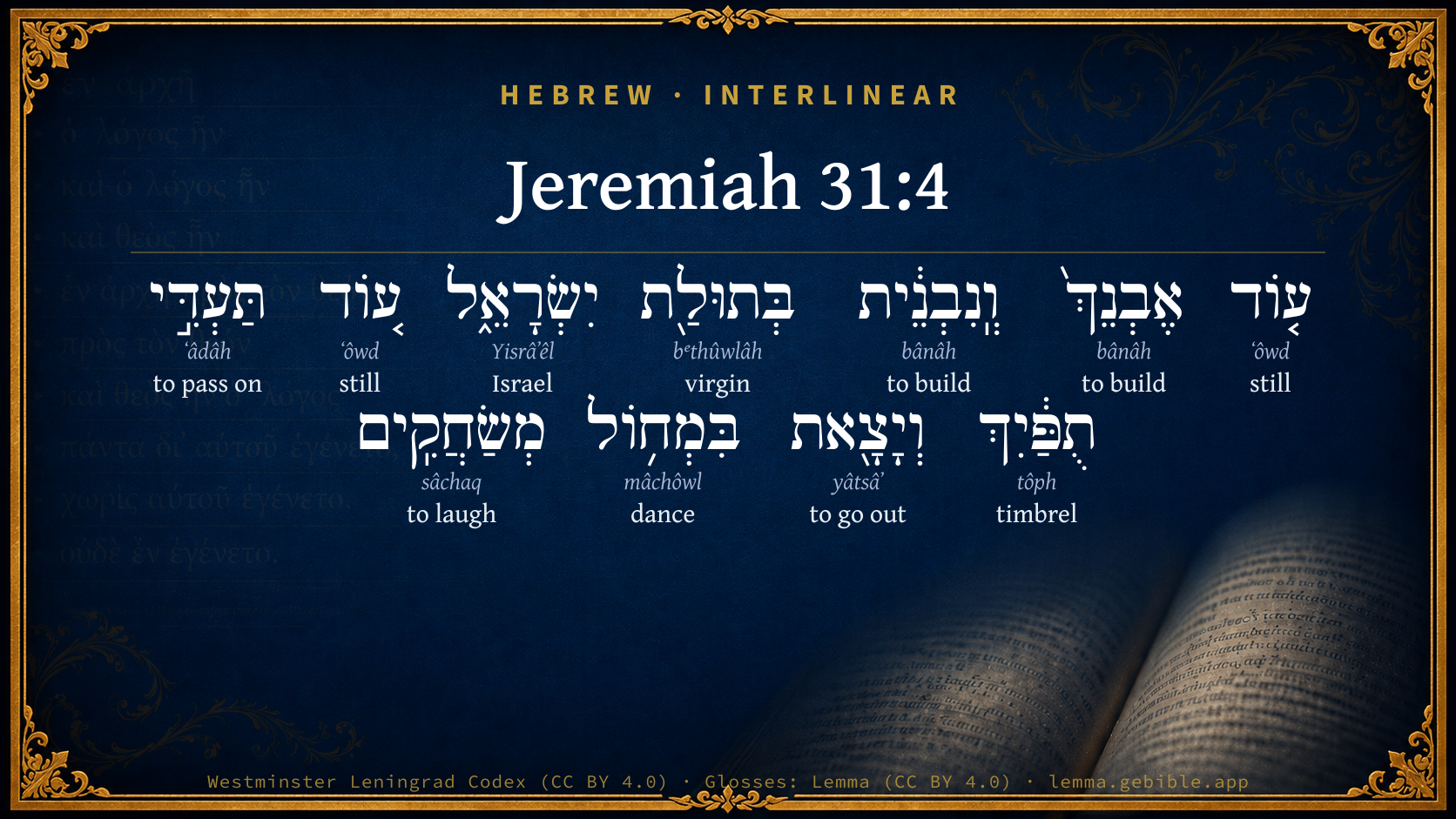
Hebrew (Westminster Leningrad Codex) Jeremiah 31:4 appears in the Hebrew Old Testament. The text above is from the Westminster Leningrad Codex. Each word links to its Strong’s number, a concise gloss, and parsing drawn from the Open Scriptures Hebrew Bible morphology. Click any word for its full Brown-Driver-Briggs (BDB) entry.
Download image
Cite this verse

Jeremiah 31:4 (World English Bible). Public Domain. Lemma interlinear Bible study tool, https://lemma.gebible.app/v/jeremiah/31/4.

Show BibTeX & RIS
BibTeX
RIS
English Translation
Again will I build you, and you shall be built, O virgin of Israel: again shall you be adorned with your tambourines, and shall go forth in the dances of those who make merry.
World English Bible · Public Domain
Download a study sheet

One document with this verse’s original text, its word-by-word gloss line, the meaning frame, cross-references with their text, attributed commentary, and full source and license credits — printable, and it pastes into notes with its structure intact.

This verse Autodidact and up

Study sheet (.html) Plain text (.txt)

A passage Seminary Student

Up to 50 verses in one chapter. A passage sheet keeps up to 6 commentary sources and 12 cross-references per verse, in the order this page ranks them, and says so on the sheet whenever that leaves anything out. Ask for a single verse and you get the Autodidact verse sheet above.

Everything on this page stays free to read, with no account — the sheet is a download of what is already on screen, not access to it.

Want to remove ads? Support Godless Engineer
Compare translations 3

The same verse in 3 English versions, stacked beneath the original-language interlinear above. Click any original word for its lexicon entry.

Each is an independent rendering of the whole verse — the interlinear is not word-aligned to these translations.

Highlighted words mark where these versions differ — a whole-verse word diff, not a word-by-word alignment.

  • World English Bible Public Domain
    Again will I build you, and you shall be built, O virgin of Israel: again shall you be adorned with your tambourines, and shall go forth in the dances of those who make merry.
  • King James Version Public Domain
    Again I will build thee, and thou shalt be built, O virgin of Israel: thou shalt again be adorned with thy tabrets, and shalt go forth in the dances of them that make merry.
  • unfoldingWord Literal Text CC BY-SA 4.0
    I will build you up again so you will be built, virgin Israel. You will again pick up your tambourines and go out with happy dances.

unfoldingWord Literal Text — © unfoldingWord, licensed CC BY-SA 4.0. Word-aligned USFM3 via Door43 (git.door43.org/unfoldingWord/en_ult).

Versions to compare (up to 4)

3 of 4 selected

Show all 18 translations

Every available English version of this verse, each an independent rendering of the whole verse.

  • World English Bible Public Domain
    Again will I build you, and you shall be built, O virgin of Israel: again shall you be adorned with your tambourines, and shall go forth in the dances of those who make merry.
  • Berean Standard Bible Public Domain
    Again I will build you, and you will be rebuilt, O Virgin Israel. Again you will take up your tambourines and go out in joyful dancing.
  • Majority Standard Bible Public Domain
    Again I will build you, and you will be rebuilt, O Virgin Israel. Again you will take up your tambourines and go out in joyful dancing.
  • King James Version Public Domain
    Again I will build thee, and thou shalt be built, O virgin of Israel: thou shalt again be adorned with thy tabrets, and shalt go forth in the dances of them that make merry.
  • American Standard Version (1901) Public Domain
    Again will I build thee, and thou shalt be built, O virgin of Israel: again shalt thou be adorned with thy tabrets, and shalt go forth in the dances of them that make merry.
  • Revised Version (1885) Public Domain
    Again will I build thee, and thou shalt be built, O virgin of Israel: again shalt thou be adorned with thy tabrets, and shalt go forth in the dances of them that make merry.
  • Geneva Bible (1599) Public Domain
    Againe I will builde thee, and thou shalt be builded, O virgine Israel: thou shalt stil be adorned with thy timbrels, and shalt goe foorth in the dance of them that be ioyfull.
  • Douay-Rheims (1899) Public Domain
    And I will build thee again, and thou shalt be built, 0 virgin of Israel: thou shalt again be adorned with thy timbrels, and shalt go forth in the dances of them that make merry.
  • Young's Literal Translation Public Domain
    Again do I build thee, And thou hast been built, O virgin of Israel, Again thou puttest on thy tabrets, And hast gone out in the chorus of the playful.
  • Literal Standard Version CC BY-SA 4.0
    I build you again, || And you have been built, || O virgin of Israel, || You put on your tambourines again, || And have gone out in the chorus of the playful.
  • Unlocked Literal Bible CC BY-SA 4.0
    I will build you up again so you will be built, virgin Israel. You will again pick up your tambourines and go out with happy dances.
  • unfoldingWord Literal Text CC BY-SA 4.0
    I will build you up again so you will be built, virgin Israel. You will again pick up your tambourines and go out with happy dances.
  • Darby Bible Public Domain
    I will build thee again, and thou shalt be built, O virgin of Israel! Thou shalt again be adorned with thy tambours, and shalt go forth in the dances of them that make merry.
  • World Messianic Bible Public Domain
    I will build you again, and you will be built, O virgin of Israel. You will again be adorned with your tambourines, and will go out in the dances of those who make merry.
  • Webster's Bible Public Domain
    Again I will build thee, and thou shalt be built, O virgin of Israel; thou shalt again be adorned with thy tabrets, and shalt go forth in the dances of them that make merry.
  • Free Bible Version CC BY-SA 4.0
    I'm going to rebuild you, and it will happen. You will be rebuilt, Virgin Israel. You will pick up your tambourines again and run outside to dance with joy.
  • Bible in Basic English Public Domain
    I will again make new your buildings, O virgin of Israel, and you will take up your place: again you will take up your instruments of music, and go out in the dances of those who are glad.
  • JPS Tanakh (1917) Public Domain
    Again will I build thee, and thou shalt be built, O virgin of Israel; again shalt thou be adorned with thy tabrets, and shalt go forth in the dances of them that make merry.

Literal Standard Version (2020), Covenant Press — licensed CC BY-SA 4.0. Text via the HelloAO Bible API (eBible.org). Unlocked Literal Bible (unfoldingWord) — licensed CC BY-SA 4.0. Text via the HelloAO Bible API (eBible.org). unfoldingWord Literal Text — © unfoldingWord, licensed CC BY-SA 4.0. Word-aligned USFM3 via Door43 (git.door43.org/unfoldingWord/en_ult). Free Bible Version, Dr. Jonathan Gallagher — licensed CC BY-SA 4.0. Text via the HelloAO Bible API (eBible.org).

Word by word

More ways to search: Search by grammar → Find every occurrence → Compare this word →

Practice this passage: Drill this verse → Learn its vocabulary →

בִּמְח֥וֹל
mâchôwl
H4234
“in/at · dance of”
Preposition + Noun, Common, Masculine, Singular, Construct
Part of Speech
Preposition + Noun
Type
Common
Gender
Masculine
Number
Singular
State
Construct
Full BDB Definition

Origin: from H2342

TWOT: 623g

dance, dancing
  1. ע֤וֹד ʻôwd H5750 “still” Adverb
  2. אֶבְנֵךְ֙ bânâh H1129 “to build · you” Verb, Qal, Imperfect, 1st Person, Common, Singular + Suffix, Personal, 2nd Person, Feminine, Singular
  3. וְֽנִבְנֵ֔ית bânâh H1129 “and · to build” Conjunction + Verb, Niphal, Sequential Perfect, 2nd Person, Feminine, Singular
  4. בְּתוּלַ֖ת bᵉthûwlâh H1330 “virgin of” Noun, Common, Feminine, Singular, Construct
  5. יִשְׂרָאֵ֑ל Yisrâʼêl H3478 “Israel” Noun, Proper
  6. ע֚וֹד ʻôwd H5750 “still” Adverb
  7. תַּעְדִּ֣י ʻâdâh H5710 “to pass on” Verb, Qal, Imperfect, 2nd Person, Feminine, Singular
  8. תֻפַּ֔יִךְ tôph H8596 “timbrels · your” Noun, Common, Masculine, Plural, Construct + Suffix, Personal, 2nd Person, Feminine, Singular
  9. וְיָצָ֖את yâtsâʼ H3318 “and · to go out” Conjunction + Verb, Qal, Sequential Perfect, 2nd Person, Feminine, Singular
  10. מְשַׂחֲקִֽים sâchaq H7832 “laughing” Verb, Piel, Participle Active, Masculine, Plural, Absolute

About this verse

These counts appear in no published source. They are computed here, from the morphology-tagged text and Lemma’s own curated glosses. What Lemma adds →

11
words
9
distinct lemmas
Prophets
section

Notable vocabulary

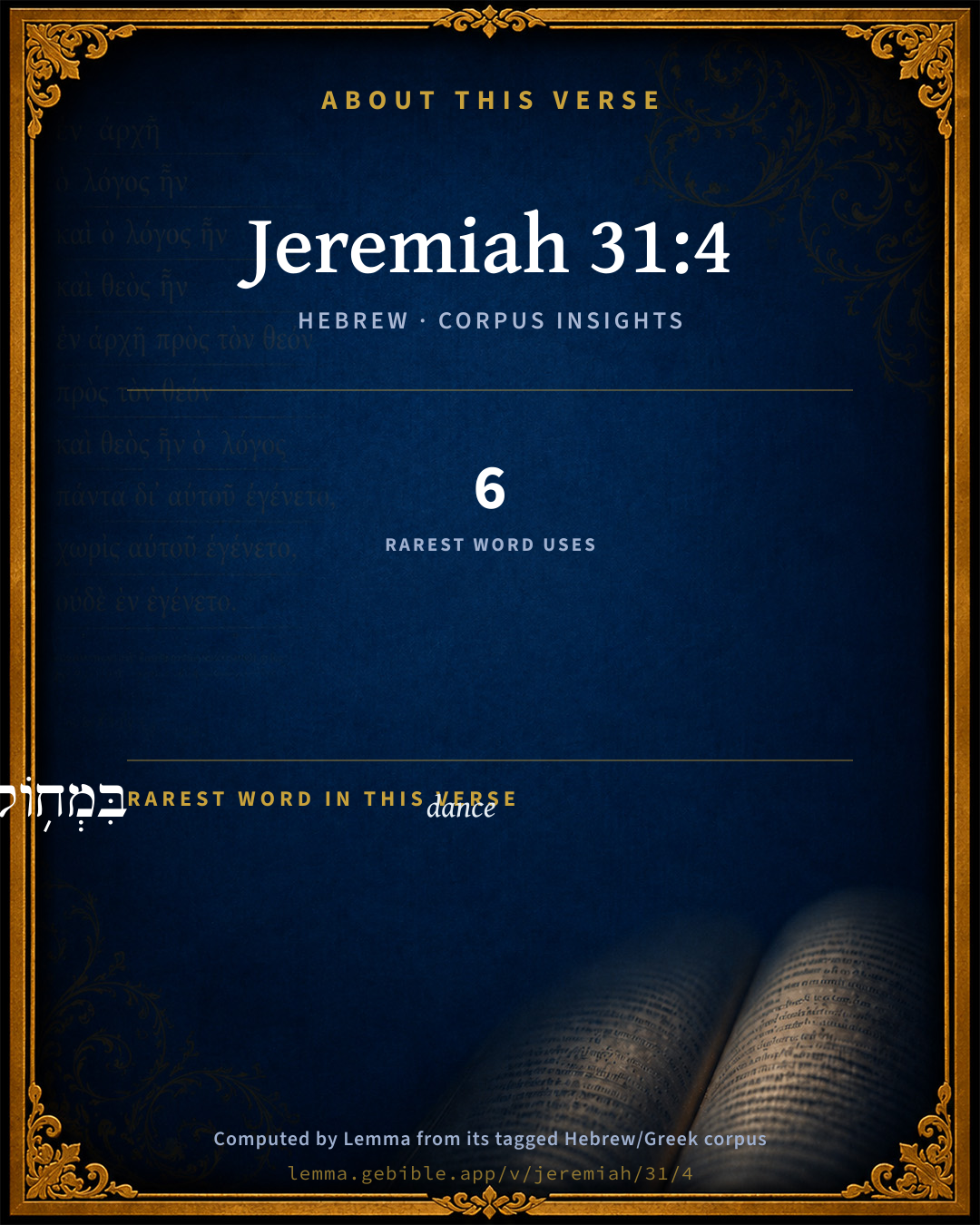
The rarest word here is בִּמְח֥וֹל dance H4234 — appearing just 6 times in the whole Hebrew Bible.

Shared distinctive vocabulary

בִּמְח֥וֹל dance H4234 occurs in 6 verses of the Hebrew Bible. Also found in:

Grammatical profile

  • 5 verbs
  • 4 nouns
  • 2 adverbs

Verb forms

  • אֶבְנֵךְ֙ Qal · Imperfect
  • וְֽנִבְנֵ֔ית Niphal · Sequential Perfect
  • תַּעְדִּ֣י Qal · Imperfect
  • וְיָצָ֖את Qal · Sequential Perfect
  • מְשַׂחֲקִֽים Piel · Participle Active

Repetition

Words recur within this verse — often emphatic in Hebrew:

  • ע֤וֹד still H5750 ×2
  • אֶבְנֵךְ֙ to build H1129 ×2

Cross-references

25

Topical passages linked to Jeremiah 31:4 in the Treasury of Scripture Knowledge — connected by theme and wording, ordered by reader-vote popularity; previews shown in the World English Bible.

  • Jeremiah 33:7 I will cause the captivity of Judah and the captivity of Israel to return, and will build them, as at the first.
  • Jeremiah 31:13 Then shall the virgin rejoice in the dance, and the young men and the old together; for I will turn their mourning into joy, and will comfort them, and make them rejoice from their sorrow.
  • Amos 5:2 "The virgin of Israel has fallen; She shall rise no more. She is cast down on her land; There is no one to raise her up."
  • Jeremiah 30:18–19 Thus says Yahweh: Behold, I will turn again the captivity of Jacob's tents, and have compassion on his dwelling-places; and the city shall be built on its own hill, and the palace shall be inhabited after its own manner.
  • Acts 15:16 'After these things I will return. I will again build the tent of David, which has fallen. I will again build its ruins. I will set it up,
  • Revelation 21:10–27 He carried me away in the Spirit to a great and high mountain, and showed me the holy city, Jerusalem, coming down out of heaven from God,
  • 2 Kings 19:21 This is the word that Yahweh has spoken concerning him: The virgin daughter of Zion has despised you and ridiculed you; the daughter of Jerusalem has shaken her head at you.
  • Psalms 51:18 Do well in your good pleasure to Zion. Build the walls of Jerusalem.
  • Psalms 149:3 Let them praise his name in the dance! Let them sing praises to him with tambourine and harp!
  • Lamentations 2:13 What shall I testify to you? what shall I liken to you, daughter of Jerusalem? What shall I compare to you, that I may comfort you, virgin daughter of Zion? For your breach is great like the sea: who can heal you?
  • Luke 15:23 Bring the fattened calf, kill it, and let us eat, and celebrate;
  • Exodus 15:20–21 Miriam the prophetess, the sister of Aaron, took a tambourine in her hand; and all the women went out after her with tambourines and with dances.
  • 1 Samuel 18:6–7 It happened as they came, when David returned from the slaughter of the Philistine, that the women came out of all the cities of Israel, singing and dancing, to meet king Saul, with tambourines, with joy, and with instruments of music.
  • Psalms 69:35 For God will save Zion, and build the cities of Judah. They shall settle there, and own it.
  • Psalms 150:3–6 Praise him with the sounding of the trumpet! Praise him with harp and lyre!
  • Jeremiah 18:13 Therefore thus says Yahweh: Ask you now among the nations, who has heard such things; the virgin of Israel has done a very horrible thing.
  • Jeremiah 31:21 Set up road signs, make guideposts; set your heart toward the highway, even the way by which you went: turn again, virgin of Israel, turn again to these your cities.
  • Lamentations 1:15 The Lord has set at nothing all my mighty men in the midst of me; He has called a solemn assembly against me to crush my young men: The Lord has trodden as in a winepress the virgin daughter of Judah.
  • Ephesians 2:20–22 being built on the foundation of the apostles and prophets, Christ Jesus himself being the chief cornerstone;
  • Judges 11:34 Jephthah came to Mizpah to his house; and, behold, his daughter came out to meet him with tambourines and with dances: and she was his only child; besides her he had neither son nor daughter.
  • Isaiah 37:22 this is the word which Yahweh has spoken concerning him: The virgin daughter of Zion has despised you and ridiculed you; the daughter of Jerusalem has shaken her head at you.
  • Jeremiah 1:10 behold, I have this day set you over the nations and over the kingdoms, to pluck up and to break down and to destroy and to overthrow, to build and to plant.
  • Jeremiah 14:17 You shall say this word to them, Let my eyes run down with tears night and day, and let them not cease; for the virgin daughter of my people is broken with a great breach, with a very grievous wound.
  • Amos 9:11 In that day I will raise up the tent of David who is fallen, and close up its breaches, and I will raise up its ruins, and I will build it as in the days of old;
  • Revelation 19:1–8 After these things I heard something like a loud voice of a great multitude in heaven, saying, "Hallelujah! Salvation, power, and glory belong to our God:

Cross-references courtesy of OpenBible.info (CC BY 4.0).

Hebrew and Greek witnesses Masoretic Hebrew ↔ Greek Septuagint

The same verse in the two great witnesses to the Old Testament, shown verse-for-verse.

These are two independent witnesses, not word-aligned to each other, and the Septuagint is shown in lemma (dictionary) form.

Hebrew Jeremiah 31:4 Masoretic · Westminster Leningrad Codex

ע֤וֹד אֶבְנֵךְ֙ וְֽנִבְנֵ֔ית בְּתוּלַ֖ת יִשְׂרָאֵ֑ל ע֚וֹד תַּעְדִּ֣י תֻפַּ֔יִךְ וְיָצָ֖את בִּמְח֥וֹל מְשַׂחֲקִֽים

Again will I build you, and you shall be built, O virgin of Israel: again shall you be adorned with your tambourines, and shall go forth in the dances of those who make merry.

World English Bible · Public Domain

Greek LXX Structure differs

In the Septuagint, Jeremiah is about an eighth shorter than the Hebrew and arranges its material differently — the Oracles Against the Nations (Hebrew chapters 46–51) appear in the middle of the Greek book, after 25:13. Because the chapter and verse boundaries do not line up, a verse-for-verse comparison with the Hebrew is not shown.

A verse-for-verse comparison isn’t shown here because the chapters and verses don’t line up. Switch to the LXX edition with the MT / LXX toggle above to read the Greek directly.

Hebrew: Westminster Leningrad Codex (CC BY 4.0). Greek: Septuagint (public domain); English from a public-domain English Septuagint. How the Septuagint differs from the Hebrew →

Targum (Aramaic paraphrase)

1

The Targum is the ancient Jewish Aramaic paraphrase of the Hebrew Scriptures — an interpretive translation, not the Hebrew text itself. Onkelos (literal) and Pseudo-Jonathan (expansive) render the Torah, and Jonathan the Prophets. Coverage is partial: where no permissively-licensed English translation exists for a verse, only the Aramaic is shown. This is verse-level text, not a word-by-word alignment to the Hebrew.

  1. Targum Jonathan Prophets (Joshua–Malachi)
    עוֹד אֲקֵימִינָךְ וְתִתְקַיְמִין כְּנִשְׁתָּא דְיִשְׂרָאֵל עוֹד תִּתְקְנִין בְּתִקֻנִיךְ וְתִפְקִין בְסִיעַת מְשַׁבְּחִין:

    "I will yet again build you up, and you shall be rebuilt, O assembly of Israel! Again you shall take up your tambourines, and go forth in the dance of the merrymakers."

    Targum Jonathan — Aramaic: “Mikraot Gedolot” (public domain). English: “Sefaria Community Translation” (CC0 1.0 (public-domain dedication)); “London "Chaldee Paraphrase," 1871” (public domain). Text via Sefaria.

Commentary

Notes on Jeremiah 31:4 from classic Christian and Jewish commentators (each source and its license shown beneath its notes). The classic Christian expositions comment on the surrounding passage and are grouped to its opening verse, so a note may address several verses; the Jewish commentaries on the Tanakh (Rashi and others) are per-verse, so they appear only where the commentator wrote on this verse.

Lemma curates 59 commentaries, every one of them public domain or Creative Commons licensed, each selected and text-cleaned for this edition rather than reprinted as found. About our sources →

Trapp's Complete Commentary

John Trapp

Jer 31:4 Again I will build thee, and thou shalt be built, O virgin of Israel: thou shalt again be adorned with thy tabrets, and shalt go forth in the dances of them that make merry.

Ver. 4. Again I will build thee.] See Jer 34:18.

Thou shalt be adorned with thy tabrets.] All shall be hail and merry with thee as heretofore: yea, thou shalt have spiritual joy, which is res severa, severe and solid, such as doth not only smoothe the brow, but fill the breast.

John Trapp, A Commentary or Exposition upon All the Books of the Old and New Testament (1647–1656) — public domain. Text from a community e-Sword module.

Tyndale Open Study Notes

Tyndale Open Resources

31:4 In their homeland, the Israelites had been guilty of “adultery” with false gods. The restored community would be like a virgin, as though the people had never forsaken the Lord. The happiness and joy of their celebrations would manifest this transformation.

Tyndale Open Study Notes — © Tyndale Open Resources, licensed CC BY-SA 4.0. Text via the HelloAO Bible API.

Geneva Bible (1599)

Geneva Bible translators

Thou shalt have still occasion to rejoice: which is meant by timbrels, and dancing, as their custom was after notable victories, Exod. 15:20; Judg. 5:2 and Jer. 18:34.

Geneva Bible (1599) marginal notes — public domain. Text via Bolls.life.

Jamieson, Fausset & Brown

Robert Jamieson, A. R. Fausset & David Brown

I will build . . . thou shalt be built--The combination of the active and passive to express the same fact implies the infallible certainty of its accomplishment. "Build," that is, establish in prosperity (Jer 33:7).

adorned with . . . tabrets-- (Sa1 18:6). Or, "adorn thyself with thy timbrels"; used by damsels on occasions of public rejoicings (Exo 15:20; Jdg 11:34). Israel had cast away all instruments of joy in her exile (Psa 137:4).

dances--holy joy, not carnal mirth.

Jamieson, Fausset & Brown — Commentary Critical and Explanatory on the Whole Bible (1871) — public domain (CC PDM 1.0). Text via the HelloAO Bible API.

Adam Clarke's Commentary

Verse 4. O virgin of Israel] Israelites in general; now called virgin, because restored to their ancient purity.

With thy tabrets] Women in general played on these; they were used in times of rejoicing, and accompanied with dancing. To these customs, still preserved, the prophet alludes.

Adam Clarke's Commentary on the Bible (1810–1826) — public domain. Text from a community e-Sword/MySword module.

John Calvin's Commentaries

Jeremiah, in this verse, proceeds with the same subject, — that though there would be the long time of seventy years, yet God would become the liberator of his Church. Length of time might have extinguished the faith of the people, as it is too commonly the case: for when nothing appears to us but the naked word, and when God repeats the same promises from day to day, we think it of no moment; and then when some evil has been prevailing, we think that all ways have been already closed up, so that God cannot bring a remedy; we thus measure his power by our own standard: and as he comes late to help us, because he suffers men to be long afflicted with disease or other evils, so we imagine that God will never come, when he suspends and delays his favor longer than we wish.

Hence the Prophet says here, I will yet build thee, and built shalt thou be, virgin of Israel; and then, thou shalt yet be adorned with thy tabrets Joy is here set in opposition to the grief with which the people were to be oppressed in exile, and in part had been already oppressed, for many had been driven into exile. But Jeremiah expresses their joy and gladness by a figurative mode of speaking, by tabrets and dances of those who play For when the Prophets announce the vengeance of God, they are wont to say, “cease shall all joy among you; ye shall not play any more with the harp or with musical instruments.” So also in this place Jeremiah says, that they would return to the tabrets and dances, when God restored them to their own country. We ought not at the same time to turn this testimony of the Prophet to excuse profane lasciviousness, by which profane men pervert the benefits of God, for they preserve no moderation in their joy, but abandon themselves, and thus become wanton against God. And it is the tendency of all dances and sounds of tabrets, to besot profane men. The Prophet then did not intend to allow this sort of licentiousness to the people: for we must ever bear in mind what he said yesterday, that the voice of praise would go forth with joy. By tabrets and dances, he then means holy joy, connected with praises to God, and with the sacrifice of thanksgiving. It afterwards follows —

John Calvin's Commentaries (1540-1563) — public domain. Text from the Calvin Translation Society English edition (1840s-50s) via the Christian Classics Ethereal Library (ccel.org). Calvin's coverage is partial (roughly two-thirds of the Bible); uncommented books and verses are honest gaps, never fabricated. The 19th-century editor's footnotes and remarks are omitted so the notes are faithfully Calvin's own voice.

Ellicott's Commentary for English Readers

(4) Thou shalt again be adorned with thy tabrets . . .—The implied idea is that of a time of rejoicing after triumphant restoration (the “building” of the previous sentence is more than that of material walls and towers), when the daughters of Israel (as in Exo_15:20; Jdg_11:34; 1Sa_18:6; Psa_68:11) should again go forth with “timbrels and dances,” with tabrets and joy and instruments of music. The “tabret” was a musical instrument of the drum type, somewhat like the Spanish or Italian tambourine, with bells attached to the metal hoop.

A Bible Commentary for English Readers, edited by Charles John Ellicott (1878–1897) — public domain. Text from a community e-Sword module.

The Cambridge Bible for Schools and Colleges

gen. ed. J. J. S. Perowne

4. will I build thee, and thou shalt be built] For build = make to prosper, see note on Jer_12:16.

O virgin of Israel] The nation is addressed under the figure of a woman, as so often.

tabrets] The tabret or timbrel, the Heb. tôph, the duff or diff of the Arabs, is a hoop on which pieces of brass are often fixed, and over which parchment is extended. It is thus played with the fingers like our tambourine. It was used in early times by the Syrians of Paddanaram (Gen_31:27), played principally by women (Exo_15:20; Jdg_11:34; 1Sa_18:6; Psa_68:25), but also by prophets (1Sa_10:5) and by others (2Sa_6:5; 1Ch_13:8). Peake refers for the place occupied by dancing in the religion of the later (post-exilic) period to an essay by Franz Delitzsch, Iris, pp. 189, 204.

The Cambridge Bible for Schools and Colleges (gen. ed. J. J. S. Perowne; Cambridge University Press, 1878–1918) — public domain. Text from a community e-Sword module.

John Gill's Exposition

Again, I will build thee, and thou shalt be built, O virgin of Israel,.... The same with "all the families of Israel", Jer 31:1; who, when converted, will be espoused to Christ as a chaste virgin; have a sincere affection for him; unfeigned faith in him, and purely worship him; receiving the pure doctrines of the Gospel, and submitting to the ordinances of it; and then will the church, comparable to a building, consisting of lively stones, laid upon the foundation Christ, which is fallen down, and lies in ruins, be rebuilt, and none shall hinder it; and a glorious building it will be, and will continue so, when its stones are laid with fair colours; its foundations with sapphires; its windows made of agates; its gates of carbuncles; and all its borders of pleasant stones, Isa 54:11;

thou shalt again be adorned with thy tabrets; or timbrels, instruments of music, such as women used at times of public joy and mirth, Exo 15:20; which became them, and were very ornamental to them; and their playing on these was usually attended with dancing; hence it follows:

and shalt go forth in the dances of them that make merry; phrases expressive of spiritual joy, which will be in the hearts of the saints, and expressed by the behaviour of them at the time of the conversion of the, Jews, which will be the marriage of the Lamb; and when the bride will be ready, being adorned with the robe of Christ's righteousness, and with the graces of his Spirit, and be brought into his presence, accompanied with a chorus of virgins her companions, undefiled ones, having harps in their hands, singing the Lamb's new song; see Rev 14:2.

John Gill's Exposition of the Whole Bible (1746–1763) — public domain (CC PDM 1.0). Text via the HelloAO Bible API.

Albert Barnes' Notes on the Bible

O virgin of Israel - i. e., the whole people (compare Jer 14:17 note).

Albert Barnes' Notes on the Bible (1834–1885) — public domain. Text from a community e-Sword/MySword module.

Matthew Poole's English Annotations

As upon their being carried into captivity both their civil state and church, which either of them were as a building framed together, were broken and pulled down, and they were scattered here and there, like the stones of a building pulled down; so God’s bringing them again together, and cementing them by a political and ecclesiastical government, is fitly compared to a building. The calling them the

virgin Israel doth not signify that the body of that people had not been defloured by idolatry, but either signifies that this promise only concerned such as had kept their virginity; or else (which it may be is more probable) Israel is here called a virgin with relation to the following words, they being virgins which were wont to go out with tabrets, 1Sa 18:6, and to dance in the time of their mirth and jollity, Exo 15:20; Jdg 11:34. The virgins are said to be adorned with their tabrets, or timbrels, either (as some think) because they were wont to tie scarfs or ribands about them, or because they looked comely with these instruments of music in their hands, or should use them in a more handsome and comely manner than they had done before, when they used them at unseasonable times. That which is here prophesied is, a merry, joyful, pleasant time to this people, when their mirth should become them; or the restoration of their religions festivals, at which they used instruments of music to express their inward spiritual joy and gladness. The prophets, 1Sa 10:5, came from the high place with a tabret, &c.

Matthew Poole's English Annotations on the Holy Bible (1683–1685) — public domain. Text from a community e-Sword/MySword module.

Whedon's Commentary on the Bible

Daniel D. Whedon

4. Virgin — See on Jer_14:17.

Tabrets — Better, as in the margin, timbrels; a certain drum-like musical instrument, carried or worn especially by women in times of rejoicing. See Jdg_11:34; 1Sa_18:6; Job_21:12; Isa_30:32.

Daniel D. Whedon (gen. ed.), Commentary on the Old and New Testaments (1874–1909) — public domain. Text from a community e-Sword module.

The Pulpit Commentary

I will build thee. A nation, like a family, is frequently compared to a building. (so Jer_12:16 Jer_24:6; comp. Eph_2:22) O virgin of Israel. The people of Israel is personified as a virgin. (comp. Jer_14:7) Adorned with thy tabrets, The expression will not, of course, bear to be logically criticized, for it was not the whole people who went out with "tabrets" or "timbrels," but the "damsels," who, it is true, formed an important part of religious processions, (Psa_68:25) and doubtless of secular ones also. (comp. Jud_1:11:34) Joyousness is an essential part of the Biblical ideal both of religion and of a normal state of society: "The joy of the Lord is your strength."

The Pulpit Commentary (1880–1919), ed. H.D.M. Spence-Jones & Joseph S. Exell — public domain. Text from a community e-Sword module.

unfoldingWord translationNotes

Door43 World Missions Community

General Information:

Yahweh continues speaking to the people of Israel.

I will build you up again so you will be built

Yahweh purposefully repeats the idea that he will build Israel to emphasize it. If your language can only use active verbs and has some other way to emphasize the idea, you may want to use it here. AT: "I will build you up again. Remember this: I will build you" (See: Active or Passive and Parallelism)

virgin Israel

It was common to refer to nations as if they were women. However, "virgin" makes a person think about a young woman who has never married and so has never had the opportunity to be faithless to her husband. Therefore, calling Israel a virgin is an ironic use of language. See how you translated this in Jeremiah 18:13. AT: "Israel, who falsely pretends to be fully devoted to me" or "my faithless people Israel" (See: Personification and Irony)

tambourines

musical instruments with heads like a drum that can be hit and with pieces of metal around their sides that sound when the instruments are shaken (See: Translate Unknowns)

translationWords

virgin

vineyard

Samaria

watch

Ephraim

preach

raise

Zion

unfoldingWord translationNotes — © Distant Shores Media and the Door43 World Missions Community, licensed CC BY-SA 4.0. Source: git.door43.org/Door43/en_tn.

Rashi

Rabbi Shlomo Yitzchaki (Rashi)

Yet again will I rebuild you, then you shall be built You had two buildings made by men. Therefore, they were destroyed. Yet again will I rebuild you, I by Myself, a third building, and you shall be built forever. shall you be adorned Heb. תַּעְדִּי.

Rashi on the Tanakh — English translations: “The Judaica Press complete Tanach with Rashi, translated by A. J. Rosenberg” (CC BY 4.0); “Pentateuch with Rashi's commentary by M. Rosenbaum and A.M. Silbermann, 1929-1934” (public domain); “The Metsudah Tanach series, Lakewood, N.J” (CC BY 4.0); and “The Book of Joshua, Metsudah Publications, 1997” (CC BY 4.0). Text via Sefaria.

Lesson kit

Teaching starters — assembled from the data on this page, not authored interpretation. Every prompt links to the verse data it draws on. Edit before teaching.

Jeremiah, in the Prophets, opens this verse with 11 words (9 distinct Hebrew lemmas). Its most distinctive word is mâchôwl (“dance”). A historical commentator’s framing appears above. Read the whole chapter for the surrounding context.

Discussion questions

  1. How does “dance” (mâchôwl) shape what this verse is saying?
  2. How does Psalms 30:11, which shares the word «dance», read alongside this verse?
  3. What does the repetition of “still” (2× in this one verse) do in this verse?
  4. These translations render this verse differently. What is at stake in choosing one wording over another?
  5. «אֶבְנֵךְ֙» is a Qal Imperfect verb. How does that grammatical form shape the action described?
  6. Compare how Trapp's Complete Commentary and Tyndale Open Study Notes read this verse. Where do they agree or differ?

Things to notice

Reading settings

Reading text

Shown beneath each verse's original-language words.

Old Testament
Old Testament edition

Read the OT as the Masoretic Hebrew (MT) or the Greek Septuagint (LXX).

English shown for the Greek Septuagint (in the Hebrew ↔ Greek comparison).

Comparing translations? Open the Compare panel on any verse page to stack up to four side by side.