Isaiah 62:5

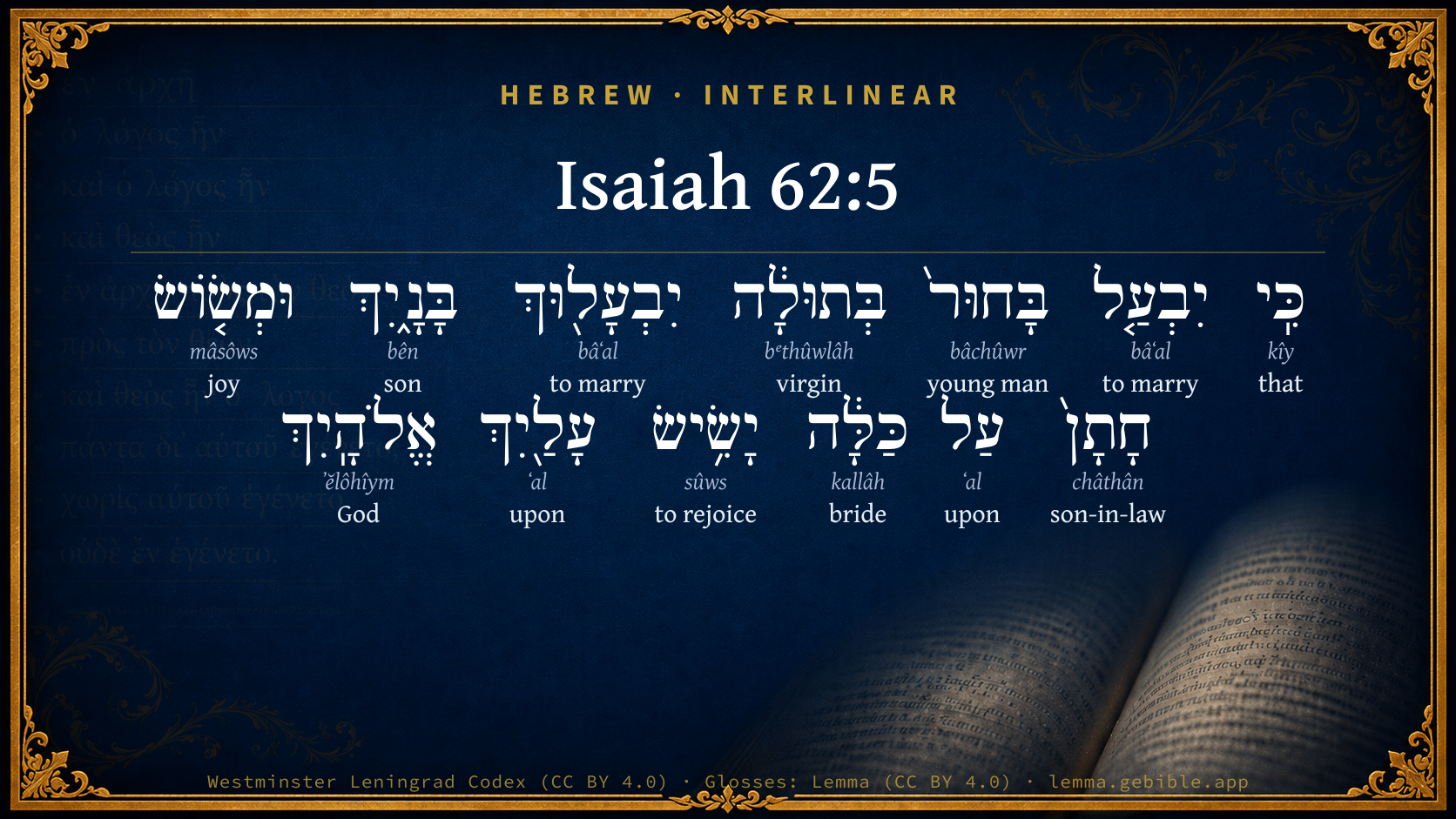
Hebrew (Westminster Leningrad Codex) Isaiah 62:5 appears in the Hebrew Old Testament. The text above is from the Westminster Leningrad Codex. Each word links to its Strong’s number, a concise gloss, and parsing drawn from the Open Scriptures Hebrew Bible morphology. Click any word for its full Brown-Driver-Briggs (BDB) entry.
Download image
Cite this verse

Isaiah 62:5 (World English Bible). Public Domain. Lemma interlinear Bible study tool, https://lemma.gebible.app/v/isaiah/62/5.

Show BibTeX & RIS
BibTeX
RIS
English Translation
For as a young man marries a virgin, so shall your sons marry you; and as the bridegroom rejoices over the bride, so shall your God rejoice over you.
World English Bible · Public Domain
Download a study sheet

One document with this verse’s original text, its word-by-word gloss line, the meaning frame, cross-references with their text, attributed commentary, and full source and license credits — printable, and it pastes into notes with its structure intact.

This verse Autodidact and up

Study sheet (.html) Plain text (.txt)

A passage Seminary Student

Up to 50 verses in one chapter. A passage sheet keeps up to 6 commentary sources and 12 cross-references per verse, in the order this page ranks them, and says so on the sheet whenever that leaves anything out. Ask for a single verse and you get the Autodidact verse sheet above.

Everything on this page stays free to read, with no account — the sheet is a download of what is already on screen, not access to it.

Want to remove ads? Support Godless Engineer
Compare translations 3

The same verse in 3 English versions, stacked beneath the original-language interlinear above. Click any original word for its lexicon entry.

Each is an independent rendering of the whole verse — the interlinear is not word-aligned to these translations.

Highlighted words mark where these versions differ — a whole-verse word diff, not a word-by-word alignment.

  • World English Bible Public Domain
    For as a young man marries a virgin, so shall your sons marry you; and as the bridegroom rejoices over the bride, so shall your God rejoice over you.
  • King James Version Public Domain
    For as a young man marrieth a virgin, so shall thy sons marry thee: and as the bridegroom rejoiceth over the bride, so shall thy God rejoice over thee.
  • unfoldingWord Literal Text CC BY-SA 4.0
    For a young man marries a young woman; your sons will marry you. And the rejoicing of a bridegroom over a bride, your God will rejoice over you.

unfoldingWord Literal Text — © unfoldingWord, licensed CC BY-SA 4.0. Word-aligned USFM3 via Door43 (git.door43.org/unfoldingWord/en_ult).

Versions to compare (up to 4)

3 of 4 selected

Show all 18 translations

Every available English version of this verse, each an independent rendering of the whole verse.

  • World English Bible Public Domain
    For as a young man marries a virgin, so shall your sons marry you; and as the bridegroom rejoices over the bride, so shall your God rejoice over you.
  • Berean Standard Bible Public Domain
    For as a young man marries a young woman, so your sons will marry you; and as a bridegroom rejoices over his bride, so your God will rejoice over you.
  • Majority Standard Bible Public Domain
    For as a young man marries a young woman, so your sons will marry you; and as a bridegroom rejoices over his bride, so your God will rejoice over you.
  • King James Version Public Domain
    For as a young man marrieth a virgin, so shall thy sons marry thee: and as the bridegroom rejoiceth over the bride, so shall thy God rejoice over thee.
  • American Standard Version (1901) Public Domain
    For as a young man marrieth a virgin, so shall thy sons marry thee; and as the bridegroom rejoiceth over the bride, so shall thy God rejoice over thee.
  • Revised Version (1885) Public Domain
    For as a young man marrieth a virgin, so shall thy sons marry thee: and as the bridegroom rejoiceth over the bride, so shall thy God rejoice over thee.
  • Geneva Bible (1599) Public Domain
    For as a yong man marieth a virgine, so shall thy sonnes marry thee: and as a bridegrome is glad of the bride, so shall thy God reioyce ouer thee.
  • Douay-Rheims (1899) Public Domain
    For the young man shall dwell with the virgin, and thy children shall dwell in thee. And the bridegroom shall rejoice over the bride, and thy God shall rejoice over thee.
  • Young's Literal Translation Public Domain
    For a young man doth marry a virgin, Thy Builders do marry thee, With the joy of a bridegroom over a bride, Rejoice over thee doth thy God.
  • Literal Standard Version CC BY-SA 4.0
    For a young man marries a virgin, || Your builders marry you, || With the joy of a bridegroom over a bride, || Your God rejoices over you.
  • Unlocked Literal Bible CC BY-SA 4.0
    Truly, as a young man marries a young woman, so your sons will marry you, and as a bridegroom rejoices over his bride, your God will rejoice over you.
  • unfoldingWord Literal Text CC BY-SA 4.0
    For a young man marries a young woman; your sons will marry you. And the rejoicing of a bridegroom over a bride, your God will rejoice over you.
  • Darby Bible Public Domain
    For [as] a young man marrieth a virgin, shall thy sons marry thee; and with the joy of the bridegroom over the bride, shall thy God rejoice over thee.
  • World Messianic Bible Public Domain
    For as a young man marries a virgin, so your sons will marry you. As a bridegroom rejoices over his bride, so your God will rejoice over you.
  • Webster's Bible Public Domain
    For as a young man marrieth a virgin, so shall thy sons marry thee: and as the bridegroom rejoiceth over the bride, so will thy God rejoice over thee.
  • Free Bible Version CC BY-SA 4.0
    For just like a young man marries a young woman, so your sons will marry you; and like a groom is happy with his bride, so your God will be happy with you.
  • Bible in Basic English Public Domain
    For as a young man takes a virgin for his wife, so will your maker be married to you: and as a husband has joy in his bride, so will the Lord your God be glad over you.
  • JPS Tanakh (1917) Public Domain
    For as a young man espouseth a virgin, so shall thy sons espouse thee; and as the bridegroom rejoiceth over the bride, so shall thy God rejoice over thee.

Literal Standard Version (2020), Covenant Press — licensed CC BY-SA 4.0. Text via the HelloAO Bible API (eBible.org). Unlocked Literal Bible (unfoldingWord) — licensed CC BY-SA 4.0. Text via the HelloAO Bible API (eBible.org). unfoldingWord Literal Text — © unfoldingWord, licensed CC BY-SA 4.0. Word-aligned USFM3 via Door43 (git.door43.org/unfoldingWord/en_ult). Free Bible Version, Dr. Jonathan Gallagher — licensed CC BY-SA 4.0. Text via the HelloAO Bible API (eBible.org).

Word by word

More ways to search: Search by grammar → Find every occurrence → Compare this word →

Practice this passage: Drill this verse → Learn its vocabulary →

יִבְעַ֤ל
bâʻal
H1166
“to marry”
Verb, Qal, Imperfect, 3rd Person, Masculine, Singular
Part of Speech
Verb
Stem
Qal
Form
Imperfect
Person
3rd Person
Gender
Masculine
Number
Singular
Full BDB Definition

Origin: a primitive root

TWOT: 262

to marry, rule over, possess, own - (Qal) - to marry, be lord (husband) over - to rule over - (Niphal) to be married
  1. כִּֽי kîy H3588 “that” Conjunction
  2. בָּחוּר֙ bâchûwr H970 “young man” Noun, Common, Masculine, Singular, Absolute
  3. בְּתוּלָ֔ה bᵉthûwlâh H1330 “virgin” Noun, Common, Feminine, Singular, Absolute
  4. יִבְעָל֖וּךְ bâʻal H1166 “to marry · you” Verb, Qal, Imperfect, 3rd Person, Masculine, Plural + Suffix, Personal, 2nd Person, Feminine, Singular
  5. בָּנָ֑יִךְ bên H1121 “sons · your” Noun, Common, Masculine, Plural, Construct + Suffix, Personal, 2nd Person, Feminine, Singular
  6. וּמְשׂ֤וֹשׂ mâsôws H4885 “and · joy of” Conjunction + Noun, Common, Masculine, Singular, Construct
  7. חָתָן֙ châthân H2860 “son-in-law” Noun, Common, Masculine, Singular, Absolute
  8. עַל ʻal H5921 “upon” Preposition
  9. כַּלָּ֔ה kallâh H3618 “bride” Noun, Common, Feminine, Singular, Absolute
  10. יָשִׂ֥ישׂ sûws H7797 “to rejoice” Verb, Qal, Imperfect, 3rd Person, Masculine, Singular
  11. עָלַ֖יִךְ ʻal H5921 “upon · you” Preposition + Suffix, Personal, 2nd Person, Feminine, Singular
  12. אֱלֹהָֽיִךְ ʼĕlôhîym H430 “God(s) · your” Noun, Common, Masculine, Plural, Construct + Suffix, Personal, 2nd Person, Feminine, Singular

About this verse

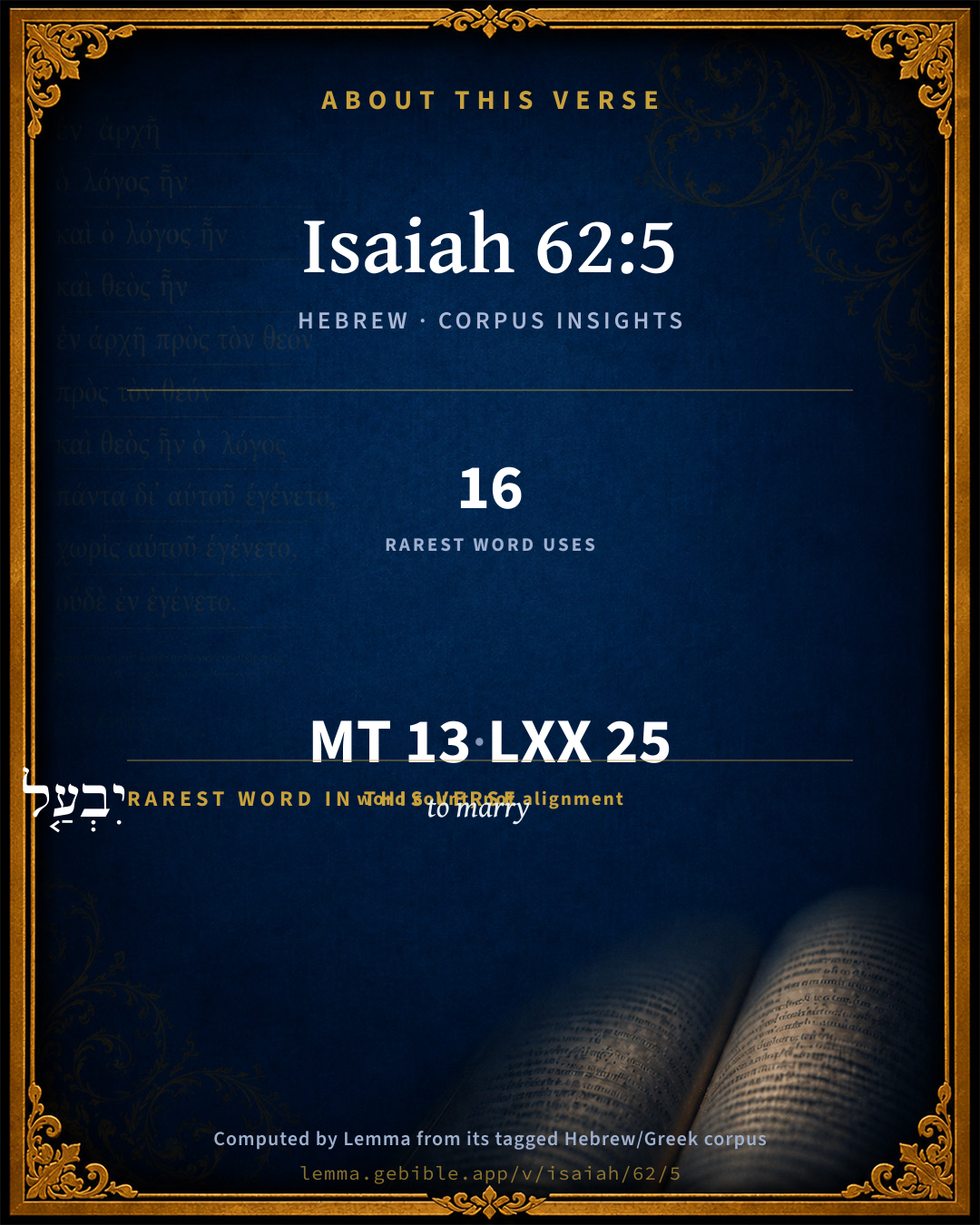
These counts appear in no published source. They are computed here, from the morphology-tagged text and Lemma’s own curated glosses. What Lemma adds →

13
words
11
distinct lemmas
Prophets
section

Notable vocabulary

The rarest word here is יִבְעַ֤ל to marry H1166 — appearing just 16 times in the whole Hebrew Bible.

Shared distinctive vocabulary

יִבְעַ֤ל to marry H1166 occurs in 14 verses of the Hebrew Bible. Also found in:

Grammatical profile

  • 3 verbs
  • 7 nouns
  • 2 prepositions
  • 1 conjunction

Verb forms

  • יִבְעַ֤ל Qal · Imperfect
  • יִבְעָל֖וּךְ Qal · Imperfect
  • יָשִׂ֥ישׂ Qal · Imperfect

Repetition

Words recur within this verse — often emphatic in Hebrew:

  • יִבְעַ֤ל to marry H1166 ×2
  • עַל upon H5921 ×2

Hebrew & Septuagint length

In English translation the verse runs 29 words from the Hebrew and 38 from the Septuagint (LXX English) — closely comparable.

A rough comparison of the two English renderings, which tokenize alike — not a word-level alignment.

Word counts can differ between the Hebrew and the Greek without any difference in meaning — e.g. the Hebrew direct-object marker אֵת has no separate Greek word, and Greek often adds the article ὁ.

In the original languages it is 13 Hebrew tokens and 25 Greek tokens — but the two are counted differently (Hebrew bundles its prefixes and suffixes into one token; the Greek is in lemma form), so that isn’t a like-for-like length.

Cross-references

7

Topical passages linked to Isaiah 62:5 in the Treasury of Scripture Knowledge — connected by theme and wording, ordered by reader-vote popularity; previews shown in the World English Bible.

  • Isaiah 62:4 You shall no more be termed Forsaken; neither shall your land any more be termed Desolate: but you shall be called Hephzibah, and your land Beulah; for Yahweh delights in you, and your land shall be married.
  • Isaiah 65:19 I will rejoice in Jerusalem, and joy in my people; and there shall be heard in her no more the voice of weeping and the voice of crying.
  • Hebrews 12:2 looking to Jesus, the author and perfecter of faith, who for the joy that was set before him endured the cross, despising shame, and has sat down at the right hand of the throne of God.
  • Psalms 45:11–16 So the king will desire your beauty, Honor him, for he is your lord.
  • Isaiah 49:18–22 Lift up your eyes round about, and see: all these gather themselves together, and come to you. As I live, says Yahweh, you shall surely clothe you with them all as with an ornament, and gird yourself with them, like a bride.
  • Jeremiah 32:41 Yes, I will rejoice over them to do them good, and I will plant them in this land assuredly with my whole heart and with my whole soul.
  • Song of Solomon 3:11 Go forth, you daughters of Zion, and see king Solomon, With the crown with which his mother has crowned him, In the day of his weddings, In the day of the gladness of his heart. Lover

Cross-references courtesy of OpenBible.info (CC BY 4.0).

Hebrew and Greek witnesses Masoretic Hebrew ↔ Greek Septuagint

The same verse in the two great witnesses to the Old Testament, shown verse-for-verse.

These are two independent witnesses, not word-aligned to each other, and the Septuagint is shown in lemma (dictionary) form.

Hebrew Isaiah 62:5 Masoretic · Westminster Leningrad Codex

כִּֽי יִבְעַ֤ל בָּחוּר֙ בְּתוּלָ֔ה יִבְעָל֖וּךְ בָּנָ֑יִךְ וּמְשׂ֤וֹשׂ חָתָן֙ עַל כַּלָּ֔ה יָשִׂ֥ישׂ עָלַ֖יִךְ אֱלֹהָֽיִךְ

For as a young man marries a virgin, so shall your sons marry you; and as the bridegroom rejoices over the bride, so shall your God rejoice over you.

World English Bible · Public Domain

Greek LXX Isaiah 62:5 Septuagint · lemma form

καί ὡς συνοἰκέω νεανίσκος παρθένος οὕτως καταοἰκέω ὁ υἱός σύ μετά σύ καί εἰμί ὅς τρόπος εὐφραίνω νυμφίος ἐπί νύμφη οὕτως εὐφραίνω κύριος ἐπί σύ

And as a young man lives with a virgin, so shall your sons dwell in you: and it shall come to pass that as a bridegroom will rejoice over a bride, so will the Lord rejoice over you.

LXX2012 (modern English Septuagint) · Public Domain

On this verse, Adam Clarke's Commentary discusses the Septuagint’s reading. Read the note in Commentary ↓

Hebrew: Westminster Leningrad Codex (CC BY 4.0). Greek: Septuagint (public domain); English from LXX2012 (modern English Septuagint) (Public Domain). How the Septuagint differs from the Hebrew →

Targum (Aramaic paraphrase)

1

The Targum is the ancient Jewish Aramaic paraphrase of the Hebrew Scriptures — an interpretive translation, not the Hebrew text itself. Onkelos (literal) and Pseudo-Jonathan (expansive) render the Torah, and Jonathan the Prophets. Coverage is partial: where no permissively-licensed English translation exists for a verse, only the Aramaic is shown. This is verse-level text, not a word-by-word alignment to the Hebrew.

  1. Targum Jonathan Prophets (Joshua–Malachi)
    אֲרֵי כְמָא דְמִתְיַתַּב עוּלֵים עִם בְּתוּלְתָּא כֵּן יִתְיַתְבוּן בְּגַוַיְכִי בְּנַיְכִי וּכְמָא דְחָדֵי חֲתָנָא עִם כַּלְתָא יֶחְדֵי עֲלָךְ אֱלָהָיִךְ:

    For as a young man dwelleth with a virgin, thus thy sons shall dwell in thee; and as the bridegroom rejoiceth over the bride, so shall thy God rejoice over thee.

    Targum Jonathan — Aramaic: “Mikraot Gedolot” (public domain). English: “Sefaria Community Translation” (CC0 1.0 (public-domain dedication)); “London "Chaldee Paraphrase," 1871” (public domain). Text via Sefaria.

Commentary

Notes on Isaiah 62:5 from classic Christian and Jewish commentators (each source and its license shown beneath its notes). The classic Christian expositions comment on the surrounding passage and are grouped to its opening verse, so a note may address several verses; the Jewish commentaries on the Tanakh (Rashi and others) are per-verse, so they appear only where the commentator wrote on this verse.

Lemma curates 59 commentaries, every one of them public domain or Creative Commons licensed, each selected and text-cleaned for this edition rather than reprinted as found. About our sources →

Trapp's Complete Commentary

John Trapp

Isa 62:5 For [as] a young man marrieth a virgin, [so] shall thy sons marry thee: and [as] the bridegroom rejoiceth over the bride, [so] shall thy God rejoice over thee.

Ver. 5. For as a young man marrieth a virgin, so shalt thy sons marry thee.] This translation (saith one who preferreth the Vulgate, ‘The young man shall dwell with the virgin’), marreth the sense, since it is improper to say of sons that they shall marry their mother. But I say, that the Church never flourisheth more, than when the son marrieth the mother, and doth his utmost to beautify and amplify her. See 2Co 11:2.

And as the bridegroom rejoiceth over the bride, so shall thy God rejoice over thee.] Communicating with our souls his sweetest favours in his ordinances, as in the bridal bed, and making us to be conceived with the fruits of righteousness to everlasting life. It is, therefore, a most unworthy thing, that men should go a whoring from under him, {Hos 4:12} and seek to themselves among the creatures alias delicias et amasias, other sweethearts.

John Trapp, A Commentary or Exposition upon All the Books of the Old and New Testament (1647–1656) — public domain. Text from a community e-Sword module.

The Biblical Illustrator

Joseph S. Exell

Isa_62:5

For as a young man marrieth a virgin

Fervid devotion to a cause

It is difficult to see how any real parallel can exist between an intellectual interest or reasoned sense of duty to a public cause or institution, although prescribing exertion and even sacrifice, and the spontaneous, glowing, fervid devotion of a young man to his chosen bride.

Say you so? Then let me say that as yet you know not some salient features of human nature. As a matter of fact abstractions, as we call them, do provoke passion; the passion of love and the passion of hate, no less truly than do concrete and visible objects. Millions of human beings have worked, suffered, fought and died for these very abstractions; for a political or social doctrine, for the fame of a fallen dynasty, for the credit of some secret club or association, for a country that has been crushed out of existence, for some wild undemonstrable theory, for some baseless or grotesque superstition, no less than for a true and soul-inspiring faith or principle. (H. P. Liddon, D. D.)

Practical devotion to the Church of Christ

Isaiahs comparison would suggest that the devotion of her sons to the city of God would have three characteristics.

I. AN UNRESERVED, WHOLE-HEARTED DEVOTION; a devotion which bestows on its object its best and its all. With my body I thee worship; and with all my worldly goods I thee endow, is the language not only of a Christian Church formulary, but of the human heart in its better mood, throughout all time; and it marks the first characteristic of that devotion to the Church of God which Isaiah saw in vision across the centuries. Undoubtedly a partial fulfilment of Isaiahs prophecy may be recognized in the love and service which Israel after the flesh received from a long line of patriot children. Noblest among them were the Maccabees; but they were only samples of a spirit which was shared, in their day and afterwards, by thousands of their countrymen. That temper was indeed too often mingled with moral alloy that sullied its purity. But the men who saved their country from the cultured Paganism of Antiochus Epiphanes, and who even after the utter ruin of their sacred house by Titus, rose once and again to pour out their blood like water in an unavailing struggle with Imperial Rome at the epoch of its greatest military power, were assuredly not men only under the sway of a common or sordid motive. In their love to Jerusalem the Holy, whose name was stamped upon their coins, they surely exhibit the careless self-abandonment of the passion which gives itself without stint to the object of its choice. The Lord had chosen Zion to be a habitation for Himself, and this choice made her, to those who had faith in it, the object of a passionate attachment in some respects without a parallel in history. Now, our Lord proclaimed and founded, within the Jewish nation, yet with a capacity and, indeed, an internal necessity of passing beyond its bounds, a new Society, which was to be more to the intellect and heart of man than the Greek πόλις, or the Roman World Empire, or the Jewish theocracy itself, ever had been or could be; yet which should sanction and satisfy, in ample measure, those instincts of union, brotherhood, improvement, order, of which earlier forms of association among men were the outcome and assertion. This Society, in virtue of its origin, its object, and its compass, He named the Kingdom of Heaven. Certain is it that the Church of Christ has inspired millions of Christians with mingled love and enthusiasm. If we believe that Christs Church, though built upon the foundation of apostles and prophets, has for the chief cornerstone, Himself; if we see in her, not a self-formed collection of individuals who agree in following Him, but, as Scripture says, His Body, instinct with His life; if for her He shed His most precious blood that He might present her glorious and immaculate in the realms of purity; then, in making much of her, we surely are doing no wrong to Him. Only because, notwithstanding the sears and stains which mark her sojourn here below, she is yet so intimately His, should she be so precious to His servants;--drawing the noblest souls into the highest paths of service.

II. THE DEVOTION WHICH ISAIAH PREDICTS WILL BE DISINTERESTED. The truehearted bridegroom marries, not that he may win rank or wealth, or public recognition, or any outward advantages whatever., he weds his bride for her own sake, because she is what she is, because in wedding her he finds the joy and satisfaction of his heart. It is for better for worse, for richer for poorer, in sickness and in health. So was it also to be with the espousals of the soul. The Holy Bride is wooed for her own sake, and not for anything that she may bestow on those who would win her.

III. AND THE PROPHETS COMPARISON SUGGESTS A DEVOTION THAT WILL LAST TILL DEATH. Till death us do part. Weariness, impaired health, diminished opportunities for usefulness may come with years; but the tie of sacred service to the cause and Church of Christ can only end with life. (H. P.Liddon, D. D.)

The Biblical Illustrator, edited by Joseph S. Exell (c. 1880s–1900s) — public domain. Text from a community e-Sword module.

Geneva Bible (1599)

Geneva Bible translators

Forasmuch as they confess one faith and religion with thee, they are in the same bond of marriage with thee, and they are called the children of the Church, inasmuch as Christ maketh her plentiful to bring forth children unto him.

Geneva Bible (1599) marginal notes — public domain. Text via Bolls.life.

Jamieson, Fausset & Brown

Robert Jamieson, A. R. Fausset & David Brown

thy sons--rather, changing the points, which are of no authority in Hebrew, "thy builder" or "restorer," that is, God; for in the parallel clause, and in Isa 62:4, God is implied as being "married" to her; whereas her "sons" could hardly be said to marry their mother; and in Isa 49:18, they are said to be her bridal ornaments, not her husband. The plural form, builders, is used of God in reverence as "husbands" (see on Isa 54:5).

over the bride--in the possession of the bride (Isa 65:19; Jer 32:41; Zep 3:17).

Jamieson, Fausset & Brown — Commentary Critical and Explanatory on the Whole Bible (1871) — public domain (CC PDM 1.0). Text via the HelloAO Bible API.

Adam Clarke's Commentary

Verse 5. For as a young man - so] The particles of comparison are not at present in the Hebrew Text: but the Septuagint, Syriac, and Chaldee seem to have read in their copies כ caph prefixed to the verb, כי כיבעל ki keyibal, which seems to have been omitted by mistake of a transcriber, occasioned by the repetition of the same two letters. And before the verb in the second line a MS. adds כן ken, so; which the Septuagint, Syriac, and Chaldee seem also to have had in their copies. In the third line of this verse the same MS. has in like manner וכמשוש vechimsos, and two MSS. and the Babylonish Talmud כמשוש kimsos, adding the כ caph; and in the fourth line, the Babylonish Talmud likewise adds כן ken, so, before the verb.

Sir John Chardin, in his note on this place, tells us, "that it is the custom in the east for youths, that were never married, always to marry virgins; and widowers, however young, to marry widows." - HARMER, Observ. ii. p. 482.

So shall thy sons marry thee.] For בניך banayich, thy sons, Bishop Lowth reads, restorer or builder, as he does not consider the word as the plural of בן ben, a son, but the participle benoni of the verb בנה banah, he built. I do not see that we gain much by this translation. Thy sons shall dwell in thee, Vulgate; and so the Septuagint and Chaldee.

Adam Clarke's Commentary on the Bible (1810–1826) — public domain. Text from a community e-Sword/MySword module.

Ellicott's Commentary for English Readers

(5) So shall thy sons marry thee . . .—The image of the bride is presented under another aspect. The people of a country are, in their collective unity, as the bridegroom, and the country is as the bride. They are bound, as the husband is to the wife, to cherish and protect it, to be ready to live and die for it.

A Bible Commentary for English Readers, edited by Charles John Ellicott (1878–1897) — public domain. Text from a community e-Sword module.

The Cambridge Bible for Schools and Colleges

gen. ed. J. J. S. Perowne

5. so shall thy sons marry thee] The harshness of the conception is obvious; and it is hardly relieved by pointing to the double meaning of the verb bâ‘al (“marry” and “possess”). Lowth and others, by a slight emendation of the text, read “so shall thy Builder (Jehovah) marry thee.” (So Cheyne, who refers to Psa_147:2 : “Jehovah is the builder up of Jerusalem.”) See on Isa_49:17.

The Cambridge Bible for Schools and Colleges (gen. ed. J. J. S. Perowne; Cambridge University Press, 1878–1918) — public domain. Text from a community e-Sword module.

John Gill's Exposition

For as a young man marrieth a virgin, so shall thy sons marry thee,.... As a young man, having married a virgin, possesses and enjoys her, and lives and dwells with her in great harmony and love, having a delight and complacency in her, there being a suitableness in her person and age; so those that are born in Zion, and brought up there, have communion with the church, and enjoy the ordinances of it; dwell and continue with her, and delight in her fellowship, ways, and worship; and have their hearts knit in love to her, professing the same faith, joining in the same worship, and walking with her in all the commandments and ordinances of the Lord. So the Septuagint and Vulgate Latin versions render it (g), "as a young man dwells with a virgin, so thy sons shall dwell in thee"; as does the Targum in like manner; and so Jarchi interprets it; for it seems exceeding disagreeable for sons to marry their mother; nor can there be an allusion to such an incestuous practice; rather it should be rendered, "as a young man hath a virgin, thy sons shall have thee" (h); have union to and communion with the church, and share in all the pleasures, privileges, and immunities of it:

and as the bridegroom rejoiceth over the bride, so shall thy God rejoice over thee; Christ is the Lord God of his church and people; Immanuel, God with us; and he stands in the relation of a bridegroom to them, and they in the relation of a bride to him; and as such he rejoices over them with exceeding great joy, and that to do them good; so he rejoiced over them from all eternity, when first betrothed to him; and so he does in time, in redemption: this was the joy set before him, which animated him to bear the cross, and despise the shame of it; namely, that those would be redeemed, and saved by him, and brought to glory; he rejoices at the conversion of them, and will present them to himself with joy in the spiritual and personal reign, and to his Father at the last day; and particularly, what is meant here, there will be such a profusion of blessings on the church in the latter day, as will abundantly show the joy of Christ in his people.

(g) , , Sept.; "habitabit enim juvenis cum virgine, et habitabunt in te filii tui", V. L. (h) "Nam ut habet juvenis virginem, habebunt te filii tui", Cocceius.

John Gill's Exposition of the Whole Bible (1746–1763) — public domain (CC PDM 1.0). Text via the HelloAO Bible API.

Albert Barnes' Notes on the Bible

For as a young man marrieth a virgin - Roberts remarks on this, ‘In general no youth marries a widow. Such a thing I scarcely ever heard of (in India), nor will it ever be except under some very extraordinary circumstances, as in the case of a queen, princess, or great heiress. Even widowers also, if possible, always marry virgins.’ The idea here is, that Yahweh would have delight in his people, which would be properly represented by the affection which a young man has for his bride.

So shall thy sons marry thee - Lowth renders this, ‘So shall thy restorer wed thee.’ He supposes that the word rendered in our common version, ‘thy sons’ (בניך bânâyı̂k), should be pointed בניך bonayı̂k, as a participle from בנה bânâh, ‘to build,’ rather than from בן bên, ‘a son.’ The parallelism requires some such construction as this; and the unusual form of expression, ‘thy sons shall be wedded to thee,’ seems also to demand it. The Septuagint renders it, ‘As a young man cohabits (συνοικῶν sunoikōn) with a virgin (bride, παρθένῳ parthenō), so shall thy, sons dwell with thee (κατοικήσουσιν οἱ υἱοί σου katoikēsousin hoi huioi sou). So the Chaldee. the conjecture of Lowth has been adopted by Koppe and Doderlin. Rosenmuller supposes that there is here a mingling or confusion of figures, and that the idea is, that her sons should possess her - an idea which is frequently conveyed by the word בעל Ba‛al, which is used here. To me it seems that there is much force in the conjecture of Lowth, and that the reference is to God as the ‘builder,’ or the restorer of Jerusalem, and that the sense is that he would be ‘married,’ or tenderly and indissolubly united to her. If it be objected that the word is in the ‘plural (בניך bonayı̂k) it may be observed thai the word commonly applied to God (אלהים 'ĕlohı̂ym) is also plural, and that an expression remarkably similar to the one before us occurs in Isa 54:5, ‘For thy Maker is thy husband’ (Hebrew, בעליך bo‛ălayk, ‘Thy husbands.’) It is not uncommon to use a plural noun when speaking of God. It should be remembered that the points in the Hebrew are of no authority, and that all the change demanded here is in them.

And as the bridegroom - Margin, as in Hebrew,’ With the joy of the bridegroom.’

Over the bride - In the possession of the bride - probably the most tender joy which results from the exercise of the social affections.

Albert Barnes' Notes on the Bible (1834–1885) — public domain. Text from a community e-Sword/MySword module.

Haydock's Catholic Bible Commentary

Dwell. Hebrew, "marry." They shall be attached to their country. --- Thee. He shall love thee as a bridegroom does one whom he has lately married. Christ never abandons his virgin spouse. (Calmet) --- Isaias speaks of some state of the Jews which has not yet taken place. (Houbigant)

George Leo Haydock (1774–1849), Haydock's Catholic Family Bible and Commentary, 1859 edition — public domain. Excludes Psalms (Douay-Rheims chapter numbering differs from Protestant) and Deuterocanonical books (Catholic canon only).

Matthew Poole's English Annotations

As a young man marrieth a virgin: this is delivered as a demonstration of what was said in the close of the 4th verse; and it is said young and virgin to note their suitableness; not old and young, but such as may delight each in other, signifying that mutual content that would be in all parties; thus it was at the first preaching of the gospel, Act 2:41-47.

So shall thy sons marry thee. Whereas it is improbable that the Spirit of God should carry on so sacred a prophecy by a similitude so abhorrent to nature, the son should marry the mother, the scruple is easily satisfied by taking the word in its right signification, to possess, as in the foregoing verse, reading it thus, As a young man marrieth or possesseth a virgin, so shall thy land be inhabited or possessed by thy sons; they shall dwell with thee as a man dwells with his wife; and thus the LXX. And it is said sons, to distinguish them from strangers, by whom she should not any longer be inhabited, but by her own natives; and expressed by marrying, to signify not only their unity of affection in the evenness of their living, but of faith in their common profession, called the common faith, Tit 1:4, according to which Paul calls Titus his son.

As the bridegroom rejoiceth, taketh delight in her; so shall thy God, viz. Christ, God and man, in thee: see Isa 62:4. Christ is often called a bridegroom, and his church a bride, 2Co 11:2; Rev 21:2,9.

Matthew Poole's English Annotations on the Holy Bible (1683–1685) — public domain. Text from a community e-Sword/MySword module.

The Pulpit Commentary

As the bridegroom rejoiceth over the bride. There is a double employment of the analogy with marriage here. The land, Judaea, personified as a female, is married to her sons, or her people, regarded (in this connection) as a male. The people, regarded as a female ("the virgin daughter of Zion," Isa_37:22) is also married to Jehovah, andrecognizes him as her Bridegroom. (Comp. Isa_54:5) As Bridegroom, God calls his bride "Hephzi-bah delight is in her."

The Pulpit Commentary (1880–1919), ed. H.D.M. Spence-Jones & Joseph S. Exell — public domain. Text from a community e-Sword module.

J. A. Alexander on Isaiah

Joseph Addison Alexander

“For (as) a young man marrieth a virgin, (so) shall thy sons marry thee, and (with) the joy of a bridegroom over a bride shall thy God rejoice over thee.” The particles of comparison are omitted, or perhaps it would be more correct to say that the comparison is only an implied one, and that the strict translation is, ‘a young man marrieth a virgin, thy sons shall marry thee,’ leaving the copula and so to be suggested by the context. So in the other clause there is no absolute need of assuming an ellipsis; since the Hebrew idiom admits of such expressions as joying the joy of a bridegroom, just as we may say in English a man lives the life of a saint, or dies the death of the righteous, both which combinations occur in our translation of the Bible (Gal 2:20; Num 23:10).

Joseph Addison Alexander, The Prophecies of Isaiah (1846–1847; New York: Scribner, 1870–1878) — public domain. Text from a community e-Sword module.

unfoldingWord translationNotes

Door43 World Missions Community

as a young man marries a young woman, so your sons will marry you

Here "sons" refers to the people of Israel and "you" refers to Judah, the land of Israel. This means the people will take possession of the land as a man takes possession of his young wife. (See: Simile)

as a bridegroom rejoices over his bride, your God will rejoice over you

This emphasizes God's happiness about his relationship with his people. (See: Simile)

translationWords

bridegroom

joy

bride

unfoldingWord translationNotes — © Distant Shores Media and the Door43 World Missions Community, licensed CC BY-SA 4.0. Source: git.door43.org/Door43/en_tn.

Rashi

Rabbi Shlomo Yitzchaki (Rashi)

As a young man lives with a virgin, etc. As a young man lives with a virgin, so shall your children live in you [after Jonathan].

Rashi on the Tanakh — English translations: “The Judaica Press complete Tanach with Rashi, translated by A. J. Rosenberg” (CC BY 4.0); “Pentateuch with Rashi's commentary by M. Rosenbaum and A.M. Silbermann, 1929-1934” (public domain); “The Metsudah Tanach series, Lakewood, N.J” (CC BY 4.0); and “The Book of Joshua, Metsudah Publications, 1997” (CC BY 4.0). Text via Sefaria.

Ibn Ezra

Rabbi Abraham ibn Ezra

So shall thy sons marry thee. This is a figurative expression for the kingdom will be restored to thee.

Ibn Ezra on the Tanakh — English translations: “Sefaria Community Translation” (CC0 1.0 (public-domain dedication)); “Yalkut, Sifsei Chachomim Chumash, Metsudah Publications, 2009” (CC BY 4.0); and “Commentary of Ibn Ezra on Isaiah - trans. by M. Friedlander, 1873” (public domain). Text via Sefaria.

Lesson kit

Teaching starters — assembled from the data on this page, not authored interpretation. Every prompt links to the verse data it draws on. Edit before teaching.

Isaiah, in the Prophets, opens this verse with 13 words (11 distinct Hebrew lemmas). Its most distinctive word is bâʻal (“to marry”). A historical commentator’s framing appears above. Read the whole chapter for the surrounding context.

Discussion questions

  1. The word bâʻal carries the sense “to marry.” How does it shape the verse?
  2. Genesis 20:3 shares the word «to marry» with this verse. How do the two illuminate each other?
  3. “to marry” occurs 2× in this one verse. What is the effect of the repetition?
  4. The translations on this page render this verse differently — a whole-verse word diff, not a word-by-word alignment. What might account for the different wordings?
  5. The verb «יִבְעַ֤ל» is Qal Imperfect. How does its form color the action?
  6. Reading how Trapp's Complete Commentary and The Biblical Illustrator read this verse, where do the two commentators agree and where do they part?

Things to notice

Reading settings

Reading text

Shown beneath each verse's original-language words.

Old Testament
Old Testament edition

Read the OT as the Masoretic Hebrew (MT) or the Greek Septuagint (LXX).

English shown for the Greek Septuagint (in the Hebrew ↔ Greek comparison).

Comparing translations? Open the Compare panel on any verse page to stack up to four side by side.