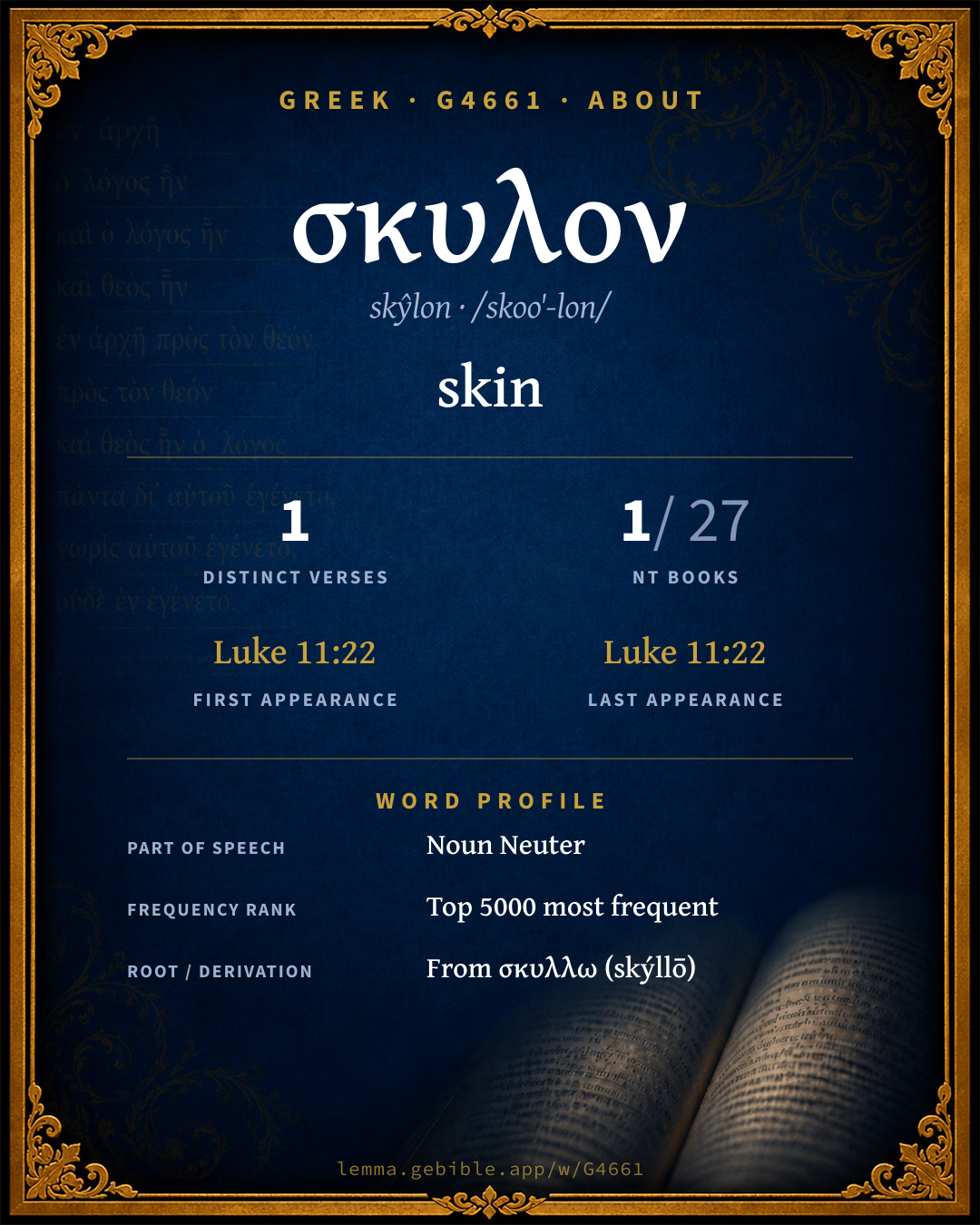
σκῦλον
skin
‘skin’ is one of 2 main senses fuller range ↓
Full lexicon entry — Thayer's Greek Lexicon
From Thayer's Greek Lexicon
Where this word appears
Grammar key — what these labels mean
Part of speech
- Noun
- A naming word — a person, place, thing, or idea.
Case
- Accusative
- The case of the direct object and of extent.
Gender
- Neuter
- Grammatically neuter.
Number
- Plural
- More than one.
Every verse where G4661 appears — 1 distinct verse across 1 book. Click any verse to open its interlinear word-by-word view. Verse text shown in the World English Bible for context — . Each verse’s Greek form is shown with its reference; the English is not keyword-highlighted, since the data carries no word-level English alignment. Use “Compare translations” on any verse to read it across multiple English versions. This concordance covers the Greek New Testament; Septuagint (Greek Old Testament) occurrences of this word are not indexed here.
Luke 1 verse
About this entry
At a glance — auto-summarized from this page’s data, not written by a person. Every figure links to its source below. This summary describes the numbers; it doesn’t interpret them.
“skin” is the headline sense of the Greek noun σκυλον (skŷlon). The Greek New Testament uses it only 1 verse. It clusters heavily in Luke, which alone accounts for 100% of its uses. Its lone occurrence is Luke 11:22. Lexicons map it across 2 senses. The sections below give every sense, occurrence, and version rendering.
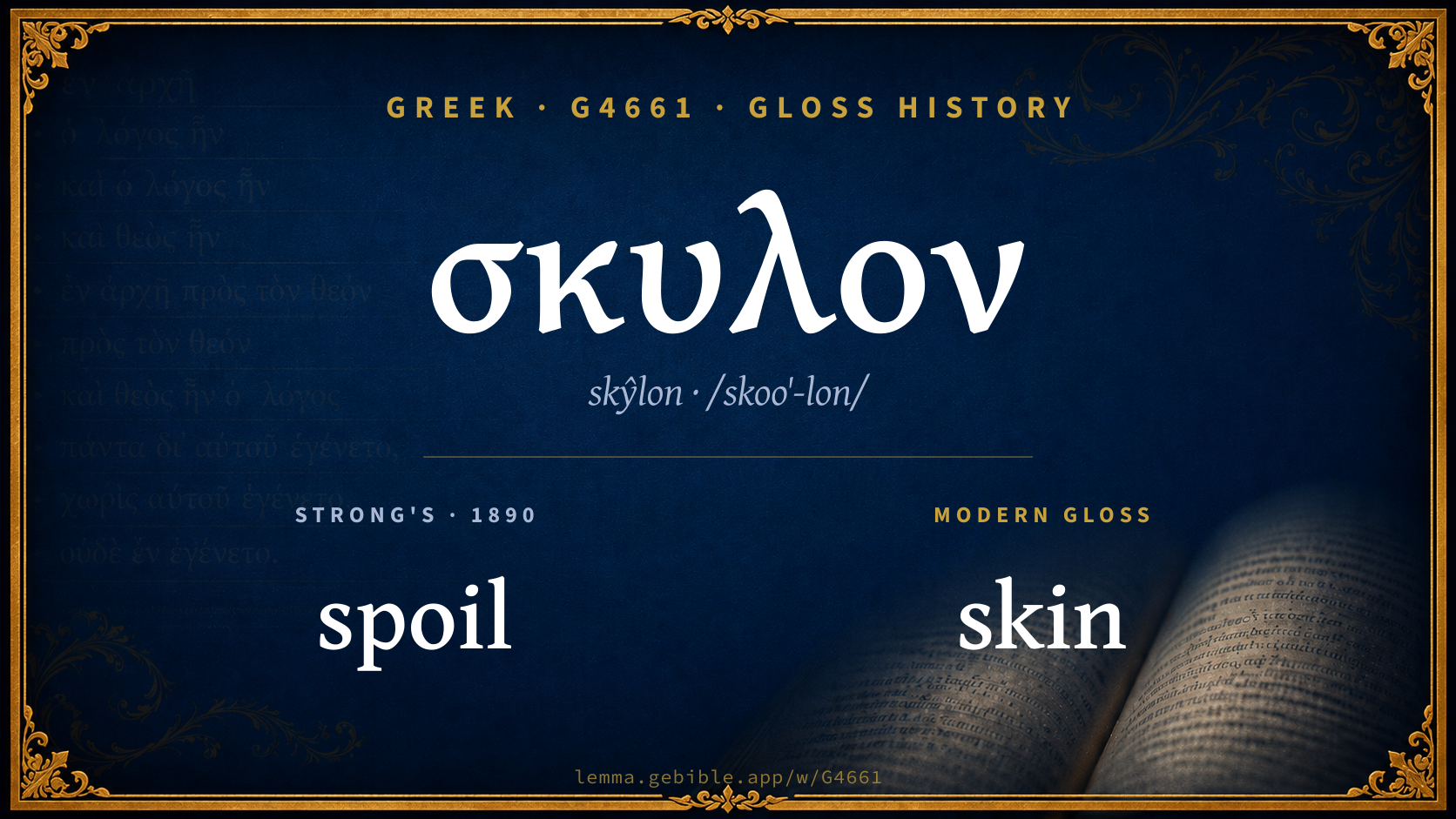
Gloss history
Strong's 1890 vs modern scholarship
About this word
Strong's G4661 catalogs a Greek word from the Greek New Testament.
These counts are not copied from any lexicon or concordance. They are computed here, from the morphology-tagged Greek New Testament. What Lemma adds →
- 1
- distinct verses
- The word appears in 1 distinct verse.
- 1 / 27
- NT books
- The word appears in 1 of 27 New Testament books.
- #3,503
- by frequency
- Top 5000 most frequent Greek words (rank 3,503 of 5,347 Greek words by occurrence).
View all 1 occurrence in the concordance →
Most concentrated in
- Luke 1 verse 100%
By section of the New Testament
By traditional corpus
Conventional, traditional groupings — biblical authorship is debated, so this is a traditional corpus grouping, not an authorship claim. Some books belong to more than one corpus (Luke is in both the Gospels and the Lukan corpus, and so on), so these shares overlap and need not total 100%. Each figure is a share of the word’s 1 distinct verse.
- Gospels 1 verse · 100%
- Lukan (Luke–Acts) 1 verse · 100%
How translations render this word
Counts come from each version’s own published word-to-Strong’s tagging or interlinear alignment — an approximate guide to how each version renders this word, not a word-level alignment the data otherwise carries. Because each total is that version’s own tagged count, the per-version totals vary from one another and need not match the appearance or distinct-verse counts above. These counts may also differ from a printed concordance because Lemma counts each distinctly tagged rendering and does not collapse phrase taggings into a single head-word total. This is a fixed set of word-tagged versions (KJV, ASV, BSB, ULT) and does not change with the reading translation you choose elsewhere. Each version’s license is shown beside its name below (and on Sources).
- King James Version: Spoils 1×
- American Standard Version: Spoils 1×
- Berean Standard Bible: Plunder 1×
- unfoldingWord Literal Text: Spoils 1×
King James Version Public Domain
Renders G4661 across 1 tagged occurrence — most commonly:
American Standard Version Public Domain
Renders G4661 across 1 tagged occurrence — most commonly:
Berean Standard Bible Public Domain
Renders G4661 across 1 tagged occurrence — most commonly:
unfoldingWord Literal Text CC BY-SA 4.0
Renders G4661 across 1 tagged occurrence — most commonly:
Senses in Thayer's
The 2 senses Thayer's distinguishes for this word, in lexicon order (not ranked by frequency or importance). The full entry — with sub-senses — is in the Lexicon Entry tab.
- a (beast's) skin stripped off, a pelt
- the weapons and valuables stripped off from an enemy, spoils
Word origin
Derived from σκυλλω (skýllō) (G4660) — to flay.
Neuter from G4660 ; something stripped (as a hide ) that is booty : - spoil.
— Strong’s Exhaustive Concordance (1890), public domain.
Septuagint usage
The same Greek word σκυλον appears 72 times in the Greek Old Testament (Septuagint), across 61 verses in 17 books.
- 72
- LXX occurrences
- Tagged occurrences of this Greek word in the Septuagint.
- 61
- verses
- Distinct Septuagint verses containing this word.
- 17 / 39
- OT books
- The word appears in 17 of the 39 Old Testament books.
Sample Septuagint occurrences
- Exodus 15:9 σκῦλον
- Numbers 31:11 σκῦλον
- Deuteronomy 2:35 σκῦλον
- Joshua 8:27 σκῦλον
- Judges 5:30 σκῦλον
- 1 Samuel 14:30 σκῦλον
- 2 Samuel 3:22 σκῦλον
- 2 Kings 3:23 σκῦλον
- 1 Chronicles 20:2 σκῦλον
- 2 Chronicles 14:12 σκῦλον
- Psalms 67:13 σκῦλον
- Proverbs 1:13 σκῦλον
Septuagint occurrences (same lexeme)
Every verse where the same Strong’s number (G4661) appears in the Greek Septuagint — showing the first 50 of 61. Verse text shown in the World English Bible for context; the Greek form is the matched word — the English is not keyword-highlighted.
- Exodus 15:9 σκῦλον The enemy said, 'I will pursue, I will overtake, I will divide the spoil. My desire shall be satisfied on them. I will draw my sword, my hand shall destroy them.'
- Numbers 31:11 σκῦλον They took all the spoil, and all the prey, both of man and of animal.
- Numbers 31:12 σκῦλον They brought the captives, and the prey, and the spoil, to Moses, and to Eleazar the priest, and to the congregation of the children of Israel, to the camp at the plains of Moab, which are by the Jordan at Jericho.
- Numbers 31:26 σκῦλον Take the sum of the prey that was taken, both of man and of animal, you, and Eleazar the priest, and the heads of the fathers' [houses] of the congregation;
- Numbers 31:27 σκῦλον and divide the prey into two parts: between the men skilled in war, who went out to battle, and all the congregation.
- Deuteronomy 2:35 σκῦλον only the cattle we took for a prey to ourselves, with the spoil of the cities which we had taken.
- Deuteronomy 3:7 σκῦλον But all the cattle, and the spoil of the cities, we took for a prey to ourselves.
- Deuteronomy 7:16 σκῦλον You shall consume all the peoples who Yahweh your God shall deliver to you; your eye shall not pity them: neither shall you serve their gods; for that will be a snare to you.
- Deuteronomy 13:17 σκῦλον There shall cleave nothing of the devoted thing to your hand; that Yahweh may turn from the fierceness of his anger, and show you mercy, and have compassion on you, and multiply you, as he has sworn to your fathers;
- Joshua 8:27 σκῦλον Only the cattle and the spoil of that city Israel took for prey to themselves, according to the word of Yahweh which he commanded Joshua.
- Joshua 11:14 σκῦλον All the spoil of these cities, and the cattle, the children of Israel took for a prey to themselves; but every man they struck with the edge of the sword, until they had destroyed them, neither left they any who breathed.
- Judges 5:30 σκῦλον Have they not found, have they not divided the spoil? A lady, two ladies to every man; To Sisera a spoil of dyed garments, A spoil of dyed garments embroidered, Of dyed garments embroidered on both sides, on the necks of the spoil?
- Judges 8:24 σκῦλον Gideon said to them, I would make a request of you, that you would give me every man the ear-rings of his spoil. (For they had golden ear-rings, because they were Ishmaelites.)
- Judges 8:25 σκῦλον They answered, We will willingly give them. They spread a garment, and did cast therein every man the ear-rings of his spoil.
- 1 Samuel 14:30 σκῦλον How much more, if haply the people had eaten freely today of the spoil of their enemies which they found? for now has there been no great slaughter among the Philistines.
- 1 Samuel 14:32 σκῦλον and the people flew on the spoil, and took sheep, and oxen, and calves, and killed them on the ground; and the people ate them with the blood.
- 1 Samuel 15:12 σκῦλον Samuel rose early to meet Saul in the morning; and it was told Samuel, saying, Saul came to Carmel, and, behold, he set him up a monument, and turned, and passed on, and went down to Gilgal.
- 1 Samuel 15:19 σκῦλον Why then didn't you obey the voice of Yahweh, but flew on the spoil, and did that which was evil in the sight of Yahweh?"
- 1 Samuel 15:21 σκῦλον But the people took of the spoil, sheep and oxen, the chief of the devoted things, to sacrifice to Yahweh your God in Gilgal.
- 1 Samuel 23:3 σκῦλον David's men said to him, Behold, we are afraid here in Judah: how much more then if we go to Keilah against the armies of the Philistines?
- 1 Samuel 30:16 σκῦλον When he had brought him down, behold, they were spread abroad over all the ground, eating and drinking, and dancing, because of all the great spoil that they had taken out of the land of the Philistines, and out of the land of Judah.
- 1 Samuel 30:19 σκῦλον There was nothing lacking to them, neither small nor great, neither sons nor daughters, neither spoil, nor anything that they had taken to them: David brought back all.
- 1 Samuel 30:20 σκῦλον David took all the flocks and the herds, [which] they drove before those [other] cattle, and said, This is David's spoil.
- 1 Samuel 30:22 σκῦλον Then answered all the wicked men and base fellows, of those who went with David, and said, Because they didn't go with us, we will not give them anything of the spoil that we have recovered, except to every man his wife and his children, that he may lead them away, and depart.
- 1 Samuel 30:26 σκῦλον When David came to Ziklag, he sent of the spoil to the elders of Judah, even to his friends, saying, Behold, a present for you of the spoil of the enemies of Yahweh:
- 2 Samuel 3:22 σκῦλον Behold, the servants of David and Joab came from a foray, and brought in a great spoil with them: but Abner was not with David in Hebron; for he had sent him away, and he was gone in peace.
- 2 Samuel 8:12 σκῦλον of Syria, and of Moab, and of the children of Ammon, and of the Philistines, and of Amalek, and of the spoil of Hadadezer, son of Rehob, king of Zobah.
- 2 Samuel 12:30 σκῦλον He took the crown of their king from off his head; and the weight of it was a talent of gold, and [in it were] precious stones; and it was set on David's head. He brought forth the spoil of the city, exceeding much.
- 2 Kings 3:23 σκῦλον and they said, This is blood; the kings are surely destroyed, and they have struck each man his fellow: now therefore, Moab, to the spoil.
- 1 Chronicles 20:2 σκῦλον David took the crown of their king from off his head, and found it to weigh a talent of gold, and there were precious stones in it; and it was set on David's head: and he brought forth the spoil of the city, exceeding much.
- 2 Chronicles 14:12 σκῦλον So Yahweh struck the Ethiopians before Asa, and before Judah; and the Ethiopians fled.
- 2 Chronicles 14:13 σκῦλον Asa and the people who were with him pursued them to Gerar: and there fell of the Ethiopians so many that they could not recover themselves; for they were destroyed before Yahweh, and before his host; and they carried away very much booty.
- 2 Chronicles 15:11 σκῦλον They sacrificed to Yahweh in that day, of the spoil which they had brought, seven hundred oxen and seven thousand sheep.
- 2 Chronicles 20:25 σκῦλον When Jehoshaphat and his people came to take the spoil of them, they found among them in abundance both riches and dead bodies, and precious jewels, which they stripped off for themselves, more than they could carry away: and they were three days in taking the spoil, it was so much.
- 2 Chronicles 24:23 σκῦλον It happened at the end of the year, that the army of the Syrians came up against him: and they came to Judah and Jerusalem, and destroyed all the princes of the people from among the people, and sent all the spoil of them to the king of Damascus.
- 2 Chronicles 25:13 σκῦλον But the men of the army whom Amaziah sent back, that they should not go with him to battle, fell on the cities of Judah, from Samaria even to Beth Horon, and struck of them three thousand, and took much spoil.
- 2 Chronicles 28:8 σκῦλον The children of Israel carried away captive of their brothers two hundred thousand, women, sons, and daughters, and took also away much spoil from them, and brought the spoil to Samaria.
- 2 Chronicles 28:14 σκῦλον So the armed men left the captives and the spoil before the princes and all the assembly.
- 2 Chronicles 28:15 σκῦλον The men who have been mentioned by name rose up, and took the captives, and with the spoil clothed all who were naked among them, and arrayed them, and shod them, and gave them to eat and to drink, and anointed them, and carried all the feeble of them on donkeys, and brought them to Jericho, the city of palm trees, to their brothers: then they returned to Samaria.
- Psalms 67:13 σκῦλον
- Psalms 118:162 σκῦλον
- Proverbs 1:13 σκῦλον We'll find all valuable wealth. We'll fill our houses with spoil.
- Proverbs 16:15 σκῦλον In the light of the king's face is life. His favor is like a cloud of the spring rain.
- Proverbs 31:11 σκῦλον The heart of her husband trusts in her. He shall have no lack of gain.
- Isaiah 8:1 σκῦλον Yahweh said to me, "Take a large tablet, and write on it with a man's pen, 'For Maher Shalal Hash Baz;'
- Isaiah 8:4 σκῦλον For before the child shall have knowledge to cry, My father, and, My mother, the riches of Damascus and the spoil of Samaria shall be carried away before the king of Assyria.
- Isaiah 9:2 σκῦλον The people who walked in darkness have seen a great light: those who lived in the land of the shadow of death, on them has the light shined.
- Isaiah 10:6 σκῦλον I will send him against a profane nation, and against the people of my wrath will I give him a charge, to take the spoil, and to take the prey, and to tread them down like the mire of the streets.
- Isaiah 33:4 σκῦλον Your spoil shall be gathered as the caterpillar gathers: as locusts leap shall men leap on it.
- Isaiah 49:24 σκῦλον Shall the prey be taken from the mighty, or the lawful captives be delivered?
These are occurrences of the same Greek lexeme (G4661) in the Septuagint — not a translation of any one Hebrew word. The store carries no word-level Hebrew↔Greek alignment, so no Hebrew original is asserted here. Counts come from the recovered LXX Strong's tagging — high-frequency vocabulary is well covered, while rare or late forms may be untagged — so they reflect tagged occurrences and may slightly undercount.