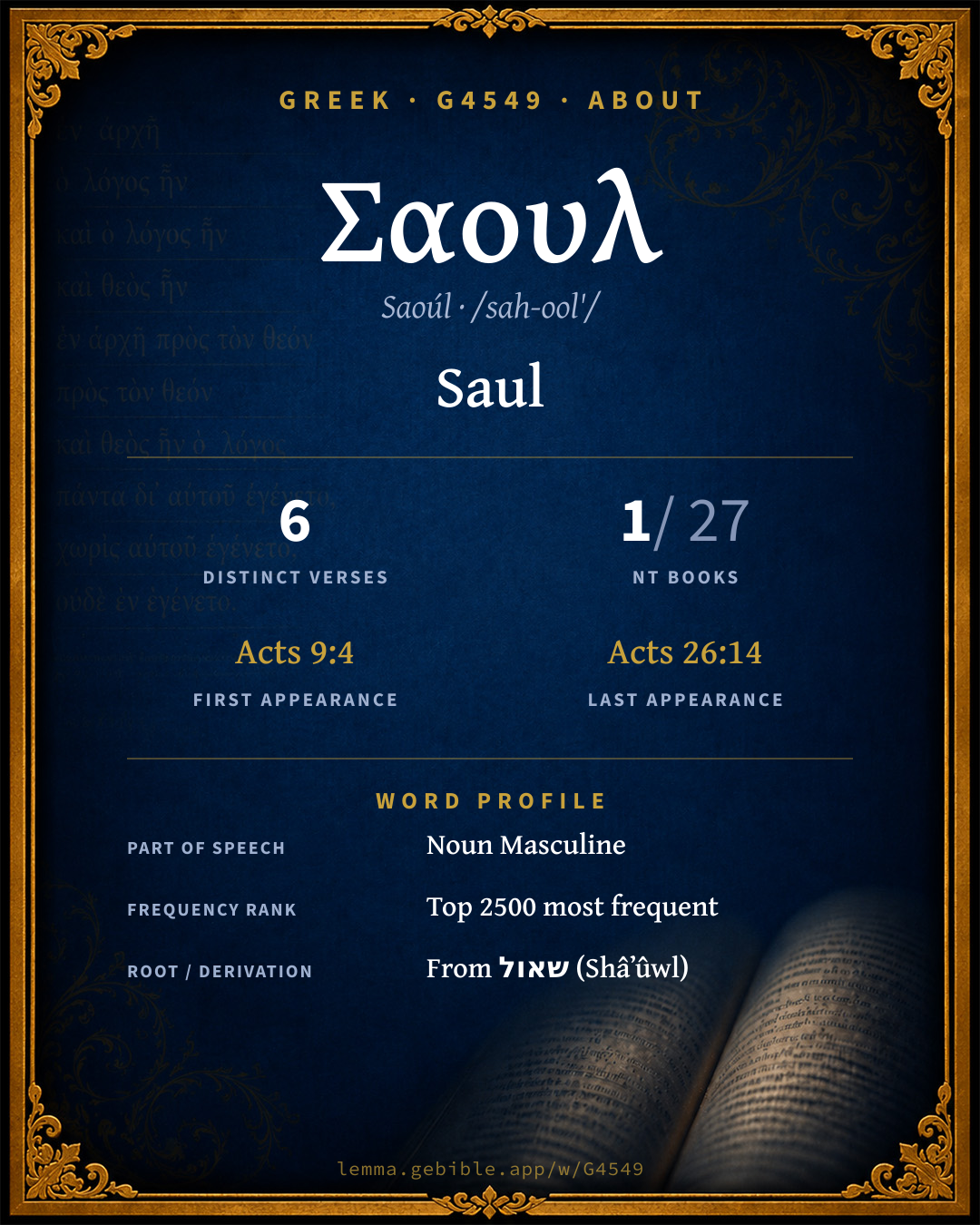
Σαούλ
Saul
Thayer's lists 3 entries for ‘Saul’ fuller range ↓
Full lexicon entry — Thayer's Greek Lexicon
From Thayer's Greek Lexicon
Where this word appears
Every verse where G4549 appears — 6 distinct verses across 1 book. Click any verse to open its interlinear word-by-word view. Verse text shown in the World English Bible for context — . Each verse’s Greek form is shown with its reference; the English is not keyword-highlighted, since the data carries no word-level English alignment. Use “Compare translations” on any verse to read it across multiple English versions. This concordance covers the Greek New Testament; Septuagint (Greek Old Testament) occurrences of this word are not indexed here.
Acts 6 verses
- Acts 9:4 Σαοὺλ Σαούλ n proper indecl n proper indecl He fell on the earth, and heard a voice saying to him, "Saul, Saul, why do you persecute me?"
- Acts 9:17 Σαοὺλ n proper indecl Ananias departed, and entered into the house. Laying his hands on him, he said, "Brother Saul, the Lord, who appeared to you on the road by which you came, has sent me, that you may receive your sight, and be filled with the Holy Spirit."
- Acts 13:21 Σαοὺλ n proper indecl Afterward they asked for a king, and God gave to them Saul the son of Kish, a man of the tribe of Benjamin, for forty years.
- Acts 22:7 Σαοὺλ Σαούλ n proper indecl n proper indecl I fell to the ground, and heard a voice saying to me, 'Saul, Saul, why are you persecuting me?'
- Acts 22:13 Σαοὺλ n proper indecl came to me, and standing by me said to me, 'Brother Saul, receive your sight!' In that very hour I looked up at him.
- Acts 26:14 Σαοὺλ Σαούλ n proper indecl n proper indecl When we had all fallen to the earth, I heard a voice saying to me in the Hebrew language, 'Saul, Saul, why are you persecuting me? It is hard for you to kick against the goads.'
About this entry
At a glance — auto-summarized from this page’s data, not written by a person. Every figure links to its source below. This summary describes the numbers; it doesn’t interpret them.
Σαουλ (Saoúl) is a Greek name most often rendered “Saul.” Acts dominates its distribution — 6 of 6 verses. Spanning 6 verses in 1 book, it ranks among the uncommon words of the Greek New Testament. Scripture first uses it in Acts 9:4. The sections below give every occurrence and version rendering.
Gloss history
Strong's 1890 vs modern scholarship
About this word
Strong's G4549 catalogs a Greek word from the Greek New Testament.
These counts are not copied from any lexicon or concordance. They are computed here, from the morphology-tagged Greek New Testament. What Lemma adds →
- 6
- distinct verses
- The word appears in 6 distinct verses.
- 1 / 27
- NT books
- The word appears in 1 of 27 New Testament books.
- #1,140
- by frequency
- Top 2500 most frequent Greek words (rank 1,140 of 5,347 Greek words by occurrence).
View all 6 occurrences in the concordance →
Most concentrated in
- Acts 6 verses 100%
By section of the New Testament
By traditional corpus
Conventional, traditional groupings — biblical authorship is debated, so this is a traditional corpus grouping, not an authorship claim. Some books belong to more than one corpus (Luke is in both the Gospels and the Lukan corpus, and so on), so these shares overlap and need not total 100%. Each figure is a share of the word’s 6 distinct verses.
- Lukan (Luke–Acts) 6 verses · 100%
How translations render this word
Counts come from each version’s own published word-to-Strong’s tagging or interlinear alignment — an approximate guide to how each version renders this word, not a word-level alignment the data otherwise carries. Because each total is that version’s own tagged count, the per-version totals vary from one another and need not match the appearance or distinct-verse counts above. These counts may also differ from a printed concordance because Lemma counts each distinctly tagged rendering and does not collapse phrase taggings into a single head-word total. This is a fixed set of word-tagged versions (KJV, ASV, BSB, ULT) and does not change with the reading translation you choose elsewhere. Each version’s license is shown beside its name below (and on Sources).
- King James Version: Saul 9×
- American Standard Version: Saul 9×
- Berean Standard Bible: Saul 9×
King James Version Public Domain
Renders G4549 across 9 tagged occurrences — most commonly:
American Standard Version Public Domain
Renders G4549 across 9 tagged occurrences — most commonly:
Berean Standard Bible Public Domain
Renders G4549 across 9 tagged occurrences — most commonly:
Senses in Thayer's
The 3 senses Thayer's distinguishes for this word, in lexicon order (not ranked by frequency or importance). The full entry — with sub-senses — is in the Lexicon Entry tab.
- Saul = "desired"
- the Jewish name of the apostle Paul
- the son of Kish and the first king of Israel
Word origin
Derived from שאול (Shâʼûwl) (H7586) — Saul.
Forms in the corpus
Same root — word family
Other Thayer's entries built from the same root as G4549, grouped by Strong’s listed origin. These share a root / origin per the lexicon — not necessarily a shared meaning. Each links to that word’s own entry.
Derives from
Proper names from this root
People and places named from this root — a name, not an additional meaning of the word.
Compare all same-root words → 2 of the same-root words are proper names (people or places). They share a root, not necessarily a meaning.
Bible dictionary
Public-domain dictionary articles matched to this entry by name (Saul). A biblical name can be shared by more than one person or place, so an article may treat several.
Easton's Bible Dictionary · M. G. Easton, 1897
Asked for. (1.) A king of Edom (Gen. 36:37, 38); called Shaul in 1 Chr. 1:48.
(2.) The son of Kish (probably his only son, and a child of prayer, "asked for"), of the tribe of Benjamin, the first king of the Jewish nation. The singular providential circumstances connected with his election as king are recorded in 1 Sam. 8-10. His father's she-asses had strayed, and Saul was sent with a servant to seek for them. Leaving his home at Gibeah (10:5, "the hill of God," A.V.; lit., as in R.V. marg., "Gibeah of God"), Saul and his servant went toward the north-west over Mount Ephraim, and then turning north-east they came to "the land of Shalisha," and thence eastward to the land of Shalim, and at length came to the district of Zuph, near Samuel's home at Ramah (9:5-10). At this point Saul proposed to return from the three days' fruitless search, but his servant suggested that they should first consult the "seer." Hearing that he was about to offer sacrifice, the two hastened into Ramah, and "behold, Samuel came out against them," on his way to the "bamah", i.e., the "height", where sacrifice was to be offered; and in answer to Saul's question, "Tell me, I pray thee, where the seer's house is," Samuel made himself known to him. Samuel had been divinely prepared for his coming (9:15-17), and received Saul as his guest. He took him with him to the sacrifice, and then after the feast "communed with Saul upon the top of the house" of all that was in his heart. On the morrow Samuel "took a vial of oil and poured it on his head," and anointed Saul as king over Israel (9:25-10:8), giving him three signs in confirmation of his call to be king. When Saul reached his home in Gibeah the last of these signs was fulfilled, and the Sprit of God came upon him, and "he was turned into another man." The simple countryman was transformed into the king of Israel, a remarkable change suddenly took place in his whole demeanour, and the people said in their astonishment, as they looked on the stalwart son of Kish, "Is Saul also among the prophets?", a saying which passed into a "proverb." (Comp. 19:24.)
The intercourse between Saul and Samuel was as yet unknown to the people. The "anointing" had been in secret. But now the time had come when the transaction must be confirmed by the nation. Samuel accordingly summoned the people to a solemn assembly "before the Lord" at Mizpeh. Here the lot was drawn (10:17-27), and it fell upon Saul, and when he was presented before them, the stateliest man in all Israel, the air was rent for the first time in Israel by the loud cry, "God save the king!" He now returned to his home in Gibeah, attended by a kind of bodyguard, "a band of men whose hearts God had touched." On reaching his home he dismissed them, and resumed the quiet toils of his former life.
Soon after this, on hearing of the conduct of Nahash the Ammonite at Jabeshgilead (q.v.), an army out of all the tribes of Israel rallied at his summons to the trysting-place at Bezek, and he led them forth a great army to battle, gaining a complete victory over the Ammonite invaders at Jabesh (11:1-11). Amid the universal joy occasioned by this victory he was now fully recognized as the king of Israel. At the invitation of Samuel "all the people went to Gilgal, and there they made Saul king before the Lord in Gilgal." Samuel now officially anointed him as king (11:15). Although Samuel never ceased to be a judge in Israel, yet now his work in that capacity practically came to an end.
Saul now undertook the great and difficult enterprise of freeing the land from its hereditary enemies the Philistines, and for this end he gathered together an army of 3,000 men (1 Sam. 13:1, 2). The Philistines were encamped at Geba. Saul, with 2,000 men, occupied Michmash and Mount Bethel; while his son Jonathan, with 1,000 men, occupied Gibeah, to the south of Geba, and seemingly without any direction from his father "smote" the Philistines in Geba. Thus roused, the Philistines, who gathered an army of 30,000 chariots and 6,000 horsemen, and "people as the sand which is on the sea-shore in multitude," encamped in Michmash, which Saul had evacuated for Gilgal. Saul now tarried for seven days in Gilgal before making any movement, as Samuel had appointed (10:8); but becoming impatient on the seventh day, as it was drawing to a close, when he had made an end of offering the burnt offering, Samuel appeared and warned him of the fatal consequences of his act of disobedience, for he had not waited long enough (13:13, 14).
When Saul, after Samuel's departure, went out from Gilgal with his 600 men, his followers having decreased to that number (13:15), against the Philistines at Michmash (q.v.), he had his head-quarters under a pomegrante tree at Migron, over against Michmash, the Wady esSuweinit alone intervening. Here at Gibeah-Geba Saul and his army rested, uncertain what to do. Jonathan became impatient, and with his armour-bearer planned an assault against the Philistines, unknown to Saul and the army (14:1-15). Jonathan and his armour-bearer went down into the wady, and on their hands and knees climbed to the top of the narrow rocky ridge called Bozez, where was the outpost of the Philistine army. They surprised and then slew twenty of the Philistines, and immediately the whole host of the Philistines was thrown into disorder and fled in great terror. "It was a very great trembling;" a supernatural panic seized the host. Saul and his 600 men, a band which speedily increased to 10,000, perceiving the confusion, pursued the army of the Philistines, and the tide of battle rolled on as far as to Bethaven, halfway between Michmash and Bethel. The Philistines were totally routed. "So the Lord saved Israel that day." While pursuing the Philistines, Saul rashly adjured the people, saying, "Cursed be the man that eateth any food until evening." But though faint and weary, the Israelites "smote the Philistines that day from Michmash to Aijalon" (a distance of from 15 to 20 miles). Jonathan had, while passing through the wood in pursuit of the Philistines, tasted a little of the honeycomb which was abundant there (14:27). This was afterwards discovered by Saul (ver. 42), and he threatened to put his son to death. The people, however, interposed, saying, "There shall not one hair of his head fall to the ground." He whom God had so signally owned, who had "wrought this great salvation in Israel," must not die. "Then Saul went up from following the Philistines: and the Philistines went to their own place" (1 Sam. 14:24-46); and thus the campaign against the Philistines came to an end. This was Saul's second great military success.
Saul's reign, however, continued to be one of almost constant war against his enemies round about (14:47, 48), in all of which he proved victorious. The war against the Amalekites is the only one which is recorded at length (1 Sam. 15). These oldest and hereditary (Ex. 17:8; Num. 14:43-45) enemies of Israel occupied the territory to the south and south-west of Palestine. Samuel summoned Saul to execute the "ban" which God had pronounced (Deut. 25:17-19) on this cruel and relentless foe of Israel. The cup of their iniquity was now full. This command was "the test of his moral qualification for being king." Saul proceeded to execute the divine command; and gathering the people together, marched from Telaim (1 Sam. 15:4) against the Amalekites, whom he smote "from Havilah until thou comest to Shur," utterly destroying "all the people with the edge of the sword", i.e., all that fell into his hands. He was, however, guilty of rebellion and disobedience in sparing Agag their king, and in conniving at his soldiers' sparing the best of the sheep and cattle; and Samuel, following Saul to Gilgal, in the Jordan valley, said unto him, "Because thou hast rejected the word of the Lord, he also hath rejected thee from being king" (15:23). The kingdom was rent from Saul and was given to another, even to David, whom the Lord chose to be Saul's successor, and whom Samuel anointed (16:1-13). From that day "the spirit of the Lord departed from Saul, and an evil spirit from the Lord troubled him." He and Samuel parted only to meet once again at one of the schools of the prophets.
David was now sent for as a "cunning player on an harp" (1 Sam. 16:16, 18), to play before Saul when the evil spirit troubled him, and thus was introduced to the court of Saul. He became a great favourite with the king. At length David returned to his father's house and to his wonted avocation as a shepherd for perhaps some three years. The Philistines once more invaded the land, and gathered their army between Shochoh and Azekah, in Ephes-dammim, on the southern slope of the valley of Elah. Saul and the men of Israel went forth to meet them, and encamped on the northern slope of the same valley which lay between the two armies. It was here that David slew Goliath of Gath, the champion of the Philistines (17:4-54), an exploit which led to the flight and utter defeat of the Philistine army. Saul now took David permanently into his service (18:2); but he became jealous of him (ver. 9), and on many occasions showed his enmity toward him (ver. 10, 11), his enmity ripening into a purpose of murder which at different times he tried in vain to carry out.
After some time the Philistines "gathered themselves together" in the plain of Esdraelon, and pitched their camp at Shunem, on the slope of Little Hermon; and Saul "gathered all Israel together," and "pitched in Gilboa" (1 Sam. 28:3-14). Being unable to discover the mind of the Lord, Saul, accompanied by two of his retinue, betook himself to the "witch of Endor," some 7 or 8 miles distant. Here he was overwhelmed by the startling communication that was mysteriously made to him by Samuel (ver. 16-19), who appeared to him. "He fell straightway all along on the earth, and was sore afraid, because of the words of Samuel" (ver. 20). The Philistine host "fought against Israel: and the men of Israel fled before the Philistines, and fell down slain in Mount Gilboa" (31:1). In his despair at the disaster that had befallen his army, Saul "took a sword and fell upon it." And the Philistines on the morrow "found Saul and his three sons fallen in Mount Gilboa." Having cut off his head, they sent it with his weapons to Philistia, and hung up the skull in the temple of Dagon at Ashdod. They suspended his headless body, with that of Jonathan, from the walls of Bethshan. The men of Jabesh-gilead afterwards removed the bodies from this position; and having burnt the flesh, they buried the bodies under a tree at Jabesh. The remains were, however, afterwards removed to the family sepulchre at Zelah (2 Sam. 21:13, 14). (See DAVID.)
(3.) "Who is also called Paul" (q.v.), the circumcision name of the apostle, given to him, perhaps, in memory of King Saul (Acts 7:58; 8:1; 9:1).
Smith's Bible Dictionary · William Smith, 1863
(desired), more accurately Shaul.
+ One of the early kings of Edom, and successor of Samlah. (Genesis 36:37,38; 1 Chronicles 1:48) (B.C. after 1450.) + The first king of Israel, the son of Kish, and of the tribe of Benjamin. (B.C, 1095-1055.) His character is in part illustrated by the fierce, wayward, fitful nature of the tribe and in part accounted for by the struggle between the old and new systems in which he found himself involved. To this we must add a taint of madness. which broke out in violent frenzy at times leaving him with long lucid intervals. He was remarkable for his strength and activity, (2 Samuel 1:25) and, like the Homeric heroes, of gigantic stature, taller by head and shoulders than the rest of the people, and of that kind of beauty denoted by the Hebrew word "good," (1 Samuel 9:2) and which caused him to be compared to the gazelle, "the gazelle of Israel." His birthplace is not expressly mentioned; but, as Zelah in Benjamin was the place of Kish's sepulchre. (2 Samuel 21:14) it was probable; his native village. His father, Kish, was a powerful and wealthy chief though the family to which he belonged was of little importance. (1 Samuel 9:1,21) A portion of his property consisted of a drove of asses. In search of these asses, gone astray on the mountains, he sent his son Saul It was while prosecuting this adventure that Saul met with Samuel for the first time at his home in Ramah, five miles north of Jerusalem. A divine intimation had made known to him the approach of Saul, whom he treated with special favor, and the next morning descending with him to the skirts of the town, Samuel poured over Saul's head the consecrated oil, and with a kiss of salutation announced to him that he was to be the ruler of the nation. (1 Samuel 9:25; 1 Samuel 10:1) Returning homeward his call was confirmed by the incidents which according to Samuel's prediction, awaited him. (1 Samuel 10:9,10) What may be named the public call occurred at Mizpeh, when lots were cast to find the tribe and family which was to produce the king, and Saul, by a divine intimation was found hid in the circle of baggage which surrounded the encampment. (1 Samuel 10:17-24) Returning to Gibeah, apparently to private life, he heard the threat issued by Nahash king of Ammon against Jabesh-gilead. He speedily collected an army, and Jabesh was rescued. The effect was instantaneous on the people, and the monarchy was inaugurated anew at Gilgal. (1 Samuel 11:1-15) It should be, however, observed that according to (1 Samuel 12:12) the affair of Nahash preceded and occasioned the election of Saul. Although king of Israel, his rule was at first limited; but in the second year of his reign he began to organize an attempt to shake off the Philistine yoke, and an army was formed. In this crisis, Saul, now on the very confines of his kingdom at Gilgal, impatient at Samuel's delay, whom he had directed to be present, offered sacrifice himself. Samuel, arriving later, pronounced the first curse, on his impetuous zeal. (1 Samuel 13:5-14) After the Philistines were driven back to their own country occurred the first appearance of Saul's madness in the rash vow which all but cost the life of his soil. (1 Samuel 14:24; 44) The expulsion of the Philistines, although not entirely completed, ch. (1 Samuel 14:52) at once placed Saul in a position higher than that of any previous ruler of Israel, and he made war upon the neighboring tribes. In the war with Amalek, ch. (1 Samuel 14:48; 15:1-9) he disobeyed the prophetical command of Samuel, which called down the second curse, and the first distinct intimation of the transference of the kingdom to a rival. The rest of Saul's life is one long tragedy. The frenzy which had given indications of itself before now at times took almost entire possession of him. In this crisis David was recommended to him. From this time forward their lives are blended together. [David] In Saul's better moments he never lost the strong affection which he had contracted for David. Occasionally, too his prophetical gift returned, blended with his madness. (2 Samuel 19:24) But his acts of fierce, wild zeal increased. At last the monarchy itself broke down under the weakness of his head. The Philistines re-entered the country, and just before giving them battle Saul's courage failed and he consulted one of the necromancers, the "Witch of Endor," who had escaped his persecution. At this distance of time it is impossible to determine the relative amount of fraud or of reality in the scene which follows, though the obvious meaning of the narrative itself tends to the hypothesis of some kind of apparition. ch. (2 Samuel 19:28) On hearing the denunciation which the apparition conveyed, Saul fell the whole length of his gigantic stature on the ground, and remained motionless till the woman and his servants forced him to eat. The next day the battle came on. The Israelites were driven up the side of Gilboa. The three sons of Saul were slain. Saul was wounded. According to one account, he fell upon his own sword, (1 Samuel 31:4) and died. The body on being found by the Philistines was stripped slid decapitated, and the headless trunk hung over the city walls, with those of his three sons. ch. (1 Samuel 31:9,10) The head was deposited (probably at Ashdod) in the temple of Dagon (1 Chronicles 10:10) The corpse was buried at Jabesh-gilead. (1 Samuel 31:13) + The Jewish name of St. Paul.
Hitchcock's Bible Names Dictionary · Roswell D. Hitchcock, 1869
demanded; lent; ditch; death
Classic public-domain reference works; full attribution on Sources.
Septuagint usage
The same Greek word Σαουλ appears 380 times in the Greek Old Testament (Septuagint), across 313 verses in 8 books.
- 380
- LXX occurrences
- Tagged occurrences of this Greek word in the Septuagint.
- 313
- verses
- Distinct Septuagint verses containing this word.
- 8 / 39
- OT books
- The word appears in 8 of the 39 Old Testament books.
Sample Septuagint occurrences
- Genesis 36:37 σαουλ
- Exodus 6:15 σαουλ
- Numbers 26:13 σαουλ
- 1 Samuel 9:2 σαούλ
- 2 Samuel 1:1 σαούλ
- 1 Chronicles 1:36 σαούλ
- Psalms 17:1 σαούλ
- Isaiah 10:29 σαούλ
Septuagint occurrences (same lexeme)
Every verse where the same Strong’s number (G4549) appears in the Greek Septuagint — showing the first 50 of 313. Verse text shown in the World English Bible for context; the Greek form is the matched word — the English is not keyword-highlighted.
- Genesis 36:37 σαουλ Samlah died, and Shaul of Rehoboth by the river, reigned in his place.
- Genesis 36:38 σαουλ Shaul died, and Baal Hanan, the son of Achbor reigned in his place.
- Genesis 46:10 σαουλ The sons of Simeon: Jemuel, Jamin, Ohad, Jachin, Zohar, and Shaul the son of a Canaanite woman.
- Exodus 6:15 σαουλ The sons of Simeon: Jemuel, and Jamin, and Ohad, and Jachin, and Zohar, and Shaul the son of a Canaanite woman; these are the families of Simeon.
- Numbers 26:13 σαουλ of Zerah, the family of the Zerahites; of Shaul, the family of the Shaulites.
- 1 Samuel 9:2 σαούλ He had a son, whose name was Saul, an impressive young man; and there was not among the children of Israel a better person than he. From his shoulders and upward he was higher than any of the people.
- 1 Samuel 9:3 σαούλ The donkeys of Kish, Saul's father, were lost. Kish said to Saul his son, Take now one of the servants with you, and arise, go seek the donkeys.
- 1 Samuel 9:5 σαούλ When they had come to the land of Zuph, Saul said to his servant who was with him, Come, and let us return, lest my father leave off caring for the donkeys, and be anxious for us.
- 1 Samuel 9:7 σαούλ Then said Saul to his servant, But, behold, if we go, what shall we bring the man? for the bread is spent in our vessels, and there is not a present to bring to the man of God: what have we?
- 1 Samuel 9:8 σαούλ The servant answered Saul again, and said, Behold, I have in my hand the fourth part of a shekel of silver: that will I give to the man of God, to tell us our way.
- 1 Samuel 9:10 σαούλ Then said Saul to his servant, Well said; come, let us go. So they went to the city where the man of God was.
- 1 Samuel 9:15 σαούλ Now Yahweh had revealed to Samuel a day before Saul came, saying,
- 1 Samuel 9:17 σαούλ When Samuel saw Saul, Yahweh said to him, Behold, the man of whom I spoke to you! this same shall have authority over my people.
- 1 Samuel 9:18 σαούλ Then Saul drew near to Samuel in the gate, and said, Tell me, Please, where the seer's house is.
- 1 Samuel 9:19 σαούλ Samuel answered Saul, and said, I am the seer; go up before me to the high place, for you shall eat with me today: and in the morning I will let you go, and will tell you all that is in your heart.
- 1 Samuel 9:21 σαούλ Saul answered, Am I not a Benjamite, of the smallest of the tribes of Israel? and my family the least of all the families of the tribe of Benjamin? why then speak you to me after this manner?
- 1 Samuel 9:22 σαούλ Samuel took Saul and his servant, and brought them into the guest-chamber, and made them sit in the best place among those who were invited, who were about thirty persons.
- 1 Samuel 9:24 σαούλ The cook took up the thigh, and that which was on it, and set it before Saul. [Samuel] said, Behold, that which has been reserved! set it before you and eat; because to the appointed time has it been kept for you, for I said, I have invited the people. So Saul ate with Samuel that day.
- 1 Samuel 9:25 σαούλ When they were come down from the high place into the city, he talked with Saul on the housetop.
- 1 Samuel 9:26 σαούλ They arose early: and it happened about the spring of the day, that Samuel called to Saul on the housetop, saying, Up, that I may send you away. Saul arose, and they went out both of them, he and Samuel, abroad.
- 1 Samuel 9:27 σαούλ As they were going down at the end of the city, Samuel said to Saul, Bid the servant pass on before us (and he passed on), but stand you still first, that I may cause you to hear the word of God.
- 1 Samuel 10:11 σαούλ It happened, when all who knew him before saw that, behold, he prophesied with the prophets, then the people said one to another, What is this that is come to the son of Kish? Is Saul also among the prophets?
- 1 Samuel 10:12 σαούλ One of the same place answered, Who is their father? Therefore it became a proverb, Is Saul also among the prophets?
- 1 Samuel 10:15 σαούλ Saul's uncle said, Tell me, Please, what Samuel said to you.
- 1 Samuel 10:16 σαούλ Saul said to his uncle, He told us plainly that the donkeys were found. But concerning the matter of the kingdom, of which Samuel spoke, he didn't tell him.
- 1 Samuel 10:21 σαούλ He brought the tribe of Benjamin near by their families; and the family of the Matrites was taken; and Saul the son of Kish was taken: but when they sought him, he could not be found.
- 1 Samuel 10:26 σαούλ Saul also went to his house to Gibeah; and there went with him the host, whose hearts God had touched.
- 1 Samuel 11:4 σαούλ Then came the messengers to Gibeah of Saul, and spoke these words in the ears of the people: and all the people lifted up their voice, and wept.
- 1 Samuel 11:5 σαούλ Behold, Saul came following the oxen out of the field; and Saul said, What ails the people that they weep? They told him the words of the men of Jabesh.
- 1 Samuel 11:6 σαούλ The Spirit of God came mightily on Saul when he heard those words, and his anger was kindled greatly.
- 1 Samuel 11:7 σαούλ He took a yoke of oxen, and cut them in pieces, and sent them throughout all the borders of Israel by the hand of messengers, saying, Whoever doesn't come forth after Saul and after Samuel, so shall it be done to his oxen. The dread of Yahweh fell on the people, and they came out as one man.
- 1 Samuel 11:11 σαούλ It was so on the next day, that Saul put the people in three companies; and they came into the midst of the camp in the morning watch, and struck the Ammonites until the heat of the day: and it happened, that those who remained were scattered, so that no two of them were left together.
- 1 Samuel 11:12 σαούλ The people said to Samuel, Who is he who said, Shall Saul reign over us? bring the men, that we may put them to death.
- 1 Samuel 11:13 σαούλ Saul said, There shall not a man be put to death this day; for today Yahweh has worked deliverance in Israel.
- 1 Samuel 11:15 σαούλ All the people went to Gilgal; and there they made Saul king before Yahweh in Gilgal; and there they offered sacrifices of peace-offerings before Yahweh; and there Saul and all the men of Israel rejoiced greatly.
- 1 Samuel 13:2 σαούλ Saul chose him three thousand men of Israel, of which two thousand were with Saul in Michmash and in the Mount of Bethel, and one thousand were with Jonathan in Gibeah of Benjamin: and the rest of the people he sent every man to his tent.
- 1 Samuel 13:3 σαούλ Jonathan struck the garrison of the Philistines that was in Geba: and the Philistines heard of it. Saul blew the trumpet throughout all the land, saying, Let the Hebrews hear.
- 1 Samuel 13:4 σαούλ All Israel heard say that Saul had struck the garrison of the Philistines, and also that Israel was had in abomination with the Philistines. The people were gathered together after Saul to Gilgal.
- 1 Samuel 13:7 σαούλ Now some of the Hebrews had gone over the Jordan to the land of Gad and Gilead; but as for Saul, he was yet in Gilgal, and all the people followed him trembling.
- 1 Samuel 13:9 σαούλ Saul said, Bring here the burnt offering to me, and the peace-offerings. He offered the burnt offering.
- 1 Samuel 13:10 σαούλ It came to pass that as soon as he had made an end of offering the burnt offering, behold, Samuel came; and Saul went out to meet him, that he might greet him.
- 1 Samuel 13:11 σαούλ Samuel said, What have you done? Saul said, Because I saw that the people were scattered from me, and that you didn't come within the days appointed, and that the Philistines assembled themselves together at Michmash;
- 1 Samuel 13:13 σαούλ Samuel said to Saul, You have done foolishly; you have not kept the commandment of Yahweh your God, which he commanded you: for now would Yahweh have established your kingdom on Israel forever.
- 1 Samuel 13:15 σαούλ Samuel arose, and got him up from Gilgal to Gibeah of Benjamin. Saul numbered the people who were present with him, about six hundred men.
- 1 Samuel 13:16 σαούλ Saul, and Jonathan his son, and the people who were present with them, abode in Geba of Benjamin: but the Philistines encamped in Michmash.
- 1 Samuel 13:22 σαούλ So it came to pass in the day of battle, that there was neither sword nor spear found in the hand of any of the people who were with Saul and Jonathan: but with Saul and with Jonathan his son was there found.
- 1 Samuel 14:1 σαούλ Now it fell on a day, that Jonathan the son of Saul said to the young man who bore his armor, Come, and let us go over to the Philistines' garrison, that is on yonder side. But he didn't tell his father.
- 1 Samuel 14:2 σαούλ Saul abode in the uttermost part of Gibeah under the pomegranate tree which is in Migron: and the people who were with him were about six hundred men;
- 1 Samuel 14:16 σαούλ The watchmen of Saul in Gibeah of Benjamin looked; and, behold, the multitude melted away, and they went [here] and there.
- 1 Samuel 14:17 σαούλ Then said Saul to the people who were with him, Number now, and see who is gone from us. When they had numbered, behold, Jonathan and his armor bearer were not there.
These are occurrences of the same Greek lexeme (G4549) in the Septuagint — not a translation of any one Hebrew word. The store carries no word-level Hebrew↔Greek alignment, so no Hebrew original is asserted here. Counts come from the recovered LXX Strong's tagging — high-frequency vocabulary is well covered, while rare or late forms may be untagged — so they reflect tagged occurrences and may slightly undercount.