
2 Chronicles 20:28

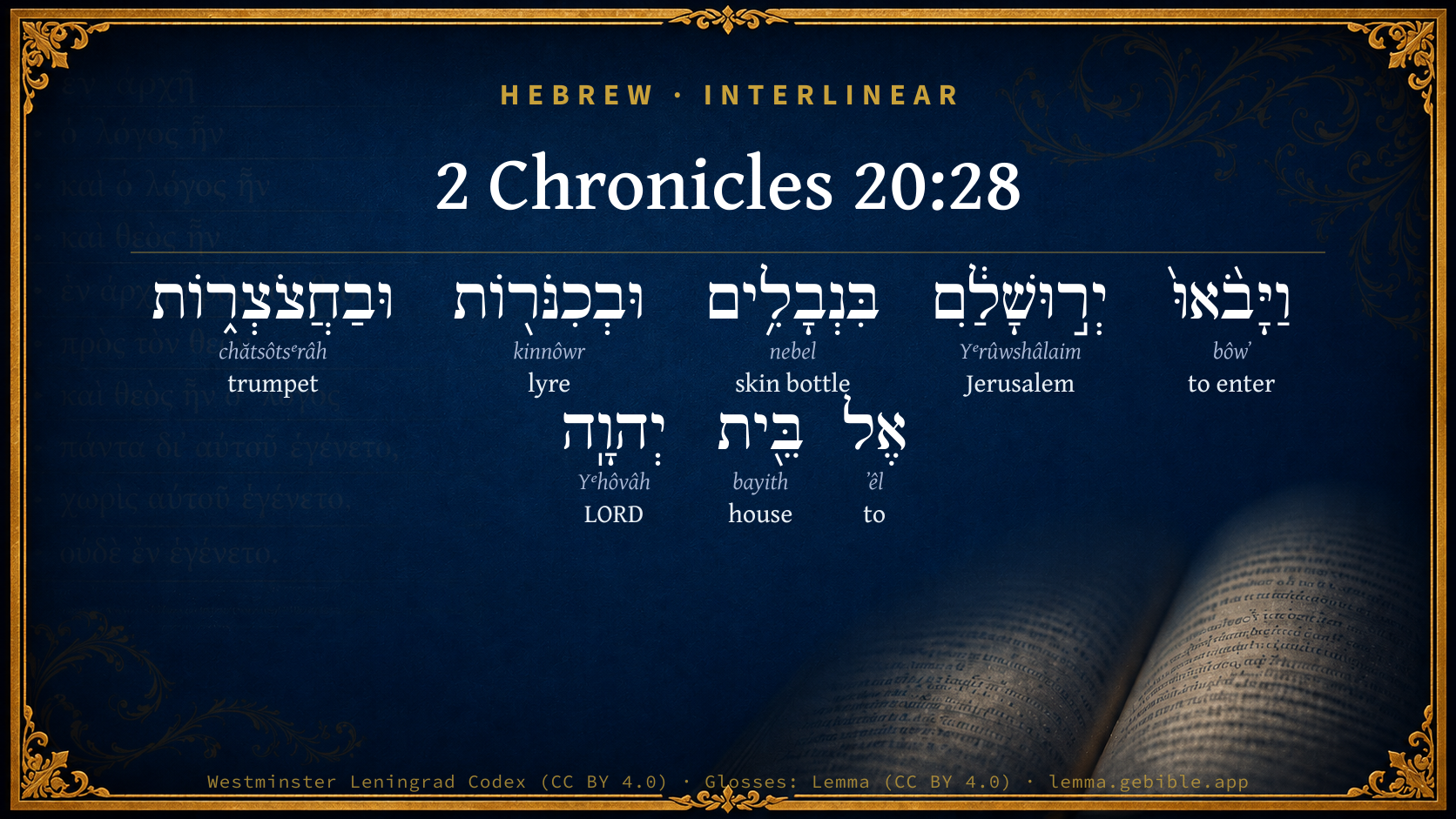
Hebrew (Westminster Leningrad Codex) 2 Chronicles 20:28 appears in the Hebrew Old Testament. The text above is from the Westminster Leningrad Codex. Each word links to its Strong’s number, a concise gloss, and parsing drawn from the Open Scriptures Hebrew Bible morphology. Click any word for its full Brown-Driver-Briggs (BDB) entry.
Download image
Cite this verse

2 Chronicles 20:28 (World English Bible). Public Domain. Lemma interlinear Bible study tool, https://lemma.gebible.app/v/2-chronicles/20/28.

Show BibTeX & RIS
BibTeX
RIS
English Translation
They came to Jerusalem with psalteries and harps and trumpets to the house of Yahweh.
World English Bible · Public Domain
Download a study sheet

One document with this verse’s original text, its word-by-word gloss line, the meaning frame, cross-references with their text, attributed commentary, and full source and license credits — printable, and it pastes into notes with its structure intact.

This verse Autodidact and up

Study sheet (.html) Plain text (.txt)

A passage Seminary Student

Up to 50 verses in one chapter. A passage sheet keeps up to 6 commentary sources and 12 cross-references per verse, in the order this page ranks them, and says so on the sheet whenever that leaves anything out. Ask for a single verse and you get the Autodidact verse sheet above.

Everything on this page stays free to read, with no account — the sheet is a download of what is already on screen, not access to it.

Want to remove ads? Support Godless Engineer
Compare translations 3

The same verse in 3 English versions, stacked beneath the original-language interlinear above. Click any original word for its lexicon entry.

Each is an independent rendering of the whole verse — the interlinear is not word-aligned to these translations.

Highlighted words mark where these versions differ — a whole-verse word diff, not a word-by-word alignment.

  • World English Bible Public Domain
    They came to Jerusalem with psalteries and harps and trumpets to the house of Yahweh.
  • King James Version Public Domain
    And they came to Jerusalem with psalteries and harps and trumpets unto the house of the LORD.
  • unfoldingWord Literal Text CC BY-SA 4.0
    And they came to Jerusalem with harps and with lyres and with trumpets to the house of Yahweh.

unfoldingWord Literal Text — © unfoldingWord, licensed CC BY-SA 4.0. Word-aligned USFM3 via Door43 (git.door43.org/unfoldingWord/en_ult).

Versions to compare (up to 4)

3 of 4 selected

Show all 18 translations

Every available English version of this verse, each an independent rendering of the whole verse.

  • World English Bible Public Domain
    They came to Jerusalem with psalteries and harps and trumpets to the house of Yahweh.
  • Berean Standard Bible Public Domain
    So they entered Jerusalem and went into the house of the LORD with harps, lyres, and trumpets.
  • Majority Standard Bible Public Domain
    So they entered Jerusalem and went into the house of the LORD with harps, lyres, and trumpets.
  • King James Version Public Domain
    And they came to Jerusalem with psalteries and harps and trumpets unto the house of the LORD.
  • American Standard Version (1901) Public Domain
    And they came to Jerusalem with psalteries and harps and trumpets unto the house of Jehovah.
  • Revised Version (1885) Public Domain
    And they came to Jerusalem with psalteries and harps and trumpets unto the house of the LORD.
  • Geneva Bible (1599) Public Domain
    And they came to Ierusalem with viols and with harpes, and with trumpets, euen vnto the house of the Lord.
  • Douay-Rheims (1899) Public Domain
    And they came into Jerusalem with psalteries, and harps, and trumpets into the house of the Lord.
  • Young's Literal Translation Public Domain
    And they come in to Jerusalem with psalteries, and with harps, and with trumpets, unto the house of Jehovah.
  • Literal Standard Version CC BY-SA 4.0
    And they come to Jerusalem with psalteries, and with harps, and with trumpets, to the house of YHWH.
  • Unlocked Literal Bible CC BY-SA 4.0
    They came to Jerusalem and to the house of Yahweh with lyres, harps, and trumpets.
  • unfoldingWord Literal Text CC BY-SA 4.0
    And they came to Jerusalem with harps and with lyres and with trumpets to the house of Yahweh.
  • Darby Bible Public Domain
    And they came to Jerusalem with lutes and harps and trumpets, to the house of Jehovah.
  • World Messianic Bible Public Domain
    They came to Jerusalem with stringed instruments, harps, and shofars to the LORD’s house.
  • Webster's Bible Public Domain
    And they came to Jerusalem with psalteries and harps and trumpets to the house of the LORD.
  • Free Bible Version CC BY-SA 4.0
    They entered Jerusalem and went straight to the Temple of the Lord, accompanied by music from harps, lyres, and trumpets.
  • Bible in Basic English Public Domain
    So they came to Jerusalem with corded instruments and wind-instruments into the house of the Lord.
  • JPS Tanakh (1917) Public Domain
    And they came to Jerusalem with psalteries and harps and trumpets unto the house of the LORD.

Literal Standard Version (2020), Covenant Press — licensed CC BY-SA 4.0. Text via the HelloAO Bible API (eBible.org). Unlocked Literal Bible (unfoldingWord) — licensed CC BY-SA 4.0. Text via the HelloAO Bible API (eBible.org). unfoldingWord Literal Text — © unfoldingWord, licensed CC BY-SA 4.0. Word-aligned USFM3 via Door43 (git.door43.org/unfoldingWord/en_ult). Free Bible Version, Dr. Jonathan Gallagher — licensed CC BY-SA 4.0. Text via the HelloAO Bible API (eBible.org).

Word by word

More ways to search: Search by grammar → Find every occurrence → Compare this word →

Practice this passage: Drill this verse → Learn its vocabulary →

About this verse

These counts appear in no published source. They are computed here, from the morphology-tagged text and Lemma’s own curated glosses. What Lemma adds →

8
words
8
distinct lemmas
Historical
section

Shared distinctive vocabulary

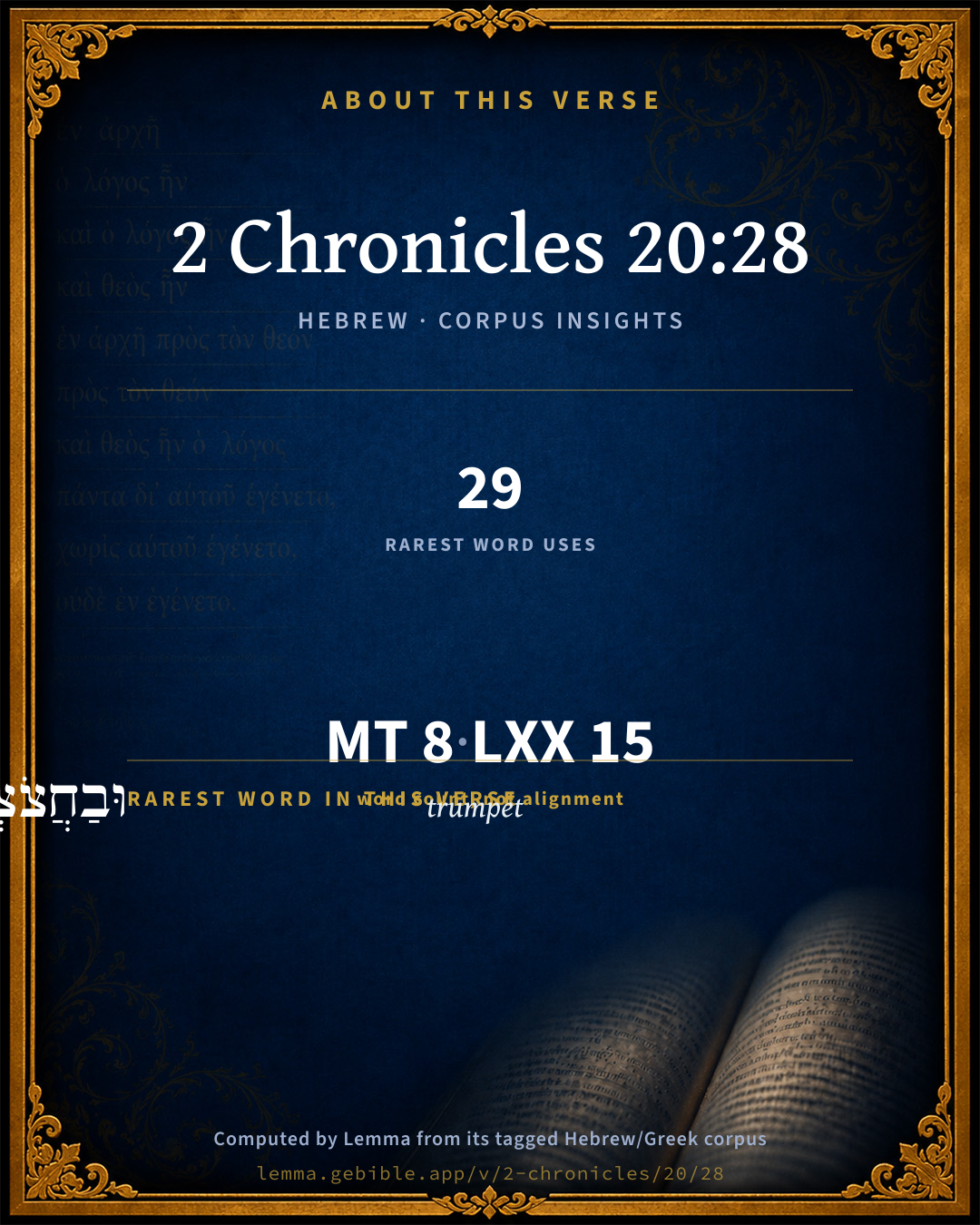
וּבַחֲצֹצְר֑וֹת trumpet H2689 occurs in 27 verses of the Hebrew Bible. Also found in:

Grammatical profile

  • 1 verb
  • 6 nouns
  • 1 preposition

Verb forms

  • וַיָּבֹ֨אוּ֙ Qal · Sequential Imperfect

Hebrew & Septuagint length

In English translation the verse runs 15 words from the Hebrew and 18 from the Septuagint (LXX English) — closely comparable.

A rough comparison of the two English renderings, which tokenize alike — not a word-level alignment.

Word counts can differ between the Hebrew and the Greek without any difference in meaning — e.g. the Hebrew direct-object marker אֵת has no separate Greek word, and Greek often adds the article ὁ.

In the original languages it is 8 Hebrew tokens and 15 Greek tokens — but the two are counted differently (Hebrew bundles its prefixes and suffixes into one token; the Greek is in lemma form), so that isn’t a like-for-like length.

Cross-references

9

Topical passages linked to 2 Chronicles 20:28 in the Treasury of Scripture Knowledge — connected by theme and wording, ordered by reader-vote popularity; previews shown in the World English Bible.

  • Revelation 14:2–3 I heard a sound from heaven, like the sound of many waters, and like the sound of a great thunder. The sound which I heard was like that of harpists playing on their harps.
  • 2 Samuel 6:5 David and all the house of Israel played before Yahweh with all manner of [instruments made of] fir-wood, and with harps, and with psalteries, and with tambourines, and with castanets, and with cymbals.
  • 1 Chronicles 13:8 David and all Israel played before God with all their might, even with songs, and with harps, and with psalteries, and with tambourines, and with cymbals, and with trumpets.
  • 1 Chronicles 23:5 and four thousand were doorkeepers; and four thousand praised Yahweh with the instruments which I made, [said David], for giving praise.
  • 1 Chronicles 25:6 All these were under the hands of their father for song in the house of Yahweh, with cymbals, psalteries, and harps, for the service of the house of God; Asaph, Jeduthun, and Heman being under the order of the king.
  • Psalms 57:8 Wake up, my glory! Wake up, psaltery and harp! I will wake up the dawn.
  • Psalms 92:3 With the ten-stringed lute, with the harp, And with the melody of the lyre.
  • Psalms 149:3 Let them praise his name in the dance! Let them sing praises to him with tambourine and harp!
  • Psalms 150:3–5 Praise him with the sounding of the trumpet! Praise him with harp and lyre!

Cross-references courtesy of OpenBible.info (CC BY 4.0).

Hebrew and Greek witnesses Masoretic Hebrew ↔ Greek Septuagint

The same verse in the two great witnesses to the Old Testament, shown verse-for-verse.

These are two independent witnesses, not word-aligned to each other, and the Septuagint is shown in lemma (dictionary) form.

Hebrew 2 Chronicles 20:28 Masoretic · Westminster Leningrad Codex

וַיָּבֹ֨אוּ֙ יְר֣וּשָׁלִַ֔ם בִּנְבָלִ֥ים וּבְכִנֹּר֖וֹת וּבַחֲצֹצְר֑וֹת אֶל בֵּ֖ית יְהוָֽה

They came to Jerusalem with psalteries and harps and trumpets to the house of Yahweh.

World English Bible · Public Domain

Greek LXX 2 Chronicles 20:28 Septuagint · lemma form

καί εἰςἔρχομαι εἰς ἰερουσαλήμ ἐν νάβλα καί ἐν κινύρα καί ἐν σάλπιγξ εἰς οἶκος κύριος

And they entered into Jerusalem with lutes and harps and trumpets, going into the house of the lord.

LXX2012 (modern English Septuagint) · Public Domain

Hebrew: Westminster Leningrad Codex (CC BY 4.0). Greek: Septuagint (public domain); English from LXX2012 (modern English Septuagint) (Public Domain). How the Septuagint differs from the Hebrew →

Commentary

Notes on 2 Chronicles 20:28 from classic Christian and Jewish commentators (each source and its license shown beneath its notes). The classic Christian expositions comment on the surrounding passage and are grouped to its opening verse, so a note may address several verses; the Jewish commentaries on the Tanakh (Rashi and others) are per-verse, so they appear only where the commentator wrote on this verse.

Lemma curates 59 commentaries, every one of them public domain or Creative Commons licensed, each selected and text-cleaned for this edition rather than reprinted as found. About our sources →

Trapp's Complete Commentary

John Trapp

2Ch 20:28 And they came to Jerusalem with psalteries and harps and trumpets unto the house of the LORD.

Ver. 28. Unto the house of the Lord.] Not to tippling houses and wine taverns, {a} as now-a-days the manner of some is.

{a} Non recta in aenopolia se contulerunt. - Lavat.

John Trapp, A Commentary or Exposition upon All the Books of the Old and New Testament (1647–1656) — public domain. Text from a community e-Sword module.

The Biblical Illustrator

Joseph S. Exell

2Ch_20:28

Every one helped to destroy another.

Mutual destruction

As we look upon the world at large, how do we see men occupied but as destroying one another! This is a marked character of the lower and worse forms of vice, that each degraded one has a wretched pleasure in bringing down other souls to the same level of degradation and ruin; but the same tendency to mutual destruction is to be seen in the first fallings away from God through all the subsequent steps in the downward road. When young men first lead one another away from home into the strange ways and strange company against which the wise man has raised his voice, what do they but destroy one another? And in the wildness which they call, for a time, pleasure--whatever form the self-indulgence, the sensuality, may wear--every one still helps to destroy another: actually, as to the misused and worn body, and with not less reality as to the corrupted and earth-engrossed soul. In another way, also, not less direct, not less fatal, though less regarded, each wanderer from God helps to destroy others. Example is sufficient to make danger. It would be a bold thing, indeed, for any one human being to look back upon his life, and to say that his example had not been fatal to some other soul. When the Spirit has done His work of converting the heart to God, and the saved sinner turns his eyes upon the sins which made the Cross necessary for him, who will not have Pauls remembrance of having given his word for death? Who will not have John Newtons memory of souls led into wrong, for whom there remains no power of recovery? And what is the record of this kind preparing for the unconverted, when a more true and more awful scene than the great dramatist has conceived of the presence of wronged souls in the visions of the night shall be upon the dying man, or, yet worse, upon the man after death; when the memory, no longer clouded by the flesh, no longer impeded by prejudice or passion, shall recall the multitudes to whom evil has been taught by word or by example; when the immortal spirit shall have the light of eternity poured upon the passed events of life, and the evil example of one look or one word shall be traced through all its train of consequences up to its final ruin of other souls? And this mutual destruction, which belongs to the very character of the unregenerate man, follows him hither even into the house of God. How is it that the children of our schools have so little profit here? that they know so little of all that passes here? How is it that we so rarely find the truth making its way from either desk or pulpit to the hearts of our docile young ones? Simply because they are destroying one another by combined inattention. The trifle which draws off the mind from prayer, the whispered word which puts some thought of earth in the place of the Bible, the merry smile which catches anothers ready eye--these are the means by which every one helps to destroy another; so that grace is provided and preached in vain. And we can scarcely hope that this will be with children alone. In a congregation of merely nominal Christians, met merely for the sake of respectability, the work of mutual destruction would go on in the general support of their common lukewarmness, and every one would help to destroy another in the subjects for conversation prepared in Gods house, and the discussion of them in the homeward way. (David Laing, M.A.)

The Biblical Illustrator, edited by Joseph S. Exell (c. 1880s–1900s) — public domain. Text from a community e-Sword module.

Ellicott's Commentary for English Readers

(28) With psalteries.—So Vulg. Rather, with harps, guitars, and clarions. (Comp. Psa_47:5-6, which may be supposed to commemorate this procession to the Temple.)

A Bible Commentary for English Readers, edited by Charles John Ellicott (1878–1897) — public domain. Text from a community e-Sword module.

John Gill's Exposition

And they came to Jerusalem with psalteries, and harps, and trumpets,.... The three principal instruments of music used in singing the praises of God; these they played upon as they came to the city, and entered it, and passed through it:

unto the house of the Lord; the temple, there to offer praise and thanksgiving again.

John Gill's Exposition of the Whole Bible (1746–1763) — public domain (CC PDM 1.0). Text via the HelloAO Bible API.

Matthew Poole's English Annotations

To renew their praises in the court of the temple, the proper and usual place for it.

Matthew Poole's English Annotations on the Holy Bible (1683–1685) — public domain. Text from a community e-Sword/MySword module.

Whedon's Commentary on the Bible

Daniel D. Whedon

28. They came to Jerusalem with psalteries and harps — It was one of the most magnificent triumphal enterings into Jerusalem that had ever been witnessed, and it was celebrated accordingly.

Daniel D. Whedon (gen. ed.), Commentary on the Old and New Testaments (1874–1909) — public domain. Text from a community e-Sword module.

John Wesley's Explanatory Notes

To the house - To renew their praises in the court of the temple, the proper and usual place for it. Praising God must not be the work of a day only, but our praises when we have received mercy, must be often repeated, as our prayers were, when we where in pursuit of it. Every day we must bless God: as long as we live, and while we have any being, we must praise him, spending our time in that work, in which we hope to spend our eternity.

John Wesley, Explanatory Notes Upon the Whole Bible (1754–1765) — public domain. Text via the GEBible commentary corpus.

Rashi

Rabbi Shlomo Yitzchaki (Rashi)

And they came to Jerusalem with psalteries, with harps, and with trumpets These three musical instruments correspond to “all the men of Judah and Jerusalem and Jehoshaphat.”

Rashi on the Tanakh — English translations: “The Judaica Press complete Tanach with Rashi, translated by A. J. Rosenberg” (CC BY 4.0); “Pentateuch with Rashi's commentary by M. Rosenbaum and A.M. Silbermann, 1929-1934” (public domain); “The Metsudah Tanach series, Lakewood, N.J” (CC BY 4.0); and “The Book of Joshua, Metsudah Publications, 1997” (CC BY 4.0). Text via Sefaria.

Lesson kit

Teaching starters — assembled from the data on this page, not authored interpretation. Every prompt links to the verse data it draws on. Edit before teaching.

2 Chronicles, in the Historical, opens this verse with 8 words (8 distinct Hebrew lemmas). Its most distinctive word is chătsôtsᵉrâh (“trumpet”). A historical commentator’s framing appears above. Read the whole chapter for the surrounding context.

Discussion questions

  1. The word chătsôtsᵉrâh carries the sense “trumpet.” How does it shape the verse?
  2. Numbers 10:2 shares the word «trumpet» with this verse. How do the two illuminate each other?
  3. These translations render this verse differently; the difference is in the English rendering, not the original. What questions does that raise?
  4. The verb «וַיָּבֹ֨אוּ֙» is Qal Sequential Imperfect. How does its form color the action?
  5. Reading how Trapp's Complete Commentary and The Biblical Illustrator read this verse, where do the two commentators agree and where do they part?

Things to notice

Reading settings

Reading text

Shown beneath each verse's original-language words.

Old Testament
Old Testament edition

Read the OT as the Masoretic Hebrew (MT) or the Greek Septuagint (LXX).

English shown for the Greek Septuagint (in the Hebrew ↔ Greek comparison).

Comparing translations? Open the Compare panel on any verse page to stack up to four side by side.