2 Timothy 3:11

Greek (Tischendorf 8th ed.) 2 Timothy 3:11 appears in the Greek New Testament. The text above is from the Tischendorf 8th edition. Each word links to its Strong’s number and a concise gloss. Click any word for its full Thayer’s Greek Lexicon entry.
Download image
Cite this verse

2 Timothy 3:11 (World English Bible). Public Domain. Lemma interlinear Bible study tool, https://lemma.gebible.app/v/2-timothy/3/11.

Show BibTeX & RIS
BibTeX
RIS
English Translation
persecutions, and sufferings: those things that happened to me at Antioch, Iconium, and Lystra. I endured those persecutions. Out of them all the Lord delivered me.
World English Bible · Public Domain
Download a study sheet

One document with this verse’s original text, its word-by-word gloss line, the meaning frame, cross-references with their text, attributed commentary, and full source and license credits — printable, and it pastes into notes with its structure intact.

This verse Autodidact and up

Study sheet (.html) Plain text (.txt)

A passage Seminary Student

Up to 50 verses in one chapter. A passage sheet keeps up to 6 commentary sources and 12 cross-references per verse, in the order this page ranks them, and says so on the sheet whenever that leaves anything out. Ask for a single verse and you get the Autodidact verse sheet above.

Everything on this page stays free to read, with no account — the sheet is a download of what is already on screen, not access to it.

Want to remove ads? Support Godless Engineer
Compare translations 3

The same verse in 3 English versions, stacked beneath the original-language interlinear above. Click any original word for its lexicon entry.

Each is an independent rendering of the whole verse — the interlinear is not word-aligned to these translations.

Highlighted words mark where these versions differ — a whole-verse word diff, not a word-by-word alignment.

  • World English Bible Public Domain
    persecutions, and sufferings: those things that happened to me at Antioch, Iconium, and Lystra. I endured those persecutions. Out of them all the Lord delivered me.
  • King James Version Public Domain
    Persecutions, afflictions, which came unto me at Antioch, at Iconium, at Lystra; what persecutions I endured: but out of them all the Lord delivered me.
  • unfoldingWord Literal Text CC BY-SA 4.0
    persecutions, sufferings, such as happened to me in Antioch, in Iconium, in Lystra, what kind of persecutions I endured. And the Lord rescued me from all.

unfoldingWord Literal Text — © unfoldingWord, licensed CC BY-SA 4.0. Word-aligned USFM3 via Door43 (git.door43.org/unfoldingWord/en_ult).

Versions to compare (up to 4)

3 of 4 selected

Show all 19 translations

Every available English version of this verse, each an independent rendering of the whole verse.

  • World English Bible Public Domain
    persecutions, and sufferings: those things that happened to me at Antioch, Iconium, and Lystra. I endured those persecutions. Out of them all the Lord delivered me.
  • Berean Standard Bible Public Domain
    my persecutions, and the sufferings that came upon me in Antioch, Iconium, and Lystra. What persecutions I endured! Yet the Lord rescued me from all of them.
  • Majority Standard Bible Public Domain
    my persecutions, and the sufferings that came upon me in Antioch, Iconium, and Lystra. What persecutions I endured! Yet the Lord rescued me from all of them.
  • King James Version Public Domain
    Persecutions, afflictions, which came unto me at Antioch, at Iconium, at Lystra; what persecutions I endured: but out of them all the Lord delivered me.
  • American Standard Version (1901) Public Domain
    persecutions, sufferings. What things befell me at Antioch, at Iconium, at Lystra; what persecutions I endured. And out of them all the Lord delivered me.
  • Revised Version (1885) Public Domain
    persecutions, sufferings; what things befell me at Antioch, at Iconium, at Lystra; what persecutions I endured: and out of them all the Lord delivered me.
  • Geneva Bible (1599) Public Domain
    Persecutions, and afflictions which came vnto me at Antiochia, at Iconium, and at Lystri, which persecutions I suffered: but from them all the Lord deliuered me.
  • Douay-Rheims (1899) Public Domain
    Persecutions, afflictions: such as came upon me at Antioch, at Iconium, and at Lystra: what persecutions I endured, and out of them all the Lord delivered me.
  • Young's Literal Translation Public Domain
    the persecutions, the afflictions, that befel me in Antioch, in Iconium, in Lystra; what persecutions I endured, and out of all the Lord did deliver me,
  • Literal Standard Version CC BY-SA 4.0
    the persecutions, the afflictions, that befell me in Antioch, in Iconium, in Lystra; what persecutions I endured! And the LORD delivered me out of all.
  • Unlocked Literal Bible CC BY-SA 4.0
    persecutions, sufferings, and what happened to me at Antioch, at Iconium, and at Lystra. I endured persecutions. Out of them all, the Lord rescued me.
  • unfoldingWord Literal Text CC BY-SA 4.0
    persecutions, sufferings, such as happened to me in Antioch, in Iconium, in Lystra, what kind of persecutions I endured. And the Lord rescued me from all.
  • Darby Bible Public Domain
    persecutions, sufferings: what [sufferings] happened to me in Antioch, in Iconium, in Lystra; what persecutions I endured; and the Lord delivered me out of all.
  • World Messianic Bible Public Domain
    persecutions, and sufferings—those things that happened to me at Antioch, Iconium, and Lystra. I endured those persecutions. The Lord delivered me out of them all.
  • Webster's Bible Public Domain
    Persecutions, afflictions which came to me at Antioch, at Iconium, at Lystra; what persecutions I endured: but out of them all the Lord delivered me.
  • Free Bible Version CC BY-SA 4.0
    how I've been persecuted and what I've suffered. You know what happened to me at Antioch, at Iconium, and at Lystra—the troubles I had and how the Lord rescued me from all of them.
  • Bible in Basic English Public Domain
    My punishments and pain; the things which came to me at Antioch, at Iconium, at Lystra; the cruel attacks made on me: and the Lord made me free from them all.
  • Text-Critical English NT CC BY 4.0
    Yoʋ know how much persecution and suffering I endured in Antioch, Iconium, and Lystra. Yet the Lord rescued me from it all.
  • Tyndale New Testament (1534) Public Domain
    persecucions and affliccions which happened vnto me at Antioche at Iconium and at lystra: which persecucions I suffered paciently. And from them all the lorde delivered me.

Literal Standard Version (2020), Covenant Press — licensed CC BY-SA 4.0. Text via the HelloAO Bible API (eBible.org). Unlocked Literal Bible (unfoldingWord) — licensed CC BY-SA 4.0. Text via the HelloAO Bible API (eBible.org). unfoldingWord Literal Text — © unfoldingWord, licensed CC BY-SA 4.0. Word-aligned USFM3 via Door43 (git.door43.org/unfoldingWord/en_ult). Free Bible Version, Dr. Jonathan Gallagher — licensed CC BY-SA 4.0. Text via the HelloAO Bible API (eBible.org).

Word by word

More ways to search: Search by grammar → Find every occurrence → Compare this word →

Practice this passage: Drill this verse → Learn its vocabulary →

ὑπήνεγκα
hypophérō
G5297
“to endure”
Verb, Aorist, Active, Indicative, 1st person, Singular
Part of Speech
Verb
Tense
Aorist
Voice
Active
Mood
Indicative
Person
1st person
Number
Singular
Full Thayer's Definition

Origin: from G5259 and G5342

TDNT: None

1. to bear by being under, bear up (a thing placed on one's shoulders) 2. to bear patiently, to endure
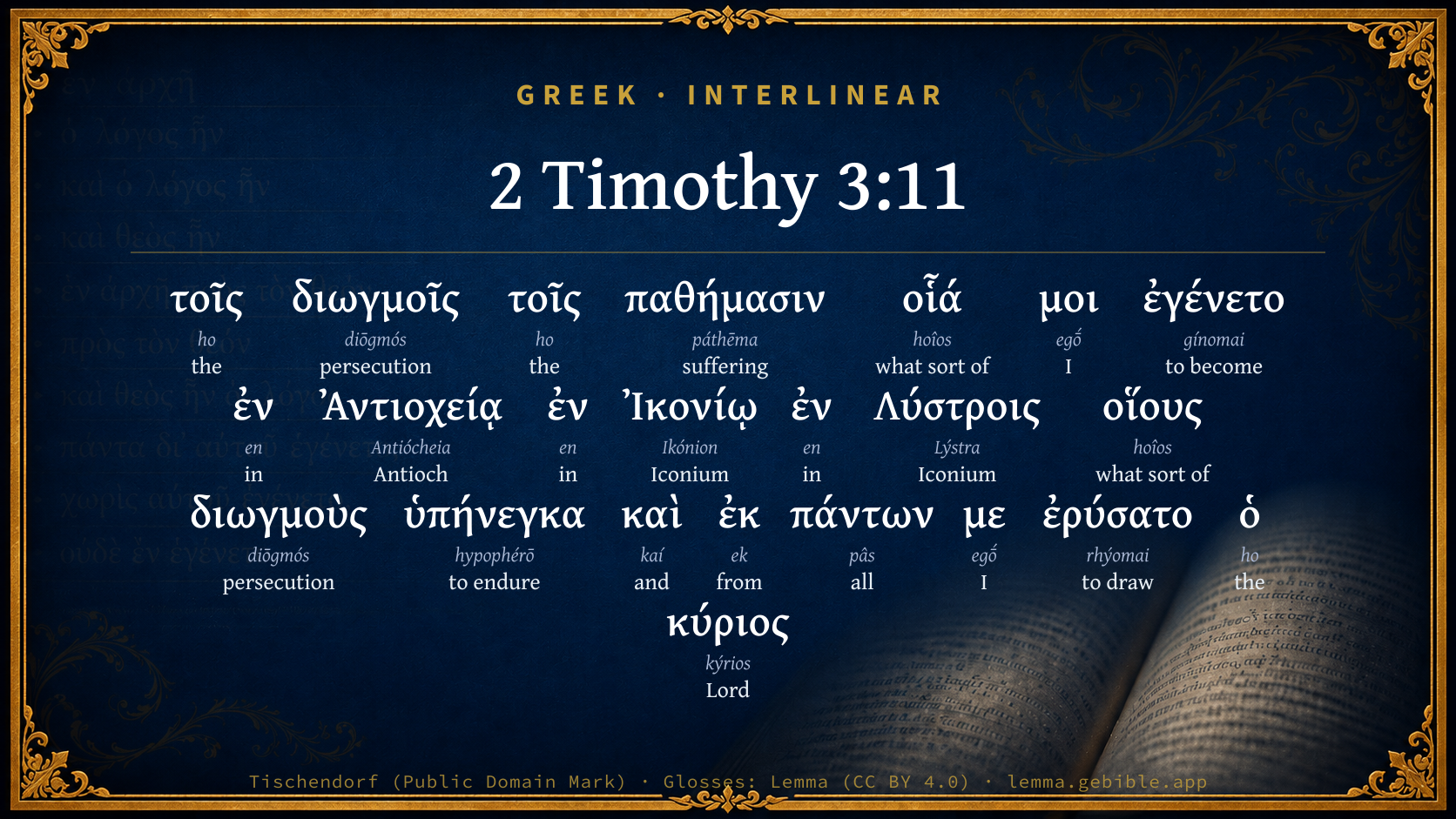
  1. τοῖς ho G3588 “the” Article, Dative, Plural, Masculine
  2. διωγμοῖς diōgmós G1375 “persecution” Noun, Dative, Plural, Masculine
  3. τοῖς ho G3588 “the” Article, Dative, Plural, Neuter
  4. παθήμασιν páthēma G3804 “suffering” Noun, Dative, Plural, Neuter
  5. οἷά hoîos G3634 “what sort of” Relative pronoun, Nominative, Plural, Neuter
  6. μοι egṓ G1473 “I” Personal pronoun, 1st person, Dative, Singular
  7. ἐγένετο gínomai G1096 “to become” Verb, Aorist, Middle deponent, Indicative, 3rd person, Singular
  8. ἐν en G1722 “in” Preposition
  9. Ἀντιοχείᾳ Antiócheia G490 “Antioch” Noun, Dative, Singular, Feminine
  10. ἐν en G1722 “in” Preposition
  11. Ἰκονίῳ Ikónion G2430 “Iconium” Noun, Dative, Singular, Neuter
  12. ἐν en G1722 “in” Preposition
  13. Λύστροις Lýstra G3082 “Iconium” Noun, Dative, Plural, Neuter
  14. οἵους hoîos G3634 “what sort of” Correlative pronoun, Accusative, Plural, Masculine
  15. διωγμοὺς diōgmós G1375 “persecution” Noun, Accusative, Plural, Masculine
  16. καὶ kaí G2532 “and” Conjunction
  17. ἐκ ek G1537 “from” Preposition
  18. πάντων pâs G3956 “all” Adjective, Genitive, Plural, Masculine
  19. με egṓ G1473 “I” Personal pronoun, 1st person, Accusative, Singular
  20. ἐρύσατο rhýomai G4506 “to draw” Verb, Aorist, Middle or Passive deponent, Indicative, 3rd person, Singular
  21. ὁ ho G3588 “the” Article, Nominative, Singular, Masculine
  22. κύριος kýrios G2962 “Lord” Noun, Nominative, Singular, Masculine

About this verse

These counts appear in no published source. They are computed here, from the morphology-tagged text and Lemma’s own curated glosses. What Lemma adds →

23
words
16
distinct lemmas
Pauline Epistles
section

Notable vocabulary

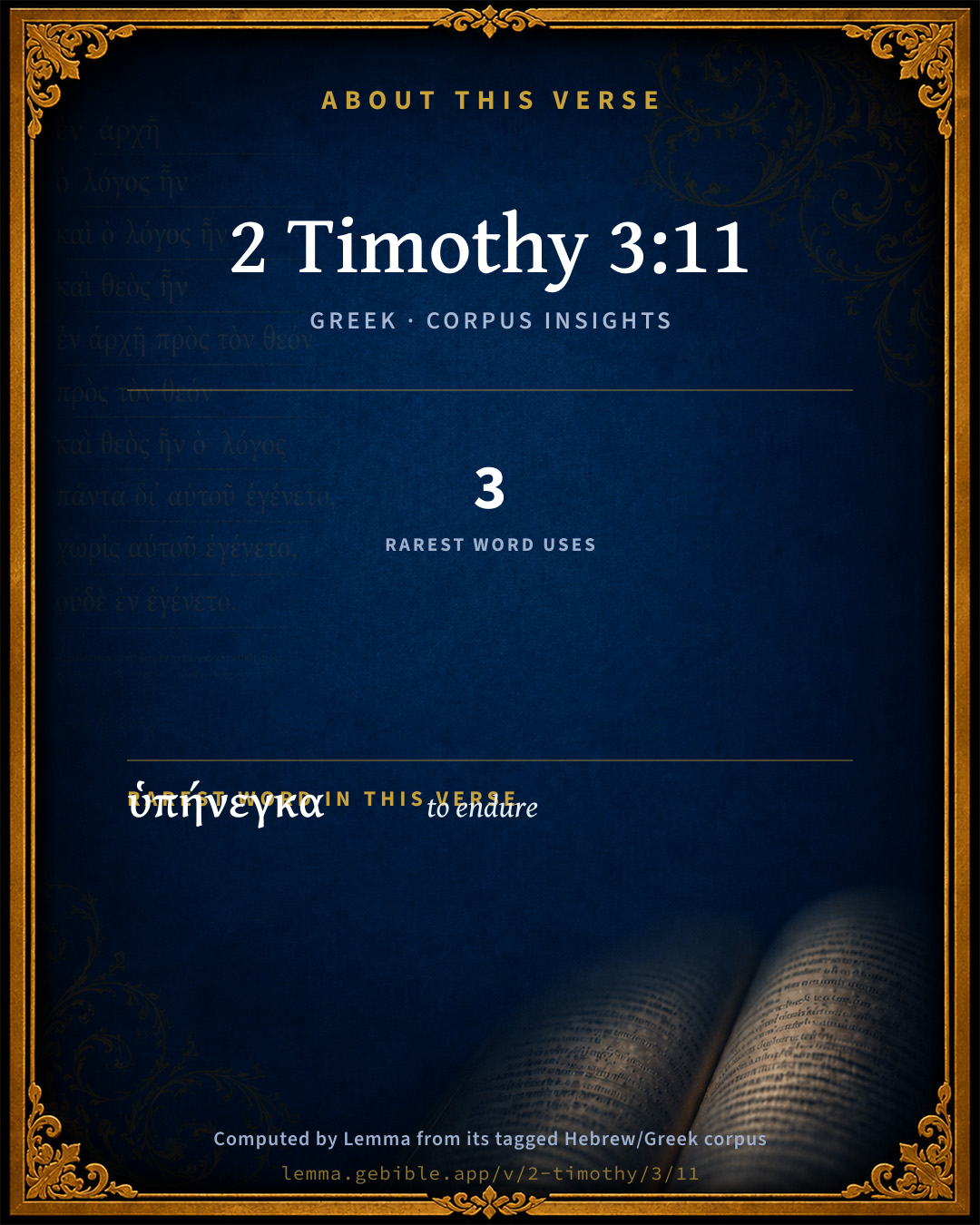
The rarest word here is ὑπήνεγκα to endure G5297 — appearing just 3 times in the whole Greek New Testament.

Shared distinctive vocabulary

ὑπήνεγκα to endure G5297 occurs in 3 verses of the Greek New Testament. Also found in:

Repetition

Words recur within this verse:

  • διωγμοῖς persecution G1375 ×2
  • οἷά what sort of G3634 ×2
  • τοῖς the G3588 ×3
  • ἐν in G1722 ×3
  • μοι I G1473 ×2

Cross-references

38

Topical passages linked to 2 Timothy 3:11 in the Treasury of Scripture Knowledge — connected by theme and wording, ordered by reader-vote popularity; previews shown in the World English Bible.

  • Psalms 34:19 Many are the afflictions of the righteous, But Yahweh delivers him out of them all.
  • Acts 14:5–6 When some of both the Gentiles and the Jews, with their rulers, made a violent attempt to mistreat and stone them,
  • 2 Corinthians 11:23–28 Are they servants of Christ? (I speak as one beside himself) I am more so; in labors more abundantly, in prisons more abundantly, in stripes above measure, in deaths often.
  • Acts 13:45 But when the Jews saw the multitudes, they were filled with jealousy, and contradicted the things which were spoken by Paul, and blasphemed.
  • Acts 13:50–51 But the Jews stirred up the devout and prominent women and the chief men of the city, and stirred up a persecution against Paul and Barnabas, and threw them out of their borders.
  • Acts 14:1–2 It happened in Iconium that they entered together into the synagogue of the Jews, and so spoke that a great multitude both of Jews and of Greeks believed.
  • Acts 14:19–21 But some Jews from Antioch and Iconium came there, and having persuaded the multitudes, they stoned Paul, and dragged him out of the city, supposing that he was dead.
  • 2 Peter 2:9 the Lord knows how to deliver the godly out of temptation and to keep the unrighteous under punishment for the day of judgment;
  • Genesis 48:16 the angel who has redeemed me from all evil, bless the lads, and let my name be named on them, and the name of my fathers Abraham and Isaac. Let them grow into a multitude in the midst of the earth."
  • 2 Samuel 22:1 David spoke to Yahweh the words of this song in the day that Yahweh delivered him out of the hand of all his enemies, and out of the hand of Saul:
  • 2 Samuel 22:49 Who brings me forth from my enemies: Yes, you lift me up above those who rise up against me; You deliver me from the violent man.
  • Job 5:19–20 He will deliver you in six troubles; Yes, in seven there shall no evil touch you.
  • Psalms 37:40 Yahweh helps them, and rescues them. He rescues them from the wicked, and saves them, Because they have taken refuge in him.
  • Psalms 91:2–6 I will say of Yahweh, "He is my refuge and my fortress; My God, in whom I trust."
  • Psalms 91:14 "Because he has set his love on me, therefore I will deliver him. I will set him on high, because he has known my name.
  • Isaiah 41:10 Don't you be afraid, for I am with you; don't be dismayed, for I am your God; I will strengthen you; yes, I will help you; yes, I will uphold you with the right hand of my righteousness.
  • Isaiah 41:14 Don't be afraid, you worm Jacob, and you men of Israel; I will help you, says Yahweh, and your Redeemer is the Holy One of Israel.
  • Isaiah 43:2 When you pass through the waters, I will be with you; and through the rivers, they shall not overflow you: when you walk through the fire, you shall not be burned, neither shall the flame kindle on you.
  • Jeremiah 1:19 They shall fight against you; but they shall not prevail against you: for I am with you, says Yahweh, to deliver you.
  • Daniel 6:27 He delivers and rescues, and he works signs and wonders in heaven and in earth, who has delivered Daniel from the power of the lions.
  • Acts 9:16 For I will show him how many things he must suffer for my name's sake."
  • Acts 9:23–25 When many days were fulfilled, the Jews conspired together to kill him,
  • Acts 13:14 But they, passing on from Perga, came to Antioch of Pisidia. They went into the synagogue on the Sabbath day, and sat down.
  • Acts 20:19 serving the Lord with all humility, with many tears, and with trials which happened to me by the plots of the Jews;
  • Acts 20:23–24 except that the Holy Spirit testifies in every city, saying that bonds and afflictions wait for me.
  • Acts 21:32–33 Immediately he took soldiers and centurions, and ran down to them. They, when they saw the chief captain and the soldiers, stopped beating Paul.
  • Acts 23:10 When a great argument arose, the commanding officer, fearing that Paul would be torn in pieces by them, commanded the soldiers to go down and take him by force from among them, and bring him into the barracks.
  • Acts 23:12–24 When it was day, some of the Jews banded together, and bound themselves under a curse, saying that they would neither eat nor drink until they had killed Paul.
  • Acts 25:3–4 asking a favor against him, that he would summon him to Jerusalem; plotting to kill him on the way.
  • Acts 26:17 delivering you from the people, and from the Gentiles, to whom I send you,
  • Acts 26:22 Having therefore obtained the help that is from God, I stand to this day testifying both to small and great, saying nothing but what the prophets and Moses said would happen,
  • Romans 8:35–37 Who shall separate us from the love of Christ? Could oppression, or anguish, or persecution, or famine, or nakedness, or peril, or sword?
  • 1 Corinthians 4:9–11 For, I think that God has displayed us, the apostles, last of all, like men sentenced to death. For we are made a spectacle to the world, both to angels and men.
  • 2 Corinthians 1:8–10 For we don't desire to have you uninformed, brothers, concerning our affliction which happened to us in Asia, that we were weighed down exceedingly, beyond our power, so much that we despaired even of life.
  • 2 Corinthians 4:8–11 We are pressed on every side, yet not crushed; perplexed, yet not to despair;
  • 2 Timothy 4:7 I have fought the good fight. I have finished the course. I have kept the faith.
  • 2 Timothy 4:17–18 But the Lord stood by me, and strengthened me, that through me the message might be fully proclaimed, and that all the Gentiles might hear; and I was delivered out of the mouth of the lion.
  • Hebrews 10:33–34 partly, being exposed to both reproaches and oppressions; and partly, becoming partakers with those who were treated so.

Cross-references courtesy of OpenBible.info (CC BY 4.0).

Commentary

Notes on 2 Timothy 3:11 from classic Christian and Jewish commentators (each source and its license shown beneath its notes). The classic Christian expositions comment on the surrounding passage and are grouped to its opening verse, so a note may address several verses; the Jewish commentaries on the Tanakh (Rashi and others) are per-verse, so they appear only where the commentator wrote on this verse.

Lemma curates 59 commentaries, every one of them public domain or Creative Commons licensed, each selected and text-cleaned for this edition rather than reprinted as found. About our sources →

Tyndale Open Study Notes

Tyndale Open Resources

3:11 Timothy was from Lystra, near Antioch and Iconium, so he knew all about what Paul had suffered (see Acts 13:14, 45-51; 14:1-8, 19-22), though he was recruited after these events (Acts 16:1-3). • the Lord rescued me: Paul could attest from his own life that the Lord would accomplish his purposes through his faithful servant (see 2 Tim 4:6-8, 17-18; Ps 22:19-22; 34:19; Dan 3:17-18; 2 Cor 1:8-10; 2 Pet 2:7-9).

Tyndale Open Study Notes — © Tyndale Open Resources, licensed CC BY-SA 4.0. Text via the HelloAO Bible API.

Bengel's Gnomon

Johann Albrecht Bengel

2Ti 3:11. Ἐν Ἀντιοχείᾳ, ἐν Ἰκονίῳ, ἐν Λύστροις, at Antioch, Iconium, Lystra) Act 13:14; Act 13:51; Act 14:6.—οἷα) οἷς shows the weightiness of the matter in hand: 1Ma 5:56, “he heard the valiant and warlike deeds, οἷα ἐποίησαν, how great were the acts which they did.”—οἶους διωγμοὺς, how great persecutions) The noun repeated after the interposition of another adds perspicuity and weight to what is said. Διωγμὸς and πάθημα are species and genus: persecution is properly, when they drive a man from one city to another, or when they attempt to apprehend him in his flight; but suffering is any calamity in general, for example, when Paul was stoned, etc.—ὑπήνεγκα, I endured) The mark of an apostle.—ἐῤῥύσατο, delivered) Another mark, to be miraculously preserved; Psalms 34 (33):17, ἐκ πασῶν τῶν θλίψεων αὐτῶν ἐῤῥύσατο αὐτούς, He delivered them out of all their afflictions.—ὁ Κύριος, the Lord) Christ.

Bengel's Gnomon of the New Testament — English translation (T&T Clark, Edinburgh, 1860) — public domain. Text from a community e-Sword module.

Expositor's Greek Testament

ed. W. Robertson Nicoll

2Ti 3:11 . Ἀντιοχείᾳ : Act 13:14 ; Act 13:45 ; Act 13:50 ; Ἰκονίῳ : Act 14:1-2 ; Act 14:5 ; Λύστροις : Act 14:6 ; Act 14:19 .

οἴους διωγμούς : There is no necessity to supply, with Alf., “Thou sawest”.

καί : and yet . The verse is an echo of Psa 33 (34):18, ὁ Κύριος … ἐκ πασῶν τῶν θλίψεων αὐτῶν ἐρύσατο αὐτούς . See also reff.

The Expositor's Greek Testament, edited by W. Robertson Nicoll (1897–1910) — public domain. Text from a community e-Sword module.

Geneva Bible (1599)

Geneva Bible translators

Which is in Pisidia.

Geneva Bible (1599) marginal notes — public domain. Text via Bolls.life.

Jamieson, Fausset & Brown

Robert Jamieson, A. R. Fausset & David Brown

afflictions--"sufferings."

which--Greek, "such as."

in Antioch--of Pisidia (Act 13:14, Act 13:50-51).

Iconium-- (Act 14:1-5).

Lystra-- (Act 14:6, Act 14:19).

what--How grievous.

out of . . . all . . . Lord delivered me-- (Ti2 4:17; Psa 34:17; Co2 1:10). An encouragement to Timothy not to fear persecutions.

Jamieson, Fausset & Brown — Commentary Critical and Explanatory on the Whole Bible (1871) — public domain (CC PDM 1.0). Text via the HelloAO Bible API.

Adam Clarke's Commentary

Verse 11. Persecutions - which came unto me at Antioch] The Antioch mentioned here was Antioch in Pisidia, to which place Paul and Barnabas came in their first apostolic progress, and where Paul delivered that memorable discourse which is preserved in the 13th chapter of Acts, Ac 13:16-43. In this city, it is said, the Jews stirred up the devout and honourable women, and the chief men of the city, and raised persecution against Paul and Barnabas, and expelled them out of their coasts; but they shook of the dust of their feet against them, and came to Iconium, Ac 13:50-51. Here there was an assault made both of the Gentiles and also of the Jews with their rulers, to treat them despitefully, and to stone them, and they fled unto Lystra and Derbe; and there came thither certain Jews, who persuaded the people, and having stoned Paul, drew him out of the city, supposing he had been dead. The historian informs us that his life was miraculously restored, and that he departed thence, and came to Derbe, and afterwards returned to Lystra, Iconium, and Antioch, where they had lately been so grievously persecuted. See Ac 14:5-6; Ac 14:19-21. These are the persecutions, c., to which the apostle alludes and we find that he mentions them here precisely in the same order in which, according to the relation of St. Luke, they occurred. Now it is said here that Timothy fully knew all these things; and we may naturally suppose they could not be unknown to him, when it is evident he was either a native of, or resided in, those parts; for when the apostle, sometime after the above, visited Derbe and Lystra, behold, a certain disciple was there named Timotheus, well reported of by the brethren that were at Lystra and Iconium; Ac 16:1-2. As these things happened in his own neighbourhood, Timothy must have known them; for a person who had such a religious education as he had could not be unacquainted with these persecutions, especially as we may believe that his mother and grandmother had been converts to Christianity at that time. See several useful remarks in Dr. Paley's Horae Paulinae, on these circumstances, page 312.

Adam Clarke's Commentary on the Bible (1810–1826) — public domain. Text from a community e-Sword/MySword module.

John Calvin's Commentaries

11 But out of them all the Lord delivered me It is a consolation which mitigates the bitterness of afflictions, that they always have a happy and joyful end. If it be objected, that the success of which he boasts is not always visible, I acknowledge that this is true, so far as relates to the feeling of the flesh; for Paul had not yet been delivered. But when God sometimes delivers us, he testifies, in this manner, that he is present with us, and will always be present; for from the feeling, or actual knowledge, of present aid, our confidence ought to be extended to the future. The meaning, therefore, is as if he had said, “Thou hast known by experience that God hath never forsaken me, so that thou hast no right to hesitate to follow my example.”

John Calvin's Commentaries (1540-1563) — public domain. Text from the Calvin Translation Society English edition (1840s-50s) via the Christian Classics Ethereal Library (ccel.org). Calvin's coverage is partial (roughly two-thirds of the Bible); uncommented books and verses are honest gaps, never fabricated. The 19th-century editor's footnotes and remarks are omitted so the notes are faithfully Calvin's own voice.

Ellicott's Commentary for English Readers

(11) Persecutions, afflictions.—St. Paul adds to “persecutions” “afflictions”—for not merely were his plans thwarted, his hopes baffled, his friends alienated, through the persistent enmity of his opponents, but bodily suffering was inflicted on him—stoning, scourging, long and weary periods of imprisonment, were among the repeated sufferings he endured for his Master’s sake. The question has been asked why, out of the pages of the closely written diary of his life’s experiences, does St. Paul select the events which took place at Antioch, Iconium, and Lystra? Was there anything special in what he endured in these places? The most satisfactory answer seems to be that, with regard to the general reader or hearer of this Epistle, what happened in these places, years before, were good examples of what had often taken place since. These were among the first cities in which St. Paul preached in the course of his missionary journeys. But a deeper reason existed for the choice of these places in his case to whom the Epistle was originally addressed. What happened on that first journey would never be forgotten by Timothy: some of the incidents were among his first experiences with St. Paul of the work—others had taken place just before St. Paul took him as his friend and associate, and, no doubt, had been often discussed in Timothy’s hearing in those anxious never-to-be-forgotten hours which preceded his choice of the calling of a missionary. Hearing of these very deeds of endurance done for the crucified Master, perhaps, not a little contributed to Timothy’s resolve to emulate these acts, and to join himself closely to the heroic missionary teacher. Certainly, the memory of what happened then St. Paul knew would possess a strong and weighty influence with his disciple, even though the events themselves were only such as had been repeated often since in his long life’s experience. (For details respecting what took place at Antioch, &c., see Acts 13, 14)

What persecutions I endured.—Some commentators understand these words as an exclamation: “What persecution I endured!” It is, however, better simply to translate the Greek, Such persecutions as I endured; in other words, Thou hast been a witness of my sufferings, such [sufferings] as I endured at Antioch, Iconium, and Lystra, such persecutions as I endured, but out of them, &c. Chrysostom remarks how both these clauses supply encouragement to the harassed servant of God. The first, that St. Paul displayed a noble readiness to endure persecution; the second, that God never left him alone. It was as though he said to Timothy, “surely no danger, no trouble, however great, need appall you. You know what I have gone through, yet in all God was with me and has kept me safe. Be sure He will be with you too.”

A Bible Commentary for English Readers, edited by Charles John Ellicott (1878–1897) — public domain. Text from a community e-Sword module.

The Cambridge Bible for Schools and Colleges

gen. ed. J. J. S. Perowne

11. afflictions, which came unto me] It is better to make the ‘afflictions’ go with the preceding, and make a new clause commence with the relative. So R.V. sufferings; what things befell me; what persecutions.

The Antioch meant is that in Pisidia, originally planted by the Magnesians. Seleucus the son of Antiochus re-settled it, and called it Antioch after the name of his father: which name it kept, though under Augustus made a colony with the additional name of Cæsarea. Plin. N.H. v. xxvii. 24 ‘Pisidæ … quorum colonia Cæsarea, eadem Antiochia.’ Its ruins are still to be seen, one of the most striking objects being a very perfect aqueduct of twenty-one arches. See Lewin, Life of St Paul, i. 137. For the work and sufferings at Antioch see Act_13:14-50. The place usually understood by Antioch would be the large and important city of Antioch in Syria; but in writing to Timothy, whose home was in that district, St Paul would use the word with its well-known local meaning.

Iconium lies S.E. of Antioch at a distance of sixty miles, on the dusty highroad connecting Ephesus with Antioch of Syria. It is still called Cogni, and, like Damascus, is an oasis in the desert, by the dry plains of Lycaonia. See Act_13:51 to Act_14:6.

Lystra lies about forty miles to the south of Iconium, on the same road, in a hollow, on the north side of which rises Kara Dagh or the Black Mountain. Its ruins remain and are called ‘the thousand and one churches,’ it having been an episcopal see under the Byzantine emperors. This was Timothy’s birth-place. See Act_14:6-20.

St Paul mentions these places and his sufferings there, (1) because they were the first, in his first period of ministry, (2) they were well known to Timothy and may well have led him to cast in his lot with the Apostle. See Introduction, pp. 57, 59, 62.

but out of them all] Rather, and, yet with an ascending force which marks a contrast, so that ‘and yet’ is hardly too strong; though the more exact rendering is to lay stress on ‘all’ and on ‘delivered,’ cf. Winer, iii. § 53, 3.

The Cambridge Bible for Schools and Colleges (gen. ed. J. J. S. Perowne; Cambridge University Press, 1878–1918) — public domain. Text from a community e-Sword module.

John Gill's Exposition

Yea, and all that will live godly in Christ Jesus,.... All that live according to the will of God revealed in his word; and to the glory of God, as the end of all their actions; and which the grace of God in the Gospel, and in their own hearts, teaches them; and who have the principles of a godly life from Christ, and derive the fresh supplies of grace and life from him, to maintain it; in whom their life is hid, and who live by faith upon him; all such that live, and that will live so, are desirous of living after this manner; in whom God has wrought in them both to will and to do, and are concerned when it is otherwise with them: these

shall suffer persecution; it is the will of God, and the appointment of heaven; Christ has foretold it, that so it shall be; and he the head has suffered it himself, and it is necessary that his members should, that they may be conformed unto him; it is the way Christ himself went to glory, and through many tribulations his people must enter the kingdom; and this is the common lot and certain case of all the saints, in one shape or another; for though all do not suffer confiscation of goods, beating, scourging, imprisonment, or a violent death; yet all are more or less afflicted and distressed by wicked men, and are subject to their reproaches and revilings, which are a branch of persecution; and that for professing Christ, and living a godly life in him and under his influence: and since such suffer as Christians, and not as evildoers; and this is the common condition of the people of God, in this world, it should not be thought strange, but be cheerfully endured; to encourage to which is the apostle's view in this passage.

John Gill's Exposition of the Whole Bible (1746–1763) — public domain (CC PDM 1.0). Text via the HelloAO Bible API.

Trapp's Complete Commentary

John Trapp

11 Persecutions, afflictions, which came unto me at Antioch, at Iconium, at Lystra; what persecutions I endured: but out of them all the Lord delivered me.

Ver. 11. What persecutions I endured] Gr. οιους, what manner of persecutions. A Christian may without sin be sensible of injuries and indignities. Only it must be the mourning of doves, and not the roaring of bears. A sheep may be as sensible of the biting of a dog as a swine is, though he raise not such a dust, make not such a din.

John Trapp, A Commentary or Exposition upon All the Books of the Old and New Testament (1647–1656) — public domain. Text from a community e-Sword module.

Albert Barnes' Notes on the Bible

Persecutions - On the meaning of this word, see the notes at Mat 5:10.

Afflictions - Trials of other kinds than those which arose from persecutions. The apostle met them everywhere; compare the notes at Act 20:23.

Which came unto me at Antioch - The Antioch here referred to is not the place of that name in Syria (see the notes at Act 11:19); but a city of the same name in Pisidia, in Asia Minor; notes, Act 13:14. Paul there suffered persecution from the Jews; Act 13:45.

At Iconium; - notes, Act 13:50. On the persecution there, see the notes at Act 14:3-6.

At Lystra; - Act 14:6. At this place, Paul was stoned; notes, Act 14:19. Timothy was a native of either Derbe or Lystra, cities near to each other, and was doubtless there at the time of this occurrence; Act 16:1.

But out of them all the Lord delivered me - See the history in the places referred to in the Acts .

Albert Barnes' Notes on the Bible (1834–1885) — public domain. Text from a community e-Sword/MySword module.

Matthew Poole's English Annotations

What persecutions for the preaching of the gospel I was under; what

afflictions I met with at Antioch in Pisidia, Act 13:14,45,50; at Iconium, whither he went from Pisidia; of the afflictions he met with there also, read Act 14:1-28.

At Lystra; what persecutions I endured: the apostle went from Iconium to Lystra, Act 14:6, there also he was persecuted, Act 14:19. Now it seemeth that in all these motions Timothy was in Paul’s company and a follower of him, so as he was a witness to all; which assureth us that though we first read of Timothy. Act 16:3, when he was circumcised, yet Paul knew him before.

But out of them all the Lord delivered me; yet God delivered Paul from all these, and that Timothy, being all that time in company with Paul, knew; from whence the apostle would have him take courage, exercise patience under suffering for such preaching and such living, being assured that God would deliver him also, preaching the same truth, and living the same holy life, though he met with the same troubles, persecutions, and afflictions.

Matthew Poole's English Annotations on the Holy Bible (1683–1685) — public domain. Text from a community e-Sword/MySword module.

The Pulpit Commentary

Suffering for afflictions, A.V; what things befell me for which came unto me, A.V; and for but, A.V Persecutions (diwgmoiv); as Mat_13:21; Act_8:1 Act_13:50 masin); 2Co_12:10, etc. Sufferings (toiv paqh) usually so rendered in the A.V (Rom_8:18; 2Co_1:5; Col_1:24. etc.) rendered "afflictions" in Heb_10:32; 1Pe_5:9. At Antioch; in Pisidia. (Act_13:14) For an account of the persecutions encountered by St. Paul at Antioch, Iconium, and Lystra, see Act 13:, Act_13:14. It was at St. Paul"s second, or rather third, visit to Lystra that he chose Timothy for his companion. (Act_16:1-3) I endured (uJpenegka); not simply "suffered," but "underwent," willingly and firmly suffered. (see 1Pe_2:19) As regards the construction, the antecedent to oi=a is paqhmasin, and the difference between aJ and oi=a is that aJ would limit the reference to the actual paqhmata at Antioch, Iconium, and Lystra, but oia extends the reference to all similar sufferings. The proper English rendering is "such as befell me." But the clause at the end of the sentence should be rendered "what great persecutions I endured." As Bengel notes, "oiov demonstrat rei gravitatem," and oiouv preceding the substantive with which it agrees (diwgmouv), cannot be construed the same as oia the relative. The sentence, oiouv diwgmouv uJpenegka, is an amplification of the preceding diwgmoiv: "Thou hast fully known my persecutionsviz. what great persecutions I endured." And out of them all, etc. This is added for Timothy"s encouragement, that he might stand fast in the face of persecutions and sufferings. Delivered me (me ejrjrJusato). Had the apostle in his mind the clause in the Lord"s Prayer, "Deliver us from evil"? (Mat_6:13) Comp. 2Ti_4:18, where the resemblance is still more striking. Observe the testimony to Christ"s omnipotence in this ascription to him, in both passages, of St. Paul"s deliverance. (comp. Act_18:10)

The Pulpit Commentary (1880–1919), ed. H.D.M. Spence-Jones & Joseph S. Exell — public domain. Text from a community e-Sword module.

The People's New Testament

B. W. Johnson

11. Persecutions … at Antioch, at Iconium, at Lystra. See Acts, chapters 13, 14. These persecutions befell Paul in the part of Asia where Timothy was reared, and hence he would be familiar with all. Out of them all the Lord delivered me. Hence, let Timothy cheerfully suffer, if need be, and trust the Lord.

B. W. Johnson's The People's New Testament with Notes (1889–1891) — public domain. Electronic text from the Christian Classics Ethereal Library (CCEL) ThML edition.

Cambridge Greek Testament for Schools and Colleges

11. τοῖς διωγμοῖς, τοῖς παθήμασιν, persecutions, sufferings, which the mention of ὑπομονή has suggested. He dwells on them parenthetically in this and the next verse.

οἶά μοι ἐγένετο, such as befell me; he only gives illustrations, as it were, of what a Christian apostle has to expect.

ἐν Ἀντιοχείᾳ κ.τ.λ. In Antioch (sc. of Pisidia, Act 13:50), in Iconium (Act 14:2), in Lystra (Act 14:19). These persecutions are selected for mention, not necessarily because they were the first which St Paul had to endure, or the most severe (for he suffered worse things at Philippi), but because they were especially well known to Timothy, who was himself of Lystra (Act 16:2), and must have been matter of common talk in that district when Timothy was a youth.

οἵους διωγμοὺς ὑπήνεγκα, such persecutions as I endured, a supplementary clause calling special attention to the fact that these particular persecutions had been endured by him.

καὶ ἐκ πάντων κ.τ.λ. And (yet, despite the greatness of the danger) out of all the Lord (sc. Christ) delivered me. See note on 2Ti 4:17-18.

Cambridge Greek Testament for Schools and Colleges (Cambridge University Press, 1896; 21 vols, various authors incl. Carr, Maclear, Plummer, Farrar, Lumby, Moule, M. R. James, Simcox) — public domain. Text from a community e-Sword module.

International Critical Commentary

11. οἷά μοι ἐγένετο] St. Paul enumerates the first only of a long train of persecutions, 2Co 11:30-33. Timothy was not his companion in these; but he doubtless heard of them and followed St. Paul in spite of them. On account of this difficulty Wohlenberg separates this verse from 10, and treats it as an exclamation. Oh, what I suffered! what persecutions I endured from the first—yet the Lord delivered me!

ἐκ πάντων κ.τ.λ.] cf. 4:18. There is here perhaps a conscious reminiscence of Psa 33:18 and 20.

ἐκέκραξαν οἱ δίκαιοι καὶ ὁ Κύριος εἰσήκουσεν αὐτῶν

καὶ ἐκ πασῶν τῶν θλίψεων αὐτῶν ἐρύσατο αὐτούς

. . . . . . .

πολλαὶ αἱ θλύψεις τῶν δικαίων

καὶ ἐκ πασῶν αὐτῶν ῥύσεται αὐτούς.

International Critical Commentary — older volumes (1896–1929), various authors — public domain. Text from a community e-Sword module.

Vincent's Word Studies in the New Testament

Marvin R. Vincent

Persecutions, afflictions [διωγμοις, παθημασιν] . Diwgmov persecution, only here in Pastorals. Occasionally in Paul. Paqhma, only here in Pastorals. Often in Paul, usually in the sense of sufferings, but twice of sinful passions, Rom 7:5; Gal 5:24.

Antioch, Iconium, Lystra. See Act 13:50; Act 14:2 ff.; Act 14:19. 'these cities may have been selected as illustrations because Timothy was at home in that region. See Act 16:1, 2. Antioch is mentioned by Paul, Gal 2:11. Iconium and Lystra nowhere in his letters.

Delivered [ερυσατο] Often in Paul. Originally, to draw to one's self; to draw out from peril. Paul, in Rom 11:26, applies the prophecy of Isa 69:20 to Christ, who is called a oJ rJuomenov the deliverer, LXX

Marvin R. Vincent, Word Studies in the New Testament (1887–1900) — public domain. Text from a community e-Sword/MySword module.

Lesson kit

Teaching starters — assembled from the data on this page, not authored interpretation. Every prompt links to the verse data it draws on. Edit before teaching.

2 Timothy, in the Pauline Epistles, opens this verse with 23 words (16 distinct Greek lemmas). Its most distinctive word is hypophérō (“to endure”). A historical commentator’s framing appears above. Read the whole chapter for the surrounding context.

Discussion questions

  1. The word hypophérō carries the sense “to endure.” How does it shape the verse?
  2. How does 1 Corinthians 10:13, which shares the word «to endure», read alongside this verse?
  3. What does the repetition of “persecution” (2× in this one verse) do in this verse?
  4. These translations render this verse differently; the difference is in the English rendering, not the original. What questions does that raise?
  5. Compare how Tyndale Open Study Notes and Bengel's Gnomon read this verse. Where do they agree or differ?

Things to notice

  • These translations choose different wording for 12 words in this verse.
  • “persecution” occurs 2× in this single verse.
  • 16 distinct Greek lemmas span 23 words in this verse.

Reading settings

Reading text

Shown beneath each verse's original-language words.

Old Testament
Old Testament edition

Read the OT as the Masoretic Hebrew (MT) or the Greek Septuagint (LXX).

English shown for the Greek Septuagint (in the Hebrew ↔ Greek comparison).

Comparing translations? Open the Compare panel on any verse page to stack up to four side by side.