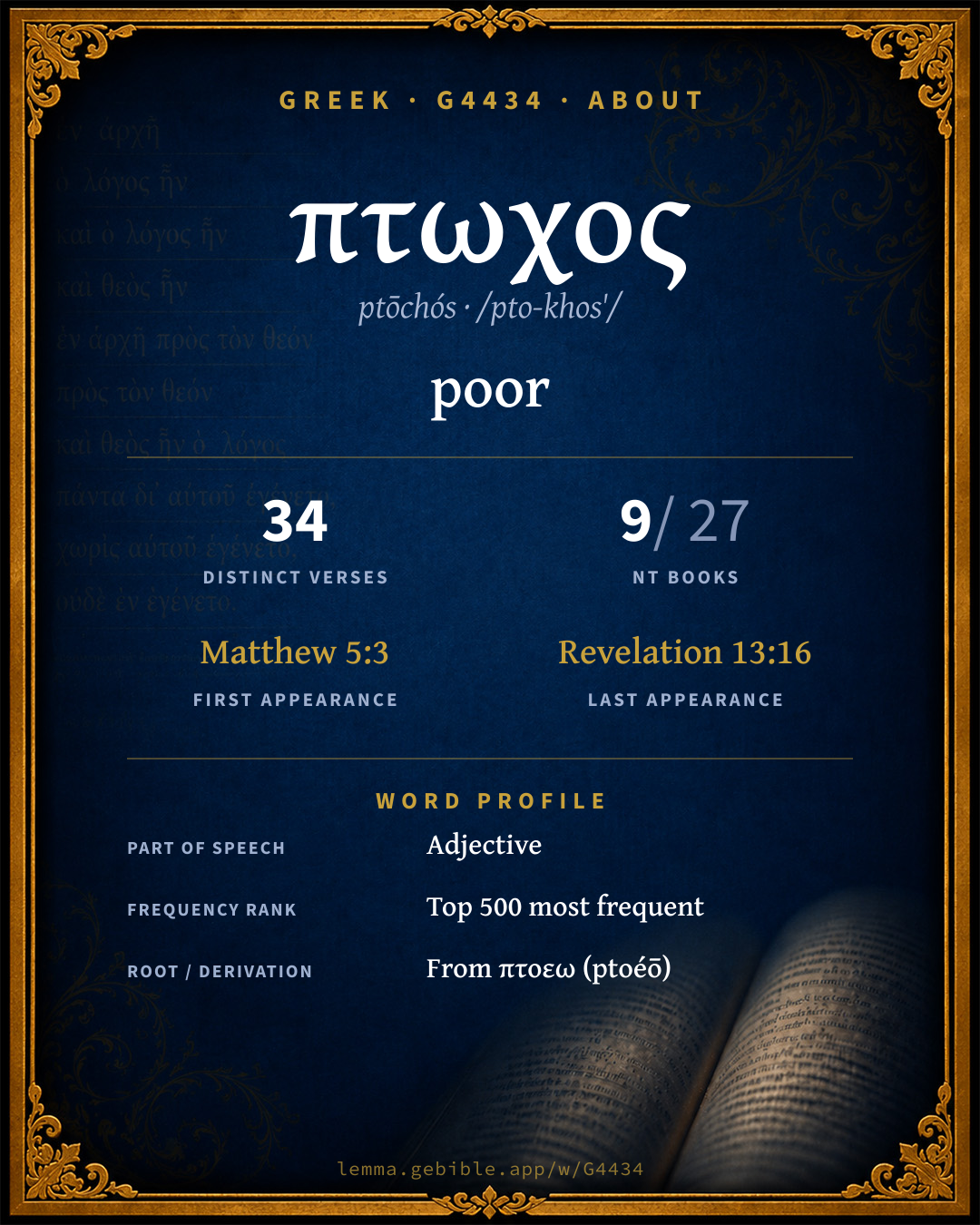
πτωχός
poor
‘poor’ is one of 3 main senses fuller range ↓
Full lexicon entry — Thayer's Greek Lexicon
From Thayer's Greek Lexicon
Where this word appears
See every Dative-case word in the Greek New Testament →
Grammar key — what these labels mean
Part of speech
- Adjective
- A word that describes or qualifies a noun.
Case
- Dative
- The case of the indirect object, means, or location — “to / for / with / in.”
- Accusative
- The case of the direct object and of extent.
- Nominative
- The case of the subject (and the predicate nominative).
- Genitive
- The case of source, possession, or “of” — answers “whose / from what.”
Gender
- Masculine
- Grammatically masculine.
- Feminine
- Grammatically feminine.
- Neuter
- Grammatically neuter.
Number
- Plural
- More than one.
- Singular
- One.
1 verse where G4434 appears in the Accusative case in the Book of Mark. Filtered view — show all forms. Click any verse to open its interlinear word-by-word view. Verse text shown in the World English Bible for context — . Each verse’s Greek form is shown with its reference; the English is not keyword-highlighted, since the data carries no word-level English alignment. Use “Compare translations” on any verse to read it across multiple English versions. This concordance covers the Greek New Testament; Septuagint (Greek Old Testament) occurrences of this word are not indexed here.
Mark
About this entry
At a glance — auto-summarized from this page’s data, not written by a person. Every figure links to its source below. This summary describes the numbers; it doesn’t interpret them.
At its core, πτωχος (ptōchós) means “poor.” Scripture first uses it in Matthew 5:3. Spanning 34 verses in 9 books, it ranks among the moderately common words of the Greek New Testament. Its uses concentrate in Luke (29% of all occurrences). Catalogued under 3 senses, its meaning is not single-sense. Dig into 34-verse concordance and the renderings breakdown below.
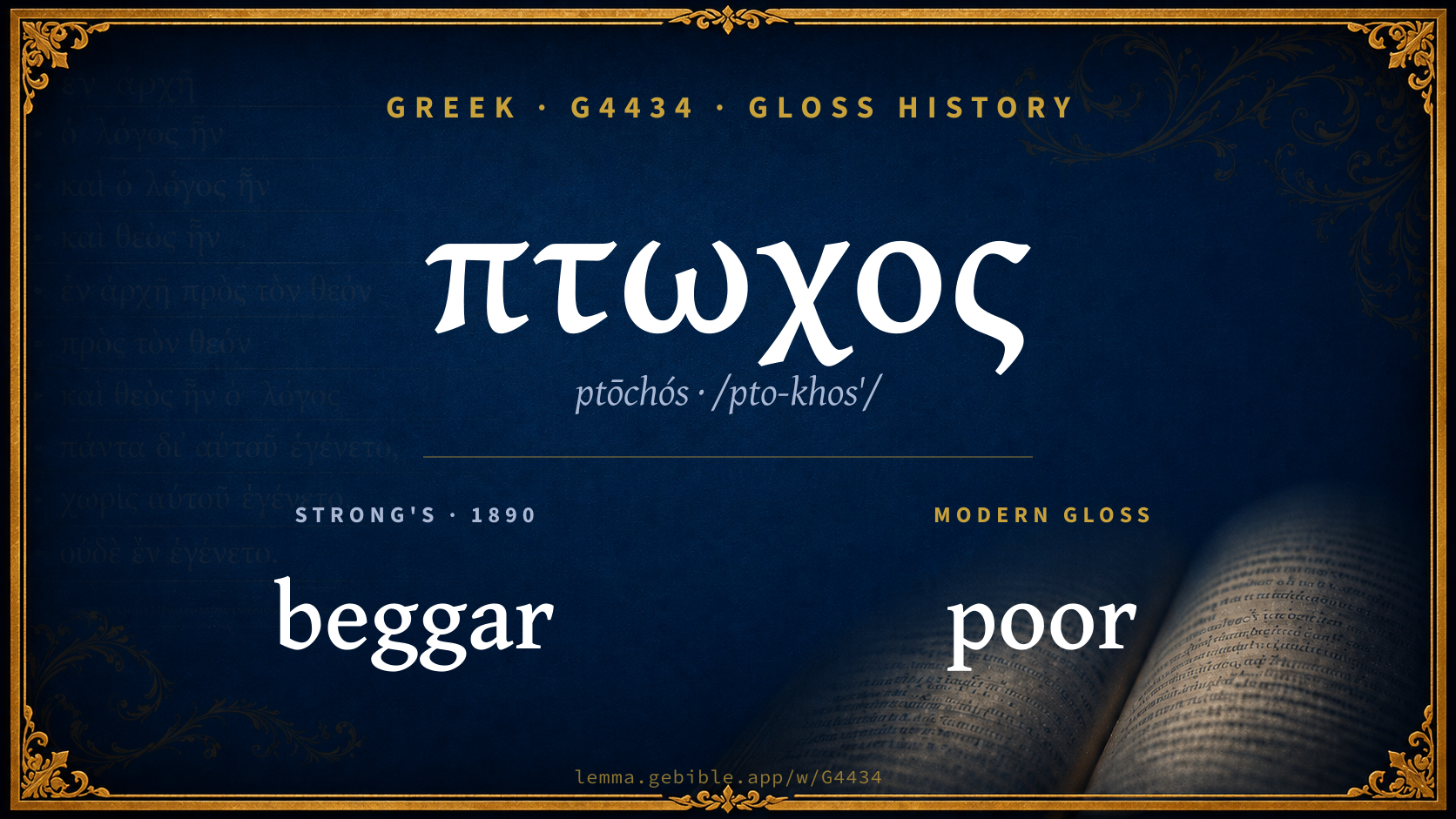
Gloss history
Strong's 1890 vs modern scholarship
About this word
Strong's G4434 catalogs a Greek word from the Greek New Testament.
These counts are not copied from any lexicon or concordance. They are computed here, from the morphology-tagged Greek New Testament. What Lemma adds →
- 34
- distinct verses
- The word appears in 34 distinct verses.
- 9 / 27
- NT books
- The word appears in 9 of 27 New Testament books.
- #424
- by frequency
- Top 500 most frequent Greek words (rank 424 of 5,347 Greek words by occurrence).
View all 34 occurrences in the concordance →
By section of the New Testament
By traditional corpus
Conventional, traditional groupings — biblical authorship is debated, so this is a traditional corpus grouping, not an authorship claim. Some books belong to more than one corpus (Luke is in both the Gospels and the Lukan corpus, and so on), so these shares overlap and need not total 100%. Each figure is a share of the word’s 34 distinct verses.
- Gospels 24 verses · 71%
- Lukan (Luke–Acts) 10 verses · 29%
- Johannine 6 verses · 18%
- Pauline corpus 4 verses · 12%
- General (Catholic) Epistles 4 verses · 12%
- Revelation 2 verses · 6%
How translations render this word
Counts come from each version’s own published word-to-Strong’s tagging or interlinear alignment — an approximate guide to how each version renders this word, not a word-level alignment the data otherwise carries. Because each total is that version’s own tagged count, the per-version totals vary from one another and need not match the appearance or distinct-verse counts above. These counts may also differ from a printed concordance because Lemma counts each distinctly tagged rendering and does not collapse phrase taggings into a single head-word total. This is a fixed set of word-tagged versions (KJV, ASV, BSB, ULT) and does not change with the reading translation you choose elsewhere. Each version’s license is shown beside its name below (and on Sources).
- King James Version: Poor 28×, Beggar 2×
- American Standard Version: Poor 26×, Beggar 2×
- Berean Standard Bible: Poor 31×, Beggar 2×
- unfoldingWord Literal Text: Poor 28×, Poor man 2×, Poor one 2×
King James Version Public Domain
Renders G4434 across 34 tagged occurrences — most commonly:
Plus 4 renderings that appear only once — usually multi-word phrases or single function words the recovered tagging swept in, not distinct renderings.
American Standard Version Public Domain
Renders G4434 across 34 tagged occurrences — most commonly:
Plus 6 renderings that appear only once — usually multi-word phrases or single function words the recovered tagging swept in, not distinct renderings.
Berean Standard Bible Public Domain
Renders G4434 across 34 tagged occurrences — most commonly:
Plus 1 rendering that appears only once — usually multi-word phrases or single function words the recovered tagging swept in, not distinct renderings.
unfoldingWord Literal Text CC BY-SA 4.0
Renders G4434 across 36 tagged occurrences — most commonly:
Plus 4 renderings that appear only once — usually multi-word phrases or single function words the recovered tagging swept in, not distinct renderings.
Senses in Thayer's
The 3 senses Thayer's distinguishes for this word, in lexicon order (not ranked by frequency or importance). The full entry — with sub-senses — is in the Lexicon Entry tab.
- reduced to beggary, begging, asking alms
- destitute of wealth, influence, position, honour
- lacking in anything
Word origin
Derived from πτοεω (ptoéō) (G4422) — to terrify.
From πτώσσω ptō ssō (to crouch ; akin to G4422 and the alternate of G4098 ); a beggar (as cringing ) that is pauper (strictly denoting absolute or public mendicancy although also used in a qualified or relative sense; whereas G3993 properly means only straitened circumstances in private) literally (often as noun) or figuratively ( distressed ): - beggar (-ly) poor.
— Strong’s Exhaustive Concordance (1890), public domain.
Forms in the corpus
The 12 distinct written forms G4434 takes in the Greek New Testament, most frequent first — each parse links to that case’s occurrences in the concordance.
| Form | Parsing | Example | Uses |
|---|---|---|---|
| πτωχοῖς ptōchoîs | Adjective, Dative, Plural, Masculine | Matthew 19:21 | 9 |
| πτωχοὺς ptōchoùs | Adjective, Accusative, Plural, Masculine | Matthew 26:11 | 6 |
| πτωχοὶ ptōchoì | Adjective, Nominative, Plural, Masculine | Matthew 5:3 | 4 |
| πτωχὴ ptōchḕ | Adjective, Nominative, Singular, Feminine | Mark 12:42 | 3 |
| πτωχὸς ptōchòs | Adjective, Nominative, Singular, Masculine | Luke 16:20 | 3 |
| πτωχούς ptōchoús | Adjective, Accusative, Plural, Masculine | Luke 14:13 | 2 |
| πτωχῶν ptōchō̂n | Adjective, Genitive, Plural, Masculine | John 12:6 | 2 |
| πτωχοί ptōchoí | Adjective, Nominative, Plural, Masculine | Luke 6:20 | 1 |
| πτωχόν ptōchón | Adjective, Accusative, Singular, Masculine | James 2:6 | 1 |
| πτωχὰ ptōchà | Adjective, Accusative, Plural, Neuter | Galatians 4:9 | 1 |
| πτωχὸν ptōchòn | Adjective, Accusative, Singular, Masculine | Luke 16:22 | 1 |
| πτωχῷ ptōchō̂ | Adjective, Dative, Singular, Masculine | James 2:3 | 1 |
Same root — word family
Other Thayer's entries built from the same root as G4434, grouped by Strong’s listed origin. These share a root / origin per the lexicon — not necessarily a shared meaning. Each links to that word’s own entry.
Derives from
Shares the same root
Derived from this word
Compare all same-root words → They share a root, not necessarily a meaning.
Septuagint usage
The same Greek word πτωχος appears 92 times in the Greek Old Testament (Septuagint), across 88 verses in 16 books.
- 92
- LXX occurrences
- Tagged occurrences of this Greek word in the Septuagint.
- 88
- verses
- Distinct Septuagint verses containing this word.
- 16 / 39
- OT books
- The word appears in 16 of the 39 Old Testament books.
Sample Septuagint occurrences
- Exodus 23:11 πτωχός
- Leviticus 19:10 πτωχός
- Deuteronomy 24:19 πτωχός
- Ruth 3:10 πτωχός
- 1 Samuel 2:8 πτωχός
- 2 Samuel 22:28 πτωχός
- 2 Kings 24:14 πτωχός
- Esther 1:20 πτωχός
- Job 29:12 πτωχός
- Psalms 9:19 πτωχός
- Proverbs 13:8 πτωχός
- Isaiah 3:14 πτωχός
Septuagint occurrences (same lexeme)
Every verse where the same Strong’s number (G4434) appears in the Greek Septuagint — showing the first 50 of 88. Verse text shown in the World English Bible for context; the Greek form is the matched word — the English is not keyword-highlighted.
- Exodus 23:11 πτωχός but the seventh year you shall let it rest and lie fallow, that the poor of your people may eat; and what they leave the animal of the field shall eat. In like manner you shall deal with your vineyard and with your olive grove.
- Leviticus 19:10 πτωχός You shall not glean your vineyard, neither shall you gather the fallen grapes of your vineyard; you shall leave them for the poor and for the foreigner. I am Yahweh your God.
- Leviticus 19:15 πτωχός "'You shall do no injustice in judgment: you shall not be partial to the poor, nor show favoritism to the great; but in righteousness shall you judge your neighbor.
- Leviticus 23:22 πτωχός "'When you reap the harvest of your land, you shall not wholly reap into the corners of your field, neither shall you gather the gleanings of your harvest: you shall leave them for the poor, and for the foreigner. I am Yahweh your God.'"
- Deuteronomy 24:19 πτωχός When you reap your harvest in your field, and have forgot a sheaf in the field, you shall not go again to get it: it shall be for the foreigner, for the fatherless, and for the widow; that Yahweh your God may bless you in all the work of your hands.
- Ruth 3:10 πτωχός He said, Blessed are you by Yahweh, my daughter: you have shown more kindness in the latter end than at the beginning, inasmuch as you didn't follow young men, whether poor or rich.
- 1 Samuel 2:8 πτωχός He raises up the poor out of the dust, He lifts up the needy from the dunghill, To make them sit with princes, Inherit the throne of glory: For the pillars of the earth are Yahweh's, He has set the world on them.
- 2 Samuel 22:28 πτωχός The afflicted people you will save; But your eyes are on the haughty, that you may bring them down.
- 2 Kings 24:14 πτωχός He carried away all Jerusalem, and all the princes, and all the mighty men of valor, even ten thousand captives, and all the craftsmen and the smiths; none remained, save the poorest sort of the people of the land.
- 2 Kings 25:12 πτωχός But the captain of the guard left of the poorest of the land to work the vineyards and fields.
- Esther 1:20 πτωχός When the king's decree which he shall make shall be published throughout all his kingdom (for it is great), all the wives will give to their husbands honor, both to great and small.
- Esther 9:22 πτωχός as the days in which the Jews had rest from their enemies, and the month which was turned to them from sorrow to gladness, and from mourning into a good day; that they should make them days of feasting and gladness, and of sending portions one to another, and gifts to the needy.
- Job 29:12 πτωχός Because I delivered the poor who cried, And the fatherless also, who had none to help him.
- Job 34:28 πτωχός So that they caused the cry of the poor to come to him, He heard the cry of the afflicted.
- Job 36:6 πτωχός He doesn't preserve the life of the wicked, But gives to the afflicted their right.
- Psalms 9:19 πτωχός Arise, Yahweh! Don't let man prevail. Let the nations be judged in your sight.
- Psalms 9:23 πτωχός
- Psalms 9:30 πτωχός
- Psalms 9:35 πτωχός
- Psalms 11:6 πτωχός On the wicked he will rain blazing coals; Fire, sulfur, and scorching wind shall be the portion of their cup.
- Psalms 13:6 πτωχός I will sing to Yahweh, Because he has been good to me.
- Psalms 21:25 πτωχός
- Psalms 24:16 πτωχός
- Psalms 33:7 πτωχός He gathers the waters of the sea together as a heap. He lays up the deeps in storehouses.
- Psalms 34:10 πτωχός The young lions do lack, and suffer hunger, But those who seek Yahweh shall not lack any good thing.
- Psalms 36:14 πτωχός
- Psalms 39:18 πτωχός
- Psalms 40:2 πτωχός He brought me up also out of a horrible pit, Out of the miry clay. He set my feet on a rock, And gave me a firm place to stand.
- Psalms 67:11 πτωχός
- Psalms 68:30 πτωχός Rebuke the wild animal of the reeds, The multitude of the bulls, with the calves of the peoples. Being humbled, may it bring bars of silver. Scatter the nations that delight in war.
- Psalms 68:33 πτωχός To him who rides on the heaven of heavens, which are of old; Behold, he utters his voice, a mighty voice.
- Psalms 69:6 πτωχός Don't let those who wait for you be shamed through me, Lord Yahweh of Hosts. Don't let those who seek you be brought to dishonor through me, God of Israel.
- Psalms 71:2 πτωχός Deliver me in your righteousness, and rescue me. Turn your ear to me, and save me.
- Psalms 71:4 πτωχός Rescue me, my God, from the hand of the wicked, From the hand of the unrighteous and cruel man.
- Psalms 71:12 πτωχός God, don't be far from me. My God, hurry to help me.
- Psalms 71:13 πτωχός Let my accusers be disappointed and consumed. Let them be covered with disgrace and scorn who want to harm me.
- Psalms 73:21 πτωχός For my soul was grieved. I was embittered in my heart.
- Psalms 81:3 πτωχός Blow the trumpet at the New Moon, At the full moon, on our feast day.
- Psalms 81:4 πτωχός For it is a statute for Israel, An ordinance of the God of Jacob.
- Psalms 85:1 πτωχός Yahweh, you have been favorable to your land. You have restored the fortunes of Jacob.
- Psalms 87:16 πτωχός
- Psalms 101:1 πτωχός I will sing of loving kindness and justice. To you, Yahweh, I will sing praises.
- Psalms 108:16 πτωχός
- Psalms 108:22 πτωχός
- Psalms 112:7 πτωχός He will not be afraid of evil news. His heart is steadfast, trusting in Yahweh.
- Psalms 131:15 πτωχός
- Psalms 139:13 πτωχός For you formed my inmost being. You knit me together in my mother's womb.
- Proverbs 13:8 πτωχός The ransom of a man's life is his riches, But the poor hear no threats.
- Proverbs 14:20 πτωχός The poor person is shunned even by his own neighbor, But the rich person has many friends.
- Proverbs 14:21 πτωχός He who despises his neighbor sins, But blessed is he who has pity on the poor.
These are occurrences of the same Greek lexeme (G4434) in the Septuagint — not a translation of any one Hebrew word. The store carries no word-level Hebrew↔Greek alignment, so no Hebrew original is asserted here. Counts come from the recovered LXX Strong's tagging — high-frequency vocabulary is well covered, while rare or late forms may be untagged — so they reflect tagged occurrences and may slightly undercount.