
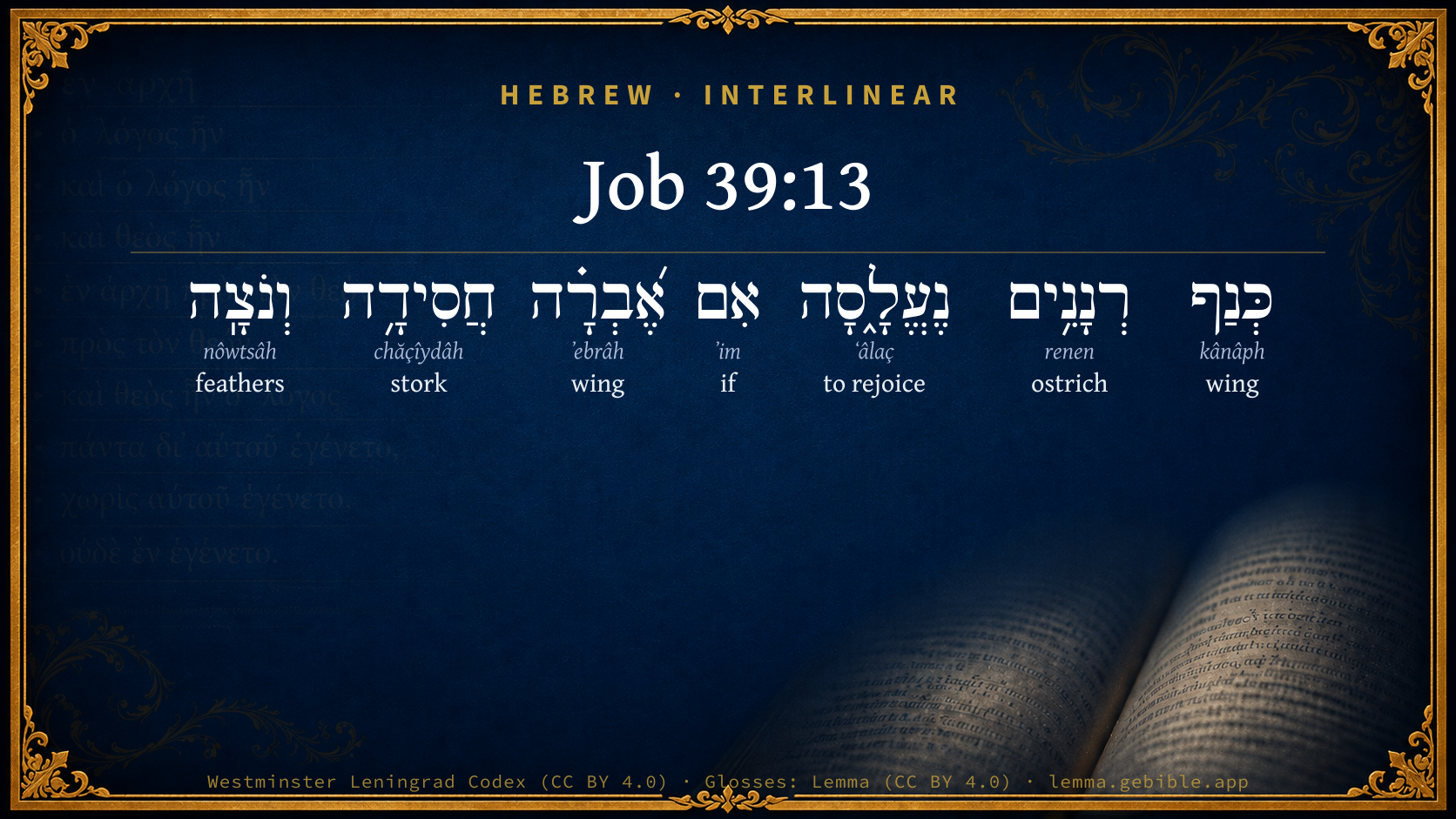
Job 39:13

Hebrew (Westminster Leningrad Codex) Job 39:13 appears in the Hebrew Old Testament. The text above is from the Westminster Leningrad Codex. Each word links to its Strong’s number, a concise gloss, and parsing drawn from the Open Scriptures Hebrew Bible morphology. Click any word for its full Brown-Driver-Briggs (BDB) entry.
Download image
Cite this verse

Job 39:13 (World English Bible). Public Domain. Lemma interlinear Bible study tool, https://lemma.gebible.app/v/job/39/13.

Show BibTeX & RIS
BibTeX
RIS
English Translation
"The wings of the ostrich wave proudly; But are they the feathers and plumage of love?
World English Bible · Public Domain
Highlights
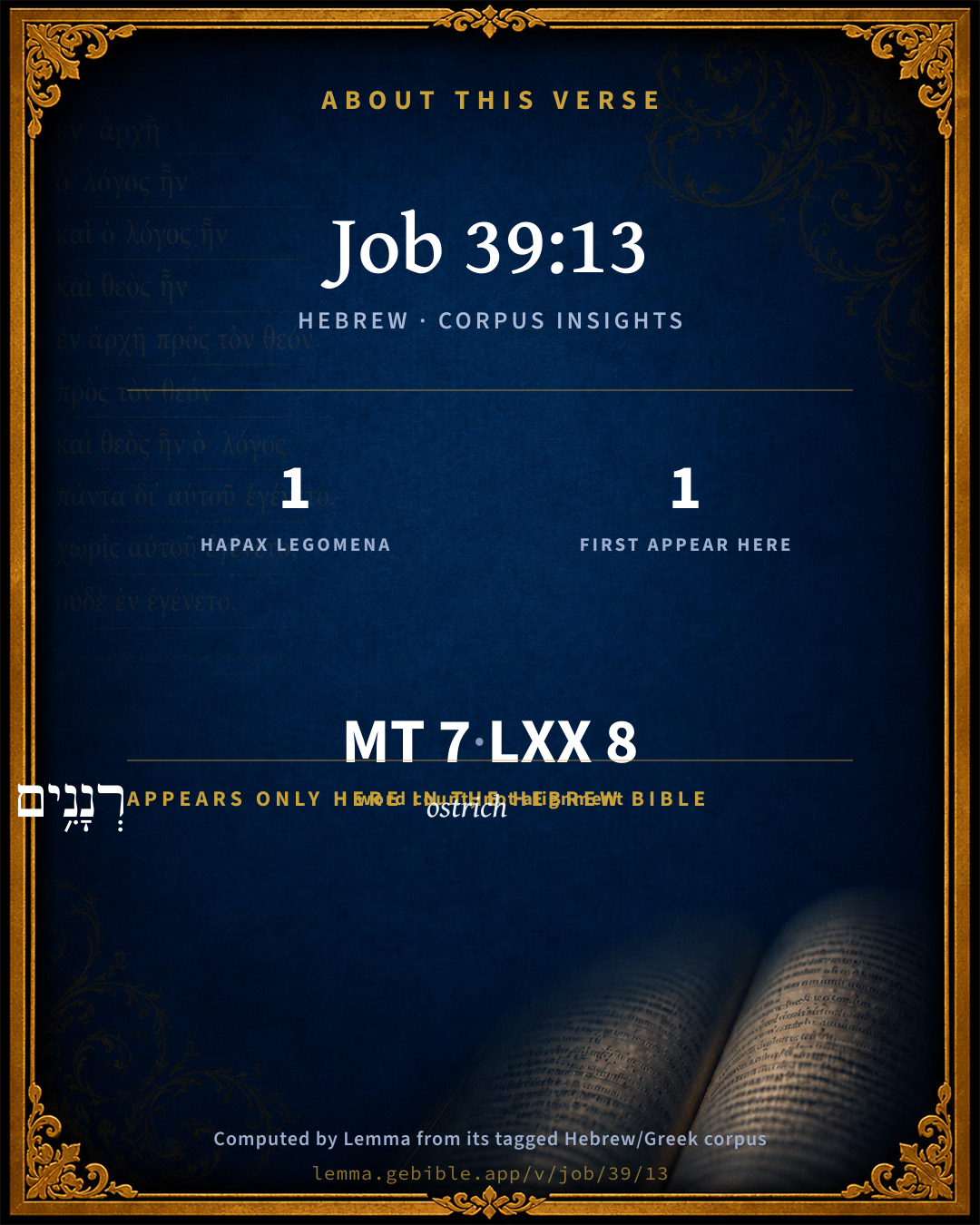
  • 1 hapax legomenon — only here in the Hebrew Bible
  • 1 first appearance in the Hebrew Bible
Full analysis ↓
Download a study sheet

One document with this verse’s original text, its word-by-word gloss line, the meaning frame, cross-references with their text, attributed commentary, and full source and license credits — printable, and it pastes into notes with its structure intact.

This verse Autodidact and up

Study sheet (.html) Plain text (.txt)

A passage Seminary Student

Up to 50 verses in one chapter. A passage sheet keeps up to 6 commentary sources and 12 cross-references per verse, in the order this page ranks them, and says so on the sheet whenever that leaves anything out. Ask for a single verse and you get the Autodidact verse sheet above.

Everything on this page stays free to read, with no account — the sheet is a download of what is already on screen, not access to it.

Want to remove ads? Support Godless Engineer
Compare translations 3

The same verse in 3 English versions, stacked beneath the original-language interlinear above. Click any original word for its lexicon entry.

Each is an independent rendering of the whole verse — the interlinear is not word-aligned to these translations.

Highlighted words mark where these versions differ — a whole-verse word diff, not a word-by-word alignment.

  • World English Bible Public Domain
    "The wings of the ostrich wave proudly; But are they the feathers and plumage of love?
  • King James Version Public Domain
    Gavest thou the goodly wings unto the peacocks? or wings and feathers unto the ostrich?
  • unfoldingWord Literal Text CC BY-SA 4.0
    The wing of ostriches flaps vigorously. If a kind feather and plumage?

unfoldingWord Literal Text — © unfoldingWord, licensed CC BY-SA 4.0. Word-aligned USFM3 via Door43 (git.door43.org/unfoldingWord/en_ult).

Versions to compare (up to 4)

3 of 4 selected

Show all 18 translations

Every available English version of this verse, each an independent rendering of the whole verse.

  • World English Bible Public Domain
    "The wings of the ostrich wave proudly; But are they the feathers and plumage of love?
  • Berean Standard Bible Public Domain
    The wings of the ostrich flap joyfully, but cannot match the pinions and feathers of the stork.
  • Majority Standard Bible Public Domain
    The wings of the ostrich flap joyfully, but cannot match the pinions and feathers of the stork.
  • King James Version Public Domain
    Gavest thou the goodly wings unto the peacocks? or wings and feathers unto the ostrich?
  • American Standard Version (1901) Public Domain
    The wings of the ostrich wave proudly; `But' are they the pinions and plumage of love?
  • Revised Version (1885) Public Domain
    The wing of the ostrich rejoiceth, but are her pinions and feathers kindly?
  • Geneva Bible (1599) Public Domain
    Canst thou binde the vnicorne with his band to labour in the furrowe? or will he plowe the valleyes after thee?
  • Douay-Rheims (1899) Public Domain
    The wing of the ostrich is like the wings of the heron, and of the hawk.
  • Young's Literal Translation Public Domain
    The wing of the rattling ones exulteth, Whether the pinion of the ostrich or hawk.
  • Literal Standard Version CC BY-SA 4.0
    [The] wing of the crying ostriches exults, but as a pinion and feather of a stork?
  • Unlocked Literal Bible CC BY-SA 4.0
    The wings of the ostrich wave proudly, but are they the pinions and plumage of love?
  • unfoldingWord Literal Text CC BY-SA 4.0
    The wing of ostriches flaps vigorously. If a kind feather and plumage?
  • Darby Bible Public Domain
    The wing of the ostrich beats joyously -- But is it the stork's pinion and plumage?
  • World Messianic Bible Public Domain
    “The wings of the ostrich wave proudly, but are they the feathers and plumage of love?
  • Webster's Bible Public Domain
    \\39:10\\Canst thou bind the unicorn with his band in the furrow? or will he harrow the valleys after thee?
  • Free Bible Version CC BY-SA 4.0
    The ostrich proudly flaps her wings, but they are nothing like the flight feathers of the stork.
  • Bible in Basic English Public Domain
    Will he be pulling your plough with cords, turning up the valleys after you?
  • JPS Tanakh (1917) Public Domain
    The wing of the ostrich beateth joyously; but are her pinions and feathers the kindly stork's?

Literal Standard Version (2020), Covenant Press — licensed CC BY-SA 4.0. Text via the HelloAO Bible API (eBible.org). Unlocked Literal Bible (unfoldingWord) — licensed CC BY-SA 4.0. Text via the HelloAO Bible API (eBible.org). unfoldingWord Literal Text — © unfoldingWord, licensed CC BY-SA 4.0. Word-aligned USFM3 via Door43 (git.door43.org/unfoldingWord/en_ult). Free Bible Version, Dr. Jonathan Gallagher — licensed CC BY-SA 4.0. Text via the HelloAO Bible API (eBible.org).

Word by word

More ways to search: Search by grammar → Find every occurrence → Compare this word →

Practice this passage: Drill this verse → Learn its vocabulary →

About this verse

These counts appear in no published source. They are computed here, from the morphology-tagged text and Lemma’s own curated glosses. What Lemma adds →

7
words
7
distinct lemmas
Wisdom
section

Notable vocabulary

1 hapax legomenon — a word that appears only here in the entire Hebrew Bible:

  • רְנָנִ֥ים ostrich H7443

First appearance in Scripture

This word makes its first canonical appearance in the Hebrew Bible here:

  • רְנָנִ֥ים ostrich H7443

Shared distinctive vocabulary

נֶעֱלָ֑סָה to rejoice H5965 occurs in 3 verses of the Hebrew Bible. Also found in:

Grammatical profile

  • 1 verb
  • 5 nouns
  • 1 conjunction

Verb forms

  • נֶעֱלָ֑סָה Niphal · Perfect

Hebrew & Septuagint length

In English translation the verse runs 16 words from the Hebrew and 18 from the Septuagint (LXX English) — closely comparable.

A rough comparison of the two English renderings, which tokenize alike — not a word-level alignment.

Word counts can differ between the Hebrew and the Greek without any difference in meaning — e.g. the Hebrew direct-object marker אֵת has no separate Greek word, and Greek often adds the article ὁ.

In the original languages it is 7 Hebrew tokens and 8 Greek tokens — but the two are counted differently (Hebrew bundles its prefixes and suffixes into one token; the Greek is in lemma form), so that isn’t a like-for-like length.

Cross-references

7

Topical passages linked to Job 39:13 in the Treasury of Scripture Knowledge — connected by theme and wording, ordered by reader-vote popularity; previews shown in the World English Bible.

  • Jeremiah 8:7 Yes, the stork in the sky knows her appointed times; and the turtle-dove and the swallow and the crane observe the time of their coming; but my people don't know Yahweh's law.
  • Zechariah 5:9 Then lifted I up my eyes, and saw, and, behold, there were two women, and the wind was in their wings. Now they had wings like the wings of a stork, and they lifted up the ephah basket between earth and the sky.
  • Leviticus 11:19 the stork, any kind of heron, the hoopoe, and the bat.
  • 1 Kings 10:22 For the king had at sea a navy of Tarshish with the navy of Hiram: once every three years came the navy of Tarshish, bringing gold, and silver, ivory, and apes, and peacocks.
  • 2 Chronicles 9:21 For the king had ships that went to Tarshish with the servants of Huram; once every three years came the ships of Tarshish, bringing gold, and silver, ivory, and apes, and peacocks.
  • Job 30:29 I am a brother to jackals, And a companion to ostriches.
  • Psalms 104:17 Where the birds make their nests. The stork makes its home in the fir trees.

Cross-references courtesy of OpenBible.info (CC BY 4.0).

Hebrew and Greek witnesses Masoretic Hebrew ↔ Greek Septuagint

The same verse in the two great witnesses to the Old Testament, shown verse-for-verse.

These are two independent witnesses, not word-aligned to each other, and the Septuagint is shown in lemma (dictionary) form.

Hebrew Job 39:13 Masoretic · Westminster Leningrad Codex

כְּנַף רְנָנִ֥ים נֶעֱלָ֑סָה אִם אֶ֝בְרָ֗ה חֲסִידָ֥ה וְנֹצָֽה

"The wings of the ostrich wave proudly; But are they the feathers and plumage of love?

World English Bible · Public Domain

Greek LXX Job 39:13 Septuagint · lemma form

πτέρυξ τέρπω νεελασα ἐάν συνλαμβάνω ασιδα καί νεσσα

The peacock has a beautiful wing: if the stork and the ostrich conceive, it is worthy of notice,

LXX2012 (modern English Septuagint) · Public Domain

On this verse, Albert Barnes' Notes on the Bible discusses the Septuagint’s reading. Read the note in Commentary ↓

Hebrew: Westminster Leningrad Codex (CC BY 4.0). Greek: Septuagint (public domain); English from LXX2012 (modern English Septuagint) (Public Domain). How the Septuagint differs from the Hebrew →

Commentary

Notes on Job 39:13 from classic Christian and Jewish commentators (each source and its license shown beneath its notes). The classic Christian expositions comment on the surrounding passage and are grouped to its opening verse, so a note may address several verses; the Jewish commentaries on the Tanakh (Rashi and others) are per-verse, so they appear only where the commentator wrote on this verse.

Lemma curates 59 commentaries, every one of them public domain or Creative Commons licensed, each selected and text-cleaned for this edition rather than reprinted as found. About our sources →

Matthew Henry's Commentary

The ostrich is a wonderful animal, a very large bird, but it never flies. Some have called it a winged camel. God here gives an account of it, and observes,

I. Something that it has in common with the peacock, that is, beautiful feathers (Job 39:13): Gavest thou proud wings unto the peacocks? so some read it. Fine feathers make proud birds. The peacock is an emblem of pride; when he struts, and shows his fine feathers, Solomon in all his glory is not arrayed like him. The ostrich too has goodly feathers, and yet is a foolish bird; for wisdom does not always go along with beauty and gaiety. Other birds do not envy the peacock or the ostrich their gaudy colours, nor complain for want of them; why then should we repine if we see others wear better clothes than we can afford to wear? God gives his gifts variously, and those gifts are not always the most valuable that make the finest show. Who would not rather have the voice of the nightingale than the tail of the peacock, the eye of the eagle and her soaring wing, and the natural affection of the stork, than the beautiful wings and feathers of the ostrich, which can never rise above the earth, and is without natural affection?

II. Something that is peculiar to itself,

1. Carelessness of her young. It is well that this is peculiar to herself, for it is a very bad character. Observe, (1.) How she exposes her eggs; she does not retire to some private place, and make a nest there, as the sparrows and swallows do (Psa 84:3), and there lay eggs and hatch her young. Most birds, as well as other animals, are strangely guided by natural instinct in providing for the preservation of their young. But the ostrich is a monster in nature, for she drops her eggs any where upon the ground and takes no care to hatch them. If the sand and the sun will hatch them, well and good; they may for her, for she will not warm them, Job 39:14. Nay, she takes no care to preserve them: The foot of the traveller may crush them, and the wild beast break them, Job 39:15. But how then are any young ones brought forth, and whence is it that the species has not perished? We must suppose either that God, by a special providence, with the heat of the sun and the sand (so some think), hatches the neglected eggs of the ostrich, as he feeds the neglected young ones of the raven, or that, though the ostrich often leaves her eggs thus, yet not always. (2.) The reason why she does thus expose her eggs. It is, [1.] For want of natural affection (Job 39:16): She is hardened against her young ones. To be hardened against any is unamiable, even in a brute-creature, much more in a rational creature that boasts of humanity, especially to be hardened against young ones, that cannot help themselves and therefore merit compassion, that give no provocation and therefore merit no hard usage: but it is worst of all for her to be hardened against her own young ones, as though they were not hers, whereas really they are parts of herself. Her labour in laying her eggs is in vain and all lost, because she has not that fear and tender concern for them that she should have. Those are most likely to lose their labour that are least in fear of losing it. [2.] For want of wisdom (Job 39:17): God has deprived her of wisdom. This intimates that the art which other animals have to nourish and preserve their young is God's gift, and that, where it exists not, God denies it, that by the folly of the ostrich, as well as by the wisdom of the ant, we may learn to be wise; for, First, As careless as the ostrich is of her eggs so careless many people are of their own souls; they make no provision for them, no proper nest in which they may be safe, leave them exposed to Satan and his temptations, which is a certain evidence that they are deprived of wisdom. Secondly, So careless are many parents of their children; some of their bodies, not providing for their own house, their own bowels, and therefore worse than infidels, and as bad as the ostrich; but many more are thus careless of their children's souls, take no care of their education, send them abroad into the world untaught, unarmed, forgetting what corruption there is in the world through lust, which will certainly crush them. Thus their labour in rearing them comes to be in vain; it were better for their country that they had never been born. Thirdly, So careless are too many ministers of their people, with whom they should reside; but they leave them in the earth, and forget how busy Satan is to sow tares while men sleep. They overlook those whom they should oversee, and are really hardened against them.

2. Care of herself. She leaves her eggs in danger, but, if she herself be in danger, no creature shall strive more to get out of the way of it than the ostrich, Job 39:18. Then she lifts up her wings on high (the strength of which then stands her in better stead than their beauty), and, with the help of them, runs so fast that a horseman at full speed cannot overtake her: She scorneth the horse and his rider. Those that are least under the law of natural affection often contend most for the law of self-preservation. Let not the rider be proud of the swiftness of his horse when such an animal as the ostrich shall out-run him.

Matthew Henry's Commentary on the Whole Bible (1708–1710) — public domain (CC PDM 1.0). Text via the HelloAO Bible API.

Trapp's Complete Commentary

John Trapp

Job 39:13 [Gavest thou] the goodly wings unto the peacocks? or wings and feathers unto the ostrich?

Ver. 13. Gavest thou the goodly wings unto the peacocks?] Alam exultandam, the wings and tail to the peacock, wherein he so prideth himself and taketh such pleasure, being all in changeable colours. So are some great promises (the peacock here hath his name from his loud and shrill voice), as often changed as moved. A beautiful bird it is, and preciously clothed by God. They were wont to say here, that peacocks, hops, and heresy came first into England in one and the same ship. They say, he most of all spreads his fair tail when he is most beheld by men, and praised. His feathers are good for little else but only to please children. But that he pulleth down his fair plumes, and setteth up his harsh note, when he looketh down upon his ill favoured feet, is an old wive’s tale; let those who wish to believe it.

Or wings and feathers unto the ostrich?] And so by a synecdoche, to all other fowls of the air; in the admirable variety of whose colours, tunes, and tastes, 1Co 15:39, much of God’s power and wisdom, yea, of his goodness also, may be seen; and therefore the loss of these creatures (good for food, for physique, and for delight, as the companions of our lives) is threatened as a judgment, Jer 4:25; Jer 9:10. Some for the ostrich render the stork, and some a night bird of an ill note; but the following description agreeth best with the bustard or ostrich, which is between a beast and a fowl, having so thin feathers and so heavy a body that be cannot fly, but only lifteth up his wings, and runneth very swiftly. Aelian saith, that he is almost as big as a camel, being, therefore, called Struthio-camelus. Pliny saith that he is higher than a horseman on horseback, and can outrun him; but is so foolish, that being pursued, if he can hide his head only in some hole or thicket, and can see nobody, he thinks himself safe, and that nobody seeth him; though his great bulk be all in sight, Cum interim tota corporis mole promineat. Other effects of his folly follow in the next words.

John Trapp, A Commentary or Exposition upon All the Books of the Old and New Testament (1647–1656) — public domain. Text from a community e-Sword module.

Albert Barnes' Notes on the Bible

Gavest thou the goodly wings unto the peacocks? - In the previous verses the appeal had been to the wild and untamable animals of the desert. In the prosecution of the argument, it was natural to allude to the feathered tribes which resided there also, and which were distinguished for their strength or fleetness of wing, as proof of the wisdom and the superintending providence of God. The idea is, that these animals, far away from the abodes of man, where it could not be pretended that man had anything to do with their training, had habits and instincts special to themselves, which showed great variety in the divine plans, and at the same time consummate wisdom. The appeal in the following verses Job 39:13-18 is to the remarkable habits of the ostrich, as illustrating the wisdom and the superintending providence of God. There has been very great variety in the translation of this verse, and it is important to ascertain its real meaning, in order to know whether there is any allusion here to the peacock, or whether it refers wholly to the ostrich. The Septuagint did not understand the passage, and a part of the words they endeavored to translate, but the others are retained without any attempt to explain them. Their version is, Πτέρυξ τερπομένων νεέλασσα, ἐὰν συλλάβῃ ἀσιδα καὶνέσσα Pterux terpomenōn neelassa, ean sullabē asida kai nessa - the wing of the exulting Neelassa if she conceives or comprehends the Asia and Nessa.” Jerome renders it,” The wing of the ostrich is like the wings of the falcon and the hawk.” Schultens renders it, “The wing of the ostrich is exulting; but is it the wing and the plumage of the stork?” He enumerates no less than twenty different interpretations of the passage. Herder renders it,

“A wing with joyous cry is uplifted yonder;

Is it the wing and feather of the ostrich?”

Umbreit renders it,

“The wing of the ostrich, which lifts itselfjoyfully,

Does it not resemble the tail and feather of the stork?”

Rosenmuller renders it,

“The wing of the ostrich exults!

Truly its wing and plumage is like that of the stork!”

Prof. Lee renders it, “Wilt thou confide in the exulting of the wings of the ostrich? Or in her choice feathers and head-plumage, when she leaveth her eggs to the earth,” etc. So Coverdale renders it, “The ostrich (whose feathers are fairer than the wings of the sparrow-hawk), when he hath laid his eggs upon the ground, he breedeth them in the dust, and forgetteth them.” In none of these versions, and in none that I have examined except that of Luther and the common English version, is there any allusion to the peacock; and amidst all the variety of the rendering, and all the difficulty of the passage, there is a common sentiment that the ostrich alone is referred to as the particular subject of the description. It is certain that the description proceeds with reference only to the habits of the ostrich, and it is very evident to my mind that in the whole passage there is no allusion whatever to the peacock.

Neither the scope of the passage, nor the words employed, it is believed, will admit of such a reference. There is great difficulty in the Hebrew text, which no one has been able fully to explain, but it is sufficiently clear to make it manifest that the ostrich, and not the peacock, is the subject of the appeal. The word which is rendered “peacock,” רננים reneniym, is derived from רנן rânan, “to give forth a tremulous and stridulous sound;” and then to give forth the voice in vibrations; to shake or trill the voice; and then, as in lamentation or joy the voice is often given forth in that manner, the word comes to mean to utter cries of joy; Isa 12:6; Isa 35:6; and also cries of lamentation or mourning, Lam 2:19. The prevailing sense of the word in the Scriptures is to rejoice; to shout for joy; to exult. The name is here given to the bird referred to, evidently from the sound which it made, and probably from its exulting or joyful cry.

The word does not elsewhere occur in the Scriptures as applicable to a bird, and there is no reason whatever, either from its etymology, or from the connection in which it is found here, to suppose that it refers to the peacock. Another reason is suggested by Scheutzer (Phys. Sac. in loc.), why the peacock cannot be intended here. It is, that the peacock is originally an East Indian fowl, and that it was imported at comparatively a late period in the Jewish history, and was doubtless unknown in the time of Job. In 1Ki 10:22, and 2Ch 9:21, it appears that peacocks were among the remarkable productions of distant countries that were imported for use or luxury by Solomon, a fact which would not have occurred had they been common in the patriarchal times. To these reasons to show that the peacock is not referred to here, Bochart, whose chapters on the subject deserve a careful attention (Hieroz. P. ii. L. ii. c. xvi. xvii.), has added the following:

(1) That if the peacock had been intended here, the allusion would not have been so brief. Of so remarkable a bird there would have been an extended description as there is of the ostrich, and of the unicorn and the horse. If the allusion is to the peacock, it is by a bare mention of the name, and by no argument, as in other cases, from the habits and instincts of the fowl.

(2) The word which is used here as a description of the bird referred to, רננים reneniym, derived from the musical properties of the bird, is by no means applicable to the peacock. It is of all fowls, perhaps, least distinguished for beauty of voice.

(3) The property ascribed to the fowl here of “exulting in the wing,” by no means agrees with the peacock. The glory and beauty of that bird is in the tail, and not in the wing. Yet the wing is here, from some cause, particularly specified. Bochart has demonstrated at great length, and with entire clearness, that the peacock was a foreign fowl, and that it must have been unknown in Judea and Arabia, as it was in Greece and Rome, at a period long after the time in which the book of Job is commonly supposed to have been written. The proper translation of the Hebrew here then would be, The wing of the exulting fowls “moves joyfully” - נעלסה ne‛âlasâh. The attention seems to be directed to the wing, as being lifted up, or as vibrating with rapidity, or as being triumphant in its movement in eluding the pursuer. It is not its beauty particularly that attracts the attention, but its exulting, joyful, triumphant, appearance.

Or wings and feathers unto the ostrich? - Margin, “or, the feathers of the stork and ostrich.” Most commentators have despaired of making any sense out of the Hebrew in this place, and there have been almost as many conjectures as there have been expositors. The Hebrew is, ונצה חסידה אם־אברה 'im'ebrâh chăsı̂ydâh venôtsâh. A literal translation of it would be, “Is it the wing of the stork, and the plumage,” or feathers? The object seems to be to institute a comparison of some kind between the ostrich and the stork. This comparison, it would seem, relates partly to the wings and plumage of the two birds, and partly to their habits and instincts; though the latter point of comparison appears to be couched in the mere name. So far as I can understand the passage, the comparison relates first to the wings and plumage. The point of vision is that of the sudden appearance of the ostrich with exulting wing, and the attention is directed to it as in the bounding speed of its movements when in rapid flight.

In this view the usual name is not given to the bird - יענה בנות benôth ya‛ănâh, Isa 13:21; Isa 34:13; Isa 43:20; Jer 50:39, but merely the name of fowls making a stridulous or whizzing sound - רננים reneniym. The question is then asked whether it has the wing and plumage of the stork - evidently implying that the wing of the stork might be supposed to be adapted to such a flight, but that it was remarkable that without such wings the ostrich was able to outstrip even the fleetest animal. The question is designed to turn the attention to the fact that the ostrich accomplishes its flight in this remarkable manner without being endowed with wings like the stork, which is capable of sustaining by its wings a long and rapid flight. The other point of the comparison seems couched in the name given to the stork, and the design is to contrast the habits of the ostrich with those of this bird - particularly in reference to their care for their young. The name given to the stork is חסידה chăsı̂ydâh, meaning literally “the pious,” a name usually given to it - ”avis pia,” from its tenderness toward its young - a virtue for which it was celebrated by the ancients, Pliny “Hist. Nat. x;” Aelian “Hist. An. 3, 23.” On the contrary, the Arabs call the ostrich the impious or ungodly bird, on account of its neglect and cruelty toward its young. The fact that the ostrich thus neglects its young, is dwelt upon in the passage before us Job 39:14-17, and in this respect she is placed in strong contrast with the stork. The verse then, I suppose, may be rendered thus:

“A wing of exulting fowls moves joyfully!

Is it the wing and the plumage of the pious bird?”

This means that with both (in regard to the wing and the habits of the two) there was a strong contrast, and yet designing to show that what seems to be a defect in the size and rigor of the wing, and what seems to be stupid forgetfulness of the bird in regard to its young, is proof of the wisdom of the Creator, who has so made it as to be able to outstrip the fleetest horse, and to be adapted to its shy and timid mode of life in the desert. The ostrich, whose principal characteristics are beautifully and strikingly detailed in this passage in Job, is a native of the torrid regions of Arabia and Africa. It is the largest of the feathered tribes and is the connecting link between quadrupeds and fowls. It has the general properties and outlines of a bird, and yet retains many of the marks of the quadruped. In appearance, the ostrich resembles the camel, and is almost as tall; and in the East is called “the camel-bird” (Calmet).

It is covered with a plumage that resembles hair more nearly than feathers; and its internal parts bear as near a resemblance to those of the quadruped as of the bird creation - Goldsmith. See also Poiret’s “Travels in the Barbary States,” as quoted by Rosenmuller, “Alte u. neue Morgenland,” No. 770. A full description is there given of the appearance and habits of the ostrich. Its head and bill resemble those of a duck; the neck may be compared with that of the swan, though it is much longer; the legs and thighs resemble those of a hen, but are fleshy and large. The end of the foot is cloven, and has two very large toes, which like the leg are covered with scales. The height of the ostrich is usually seven feet from the head to the ground; but from the back it is only four, so that the head and the neck are about three feet long. From the head to the end of the tail, when the neck is stretched in a right line, the length is seven feet.

One of the wings with the feathers spread out is three feet in length. At the end of the wing there is a species of spur almost like the quill of a porcupine. It is an inch long, and is hollow, and of a bony substance. The plumage is generally white and black, though some of them are said to be gray. There are no feathers on the sides of the thighs, nor under the wings. It has not, like most birds, feathers of various kinds, but they are all bearded with detached hairs or filaments, without consistence and reciprocal adherence. The feathers of the ostrich are almost as soft as down, and are therefore wholly unfit for flying, or to defend the body from external injury. The feathers of other birds have the web broader on one side than the other, but those of the ostrich have the shaft exactly in the middle. In other birds, the filaments that compose the feathers of the wings are firmly attached to each other, or are “hooked together,” so that they are adapted to catch and resist the air; on those of the ostrich no such attachments are found.

The consequence is, that they cannot oppose to the air a suitable resistance, as is the case with other birds, and are therefore incapable of flying, and in fact never mount on the wing. The wing is used (see the notes at Job 39:18) only to balance the bird, and to aid it in running. The great size of the bird - weighing 75 or 80 pounds - would require an immense power of wing to elevate it in the air, and it has, therefore, been furnished with the means of surpassing all other animals in the rapidity with which it runs, so that it may escape its pursuers. The ostrich is made to live in the wilderness, and it was called by the ancients “a lover of the deserts.” It is shy and timorous in no common degree, and avoids the cultivated fields and the abodes of man, and retreats into the utmost recesses of the desert. In those dreary wastes its subsistence is the few tufts of coarse grass which are scattered here and there, but it will eat almost anything that comes in its way.

It is the most voracious of animals, and will devour leather, glass, hair, iron, stones, or anything that is given. Valisnieri found the first stomach filled with a quantity of incongruous substances; grass, nuts, cords, stones, glass, brass, copper, iron, tin, lead, and wood, and among the rest, a piece of stone that weighed more than a pound. It would seem that the ostrich is obliged to fill up the great capacity of its stomach in order to be at ease; but that, nutritious substances not occurring, it pours in whatever is at hand to supply the void. The flesh of the ostrich was forbidden by the laws of Moses to be eaten Lev 11:13, but it is eaten by some of the savage nations of Africa, who hunt them for their flesh, which they regard as a dainty. The principal value of the ostrich, however, and the principal reason why it is hunted. is in the long feathers that compose the wing and the tail, and which are used so extensively for ornaments, The ancients used these plumes in their helmets; the ladies, in the East, as well as in the West, use them to decorate their persons, and they have been extensively employed also as badges of mourning on hearses. The Arabians assert that the ostrich never drinks, and the chosen place of its habitation - the waste, sandy desert - seems to confirm the assertion. As the ostrich, in the passage before us, is contrasted with the stork, the accompanying illustrations will serve to explain the passage.

Albert Barnes' Notes on the Bible (1834–1885) — public domain. Text from a community e-Sword/MySword module.

Joseph Benson's Commentary

Job 39:13. Gavest thou the goodly wings unto the peacocks? — The subject now changes from beasts to birds. There is no Hebrew in the text for gavest thou, and Bochart, who says of this verse, Vix ullus sit Scripturæ locus qui minus intelligatur, There is, perhaps, scarce any passage of Scripture which is less understood, “seems to have proved beyond dispute,” says Dr. Dodd, “that the word rendered peacocks,” רננים, renanim, “signifies ostriches, and the following description entirely agrees with that opinion. Mr. Heath renders the verse, The wing of the ostrich is triumphantly expanded, though the strong pinion be the portion of the stork and the falcon. Dr. Shaw renders the verse, The wing of the ostrich is quivering, or expanded, the very feathers and plumage of the stork; and he observes, that the warming the eggs in the dust, or sand, is by incubation. In commenting on these verses it may be observed, says the doctor, that when the ostrich is full grown, the neck, particularly of the male, which before was almost naked, is now very beautifully covered with red feathers. The plumage likewise upon the shoulders, the back, and some parts of the wings, from being hitherto of a dark grayish colour, becomes as black as jet, while the rest of the feathers retain an exquisite whiteness. They are, as described Job 39:13, the very feathers and plumage of the stork; that is, they consist of such black and white feathers as the stork, called from thence πελαργος, is known to have. But the belly, the thighs, and the breast, do not partake of this covering, being usually naked, and when touched are of the same warmth as the flesh of quadrupeds. Under the joint of the great pinion, and sometimes upon the lesser, there is a strong pointed excrescence, like a cock’s spur, with which it is said to prick and stimulate itself, and thereby acquire fresh strength and vigour whenever it is pursued.”

Joseph Benson's Commentary on the Old and New Testaments (1811–1818) — public domain. Text from a community e-Sword module.

Whedon's Commentary on the Bible

Daniel D. Whedon

β. The ostrich, resembling the stork in her stilt-like structure, the colour of her feathers, and gregarious habits, widely differs from the stork in respect to care for her young, and yet, in one particular at least — that of fleetness — she ranks pre-eminently among creatures vastly wiser and more affectionate than she, Job_39:13-18.

13. Peacocks — רננים. The Hebrew signifies “cryings,” “wailings,” and should, as Bochartus has shown, be rendered “ostriches,” the cry of which is a prolonged wail, said to be as loud as that of a lion. “The female ostriches,” says Consul Wetzstein, “are called ‘renanim,’ not from the whirring of their wings when flapped about, but from their piercing, screeching cry.” Job has before alluded to this peculiarity of the ostrich in Job_30:29, (see note,) where the word for ostrich is יענה, a howl, a cry; though others (Gesenius) make the root to signify “greed,” “voraciousness,” which as properly expresses another equally marked characteristic. This camel-bird, as the Persians, the Greeks, (Στρουθοκαμηλος,) and the Romans, (struthiocamelus,) call it on account of its camel-like neck, still inhabits the great Syrian desert; some are found in the Hauran, “and a few,” says Burckhardt, “are taken almost every year, even within two days’ journey of Damascus.… The people of Aleppo sometimes bring home ostriches which they had killed at the distance of two or three days eastward.” The feathers, to which special allusion is made in the text, have always, on account of their surpassing beauty, been held in great value. The male has black feathers, with white ends, except the tail feathers, which are wholly white. But the feathers of the female are spotted grey. See BURCKHARDT, Notes on the Bedouins, i, p. 217. The feathers of the stork, on the other hand, are pure white, except the greater coverts, scapulars, and quill feathers, which are black. For some unknown reason the ostrich was held sacred by the ancient Assyrian, as is shown by its being frequently introduced on Babylonian and Assyrian cylinders, accompanied by the emblematical flower. It was also found as an ornament on the robes of figures in the most ancient edifice at Nimroud. — LAYARD, Nineveh, etc., 2:437. An ostrich feather was a symbol of the goddess of truth or justice. See note on Job_31:6, and Wilkinson, Ancient Egypt, v, p. 216. The abrupt introduction of renanim, “the wailing ones,” (ostrich,) is happily illustrated by Herder: “The ostrich, on its first rising to the view, is sketched with an expression of eagerness and exultation. Such is the feeling of surprise, and wonder, too, that the name is at first forgotten, and it presents itself to the sight as a winged giant, exulting in the race, and shouting for joy. What is stupid forgetfulness in the bird appears as the wisdom of the Creator, by which be has kindly adapted it to its shy and timid life in the desert.” — Hebrews Poet., 1:102.

The goodly wings unto the peacocks — Of this difficult verse Schultens cites nineteen explanations; his own, the twentieth, is now substantially accepted by Arnheim, Umbreit, Hengstenberg, Hitzig, Cook, (Speaker’s Com.,) etc., as follows: —

The wing of the ostrich waveth joyously,*

Is it the wing and feathers of the stork?

In other words, “hath she the fond wing and plumage of the stork?” The Septuagint gave up the passage in despair, simply refraining the more difficult Hebrew words, without any attempt at explanation. Their version is, Πτερυξ τερπομενων νεελασσα, εαν συλλαβη ασιδα και νεσσα, literally, “a wing of delighted ones is Neelassa, (Hebrews, נעלסה,) if she conceives [comprehends] Asis and Nessa.” Jerome’s, though more intelligible, is quite as insipid: “The wing of the ostrich is like the wings of the falcon and the hawk.” Among moderns, Ewald, Hirtzel, Delitzsch, etc., accord to חסידה, stork, its radical meaning of pious, a name the stork bore on account of her affectionate solicitude for her young; and, making the word a predicate, read the second clause, “Is she pious, wing and feather?” Wordsworth understands the meaning to be, “The wing of the ostrich exults gloriously; she makes a great display of her flaunting plumage; but does she use her wings for purposes of natural affection for her offspring? No.” Whichever of the two readings, that of Schultens, or that of Ewald, is adopted, the sense is not materially altered. The grammatical reasons given by Hitzig are quite decisive for the former.

[* Homer says similarly of the cranes, which in some marked respects resemble the storks, “They fly here and there, rejoicing in their wings.” — Iliad, 2:462.] This chapter has thus far traced resemblances, marks of connotation, which bring the species together under the genus, and has pointed out differences of disposition or mode of life, and has impliedly asked Job to account for them, both for the difference between the wild and tame ass. and between the reem and his tame congener, the ox; and now between the stork and the ostrich, which are so like and yet so unlike. While the ostrich, as we have before seen, in plumage and general make presents considerable resemblance to the stork, the contrast in disposition is perhaps greater than that between any other two species of birds. The one is affectionate; builds “her house” in the fir-trees, (Psa_104:17;) and displays remarkable intelligence and a self-sacrificing devotion to her young that is almost without parallel among birds. These traits have everywhere been noted.

The Romans followed the Hebrew in calling her the pious bird, avis pia. Pliny (book Job 10:31) informs us that in Thessaly it was a capital crime for any one to kill a stork. See, also, Aristotle, (Anim. Job_9:13,) and AElian, (Anim. Job_3:23.) Both the ancient Egyptians and the Greeks made the stork the symbol of love to children. The former looked upon her with a reverence only inferior to that which they paid to the mystical ibis. Instances are on record in which the stork, in cases of danger, such as of fire, unable to remove her young, has remained and shared their fate. See Encyc Brit., 16:799, eighth edition. On the other hand, the ostrich, whom the Arabs call an impious bird, displays traits the reverse of these, which the sacred writer proceeds to give at large.

In illustration of the phrase, “the wing waveth joyously,” the observation of Dr. Shaw upon an ostrich, taken and tamed, may be cited: “In the heat of the day, particularly, it would strut along the sunny side of the house with great majesty. It would be perpetually fanning and priding itself with its quivering, expanded wings, and seem, at every turn, to admire and be in love with its shadow. Even at other times, whether walking about or resting itself upon the ground, the wings would continue these fanning, vibratory motions, as if they were designed to mitigate and assuage that extraordinary heat wherewith their bodies seem to be naturally affected.” — Travels in Barbary, sec. ed., p. 454.

Wings… feathers — “On the Darwin or Lucretian theory, her poor flapper, which she uses so much, ought to have become a warm, well-feathered pinion ages ago.” — T. Lewis.

Daniel D. Whedon (gen. ed.), Commentary on the Old and New Testaments (1874–1909) — public domain. Text from a community e-Sword module.

Keil & Delitzsch

C. F. Keil & F. Delitzsch

13 The wing of the ostrich vibrates joyously,

Is she pious, wing and feather?

14 No, she leaveth her eggs in the earth

And broodeth over the dust,

15 Forgetting that a foot may crush them,

And the beast of the field trample them.

16 She treateth her young ones harshly as if they were not hers;

In vain is her labour, without her being distressed.

17 For Eloah hath caused her to forget wisdom,

And gave her no share of understanding.

18 At the time when she lasheth herself aloft,

She derideth the horse and horseman.

As the wild ass and the ox-like oryx cannot be tamed by man, and employed in his service like the domestic ass and ox, so the ostrich, although resembling the stork in its stilt-like structure, the colour of its feathers, and its gregarious life, still has characteristics totally different from those one ought to look for according to this similarity. רננים, a wail, prop. a tremulous shrill sound (vid., Job 39:23), is a name of the female ostrich, whose peculiar cry is called in Arabic zimâr (זמר). נעלס (from עלס, which in comparison with עלץ, עלז, rarely occurs) signifies to make gestures of joy. אם, Job 39:13, is an interrogative an; חסידה, pia, is a play upon the name of the stork, which is so called: pia instar ciconiae (on this figure of speech, comp. Mehren's Rehtorik der Araber, S. 178). כּי, Job 39:14, establishes the negation implied in the question, as e.g., Isa 28:28. The idea is not that the hen-ostrich abandons the hatching of her eggs to the earth (עזב ל as Psa 16:10), and makes them "glow over the dust" (Schlottm.), for the maturing energy compensating for the sitting of the parent bird proceeds from the sun's heat, which ought to have been mentioned; one would also expect a Hiph. instead of the Piel תּחמּם, which can be understood only of hatching by her own warmth. The hen-ostrich also really broods herself, although from time to time she abandons the חמּם to the sun.

(Note: It does, however, as it appears, actually occur, that the female leaves the work of hatching to the sun by day, and to the male at night, and does not sit at all herself; vid., Funke's Naturgeschichte, revised by Taschenberg (1864), S. 243f.)

That which contrasts with the φιλοστοργία of the stork, which is here made prominent, is that she lays here eggs in a hole in the ground, and partly, when the nest is full, above round about it, while חסידה ברושׁים ביתה, Psa 104:17. רננים is construed in accordance with its meaning as fem. sing., Ew. 318, a. Since she acts thus, what next happens consistently therewith is told by the not aoristic but only consecutive ותּשׁכּח: and so she forgets that the foot may crush (זוּר, to press together, break by pressure, as הזּוּרה, Isa 59:5 = הזּוּרה, that which is crushed, comp. לנה = לנה, Zac 5:4) them (i.e., the eggs, Ges. 146, 3), and the beast of the field may trample them down, crush them (דּוּשׁ as Arab. dâs, to crush by treading upon anything, to tread out).

Job 39:16

The difficulty of הקשׁיח (from קשׁח, Arab. qsḥ, hardened from קשׁה, Arab. qsâ) being used of the hen-ostrich in the masc., may be removed by the pointing הקשׁיח (Ew.); but this alteration is unnecessary, since the Hebr. also uses the masc. for the fem. where it might be regarded as impossible (vid., Job 39:3, and comp. e.g., Isa 32:11.). Jer. translates correctly according to the sense: quasi non sint sui, but ל is not directly equivalent to כּ; what is meant is, that by the harshness of her conduct she treats her young as not belonging to her, so that they become strange to her, Ew. 217, d. In Job 39:16 the accentuation varies: in vain (לריק with Rebia mugrasch) is her labour that is devoid of anxiety; or: in vain is her labour (לריק( ruobal r with Tarcha, יגיעהּ with Munach vicarium) without anxiety (on her part); or: in vain is her labour (לריק with Mercha, יגיעה with Rebia mugrasch), yet she is without anxiety. The middle of these renderings (לריק in all of them, like Isa 49:4 = לריק, Isa 65:23 and freq.) seems to us the most pleasing: the labour of birth and of the brooding undertaken in places where the eggs are put beyond the danger of being crushed, is without result, without the want of success distressing her, since she does not anticipate it, and therefore also takes no measures to prevent it. The eggs that are only just covered with earth, or that lie round about the nest, actually become a prey to the jackals, wild-cats, and other animals; and men can get them for themselves one by one, if they only take care to prevent their footprints being recognised; for if the ostrich observes that its nest is discovered, it tramples upon its own eggs, and makes its nest elsewhere (Schlottm., according to Lichtenstein's Sdafrik. Reise). That it thus abandons its eggs to the danger of being crushed and to plunder, arises, according to Job 39:17, from the fact that God has caused it to forget wisdom, i.e., as Job 39:17 explains, has extinguished in it, deprived it of, the share thereof (ב as Isa 53:12, lxx ἐν, as Act 8:21) which it might have had. It is only one of the stupidities of the ostrich that is made prominent here; the proverbial ahmaq min en-na‛âme, "more foolish than the ostrich," has its origin in more such characteristics. But if the care with which other animals guard their young ones is denied to it, it has in its stead another remarkable characteristic: at the time when (כּעת here followed by an elliptical relative clause, which is clearly possible, just as with בּעת, Job 6:17) it stretches (itself) on high, i.e., it starts up with alacrity from its ease (on the radical signification of המריא = המרה), and hurries forth with a powerful flapping of its wings, half running half flying, it derides the horse and its rider - they do not overtake it, it is the swiftest of all animals; wherefore Arab. '‛dâ mn 'l-dlı̂m ‛zalı̂m, equivalent to delı̂m according to a less exact pronunciation, supra, p. 582, note) and Arab. 'nfr mn 'l-n‛âmt, fleeter than the ostrich, is just as proverbial as the above Arab. 'ḥmq mn 'l-wa‛nat; and "on ostrich's wings" is equivalent to driving along with incomparable swiftness. Moreover, on תּמריא and תּשׂחק, which refer to the female, it is to be observed that she is very anxious, and deserts everything in her fright, while the male ostrich does not forsake his young, and flees no danger.

(Note: We take this remark from Doumas, Horse of the Sahara. The following contribution from Wetzstein only came to hand after the exposition was completed: "The female ostriches are called רננים not from the whirring of their wings when flapped about, but from their piercing screeching cry when defending their eggs against beasts of prey (chiefly hyaenas), or when searching for the male bird. Now they are called rubd, from sing. rubda (instead of rabdâ), from the black colour of their long wing-feathers; for only the male, which is called חיק (pronounce hêtsh), has white. The ostrich-tribe has the name of בּת יענה bat (Arab. bdt 'l-wa‛nat), 'inhabitant of the desert,' because it is only at home in the most lonely parts of the steppe, in perfectly barren deserts. Neshwn the Himjarite, in his 'Shems el-'olm' (MSS in the Royal Library at Berlin, sectio Wetzst. I No. 149, Bd. i.f. 110b), defines the word el-wa‛na by: ארץ ביצא לא תנבת שׁיא, a white (chalky or sandy) district, which brings forth nothing; and the Kms explains it by ארץ צלבּה, a hard (unfruitful) district. In perfect analogy with the Hebr. the Arabic calls the ostrich abu (and umm) es-sahârâ, 'possessor of the sterile deserts.' The name יענים, Lam 4:3, is perfectly correct, and corresponds to the form יעלים (steinbocks); the form פעל (Arab. f‛l) is frequently the Nisbe of פעל and פעלה, according to which יען = בּת היענה and יעל = בּת היּעלה, 'inhabitant of the inaccessible rocks.' Hence, says Neshwn (against the non-Semite Firzbdi), wa‛l (יעל and wa‛la) is exclusively the high place of the rocks, and wa‛il (יעל exclusively the steinbock. The most common Arabic name of the ostrich is na‛âme, נעמה, collective na‛âm, from the softness (nu‛ûma, נעוּמה) of its feathers, with which the Arab women (in Damascus frequently) stuff cushions and pillows. Umm thelâthin, 'mother of thirty,' is the name of the female ostrich, because as a rule she lays thirty eggs. The ostrich egg is called in the steppe dahwa, דּחוה (coll. dahû), a word that is certainly very ancient. Nevertheless the Hauranites prefer the word medha, מדחה. A place hollowed out in the ground serves as a nest, which the ostrich likes best to dig in the hot sand, on which account they are very common in the sandy tracts of Ard ed-Dehan (דהנא), between the Shemmar mountains and the Sawd (Chaldaea). Thence at the end of April come the ostrich hunters with their spoil, the hides of the birds together with the feathers, to Syria. Such an unplucked hide is called gizze (גזּה). The hunters inform us that the female sits alone on the nest from early in the day until evening, and from evening until early in the morning with the male, which wanders about throughout the day. The statement that the ostrich does not sit on its eggs, is perhaps based on the fact that the female frequently, and always before the hunters, forsakes the eggs during the first period of brooding. Even. Job 39:14 and Job 39:15 do not say more than this. But when the time of hatching (called el-faqs, פקץ) is near, the hen no longer leaves the eggs. The same observation is also made with regard to the partridge of Palestine (el-hagel, חגל), which has many other characteristics in common with the ostrich.

That the ostrich is accounted stupid (Job 39:17) may arise from the fact, that when the female has been frightened from the eggs she always seeks out the male with a loud cry; she then, as the hunters unanimously assert, brings him forcibly back to the nest (hence its Arabic name zalı̂m, 'the violent one'). During the interval the hunter has buried himself in the sand, and on their arrival, by a good shot often kills both together in the nest. It may also be accounted as stupidity, that, when the wind is calm, instead of flying before the riding hunters, the bird tries to hide itself behind a mound or in the hollows of the ground. But that, when escape is impossible, it is said to try to hide its head in the sand, the hunters regard as an absurdity. If the wind aids it, the fleeing ostrich spreads out the feathers of its tail like a sail, and by constantly steering itself with its extended wings, it escapes its pursuers with ease. The word המריא, Job 39:18, appears to be a hunting expression, and (without an accus. objecti) to describe this spreading out of the feathers, therefore to be perfectly synonymous with the תערישׁ (Arab. t'rı̂š) of the ostrich hunters of the present day. Thus sings the poet Rshid of the hunting race of the Sulubt: 'And the head (of the bride with its loosened locks) resembles the (soft and black) feathers of the ostrich-hen, when she spreads them out (‛arrashannâ). They saw the hunter coming upon them where there was no hiding-place, And stretched their legs as they fled.' The prohibition to eat the ostrich in the Thora (Lev 11:16; Deu 14:15) is perhaps based upon the cruelty of the hunt; for it is with the rarest exceptions always killed only on its eggs. The female, which, as has been said already, does not flee towards the end of the time of brooding, stoops on the approach of the hunter, inclines the head on one side and looks motionless at her enemy. Several Beduins have said to me, that a man must have a hard heart to fire under such circumstances. If the bird is killed, the hunter covers the blood with sand, puts the female again upon the eggs, buries himself at some distance in the sand, and waits till evening, when the male comes, which is now shot likewise, beside the female. The Mosaic law might accordingly have forbidden the hunting of the ostrich from the same feeling of humanity which unmistakeably regulated it in other decisions (as Exo 23:19; Deu 22:6., Lev 22:28, and freq.).)

Keil & Delitzsch — Biblical Commentary on the Old Testament (1861–1891) — public domain (CC PDM 1.0). Text via the HelloAO Bible API. (Old Testament only.)

Tyndale Open Study Notes

Tyndale Open Resources

39:13-18 In the ancient Near East, the ostrich had a reputation as a bird that God had deprived of wisdom.

Tyndale Open Study Notes — © Tyndale Open Resources, licensed CC BY-SA 4.0. Text via the HelloAO Bible API.

Jamieson, Fausset & Brown

Robert Jamieson, A. R. Fausset & David Brown

Rather, "the wing of the ostrich hen"--literally, "the crying bird"; as the Arab name for it means "song"; referring to its night cries (Job 30:29; Mic 1:8) vibrating joyously. "Is it not like the quill and feathers of the pious bird" (the stork)? [UMBREIT]. The vibrating, quivering wing, serving for sail and oar at once, is characteristic of the ostrich in full course. Its white and black feathers in the wing and tail are like the stork's. But, unlike that bird, the symbol of parental love in the East, it with seeming want of natural (pious) affection deserts its young. Both birds are poetically called by descriptive, instead of their usual appellative, names.

Jamieson, Fausset & Brown — Commentary Critical and Explanatory on the Whole Bible (1871) — public domain (CC PDM 1.0). Text via the HelloAO Bible API.

Adam Clarke's Commentary

Verse 13. The goodly wings unto the peacocks?] I believe peacocks are not intended here; and the Hebrew word רננים renanim should be translated ostriches; and the term חסידה chasidah, which we translate ostrich, should be, as it is elsewhere translated, stork; and perhaps the word נצה notsah, rendered here feathers, should be translated hawk, or pelican.

The Vulgate has, Penna struthionis similis est pennis herodii et accipitris; "the feather of the ostrich is like to that of the stork and the hawk." The Chaldee has, "The wing of the wild cock, who crows and claps his wings, is like to the wing of the stork and the hawk." The Septuagint, not knowing what to make of these different terms, have left them all untranslated, so as to make a sentence without sense. Mr. Good has come nearest both to the original and to the meaning, by translating thus: -

"The wing of the ostrich tribe is for flapping;

But of the stork and falcon for flight."

Though the wings of the ostrich, says he, cannot raise it from the ground, yet by the motion here alluded to, by a perpetual vibration, or flapping - by perpetually catching or drinking in the wind, (as the term נעלסה neelasah implies, which we render goodly,) they give it a rapidity of running beyond that possessed by any other animal in the world. Adanson informs us, that when he was at the factory in Padore, he was in possession of two tame ostriches; and to try their strength, says he, "I made a full-grown negro mount the smallest, and two others the largest. This burden did not seem at all disproportioned to their strength. At first they went a pretty high trot; and, when they were heated a little, they expanded their wings, as if it were to catch the wind, and they moved with such fleetness as to seem to be off the ground. And I am satisfied that those ostriches would have distanced the fleetest race-horses that were ever bred in England."

As to נצה notsah, here translated falcon, Mr. Good observes, that the term [Arabian] naz is used generally by the Arabian writers to signify both falcon and hawk; and there can be little doubt that such is the real meaning of the Hebrew word; and that it imports various species of the falcon family, as jer-falcon, gos-hawk, and sparrow-hawk.

"The argument drawn from natural history advances from quadrupeds to birds; and of birds, those only are selected for description which are most common to the country in which the scene lies, and at the same time are most singular in their properties. Thus the ostrich is admirably contrasted with the stork and the eagle, as affording us an instance of a winged animal totally incapable of flight, but endued with an unrivalled rapidity of running, compared with birds whose flight is proverbially fleet, powerful, and persevering. Let man, in the pride of his wisdom, explain or arraign this difference of construction.

"Again, the ostrich is peculiarly opposed to the stork and to some species of the eagle in another sense, and a sense adverted to in the verses immediately ensuing; for the ostrich is well known to take little or no care of its eggs, or of its young, while the stork ever has been, and ever deserves to be, held in proverbial repute for its parental tenderness. The Hebrew word חסידה chasidah, imports kindness or affection; and our own term stork, if derived from the Greek στοργη, storge, as some pretend, has the same original meaning." - GOOD'S JOB.

Adam Clarke's Commentary on the Bible (1810–1826) — public domain. Text from a community e-Sword/MySword module.

Ellicott's Commentary for English Readers

(13) Gavest thou the goodly wings unto the peacocks?—Rather, The wing of the ostrich is superb, but are her pinions and her feathers like the stork’s? Ostrich feathers are said to be worth from £8 to £15 a pound; but, beautiful and valuable as they are, they are hardly like the plumage of a bird, and are not so used for flight; on the contrary, the ostrich runs like a quadruped, it is stated at the rate sometimes of fifty or sixty miles an hour.

A Bible Commentary for English Readers, edited by Charles John Ellicott (1878–1897) — public domain. Text from a community e-Sword module.

The Cambridge Bible for Schools and Colleges

gen. ed. J. J. S. Perowne

13. The verse reads,

The wing of the ostrich beats joyously,

Is it a kindly pinion and feather?

The word rendered ostrich means lit. crying or wailing, that is, the cryer or wailer; the female ostrich is probably meant, see on ch. Job_30:29. The word “kindly,” lit. pious, is the name given to the stork (Psa_104:17), whose affection for its young is proverbial, and there may be in the term an allusion to this bird, which the ostrich in some points resembles externally, but from which it differs so strangely in disposition.

13–18. The ostrich.

The Cambridge Bible for Schools and Colleges (gen. ed. J. J. S. Perowne; Cambridge University Press, 1878–1918) — public domain. Text from a community e-Sword module.

John Gill's Exposition

Gavest thou the goodly wings unto the peacocks?.... Rather "ostriches", as the Vulgate Latin and Tigurine versions render it; some render it, "the wing of those that exult is joyful", so Montanus; that is, of the ostriches; who, in confidence of their wings, exult and glory over the horse and his rider, Job 39:18; for peacocks are not remarkable for their wings, but for their tails; whereas the wings of the ostrich are as sails unto them, as several writers observe (k); and with which they rather run, or row, than fly: hence it is called by Plautus (l) "passer marinus", the sea sparrow: and the feathers of it are more goodly than those of the wings of the peacock; and besides, it is a question whether the peacock was where Job lived, and in his times; since it is originally from the Indies, and from thence it was brought to Judea in the times of Solomon; and was not known in Greece and Rome (m) until later ages. Alexander the Great, when he first saw them in India, was surprised at them; and yet Solon (n) speaks of them in his time as seen by him, which was at least two hundred years before Alexander; though at Rome not common in the times of Horace (o), who calls a peacock "rara avis"; and speaks of them as sold for a great price; but ostriches were well known in Arabia, where Job lived, as is testified by Xenophon (p), Strabo (q), and Diodorus Siculus (r). Moreover, what is said in the following verses is only true of the ostrich, and that only is spoken of here and there, as it follows;

or wings and feathers unto the ostrich; or whose wings and feathers are like the storks; and so Bochart renders the words, truly they have "the wing and feather of the stork"; the colours of which are black and white, from whence it has its name (s) in Greek; and so Leo Africanus (t) says of the ostriches, that they have in their wings large feathers of a black and white colour; and this was a creature well known in Arabia (u), in which Job lived.

(k) Xenophon. de Expedit. Cyri, l. 1. Aelian. de. Animal. l. 2. c. 77. (l) Persa, Act. 2. Sc. 2. v. 17. (m) Aelian. de Animal. l. 5. c. 21. (n) Laert. Vit. Solon. l. 1. c. 2. (o) Sermon. l. 2. Sat. 2. v. 25, 26. Vid. Plin. Nat. Hist. l. 10. c. 20. Macrob. Saturnal. l. 3. c. 13. (p) Ut supra. (Xenophon. de Expedit. Cyri, l. 1.) (q) Geograph. l. 16. p. 531. (r) Bibliothec. l. 2. p. 133. (s) Suidas in voce (t) Descriptio Africae, l. 9. p. 766. (u) Diodor. Sicul. ut supra. (Bibliothec. l. 2. p. 133.)

John Gill's Exposition of the Whole Bible (1746–1763) — public domain (CC PDM 1.0). Text via the HelloAO Bible API.

Haydock's Catholic Bible Commentary

Hawk. We may also read, "Is the wing of the ostrich like?" Septuagint or Theodotion, "The bird of Neelasa is rejoicing, if she take the Asida, &c., the Neessa." (Haydock) --- Hebrew is variously translated, "The ostrich lifts itself up with its wings, which have feathers, as well as those of the stork." (Bochart) --- It flutters, running like a partridge, swifter than any horse. (Adamson) --- "Canst thou give to the stork and the ostrich their feathers," which form all their beauty? (Calmet) --- Protestants, "Gavest thou the goodly wings upon the peacock, or wings and feathers unto the ostrich?" (Haydock) --- The import of these names is uncertain. (Menochius) --- Renanim, (from Ron, "to cry, or move quickly,") may signify peacocks, ostriches, &c. Chasida, "a stork, (Haydock; Jer.[Jeremias?]) falcon, (Worthington) or heron; notsa "a hawk, or a feather." (Haydock) --- The first term occurs no where else, and may denote any singing birds or grasshoppers, as the last may be applied to the ostrich, which has "wings," though it fly not. (Grotius) (Calmet) --- Acknowledge the wisdom of Providence, which has thus enabled such a huge animal to travel so fast. (Menochius) --- See Parkhurst, alcs. (Haydock)

George Leo Haydock (1774–1849), Haydock's Catholic Family Bible and Commentary, 1859 edition — public domain. Excludes Psalms (Douay-Rheims chapter numbering differs from Protestant) and Deuterocanonical books (Catholic canon only).

Matthew Poole's English Annotations

Gavest thou: the style of this book is very concise, and some verb is manifestly wanting to supply the sense; and this seems to be fitly understood out of Job 39:19, where it is expressed. The goodly; or, triumphant; that wherein it triumpheth or prideth itself. Wings, or feathers; Heb. wing or feather. The peacock’s beauty lies in its tail; which may well enough be comprehended under this name, as it is confessed that the Latin word ala, which properly signifies a wing, is used by Martial and Claudian to express the peacock’s tail.

The peacocks; or, as some render it, to the ostrich, whose wings are much more great and goodly than those of the peacock. And for the other word in the next clause, which is rendered

ostrich, they translate it another way; for that the Hebrew word hasidah doth not signify an ostrich, seems plain from the mention and description of that bird, Psa 104:17; Jer 8:7; Lam 4:3; Zec 5:9, which doth not at all agree to the ostrich. And forasmuch as the following verses do evidently speak of the ostrich, and it is absurd to discourse of a bird which had not been so much as named, and consequently the name of it must be found in this verse, and there is no other word in this verse which bids so fair for it, it may seem probable that this word is not to be rendered the peacock, (though it be so taken by most,) but the ostrich. Nor is it likely that both the peacock and the ostrich should be crowded together into one verse, especially when all the following characters belong only to the latter of them. Add to this, that it is confessed, even by the Hebrew writers themselves, that there is a great uncertainty in the signification of the names of birds and beasts; and therefore it is not strange if many interpreters were mistaken in the signification of this word. Or

wings and feathers unto the ostrich: or, or the wings or feathers of the stork (or, or) the ostrich. Or, didst thou give (which may be repeated out of the former branch)

the wings and feathers to the stork? Or, verily (the particle im being oft used as a note of confirmation, as Psa 59:16; 63:7; Pro 3:34; 23:18) it hath

wings and feathers like those of a stork; for so indeed they are, black and white like them. And this may be noted as a great and a remarkable work of God, that it should really have wings and feathers as other birds have, and particularly the stork, who comes nearest to it in bulk and colour, although otherwise, by its vast bulk, it might seem to be a beast rather than a bird, as it is also called by Aristotle, and Pliny, and others.

Matthew Poole's English Annotations on the Holy Bible (1683–1685) — public domain. Text from a community e-Sword/MySword module.

The Pulpit Commentary

Gavest thou the goodly wings unto the peacocks? rather, the wing of the ostrich (literally, of ostriches) is exultant; i.e. a thing that it glories in. The allusion is, perhaps, to the flapping of its wings by the ostrich, as it hurries over the ground, which is sore, thing like that of a cock before crowing or after beating an antagonist. Or wings and feathers unto the ostrich? This clause is very obscure, but may perhaps mean, Are her feathers and plumage kindly? (see the Revised Version); i.e. does she use them for the same kindly purpose as other birds to warm her eggs, and forward the process of hatching them? Vers. 13-18. The careless ostrich.

Each creature has its own distinctive features determined for it by the wisdom and conferred on it by the power of God. Some of these features are not attractive, nor what we should have selected if we had had the ordering of creation. They are the more significant on this account, because they show us the more clearly that nature is not ordered according to our thought, and yet the whole description shows that it is ordered well, and for a grand total result of life far beyond anything we could have imagined. Now, we have the special characteristics of the ostrich sketched with a master-hand in view of these considerations.

I EXCELLENCES. Here is no caricature, exaggerating eccentricities. Though what look like the defects of the ostrich are to be referred to, its goodly wings are first mentioned. Let us see merit wherever we can. In giving blame, let us not condemn wholesale. Although all may not be as we should wish, let us generously acknowledge that all is not bad. It is better to admire the good in the world than to be only on the look out for the evil. We shall be more helpful friends if we rejoice to lay hold of what is admirable in others, and seek this first, instead of pouncing upon the ugly faults, like vultures who have eyes for nothing but carrion.

II DEFECTS. The ostrich is not perfect, according to man"s idea of perfection. There are defects in nature, and these defects are not ignored in the natural theology of "Job;" It is wiser to admit them frankly than to gloss them over. Although they may not be the principal characteristics, they startle us by their very existence, The ostrich appears to be lacking in maternal care; it is a foolish creature, leaving its eggs without imagining the danger they are in of being trampled on by the wild animals of the desert. God is leading nature on to perfection, but it is not yet perfect. The law of nature, like that of man, is progress, not stationary completeness.

III COMPENSATIONS. Things are not so bad with the ostrich as they appear to us at first sight. Although the ostrich-eggs are left in the sand, they do not perish as the eggs of most birds under ordinary circumstances would do. Beneath the tropical heat of the sun they can be deserted during the day, the bird returning to sit on them at night. Thus by the wonderful balancing of influences in nature the careless maternity of the ostrich does not seriously endanger its offspring. If God has not given the bird wisdom, it does not need it. So long as we keep to the lines that God has laid down, we shall see that most defects have ample compensation in other directions. The culpable carelessness is that which goes against the laws of God; the fatal folly is that which departs from his ways. This carelessness and this folly are not found in the ostrich; they are only seen in man. W.F.A.

The Pulpit Commentary (1880–1919), ed. H.D.M. Spence-Jones & Joseph S. Exell — public domain. Text from a community e-Sword module.

unfoldingWord translationNotes

Door43 World Missions Community

Connecting Statement:

Yahweh continues to challenge Job.

The wings of the ostrich ... pinions and plumage of love?

Yahweh uses this question to emphasize that Job cannot explain why ostriches behave the way they do. AT: "You do not know whether the pinions and plumage of the ostrich represent love when they wave their wings proudly." (See: Rhetorical Question)

ostrich

a very large bird that can run very fast but cannot fly

wave proudly

"move with joy"

pinions

the very long feathers on the wings of birds

plumage

the smaller feathers that cover the body of a bird

of love

The Hebrew word is uncertain. Possible meanings are 1) "of faithfulness" or 2) "of a stork." The name of the stork meant "the faithful one" or "the loving one" because people knew that storks take very good care of their chicks.

on the earth

"on the ground"

crush them

The word "them" refers to the eggs.

trample them

"step on them"

translationWords

proud

love

earth

beast

unfoldingWord translationNotes — © Distant Shores Media and the Door43 World Missions Community, licensed CC BY-SA 4.0. Source: git.door43.org/Door43/en_tn.

Rashi

Rabbi Shlomo Yitzchaki (Rashi)

The wing of the renanim rejoices This is the name of a huge bird, called in the language of the Mishnah, Bar Yochni (Bechoroth 57b).

the winged Heb. אֶבְרָה. Every bird is called אֶבְרָה because it flies; i.e., either the bird named “stork,” or the bird called nozah. Note her behavior.

Rashi on the Tanakh — English translations: “The Judaica Press complete Tanach with Rashi, translated by A. J. Rosenberg” (CC BY 4.0); “Pentateuch with Rashi's commentary by M. Rosenbaum and A.M. Silbermann, 1929-1934” (public domain); “The Metsudah Tanach series, Lakewood, N.J” (CC BY 4.0); and “The Book of Joshua, Metsudah Publications, 1997” (CC BY 4.0). Text via Sefaria.

Lesson kit

Teaching starters — assembled from the data on this page, not authored interpretation. Every prompt links to the verse data it draws on. Edit before teaching.

Job, in the Wisdom, opens this verse with 7 words (7 distinct Hebrew lemmas). Its most distinctive word is renen (“ostrich”). A historical commentator’s framing appears above. Read the whole chapter for the surrounding context.

Discussion questions

  1. How does “ostrich” (renen) shape what this verse is saying?
  2. 1 word here appears nowhere else in the Hebrew Bible. Why might the author reach for such rare wording?
  3. This is the first place “ostrich” appears in Scripture (first appears here). What does its debut here establish?
  4. How does Job 20:18, which shares the word «to rejoice», read alongside this verse?
  5. The translations on this page render this verse differently — a whole-verse word diff, not a word-by-word alignment. What might account for the different wordings?
  6. «נֶעֱלָ֑סָה» is a Niphal Perfect verb. How does that grammatical form shape the action described?
  7. Compare how Matthew Henry's Commentary and Trapp's Complete Commentary read this verse. Where do they agree or differ?

Things to notice

Reading settings

Reading text

Shown beneath each verse's original-language words.

Old Testament
Old Testament edition

Read the OT as the Masoretic Hebrew (MT) or the Greek Septuagint (LXX).

English shown for the Greek Septuagint (in the Hebrew ↔ Greek comparison).

Comparing translations? Open the Compare panel on any verse page to stack up to four side by side.