
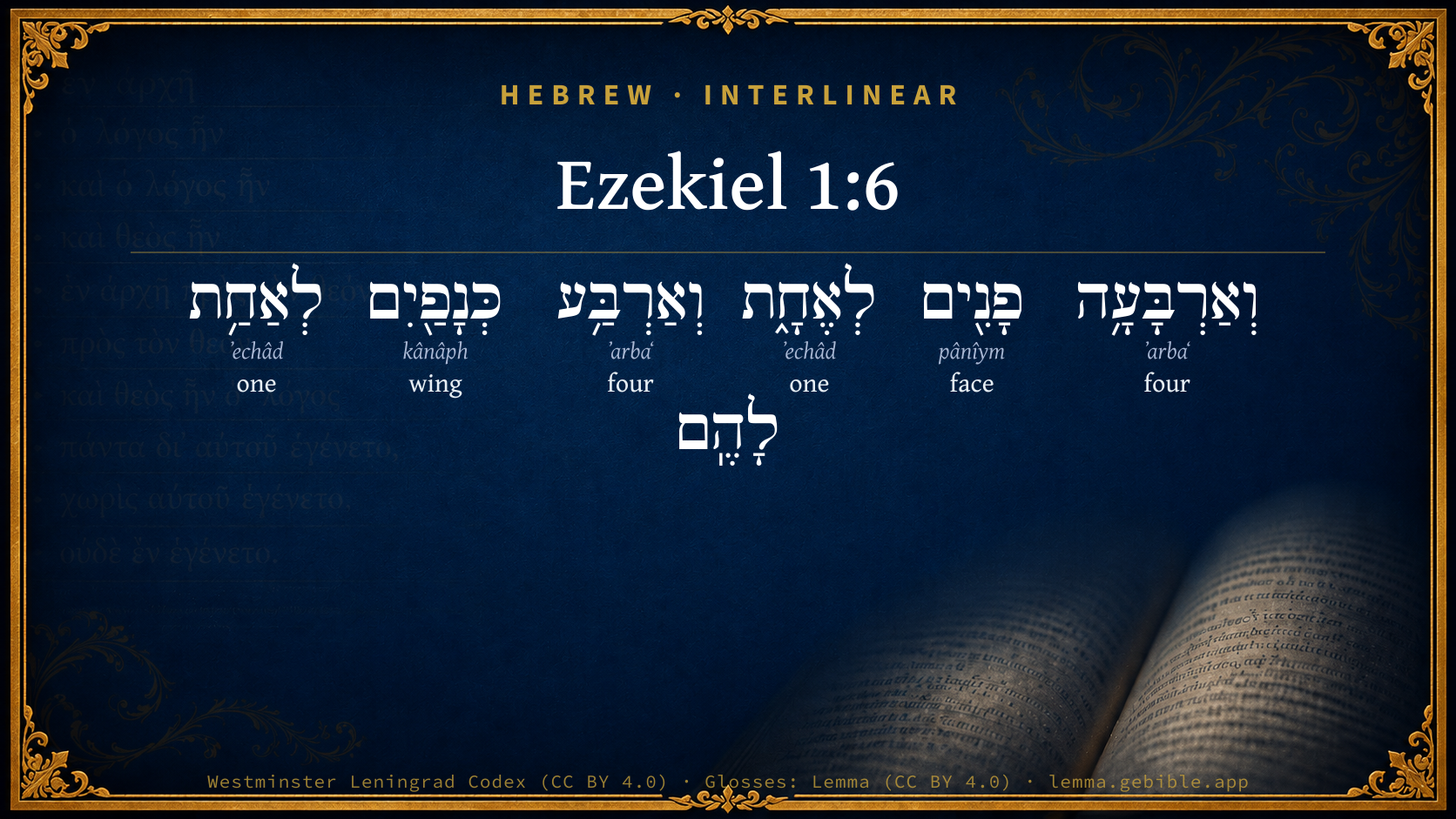
Ezekiel 1:6

Hebrew (Westminster Leningrad Codex) Ezekiel 1:6 appears in the Hebrew Old Testament. The text above is from the Westminster Leningrad Codex. Each word links to its Strong’s number, a concise gloss, and parsing drawn from the Open Scriptures Hebrew Bible morphology. Click any word for its full Brown-Driver-Briggs (BDB) entry.
Download image
Cite this verse

Ezekiel 1:6 (World English Bible). Public Domain. Lemma interlinear Bible study tool, https://lemma.gebible.app/v/ezekiel/1/6.

Show BibTeX & RIS
BibTeX
RIS
English Translation
Everyone had four faces, and everyone of them had four wings.
World English Bible · Public Domain
Download a study sheet

One document with this verse’s original text, its word-by-word gloss line, the meaning frame, cross-references with their text, attributed commentary, and full source and license credits — printable, and it pastes into notes with its structure intact.

This verse Autodidact and up

Study sheet (.html) Plain text (.txt)

A passage Seminary Student

Up to 50 verses in one chapter. A passage sheet keeps up to 6 commentary sources and 12 cross-references per verse, in the order this page ranks them, and says so on the sheet whenever that leaves anything out. Ask for a single verse and you get the Autodidact verse sheet above.

Everything on this page stays free to read, with no account — the sheet is a download of what is already on screen, not access to it.

Want to remove ads? Support Godless Engineer
Compare translations 3

The same verse in 3 English versions, stacked beneath the original-language interlinear above. Click any original word for its lexicon entry.

Each is an independent rendering of the whole verse — the interlinear is not word-aligned to these translations.

Highlighted words mark where these versions differ — a whole-verse word diff, not a word-by-word alignment.

  • World English Bible Public Domain
    Everyone had four faces, and everyone of them had four wings.
  • King James Version Public Domain
    And every one had four faces, and every one had four wings.
  • unfoldingWord Literal Text CC BY-SA 4.0
    but they had four faces each, and each of the creatures had four wings.

unfoldingWord Literal Text — © unfoldingWord, licensed CC BY-SA 4.0. Word-aligned USFM3 via Door43 (git.door43.org/unfoldingWord/en_ult).

Versions to compare (up to 4)

3 of 4 selected

Show all 18 translations

Every available English version of this verse, each an independent rendering of the whole verse.

  • World English Bible Public Domain
    Everyone had four faces, and everyone of them had four wings.
  • Berean Standard Bible Public Domain
    but each had four faces and four wings.
  • Majority Standard Bible Public Domain
    but each had four faces and four wings.
  • King James Version Public Domain
    And every one had four faces, and every one had four wings.
  • American Standard Version (1901) Public Domain
    And every one had four faces, and every one of them had four wings.
  • Revised Version (1885) Public Domain
    And every one had four faces, and every one of them had four wings.
  • Geneva Bible (1599) Public Domain
    And euery one had foure faces, and euery one had foure wings.
  • Douay-Rheims (1899) Public Domain
    Every one had four faces, and every one four wings.
  • Young's Literal Translation Public Domain
    and four faces `are' to each, and four wings `are' to each of them,
  • Literal Standard Version CC BY-SA 4.0
    and each had four faces and each of them had four wings,
  • Unlocked Literal Bible CC BY-SA 4.0
    but they had four faces each, and each of the creatures had four wings.
  • unfoldingWord Literal Text CC BY-SA 4.0
    but they had four faces each, and each of the creatures had four wings.
  • Darby Bible Public Domain
    And every one had four faces, and every one of them had four wings.
  • World Messianic Bible Public Domain
    Everyone had four faces, and each one of them had four wings.
  • Webster's Bible Public Domain
    And every one had four faces, and every one had four wings.
  • Free Bible Version CC BY-SA 4.0
    but they each had four faces and four wings.
  • Bible in Basic English Public Domain
    And every one had four faces, and every one of them had four wings.
  • JPS Tanakh (1917) Public Domain
    And every one had four faces, and every one of them had four wings.

Literal Standard Version (2020), Covenant Press — licensed CC BY-SA 4.0. Text via the HelloAO Bible API (eBible.org). Unlocked Literal Bible (unfoldingWord) — licensed CC BY-SA 4.0. Text via the HelloAO Bible API (eBible.org). unfoldingWord Literal Text — © unfoldingWord, licensed CC BY-SA 4.0. Word-aligned USFM3 via Door43 (git.door43.org/unfoldingWord/en_ult). Free Bible Version, Dr. Jonathan Gallagher — licensed CC BY-SA 4.0. Text via the HelloAO Bible API (eBible.org).

Word by word

More ways to search: Search by grammar → Find every occurrence → Compare this word →

Practice this passage: Drill this verse → Learn its vocabulary →

About this verse

These counts appear in no published source. They are computed here, from the morphology-tagged text and Lemma’s own curated glosses. What Lemma adds →

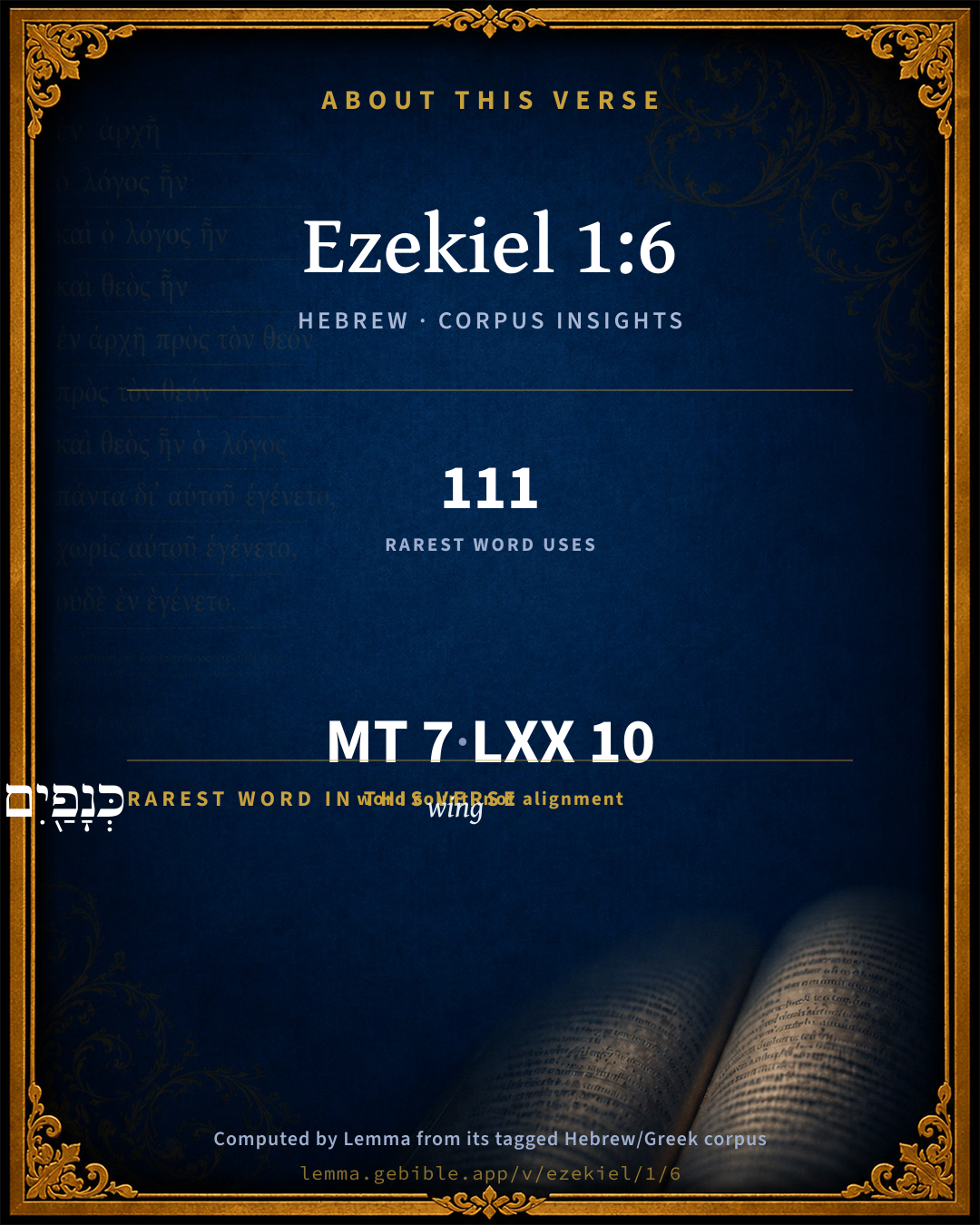
7
words
4
distinct lemmas
Prophets
section

Grammatical profile

  • 2 nouns
  • 4 adjectives
  • 1 preposition

Repetition

Words recur within this verse — often emphatic in Hebrew:

  • וְאַרְבָּעָ֥ה four H702 ×2
  • לְאֶחָ֑ת one H259 ×2

Hebrew & Septuagint length

In English translation the verse runs 11 words from the Hebrew and 12 from the Septuagint (LXX English) — closely comparable.

A rough comparison of the two English renderings, which tokenize alike — not a word-level alignment.

Word counts can differ between the Hebrew and the Greek without any difference in meaning — e.g. the Hebrew direct-object marker אֵת has no separate Greek word, and Greek often adds the article ὁ.

In the original languages it is 7 Hebrew tokens and 10 Greek tokens — but the two are counted differently (Hebrew bundles its prefixes and suffixes into one token; the Greek is in lemma form), so that isn’t a like-for-like length.

Cross-references

9

Topical passages linked to Ezekiel 1:6 in the Treasury of Scripture Knowledge — connected by theme and wording, ordered by reader-vote popularity; previews shown in the World English Bible.

  • Ezekiel 10:14 Every one had four faces: the first face was the face of the cherub, and the second face was the face of a man, and the third face the face of a lion, and the fourth the face of an eagle.
  • Exodus 25:20 The cherubim shall spread out their wings upward, covering the mercy seat with their wings, with their faces toward one another. The faces of the cherubim shall be toward the mercy seat.
  • 1 Kings 6:24–27 Five cubits was the one wing of the cherub, and five cubits the other wing of the cherub: from the uttermost part of the one wing to the uttermost part of the other were ten cubits.
  • Isaiah 6:2 Above him stood the seraphim. Each one had six wings. With two he covered his face. With two he covered his feet. With two he flew.
  • Ezekiel 1:8–11 They had the hands of a man under their wings on their four sides; and they four had their faces and their wings [thus]:
  • Ezekiel 1:15 Now as I saw the living creatures, behold, one wheel on the earth beside the living creatures, for each of the four faces of it.
  • Ezekiel 10:10 As for their appearance, they four had one likeness, as if a wheel have been within a wheel.
  • Ezekiel 10:21–22 Every one had four faces, and every one four wings; and the likeness of the hands of a man was under their wings.
  • Revelation 4:7–8 The first creature was like a lion, and the second creature like a calf, and the third creature had a face like a man, and the fourth was like a flying eagle.

Cross-references courtesy of OpenBible.info (CC BY 4.0).

Hebrew and Greek witnesses Masoretic Hebrew ↔ Greek Septuagint

The same verse in the two great witnesses to the Old Testament, shown verse-for-verse.

These are two independent witnesses, not word-aligned to each other, and the Septuagint is shown in lemma (dictionary) form.

Hebrew Ezekiel 1:6 Masoretic · Westminster Leningrad Codex

וְאַרְבָּעָ֥ה פָנִ֖ים לְאֶחָ֑ת וְאַרְבַּ֥ע כְּנָפַ֖יִם לְאַחַ֥ת לָהֶֽם

Everyone had four faces, and everyone of them had four wings.

World English Bible · Public Domain

Greek LXX Ezekiel 1:6 Septuagint · lemma form

καί τέσσαρες πρόσωπον ὁ εἷς καί τέσσαρες πτέρυξ ὁ εἷς

And each one had four faces, and each one had four wings.

LXX2012 (modern English Septuagint) · Public Domain

Hebrew: Westminster Leningrad Codex (CC BY 4.0). Greek: Septuagint (public domain); English from LXX2012 (modern English Septuagint) (Public Domain). How the Septuagint differs from the Hebrew →

Targum (Aramaic paraphrase)

1

The Targum is the ancient Jewish Aramaic paraphrase of the Hebrew Scriptures — an interpretive translation, not the Hebrew text itself. Onkelos (literal) and Pseudo-Jonathan (expansive) render the Torah, and Jonathan the Prophets. Coverage is partial: where no permissively-licensed English translation exists for a verse, only the Aramaic is shown. This is verse-level text, not a word-by-word alignment to the Hebrew.

  1. Targum Jonathan Prophets (Joshua–Malachi)
    וְאַרְבְּעָא אַפִּין לַחֲדָא וְאַרְבַּע אַפִּין לְכָל חַד וְחַד שִׁתָּא עֲסַר אַפִּין לְבִרְיָתָא חֲדָא מִנְיַן אַפַּיָא דְאַרְבַּע בִּרְיָן שִׁתִּין וְאַרְבְּעָא אַפִּין וְאַרְבְּעָה גַפִּין לַחֲדָא וְאַרְבְּעָא גַפִּין לְכָל חַד וְחַד שִׁתָּת עֲסַר לְכָל אַפָּא וְאַפָּא שִׁתִּין וְאַרְבָּעָא גַפִּין לְבִרְיָתָא חֲדָא וַהֲווֹ מִנְיָן גַפַּיָא דְאַרְבַּע בִּרְיָן מָאתָן וְחַמְשִׁין וְשִׁתָּא גַפִּין:

    (no public-domain English translation for this verse)

    Targum Jonathan — Aramaic: “Mikraot Gedolot” (public domain). English: “Sefaria Community Translation” (CC0 1.0 (public-domain dedication)); “London "Chaldee Paraphrase," 1871” (public domain). Text via Sefaria.

Commentary

Notes on Ezekiel 1:6 from classic Christian and Jewish commentators (each source and its license shown beneath its notes). The classic Christian expositions comment on the surrounding passage and are grouped to its opening verse, so a note may address several verses; the Jewish commentaries on the Tanakh (Rashi and others) are per-verse, so they appear only where the commentator wrote on this verse.

Lemma curates 59 commentaries, every one of them public domain or Creative Commons licensed, each selected and text-cleaned for this edition rather than reprinted as found. About our sources →

Trapp's Complete Commentary

John Trapp

Eze 1:6 And every one had four faces, and every one had four wings.

Ver. 6. And every one had four faces.] To set forth, saith an expositor, that the power of angels is exercised about all creatures. It is as if the angels did bear on them the heads of all living creatures - i.e., did comprehend in themselves all the elements and all the parts of the world; not as if they did move or act by their own power, but as they are God’s hands and agents, employed by him at pleasure, for the good of his Church especially, {Heb 1:14} as being fit and ready to every good work. So should we strive to be. {Tit 3:1}

And every one had four wings.] To set forth their agility, their incredible swiftness, far beyond that of the sun, which yet, if Bellarmine {a} reckoneth right, runneth, in the eighth part of an hour, seven thousand miles; others say many more.

{a} De Ascens. ment. in Deum, grad. 7.

John Trapp, A Commentary or Exposition upon All the Books of the Old and New Testament (1647–1656) — public domain. Text from a community e-Sword module.

Jamieson, Fausset & Brown

Robert Jamieson, A. R. Fausset & David Brown

Not only were there four distinct living creatures, but each of the four had four faces, making sixteen in all. The four living creatures of the cherubim answer by contrast to the four world monarchies represented by four beasts, Assyria, Persia, Greece, and Rome (Dan. 7:1-28). The Fathers identified them with the four Gospels: Matthew the lion, Mark the ox, Luke the man, John the eagle. Two cherubim only stood over the ark in the temple; two more are now added, to imply that, while the law is retained as the basis, a new form is needed to be added to impart new life to it. The number four may have respect to the four quarters of the world, to imply that God's angels execute His commands everywhere. Each head in front had the face of a man as the primary and prominent one: on the right the face of a lion, on the left the face of an ox, above from behind the face of an eagle. The Mosaic cherubim were similar, only that the human faces were put looking towards each other, and towards the mercy seat between, being formed out of the same mass of pure gold as the latter (Exo 25:19-20). In Isa 6:2 two wings are added to cover their countenances; because there they stand by the throne, here under the throne; there God deigns to consult them, and His condescension calls forth their humility, so that they veil their faces before Him; here they execute His commands. The face expresses their intelligence; the wings, their rapidity in fulfilling God's will. The Shekinah or flame, that signified God's presence, and the written name, JEHOVAH, occupied the intervening space between the cherubim Gen 4:14, Gen 4:16; Gen 3:24 ("placed"; properly, "to place in a tabernacle"), imply that the cherubim were appointed at the fall as symbols of God's presence in a consecrated place, and that man was to worship there. In the patriarchal dispensation when the flood had caused the removal of the cherubim from Eden, seraphim or teraphim (Chaldean dialect) were made as models of them for domestic use (Gen 31:19, Margin; Gen 31:30). The silence of the twenty-fifth and twenty-sixth chapters of Exodus to their configuration, whereas everything else is minutely described, is because their form was so well-known already to Bezaleel and all Israel by tradition as to need no detailed description. Hence Ezekiel (Eze 10:20) at once knows them, for he had seen them repeatedly in the carved work of the outer sanctuary of Solomon's temple (Kg1 6:23-29). He therefore consoles the exiles with the hope of having the same cherubim in the renovated temple which should be reared; and he assures them that the same God who dwelt between the cherubim of the temple would be still with His people by the Chebar. But they were not in Zerubbabel's temple; therefore Ezekiel's foretold temple, if literal, is yet future. The ox is selected as chief of the tame animals, the lion among the wild, the eagle among birds, and man the head of all, in his ideal, realized by the Lord Jesus, combining all the excellencies of the animal kingdom. The cherubim probably represent the ruling powers by which God acts in the natural and moral world. Hence they sometimes answer to the ministering angels; elsewhere, to the redeemed saints (the elect Church) through whom, as by the angels, God shall hereafter rule the world and proclaim the manifold wisdom of God (Mat 19:28; Co1 6:2; Eph 3:10; Rev 3:21; Rev 4:6-8). The "lions" and "oxen," amidst "palms" and "open flowers" carved in the temple, were the four-faced cherubim which, being traced on a flat surface, presented only one aspect of the four. The human-headed winged bulls and eagle-headed gods found in Nineveh, sculptured amidst palms and tulip-shaped flowers, were borrowed by corrupted tradition from the cherubim placed in Eden near its fruits and flowers. So the Aaronic calf (Exo 32:4-5) and Jeroboam's calves at Dan and Beth-el, a schismatic imitation of the sacred symbols in the temple at Jerusalem. So the ox figures of Apis on the sacred arks of Egypt.

Jamieson, Fausset & Brown — Commentary Critical and Explanatory on the Whole Bible (1871) — public domain (CC PDM 1.0). Text via the HelloAO Bible API.

Adam Clarke's Commentary

Verse 6. Every one had four faces] There were four several figures of these living creatures, and each of these figures had four distinct faces: but as the face of the man was that which was presented to the prophet's view, so that he saw it more plainly than any of the others; hence it is said, Eze 1:5, that each of these figures had the likeness of a man; and the whole of this compound image bore a general resemblance to the human figure.

Adam Clarke's Commentary on the Bible (1810–1826) — public domain. Text from a community e-Sword/MySword module.

John Calvin's Commentaries

He now comes to the heads and wings themselves. Many suppose that each animal had four heads, and then that four appearances belonged to each head; others extend the wings much further, because they assign four wings to each of the four heads, and others even sixteen; but this does not seem in accordance with the Prophet’s words. He simply says each had four heads, and then four wings. The wings and the heads correspond; but one animal was endowed with only four heads, and so I do not think that it had more than four wings, which will again be evident from the context. He adds afterwards —

John Calvin's Commentaries (1540-1563) — public domain. Text from the Calvin Translation Society English edition (1840s-50s) via the Christian Classics Ethereal Library (ccel.org). Calvin's coverage is partial (roughly two-thirds of the Bible); uncommented books and verses are honest gaps, never fabricated. The 19th-century editor's footnotes and remarks are omitted so the notes are faithfully Calvin's own voice.

Ellicott's Commentary for English Readers

(6) Four faces.—The cherubim, being merely symbolical figures, are variously represented. Those placed in the Tabernacle and in the Temple of Solomon appear to have had only a single face; those described in Ezekiel’s vision of the Temple (Eze_41:18-19) had two; the four living creatures of Rev_4:7 were each different from the other: one like a man, one like a lion, one like an ox, and one like an eagle, and these four are combined here in each one of the cherubim (Eze_1:10). Man is the head of the whole animal creation, the lion of wild beasts, the ox of the domestic animals, and the eagle of the birds.

Four wings.—In Rev_4:8, six wings are mentioned, as also with the seraphim of Isa_6:2. The cherubim in Solomon’s Temple had two (1Ki_6:27). In Eze_10:21, as here, they have four. The number is plainly not important, though doubtless assigned to them with reference to the number of creatures, and of their faces, and of the wheels; but that they should have more than the normal number of two is here appropriate, partly to concur with the other indications of the fulness of their life and activity, and partly because (Eze_1:11) two of them were used to express their reverence, as were four of those of the seraphim in Isaiah.

A Bible Commentary for English Readers, edited by Charles John Ellicott (1878–1897) — public domain. Text from a community e-Sword module.

The Cambridge Bible for Schools and Colleges

gen. ed. J. J. S. Perowne

6. had four faces] These were a man’s in front of each, an eagle’s opposite to this at the back of each; a lion’s on the right hand of each, and the face of an ox on the left of each. Thus four different faces were presented in each direction, so that in whatever direction the whole moved, while a man’s face was presented first, those of a lion, an ox and an eagle were also encountered. In this view the four living creatures made up one creature, and each of the four was in small that which the four were combined.

The Cambridge Bible for Schools and Colleges (gen. ed. J. J. S. Perowne; Cambridge University Press, 1878–1918) — public domain. Text from a community e-Sword module.

John Gill's Exposition

And or but everyone had four faces,.... Which are described; see Gill on Eze 1:10. The Targum multiplies the faces in a strange monstrous manner, paraphrasing the words thus,

"each had four faces, and there were four faces to everyone "of them", and every creature had sixteen faces; the number of the faces of the four creatures was sixty and four;''

and everyone had four wings; the seraphim in Isa 6:2; and the four beasts or living creatures in Rev 4:8; had six wings; and so it seems that these had also, from Eze 1:11; as will be seen there; nor is this any contradiction to the account here given, since it is not said they had only four wings. The Targum gives the same monstrous account of their wings as of their faces, saying,

"each had four wings, and there were four wings for everyone of them, sixteen wings to every face, and sixty four to every creature; and the number of the wings of the four living creatures were two hundred and fifty six.''

Jarchi is of the same opinion, and confirms it in his note on the text, which is this,

""four faces to one"; that is, to the face of a man only were four faces, and so, to the lion, to the eagle, and to the ox, lo, sixteen to a living creature, and so to every living creature; and four wings to everyone of the faces, lo, sixty and four wings to a living creatures and which, according to the Targum of Jonathan, amounts to two hundred and fifty six wings;''

what these wings signified; see Gill on Eze 1:11;

John Gill's Exposition of the Whole Bible (1746–1763) — public domain (CC PDM 1.0). Text via the HelloAO Bible API.

Albert Barnes' Notes on the Bible

In the Revelation of John each “beast” has its own distinctive character, here each unites in itself the four characters; there each has six wings, like the Seraphim Isa 6:2, here only four.

Albert Barnes' Notes on the Bible (1834–1885) — public domain. Text from a community e-Sword/MySword module.

Haydock's Catholic Bible Commentary

Faces. This sometimes means shapes; and Pererius supposes that the animal had the head of a man, and the breast covered with lions’ hair, the feet or round cloven hoofs of an ox, and the wings of an eagle. But it had rather four faces as well as wings, the faces of the man and lion being to the right, and the other two to the left; (Calmet; Tirinus) or the eagle was behind (Haydock) or above the head of the man, and the lion and ox at his right and left. (Cornelius a Lapide) (Menochius)

George Leo Haydock (1774–1849), Haydock's Catholic Family Bible and Commentary, 1859 edition — public domain. Excludes Psalms (Douay-Rheims chapter numbering differs from Protestant) and Deuterocanonical books (Catholic canon only).

Matthew Poole's English Annotations

And every one of those four living creatures which appeared to the prophet had four faces: this hieroglyphic, though it seems to present us with a monstrous sight, yet does not unbecome the Divine Wisdom, nor doth it want like representations, as Eze 10:14; Rev 4:6; 5:6; and speaks either the full fitness of angels to do God’s commands in all things and occasions, or the perfection of their nature and obedience; or the universal dominion of God, and the universal subjection of the creatures.

Faces; some would have this not literally understood of that part of the body which is properly the face, though I see no cause for it; but as these living creatures had wings, so they had faces, and what those were the 10th verse does tell us.

And every one had four wings; if it were every face had four wings, each living creature would have sixteen wings, but it is every one of the living creatures had four wings. With two they did fly, noting the speed of their obedience; and with two they cover their body, denoting the reverence of their mind, and obedience.

Matthew Poole's English Annotations on the Holy Bible (1683–1685) — public domain. Text from a community e-Sword/MySword module.

Whedon's Commentary on the Bible

Daniel D. Whedon

6. Four faces — A man’s face in front, an eagle’s behind, the face of an ox on the left, and of a lion on the right. This is the usual explanation, but Hugo Winckler (Altorientalische Forschungen, 1896), from a monument recently discovered at Sendschirli which seems to somewhat resemble this description, would draw the conclusion that each one had a human body and “the appearance of a man,” but also that each creature was four-headed; the four heads facing the cardinal points: the four faces of the man looking toward the east, the four lion faces toward the west, the four bull faces toward the north, the four eagle faces toward the south. The fact seems to be that these were symbolic creatures, never intended for pictorial representation.

Four wings — The winged sun-disk is the oldest known symbol of deity and was reverenced in Arabia, Babylonia, Phoenicia, and Egypt. Even in Christian times this same symbol was used for the divine Christ by the Copts. Wesley says of the use of these wings: “With two they flew, denoting the speed of their obedience; and with two they covered their body, denoting their reverence.”

Daniel D. Whedon (gen. ed.), Commentary on the Old and New Testaments (1874–1909) — public domain. Text from a community e-Sword module.

The Pulpit Commentary

We note the points of contrast with other like visions.

1. Eze_6:2 each seraph has six wings, as each "living creature" Rev_4:8.

2. Eze_4:7 the four heads are distributed, one to each of the"living creatures," while here each has four faces, and forms, as it were, a Janus quadrifrons. The wings are described more minutely in ver. 11.

The Pulpit Commentary (1880–1919), ed. H.D.M. Spence-Jones & Joseph S. Exell — public domain. Text from a community e-Sword module.

John Wesley's Explanatory Notes

Wings - With two they flew, denoting the speed of their obedience; and with two they covered their body, denoting their reverence.

John Wesley, Explanatory Notes Upon the Whole Bible (1754–1765) — public domain. Text via the GEBible commentary corpus.

Rashi

Rabbi Shlomo Yitzchaki (Rashi)

and each one had four faces “Each one” means that the human countenance had four faces, as did that of the lion, the eagle, and the ox, totaling sixteen [faces] to one living being. It was thus for each living being, and four wings for each of the faces, totaling sixty-four wings for each living being. This is [why] Jonathan paraphrased: two hundred fifty-six wings.

Rashi on the Tanakh — English translations: “The Judaica Press complete Tanach with Rashi, translated by A. J. Rosenberg” (CC BY 4.0); “Pentateuch with Rashi's commentary by M. Rosenbaum and A.M. Silbermann, 1929-1934” (public domain); “The Metsudah Tanach series, Lakewood, N.J” (CC BY 4.0); and “The Book of Joshua, Metsudah Publications, 1997” (CC BY 4.0). Text via Sefaria.

Lesson kit

Teaching starters — assembled from the data on this page, not authored interpretation. Every prompt links to the verse data it draws on. Edit before teaching.

Ezekiel, in the Prophets, opens this verse with 7 words (4 distinct Hebrew lemmas). Its most distinctive word is kânâph (“wing”). A historical commentator’s framing appears above. Read the whole chapter for the surrounding context.

Discussion questions

  1. How does “wing” (kânâph) shape what this verse is saying?
  2. Ezekiel 10:14 shares this passage’s theme. How do the two illuminate each other?
  3. “four” occurs 2× in this one verse. What is the effect of the repetition?
  4. These translations render this verse differently. What is at stake in choosing one wording over another?
  5. Reading how Trapp's Complete Commentary and Jamieson, Fausset & Brown read this verse, where do the two commentators agree and where do they part?

Things to notice

Reading settings

Reading text

Shown beneath each verse's original-language words.

Old Testament
Old Testament edition

Read the OT as the Masoretic Hebrew (MT) or the Greek Septuagint (LXX).

English shown for the Greek Septuagint (in the Hebrew ↔ Greek comparison).

Comparing translations? Open the Compare panel on any verse page to stack up to four side by side.