Ezekiel 1:8

Hebrew (Westminster Leningrad Codex) Ezekiel 1:8 appears in the Hebrew Old Testament. The text above is from the Westminster Leningrad Codex. Each word links to its Strong’s number, a concise gloss, and parsing drawn from the Open Scriptures Hebrew Bible morphology. Click any word for its full Brown-Driver-Briggs (BDB) entry.
Download image
Cite this verse

Ezekiel 1:8 (World English Bible). Public Domain. Lemma interlinear Bible study tool, https://lemma.gebible.app/v/ezekiel/1/8.

Show BibTeX & RIS
BibTeX
RIS
English Translation
They had the hands of a man under their wings on their four sides; and they four had their faces and their wings [thus]:
World English Bible · Public Domain
Download a study sheet

One document with this verse’s original text, its word-by-word gloss line, the meaning frame, cross-references with their text, attributed commentary, and full source and license credits — printable, and it pastes into notes with its structure intact.

This verse Autodidact and up

Study sheet (.html) Plain text (.txt)

A passage Seminary Student

Up to 50 verses in one chapter. A passage sheet keeps up to 6 commentary sources and 12 cross-references per verse, in the order this page ranks them, and says so on the sheet whenever that leaves anything out. Ask for a single verse and you get the Autodidact verse sheet above.

Everything on this page stays free to read, with no account — the sheet is a download of what is already on screen, not access to it.

Want to remove ads? Support Godless Engineer
Compare translations 3

The same verse in 3 English versions, stacked beneath the original-language interlinear above. Click any original word for its lexicon entry.

Each is an independent rendering of the whole verse — the interlinear is not word-aligned to these translations.

Highlighted words mark where these versions differ — a whole-verse word diff, not a word-by-word alignment.

  • World English Bible Public Domain
    They had the hands of a man under their wings on their four sides; and they four had their faces and their wings [thus]:
  • King James Version Public Domain
    And they had the hands of a man under their wings on their four sides; and they four had their faces and their wings.
  • unfoldingWord Literal Text CC BY-SA 4.0
    Yet they had human hands under their wings on all four sides. For all four, their faces and wings were like this:

unfoldingWord Literal Text — © unfoldingWord, licensed CC BY-SA 4.0. Word-aligned USFM3 via Door43 (git.door43.org/unfoldingWord/en_ult).

Versions to compare (up to 4)

3 of 4 selected

Show all 18 translations

Every available English version of this verse, each an independent rendering of the whole verse.

  • World English Bible Public Domain
    They had the hands of a man under their wings on their four sides; and they four had their faces and their wings [thus]:
  • Berean Standard Bible Public Domain
    Under their wings on their four sides they had human hands. All four living creatures had faces and wings,
  • Majority Standard Bible Public Domain
    Under their wings on their four sides they had human hands. All four living creatures had faces and wings,
  • King James Version Public Domain
    And they had the hands of a man under their wings on their four sides; and they four had their faces and their wings.
  • American Standard Version (1901) Public Domain
    And they had the hands of a man under their wings on their four sides; and they four had their faces and their wings `thus':
  • Revised Version (1885) Public Domain
    And they had the hands of a man under their wings on their four sides: and they four had their faces and their wings thus;
  • Geneva Bible (1599) Public Domain
    And the handes of a man came out from vnder their wings in the foure parts of them, and they foure had their faces, and their wings.
  • Douay-Rheims (1899) Public Domain
    And they had the hands of a man under their wings on their four sides: and they bad faces, and wings on the four sides,
  • Young's Literal Translation Public Domain
    and hands of man under their wings -- on their four sides, and their faces and their wings -- `are' to them four;
  • Literal Standard Version CC BY-SA 4.0
    and on their four sides [each had] hands of man under their wings; and [each] of the four had their faces and their wings;
  • Unlocked Literal Bible CC BY-SA 4.0
    Yet they had human hands under their wings on all four sides. For all four, their faces and wings were like this:
  • unfoldingWord Literal Text CC BY-SA 4.0
    Yet they had human hands under their wings on all four sides. For all four, their faces and wings were like this:
  • Darby Bible Public Domain
    And they had the hands of a man under their wings on their four sides; and they four had their faces and their wings:
  • World Messianic Bible Public Domain
    They had the hands of a man under their wings on their four sides. The four of them had their faces and their wings like this:
  • Webster's Bible Public Domain
    And they had the hands of a man under their wings on their four sides; and they four had their faces and their wings.
  • Free Bible Version CC BY-SA 4.0
    They had human hands under their wings on each of their four sides. The four of them all had faces and wings,
  • Bible in Basic English Public Domain
    And they had the hands of a man under their wings; the four of them had faces on their four sides.
  • JPS Tanakh (1917) Public Domain
    And they had the hands of a man under their wings on their four sides; and as for the faces and wings of them four,

Literal Standard Version (2020), Covenant Press — licensed CC BY-SA 4.0. Text via the HelloAO Bible API (eBible.org). Unlocked Literal Bible (unfoldingWord) — licensed CC BY-SA 4.0. Text via the HelloAO Bible API (eBible.org). unfoldingWord Literal Text — © unfoldingWord, licensed CC BY-SA 4.0. Word-aligned USFM3 via Door43 (git.door43.org/unfoldingWord/en_ult). Free Bible Version, Dr. Jonathan Gallagher — licensed CC BY-SA 4.0. Text via the HelloAO Bible API (eBible.org).

Word by word

More ways to search: Search by grammar → Find every occurrence → Compare this word →

Practice this passage: Drill this verse → Learn its vocabulary →

רִבְעֵיהֶ֑ם
rebaʻ
H7253
“sides · their”
Noun, Common, Masculine, Plural, Construct + Suffix, Personal, 3rd Person, Masculine, Plural
Part of Speech
Noun
Type
Common
Gender
Masculine
Number
Plural
State
Construct
Full BDB Definition

Origin: from H7251

TWOT: 2107a

fourth part, four sides - fourth part - four sides
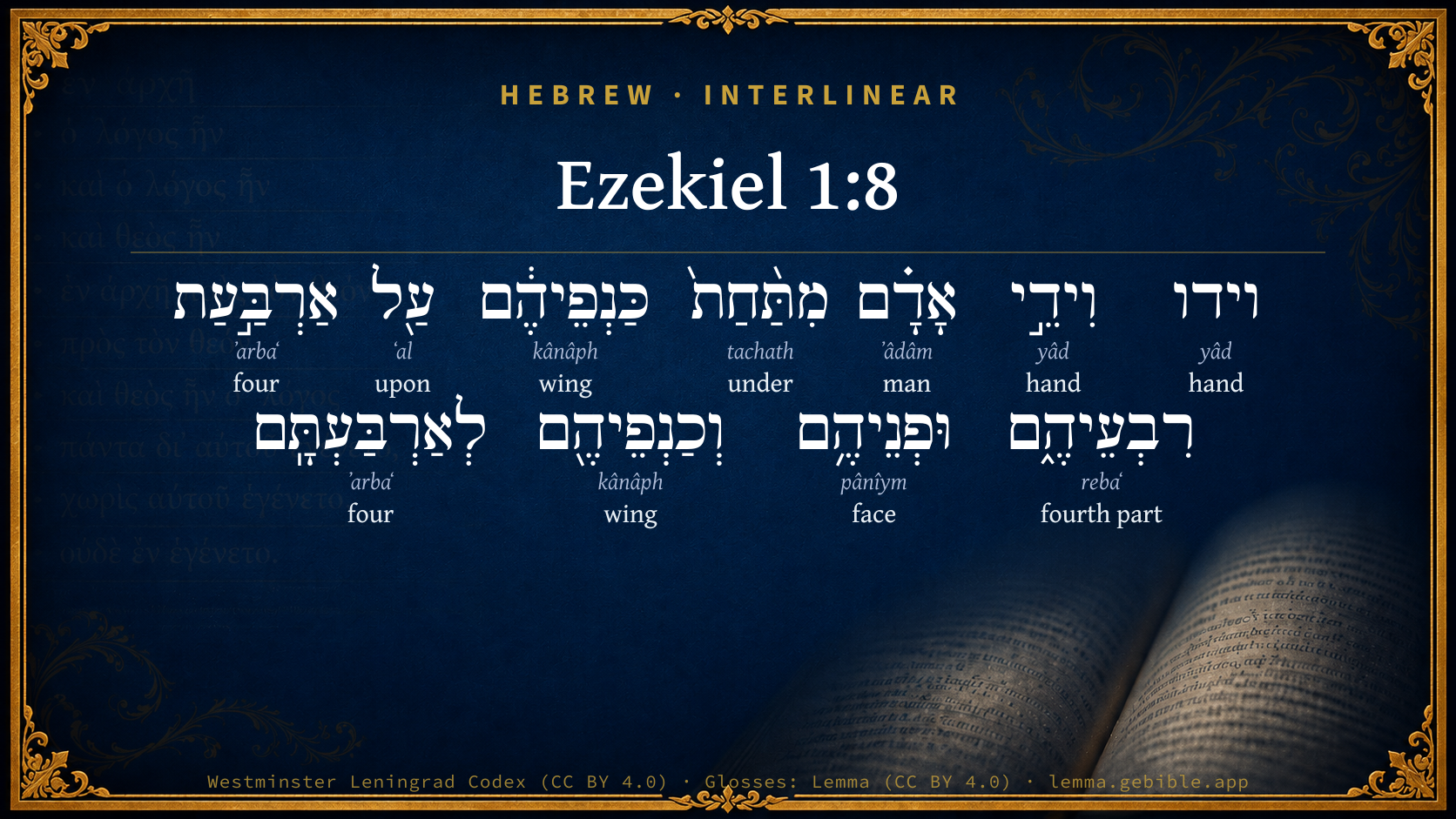
  1. וידו yâd H3027 “and · hands · his” Conjunction + Noun, Common, Both, Dual, Construct + Suffix, Personal, 3rd Person, Masculine, Singular
  2. וִידֵ֣י yâd H3027 “and · hands of” Conjunction + Noun, Common, Both, Dual, Construct
  3. אָדָ֗ם ʼâdâm H120 “man” Noun, Common, Masculine, Singular, Absolute
  4. מִתַּ֨חַת֙ tachath H8478 “from · under” Preposition + Preposition
  5. כַּנְפֵיהֶ֔ם kânâph H3671 “wings · their” Noun, Common, Feminine, Dual, Construct + Suffix, Personal, 3rd Person, Masculine, Plural
  6. עַ֖ל ʻal H5921 “upon” Preposition
  7. אַרְבַּ֣עַת ʼarbaʻ H702 “four” Adjective, Cardinal number, Masculine, Singular, Construct
  8. וּפְנֵיהֶ֥ם pânîym H6440 “and · face(s) · their” Conjunction + Noun, Common, Both, Plural, Construct + Suffix, Personal, 3rd Person, Masculine, Plural
  9. וְכַנְפֵיהֶ֖ם kânâph H3671 “and · wings · their” Conjunction + Noun, Common, Feminine, Dual, Construct + Suffix, Personal, 3rd Person, Masculine, Plural
  10. לְאַרְבַּעְתָּֽם ʼarbaʻ H702 “to/for · four · their” Preposition + Adjective, Cardinal number, Masculine, Singular, Construct + Suffix, Personal, 3rd Person, Masculine, Plural

About this verse

These counts appear in no published source. They are computed here, from the morphology-tagged text and Lemma’s own curated glosses. What Lemma adds →

11
words
8
distinct lemmas
Prophets
section

Notable vocabulary

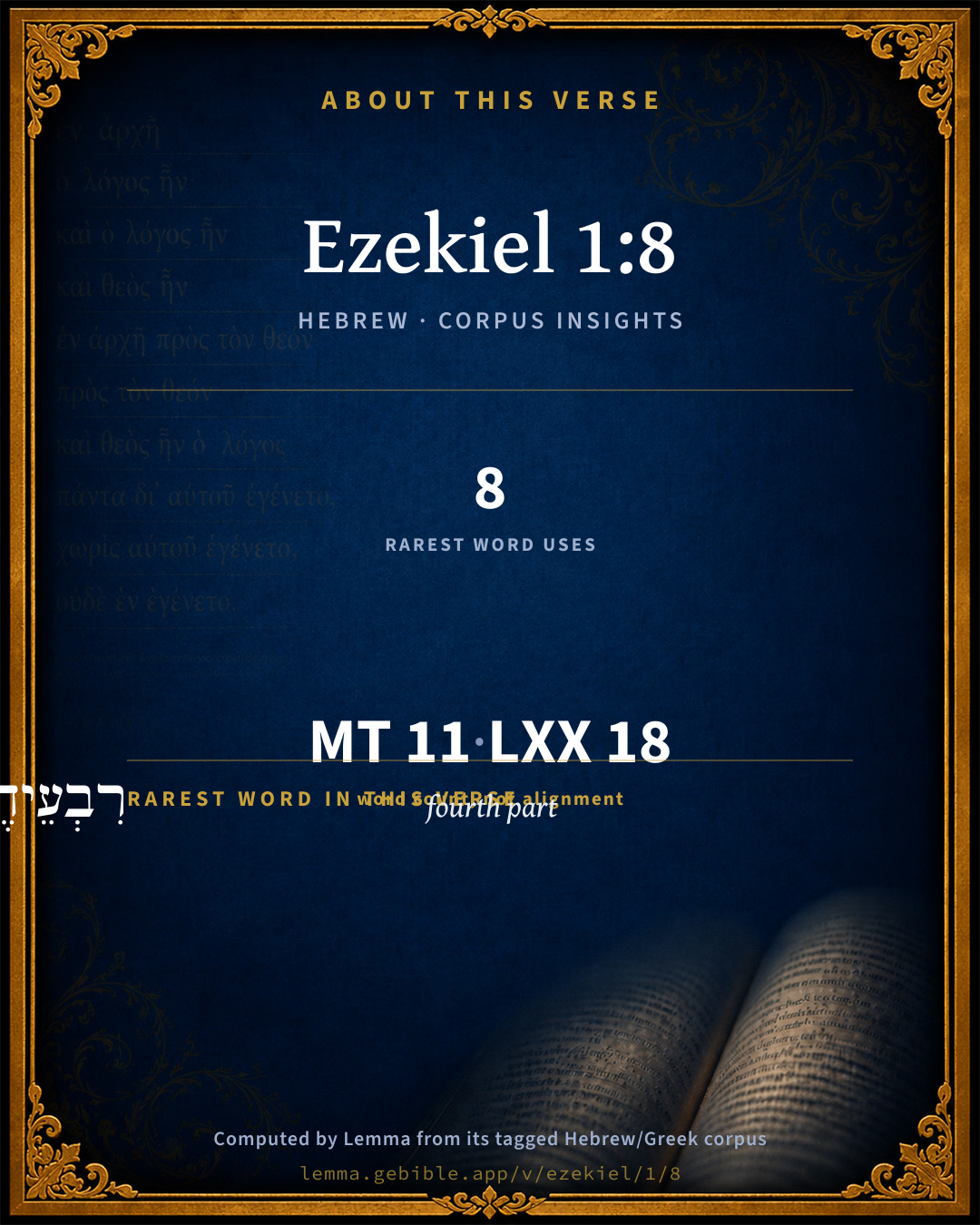
The rarest word here is רִבְעֵיהֶ֑ם fourth part H7253 — appearing just 8 times in the whole Hebrew Bible.

Shared distinctive vocabulary

רִבְעֵיהֶ֑ם fourth part H7253 occurs in 7 verses of the Hebrew Bible. Also found in:

Grammatical profile

  • 7 nouns
  • 2 adjectives
  • 2 prepositions

Repetition

Words recur within this verse — often emphatic in Hebrew:

  • וידו hand H3027 ×2
  • כַּנְפֵיהֶ֔ם wing H3671 ×2
  • אַרְבַּ֣עַת four H702 ×2

Hebrew & Septuagint length

In English translation the verse runs 24 words from the Hebrew and 14 from the Septuagint (LXX English) — the Septuagint runs noticeably shorter here. See the side-by-side →

A rough comparison of the two English renderings, which tokenize alike — not a word-level alignment.

Word counts can differ between the Hebrew and the Greek without any difference in meaning — e.g. the Hebrew direct-object marker אֵת has no separate Greek word, and Greek often adds the article ὁ.

In the original languages it is 11 Hebrew tokens and 18 Greek tokens — but the two are counted differently (Hebrew bundles its prefixes and suffixes into one token; the Greek is in lemma form), so that isn’t a like-for-like length.

Cross-references

8

Topical passages linked to Ezekiel 1:8 in the Treasury of Scripture Knowledge — connected by theme and wording, ordered by reader-vote popularity; previews shown in the World English Bible.

  • Ezekiel 10:21 Every one had four faces, and every one four wings; and the likeness of the hands of a man was under their wings.
  • Isaiah 6:6 Then one of the seraphim flew to me, having a live coal in his hand, which he had taken with the tongs from off the altar.
  • Ezekiel 1:17 When they went, they went in their four directions: they didn't turn when they went.
  • Ezekiel 8:3 He put forth the form of a hand, and took me by a lock of my head; and the Spirit lifted me up between earth and the sky, and brought me in the visions of God to Jerusalem, to the door of the gate of the inner [court] that looks toward the north; where was the seat of the image of jealousy, which provokes to jealousy.
  • Ezekiel 10:2 He spoke to the man clothed in linen, and said, Go in between the whirling [wheels], even under the cherub, and fill both your hands with coals of fire from between the cherubim, and scatter them over the city. He went in as I watched.
  • Ezekiel 10:7–8 The cherub stretched forth his hand from between the cherubim to the fire that was between the cherubim, and took [of it], and put it into the hands of him who was clothed in linen, who took it and went out.
  • Ezekiel 10:11 When they went, they went in their four directions: they didn't turn as they went, but to the place where the head looked they followed it; they didn't turn as they went.
  • Ezekiel 10:18 The glory of Yahweh went forth from over the threshold of the house, and stood over the cherubim.

Cross-references courtesy of OpenBible.info (CC BY 4.0).

Hebrew and Greek witnesses Masoretic Hebrew ↔ Greek Septuagint

The same verse in the two great witnesses to the Old Testament, shown verse-for-verse.

Here the Septuagint runs noticeably shorter than the Hebrew — LXX2012 (modern English Septuagint) 14 words vs World English Bible 24. A rough length comparison of the two English translations, not a word-level alignment — read both below.

These are two independent witnesses, not word-aligned to each other, and the Septuagint is shown in lemma (dictionary) form.

Hebrew Ezekiel 1:8 Masoretic · Westminster Leningrad Codex

וידו וִידֵ֣י אָדָ֗ם מִתַּ֨חַת֙ כַּנְפֵיהֶ֔ם עַ֖ל אַרְבַּ֣עַת רִבְעֵיהֶ֑ם וּפְנֵיהֶ֥ם וְכַנְפֵיהֶ֖ם לְאַרְבַּעְתָּֽם

They had the hands of a man under their wings on their four sides; and they four had their faces and their wings [thus]:

World English Bible · Public Domain

Greek LXX Ezekiel 1:8 Septuagint · lemma form

καί χείρ ἄνθρωπος ὑποκάτωθεν ὁ πτέρυξ αὐτός ἐπί ὁ τέσσαρες μέρος αὐτός καί ὁ πρόσωπον αὐτός ὁ τέσσαρες

And the hand of a man was under their wings on their four sides.

LXX2012 (modern English Septuagint) · Public Domain

On this verse, The Cambridge Bible for Schools and Colleges discusses the Septuagint’s reading. Read the note in Commentary ↓

Hebrew: Westminster Leningrad Codex (CC BY 4.0). Greek: Septuagint (public domain); English from LXX2012 (modern English Septuagint) (Public Domain). How the Septuagint differs from the Hebrew →

Targum (Aramaic paraphrase)

1

The Targum is the ancient Jewish Aramaic paraphrase of the Hebrew Scriptures — an interpretive translation, not the Hebrew text itself. Onkelos (literal) and Pseudo-Jonathan (expansive) render the Torah, and Jonathan the Prophets. Coverage is partial: where no permissively-licensed English translation exists for a verse, only the Aramaic is shown. This is verse-level text, not a word-by-word alignment to the Hebrew.

  1. Targum Jonathan Prophets (Joshua–Malachi)
    וִידִין כִּידֵי אֱנָשָׁא עֲבִיד לְהוֹן מִתְּחוֹת גַפֵּיהוֹן עַל אַרְבַּע סִטְרֵיהוֹן לְמֶחְתֵּי בְהֵן גוּמְרִין דְאֵשָׁא מִבֵּינֵי כְרוּבַיָא מִתְּחוֹת רְקִיעָא דְעַל רֵישֵׁיהוֹן לְמִתַּן עַל חוּפְנֵי סַרְפַּיָא לְמִזְרַק עַל אֲתַר רַשִׁיעַיָא לְאַבָּדָא חַיָבַיָא עָבְרֵי מֵימְרֵיהּ וְאַפֵּיהוֹן וְגַפֵּיהוֹן שַׁוֵי לְאַרְבַּעְתְּהֵן:

    (no public-domain English translation for this verse)

    Targum Jonathan — Aramaic: “Mikraot Gedolot” (public domain). English: “Sefaria Community Translation” (CC0 1.0 (public-domain dedication)); “London "Chaldee Paraphrase," 1871” (public domain). Text via Sefaria.

Commentary

Notes on Ezekiel 1:8 from classic Christian and Jewish commentators (each source and its license shown beneath its notes). The classic Christian expositions comment on the surrounding passage and are grouped to its opening verse, so a note may address several verses; the Jewish commentaries on the Tanakh (Rashi and others) are per-verse, so they appear only where the commentator wrote on this verse.

Lemma curates 59 commentaries, every one of them public domain or Creative Commons licensed, each selected and text-cleaned for this edition rather than reprinted as found. About our sources →

The Cambridge Bible for Schools and Colleges

gen. ed. J. J. S. Perowne

8. Each living creature appears to have had four hands or arms, cf. ch. Eze_10:21. The last words of Eze_1:8 must be joined with Eze_1:9 : “and their faces and their wings, of them four—their wings were joined one to another; they turned not when they went, they went every one straightforward.” The meaning is that as each creature with his outstretched wings formed one side of the square his wings touched or were joined to those of two other creatures, one on his right and another on his left. The words “they turned not” refer to the faces. The above sentence is very awkward, and the whole is given by LXX. in a much shorter form: Eze_1:8 and the faces of them four Eze_1:9 turned not when they went, they went every one straightforward. The clauses in Eze_1:9 (Heb.) correspond respectively to Eze_1:11-12.

The Cambridge Bible for Schools and Colleges (gen. ed. J. J. S. Perowne; Cambridge University Press, 1878–1918) — public domain. Text from a community e-Sword module.

Trapp's Complete Commentary

John Trapp

Eze 1:8 And [they had] the hands of a man under their wings on their four sides; and they four had their faces and their wings.

Ver. 8. And they had the hands of a man under their wings.] Faces, wings, hands, all to express, saith one, the sufficiency of God’s providence for all means of help. A little of the angels, saith another, is set forth by these faces, wings, hands, feet, but the distinct knowledge of angels, as angels, is reserved till we are like the angels in heaven. Great angels they are, but act invisibly for the most part; their hands are under their wings.

John Trapp, A Commentary or Exposition upon All the Books of the Old and New Testament (1647–1656) — public domain. Text from a community e-Sword module.

The Biblical Illustrator

Joseph S. Exell

Eze_1:8-9

The hands of a man under their wings.

Suppression of self

We are to do Gods works without noise or notice of ourselves. Angels, that are agents for God, have their hands under their wings; their actions are seen, but not their hands. When Manoah catechised the angel, and asked him, What is thy name? the angel would not tell him, but said, Why askest thou thus after my name, seeing it is secret? And you shall not find the names of above two angels in Scripture, Gabriel and Michael. Angels are jealous of Gods glory, and had rather conceal their hands and names than God should lose the least degree of His glory; for Manoah would therefore have known his name, that he might have honoured the angel afterward: and we are very apt to look at the instrument, and neglect the principal. It is wisdom to muffle up ourselves and to hold forth God as much as may be: Mat_5:16, Let your light so shine before men, that they may see your good works, etc.; He doth not say, that they may see you, but see your good works, and glorify your Father, not you. (W. Greenhill, M. A.)

The hand under the wing

I. As a symbol of the ideal life of man. Perfect blending of serving and soaring. Man is a child of the skies as well as of the soft.

II. As a symbol of superhuman energy and force in connection with the human instrumentality. Human skill, tact, and eloquence are powerless unless winged by superhuman might.

III. The right place for the hand of service is under the wing of faith. Whether ye eat or drink, etc.

IV. In the noblest service there is need for swiftness and grace. If there were more delight in service there would be no need to repeat appeals and resort to contrivances and schemes to get work done.

V. The hand of service partly hidden by that which gives it speed. Often those whose days are filled with business find time for Christian labour of most varied kinds. (H. Starmer.)

And they went everyone straight forward.--

The straightforward direction

If you look at a map of Russia, you will find that the railroad between the cities of Moscow and St. Petersburg is a straight line. It happened in this way. When the engineers were about to survey for making the railway, they asked the Czar which way he wished the line to take. He asked for a map, and, without a moments hesitation, he took a ruler and drew a straight line between the two cities, and said, That is the way I wish the line to be made. And has not God in the same manner drawn a straight line from the soul to Himself, its true goal, and is not Conscience the bright and shining light that signals the way clear between earth and heaven? (Sunday Circle.)

Going straight toward the goal

The man who says, I am going straight for glory, and if anybody is in my way, so much the worse for him, for I am bound to take the right road; such a man will find a pretty clear track. Mr. Moody would say, Make a bee line for heaven. A bee knows the nearest way, and keeps to it with all its force. Let me hear each one of you say, I am not going to take any corners, or twists, or windabouts; but straight away, what God bids me to do I am going to do; what He bids me believe I am going to believe, and if there is anything to be suffered for it, all right. (C. H. Spurgeon.)

The Biblical Illustrator, edited by Joseph S. Exell (c. 1880s–1900s) — public domain. Text from a community e-Sword module.

Jamieson, Fausset & Brown

Robert Jamieson, A. R. Fausset & David Brown

The hands of each were the hands of a man. The hand is the symbol of active power, guided by skilfulness (Psa 78:72).

under their wings--signifying their operations are hidden from our too curious prying; and as the "wings" signify something more than human, namely, the secret prompting of God, it is also implied that they are moved by it and not by their own power, so that they do nothing at random, but all with divine wisdom.

they four had . . . faces and . . . wings--He returns to what he had stated already in Eze 1:6; this gives a reason why they had hands on their four sides, namely, because they had faces and wings on the four sides. They moved whithersoever they would, not by active energy merely, but also by knowledge (expressed by their faces) and divine guidance (expressed by their "wings").

Jamieson, Fausset & Brown — Commentary Critical and Explanatory on the Whole Bible (1871) — public domain (CC PDM 1.0). Text via the HelloAO Bible API.

Adam Clarke's Commentary

Verse 8. They had the hands of a man under their wings] I doubt much whether the arms be not here represented as all covered with feathers, so that they had the appearance of wings, only the hand was bare; and I rather think that this is the meaning of their having "the hands of a man under their wings."

Adam Clarke's Commentary on the Bible (1810–1826) — public domain. Text from a community e-Sword/MySword module.

John Calvin's Commentaries

Now the Prophet says: hands were under their wings Since hands are the principal instruments of action, we know that all actions are often denoted by this word: whence hands, either pure or defiled, signify the works of men either clean or unclean. When the Prophet says that the animals were endowed with hands, he signifies that they were ready for the performance of any duty enjoined upon them: for he who is without hands lies useless, and cannot execute any work. Therefore that the Prophet may express angelic vigor, he says that they had hands. This also refers to their human figure, but hands denote something peculiar: namely, that they have such agility that they can execute every commandment of God. For he says: they were under their wings, by which words he signifies, that the angels have no motions in themselves, so that they cannot be carried where they please, except they are divinely impelled, and their every action guided by the will of God. For without doubt by wings, as in this place so in others, we must understand something more than human, Since therefore the wings, with which the animals are clothed, signify nothing else but the secret instinct of God, it follows, that hands hidden under the wings denote nothing else than that angels do not move, as we say, intrinsically, but are impelled from without, namely, by the power of God himself: hence they are not carried about rashly hither and thither, but all their actions are governed by God, since he bends and directs them whithersoever he pleases. This is the reason why the Prophet says that he saw hands on the animals, and then that those hands were under their wings He repeats again, they had faces, and four wings to them The use of the phrase four sides is worthy of notice, just as if he had said that the animals have the power of acting equally in all directions, not that they had four hands each, although at first sight this may appear to be the meaning of the words on four sides, or in each corner, but it simply means that the hands so appeared on the animals, that they were ready for action whensoever God wishes to impel these animals. Now follows —

John Calvin's Commentaries (1540-1563) — public domain. Text from the Calvin Translation Society English edition (1840s-50s) via the Christian Classics Ethereal Library (ccel.org). Calvin's coverage is partial (roughly two-thirds of the Bible); uncommented books and verses are honest gaps, never fabricated. The 19th-century editor's footnotes and remarks are omitted so the notes are faithfully Calvin's own voice.

Ellicott's Commentary for English Readers

(8) The hands of a man.—Implying, of course, also human arms. This particular adds to the generally human appearance of the cherubim, yet we must understand (see Eze_1:11) that there were four hands corresponding to the wings for each cherub. These hands were “under their wings on their four sides.” Hence the wings must have been attached at the shoulder. The repetition, “they four had their faces and their wings,” is for the sake of emphasis and distinctness.

A Bible Commentary for English Readers, edited by Charles John Ellicott (1878–1897) — public domain. Text from a community e-Sword module.

John Gill's Exposition

And they had the hands of a man under their wings on their four sides,.... "Hands of a man" denote action, according to knowledge; ministers of the Gospel are men of practice and business, as well as have the theory and knowledge of things; and they act like men in a rational way, according to the will of God revealed in the word: and these being "on their four sides", show that they have much work to do all around, on every side; in ministering the word, administering ordinances; visiting their people; giving counsel, caution, comfort, exhortation, instruction, &c. and that they have many hands to do, it with, much grace and strength from above; and they have need of all the hands they have; and what they have they constantly employ, and are steadfast and immovable, always abounding in the work of the Lord. Briareus, a man of business, is represented by the poets as having a hundred hands. These being "under their wings", show that, besides their public ministrations, they do much work secretly and privately, in their closet and studies, where no eye sees them but the eye of God, as well as in private houses, by their visits and conversation; and is also expressive of their modesty and humility, not doing what they do to be seen of men, nor boasting of their works; but ascribing all to the grace of God, and strength of Christ, by which they perform them, and which give them success The Jews, in the Talmud (m), interpret this of the hand of God himself which is stretched out under the wings of the living creatures, to receive penitent persons; because it is written "his hand", but read "hands". And they four had their faces and their wings; that is, on their four sides; a face and a wing before, and a face and a wing behind, and a face and a wing on each side; and under each wing a man's hand and arm. The Targum of the whole is,

"and hands, as the hands of a man, were made for them under their wings on their four sides; to take in them coals of fire from between the cherubim under the firmament, which was over their seats, to, put them into the hands of the seraphim, to scatter upon the place of the ungodly, to destroy the wicked that transgress his word; and their faces and their wings were equal to them four;''

see Eze 10:2.

(m) Bab. Pesachim, fol. 119. 1.

John Gill's Exposition of the Whole Bible (1746–1763) — public domain (CC PDM 1.0). Text via the HelloAO Bible API.

Albert Barnes' Notes on the Bible

Or, “They had the hands of a man under their wings on all four sides, just as they had wings and faces on all four sides.”

Albert Barnes' Notes on the Bible (1834–1885) — public domain. Text from a community e-Sword/MySword module.

Haydock's Catholic Bible Commentary

Wings. Their arms were covered with feathers, and the hand appeared at the extremity; or they had four arms under the wings, chap. x. 8. They all came from the shoulders, so as to correspond with the four faced animal, ver. 6. (Calmet) --- Others believe that each face had four wings, so that the animal would have sixteen. (Maldonat) --- In Isaias ix. 2., the cherub has six wings. The form was variable, as there was nothing in nature similar. They were perhaps designed to represent the eternity and dominion of God over the whole creation, ver. 28. (Haydock)

George Leo Haydock (1774–1849), Haydock's Catholic Family Bible and Commentary, 1859 edition — public domain. Excludes Psalms (Douay-Rheims chapter numbering differs from Protestant) and Deuterocanonical books (Catholic canon only).

Matthew Poole's English Annotations

They; each of the four living creatures.

Had the hands: hands in every language, especially in the Oriental, imply power; and being the chief instruments of action, are here ascribed to these active instruments that execute the commands of God.

Of a man: this is added to denote the wisdom, dexterity, and vigilance wherewith they discharge their ministry.

Under their wings; their power and manner of exerting it is secret and invisible, and it is put forth as God pleaseth to move them.

On their four sides; on each side of the chariot one of these living creatures stood, and so on each side hands were ready to act as they were moved; and though it was to all parts of the world, yet were they most ready and prepared.

And they four had their faces and their wings; it is doubled to confirm the truth and certainty of the thing, and to intimate the greatness of their power, agility, and wisdom.

Matthew Poole's English Annotations on the Holy Bible (1683–1685) — public domain. Text from a community e-Sword/MySword module.

Whedon's Commentary on the Bible

Daniel D. Whedon

8. Hands of a man — Each creature had four wings and beneath the wings “the hand of a man” — whether two or four hands is not stated. The thing to be noted is the symbolic expression of humanity. Surely Ezekiel could not have dreamed even then of a divine incarnation — the hands of a man beneath the activities of the universe?

Daniel D. Whedon (gen. ed.), Commentary on the Old and New Testaments (1874–1909) — public domain. Text from a community e-Sword module.

The Pulpit Commentary

They had the hands of a man, etc. The prophet seems to describe each detail in the order in which it presented itself to him. What he next sees is that each of the four forms has two hands on each of its four sides. Nothing could supersede that symbol of activity and strength.

The Pulpit Commentary (1880–1919), ed. H.D.M. Spence-Jones & Joseph S. Exell — public domain. Text from a community e-Sword module.

John Wesley's Explanatory Notes

Under - Their power and manner of exerting it is secret and invisible. Sides - On each side of the chariot one of these living creatures flood, and so on each side hands were ready to act as they were moved. They four - It is doubled to confirm the truth and certainty of the thing.

John Wesley, Explanatory Notes Upon the Whole Bible (1754–1765) — public domain. Text via the GEBible commentary corpus.

Rashi

Rabbi Shlomo Yitzchaki (Rashi)

And human hands were beneath their wings As the Targum paraphrases: to pick up coals of fire with them, etc. Likewise, we find in this Book (10:7): “And the cherub stretched forth his hand, etc. to the fire that was between the cherubim, and he picked it up and gave it to the hands of the one dressed in linen.” And so, [in the verse] after it, “And there appeared to the cherubim the form of a human hand, etc.” The human hands pick up the fire and give it to the cherub, and the cherub [gives it] to the messenger, in order [to allow] the coals to cool off [as they pass] from hand to hand, to mitigate Israel’s punishment.

on their four sides To the four directions of the world, for they have faces and wings in every direction.

and their faces and their wings were the same to all four of them As the Targum renders: were the same to all four of them.

Rashi on the Tanakh — English translations: “The Judaica Press complete Tanach with Rashi, translated by A. J. Rosenberg” (CC BY 4.0); “Pentateuch with Rashi's commentary by M. Rosenbaum and A.M. Silbermann, 1929-1934” (public domain); “The Metsudah Tanach series, Lakewood, N.J” (CC BY 4.0); and “The Book of Joshua, Metsudah Publications, 1997” (CC BY 4.0). Text via Sefaria.

Lesson kit

Teaching starters — assembled from the data on this page, not authored interpretation. Every prompt links to the verse data it draws on. Edit before teaching.

Ezekiel, in the Prophets, opens this verse with 11 words (8 distinct Hebrew lemmas). Its most distinctive word is rebaʻ (“fourth part”). The Greek Septuagint runs shorter here. A historical commentator’s framing appears above. Read the whole chapter for the surrounding context.

Discussion questions

  1. How does “fourth part” (rebaʻ) shape what this verse is saying?
  2. Exodus 29:40 shares the word «fourth part» with this verse. How do the two illuminate each other?
  3. “hand” occurs 2× in this one verse. What is the effect of the repetition?
  4. Compared with the Hebrew, the Septuagint runs shorter here. What questions does that raise?
  5. These translations render this verse differently; the difference is in the English rendering, not the original. What questions does that raise?
  6. Reading how The Cambridge Bible for Schools and Colleges and Trapp's Complete Commentary read this verse, where do the two commentators agree and where do they part?

Things to notice

Reading settings

Reading text

Shown beneath each verse's original-language words.

Old Testament
Old Testament edition

Read the OT as the Masoretic Hebrew (MT) or the Greek Septuagint (LXX).

English shown for the Greek Septuagint (in the Hebrew ↔ Greek comparison).

Comparing translations? Open the Compare panel on any verse page to stack up to four side by side.