Ezekiel 10:12

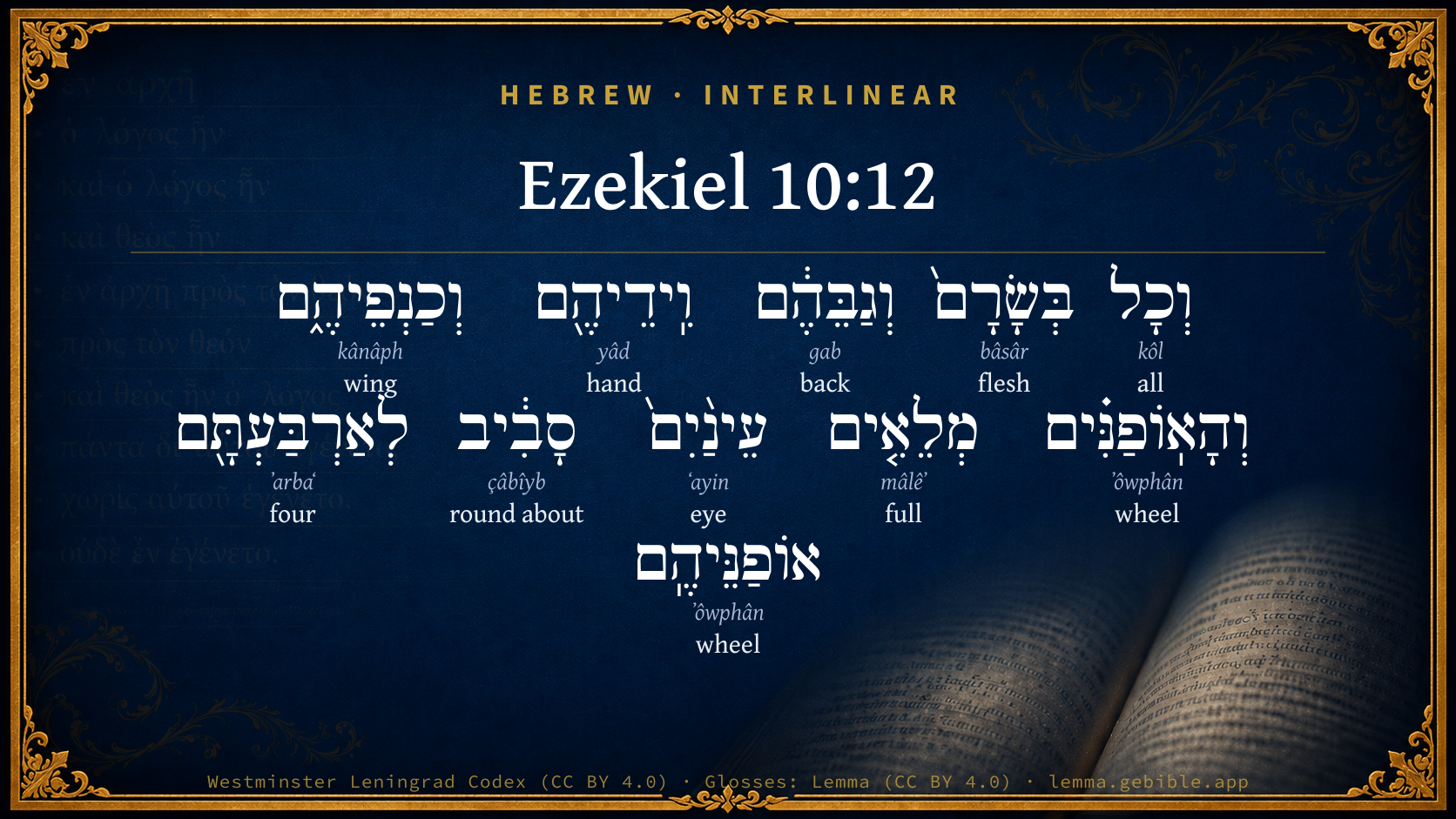
Hebrew (Westminster Leningrad Codex) Ezekiel 10:12 appears in the Hebrew Old Testament. The text above is from the Westminster Leningrad Codex. Each word links to its Strong’s number, a concise gloss, and parsing drawn from the Open Scriptures Hebrew Bible morphology. Click any word for its full Brown-Driver-Briggs (BDB) entry.
Download image
Cite this verse

Ezekiel 10:12 (World English Bible). Public Domain. Lemma interlinear Bible study tool, https://lemma.gebible.app/v/ezekiel/10/12.

Show BibTeX & RIS
BibTeX
RIS
English Translation
Their whole body, and their backs, and their hands, and their wings, and the wheels, were full of eyes round about, [even] the wheels that they four had.
World English Bible · Public Domain
Download a study sheet

One document with this verse’s original text, its word-by-word gloss line, the meaning frame, cross-references with their text, attributed commentary, and full source and license credits — printable, and it pastes into notes with its structure intact.

This verse Autodidact and up

Study sheet (.html) Plain text (.txt)

A passage Seminary Student

Up to 50 verses in one chapter. A passage sheet keeps up to 6 commentary sources and 12 cross-references per verse, in the order this page ranks them, and says so on the sheet whenever that leaves anything out. Ask for a single verse and you get the Autodidact verse sheet above.

Everything on this page stays free to read, with no account — the sheet is a download of what is already on screen, not access to it.

Want to remove ads? Support Godless Engineer
Compare translations 3

The same verse in 3 English versions, stacked beneath the original-language interlinear above. Click any original word for its lexicon entry.

Each is an independent rendering of the whole verse — the interlinear is not word-aligned to these translations.

Highlighted words mark where these versions differ — a whole-verse word diff, not a word-by-word alignment.

  • World English Bible Public Domain
    Their whole body, and their backs, and their hands, and their wings, and the wheels, were full of eyes round about, [even] the wheels that they four had.
  • King James Version Public Domain
    And their whole body, and their backs, and their hands, and their wings, and the wheels, were full of eyes round about, even the wheels that they four had.
  • unfoldingWord Literal Text CC BY-SA 4.0
    Their whole body—including their backs, their hands, and their wings—was covered with eyes, and eyes covered the four wheels all around also.

unfoldingWord Literal Text — © unfoldingWord, licensed CC BY-SA 4.0. Word-aligned USFM3 via Door43 (git.door43.org/unfoldingWord/en_ult).

Versions to compare (up to 4)

3 of 4 selected

Show all 18 translations

Every available English version of this verse, each an independent rendering of the whole verse.

  • World English Bible Public Domain
    Their whole body, and their backs, and their hands, and their wings, and the wheels, were full of eyes round about, [even] the wheels that they four had.
  • Berean Standard Bible Public Domain
    Their entire bodies, including their backs, hands, and wings, were full of eyes all around, as were their four wheels.
  • Majority Standard Bible Public Domain
    Their entire bodies, including their backs, hands, and wings, were full of eyes all around, as were their four wheels.
  • King James Version Public Domain
    And their whole body, and their backs, and their hands, and their wings, and the wheels, were full of eyes round about, even the wheels that they four had.
  • American Standard Version (1901) Public Domain
    And their whole body, and their backs, and their hands, and their wings, and the wheels, were full of eyes round about, `even' the wheels that they four had.
  • Revised Version (1885) Public Domain
    And their whole body, and their backs, and their hands, and their wings, and the wheels, were full of eyes round about, even the wheels that they four had.
  • Geneva Bible (1599) Public Domain
    And their whole bodie, and their rings, and their hands, and their wings, and the wheeles were full of eyes round about, euen in the same foure wheeles.
  • Douay-Rheims (1899) Public Domain
    And their whole body, and their necks, and their hands, and their wings, and the circles were full of eyes, round about the four wheels.
  • Young's Literal Translation Public Domain
    And all their flesh, and their backs, and their hands, and their wings, and the wheels, are full of eyes round about; to them four `are' their wheels.
  • Literal Standard Version CC BY-SA 4.0
    And all their flesh, and their backs, and their hands, and their wings, and the wheels, are full of eyes all around—[the] wheels [the] four had.
  • Unlocked Literal Bible CC BY-SA 4.0
    Their whole body—including their backs, their hands, and their wings—was covered with eyes, and eyes covered the four wheels all around also.
  • unfoldingWord Literal Text CC BY-SA 4.0
    Their whole body—including their backs, their hands, and their wings—was covered with eyes, and eyes covered the four wheels all around also.
  • Darby Bible Public Domain
    And their whole body, and their backs, and their hands, and their wings, and the wheels were full of eyes round about, in them four [and] their wheels.
  • World Messianic Bible Public Domain
    Their whole body, including their backs, their hands, their wings, and the wheels, were full of eyes all around, even the wheels that the four of them had.
  • Webster's Bible Public Domain
    And their whole body, and their backs, and their hands, and their wings, and the wheels, were full of eyes on every side, even the wheels that they four had.
  • Free Bible Version CC BY-SA 4.0
    The whole of their bodies, including their backs, hands, and wings, were covered in eyes, as were all four wheels.
  • Bible in Basic English Public Domain
    And the edges of the four wheels were full of eyes round about.
  • JPS Tanakh (1917) Public Domain
    And their whole body, and their backs, and their hands, and their wings, and the wheels were full of eyes round about, even the wheels that they four had.

Literal Standard Version (2020), Covenant Press — licensed CC BY-SA 4.0. Text via the HelloAO Bible API (eBible.org). Unlocked Literal Bible (unfoldingWord) — licensed CC BY-SA 4.0. Text via the HelloAO Bible API (eBible.org). unfoldingWord Literal Text — © unfoldingWord, licensed CC BY-SA 4.0. Word-aligned USFM3 via Door43 (git.door43.org/unfoldingWord/en_ult). Free Bible Version, Dr. Jonathan Gallagher — licensed CC BY-SA 4.0. Text via the HelloAO Bible API (eBible.org).

Word by word

More ways to search: Search by grammar → Find every occurrence → Compare this word →

Practice this passage: Drill this verse → Learn its vocabulary →

וְגַבֵּהֶ֔ם
gab
H1354
“and · backs · their”
Conjunction + Noun, Common, Both, Plural, Construct + Suffix, Personal, 3rd Person, Masculine, Plural
Part of Speech
Conjunction + Noun
Type
Common
Gender
Both
Number
Plural
State
Construct
Full BDB Definition

Origin: from an unused root

TWOT: 303a

convex surface, back - back (of man) - mound (for illicit worship) - boss (convex projection of shield) - bulwarks, breastworks (of arguments - figuratively) - brow, eyebrow - rim (of wheel)
  1. וְכָל kôl H3605 “and · all of” Conjunction + Noun, Common, Masculine, Singular, Construct
  2. בְּשָׂרָם֙ bâsâr H1320 “flesh · their” Noun, Common, Masculine, Singular, Construct + Suffix, Personal, 3rd Person, Masculine, Plural
  3. וִֽידֵיהֶ֖ם yâd H3027 “and · hands · their” Conjunction + Noun, Common, Both, Dual, Construct + Suffix, Personal, 3rd Person, Masculine, Plural
  4. וְכַנְפֵיהֶ֑ם kânâph H3671 “and · wings · their” Conjunction + Noun, Common, Feminine, Dual, Construct + Suffix, Personal, 3rd Person, Masculine, Plural
  5. וְהָאֽוֹפַנִּ֗ים ʼôwphân H212 “and · the · wheels” Conjunction + Particle, Definite Article + Noun, Common, Masculine, Plural, Absolute
  6. מְלֵאִ֤ים mâlêʼ H4392 “full” Adjective, Adjective, Masculine, Plural, Absolute
  7. עֵינַ֨יִם֙ ʻayin H5869 “eyes” Noun, Common, Both, Dual, Absolute
  8. סָבִ֔יב çâbîyb H5439 “round about” Noun, Common, Both, Singular, Absolute
  9. לְאַרְבַּעְתָּ֖ם ʼarbaʻ H702 “to/for · four · their” Preposition + Adjective, Cardinal number, Masculine, Singular, Construct + Suffix, Personal, 3rd Person, Masculine, Plural
  10. אוֹפַנֵּיהֶֽם ʼôwphân H212 “wheels · their” Noun, Common, Masculine, Plural, Construct + Suffix, Personal, 3rd Person, Masculine, Plural

About this verse

These counts appear in no published source. They are computed here, from the morphology-tagged text and Lemma’s own curated glosses. What Lemma adds →

11
words
10
distinct lemmas
Prophets
section

Notable vocabulary

The rarest word here is וְגַבֵּהֶ֔ם back H1354 — appearing just 13 times in the whole Hebrew Bible.

Shared distinctive vocabulary

וְגַבֵּהֶ֔ם back H1354 occurs in 11 verses of the Hebrew Bible. Also found in:

Grammatical profile

  • 9 nouns
  • 2 adjectives

Repetition

A word recurs within this verse — often emphatic in Hebrew:

  • וְהָאֽוֹפַנִּ֗ים wheel H212 ×2

Hebrew & Septuagint length

In English translation the verse runs 28 words from the Hebrew and 21 from the Septuagint (LXX English) — closely comparable.

A rough comparison of the two English renderings, which tokenize alike — not a word-level alignment.

Word counts can differ between the Hebrew and the Greek without any difference in meaning — e.g. the Hebrew direct-object marker אֵת has no separate Greek word, and Greek often adds the article ὁ.

Cross-references

3

Topical passages linked to Ezekiel 10:12 in the Treasury of Scripture Knowledge — connected by theme and wording, ordered by reader-vote popularity; previews shown in the World English Bible.

  • Ezekiel 1:18 As for their rims, they were high and dreadful; and they four had their rims full of eyes round about.
  • Revelation 4:6 Before the throne was something like a sea of glass, similar to crystal. In the midst of the throne, and around the throne were four living creatures full of eyes before and behind.
  • Revelation 4:8 The four living creatures, each one of them having six wings, are full of eyes around about and within. They have no rest day and night, saying, "Holy, holy, holy, holy, holy, holy, holy, holy, holy is the Lord God, the Almighty, who was and who is and who is to come!"

Cross-references courtesy of OpenBible.info (CC BY 4.0).

Hebrew and Greek witnesses Masoretic Hebrew ↔ Greek Septuagint

The same verse in the two great witnesses to the Old Testament, shown verse-for-verse.

These are two independent witnesses, not word-aligned to each other, and the Septuagint is shown in lemma (dictionary) form.

Hebrew Ezekiel 10:12 Masoretic · Westminster Leningrad Codex

וְכָל בְּשָׂרָם֙ וְגַבֵּהֶ֔ם וִֽידֵיהֶ֖ם וְכַנְפֵיהֶ֑ם וְהָאֽוֹפַנִּ֗ים מְלֵאִ֤ים עֵינַ֨יִם֙ סָבִ֔יב לְאַרְבַּעְתָּ֖ם אוֹפַנֵּיהֶֽם

Their whole body, and their backs, and their hands, and their wings, and the wheels, were full of eyes round about, [even] the wheels that they four had.

World English Bible · Public Domain

Greek LXX Ezekiel 10:12 Septuagint · lemma form

καί ὁ νῶτος αὐτός καί ὁ χείρ αὐτός καί ὁ πτέρυξ αὐτός καί ὁ τροχός πλήρης ὀφθαλμός κυκλόθεν ὁ τέσσαρες τροχός αὐτός

And their backs, and their hands, and their wings, and the wheels, were full of eyes round about the four wheels.

LXX2012 (modern English Septuagint) · Public Domain

On this verse, The Cambridge Bible for Schools and Colleges discusses the Septuagint’s reading. Read the note in Commentary ↓

Hebrew: Westminster Leningrad Codex (CC BY 4.0). Greek: Septuagint (public domain); English from LXX2012 (modern English Septuagint) (Public Domain). How the Septuagint differs from the Hebrew →

Targum (Aramaic paraphrase)

1

The Targum is the ancient Jewish Aramaic paraphrase of the Hebrew Scriptures — an interpretive translation, not the Hebrew text itself. Onkelos (literal) and Pseudo-Jonathan (expansive) render the Torah, and Jonathan the Prophets. Coverage is partial: where no permissively-licensed English translation exists for a verse, only the Aramaic is shown. This is verse-level text, not a word-by-word alignment to the Hebrew.

  1. Targum Jonathan Prophets (Joshua–Malachi)
    וְכָל בִּסְרֵיהוֹן וְגַבֵּיהוֹן וְאֶשְׁדַתְהוֹן וְכַנְפֵיהוֹן וְגַלְגְלַיָא מְלַן עַיְנִין סְחוֹר סְחוֹר לְאַרְבַּעְתְּהוֹן דְגַלְגְלַיָא:

    (no public-domain English translation for this verse)

    Targum Jonathan — Aramaic: “Mikraot Gedolot” (public domain). English: “Sefaria Community Translation” (CC0 1.0 (public-domain dedication)); “London "Chaldee Paraphrase," 1871” (public domain). Text via Sefaria.

Commentary

Notes on Ezekiel 10:12 from classic Christian and Jewish commentators (each source and its license shown beneath its notes). The classic Christian expositions comment on the surrounding passage and are grouped to its opening verse, so a note may address several verses; the Jewish commentaries on the Tanakh (Rashi and others) are per-verse, so they appear only where the commentator wrote on this verse.

Lemma curates 59 commentaries, every one of them public domain or Creative Commons licensed, each selected and text-cleaned for this edition rather than reprinted as found. About our sources →

Trapp's Complete Commentary

John Trapp

Eze 10:12 And their whole body, and their backs, and their hands, and their wings, and the wheels, [were] full of eyes round about, [even] the wheels that they four had.

Ver. 12. And the whole body,] viz., Of the cherubims. {as Eze 1:19-21} The wheels are said to be full of eyes. God, who overruleth all, is ολοφθαλμος, All eye. His providence is like a well drawn picture, which vieweth all that are in the room. {a}

{a} Omnia in omnes partes illustrat Dei providentia. - Jun. Dei providentia oculatissima. - A Lap., Diod.

John Trapp, A Commentary or Exposition upon All the Books of the Old and New Testament (1647–1656) — public domain. Text from a community e-Sword module.

The Biblical Illustrator

Joseph S. Exell

Eze_10:12

Full of eyes round about.

Divine vigilance

God has been called All eye. This is the terrible pain of living, that there is no privacy, no solitude, no possibility of a man getting absolutely with himself and by himself. Wherever we are we are in public. We can, indeed, exclude the vulgar public, the common herd, the thoughtless multitude; a plain deal door can shut out that kind of world: but what can shut out the beings who do the will of Heaven, and who are full of eyes, their very chariot wheels being luminous with eyes, everything round about them looking at us critically, penetratingly, judicially? We live unwisely when we suppose that we are not being superintended, observed, criticised, and judged. Thou God seest me; The eyes of the Lord run to and fro throughout the whole earth. We need not regard this aspect of Divine providence as alarming. The aspect will be to us what we are to it. Faithful servants are encouraged by the remembrance of the fact that the taskmasters eye is upon them; unfaithful servants will regard the action of that eye as a judgment. Thus God is to us what we are to God. If we are humble, He is gracious; if we are froward, He is haughty; if we are sinful, He is angry; if we are prayerful, He is condescending and sympathetic. Let the wicked man tremble when he hears that the whole horizon is starred with gleaming eyes that are looking him through and through; but let the good man rejoice that all heaven is one eye looking upon him with complacency, watching all his action that it may come to joy, reward, rest, and higher power of service in the generations yet to dawn. (J. Parker, D. D.)

The eyes of Providence

Full of eyes round about. Here is a difference from that in Eze_1:18. It is said there the rings were full of eyes; here, that all, even wheels and cherubims, were full of eyes, and He that sat on the throne, even the Lord, He is full of eyes.

1. The motions of causes and creatures here below are not casual or disorderly. The wheels and cherubims are full of eyes, they see and know their way, the work they have to do, the place they are to go unto; the eye of Providence is in every creature and every motion. When things fall out contrary, or beside our expectations, you say they are mischances; but you are mistaken: in sea or land affairs, in martial, magisterial, or ministerial, yea domestic affairs, whatever falls out is an act of Providence; surprising or sinking of ships, disappointment of counsels, defeating of armies, escape of prisoners, interception of letters, firing of towns, drownings, self-murderings, divisions of brethren, clandestine marriages, abortions, divorces, the eyes of Providence are in them all, and heavens intentions are accomplished in them.

2. There is much glory and beauty in the works of Divine providence. All the wheels and cherubims are full of eyes; the wheels have eyes round about, not in one place, but in every place; the cherubims, their bodies, backs, hands, and wings are full of eyes; and (Rev_4:8) they are full of eyes within, they are inwardly and outwardly glorious, beautiful. Mans eyes add not so much beauty and glory to his face, as these eyes do to the works of God in the world. The peacocks train, which is full of eyes, how beautiful and glorious is it! yet far short of the beauty and glory which is in Gods government of the world. When the queen of Sheba saw so much wisdom in a man, so much glory and beauty in the order of his house, she admired, and had no spirit left in her (1Ki_10:4-5). And could we see the wisdom which is in God, the glory and beauty which is in His ordering the wheels, we would be so far from complaining of any wheels motion that we would admire every wheel, the order and motion of it; but oh, how blind are we, who hardly have an eye to see any of these eyes! When a man is on a high hill, there are many hedges, ditches, and separations of one piece of land from another; there are low shrubs and higher trees, here a hill and there a river; yet all contribute something to make a beautiful and glorious prospect to the eye: and so it is in the works of providence. If we were lifted up by the Spirit to view the wheels and their motions, we should find that all these things that seem grievous to us, our wars, divisions, taxes, burdens, and such like, do contribute much towards a glorious prospect. (W. Greenhill, M. A.)

The Biblical Illustrator, edited by Joseph S. Exell (c. 1880s–1900s) — public domain. Text from a community e-Sword module.

Tyndale Open Study Notes

Tyndale Open Resources

10:12 covered with eyes: The elders’ earlier statement that “the Lord doesn’t see us” (8:12) was foolish and false.

Tyndale Open Study Notes — © Tyndale Open Resources, licensed CC BY-SA 4.0. Text via the HelloAO Bible API.

Geneva Bible (1599)

Geneva Bible translators

Or, trents.

Geneva Bible (1599) marginal notes — public domain. Text via Bolls.life.

Jamieson, Fausset & Brown

Robert Jamieson, A. R. Fausset & David Brown

body--literally, "flesh," because a body consists of flesh.

wheels . . . full of eyes--The description (Eze 1:18) attributes eyes to the "wheels" alone; here there is added, on closer observation, that the cherubim themselves had them. The "eyes" imply that God, by His wisdom, beautifully reconciles seeming contrarieties (compare Ch2 16:9; Pro 15:3; Zac 4:10).

Jamieson, Fausset & Brown — Commentary Critical and Explanatory on the Whole Bible (1871) — public domain (CC PDM 1.0). Text via the HelloAO Bible API.

John Calvin's Commentaries

He adds, that the wheels were full of eyes. Hence we gather, that although by the events of things God may seem to sport and to have various erratic circuits, yet all things are governed by his inestimable wisdom: for this reason the wheels are said to be full of eyes The Prophet uses the word flesh inappropriately for the very body of the wheels. But we know that the language which he used in exile was not very elegant, and hence it is by no means wonderful if it is rather rough and savors of asperity. Yet the sense is not doubtful, since the whole body of the wheels in their back and their hands was all full of eyes: he next adds, the wheels themselves, not to mark anything different, but afterwards when he speaks of the flesh, the back and the hands, he names the wheels simply: as if he had said that they were full of eyes in every part. Now we see how things contrary in appearance may be best reconciled. For the events of things are as unstable as if any one kept turning’ a wheel: then they become complicated, as if wheel was within wheel: but in the meantime God so tempers all things among themselves which seem to us confused, that it may appear that he perceives best what is necessary to be done, and that the events of things are full of eyes. But whence does this arise? This clearness depends on the angelic inspiration, for the wheels are not turned in different directions of their own accord, but each follows its own leader and head. It is also said, in appearance like the stone Tharsis, (beryl.) Jerome thought the Cilician sea was intended, and so translated it sky-colored: but because we know that this name beryl occurs among the precious stones, I therefore retain the simple sense. Now it follows —

John Calvin's Commentaries (1540-1563) — public domain. Text from the Calvin Translation Society English edition (1840s-50s) via the Christian Classics Ethereal Library (ccel.org). Calvin's coverage is partial (roughly two-thirds of the Bible); uncommented books and verses are honest gaps, never fabricated. The 19th-century editor's footnotes and remarks are omitted so the notes are faithfully Calvin's own voice.

The Cambridge Bible for Schools and Colleges

gen. ed. J. J. S. Perowne

12. their whole body] Lit. flesh, a strange term to be used of the living creatures. LXX. omits. The word “backs” is used of the felloes of the wheels in ch. Eze_1:18, and in this verse the living creatures and the wheels are confused together.

wheels that they four had] More naturally: even their four wheels, lit. even they four, their wheels, where “they” anticipates “wheels.”

The Cambridge Bible for Schools and Colleges (gen. ed. J. J. S. Perowne; Cambridge University Press, 1878–1918) — public domain. Text from a community e-Sword module.

John Gill's Exposition

And their whole body, and their backs, and their hands, and their wings,.... This is to be understood not of the wheels, to whom body or flesh, backs, hands, and wings, do not belong, but of the cherubim; and the sense is, that as the wheels were alike, and had one and the same form and appearance, so had the cherubim; they were exactly alike in their body, backs, hands, and wings; denoting the agreement between Gospel ministers, in their doctrine, work, and conversation:

and the wheels were full of eyes round about; that is, the rings or circles of the wheels, as in Eze 1:18; signifying that churches consisted of enlightened persons, who had a sight of their sin and danger, and looked to Christ for salvation, and walked circumspectly, and watched over one another:

even the wheels that they four had: the wheels that belonged to the four living creatures or cherubim.

John Gill's Exposition of the Whole Bible (1746–1763) — public domain (CC PDM 1.0). Text via the HelloAO Bible API.

Haydock's Catholic Bible Commentary

Wheels. These, as well as (Haydock) the cherubim, (Theodoret) were full of eyes. (Calmet)

George Leo Haydock (1774–1849), Haydock's Catholic Family Bible and Commentary, 1859 edition — public domain. Excludes Psalms (Douay-Rheims chapter numbering differs from Protestant) and Deuterocanonical books (Catholic canon only).

Matthew Poole's English Annotations

Now he describes both cherubims and wheels as full of wisdom, and as governed by an excellent wisdom.

Their whole body: angels have not bodies of flesh, but

body here is figurative, as also

back, and

wings, and

hands. The two latter are expressly ascribed to the cherubims, Eze 10:8; the two former not mentioned before, (as I think,) but all full of eyes, i.e. wisdom, foresight, watchfulness, and diligence.

That they four had; the four cherubims had to move, govern, and direct.

Matthew Poole's English Annotations on the Holy Bible (1683–1685) — public domain. Text from a community e-Sword/MySword module.

Whedon's Commentary on the Bible

Daniel D. Whedon

12. The prophet now sees, what escaped him at the first appearance of these creatures (Eze_1:5-13), that they, as well as the wheels, were full of eyes. Though the movements of the living creatures and the wheels were like lightning there was nothing capricious or blind about these. An infinite knowledge guided their activity. (Compare Rev_4:6.) As has been said, the prophet receives here a new impression of the all-seeing eye of Jehovah. Everywhere as he stands face to face with the forces of nature he can say — must say, within himself — “Thou God seest me!”

Daniel D. Whedon (gen. ed.), Commentary on the Old and New Testaments (1874–1909) — public domain. Text from a community e-Sword module.

The Pulpit Commentary

And their whole body. Here there is distinctly a new feature. Eze_1:18 the "rings" of the wheels were "full of eyes." Here the eyes are everywhere. It is not hard to interpret this part of the vision. The prophet receives a new impression of the all-seeing eye of Jehovah. Everywhere, as he stands face to face with the forces of nature, he can say, must say, within himself, "Thou God seest me". (Gen_16:13) There is an eye that looks upon him where he least expects it. The same thought appears in the stone with seven eyes in Zec_3:9. St. John reproduces it in the same form as Ezekiel, with the exception of the wheels, which form no part of his vision, in Rev_4:6.

The Pulpit Commentary (1880–1919), ed. H.D.M. Spence-Jones & Joseph S. Exell — public domain. Text from a community e-Sword module.

John Wesley's Explanatory Notes

And - Now he describes both the cherubim and wheels as full of wisdom, and as governed by an excellent wisdom. The wheels - Which the four cherubim had to move, govern, and direct.

John Wesley, Explanatory Notes Upon the Whole Bible (1754–1765) — public domain. Text via the GEBible commentary corpus.

unfoldingWord translationNotes

Door43 World Missions Community

Their whole body

"The whole bodies of the cherubim"

wheels

Translate the word "wheels" as in Ezekiel 1:15.

the wheels were called, "Whirling."

The word "Whirling" means "Spinning." Here it is the name of the wheels. This can be stated in active form. AT: "someone called the wheels, 'Whirling.'" or "the name of the wheels was 'Whirling.'" (See: Active or Passive)

They had four faces each

"Each cherub had four faces" or "Each of the cherubim had four faces." Each creature had a face on the front, a face on the back, and a face on each side of its head. See how you translated this in Ezekiel 1:6.

translationWords

lions

eagle

unfoldingWord translationNotes — © Distant Shores Media and the Door43 World Missions Community, licensed CC BY-SA 4.0. Source: git.door43.org/Door43/en_tn.

Rashi

Rabbi Shlomo Yitzchaki (Rashi)

and their hubs Heb. וִידֵיהֶם of the wheels. They are the hole in which the [axle of the] chariot turns, called boyol, nave, hub. Jonathan, however, renders: וְאֲשְּׁדַתְהוֹן, and their pourings.

to their four wheels To the four wheels of the living beings.

Rashi on the Tanakh — English translations: “The Judaica Press complete Tanach with Rashi, translated by A. J. Rosenberg” (CC BY 4.0); “Pentateuch with Rashi's commentary by M. Rosenbaum and A.M. Silbermann, 1929-1934” (public domain); “The Metsudah Tanach series, Lakewood, N.J” (CC BY 4.0); and “The Book of Joshua, Metsudah Publications, 1997” (CC BY 4.0). Text via Sefaria.

Lesson kit

Teaching starters — assembled from the data on this page, not authored interpretation. Every prompt links to the verse data it draws on. Edit before teaching.

Ezekiel, in the Prophets, opens this verse with 11 words (10 distinct Hebrew lemmas). Its most distinctive word is gab (“back”). A historical commentator’s framing appears above. Read the whole chapter for the surrounding context.

Discussion questions

  1. What does “back” (gab) contribute to the verse as a whole?
  2. How does Leviticus 14:9, which shares the word «back», read alongside this verse?
  3. What does the repetition of “wheel” (2× in this one verse) do in this verse?
  4. These translations render this verse differently. What is at stake in choosing one wording over another?
  5. Compare how Trapp's Complete Commentary and The Biblical Illustrator read this verse. Where do they agree or differ?

Things to notice

Reading settings

Reading text

Shown beneath each verse's original-language words.

Old Testament
Old Testament edition

Read the OT as the Masoretic Hebrew (MT) or the Greek Septuagint (LXX).

English shown for the Greek Septuagint (in the Hebrew ↔ Greek comparison).

Comparing translations? Open the Compare panel on any verse page to stack up to four side by side.