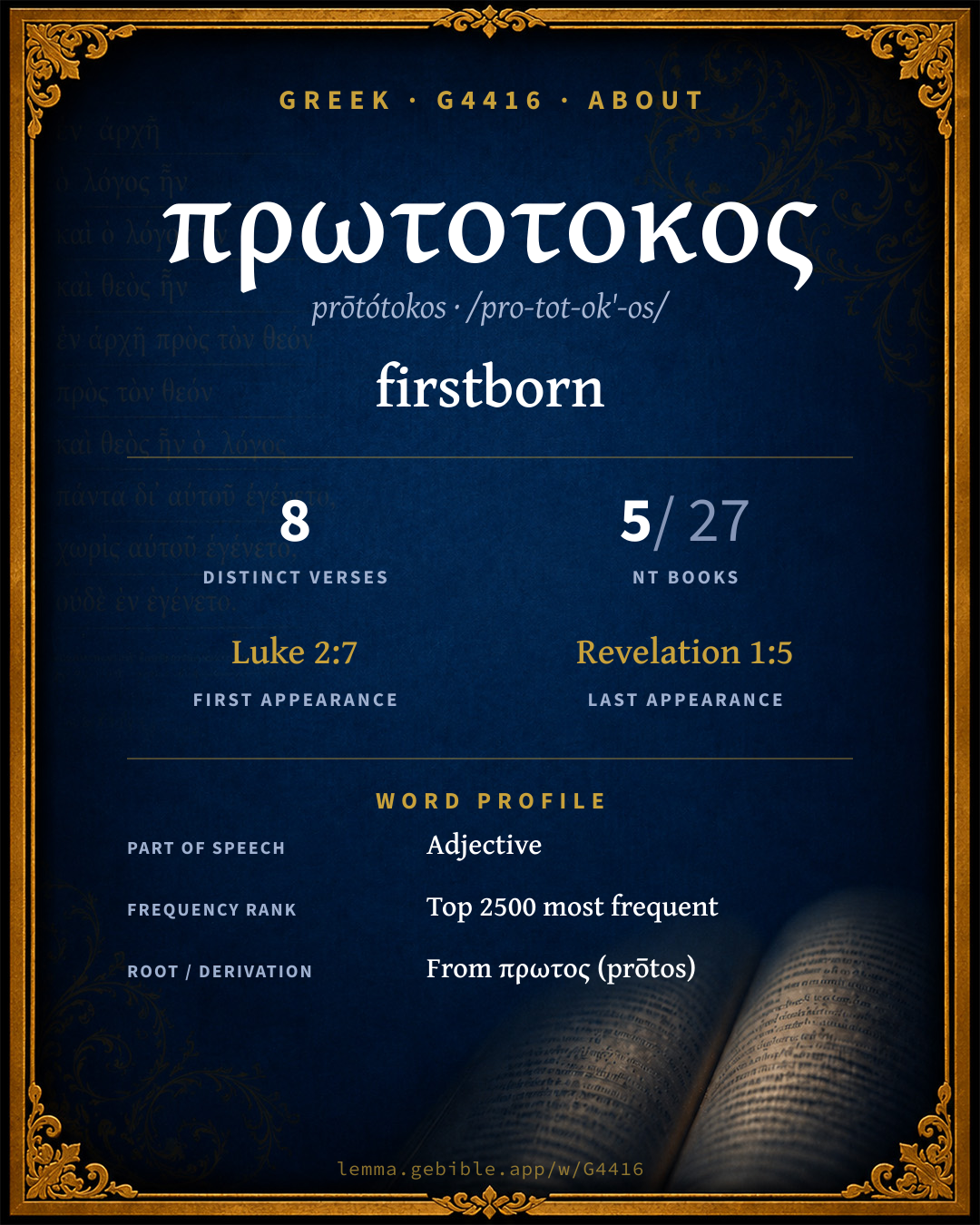
πρωτοτόκος
firstborn
‘firstborn’ is one of 2 main senses fuller range ↓
Full lexicon entry — Thayer's Greek Lexicon
From Thayer's Greek Lexicon
Where this word appears
Grammar key — what these labels mean
Part of speech
- Adjective
- A word that describes or qualifies a noun.
Case
- Accusative
- The case of the direct object and of extent.
- Nominative
- The case of the subject (and the predicate nominative).
- Genitive
- The case of source, possession, or “of” — answers “whose / from what.”
Gender
- Masculine
- Grammatically masculine.
- Neuter
- Grammatically neuter.
Number
- Singular
- One.
- Plural
- More than one.
Degree
- Superlative
- Expresses the greatest degree (“greatest,” “most”).
Every verse where G4416 appears in the Book of Luke — 1 distinct verse. Click any verse to open its interlinear word-by-word view. Verse text shown in the World English Bible for context — . Each verse’s Greek form is shown with its reference; the English is not keyword-highlighted, since the data carries no word-level English alignment. Use “Compare translations” on any verse to read it across multiple English versions. This concordance covers the Greek New Testament; Septuagint (Greek Old Testament) occurrences of this word are not indexed here.
Luke
About this entry
At a glance — auto-summarized from this page’s data, not written by a person. Every figure links to its source below. This summary describes the numbers; it doesn’t interpret them.
The Greek adjective πρωτοτοκος centers on the idea of “firstborn.” Its earliest occurrence is Luke 2:7. It turns up in 8 verses across 5 books, an uncommon footprint. The word gravitates to Hebrews (38%), then Colossians and Luke. Thayer's distinguishes 2 senses for it. Dig into 8-verse concordance and the renderings breakdown below.
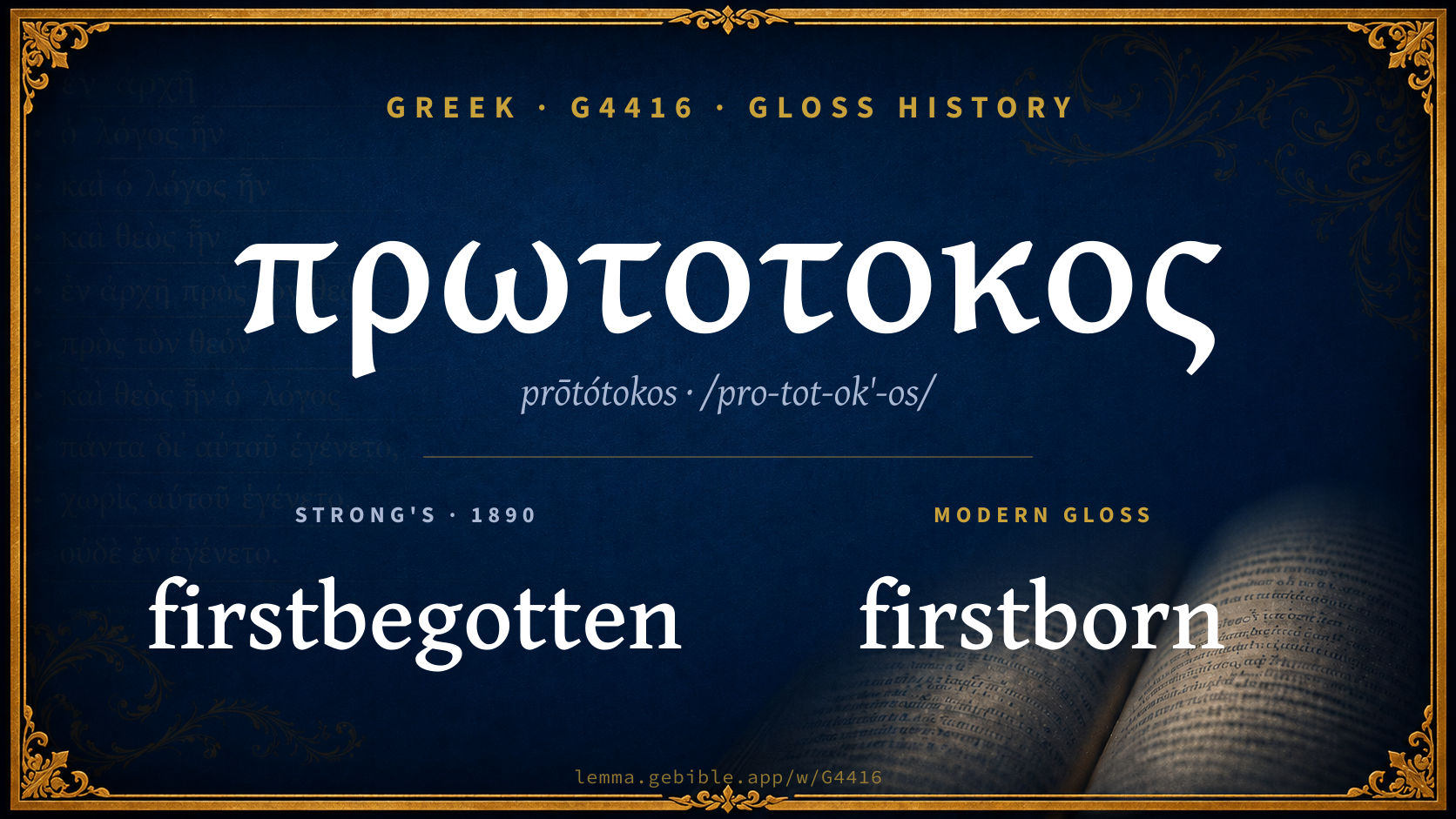
Gloss history
Strong's 1890 vs modern scholarship
About this word
Strong's G4416 catalogs a Greek word from the Greek New Testament.
These counts are not copied from any lexicon or concordance. They are computed here, from the morphology-tagged Greek New Testament. What Lemma adds →
- 8
- distinct verses
- The word appears in 8 distinct verses.
- 5 / 27
- NT books
- The word appears in 5 of 27 New Testament books.
- #1,240
- by frequency
- Top 2500 most frequent Greek words (rank 1,240 of 5,347 Greek words by occurrence).
View all 8 occurrences in the concordance →
Most concentrated in
- Hebrews 3 verses 38%
- Colossians 2 verses 25%
- Luke 1 verse 13%
By section of the New Testament
By traditional corpus
Conventional, traditional groupings — biblical authorship is debated, so this is a traditional corpus grouping, not an authorship claim. Some books belong to more than one corpus (Luke is in both the Gospels and the Lukan corpus, and so on), so these shares overlap and need not total 100%. Each figure is a share of the word’s 8 distinct verses.
- Pauline corpus 3 verses · 38%
- Hebrews 3 verses · 38%
- Gospels 1 verse · 13%
- Lukan (Luke–Acts) 1 verse · 13%
- Johannine 1 verse · 13%
- Revelation 1 verse · 13%
How translations render this word
Counts come from each version’s own published word-to-Strong’s tagging or interlinear alignment — an approximate guide to how each version renders this word, not a word-level alignment the data otherwise carries. Because each total is that version’s own tagged count, the per-version totals vary from one another and need not match the appearance or distinct-verse counts above. These counts may also differ from a printed concordance because Lemma counts each distinctly tagged rendering and does not collapse phrase taggings into a single head-word total. This is a fixed set of word-tagged versions (KJV, ASV, BSB, ULT) and does not change with the reading translation you choose elsewhere. Each version’s license is shown beside its name below (and on Sources).
- King James Version: Firstborn 7×
- American Standard Version: Firstborn 8×
- Berean Standard Bible: Firstborn 8×
- unfoldingWord Literal Text: Firstborn 7×
King James Version Public Domain
Renders G4416 across 9 tagged occurrences — most commonly:
Plus 2 renderings that appear only once — usually multi-word phrases or single function words the recovered tagging swept in, not distinct renderings.
American Standard Version Public Domain
Renders G4416 across 9 tagged occurrences — most commonly:
Plus 1 rendering that appears only once — usually multi-word phrases or single function words the recovered tagging swept in, not distinct renderings.
Berean Standard Bible Public Domain
Renders G4416 across 8 tagged occurrences — most commonly:
unfoldingWord Literal Text CC BY-SA 4.0
Renders G4416 across 9 tagged occurrences — most commonly:
Plus 2 renderings that appear only once — usually multi-word phrases or single function words the recovered tagging swept in, not distinct renderings.
Senses in Thayer's
The 2 senses Thayer's distinguishes for this word, in lexicon order (not ranked by frequency or importance). The full entry — with sub-senses — is in the Lexicon Entry tab.
- of man or beast
- of Christ, the first born of all creation
Word origin
Derived from πρωτος (prōtos) (G4413) — first.
Forms in the corpus
The 4 distinct written forms G4416 takes in the Greek New Testament, most frequent first — each parse links to that case’s occurrences in the concordance.
| Form | Parsing | Example | Uses |
|---|---|---|---|
| πρωτότοκον prōtótokon | Adjective, Accusative, Singular, Masculine, Superlative | Luke 2:7 | 3 |
| πρωτότοκος prōtótokos | Adjective, Nominative, Singular, Masculine, Superlative | Colossians 1:15 | 3 |
| πρωτοτόκων prōtotókōn | Adjective, Genitive, Plural, Masculine, Superlative | Hebrews 12:23 | 1 |
| πρωτότοκα prōtótoka | Adjective, Accusative, Plural, Neuter, Superlative | Hebrews 11:28 | 1 |
Same root — word family
Other Thayer's entries built from the same root as G4416, grouped by Strong’s listed origin. These share a root / origin per the lexicon — not necessarily a shared meaning. Each links to that word’s own entry.
Derives from
Shares the same root
- πρωτευω prōteúō G4409 to be first
- πρωτοκαθεδρια prōtokathedría G4410 to sit first
- πρωτοκλισια prōtoklisía G4411 first seat
- πρωτον prōton G4412 first
- πρωτοστατης prōtostátēs G4414 front-rank soldier
Derived from this word
Compare all same-root words → Showing 4 of 8 — not the complete family. They share a root, not necessarily a meaning.
Septuagint usage
The same Greek word πρωτοτοκος appears 127 times in the Greek Old Testament (Septuagint), across 102 verses in 19 books.
- 127
- LXX occurrences
- Tagged occurrences of this Greek word in the Septuagint.
- 102
- verses
- Distinct Septuagint verses containing this word.
- 19 / 39
- OT books
- The word appears in 19 of the 39 Old Testament books.
Sample Septuagint occurrences
- Genesis 4:4 πρωτότοκος
- Exodus 4:22 πρωτότοκος
- Leviticus 27:26 πρωτότοκος
- Numbers 1:20 πρωτότοκος
- Deuteronomy 12:6 πρωτότοκος
- Joshua 6:26 πρωτότοκος
- Judges 8:20 πρωτότοκος
- 1 Samuel 8:2 πρωτότοκος
- 2 Samuel 3:2 πρωτότοκος
- 1 Kings 16:34 πρωτότοκος
- 2 Kings 3:27 πρωτότοκος
- 1 Chronicles 1:17 πρωτότοκος
Septuagint occurrences (same lexeme)
Every verse where the same Strong’s number (G4416) appears in the Greek Septuagint — showing the first 50 of 102. Verse text shown in the World English Bible for context; the Greek form is the matched word — the English is not keyword-highlighted.
- Genesis 4:4 πρωτότοκος Abel also brought some of the firstborn of his flock and of the fat of it. Yahweh respected Abel and his offering,
- Genesis 10:15 πρωτότοκος Canaan became the father of Sidon (his firstborn), Heth,
- Genesis 22:21 πρωτότοκος Uz his firstborn, Buz his brother, Kemuel the father of Aram,
- Genesis 25:13 πρωτότοκος These are the names of the sons of Ishmael, by their names, according to the order of their birth: the firstborn of Ishmael, Nebaioth, then Kedar, Adbeel, Mibsam,
- Genesis 25:25 πρωτότοκος The first came out red all over, like a hairy garment. They named him Esau.
- Genesis 27:19 πρωτότοκος Jacob said to his father, "I am Esau your firstborn. I have done what you asked me to do. Please arise, sit and eat of my venison, that your soul may bless me."
- Genesis 27:32 πρωτότοκος Isaac his father said to him, "Who are you?" He said, "I am your son, your firstborn, Esau."
- Genesis 35:23 πρωτότοκος The sons of Leah: Reuben (Jacob's firstborn), Simeon, Levi, Judah, Issachar, and Zebulun.
- Genesis 36:15 πρωτότοκος These are the chiefs of the sons of Esau: the sons of Eliphaz the firstborn of Esau: chief Teman, chief Omar, chief Zepho, chief Kenaz,
- Genesis 38:6 πρωτότοκος Judah took a wife for Er, his firstborn, and her name was Tamar.
- Genesis 38:7 πρωτότοκος Er, Judah's firstborn, was wicked in the sight of Yahweh. Yahweh killed him.
- Genesis 41:51 πρωτότοκος Joseph called the name of the firstborn Manasseh, "For," he said, "God has made me forget all my toil, and all my father's house."
- Genesis 43:33 πρωτότοκος They sat before him, the firstborn according to his birthright, and the youngest according to his youth, and the men marveled one with another.
- Genesis 46:8 πρωτότοκος These are the names of the children of Israel, who came into Egypt, Jacob and his sons: Reuben, Jacob's firstborn.
- Genesis 48:18 πρωτότοκος Joseph said to his father, "Not so, my father; for this is the firstborn; put your right hand on his head."
- Genesis 49:3 πρωτότοκος "Reuben, you are my firstborn, my might, and the beginning of my strength; The pre-eminence of dignity, and the pre-eminence of power.
- Exodus 4:22 πρωτότοκος You shall tell Pharaoh, 'Thus says Yahweh, Israel is my son, my firstborn,
- Exodus 4:23 πρωτότοκος and I have said to you, "Let my son go, that he may serve me;" and you have refused to let him go. Behold, I will kill your son, your firstborn.'"
- Exodus 6:14 πρωτότοκος These are the heads of their fathers' houses. The sons of Reuben the firstborn of Israel: Hanoch, and Pallu, Hezron, and Carmi; these are the families of Reuben.
- Exodus 11:5 πρωτότοκος and all the firstborn in the land of Egypt shall die, from the firstborn of Pharaoh who sits on his throne, even to the firstborn of the maid-servant who is behind the mill; and all the firstborn of cattle.
- Exodus 12:12 πρωτότοκος For I will go through the land of Egypt in that night, and will strike all the firstborn in the land of Egypt, both man and animal. Against all the gods of Egypt I will execute judgments: I am Yahweh.
- Exodus 12:29 πρωτότοκος It happened at midnight, that Yahweh struck all the firstborn in the land of Egypt, from the firstborn of Pharaoh who sat on his throne to the firstborn of the captive who was in the dungeon; and all the firstborn of cattle.
- Exodus 13:2 πρωτότοκος "Sanctify to me all of the firstborn, whatever opens the womb among the children of Israel, both of man and of animal. It is mine."
- Exodus 13:13 πρωτότοκος Every firstborn of a donkey you shall redeem with a lamb; and if you will not redeem it, then you shall break its neck; and you shall redeem all the firstborn of man among your sons.
- Exodus 13:15 πρωτότοκος and it happened, when Pharaoh would hardly let us go, that Yahweh killed all the firstborn in the land of Egypt, both the firstborn of man, and the firstborn of animal. Therefore I sacrifice to Yahweh all that opens the womb, being males; but all the firstborn of my sons I redeem.'
- Exodus 22:28 πρωτότοκος "You shall not blaspheme God, nor curse a ruler of your people.
- Exodus 34:19 πρωτότοκος All that opens the womb is mine; and all your cattle that is male, the firstborn of cow and sheep.
- Exodus 34:20 πρωτότοκος The firstborn of a donkey you shall redeem with a lamb: and if you will not redeem it, then you shall break its neck. All the firstborn of your sons you shall redeem. No one shall appear before me empty.
- Leviticus 27:26 πρωτότοκος "'Only the firstborn among animals, which is made a firstborn to Yahweh, no man may dedicate it; whether an ox or sheep, it is Yahweh's.
- Numbers 1:20 πρωτότοκος The children of Reuben, Israel's firstborn, their generations, by their families, by their fathers' houses, according to the number of the names, one by one, every male from twenty years old and upward, all who were able to go out to war;
- Numbers 3:2 πρωτότοκος These are the names of the sons of Aaron: Nadab the firstborn, and Abihu, Eleazar, and Ithamar.
- Numbers 3:12 πρωτότοκος "Behold, I have taken the Levites from among the children of Israel instead of all the firstborn who open the womb among the children of Israel; and the Levites shall be mine:
- Numbers 3:13 πρωτότοκος for all the firstborn are mine. On the day that I struck down all the firstborn in the land of Egypt I made holy to me all the firstborn in Israel, both man and animal. They shall be mine. I am Yahweh."
- Numbers 3:40 πρωτότοκος Yahweh said to Moses, "Number all the firstborn males of the children of Israel from a month old and upward, and take the number of their names.
- Numbers 3:41 πρωτότοκος You shall take the Levites for me (I am Yahweh) instead of all the firstborn among the children of Israel; and the cattle of the Levites instead of all the firstborn among the cattle of the children of Israel."
- Numbers 3:42 πρωτότοκος Moses numbered, as Yahweh commanded him, all the firstborn among the children of Israel.
- Numbers 3:43 πρωτότοκος All the firstborn males according to the number of names, from a month old and upward, of those who were numbered of them, were twenty-two thousand two hundred seventy-three.
- Numbers 3:45 πρωτότοκος "Take the Levites instead of all the firstborn among the children of Israel, and the cattle of the Levites instead of their cattle; and the Levites shall be mine. I am Yahweh.
- Numbers 3:46 πρωτότοκος For the redemption of the two hundred seventy-three of the firstborn of the children of Israel, who exceed the number of the Levites,
- Numbers 3:50 πρωτότοκος from the firstborn of the children of Israel he took the money, one thousand three hundred sixty-five shekels, after the shekel of the sanctuary:
- Numbers 8:16 πρωτότοκος For they are wholly given to me from among the children of Israel; instead of all who open the womb, even the firstborn of all the children of Israel, I have taken them to me.
- Numbers 8:17 πρωτότοκος For all the firstborn among the children of Israel are mine, both man and animal. On the day that I struck all the firstborn in the land of Egypt, I sanctified them for myself.
- Numbers 8:18 πρωτότοκος I have taken the Levites instead of all the firstborn among the children of Israel.
- Numbers 18:15 πρωτότοκος Everything that opens the womb, of all flesh which they offer to Yahweh, both of man and animal shall be yours: nevertheless the firstborn of man shall you surely redeem, and the firstborn of unclean animals shall you redeem.
- Numbers 18:17 πρωτότοκος But the firstborn of a cow, or the firstborn of a sheep, or the firstborn of a goat, you shall not redeem; they are holy: you shall sprinkle their blood on the altar, and shall burn their fat for an offering made by fire, for a sweet savor to Yahweh.
- Numbers 26:5 πρωτότοκος Reuben, the firstborn of Israel; the sons of Reuben: [of] Hanoch, the family of the Hanochites; of Pallu, the family of the Palluites;
- Numbers 33:4 πρωτότοκος while the Egyptians were burying all their firstborn, whom Yahweh had struck among them: on their gods also Yahweh executed judgments.
- Deuteronomy 12:6 πρωτότοκος and there you shall bring your burnt offerings, and your sacrifices, and your tithes, and the heave-offering of your hand, and your vows, and your freewill-offerings, and the firstborn of your herd and of your flock:
- Deuteronomy 12:17 πρωτότοκος You may not eat within your gates the tithe of your grain, or of your new wine, or of your oil, or the firstborn of your herd or of your flock, nor any of your vows which you vow, nor your freewill-offerings, nor the heave-offering of your hand;
- Deuteronomy 14:23 πρωτότοκος You shall eat before Yahweh your God, in the place which he shall choose, to cause his name to dwell there, the tithe of your grain, of your new wine, and of your oil, and the firstborn of your herd and of your flock; that you may learn to fear Yahweh your God always.
These are occurrences of the same Greek lexeme (G4416) in the Septuagint — not a translation of any one Hebrew word. The store carries no word-level Hebrew↔Greek alignment, so no Hebrew original is asserted here. Counts come from the recovered LXX Strong's tagging — high-frequency vocabulary is well covered, while rare or late forms may be untagged — so they reflect tagged occurrences and may slightly undercount.