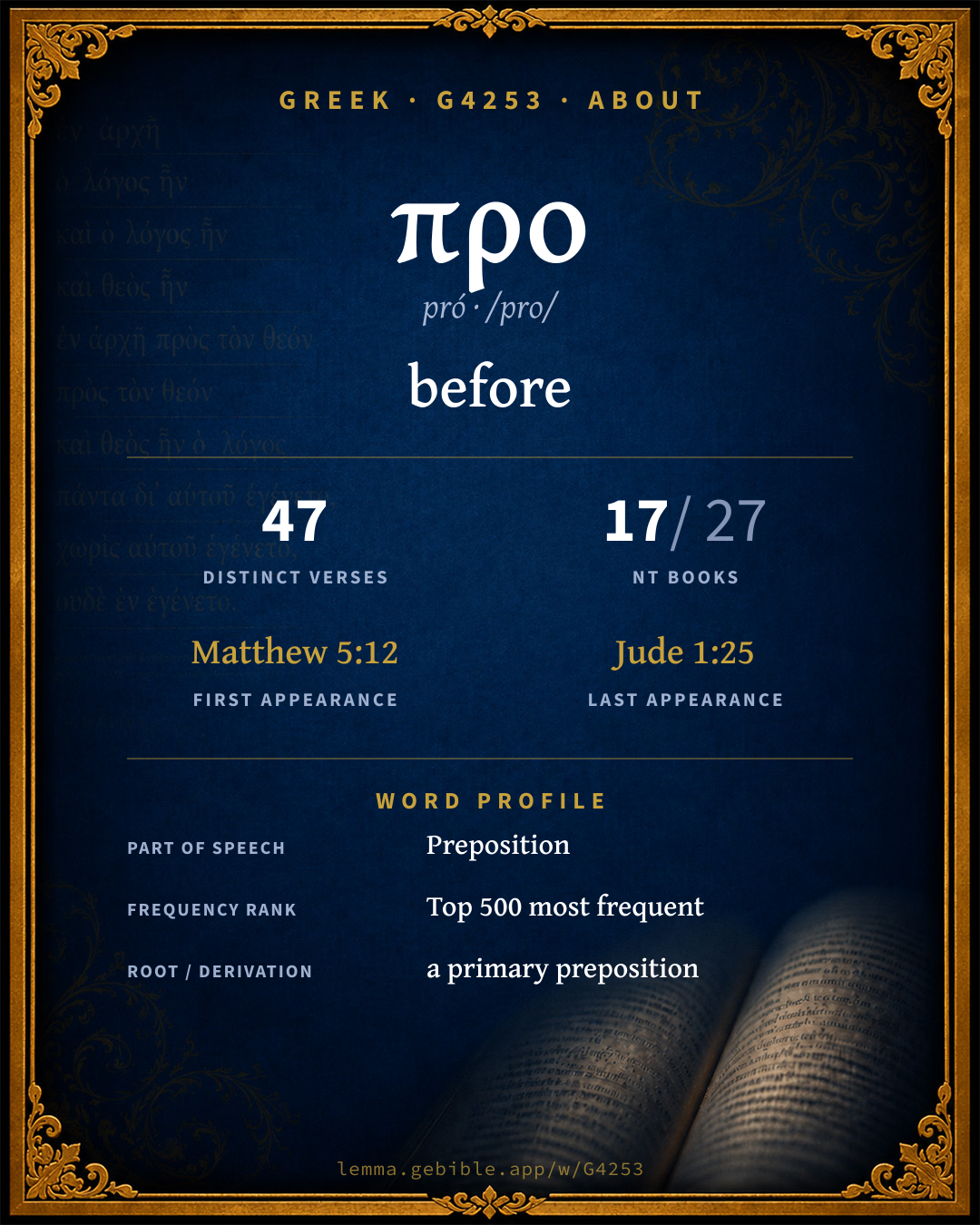
πρό
before
Full lexicon entry — Thayer's Greek Lexicon
From Thayer's Greek Lexicon
Where this word appears
Grammar key — what these labels mean
Part of speech
- Preposition
- A relational word governing a noun in a particular case.
Every verse where G4253 appears in the Book of Mark — 1 distinct verse. Click any verse to open its interlinear word-by-word view. Verse text shown in the World English Bible for context — . Each verse’s Greek form is shown with its reference; the English is not keyword-highlighted, since the data carries no word-level English alignment. Use “Compare translations” on any verse to read it across multiple English versions. This concordance covers the Greek New Testament; Septuagint (Greek Old Testament) occurrences of this word are not indexed here.
Mark
About this entry
At a glance — auto-summarized from this page’s data, not written by a person. Every figure links to its source below. This summary describes the numbers; it doesn’t interpret them.
προ (pró) is a Greek preposition most often rendered “before.” It first appears in Matthew 5:12. It turns up in 47 verses across 17 books, a moderately common footprint. From the same root come πορρω, πρηνης and πριν. The sections below give every sense, occurrence, and version rendering.
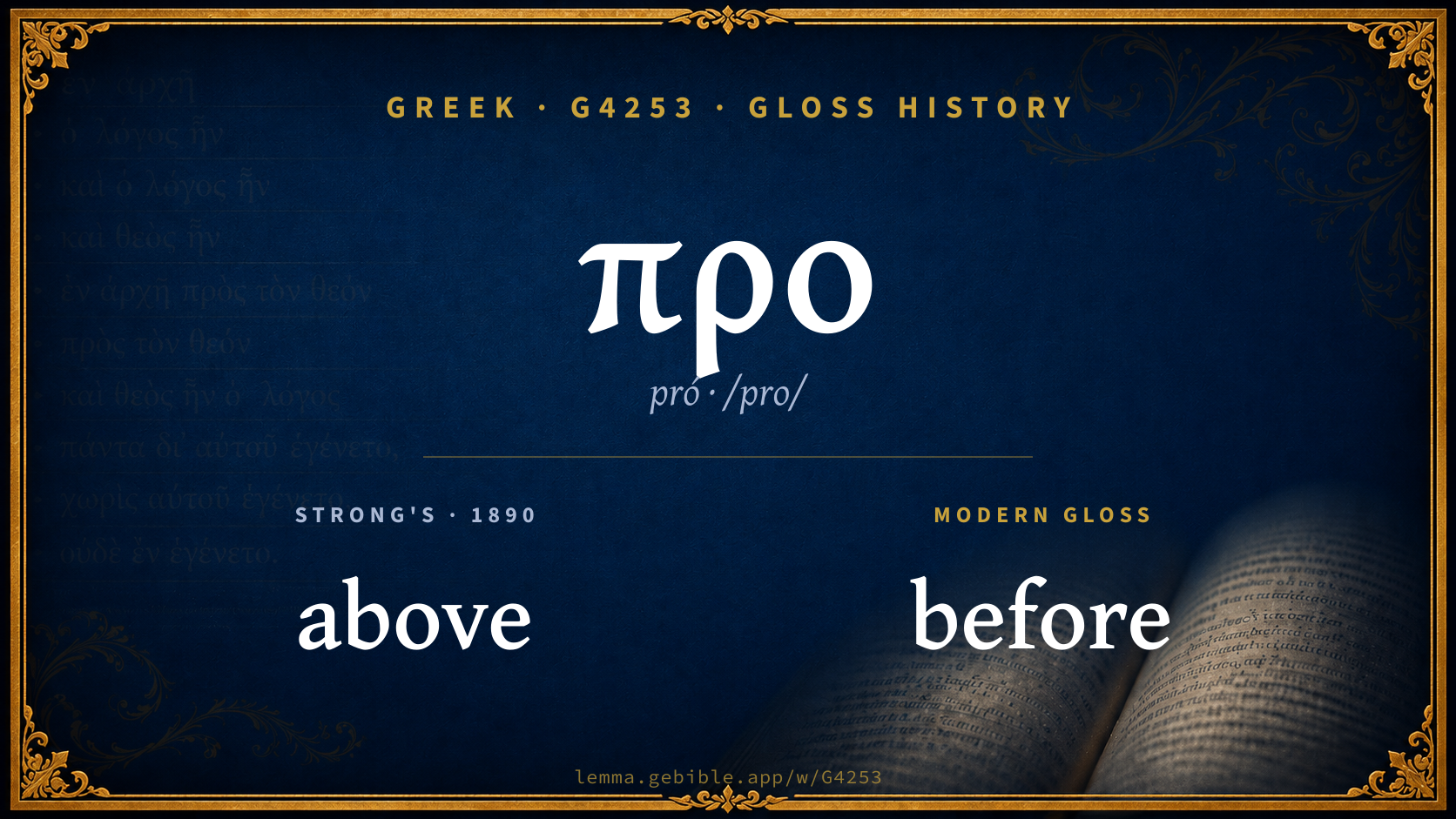
Gloss history
Strong's 1890 vs modern scholarship
About this word
Strong's G4253 catalogs a Greek word from the Greek New Testament.
These counts are not copied from any lexicon or concordance. They are computed here, from the morphology-tagged Greek New Testament. What Lemma adds →
- 47
- distinct verses
- The word appears in 47 distinct verses.
- 17 / 27
- NT books
- The word appears in 17 of 27 New Testament books.
- #326
- by frequency
- Top 500 most frequent Greek words (rank 326 of 5,347 Greek words by occurrence).
View all 47 occurrences in the concordance →
By section of the New Testament
By traditional corpus
Conventional, traditional groupings — biblical authorship is debated, so this is a traditional corpus grouping, not an authorship claim. Some books belong to more than one corpus (Luke is in both the Gospels and the Lukan corpus, and so on), so these shares overlap and need not total 100%. Each figure is a share of the word’s 47 distinct verses.
- Gospels 22 verses · 47%
- Lukan (Luke–Acts) 15 verses · 32%
- Pauline corpus 12 verses · 26%
- Johannine 8 verses · 17%
- General (Catholic) Epistles 5 verses · 11%
- Hebrews 1 verse · 2%
How translations render this word
Counts come from each version’s own published word-to-Strong’s tagging or interlinear alignment — an approximate guide to how each version renders this word, not a word-level alignment the data otherwise carries. Because each total is that version’s own tagged count, the per-version totals vary from one another and need not match the appearance or distinct-verse counts above. These counts may also differ from a printed concordance because Lemma counts each distinctly tagged rendering and does not collapse phrase taggings into a single head-word total. This is a fixed set of word-tagged versions (KJV, ASV, BSB, ULT) and does not change with the reading translation you choose elsewhere. Each version’s license is shown beside its name below (and on Sources).
- King James Version: Before 43×, Above 3×
- American Standard Version: Before 38×, Above 2×
- Berean Standard Bible: Before 31×, Ahead of you 3×, At 3×
- unfoldingWord Literal Text: Before 42×, At 2×
King James Version Public Domain
Renders G4253 across 49 tagged occurrences — most commonly:
Plus 3 renderings that appear only once — usually multi-word phrases or single function words the recovered tagging swept in, not distinct renderings.
American Standard Version Public Domain
Renders G4253 across 45 tagged occurrences — most commonly:
Plus 5 renderings that appear only once — usually multi-word phrases or single function words the recovered tagging swept in, not distinct renderings. Not rendered by a distinct English word in 1 further occurrence.
Berean Standard Bible Public Domain
Renders G4253 across 47 tagged occurrences — most commonly:
Plus 6 renderings that appear only once — usually multi-word phrases or single function words the recovered tagging swept in, not distinct renderings.
unfoldingWord Literal Text CC BY-SA 4.0
Renders G4253 across 47 tagged occurrences — most commonly:
Plus 3 renderings that appear only once — usually multi-word phrases or single function words the recovered tagging swept in, not distinct renderings.
Senses in Thayer's
The 1 sense Thayer's distinguishes for this word, in lexicon order (not ranked by frequency or importance). The full entry — with sub-senses — is in the Lexicon Entry tab.
- before
Word origin
Origin: a primary preposition
A primary preposition; fore that is in front of prior (figuratively superior ) to . In compounds it retains the same significations : - above ago before or ever. In compounds it retains the same significations.
— Strong’s Exhaustive Concordance (1890), public domain.
Forms in the corpus
The 2 distinct written forms G4253 takes in the Greek New Testament, most frequent first — each parse links to that case’s occurrences in the concordance.
| Form | Parsing | Example | Uses |
|---|---|---|---|
| πρὸ prò | Preposition | Matthew 5:12 | 44 |
| Πρὸ Prò | Preposition | Luke 21:12 | 3 |
Same root — word family
Other Thayer's entries built from the same root as G4253, grouped by Strong’s listed origin. These share a root / origin per the lexicon — not necessarily a shared meaning. Each links to that word’s own entry.
Derived from this word
- πορρω pórrhō G4206 far
- πρηνης prēnḗs G4248 headlong
- πριν prín G4250 before
- προαγω proágō G4254 to lead forward
- προαιρεομαι proairéomai G4255 to choose before
- προαιτιαομαι proaitiáomai G4256 to charge previously
- προακουω proakoúō G4257 to hear before
- προαμαρτανω proamartánō G4258 to sin before
- προαυλιον proaúlion G4259 porch
- προβαινω probaínō G4260 to go forward
- προβαλλω probállō G4261 to throw forward
- προβιβαζω probibázō G4264 to drag forward
- προβλεπω problépō G4265 to foresee
- προγινομαι progínomai G4266 to come before
- προγινωσκω proginṓskō G4267 to foreknow
- προγραφω prográphō G4270 to write before
- προδηλος pródēlos G4271 manifest
- προδιδωμι prodídōmi G4272 to give before
- προειδω proeídō G4275 to foresee
- προελπιζω proelpízō G4276 to hope before
- προεπω proépō G4277 to say before
- προεναρχομαι proenárchomai G4278 to begin before
- προεπαγγελλομαι proepangéllomai G4279 to promise before
- προερεω proeréō G4280 to say before
+48 more words derive from G4253 (not shown).
Proper names from this root
People and places named from this root — a name, not an additional meaning of the word.
Compare all same-root words → Showing 4 of 74 — not the complete family. 1 of the same-root words is a proper name (a person or place). They share a root, not necessarily a meaning.
Septuagint usage
The same Greek word προ appears 215 times in the Greek Old Testament (Septuagint), across 196 verses in 31 books.
- 215
- LXX occurrences
- Tagged occurrences of this Greek word in the Septuagint.
- 196
- verses
- Distinct Septuagint verses containing this word.
- 31 / 39
- OT books
- The word appears in 31 of the 39 Old Testament books.
Sample Septuagint occurrences
- Genesis 2:5 πρό
- Exodus 4:10 πρό
- Leviticus 5:4 πρό
- Numbers 13:22 πρό
- Deuteronomy 1:21 πρό
- Joshua 3:1 πρό
- Judges 1:12 προ
- Ruth 3:14 πρό
- 1 Samuel 18:9 πρό
- 2 Samuel 8:4 προ
- 1 Kings 5:14 προ
- 2 Kings 6:32 πρό
Septuagint occurrences (same lexeme)
Every verse where the same Strong’s number (G4253) appears in the Greek Septuagint — showing the first 50 of 196. Verse text shown in the World English Bible for context; the Greek form is the matched word — the English is not keyword-highlighted.
- Genesis 2:5 πρό No plant of the field was yet in the earth, and no herb of the field had yet sprung up; for Yahweh God had not caused it to rain on the earth. There was not a man to till the ground,
- Genesis 11:4 πρό They said, "Come, let's build us a city, and a tower, whose top reaches to the sky, and let's make us a name; lest we be scattered abroad on the surface of the whole earth."
- Genesis 13:10 πρό Lot lifted up his eyes, and saw all the plain of the Jordan, that it was well watered every where, before Yahweh destroyed Sodom and Gomorrah, like the garden of Yahweh, like the land of Egypt, as you go to Zoar.
- Genesis 19:4 πρό But before they lay down, the men of the city, the men of Sodom, surrounded the house, both young and old, all the people from every quarter.
- Genesis 24:15 πρό It happened, before he had done speaking, that behold, Rebekah came out, who was born to Bethuel the son of Milcah, the wife of Nahor, Abraham's brother, with her pitcher on her shoulder.
- Genesis 24:45 πρό Before I had done speaking in my heart, behold, Rebekah came forth with her pitcher on her shoulder. She went down to the spring, and drew. I said to her, 'Please let me drink.'
- Genesis 27:7 πρό 'Bring me venison, and make me savory food, that I may eat, and bless you before Yahweh before my death.'
- Genesis 27:10 πρό You shall bring it to your father, that he may eat, so that he may bless you before his death."
- Genesis 27:33 πρό Isaac trembled violently, and said, "Who, then, is he who has taken venison, and brought it me, and I have eaten of all before you came, and have blessed him? Yes, he will be blessed."
- Genesis 36:31 πρό These are the kings who reigned in the land of Edom, before any king reigned over the children of Israel.
- Genesis 37:18 πρό They saw him afar off, and before he came near to them, they conspired against him to kill him.
- Genesis 38:28 προ It happened, when she travailed, that one put out a hand: and the midwife took and tied a scarlet thread on his hand, saying, "This came out first."
- Genesis 41:50 πρό To Joseph were born two sons before the year of famine came, whom Asenath, the daughter of Potiphera priest of On, bore to him.
- Genesis 45:28 πρό Israel said, "It is enough. Joseph my son is still alive. I will go and see him before I die."
- Genesis 48:5 πρό Now your two sons, who were born to you in the land of Egypt before I came to you into Egypt, are mine; Ephraim and Manasseh, even as Reuben and Simeon, will be mine.
- Genesis 50:16 πρό They sent a message to Joseph, saying, "Your father commanded before he died, saying,
- Exodus 4:10 πρό Moses said to Yahweh, "Oh, Lord, I am not eloquent, neither before now, nor since you have spoken to your servant; for I am slow of speech, and of a slow tongue."
- Exodus 12:34 πρό The people took their dough before it was leavened, their kneading-troughs being bound up in their clothes on their shoulders.
- Exodus 13:9 πρό It shall be for a sign to you on your hand, and for a memorial between your eyes, that the law of Yahweh may be in your mouth; for with a strong hand Yahweh has brought you out of Egypt.
- Exodus 13:16 πρό It shall be for a sign on your hand, and for symbols between your eyes: for by strength of hand Yahweh brought us forth out of Egypt."
- Exodus 17:6 πρό Behold, I will stand before you there on the rock in Horeb. You shall strike the rock, and water will come out of it, that the people may drink." Moses did so in the sight of the elders of Israel.
- Exodus 21:29 πρό But if the bull had a habit of goring in the past, and it has been testified to its owner, and he has not kept it in, but it has killed a man or a woman, the bull shall be stoned, and its owner shall also be put to death.
- Exodus 21:36 πρό Or if it is known that the bull was in the habit of goring in the past, and its owner has not kept it in, he shall surely pay bull for bull, and the dead animal shall be his own.
- Exodus 22:25 πρό "If you lend money to any of my people with you who is poor, you shall not be to him as a creditor; neither shall you charge him interest.
- Exodus 23:20 πρό "Behold, I send an angel before you, to keep you by the way, and to bring you into the place which I have prepared.
- Exodus 32:34 πρό Now go, lead the people to the place of which I have spoken to you. Behold, my angel shall go before you. Nevertheless in the day when I punish, I will punish them for their sin."
- Exodus 33:2 πρό I will send an angel before you; and I will drive out the Canaanite, the Amorite, and the Hittite, and the Perizzite, the Hivite, and the Jebusite:
- Exodus 34:6 πρό Yahweh passed by before him, and proclaimed, "Yahweh! Yahweh, a merciful and gracious God, slow to anger, and abundant in loving kindness and truth,
- Exodus 34:11 πρό Observe that which I command you this day. Behold, I drive out before you the Amorite, the Canaanite, the Hittite, the Perizzite, the Hivite, and the Jebusite.
- Exodus 34:24 πρό For I will drive out nations before you and enlarge your borders; neither shall any man desire your land when you go up to appear before Yahweh, your God, three times in the year.
- Leviticus 5:4 πρό "'Or if anyone swears rashly with his lips to do evil, or to do good, whatever it is that a man might utter rashly with an oath, and it is hidden from him; when he knows of it, then he shall be guilty of one of these.
- Leviticus 14:36 πρό The priest shall command that they empty the house, before the priest goes in to examine the plague, that all that is in the house not be made unclean: and afterward the priest shall go in to inspect the house.
- Leviticus 18:24 πρό "'Don't defile yourselves in any of these things: for in all these the nations which I am casting out before you were defiled.
- Leviticus 18:28 πρό that the land not vomit you out also, when you defile it, as it vomited out the nation that was before you.
- Leviticus 18:30 πρό Therefore you shall keep my charge, that you do not practice any of these abominable customs, which were practiced before you, and that you do not defile yourselves with them: I am Yahweh your God.'"
- Numbers 13:22 πρό They went up by the South, and came to Hebron; and Ahiman, Sheshai, and Talmai, the children of Anak, were there. (Now Hebron was built seven years before Zoan in Egypt.)
- Numbers 14:42 πρό Don't go up, for Yahweh isn't among you; that you not be struck down before your enemies.
- Numbers 27:17 πρό who may go out before them, and who may come in before them, and who may lead them out, and who may bring them in; that the congregation of Yahweh not be as sheep which have no shepherd.
- Numbers 33:52 πρό then you shall drive out all the inhabitants of the land from before you, and destroy all their figured [stones], and destroy all their molten images, and demolish all their high places:
- Deuteronomy 1:21 πρό Behold, Yahweh your God has set the land before you: go up, take possession, as Yahweh, the God of your fathers, has spoken to you; don't be afraid, neither be dismayed.
- Deuteronomy 1:30 πρό Yahweh your God who goes before you, he will fight for you, according to all that he did for you in Egypt before your eyes,
- Deuteronomy 2:21 πρό a people great, and many, and tall, as the Anakim; but Yahweh destroyed them before them; and they succeeded them, and lived in their place;
- Deuteronomy 2:31 πρό Yahweh said to me, Behold, I have begun to deliver up Sihon and his land before you: begin to possess, that you may inherit his land.
- Deuteronomy 2:33 πρό Yahweh our God delivered him up before us; and we struck him, and his sons, and all his people.
- Deuteronomy 3:18 πρό I commanded you at that time, saying, Yahweh your God has given you this land to possess it: you shall pass over armed before your brothers the children of Israel, all the men of valor.
- Deuteronomy 3:28 πρό But charge Joshua, and encourage him, and strengthen him; for he shall go over before this people, and he shall cause them to inherit the land which you shall see.
- Deuteronomy 4:38 πρό to drive out nations from before you greater and mightier than you, to bring you in, to give you their land for an inheritance, as at this day.
- Deuteronomy 4:42 πρό that the manslayer might flee there, who kills his neighbor unawares, and didn't hate him in time past; and that fleeing to one of these cities he might live:
- Deuteronomy 5:7 πρό You shall have no other gods before me.
- Deuteronomy 6:8 πρό You shall bind them for a sign on your hand, and they shall be for symbols between your eyes.
These are occurrences of the same Greek lexeme (G4253) in the Septuagint — not a translation of any one Hebrew word. The store carries no word-level Hebrew↔Greek alignment, so no Hebrew original is asserted here. Counts come from the recovered LXX Strong's tagging — high-frequency vocabulary is well covered, while rare or late forms may be untagged — so they reflect tagged occurrences and may slightly undercount.