
Job 36:23

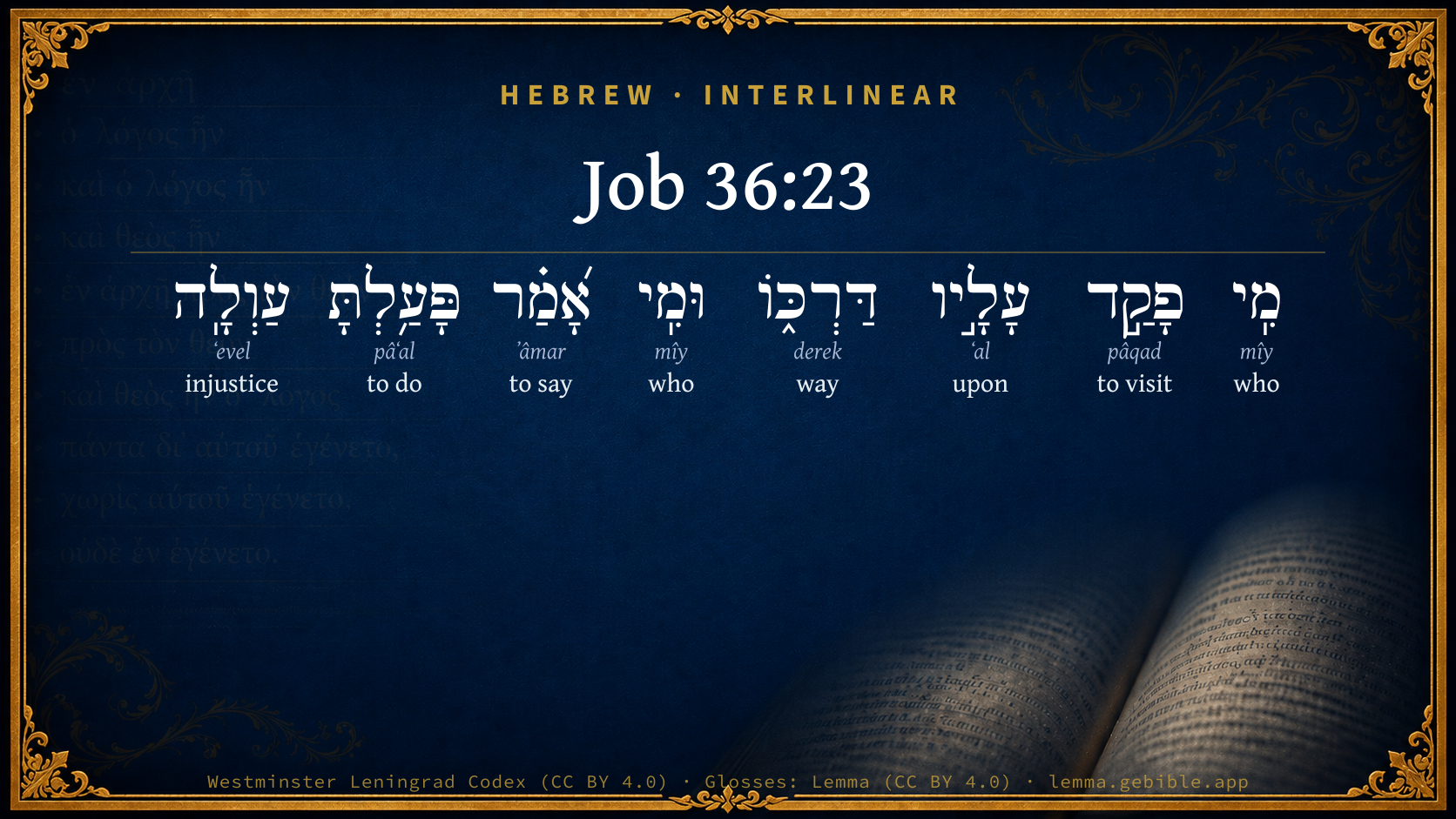
Hebrew (Westminster Leningrad Codex) Job 36:23 appears in the Hebrew Old Testament. The text above is from the Westminster Leningrad Codex. Each word links to its Strong’s number, a concise gloss, and parsing drawn from the Open Scriptures Hebrew Bible morphology. Click any word for its full Brown-Driver-Briggs (BDB) entry.
Download image
Cite this verse

Job 36:23 (World English Bible). Public Domain. Lemma interlinear Bible study tool, https://lemma.gebible.app/v/job/36/23.

Show BibTeX & RIS
BibTeX
RIS
English Translation
Who has prescribed his way for him? Or who can say, 'You have committed unrighteousness?'
World English Bible · Public Domain
Download a study sheet

One document with this verse’s original text, its word-by-word gloss line, the meaning frame, cross-references with their text, attributed commentary, and full source and license credits — printable, and it pastes into notes with its structure intact.

This verse Autodidact and up

Study sheet (.html) Plain text (.txt)

A passage Seminary Student

Up to 50 verses in one chapter. A passage sheet keeps up to 6 commentary sources and 12 cross-references per verse, in the order this page ranks them, and says so on the sheet whenever that leaves anything out. Ask for a single verse and you get the Autodidact verse sheet above.

Everything on this page stays free to read, with no account — the sheet is a download of what is already on screen, not access to it.

Want to remove ads? Support Godless Engineer
Compare translations 3

The same verse in 3 English versions, stacked beneath the original-language interlinear above. Click any original word for its lexicon entry.

Each is an independent rendering of the whole verse — the interlinear is not word-aligned to these translations.

Highlighted words mark where these versions differ — a whole-verse word diff, not a word-by-word alignment.

  • World English Bible Public Domain
    Who has prescribed his way for him? Or who can say, 'You have committed unrighteousness?'
  • King James Version Public Domain
    Who hath enjoined him his way? or who can say, Thou hast wrought iniquity?
  • unfoldingWord Literal Text CC BY-SA 4.0
    Who has appointed his way to him? Or who has said, ‘You have committed unrighteousness?’

unfoldingWord Literal Text — © unfoldingWord, licensed CC BY-SA 4.0. Word-aligned USFM3 via Door43 (git.door43.org/unfoldingWord/en_ult).

Versions to compare (up to 4)

3 of 4 selected

Show all 18 translations

Every available English version of this verse, each an independent rendering of the whole verse.

  • World English Bible Public Domain
    Who has prescribed his way for him? Or who can say, 'You have committed unrighteousness?'
  • Berean Standard Bible Public Domain
    Who has appointed His way for Him, or told Him, ‘You have done wrong’?
  • Majority Standard Bible Public Domain
    Who has appointed His way for Him, or told Him, ‘You have done wrong’?
  • King James Version Public Domain
    Who hath enjoined him his way? or who can say, Thou hast wrought iniquity?
  • American Standard Version (1901) Public Domain
    Who hath enjoined him his way? Or who can say, Thou hast wrought unrighteousness?
  • Revised Version (1885) Public Domain
    Who hath enjoined him his way? or who can say, Thou hast wrought unrighteousness?
  • Geneva Bible (1599) Public Domain
    Who hath appointed to him his way? or who can say, Thou hast done wickedly?
  • Douay-Rheims (1899) Public Domain
    Who can search out his ways? or who can say to him: Thou has wrought iniquity?
  • Young's Literal Translation Public Domain
    Who hath appointed unto Him his way? And who said, `Thou hast done iniquity?'
  • Literal Standard Version CC BY-SA 4.0
    Who has appointed to Him His way? And who said, You have done iniquity?
  • Unlocked Literal Bible CC BY-SA 4.0
    Who has ever instructed him about his way? Who can ever say to him, 'You have committed unrighteousness?'
  • unfoldingWord Literal Text CC BY-SA 4.0
    Who has appointed his way to him? Or who has said, ‘You have committed unrighteousness?’
  • Darby Bible Public Domain
    Who hath appointed him his way? or who hath said, Thou hast wrought unrighteousness?
  • World Messianic Bible Public Domain
    Who has prescribed his way for him? Or who can say, ‘You have committed unrighteousness’?
  • Webster's Bible Public Domain
    Who hath enjoined him his way? or who can say, Thou hast wrought iniquity?
  • Free Bible Version CC BY-SA 4.0
    Who has instructed him what to do? Who can say to him ‘You have done wrong’?
  • Bible in Basic English Public Domain
    Who ever gave orders to him, or said to him, You have done wrong?
  • JPS Tanakh (1917) Public Domain
    Who hath enjoined Him His way? Or who hath said: 'Thou hast wrought unrighteousness'?

Literal Standard Version (2020), Covenant Press — licensed CC BY-SA 4.0. Text via the HelloAO Bible API (eBible.org). Unlocked Literal Bible (unfoldingWord) — licensed CC BY-SA 4.0. Text via the HelloAO Bible API (eBible.org). unfoldingWord Literal Text — © unfoldingWord, licensed CC BY-SA 4.0. Word-aligned USFM3 via Door43 (git.door43.org/unfoldingWord/en_ult). Free Bible Version, Dr. Jonathan Gallagher — licensed CC BY-SA 4.0. Text via the HelloAO Bible API (eBible.org).

Word by word

More ways to search: Search by grammar → Find every occurrence → Compare this word →

Practice this passage: Drill this verse → Learn its vocabulary →

About this verse

These counts appear in no published source. They are computed here, from the morphology-tagged text and Lemma’s own curated glosses. What Lemma adds →

8
words
7
distinct lemmas
Wisdom
section

Shared distinctive vocabulary

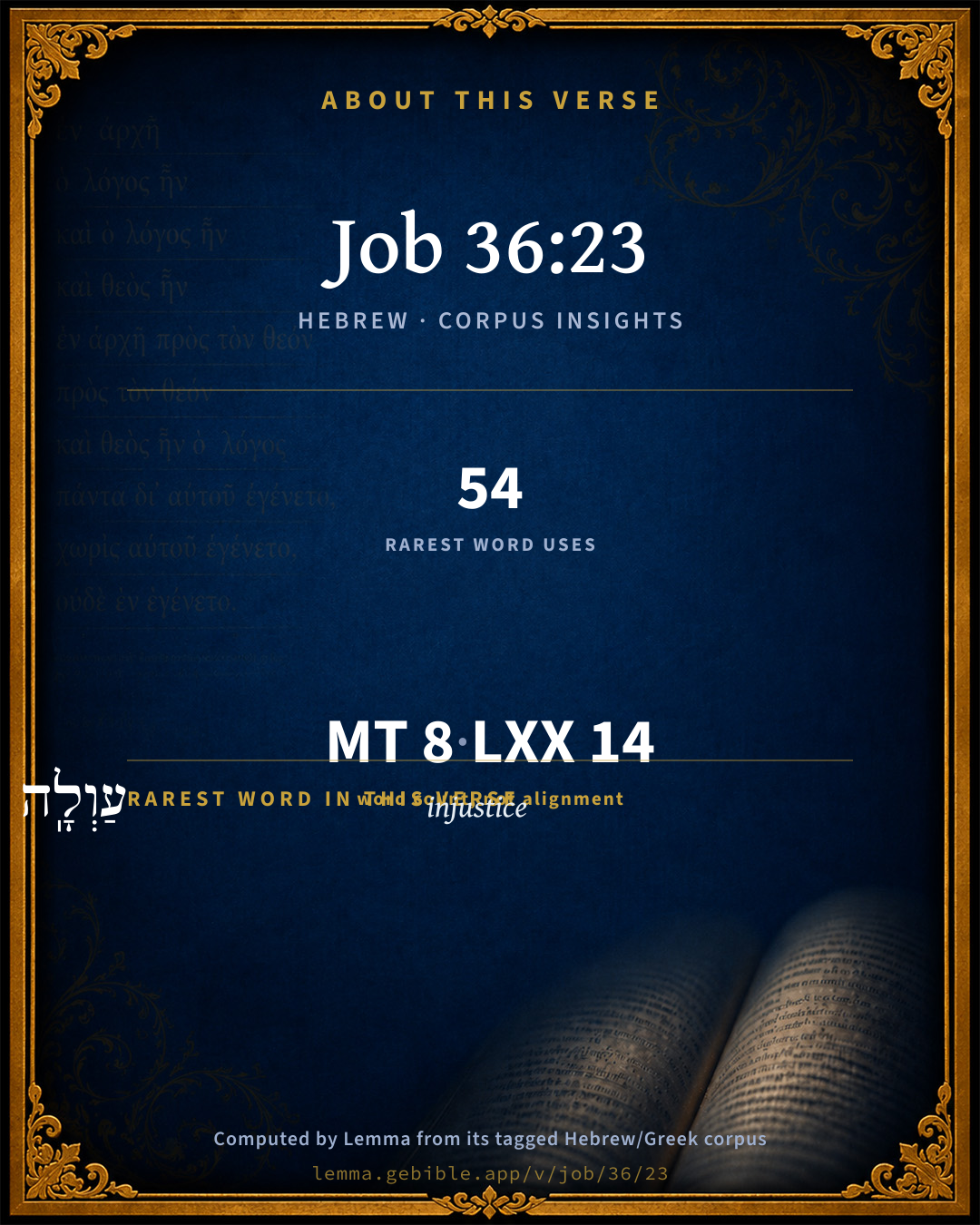
עַוְלָֽה injustice H5766 occurs in 51 verses of the Hebrew Bible. Also found in:

Grammatical profile

  • 3 verbs
  • 2 nouns
  • 1 preposition
  • 2 particles

Verb forms

  • פָקַ֣ד Qal · Perfect
  • אָ֝מַ֗ר Qal · Perfect
  • פָּעַ֥לְתָּ Qal · Perfect

Repetition

A word recurs within this verse — often emphatic in Hebrew:

Hebrew & Septuagint length

In English translation the verse runs 15 words from the Hebrew and 16 from the Septuagint (LXX English) — closely comparable.

A rough comparison of the two English renderings, which tokenize alike — not a word-level alignment.

Word counts can differ between the Hebrew and the Greek without any difference in meaning — e.g. the Hebrew direct-object marker אֵת has no separate Greek word, and Greek often adds the article ὁ.

In the original languages it is 8 Hebrew tokens and 14 Greek tokens — but the two are counted differently (Hebrew bundles its prefixes and suffixes into one token; the Greek is in lemma form), so that isn’t a like-for-like length.

Cross-references

11

Topical passages linked to Job 36:23 in the Treasury of Scripture Knowledge — connected by theme and wording, ordered by reader-vote popularity; previews shown in the World English Bible.

  • 1 Corinthians 2:16 "For who has known the mind of the Lord, that he should instruct him?" But we have Christ's mind.
  • Job 8:3 Does God pervert justice? Or does the Almighty pervert righteousness?
  • Isaiah 40:13–14 Who has directed the Spirit of Yahweh, or being his counselor has taught him?
  • Job 34:10 "Therefore listen to me, you men of understanding: Far be it from God, that he should do wickedness, From the Almighty, that he should commit iniquity.
  • Job 34:13–33 Who gave him a charge over the earth? Or who has appointed him over the whole world?
  • Romans 2:5 But according to your hardness and unrepentant heart you are treasuring up for yourself wrath in the day of wrath, revelation, and of the righteous judgment of God;
  • Romans 11:34 "For who has known the mind of the Lord? Or who has been his counselor?"
  • Ephesians 1:11 in whom also we were assigned an inheritance, having been foreordained according to the purpose of him who works all things after the counsel of his will;
  • Job 40:8 Will you even annul my judgment? Will you condemn me, that you may be justified?
  • Romans 3:5 But if our unrighteousness commends the righteousness of God, what will we say? Is God unrighteous who inflicts wrath? I speak like men do.
  • Romans 9:14 What shall we say then? Is there unrighteousness with God? May it never be!

Cross-references courtesy of OpenBible.info (CC BY 4.0).

Hebrew and Greek witnesses Masoretic Hebrew ↔ Greek Septuagint

The same verse in the two great witnesses to the Old Testament, shown verse-for-verse.

These are two independent witnesses, not word-aligned to each other, and the Septuagint is shown in lemma (dictionary) form.

Hebrew Job 36:23 Masoretic · Westminster Leningrad Codex

מִֽי פָקַ֣ד עָלָ֣יו דַּרְכּ֑וֹ וּמִֽי אָ֝מַ֗ר פָּעַ֥לְתָּ עַוְלָֽה

Who has prescribed his way for him? Or who can say, 'You have committed unrighteousness?'

World English Bible · Public Domain

Greek LXX Job 36:23 Septuagint · lemma form

τίς δέ εἰμί ὁ ἐτάζω αὐτός ὁ ἔργον ἤ τίς ὁ εἶπον πράσσω ἄδικος

And who is he that examines his works? or who can say, he has wrought injustice?

LXX2012 (modern English Septuagint) · Public Domain

Hebrew: Westminster Leningrad Codex (CC BY 4.0). Greek: Septuagint (public domain); English from LXX2012 (modern English Septuagint) (Public Domain). How the Septuagint differs from the Hebrew →

Commentary

Notes on Job 36:23 from classic Christian and Jewish commentators (each source and its license shown beneath its notes). The classic Christian expositions comment on the surrounding passage and are grouped to its opening verse, so a note may address several verses; the Jewish commentaries on the Tanakh (Rashi and others) are per-verse, so they appear only where the commentator wrote on this verse.

Lemma curates 59 commentaries, every one of them public domain or Creative Commons licensed, each selected and text-cleaned for this edition rather than reprinted as found. About our sources →

Trapp's Complete Commentary

John Trapp

Job 36:23 Who hath enjoined him his way? or who can say, Thou hast wrought iniquity?

Ver. 23. Who hath enjoined him his way?] q.d. Wilt thou take upon thee to teach this great Teacher how to govern the world? This were a strange kind of arrogance.

Or who can say, Thou hast wrought iniquity?] God’s judgments are sometimes secret, but always just. Let not men reprehend what they do not yet comprehend, but content themselves with a learned ignorance, till God shall further discover himself, saying of God’s works, as Socrates did of a certain book that he had read, What I understand therein is very good, and so I think is that I understand not. When we come into a craftsman’s shop, we may see many tools, the use whereof we know not, and yet we conclude they are of some use. Why then should men rashly censure God’s proceedings, which are many times in mediis contrariis, as Luther was wont to say, brought about by contrary means; that he may be the more admired, as Nazianzen giveth the reason, ’Iνα και μαλλον θαυμαζηται (Naz. in Cypr.). The craftsman with a crooked tool makes straight work. The apothecary maketh of a poisonous viper a wholesome antidote; so here. Far be it from us therefore to charge God with iniquity, for this were, with those mad Manichees, to affirm, that till he had created light he dwelt in darkness, as if God were not an eternal light, 1Jn 1:5 1Ti 6:16, Manichaeorum diabolicus sarcasmus (Paraeus).

John Trapp, A Commentary or Exposition upon All the Books of the Old and New Testament (1647–1656) — public domain. Text from a community e-Sword module.

Jamieson, Fausset & Brown

Robert Jamieson, A. R. Fausset & David Brown

Job dared to prescribe to God what He should do (Job 34:10, Job 34:13).

Jamieson, Fausset & Brown — Commentary Critical and Explanatory on the Whole Bible (1871) — public domain (CC PDM 1.0). Text via the HelloAO Bible API.

Adam Clarke's Commentary

Verse 23. Who hath enjoined him his way] Has God taken instructions from any man how he shall govern the world?

Thou hast wrought iniquity?] Who can prove, in the whole compass of the creation, that there is one thing imperfect, superabundant, or out of its place? Who can show that there is, in the course of the Divine providence, one unrighteous, cruel, or unwise act? All the cunning and wickedness of man have never been able to find out the smallest flaw in the work of God.

Adam Clarke's Commentary on the Bible (1810–1826) — public domain. Text from a community e-Sword/MySword module.

The Cambridge Bible for Schools and Colleges

gen. ed. J. J. S. Perowne

23. The verse expresses the idea that God is supreme; none enjoins or appoints Him His way; He is “God over all;” and hence none can pass judgment upon His doings.

The Cambridge Bible for Schools and Colleges (gen. ed. J. J. S. Perowne; Cambridge University Press, 1878–1918) — public domain. Text from a community e-Sword module.

John Gill's Exposition

Who hath enjoined him his way?.... He teaches men his own ways, the methods of his grace and mercy towards them; and he prescribes to them the ways in which they should walk; but none can lead or prescribe to him; as the way of governing the world, in what manner he should act in it; who has "taught him in the path of judgment?" or "showed to him the way of understanding?" Isa 40:14; and particularly whom he should afflict, in what manner he should do it, when and how long he should continue it; all which he does according to his sovereign will, and is not to be controlled: and, in a spiritual sense, no man can or ought to enjoin and prescribe to him whom he should save, and in what way; he saves whom he pleases, and in his own way, even by his Son Jesus Christ, and no other; or "who hath visited", or "should visit on him", or "with him his way" (e)? who can take upon him to examine into his ways, and scrutinize them, and call him to an account for what he does? no man can overlook his ways and works, or censure him for any of his actions:

or, who can say, thou hast wrought iniquity? this may be said of every man, but it cannot be said of God by any without sin; for, as there is no iniquity in his nature, there can be none in his works; not any in his works of providence, no, not in the afflictions of his people; just and true are all his ways.

(e) "quis visitavit super illum viam ejus", Montanus, Michaelis; "cum eo", Tigurine version.

John Gill's Exposition of the Whole Bible (1746–1763) — public domain (CC PDM 1.0). Text via the HelloAO Bible API.

Albert Barnes' Notes on the Bible

Who hath enjoined him his way? - Who hath prescribed to him what he ought to do? Who is superior to him, and has marked out for him the plan which he ought to pursue? The idea is, that God is supreme and independent; no one has advised him, and no one has a right to counsel him. Perhaps, also, Elihu designs this as a reproof to Job for having complained so much of the government of God, and for being disposed, as he thought, to “prescribe” to God what he should do.

Who can say, Thou hast wrought iniquity? - Thou hast done wrong. The object of Elihu is here to show that no one has a right to say this; no one could, in fact, say it. It was to be regarded as an indisputable point that God is always right, and that however dark his dealings with people may seem, the “reason” why they are mysterious “never is, that God is wrong.”

Albert Barnes' Notes on the Bible (1834–1885) — public domain. Text from a community e-Sword/MySword module.

Matthew Poole's English Annotations

His way, wherein he would walk, i.e. what courses and methods he should use in the administration of human affairs. If he had a superior Lord who gave him laws for his actions, he might be accountable to him, and questionable for what he did; but he is supreme, absolute, and uncontrollable, who hath no law to regulate him but his own holy nature and blessed will. And therefore how rash, and impudent, and absurd a thing is it for any man to censure his proceedings!

Thou hast wrought iniquity; thou hast swerved from the law and rule given to thee.

Matthew Poole's English Annotations on the Holy Bible (1683–1685) — public domain. Text from a community e-Sword/MySword module.

Whedon's Commentary on the Bible

Daniel D. Whedon

23. Who hath enjoined him his way — God is responsible to no one, (Job_34:13,) not to Job even, who, as Elihu thinks, is disposed to dictate to God his way.

Daniel D. Whedon (gen. ed.), Commentary on the Old and New Testaments (1874–1909) — public domain. Text from a community e-Sword module.

The Pulpit Commentary

Who hath enjoined him his way? (comp. Job_34:13) While God is thus the universal and all-perfect Teacher, there are some who would fain instruct him, dictate the course which he ought to pursue, improve and amend his universe. Something of this spirit has appeared in Job"s remonstrances, which seem to insinuate that the Divine government of the world might be carried on better than it is. (see Job_9:22-24 Job_10:3 Job_13:20-26 Job_16:11-17, etc.) Elihu"s intention is to reprove Job for his presumption. Or who can say, Thou hast wrought iniquity? Job has not said this; but he has gone near to saying it; (Job_9:24 Job_10:3 Job_21:7-26 Job_24:2-12, etc.) compare the comment on Job_34:5-12.

The Pulpit Commentary (1880–1919), ed. H.D.M. Spence-Jones & Joseph S. Exell — public domain. Text from a community e-Sword module.

Rashi

Rabbi Shlomo Yitzchaki (Rashi)

Who charged Him with His way [Who] commanded Him from time immemorial, “You shall follow this way”?

Rashi on the Tanakh — English translations: “The Judaica Press complete Tanach with Rashi, translated by A. J. Rosenberg” (CC BY 4.0); “Pentateuch with Rashi's commentary by M. Rosenbaum and A.M. Silbermann, 1929-1934” (public domain); “The Metsudah Tanach series, Lakewood, N.J” (CC BY 4.0); and “The Book of Joshua, Metsudah Publications, 1997” (CC BY 4.0). Text via Sefaria.

Lesson kit

Teaching starters — assembled from the data on this page, not authored interpretation. Every prompt links to the verse data it draws on. Edit before teaching.

Job, in the Wisdom, opens this verse with 8 words (7 distinct Hebrew lemmas). Its most distinctive word is ʻevel (“injustice”). A historical commentator’s framing appears above. Read the whole chapter for the surrounding context.

Discussion questions

  1. The word ʻevel carries the sense “injustice.” How does it shape the verse?
  2. How does Leviticus 19:15, which shares the word «injustice», read alongside this verse?
  3. What does the repetition of “who” (2× in this one verse) do in this verse?
  4. These translations render this verse differently. What is at stake in choosing one wording over another?
  5. «פָקַ֣ד» is a Qal Perfect verb. How does that grammatical form shape the action described?
  6. Compare how Trapp's Complete Commentary and Jamieson, Fausset & Brown read this verse. Where do they agree or differ?

Things to notice

Reading settings

Reading text

Shown beneath each verse's original-language words.

Old Testament
Old Testament edition

Read the OT as the Masoretic Hebrew (MT) or the Greek Septuagint (LXX).

English shown for the Greek Septuagint (in the Hebrew ↔ Greek comparison).

Comparing translations? Open the Compare panel on any verse page to stack up to four side by side.