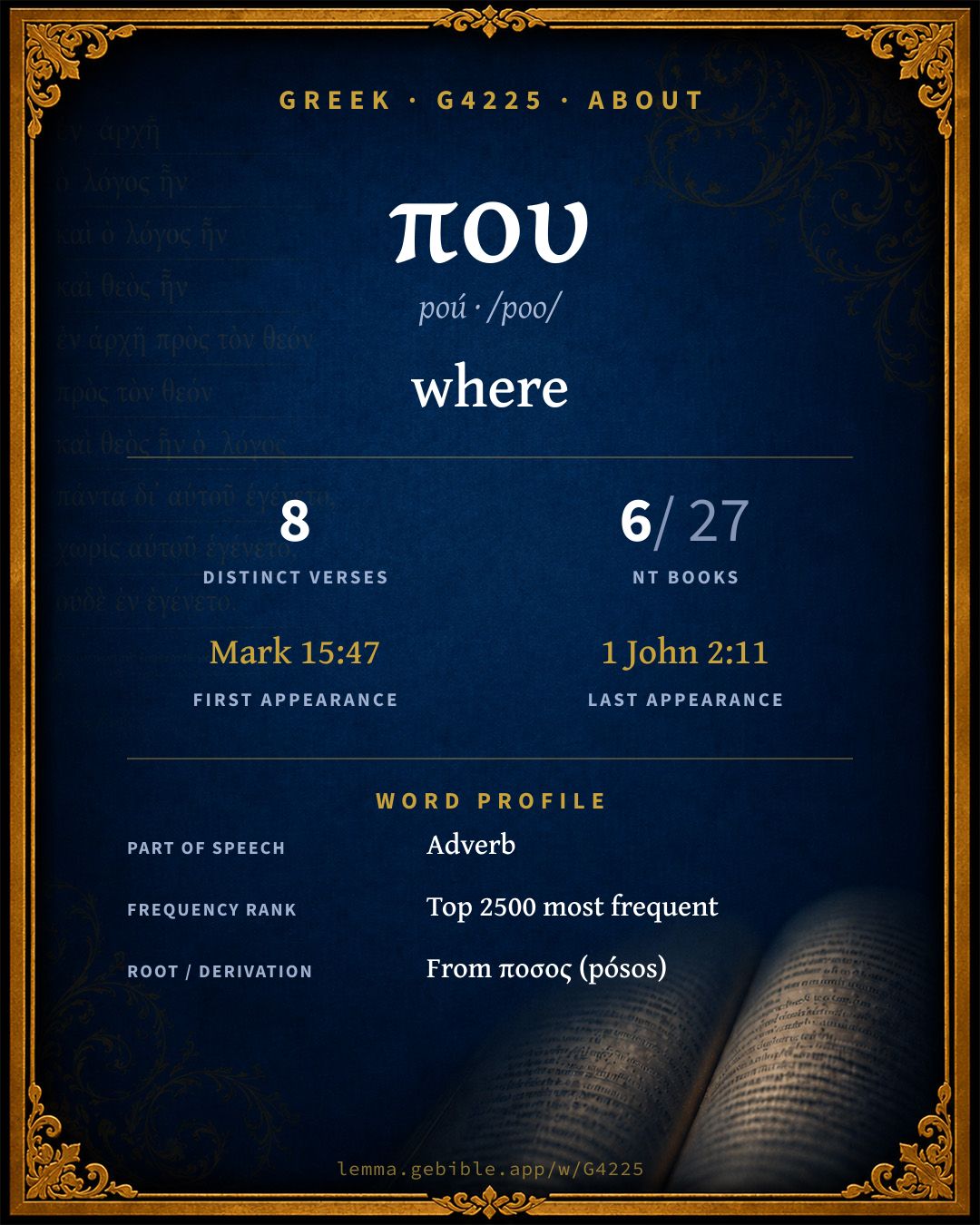
πού
where
Full lexicon entry — Thayer's Greek Lexicon
From Thayer's Greek Lexicon
Where this word appears
Grammar key — what these labels mean
Part of speech
- Particle
- A short, often untranslatable function word adding nuance or connection.
- Conjunction
- A joining word linking words or clauses.
Degree
- Negative
- Marks a negative form.
Every verse where G4225 appears in the Book of Hebrews — 2 distinct verses. Click any verse to open its interlinear word-by-word view. Verse text shown in the World English Bible for context — . Each verse’s Greek form is shown with its reference; the English is not keyword-highlighted, since the data carries no word-level English alignment. Use “Compare translations” on any verse to read it across multiple English versions. This concordance covers the Greek New Testament; Septuagint (Greek Old Testament) occurrences of this word are not indexed here.
Hebrews
About this entry
At a glance — auto-summarized from this page’s data, not written by a person. Every figure links to its source below. This summary describes the numbers; it doesn’t interpret them.
που — transliterated poú — is a Greek verb carrying the sense “where.” Its earliest occurrence is Mark 15:47. It appears 8 verses across 6 books of the Greek New Testament, among its uncommon vocabulary. More than a quarter of its appearances fall in John. It shares a root with ποσος, ποσακις and πηλικος. Each statement above links to its evidence; the full detail follows below.
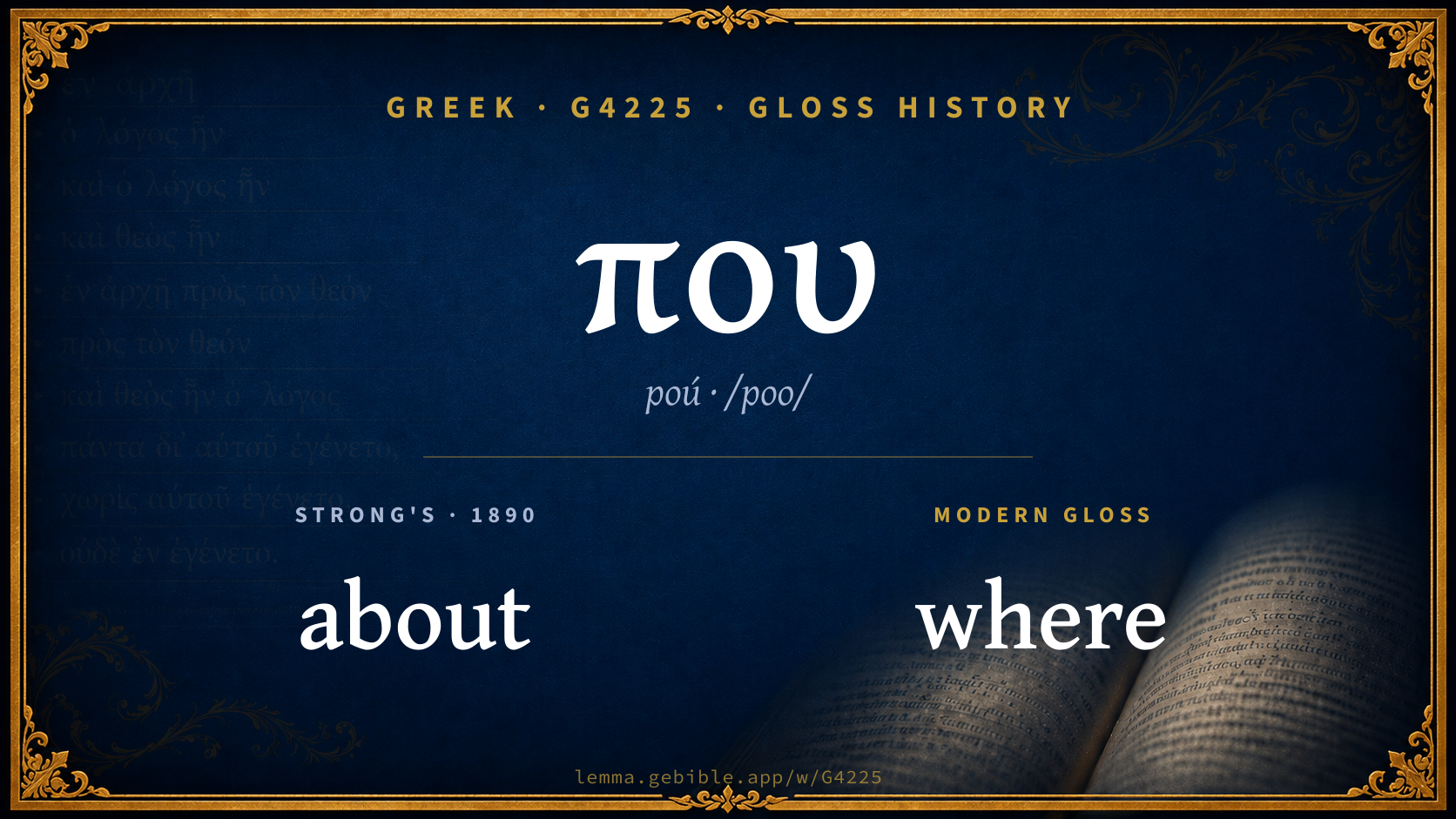
Gloss history
Strong's 1890 vs modern scholarship
About this word
Strong's G4225 catalogs a Greek word from the Greek New Testament.
These counts are not copied from any lexicon or concordance. They are computed here, from the morphology-tagged Greek New Testament. What Lemma adds →
- 8
- distinct verses
- The word appears in 8 distinct verses.
- 6 / 27
- NT books
- The word appears in 6 of 27 New Testament books.
- #1,240
- by frequency
- Top 2500 most frequent Greek words (rank 1,240 of 5,347 Greek words by occurrence).
View all 8 occurrences in the concordance →
By section of the New Testament
By traditional corpus
Conventional, traditional groupings — biblical authorship is debated, so this is a traditional corpus grouping, not an authorship claim. Some books belong to more than one corpus (Luke is in both the Gospels and the Lukan corpus, and so on), so these shares overlap and need not total 100%. Each figure is a share of the word’s 8 distinct verses.
- Gospels 3 verses · 38%
- Johannine 3 verses · 38%
- Hebrews 2 verses · 25%
- Lukan (Luke–Acts) 1 verse · 13%
- Pauline corpus 1 verse · 13%
- General (Catholic) Epistles 1 verse · 13%
How translations render this word
Counts come from each version’s own published word-to-Strong’s tagging or interlinear alignment — an approximate guide to how each version renders this word, not a word-level alignment the data otherwise carries. Because each total is that version’s own tagged count, the per-version totals vary from one another and need not match the appearance or distinct-verse counts above. These counts may also differ from a printed concordance because Lemma counts each distinctly tagged rendering and does not collapse phrase taggings into a single head-word total. This is a fixed set of word-tagged versions (KJV, ASV, BSB, ULT) and does not change with the reading translation you choose elsewhere. Each version’s license is shown beside its name below (and on Sources).
- King James Version: Certain place 2×
- American Standard Version: Where 2×
- Berean Standard Bible: Where 3×, Somewhere 2×
- unfoldingWord Literal Text: Somewhere 3×
King James Version Public Domain
Renders G4225 across 3 tagged occurrences — most commonly:
Plus 1 rendering that appears only once — usually multi-word phrases or single function words the recovered tagging swept in, not distinct renderings.
American Standard Version Public Domain
Renders G4225 across 6 tagged occurrences — most commonly:
Plus 4 renderings that appear only once — usually multi-word phrases or single function words the recovered tagging swept in, not distinct renderings.
Berean Standard Bible Public Domain
Renders G4225 across 6 tagged occurrences — most commonly:
Plus 1 rendering that appears only once — usually multi-word phrases or single function words the recovered tagging swept in, not distinct renderings. Not rendered by a distinct English word in 1 further occurrence.
unfoldingWord Literal Text CC BY-SA 4.0
Renders G4225 across 4 tagged occurrences — most commonly:
Plus 1 rendering that appears only once — usually multi-word phrases or single function words the recovered tagging swept in, not distinct renderings.
Senses in Thayer's
The 1 sense Thayer's distinguishes for this word, in lexicon order (not ranked by frequency or importance). The full entry — with sub-senses — is in the Lexicon Entry tab.
- where?, in what place?
Word origin
Derived from ποσος (pósos) (G4214) — how much.
Genitive case of πός pos an indefinite pronoun ( some ) otherwise obsolete (compare G4214 ); as adverb of place somewhere that is nearly : - about a certain place.
— Strong’s Exhaustive Concordance (1890), public domain.
Forms in the corpus
The 4 distinct written forms G4225 takes in the Greek New Testament, most frequent first — each parse links to that case’s occurrences in the concordance.
| Form | Parsing | Example | Uses |
|---|---|---|---|
| ποῦ poû | Particle | Mark 15:47 | 4 |
| που pou | Particle | Romans 4:19 | 2 |
| μήπου mḗpou | Conjunction, Negative | Acts 27:29 | 1 |
| πού poú | Particle | Hebrews 2:6 | 1 |
Same root — word family
Other Thayer's entries built from the same root as G4225, grouped by Strong’s listed origin. These share a root / origin per the lexicon — not necessarily a shared meaning. Each links to that word’s own entry.
Derives from
Shares the same root
Derived from this word
- πηλικος pēlíkos G4080 how great
- ποτε poté G4218 formerly
- που poû G4226 somewhere
- -πως -pṓs G4458 by any means
Compare all same-root words → Showing 4 of 7 — not the complete family. They share a root, not necessarily a meaning.
Septuagint usage
The same Greek word που appears 101 times in the Greek Old Testament (Septuagint), across 87 verses in 25 books.
- 101
- LXX occurrences
- Tagged occurrences of this Greek word in the Septuagint.
- 87
- verses
- Distinct Septuagint verses containing this word.
- 25 / 39
- OT books
- The word appears in 25 of the 39 Old Testament books.
Sample Septuagint occurrences
- Genesis 3:9 ποῦ
- Exodus 2:20 ποῦ
- Deuteronomy 1:28 ποῦ
- Joshua 2:5 ποῦ
- Judges 6:13 ποῦ
- Ruth 2:19 ποῦ
- 1 Samuel 10:14 ποῦ
- 2 Samuel 2:1 ποῦ
- 1 Kings 10:12 που
- 2 Kings 2:14 ποῦ
- Job 17:15 ποῦ
- Psalms 41:4 ποῦ
Septuagint occurrences (same lexeme)
Every verse where the same Strong’s number (G4225) appears in the Greek Septuagint — showing the first 50 of 87. Verse text shown in the World English Bible for context; the Greek form is the matched word — the English is not keyword-highlighted.
- Genesis 3:9 ποῦ Yahweh God called to the man, and said to him, "Where are you?"
- Genesis 4:9 ποῦ Yahweh said to Cain, "Where is Abel, your brother?" He said, "I don't know. Am I my brother's keeper?"
- Genesis 16:8 ποῦ He said, "Hagar, Sarai's handmaid, where did you come from? Where are you going?" She said, "I am fleeing from the face of my mistress Sarai."
- Genesis 18:9 ποῦ They said to him, "Where is Sarah, your wife? He said, "See, in the tent."
- Genesis 19:5 ποῦ They called to Lot, and said to him, "Where are the men who came in to you this night? Bring them out to us, that we may have sex with them."
- Genesis 22:7 ποῦ Isaac spoke to Abraham his father, and said, "My father?" He said, "Here I am, my son." He said, "Here is the fire and the wood, but where is the lamb for a burnt offering?"
- Genesis 32:18 ποῦ Then you shall say, 'They are your servant, Jacob's. It is a present sent to my lord, Esau. Behold, he also is behind us.'"
- Genesis 37:16 ποῦ He said, "I am looking for my brothers. Tell me, please, where they are feeding the flock."
- Genesis 37:30 ποῦ He returned to his brothers, and said, "The child is no more; and I, where will I go?"
- Genesis 38:21 ποῦ Then he asked the men of her place, saying, "Where is the prostitute, that was at Enaim by the road?" They said, "There has been no prostitute here."
- Exodus 2:20 ποῦ He said to his daughters, "Where is he? Why is it that you have left the man? Call him, that he may eat bread."
- Deuteronomy 1:28 ποῦ Where are we going up? our brothers have made our heart to melt, saying, The people are greater and taller than we; the cities are great and fortified up to the sky; and moreover we have seen the sons of the Anakim there.
- Deuteronomy 32:37 ποῦ He will say, Where are their gods, The rock in which they took refuge;
- Joshua 2:5 ποῦ and it happened about the time of the shutting of the gate, when it was dark, that the men went out; where the men went I don't know: pursue after them quickly; for you will overtake them.
- Joshua 8:20 ποῦ When the men of Ai looked behind them, they saw, and, behold, the smoke of the city ascended up to heaven, and they had no power to flee this way or that way: and the people who fled to the wilderness turned back on the pursuers.
- Judges 6:13 ποῦ Gideon said to him, Oh, my lord, if Yahweh is with us, why then has all this happened to us? and where are all his wondrous works which our fathers told us of, saying, Did not Yahweh bring us up from Egypt? but now Yahweh has cast us off, and delivered us into the hand of Midian.
- Judges 8:18 ποῦ Then said he to Zebah and Zalmunna, What manner of men were they whom you killed at Tabor? They answered, As you are, so were they; each one resembled the children of a king.
- Judges 9:38 ποῦ Then said Zebul to him, Where is now your mouth, that you said, Who is Abimelech, that we should serve him? is not this the people that you have despised? go out now, I pray, and fight with them.
- Judges 19:17 ποῦ He lifted up his eyes, and saw the wayfaring man in the street of the city; and the old man said, Where go you? and whence come you?
- Judges 20:3 ποῦ (Now the children of Benjamin heard that the children of Israel had gone up to Mizpah.) The children of Israel said, Tell us, how was this wickedness brought to pass?
- Ruth 2:19 ποῦ Her mother-in-law said to her, Where have you gleaned today? and where have you worked? blessed be he who did take knowledge of you. She shown her mother-in-law with whom she had worked, and said, The man's name with whom I worked today is Boaz.
- 1 Samuel 10:14 ποῦ Saul's uncle said to him and to his servant, Where went you? He said, To seek the donkeys; and when we saw that they were not found, we came to Samuel.
- 1 Samuel 19:22 ποῦ Then went he also to Ramah, and came to the great well that is in Secu: and he asked and said, Where are Samuel and David? One said, Behold, they are at Naioth in Ramah.
- 1 Samuel 26:16 ποῦ This thing isn't good that you have done. As Yahweh lives, you are worthy to die, because you have not kept watch over your lord, Yahweh's anointed. Now see where the king's spear is, and the jar of water that was at his head.
- 2 Samuel 2:1 ποῦ It happened after this, that David inquired of Yahweh, saying, Shall I go up into any of the cities of Judah? Yahweh said to him, Go up. David said, Where shall I go up? He said, To Hebron.
- 2 Samuel 2:22 ποῦ Abner said again to Asahel, Turn you aside from following me: why should I strike you to the ground? how then should I hold up my face to Joab your brother?
- 2 Samuel 9:4 ποῦ The king said to him, Where is he? Ziba said to the king, Behold, he is in the house of Machir the son of Ammiel, in Lo Debar.
- 2 Samuel 13:13 ποῦ I, where shall I carry my shame? and as for you, you will be as one of the fools in Israel. Now therefore, please speak to the king; for he will not withhold me from you.
- 2 Samuel 16:3 ποῦ The king said, Where is your master's son? Ziba said to the king, Behold, he abides at Jerusalem; for he said, Today will the house of Israel restore me the kingdom of my father.
- 2 Samuel 17:20 ποῦ Absalom's servants came to the woman to the house; and they said, Where are Ahimaaz and Jonathan? The woman said to them, They have gone over the brook of water. When they had sought and could not find them, they returned to Jerusalem.
- 1 Kings 10:12 που The king made of the almug trees pillars for the house of Yahweh, and for the king's house, harps also and psalteries for the singers: there came no such almug trees, nor were seen, to this day.
- 2 Kings 2:14 ποῦ He took the mantle of Elijah that fell from him, and struck the waters, and said, Where is Yahweh, the God of Elijah? and when he also had struck the waters, they were divided here and there; and Elisha went over.
- 2 Kings 6:6 ποῦ The man of God said, Where fell it? He shown him the place. He cut down a stick, and cast it in there, and made the iron to swim.
- 2 Kings 6:13 ποῦ He said, Go and see where he is, that I may send and get him. It was told him, saying, Behold, he is in Dothan.
- 2 Kings 18:34 ποῦ Where are the gods of Hamath, and of Arpad? where are the gods of Sepharvaim, of Hena, and Ivvah? have they delivered Samaria out of my hand?
- 2 Kings 19:13 ποῦ Where is the king of Hamath, and the king of Arpad, and the king of the city of Sepharvaim, of Hena, and Ivvah?
- Job 17:15 ποῦ Where then is my hope? As for my hope, who shall see it?
- Job 19:29 ποῦ Be afraid of the sword, For wrath brings the punishments of the sword, That you may know there is a judgment."
- Job 20:7 ποῦ Yet he shall perish forever like his own dung, Those who have seen him shall say, 'Where is he?'
- Job 21:28 ποῦ For you say, 'Where is the house of the prince? Where is the tent in which the wicked lived?'
- Job 35:10 ποῦ But none says, 'Where is God my Maker, Who gives songs in the night,
- Job 38:4 ποῦ "Where were you when I laid the foundations of the earth? Declare, if you have understanding.
- Psalms 41:4 ποῦ I said, "Yahweh, have mercy on me! Heal me, for I have sinned against you."
- Psalms 41:11 ποῦ By this I know that you delight in me, Because my enemy doesn't triumph over me.
- Psalms 78:10 ποῦ They didn't keep God's covenant, And refused to walk in his law.
- Psalms 88:50 ποῦ
- Psalms 113:10 ποῦ
- Psalms 138:7 ποῦ Though I walk in the midst of trouble, you will revive me. You will stretch forth your hand against the wrath of my enemies. Your right hand will save me.
- Proverbs 11:31 ποῦ Behold, the righteous shall be repaid in the earth; How much more the wicked and the sinner!
- Proverbs 23:30 ποῦ Those who stay long at the wine; Those who go to seek out mixed wine.
These are occurrences of the same Greek lexeme (G4225) in the Septuagint — not a translation of any one Hebrew word. The store carries no word-level Hebrew↔Greek alignment, so no Hebrew original is asserted here. Counts come from the recovered LXX Strong's tagging — high-frequency vocabulary is well covered, while rare or late forms may be untagged — so they reflect tagged occurrences and may slightly undercount.