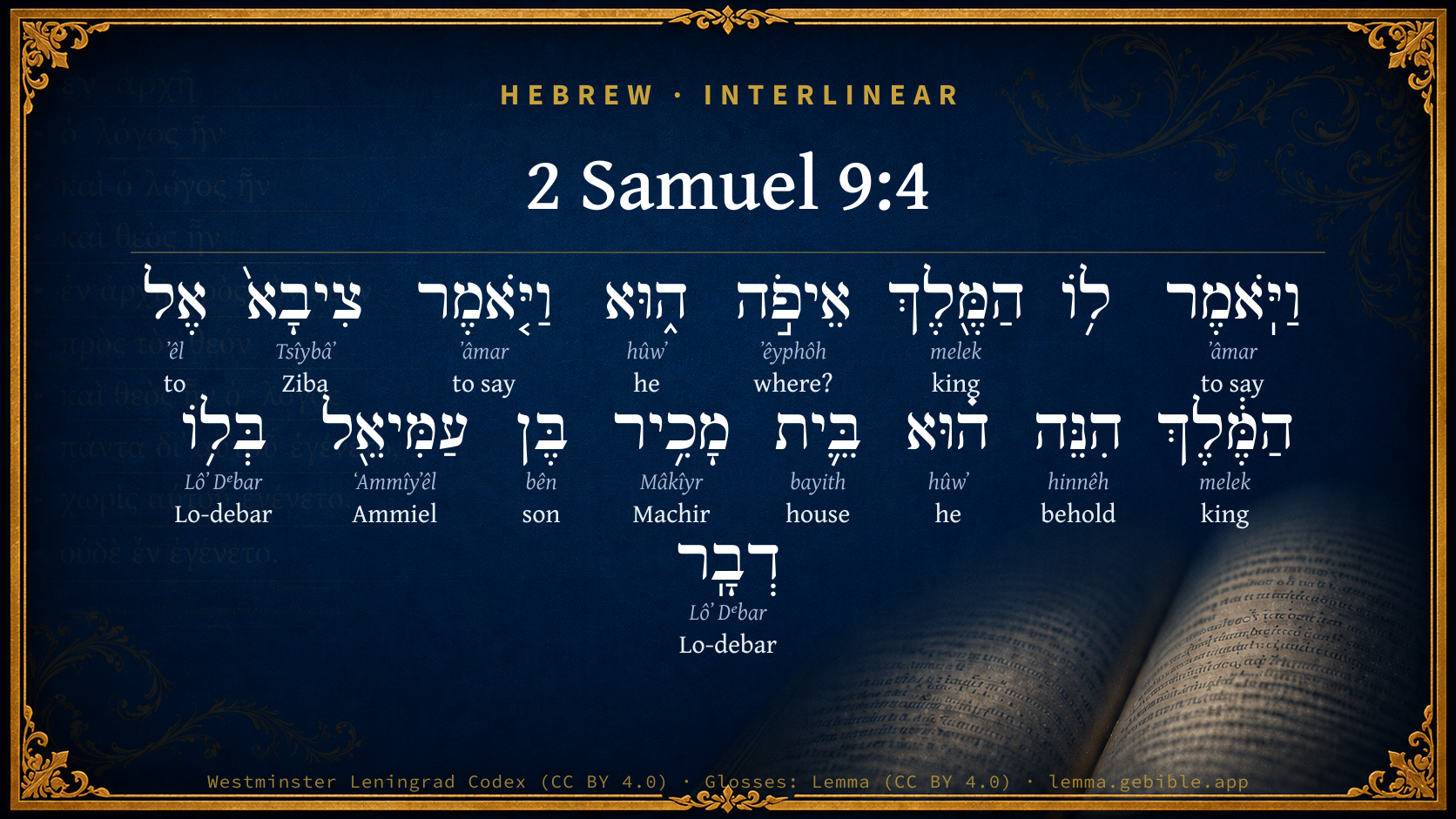
2 Samuel 9:4

Hebrew (Westminster Leningrad Codex) 2 Samuel 9:4 appears in the Hebrew Old Testament. The text above is from the Westminster Leningrad Codex. Each word links to its Strong’s number, a concise gloss, and parsing drawn from the Open Scriptures Hebrew Bible morphology. Click any word for its full Brown-Driver-Briggs (BDB) entry.
Download image
Cite this verse

2 Samuel 9:4 (World English Bible). Public Domain. Lemma interlinear Bible study tool, https://lemma.gebible.app/v/2-samuel/9/4.

Show BibTeX & RIS
BibTeX
RIS
English Translation
The king said to him, Where is he? Ziba said to the king, Behold, he is in the house of Machir the son of Ammiel, in Lo Debar.
World English Bible · Public Domain
Highlights
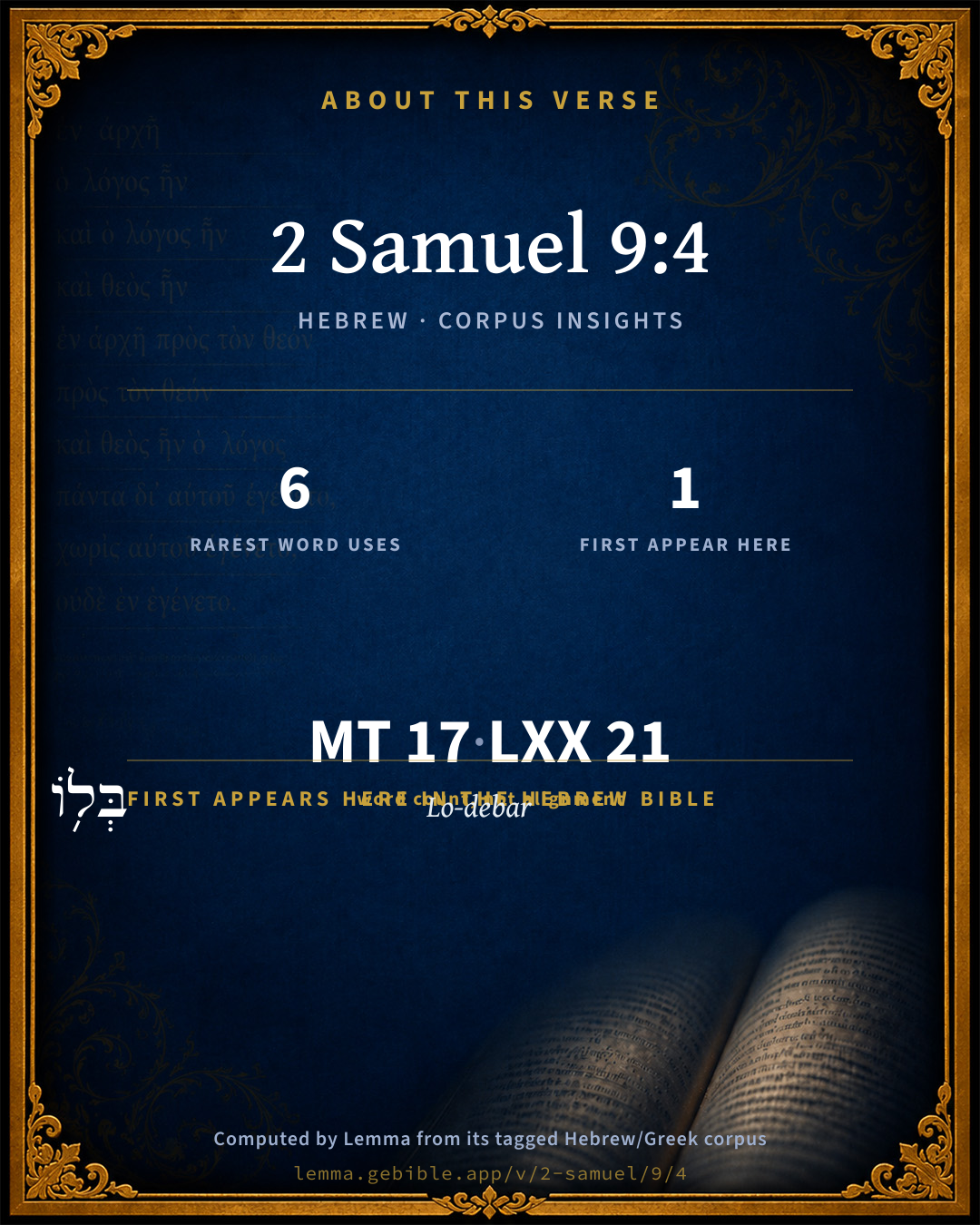
  • 1 first appearance in the Hebrew Bible
Full analysis ↓
Download a study sheet

One document with this verse’s original text, its word-by-word gloss line, the meaning frame, cross-references with their text, attributed commentary, and full source and license credits — printable, and it pastes into notes with its structure intact.

This verse Autodidact and up

Study sheet (.html) Plain text (.txt)

A passage Seminary Student

Up to 50 verses in one chapter. A passage sheet keeps up to 6 commentary sources and 12 cross-references per verse, in the order this page ranks them, and says so on the sheet whenever that leaves anything out. Ask for a single verse and you get the Autodidact verse sheet above.

Everything on this page stays free to read, with no account — the sheet is a download of what is already on screen, not access to it.

Want to remove ads? Support Godless Engineer
Compare translations 3

The same verse in 3 English versions, stacked beneath the original-language interlinear above. Click any original word for its lexicon entry.

Each is an independent rendering of the whole verse — the interlinear is not word-aligned to these translations.

Highlighted words mark where these versions differ — a whole-verse word diff, not a word-by-word alignment.

  • World English Bible Public Domain
    The king said to him, Where is he? Ziba said to the king, Behold, he is in the house of Machir the son of Ammiel, in Lo Debar.
  • King James Version Public Domain
    And the king said unto him, Where is he? And Ziba said unto the king, Behold, he is in the house of Machir, the son of Ammiel, in Lodebar.
  • unfoldingWord Literal Text CC BY-SA 4.0
    And the king said to him, “Where he?” And Ziba said to the king, “Behold, he the house of Machir, the son of Ammiel, in Lo-Debar.”

unfoldingWord Literal Text — © unfoldingWord, licensed CC BY-SA 4.0. Word-aligned USFM3 via Door43 (git.door43.org/unfoldingWord/en_ult).

Versions to compare (up to 4)

3 of 4 selected

Show all 18 translations

Every available English version of this verse, each an independent rendering of the whole verse.

  • World English Bible Public Domain
    The king said to him, Where is he? Ziba said to the king, Behold, he is in the house of Machir the son of Ammiel, in Lo Debar.
  • Berean Standard Bible Public Domain
    “Where is he?” replied the king. And Ziba said, “Indeed, he is in Lo-debar at the house of Machir son of Ammiel.”
  • Majority Standard Bible Public Domain
    “Where is he?” replied the king. And Ziba said, “Indeed, he is in Lo-debar at the house of Machir son of Ammiel.”
  • King James Version Public Domain
    And the king said unto him, Where is he? And Ziba said unto the king, Behold, he is in the house of Machir, the son of Ammiel, in Lodebar.
  • American Standard Version (1901) Public Domain
    And the king said unto him, Where is he? And Ziba said unto the king, Behold, he is in the house of Machir the son of Ammiel, in Lo-debar.
  • Revised Version (1885) Public Domain
    And the king said unto him, Where is he? And Ziba said unto the king, Behold, he is in the house of Machir the son of Ammiel, in Lo-debar.
  • Geneva Bible (1599) Public Domain
    Then the King said vnto him, Where is he? And Ziba said vnto the King, Behold, he is in the house of Machir ye sonne of Ammiel of Lo-debar.
  • Douay-Rheims (1899) Public Domain
    Where is he? said he. And Siba said to the king: Behold he is in the house of Machir the son of Ammiel in Lodabar.
  • Young's Literal Translation Public Domain
    And the king saith to him, `Where `is' he?' and Ziba saith unto the king, `Lo, he `is' in the house of Machir, son of Ammiel, in Lo-Debar.'
  • Literal Standard Version CC BY-SA 4.0
    And the king says to him, “Where [is] he?” And Ziba says to the king, “Behold, he [is] in the house of Machir, son of Ammiel, in Behold-Debar.”
  • Unlocked Literal Bible CC BY-SA 4.0
    The king said to him, “Where is he?” Ziba replied to the king, “Look, he is in the house of Machir son of Ammiel in Lo Debar.”
  • unfoldingWord Literal Text CC BY-SA 4.0
    And the king said to him, “Where he?” And Ziba said to the king, “Behold, he the house of Machir, the son of Ammiel, in Lo-Debar.”
  • Darby Bible Public Domain
    And the king said to him, Where is he? And Ziba said to the king, Behold, he is in the house of Machir the son of Ammiel, in Lodebar.
  • World Messianic Bible Public Domain
    The king said to him, “Where is he?” Ziba said to the king, “Behold, he is in the house of Machir the son of Ammiel, in Lo Debar.”
  • Webster's Bible Public Domain
    And the king said to him, Where is he? And Ziba said to the king, Behold, he is in the house of Machir, the son of Ammiel, in Lo-debar.
  • Free Bible Version CC BY-SA 4.0
    “Where is he?” asked the king. “He's in the town of Lo-debar, living in the home of Machir, son of Ammiel,” Ziba replied.
  • Bible in Basic English Public Domain
    And the king said to him, Where is he? And Ziba said to the king, He is in the house of Machir, the son of Ammiel, in Lo-debar.
  • JPS Tanakh (1917) Public Domain
    And the king said unto him: 'Where is he?' And Ziba said unto the king: 'Behold, he is in the house of Machir the son of Ammiel, in Lo-debar.'

Literal Standard Version (2020), Covenant Press — licensed CC BY-SA 4.0. Text via the HelloAO Bible API (eBible.org). Unlocked Literal Bible (unfoldingWord) — licensed CC BY-SA 4.0. Text via the HelloAO Bible API (eBible.org). unfoldingWord Literal Text — © unfoldingWord, licensed CC BY-SA 4.0. Word-aligned USFM3 via Door43 (git.door43.org/unfoldingWord/en_ult). Free Bible Version, Dr. Jonathan Gallagher — licensed CC BY-SA 4.0. Text via the HelloAO Bible API (eBible.org).

Word by word

More ways to search: Search by grammar → Find every occurrence → Compare this word →

Practice this passage: Drill this verse → Learn its vocabulary →

עַמִּיאֵ֖ל
ʻAmmîyʼêl
H5988
“Ammiel”
Noun, Proper
Part of Speech
Noun
Type
Proper
Full BDB Definition

Origin: from H5971 and H410

TWOT: None

Ammiel = "my kinsman is God" - the spy from the tribe of Dan who perished in the plague for his evil report - father of Machir of Lo-debar - father of Bathsheba; also 'Eliam' - the 6th son of Obed-edom and doorkeeper of the temple
  1. וַיֹּֽאמֶר ʼâmar H559 “and · to say” Conjunction + Verb, Qal, Sequential Imperfect, 3rd Person, Masculine, Singular
  2. הַמֶּ֖לֶךְ melek H4428 “the · king” Particle, Definite Article + Noun, Common, Masculine, Singular, Absolute
  3. אֵיפֹ֣ה ʼêyphôh H375 “where?” Particle, Interrogative
  4. ה֑וּא hûwʼ H1931 “he” Pronoun, Personal, 3rd Person, Masculine, Singular
  5. וַיֹּ֤אמֶר ʼâmar H559 “and · to say” Conjunction + Verb, Qal, Sequential Imperfect, 3rd Person, Masculine, Singular
  6. צִיבָא֙ Tsîybâʼ H6717 “Ziba” Noun, Proper
  7. אֶל ʼêl H413 “to” Preposition
  8. הַמֶּ֔לֶךְ melek H4428 “the · king” Particle, Definite Article + Noun, Common, Masculine, Singular, Absolute
  9. הִנֵּה hinnêh H2009 “behold” Particle, Demonstrative
  10. ה֗וּא hûwʼ H1931 “he” Pronoun, Personal, 3rd Person, Masculine, Singular
  11. בֵּ֛ית bayith H1004 “house of” Noun, Common, Masculine, Singular, Construct
  12. מָכִ֥יר Mâkîyr H4353 “Machir” Noun, Proper
  13. בֶּן bên H1121 “son of” Noun, Common, Masculine, Singular, Construct
  14. בְּל֥וֹ Lôʼ Dᵉbar H3810 “in/at · Lo-debar” Preposition + Noun, Proper
  15. דְבָֽר Lôʼ Dᵉbar H3810 “Lo-debar” Noun, Proper

About this verse

These counts appear in no published source. They are computed here, from the morphology-tagged text and Lemma’s own curated glosses. What Lemma adds →

17
words
12
distinct lemmas
Historical
section

Notable vocabulary

The rarest word here is עַמִּיאֵ֖ל Ammiel H5988 — appearing just 6 times in the whole Hebrew Bible.

First appearance in Scripture

This word makes its first canonical appearance in the Hebrew Bible here:

  • בְּל֥וֹ Lo-debar H3810

Shared distinctive vocabulary

עַמִּיאֵ֖ל Ammiel H5988 occurs in 6 verses of the Hebrew Bible. Also found in:

Grammatical profile

  • 2 verbs
  • 9 nouns
  • 2 pronouns
  • 2 prepositions
  • 2 particles

Verb forms

  • וַיֹּֽאמֶר Qal · Sequential Imperfect
  • וַיֹּ֤אמֶר Qal · Sequential Imperfect

Repetition

Words recur within this verse — often emphatic in Hebrew:

  • וַיֹּֽאמֶר to say H559 ×2
  • הַמֶּ֖לֶךְ king H4428 ×2
  • בְּל֥וֹ Lo-debar H3810 ×2
  • ה֑וּא he H1931 ×2

Hebrew & Septuagint length

In English translation the verse runs 28 words from the Hebrew and 27 from the Septuagint (LXX English) — closely comparable.

A rough comparison of the two English renderings, which tokenize alike — not a word-level alignment.

Word counts can differ between the Hebrew and the Greek without any difference in meaning — e.g. the Hebrew direct-object marker אֵת has no separate Greek word, and Greek often adds the article ὁ.

In the original languages it is 17 Hebrew tokens and 21 Greek tokens — but the two are counted differently (Hebrew bundles its prefixes and suffixes into one token; the Greek is in lemma form), so that isn’t a like-for-like length.

Cross-references

1

Topical passages linked to 2 Samuel 9:4 in the Treasury of Scripture Knowledge — connected by theme and wording, ordered by reader-vote popularity; previews shown in the World English Bible.

  • 2 Samuel 17:27–29 It happened, when David was come to Mahanaim, that Shobi the son of Nahash of Rabbah of the children of Ammon, and Machir the son of Ammiel of Lodebar, and Barzillai the Gileadite of Rogelim,

Cross-references courtesy of OpenBible.info (CC BY 4.0).

Hebrew and Greek witnesses Masoretic Hebrew ↔ Greek Septuagint

The same verse in the two great witnesses to the Old Testament, shown verse-for-verse.

These are two independent witnesses, not word-aligned to each other, and the Septuagint is shown in lemma (dictionary) form.

Hebrew 2 Samuel 9:4 Masoretic · Westminster Leningrad Codex

וַיֹּֽאמֶר ל֥וֹ הַמֶּ֖לֶךְ אֵיפֹ֣ה ה֑וּא וַיֹּ֤אמֶר צִיבָא֙ אֶל הַמֶּ֔לֶךְ הִנֵּה ה֗וּא בֵּ֛ית מָכִ֥יר בֶּן עַמִּיאֵ֖ל בְּל֥וֹ דְבָֽר

The king said to him, Where is he? Ziba said to the king, Behold, he is in the house of Machir the son of Ammiel, in Lo Debar.

World English Bible · Public Domain

Greek LXX 2 Samuel 9:4 Septuagint · lemma form

καί εἶπον ὁ βασιλεύς ποῦ οὗτος καί εἶπον σιβα πρός ὁ βασιλεύς ἰδού ἐν οἶκος μαχιρ υἱός αμιηλ ἐκ ὁ λαδαβαρ

And the king said, Where is he? and Siba said to the king, Behold, he is in the house of Machir the son of Amiel of Lodabar.

LXX2012 (modern English Septuagint) · Public Domain

Hebrew: Westminster Leningrad Codex (CC BY 4.0). Greek: Septuagint (public domain); English from LXX2012 (modern English Septuagint) (Public Domain). How the Septuagint differs from the Hebrew →

Targum (Aramaic paraphrase)

1

The Targum is the ancient Jewish Aramaic paraphrase of the Hebrew Scriptures — an interpretive translation, not the Hebrew text itself. Onkelos (literal) and Pseudo-Jonathan (expansive) render the Torah, and Jonathan the Prophets. Coverage is partial: where no permissively-licensed English translation exists for a verse, only the Aramaic is shown. This is verse-level text, not a word-by-word alignment to the Hebrew.

  1. Targum Jonathan Prophets (Joshua–Malachi)
    וַאֲמַר לֵיהּ מַלְכָּא הֵיכָא הוּא וַאֲמַר צִיבָא לְמַלְכָּא הָא הוּא בֵּית מָכִיר בַּר עַמִיאֵל בְּלוֹ דְבָר:

    (no public-domain English translation for this verse)

    Targum Jonathan — Aramaic: “Mikraot Gedolot” (public domain). English: “Sefaria Community Translation” (CC0 1.0 (public-domain dedication)); “London "Chaldee Paraphrase," 1871” (public domain). Text via Sefaria.

Commentary

Notes on 2 Samuel 9:4 from classic Christian and Jewish commentators (each source and its license shown beneath its notes). The classic Christian expositions comment on the surrounding passage and are grouped to its opening verse, so a note may address several verses; the Jewish commentaries on the Tanakh (Rashi and others) are per-verse, so they appear only where the commentator wrote on this verse.

Lemma curates 59 commentaries, every one of them public domain or Creative Commons licensed, each selected and text-cleaned for this edition rather than reprinted as found. About our sources →

Trapp's Complete Commentary

John Trapp

2Sa 9:4 And the king said unto him, Where [is] he? And Ziba said unto the king, Behold, he [is] in the house of Machir, the son of Ammiel, in Lodebar.

Ver. 4. Behold, he is in the house of Machir … in Lodebar.] Which was a place beyond Jordan. {2Sa 17:27} Here, in a remote part of the country, Mephibosheth secreted and secured himself; little thinking of any court preferment, which yet God was now providing for him: his motto might be,

“ Crede mihi bene qui latuit, bene vixit ”

John Trapp, A Commentary or Exposition upon All the Books of the Old and New Testament (1647–1656) — public domain. Text from a community e-Sword module.

Joseph Benson's Commentary

2Sa 9:4. He is in the house of Machir — This Machir appears to have been a generous man, who entertained Mephibosheth out of mere compassion, not of disaffection to David: for afterward we find him kind to David himself, when he fled from Absalom. David now little thought that the time would come when he himself should need his assistance. Let us be forward to give, because we know not what we ourselves may some time want.

Joseph Benson's Commentary on the Old and New Testaments (1811–1818) — public domain. Text from a community e-Sword module.

Tyndale Open Study Notes

Tyndale Open Resources

9:4 Lo-debar was a small town in northern Transjordan (the area east of the Jordan), close to Mahanaim, the capital city of Mephibosheth’s late uncle, Ishbosheth. The town was also near Jabesh-gilead, where Saul first made a name for himself (1 Sam 11:1-13). • Makir son of Ammiel, Mephibosheth’s host, later supported David during Absalom’s revolt (2 Sam 17:27).

Tyndale Open Study Notes — © Tyndale Open Resources, licensed CC BY-SA 4.0. Text via the HelloAO Bible API.

Adam Clarke's Commentary

Verse 4. Lo-debar.] Supposed to have been situated beyond Jordan; but there is nothing certain known concerning it.

Adam Clarke's Commentary on the Bible (1810–1826) — public domain. Text from a community e-Sword/MySword module.

John Gill's Exposition

And the king said unto him, where is he?.... In what part of the land, city, or town, does he dwell?

and Ziba said unto the king, behold, he is in the house of Machir,

the son of Ammiel; a descendant of Machir, the son of Manasseh, to whom the land of Gilead was given, which lay on the other side Jordan:

in Lodebar; a place in that country, perhaps the same with Debir in Jos 13:26. Here it may be his mother's relations lived, and here he might dwell in obscurity, and lie hid from the knowledge of David; who, it might be feared by his friends, would have dispatched him, had he known where he was. Some take it to be an appellative, and render it, as Abarbinel observes, "without anything"; as if he was so poor that he had not anything to support himself with. No mention as yet is made of his name, perhaps because the historian had given it before, Sa2 4:4.

John Gill's Exposition of the Whole Bible (1746–1763) — public domain (CC PDM 1.0). Text via the HelloAO Bible API.

Albert Barnes' Notes on the Bible

David reaped the fruit of his kindness to Mephibosheth, for, when he fled from Absalom, Machir, the son of Ammiel, was one of those who were most liberal in providing him and his army with necessaries (marginal reference). According to 1Ch 3:5, Ammiel (called inversely Eliam, 2Sa 11:3) was the father of Bath-sheba. If this be the same Ammiel, Machir would be Bath-sheba’s brother. However, the name is not a very uncommon one (Num 13:12; 1Ch 26:5, etc.).

Lo-debar - Evidently on the east of Jordan River, and in the neighborhood of Ish-bosheth’s capital, Mahanaim 2Sa 17:27, but not identified by any modern traveler. Thought by some, not improbably, to be the same as Debir Jos 13:26.

Albert Barnes' Notes on the Bible (1834–1885) — public domain. Text from a community e-Sword/MySword module.

Haydock's Catholic Bible Commentary

Lodabar, probably on the east side of the Jordan. (Calmet) --- Machir was a powerful man of the tribe of Manasses. (Menochius)

George Leo Haydock (1774–1849), Haydock's Catholic Family Bible and Commentary, 1859 edition — public domain. Excludes Psalms (Douay-Rheims chapter numbering differs from Protestant) and Deuterocanonical books (Catholic canon only).

Matthew Poole's English Annotations

In a place beyond Jordan, 2Sa 17:27, where his friends thought he might be kept out of David’s sight.

Matthew Poole's English Annotations on the Holy Bible (1683–1685) — public domain. Text from a community e-Sword/MySword module.

Whedon's Commentary on the Bible

Daniel D. Whedon

4. Machir — Josephus calls him “the principal man of Gilead.” He also showed kindness to David when he fled from Absalom. 2Sa_17:27.

Lodebar — A town of Gilead, not far from Mahanaim, and probably identical with Debir of Jos_13:26. Its site is unknown.

Daniel D. Whedon (gen. ed.), Commentary on the Old and New Testaments (1874–1909) — public domain. Text from a community e-Sword module.

The Pulpit Commentary

Machir, the son of Ammiel, in Lo-debar. Of Lo-debar nothing is known, but it must have been east of the Jordan, near Mahanaim. Of Ammiel we read again in 2Sa_17:27, where we find that he was a man of wealth, who helped to supply the wants of David and his men during the rebellion of Absalom. Possibly this kindness of David towards one for whom he had feelings of loyalty, as representing a royal house to which he had remained faithful, won his heart. There was a magnanimity about it which would commend it to a man who was himself generous and true.

Ver. 4. (GILEAD.)

The kindness of Machir Ben-Ammiel.

One of the obscure characters of Scripture. He dwelt at Lo-debar, among the mountains of Gilead, "a favourite asylum for refugees;" was, probably, a descendant of Machir the son of Manasseh; and "the principal man of Gilead" (Josephus). Of his generosity two notable instances are recorded (ch. 4:4; 17:27). From these it may be inferred that he was rich in earthly possessions, and (what is of much greater importance) in:

1. Grateful memories. Like the men of Jabesh-Gilead, he remembered the heroic enterprise of Saul on behalf of his people. (1Sa_11:9 1Sa_31:1 1Ch_2:4-7)

But, O Saul, do not fail us. Saul. Fail ye? Let the morn fail to break; I will not break My word. Haste, or I"m there before you. Fail? Let the morn fail in the east; I"ll not fail you; But swift and silent as the streaming wind, Unseen approach, then gathering up my force At dawning, sweep on Amnon, as night"s blast Sweeps down from Carmel on the dusky sea. (C. Heavysege, "Saul: a Drama. )

Hence he afforded ready shelter and hospitality to his grandson, and may have assisted the revival of his house at Mahanaim; (2Sa_2:8) and when, subsequently, David was in exile at the same place, remembering his kindness to Mephibosheth, rendered him generous aid.

1. Tender compassion toward the orphan, unfortunate add friendless. The sight of human distress drew forth his sympathy; and (like the good Samaritan) he suffered no other considerations to hinder its practical expression.

2. Constant friendship. During many years (ver. 12), with all their changes, he provided, apparently "without fee or reward," a peaceful home for the crippled prince, and continued his steadfast protector.

3. Active benevolence. He was "rich in good works". (1Ti_6:18) Sensibility, as the word is generally used, is a mere animal instinct, useless when it does not immediately lead to active benevolence; and in such cases not only useless, but pernicious, because it has a tendency to produce a resting satisfied with the emotion and a neglect of the action" (W. Cooke Taylor).

4. Beneficent influence. His conduct could not but produce a good effect on the rude, warlike tribe of which he was chief; and possibly incited others (Shobi and Barzillai) to the like.

Great deeds cannot die: They with the sun and moon renew their light Forever, blessing those that look on them. (Tennyson. )

5. Noble recompense. "The blessing of him that was ready to perish", (Job_29:13) the approval of his own conscience, the enduring memorial of a good name. Although (like that of Abou Ben-Adhem) his name has not been written in the sacred record among "the names of those who love the Lord," but only "as one that loves his fellow men," it could not fail of being divinely honoured.

The angel wrote, and vanished. The next night It came again, with a great wakening light, And show"d the names whom love of God had bless"d, And lo! Ben-Adhem"s name led all the rest. (Leigh Hunt. )

D.

The Pulpit Commentary (1880–1919), ed. H.D.M. Spence-Jones & Joseph S. Exell — public domain. Text from a community e-Sword module.

Lesson kit

Teaching starters — assembled from the data on this page, not authored interpretation. Every prompt links to the verse data it draws on. Edit before teaching.

2 Samuel, in the Historical, opens this verse with 17 words (12 distinct Hebrew lemmas). Its most distinctive word is ʻAmmîyʼêl (“Ammiel”). A historical commentator’s framing appears above. Read the whole chapter for the surrounding context.

Discussion questions

  1. What does “Ammiel” (ʻAmmîyʼêl) contribute to the verse as a whole?
  2. The word “Lo-debar” first appears here in Scripture. What is being introduced at this debut?
  3. Numbers 13:12 shares the word «Ammiel» with this verse. How do the two illuminate each other?
  4. “to say” occurs 2× in this one verse. What is the effect of the repetition?
  5. These translations render this verse differently. What is at stake in choosing one wording over another?
  6. The verb «וַיֹּֽאמֶר» is Qal Sequential Imperfect. How does its form color the action?
  7. Reading how Trapp's Complete Commentary and Joseph Benson's Commentary read this verse, where do the two commentators agree and where do they part?

Things to notice

Reading settings

Reading text

Shown beneath each verse's original-language words.

Old Testament
Old Testament edition

Read the OT as the Masoretic Hebrew (MT) or the Greek Septuagint (LXX).

English shown for the Greek Septuagint (in the Hebrew ↔ Greek comparison).

Comparing translations? Open the Compare panel on any verse page to stack up to four side by side.