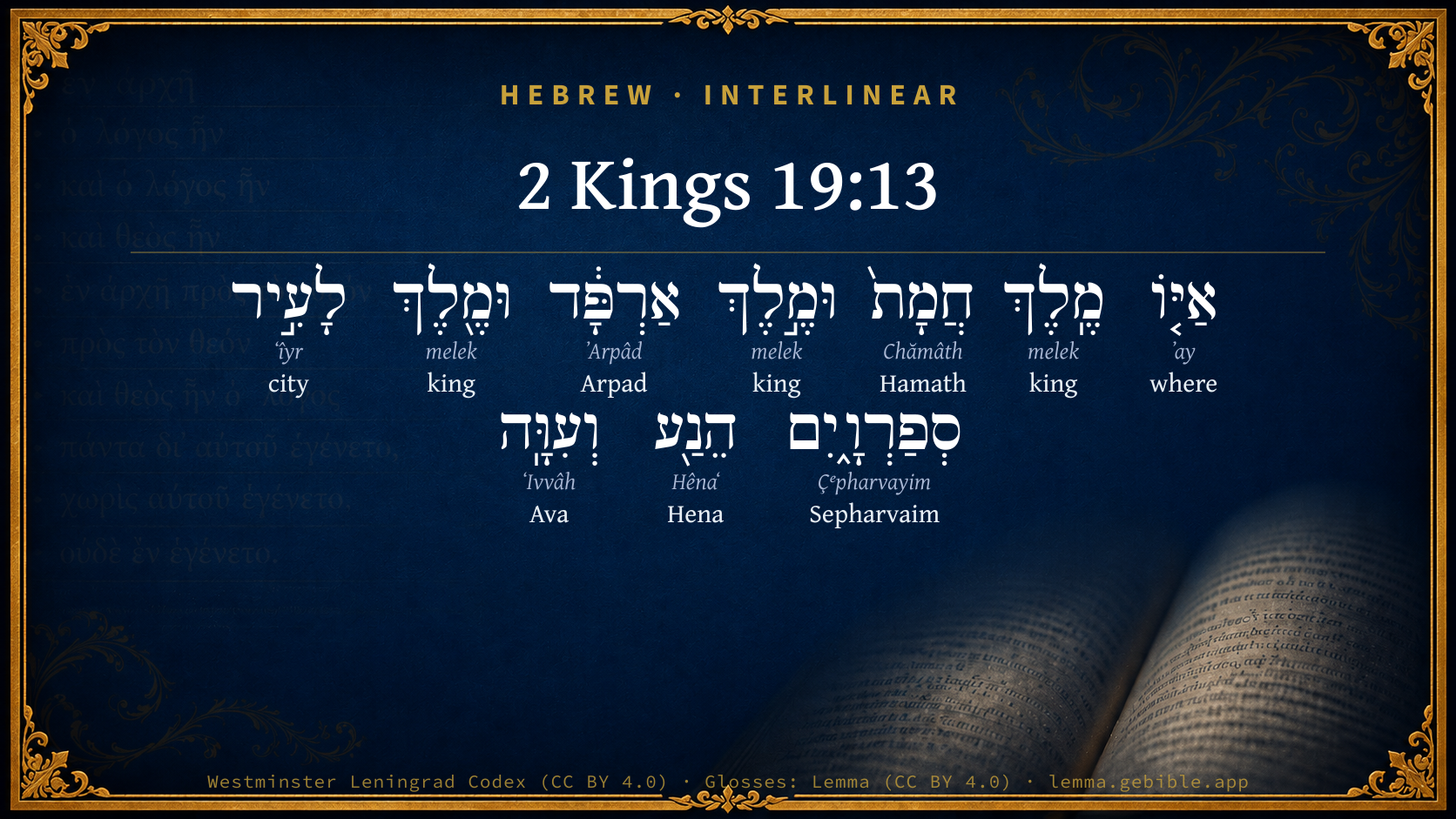
2 Kings 19:13

Hebrew (Westminster Leningrad Codex) 2 Kings 19:13 appears in the Hebrew Old Testament. The text above is from the Westminster Leningrad Codex. Each word links to its Strong’s number, a concise gloss, and parsing drawn from the Open Scriptures Hebrew Bible morphology. Click any word for its full Brown-Driver-Briggs (BDB) entry.
Download image
Cite this verse

2 Kings 19:13 (World English Bible). Public Domain. Lemma interlinear Bible study tool, https://lemma.gebible.app/v/2-kings/19/13.

Show BibTeX & RIS
BibTeX
RIS
English Translation
Where is the king of Hamath, and the king of Arpad, and the king of the city of Sepharvaim, of Hena, and Ivvah?
World English Bible · Public Domain
Download a study sheet

One document with this verse’s original text, its word-by-word gloss line, the meaning frame, cross-references with their text, attributed commentary, and full source and license credits — printable, and it pastes into notes with its structure intact.

This verse Autodidact and up

Study sheet (.html) Plain text (.txt)

A passage Seminary Student

Up to 50 verses in one chapter. A passage sheet keeps up to 6 commentary sources and 12 cross-references per verse, in the order this page ranks them, and says so on the sheet whenever that leaves anything out. Ask for a single verse and you get the Autodidact verse sheet above.

Everything on this page stays free to read, with no account — the sheet is a download of what is already on screen, not access to it.

Want to remove ads? Support Godless Engineer
Compare translations 3

The same verse in 3 English versions, stacked beneath the original-language interlinear above. Click any original word for its lexicon entry.

Each is an independent rendering of the whole verse — the interlinear is not word-aligned to these translations.

Highlighted words mark where these versions differ — a whole-verse word diff, not a word-by-word alignment.

  • World English Bible Public Domain
    Where is the king of Hamath, and the king of Arpad, and the king of the city of Sepharvaim, of Hena, and Ivvah?
  • King James Version Public Domain
    Where is the king of Hamath, and the king of Arpad, and the king of the city of Sepharvaim, of Hena, and Ivah?
  • unfoldingWord Literal Text CC BY-SA 4.0
    Where the king of Hamath or the king of Arpad or the king of the city of Sepharvaim, Hena, or Ivvah?’”

unfoldingWord Literal Text — © unfoldingWord, licensed CC BY-SA 4.0. Word-aligned USFM3 via Door43 (git.door43.org/unfoldingWord/en_ult).

Versions to compare (up to 4)

3 of 4 selected

Show all 18 translations

Every available English version of this verse, each an independent rendering of the whole verse.

  • World English Bible Public Domain
    Where is the king of Hamath, and the king of Arpad, and the king of the city of Sepharvaim, of Hena, and Ivvah?
  • Berean Standard Bible Public Domain
    Where are the kings of Hamath, Arpad, Sepharvaim, Hena, and Ivvah?’”
  • Majority Standard Bible Public Domain
    Where are the kings of Hamath, Arpad, Sepharvaim, Hena, and Ivvah?’”
  • King James Version Public Domain
    Where is the king of Hamath, and the king of Arpad, and the king of the city of Sepharvaim, of Hena, and Ivah?
  • American Standard Version (1901) Public Domain
    Where is the king of Hamath, and the king of Arpad, and the king of the city of Sepharvaim, of Hena, and Ivvah?
  • Revised Version (1885) Public Domain
    Where is the king of Hamath, and the king of Arpad, and the king of the city of Sepharvaim, of Hena, and Ivvah?
  • Geneva Bible (1599) Public Domain
    Where is the King of Hamath, and the King of Arpad, and the King of the citie of Shepharuaim, Hena and Iuah?
  • Douay-Rheims (1899) Public Domain
    Where is the king of Emath, and the king of Arphad, and the king of the city of Sepharvaim, of Ana and of Ava?
  • Young's Literal Translation Public Domain
    Where `is' the king of Hamath, and the king of Arpad, and the king of the city of Sepharvaim, Hena, and Ivvah?'
  • Literal Standard Version CC BY-SA 4.0
    Where [is] the king of Hamath, and the king of Arpad, and the king of the city of Sepharvaim, Hena, and Ivvah?”
  • Unlocked Literal Bible CC BY-SA 4.0
    Where are the king of Hamath, the king of Arpad, the king of the cities of Sepharvaim, of Hena, and Ivvah?'”
  • unfoldingWord Literal Text CC BY-SA 4.0
    Where the king of Hamath or the king of Arpad or the king of the city of Sepharvaim, Hena, or Ivvah?’”
  • Darby Bible Public Domain
    Where is the king of Hamath, and the king of Arpad, and the king of the city of Sepharvaim, of Hena, and Ivvah?
  • World Messianic Bible Public Domain
    Where is the king of Hamath, the king of Arpad, and the king of the city of Sepharvaim, of Hena, and Ivvah?’”
  • Webster's Bible Public Domain
    Where is the king of Hamath, and the king of Arpad, and the king of the city of Sepharvaim, of Hena, and Ivah?
  • Free Bible Version CC BY-SA 4.0
    Where today is the king of Hamath, the king of Arpad, the king of the city of Sepharvaim, the king of Hena, or the king of Ivvah?’”
  • Bible in Basic English Public Domain
    Where is the king of Hamath, and the king of Arpad, and the king of the town of Sepharvaim, of Hena and of Ivvah?
  • JPS Tanakh (1917) Public Domain
    Where is the king of Hamath, and the king of Arpad, and the king of the city of Sepharvaim, of Hena, and Ivvah?'

Literal Standard Version (2020), Covenant Press — licensed CC BY-SA 4.0. Text via the HelloAO Bible API (eBible.org). Unlocked Literal Bible (unfoldingWord) — licensed CC BY-SA 4.0. Text via the HelloAO Bible API (eBible.org). unfoldingWord Literal Text — © unfoldingWord, licensed CC BY-SA 4.0. Word-aligned USFM3 via Door43 (git.door43.org/unfoldingWord/en_ult). Free Bible Version, Dr. Jonathan Gallagher — licensed CC BY-SA 4.0. Text via the HelloAO Bible API (eBible.org).

Word by word

More ways to search: Search by grammar → Find every occurrence → Compare this word →

Practice this passage: Drill this verse → Learn its vocabulary →

About this verse

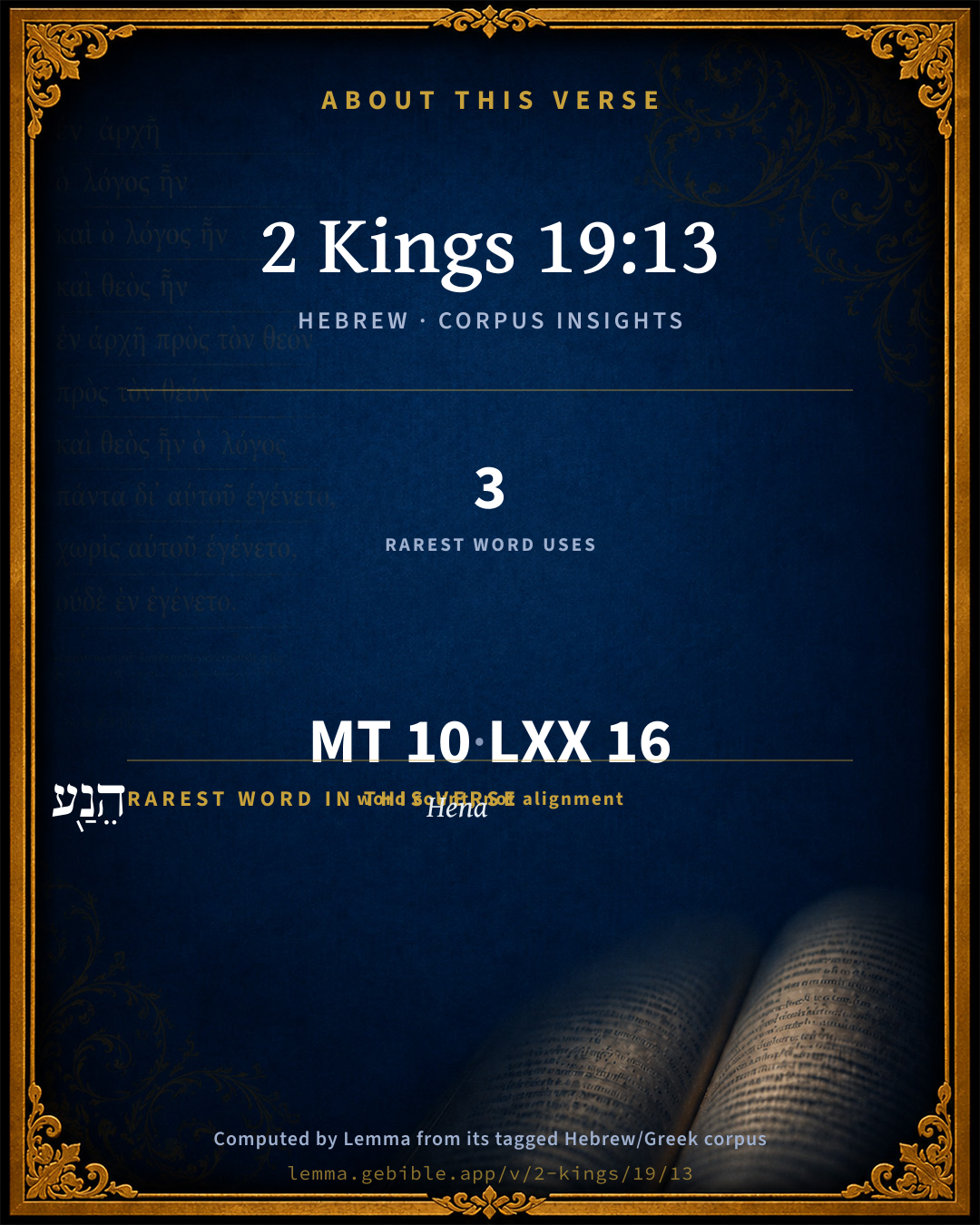
These counts appear in no published source. They are computed here, from the morphology-tagged text and Lemma’s own curated glosses. What Lemma adds →

10
words
8
distinct lemmas
Historical
section

Notable vocabulary

The rarest word here is הֵנַ֖ע Hena H2012 — appearing just 3 times in the whole Hebrew Bible.

Shared distinctive vocabulary

הֵנַ֖ע Hena H2012 occurs in 3 verses of the Hebrew Bible. Also found in:

Grammatical profile

  • 9 nouns
  • 1 particle

Repetition

A word recurs within this verse — often emphatic in Hebrew:

  • מֶֽלֶךְ king H4428 ×3

Hebrew & Septuagint length

In English translation the verse runs 23 words from the Hebrew and 25 from the Septuagint (LXX English) — closely comparable.

A rough comparison of the two English renderings, which tokenize alike — not a word-level alignment.

Word counts can differ between the Hebrew and the Greek without any difference in meaning — e.g. the Hebrew direct-object marker אֵת has no separate Greek word, and Greek often adds the article ὁ.

In the original languages it is 10 Hebrew tokens and 16 Greek tokens — but the two are counted differently (Hebrew bundles its prefixes and suffixes into one token; the Greek is in lemma form), so that isn’t a like-for-like length.

Cross-references

9

Topical passages linked to 2 Kings 19:13 in the Treasury of Scripture Knowledge — connected by theme and wording, ordered by reader-vote popularity; previews shown in the World English Bible.

  • 2 Kings 18:34 Where are the gods of Hamath, and of Arpad? where are the gods of Sepharvaim, of Hena, and Ivvah? have they delivered Samaria out of my hand?
  • Numbers 13:21 So they went up, and spied out the land from the wilderness of Zin to Rehob, to the entrance of Hamath.
  • Numbers 34:8 from Mount Hor you shall mark out to the entrance of Hamath; and the goings out of the border shall be at Zedad;
  • 2 Kings 17:24 The king of Assyria brought men from Babylon, and from Cuthah, and from Avva, and from Hamath and Sepharvaim, and placed them in the cities of Samaria instead of the children of Israel; and they possessed Samaria, and lived in the cities of it.
  • Isaiah 11:11 It shall happen in that day, that the Lord will set his hand again the second time to recover the remnant of his people, who shall remain, from Assyria, and from Egypt, and from Pathros, and from Cush, and from Elam, and from Shinar, and from Hamath, and from the islands of the sea.
  • Isaiah 37:13–20 Where is the king of Hamath, and the king of Arpad, and the king of the city of Sepharvaim, of Hena, and Ivvah?
  • Jeremiah 39:5 But the army of the Chaldeans pursued after them, and overtook Zedekiah in the plains of Jericho: and when they had taken him, they brought him up to Nebuchadrezzar king of Babylon to Riblah in the land of Hamath; and he gave judgment on him.
  • Jeremiah 49:23 Of Damascus. Hamath is confounded, and Arpad; for they have heard evil news, they are melted away: there is sorrow on the sea; it can't be quiet.
  • Zechariah 9:2 And Hamath, also, which borders on it; Tyre and Sidon, because they are very wise.

Cross-references courtesy of OpenBible.info (CC BY 4.0).

Hebrew and Greek witnesses Masoretic Hebrew ↔ Greek Septuagint

The same verse in the two great witnesses to the Old Testament, shown verse-for-verse.

These are two independent witnesses, not word-aligned to each other, and the Septuagint is shown in lemma (dictionary) form.

Hebrew 2 Kings 19:13 Masoretic · Westminster Leningrad Codex

אַיּ֤וֹ מֶֽלֶךְ חֲמָת֙ וּמֶ֣לֶךְ אַרְפָּ֔ד וּמֶ֖לֶךְ לָעִ֣יר סְפַרְוָ֑יִם הֵנַ֖ע וְעִוָּֽה

Where is the king of Hamath, and the king of Arpad, and the king of the city of Sepharvaim, of Hena, and Ivvah?

World English Bible · Public Domain

Greek LXX 2 Kings 19:13 Septuagint · lemma form

ποῦ εἰμί ὁ βασιλεύς αιμαθ καί ὁ βασιλεύς αρφαδ καί ποῦ εἰμί σεπφαρουαιν ανα καί αυα

Where is the king of Haemath, and the king of Arphad? and where is the king of the city of Seppharvaim, of Ana, and Aba?

LXX2012 (modern English Septuagint) · Public Domain

Hebrew: Westminster Leningrad Codex (CC BY 4.0). Greek: Septuagint (public domain); English from LXX2012 (modern English Septuagint) (Public Domain). How the Septuagint differs from the Hebrew →

Targum (Aramaic paraphrase)

1

The Targum is the ancient Jewish Aramaic paraphrase of the Hebrew Scriptures — an interpretive translation, not the Hebrew text itself. Onkelos (literal) and Pseudo-Jonathan (expansive) render the Torah, and Jonathan the Prophets. Coverage is partial: where no permissively-licensed English translation exists for a verse, only the Aramaic is shown. This is verse-level text, not a word-by-word alignment to the Hebrew.

  1. Targum Jonathan Prophets (Joshua–Malachi)
    אָן מַלְכָּא דַחֲמַת וּמַלְכָּא דְאַרְפָּד וּמַלְכָּא דִלְקַרְתָּא סְפַרְוָיִם הָא טַלְטִילוּנוּן וְאַגְלִיאוּנוּן:

    (no public-domain English translation for this verse)

    Targum Jonathan — Aramaic: “Mikraot Gedolot” (public domain). English: “Sefaria Community Translation” (CC0 1.0 (public-domain dedication)); “London "Chaldee Paraphrase," 1871” (public domain). Text via Sefaria.

Commentary

Notes on 2 Kings 19:13 from classic Christian and Jewish commentators (each source and its license shown beneath its notes). The classic Christian expositions comment on the surrounding passage and are grouped to its opening verse, so a note may address several verses; the Jewish commentaries on the Tanakh (Rashi and others) are per-verse, so they appear only where the commentator wrote on this verse.

Lemma curates 59 commentaries, every one of them public domain or Creative Commons licensed, each selected and text-cleaned for this edition rather than reprinted as found. About our sources →

Trapp's Complete Commentary

John Trapp

2Ki 19:13 Where [is] the king of Hamath, and the king of Arpad, and the king of the city of Sepharvaim, of Hena, and Ivah?

Ver. 13. Where is the king of Hamath, &c.?] See 2Ki 18:33. Only there it is gods of those places, and here kings. The heathens commonly called their gods kings - as Fοιβε αναξ, βασιλευς ανδρων τε θεων τε, &c. - and they reckoned, that whatsoever their gods could do, their kings should be sure of. We have not so served the gods, said that Roman emperor, that they should serve us no better than to give the enemy the better of us. {a}

{a} Non sic deos coluimus, &c. - Antonin. Phil.

John Trapp, A Commentary or Exposition upon All the Books of the Old and New Testament (1647–1656) — public domain. Text from a community e-Sword module.

Albert Barnes' Notes on the Bible

Compare the marginal reference 2Ki 17:24. 2Ki 19:12 refers to former Assyrian successes, 2Ki 19:13 to comparatively recent ones.

Albert Barnes' Notes on the Bible (1834–1885) — public domain. Text from a community e-Sword/MySword module.

Joseph Benson's Commentary

2Ki 19:13. Where is the king of Hamath, &c. — He may mean the gods of these places, calling them their kings, because the people looked upon them as their protectors and governors, which kings are or should be to their subjects: or rather, he means their kings, properly so called. And so, as before he compared their gods with the God of Jerusalem, so now he compares their kings with King Hezekiah; and by both comparisons intends to persuade Hezekiah and his people that neither he, their king, nor their God, was able to save them out of his hand.

Joseph Benson's Commentary on the Old and New Testaments (1811–1818) — public domain. Text from a community e-Sword module.

Ellicott's Commentary for English Readers

(13) The king.—Comp. 2Ki_18:34, from which, as well as from the sequence of thought in 2Ki_19:12-13 here, it is clear that “king” is here used as a synonym of local god. (Comp. Amo_5:26; Psa_5:2 : “My King, and my God.”)

A Bible Commentary for English Readers, edited by Charles John Ellicott (1878–1897) — public domain. Text from a community e-Sword module.

The Cambridge Bible for Schools and Colleges

gen. ed. J. J. S. Perowne

13. Where is the king of Hamath] On all the places named here, see above in the notes on 2Ki_17:34.

The Cambridge Bible for Schools and Colleges (gen. ed. J. J. S. Perowne; Cambridge University Press, 1878–1918) — public domain. Text from a community e-Sword module.

Matthew Poole's English Annotations

where is the king of Hamath? either,

1. Their god, whom he here calls their king, because they looked upon him as their protector and governor, which kings are or should be to their people. Or rather,

2. Their king properly so called. And as before he compared their gods with the God of Jerusalem, so now he compares their kings with king Hezekiah; and by both intends to persuade them, that neither their God nor their king was able to save them out of his hand.

Of Sepharvaim, of Itena, and Ivah; of which See Poole "2Ki 18:31".

Matthew Poole's English Annotations on the Holy Bible (1683–1685) — public domain. Text from a community e-Sword/MySword module.

Whedon's Commentary on the Bible

Daniel D. Whedon

13. Where is the king of Hamath — In 2Ki_18:34, we have “gods of Hamath.” The arrogant Assyrian claims that neither gods nor kings can resist his power.

Daniel D. Whedon (gen. ed.), Commentary on the Old and New Testaments (1874–1909) — public domain. Text from a community e-Sword module.

The Pulpit Commentary

Where is the King of Hamath. Ilu-bid, King of Hamath, raised a rebellion against Sargon in B.C. 720, and was taken prisoner the same year and carried to Assyria (see the "Eponym Canon," p. 127). And the King of Arpad. Arpad revolted in conjunction with Hamath, and was reduced about the same time ("Eponym Canon," p. 126). Its "king" is not mentioned, but he probably shared the fate of Ilu-bid. And the King of the city of Sepharvaim, of Hens, and Ivah? It is probably not meant that these three cities were all of them under the dominion of one and the same king. "King" is to be taken distributively. (On the sites of the cities, see the comment upon 2Ki_18:34)

The Pulpit Commentary (1880–1919), ed. H.D.M. Spence-Jones & Joseph S. Exell — public domain. Text from a community e-Sword module.

Rashi

Rabbi Shlomo Yitzchaki (Rashi)

He exiled and twisted. The king of Ashur exiled and twisted them.

Rashi on the Tanakh — English translations: “The Judaica Press complete Tanach with Rashi, translated by A. J. Rosenberg” (CC BY 4.0); “Pentateuch with Rashi's commentary by M. Rosenbaum and A.M. Silbermann, 1929-1934” (public domain); “The Metsudah Tanach series, Lakewood, N.J” (CC BY 4.0); and “The Book of Joshua, Metsudah Publications, 1997” (CC BY 4.0). Text via Sefaria.

Lesson kit

Teaching starters — assembled from the data on this page, not authored interpretation. Every prompt links to the verse data it draws on. Edit before teaching.

2 Kings, in the Historical, opens this verse with 10 words (8 distinct Hebrew lemmas). Its most distinctive word is Hênaʻ (“Hena”). A historical commentator’s framing appears above. Read the whole chapter for the surrounding context.

Discussion questions

  1. How does “Hena” (Hênaʻ) shape what this verse is saying?
  2. 2 Kings 18:34 shares the word «Hena» with this verse. How do the two illuminate each other?
  3. “king” occurs 3× in this one verse. What is the effect of the repetition?
  4. The translations on this page render this verse differently — a whole-verse word diff, not a word-by-word alignment. What might account for the different wordings?
  5. Reading how Trapp's Complete Commentary and Albert Barnes' Notes on the Bible read this verse, where do the two commentators agree and where do they part?

Things to notice

Reading settings

Reading text

Shown beneath each verse's original-language words.

Old Testament
Old Testament edition

Read the OT as the Masoretic Hebrew (MT) or the Greek Septuagint (LXX).

English shown for the Greek Septuagint (in the Hebrew ↔ Greek comparison).

Comparing translations? Open the Compare panel on any verse page to stack up to four side by side.