
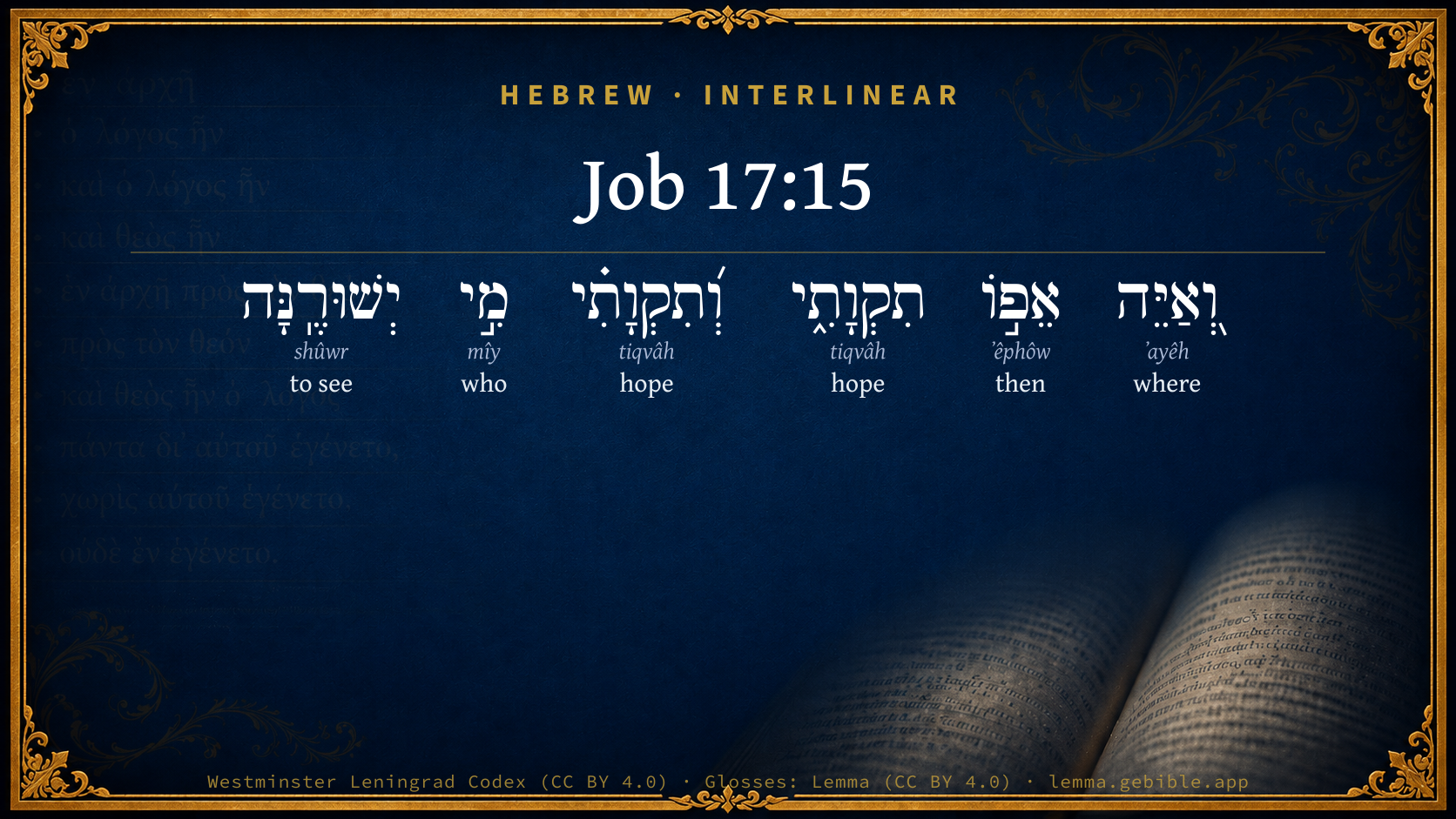
Job 17:15

Hebrew (Westminster Leningrad Codex) Job 17:15 appears in the Hebrew Old Testament. The text above is from the Westminster Leningrad Codex. Each word links to its Strong’s number, a concise gloss, and parsing drawn from the Open Scriptures Hebrew Bible morphology. Click any word for its full Brown-Driver-Briggs (BDB) entry.
Download image
Cite this verse

Job 17:15 (World English Bible). Public Domain. Lemma interlinear Bible study tool, https://lemma.gebible.app/v/job/17/15.

Show BibTeX & RIS
BibTeX
RIS
English Translation
Where then is my hope? As for my hope, who shall see it?
World English Bible · Public Domain
Download a study sheet

One document with this verse’s original text, its word-by-word gloss line, the meaning frame, cross-references with their text, attributed commentary, and full source and license credits — printable, and it pastes into notes with its structure intact.

This verse Autodidact and up

Study sheet (.html) Plain text (.txt)

A passage Seminary Student

Up to 50 verses in one chapter. A passage sheet keeps up to 6 commentary sources and 12 cross-references per verse, in the order this page ranks them, and says so on the sheet whenever that leaves anything out. Ask for a single verse and you get the Autodidact verse sheet above.

Everything on this page stays free to read, with no account — the sheet is a download of what is already on screen, not access to it.

Want to remove ads? Support Godless Engineer
Compare translations 3

The same verse in 3 English versions, stacked beneath the original-language interlinear above. Click any original word for its lexicon entry.

Each is an independent rendering of the whole verse — the interlinear is not word-aligned to these translations.

Highlighted words mark where these versions differ — a whole-verse word diff, not a word-by-word alignment.

  • World English Bible Public Domain
    Where then is my hope? As for my hope, who shall see it?
  • King James Version Public Domain
    And where is now my hope? as for my hope, who shall see it?
  • unfoldingWord Literal Text CC BY-SA 4.0
    where then my hope? And my hope, who would see it?

unfoldingWord Literal Text — © unfoldingWord, licensed CC BY-SA 4.0. Word-aligned USFM3 via Door43 (git.door43.org/unfoldingWord/en_ult).

Versions to compare (up to 4)

3 of 4 selected

Show all 18 translations

Every available English version of this verse, each an independent rendering of the whole verse.

  • World English Bible Public Domain
    Where then is my hope? As for my hope, who shall see it?
  • Berean Standard Bible Public Domain
    where then is my hope? Who can see any hope for me?
  • Majority Standard Bible Public Domain
    where then is my hope? Who can see any hope for me?
  • King James Version Public Domain
    And where is now my hope? as for my hope, who shall see it?
  • American Standard Version (1901) Public Domain
    Where then is my hope? And as for my hope, who shall see it?
  • Revised Version (1885) Public Domain
    Where then is my hope? and as for my hope, who shall see it?
  • Geneva Bible (1599) Public Domain
    Where is then now mine hope? or who shall consider the thing, that I hoped for?
  • Douay-Rheims (1899) Public Domain
    Where is now then my expectation, and who considereth my patience?
  • Young's Literal Translation Public Domain
    And where `is' now my hope? Yea, my hope, who doth behold it?
  • Literal Standard Version CC BY-SA 4.0
    And where [is] my hope now? Indeed, my hope, who beholds it?
  • Unlocked Literal Bible CC BY-SA 4.0
    where then is my hope? As for my hope, who can see any?
  • unfoldingWord Literal Text CC BY-SA 4.0
    where then my hope? And my hope, who would see it?
  • Darby Bible Public Domain
    And where is then my hope? yea, my hope, who shall see it?
  • World Messianic Bible Public Domain
    where then is my hope? As for my hope, who will see it?
  • Webster's Bible Public Domain
    And where is now my hope? as for my hope, who will see it?
  • Free Bible Version CC BY-SA 4.0
    So then where is my hope? Can anyone see any hope for me?
  • Bible in Basic English Public Domain
    Where then is my hope? and who will see my desire?
  • JPS Tanakh (1917) Public Domain
    Where then is my hope? And as for my hope, who shall see it?

Literal Standard Version (2020), Covenant Press — licensed CC BY-SA 4.0. Text via the HelloAO Bible API (eBible.org). Unlocked Literal Bible (unfoldingWord) — licensed CC BY-SA 4.0. Text via the HelloAO Bible API (eBible.org). unfoldingWord Literal Text — © unfoldingWord, licensed CC BY-SA 4.0. Word-aligned USFM3 via Door43 (git.door43.org/unfoldingWord/en_ult). Free Bible Version, Dr. Jonathan Gallagher — licensed CC BY-SA 4.0. Text via the HelloAO Bible API (eBible.org).

Word by word

More ways to search: Search by grammar → Find every occurrence → Compare this word →

Practice this passage: Drill this verse → Learn its vocabulary →

About this verse

These counts appear in no published source. They are computed here, from the morphology-tagged text and Lemma’s own curated glosses. What Lemma adds →

6
words
5
distinct lemmas
Wisdom
section

Notable vocabulary

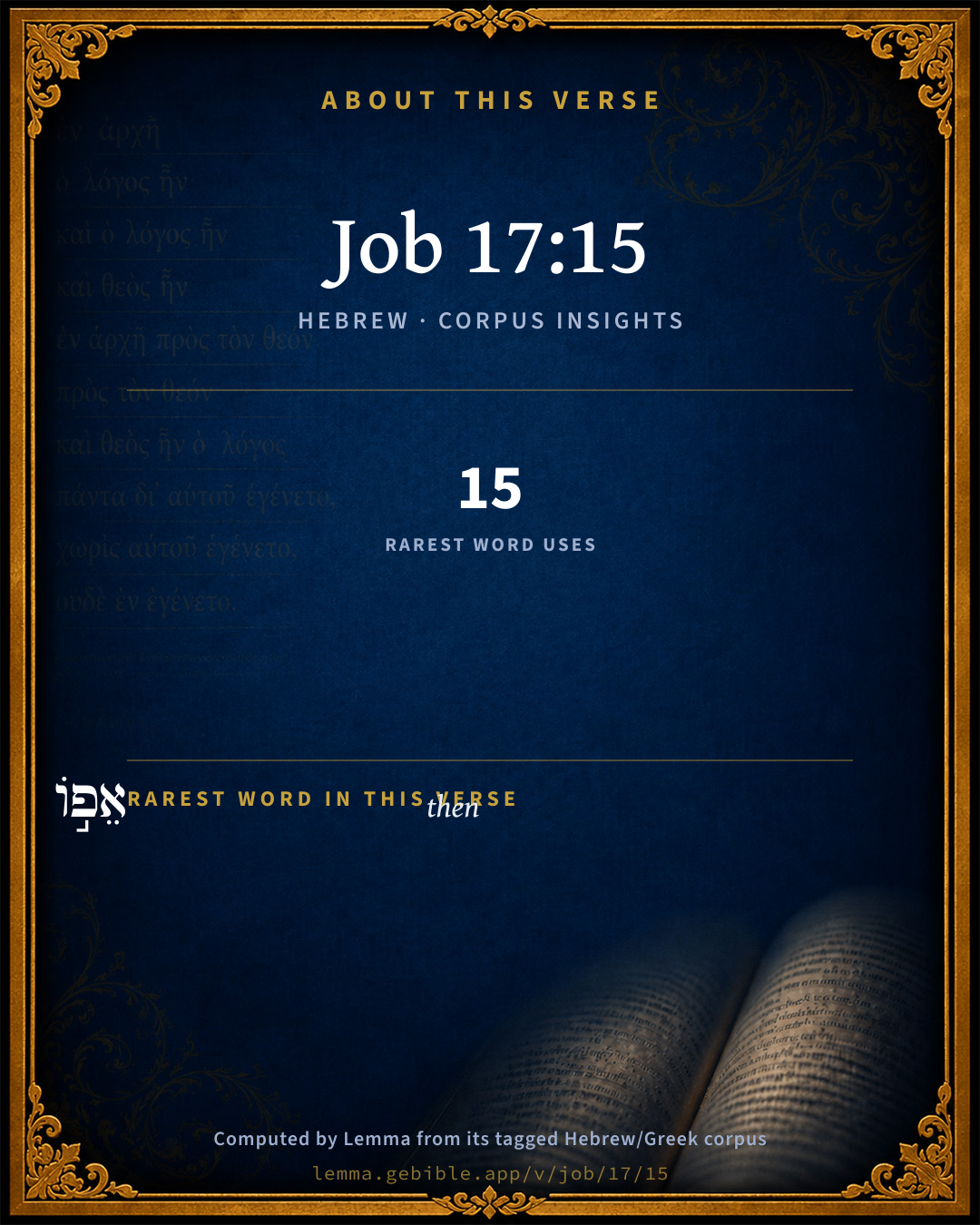
The rarest word here is אֵפ֣וֹ then H645 — appearing just 15 times in the whole Hebrew Bible.

Shared distinctive vocabulary

אֵפ֣וֹ then H645 occurs in 15 verses of the Hebrew Bible. Also found in:

Grammatical profile

  • 1 verb
  • 2 nouns
  • 1 adverb
  • 2 particles

Verb forms

  • יְשׁוּרֶֽנָּה Qal · Imperfect

Repetition

A word recurs within this verse — often emphatic in Hebrew:

  • תִקְוָתִ֑י hope H8615 ×2

Hebrew & Septuagint length

In English translation the verse runs 13 words from the Hebrew and 13 from the Septuagint (LXX English) — the same length.

A rough comparison of the two English renderings, which tokenize alike — not a word-level alignment.

Word counts can differ between the Hebrew and the Greek without any difference in meaning — e.g. the Hebrew direct-object marker אֵת has no separate Greek word, and Greek often adds the article ὁ.

Cross-references

5

Topical passages linked to Job 17:15 in the Treasury of Scripture Knowledge — connected by theme and wording, ordered by reader-vote popularity; previews shown in the World English Bible.

  • Job 13:15 Behold, he will kill me; I have no hope. Nevertheless, I will maintain my ways before him.
  • Job 4:6 Isn't your piety your confidence, The integrity of your ways your hope?
  • Job 6:11 What is my strength, that I should wait? What is my end, that I should be patient?
  • Job 19:10 He has broken me down on every side, and I am gone. My hope he has plucked up like a tree.
  • Job 7:6 My days are swifter than a weaver's shuttle, And are spent without hope.

Cross-references courtesy of OpenBible.info (CC BY 4.0).

Hebrew and Greek witnesses Masoretic Hebrew ↔ Greek Septuagint

The same verse in the two great witnesses to the Old Testament, shown verse-for-verse.

These are two independent witnesses, not word-aligned to each other, and the Septuagint is shown in lemma (dictionary) form.

Hebrew Job 17:15 Masoretic · Westminster Leningrad Codex

וְ֭אַיֵּה אֵפ֣וֹ תִקְוָתִ֑י וְ֝תִקְוָתִ֗י מִ֣י יְשׁוּרֶֽנָּה

Where then is my hope? As for my hope, who shall see it?

World English Bible · Public Domain

Greek LXX Job 17:15 Septuagint · lemma form

ποῦ οὖν ἐγώ ἔτι εἰμί ὁ ἐλπίς ἦ ὁ ἀγαθός ἐγώ ὁράω

Where then is yet my hope? or where shall I see my good?

LXX2012 (modern English Septuagint) · Public Domain

Hebrew: Westminster Leningrad Codex (CC BY 4.0). Greek: Septuagint (public domain); English from LXX2012 (modern English Septuagint) (Public Domain). How the Septuagint differs from the Hebrew →

Commentary

Notes on Job 17:15 from classic Christian and Jewish commentators (each source and its license shown beneath its notes). The classic Christian expositions comment on the surrounding passage and are grouped to its opening verse, so a note may address several verses; the Jewish commentaries on the Tanakh (Rashi and others) are per-verse, so they appear only where the commentator wrote on this verse.

Lemma curates 59 commentaries, every one of them public domain or Creative Commons licensed, each selected and text-cleaned for this edition rather than reprinted as found. About our sources →

Trapp's Complete Commentary

John Trapp

Job 17:15 And where [is] now my hope? as for my hope, who shall see it?

Ver. 15. And where is now my hope? &c.] Heb. And where is my hope? sc. of restoration to my pristine prosperity, which you have so often promised me, who am now ready set upon the confines of death? Job was past the Cape of Good Hope in his own apprehension; but God turned again his captivity, Job 42:10 Qui nihil sperare potest desperet nihil. Who is able to hope for nothing, despairs for nothing. Job did well to propound death to himself, and prepare for it by such a before mentioned familiarity; but yet he should have better thought of the infinite power and goodness of God, who raiseth the dead, and delighteth to help such as are forsaken of their hopes. "Who delivered us from so great a death, and doth deliver: in whom we trust that he will yet deliver," 2Co 1:10. The Hebrew word that signifieth hope signifieth also a line, because by hope the heart should be stretched out as a line to the thing it hopeth for; and because it signifieth also a congregation, therefore some render this verse thus, And where now is my congregation? And as for my congregation, who shall see it? q.d. I have no other family or familiars but what are to be found in the grave, Jer 3:17 Gen 3:19.

John Trapp, A Commentary or Exposition upon All the Books of the Old and New Testament (1647–1656) — public domain. Text from a community e-Sword module.

The Biblical Illustrator

Joseph S. Exell

Job_17:15

And where is now my hope?

Where now my hope

I. Occasions in life which force upon us this inquiry.

1. In those seasons when the troubles of life press heavily.

2. When our human dependencies have failed.

3. When the terrors of a guilty conscience seize us.

4. The question irresistibly presses upon all as death seems to approach.

II. The disappointment of those who have not provided against these seasons of trial.

1. All earthly hopes are, in their very nature, inadequate to our exigencies.

2. All the hopes which are derived from the world and the creatures are temporal in their duration.

3. If they could endure and go with us into eternity, or the separate state of souls,--yet they would not stand the test of the final day of account.

III. See the necessity of close self-exaltation.

1. This examination should refer to the object of our hope.

2. We should examine whether we have a well-grounded and scriptural prospect of attaining to the object of our hope. It is possible that we may practise self-delusion.

3. Your hope may be good as to its object, its foundation may be the work of Jesus Christ, an anchor sure and steadfast, but have you a valid title to appropriate that hope to yourself?

4. Inquire whether your hope has borne any trials. Application--

(1) The discovery that our hope is good, and entereth into that within the veil, may well afford exultation.

2. But, if our hope is found vain and weak, or absolutely false, it is high time to abandon it and seek a better. (The Evangelist.)

Hope held out to anxious inquirers

I. The inquiry. Where is my hope?

1. Is your hope in the world? This is the case with multitudes. Then your hope is set on that which is not good.

2. Is your hope in sin? Is that possible? The pleasures of sin are but for a season, the pains of sin are for eternity.

3. Is your hope in your works? This was the case with the ancient Pharisees. They went about to establish their own righteousness, but failed in the attempt. All who are of the works of the law are under it as a covenant; and as such it requires perfect obedience, or there is no justification by it.

4. Is your hope in your knowledge? Knowledge puffeth up. The Kingdom of God is not in word, but in power.

5. Is your hope in Christ? Then it is in the right place. The hope of Job was in him--the Redeemer; so was the hope of the primitive Christians.

II. The cases in which inquirers are warranted to hope. We are not warranted to hold out hope in every case. You must be made to feel your guilt, before you will give up your false hope. You must be made to feel your insufficiency before you will apply to Christ for relief.

1. If you repent you are warranted to hope.

2. If you believe, you are warranted to hope.

3. If you obey, you are warranted to hope.

4. If you love Christ, you are warranted to hope.

5. So you are, if you love the house of prayer.

6. And if you love the brethren.

7. And if you seek the Divine glory.

III. The qualities of the hope which the gospel inspires.

1. It is a Divine hope.

2. A lively hope.

3. A joyful hope.

4. A liberal hope.

5. A permanent hope.

In conclusion, let us consider the inquiry in the text in reference to ourselves, and thus endeavour to make a suitable improvement of the subject. Where is now my hope? (Thomas Hitchin.)

.

The Biblical Illustrator, edited by Joseph S. Exell (c. 1880s–1900s) — public domain. Text from a community e-Sword module.

Jamieson, Fausset & Brown

Robert Jamieson, A. R. Fausset & David Brown

Who shall see it fulfilled? namely, the "hope" (Job 11:18) which they held out to him of restoration.

Jamieson, Fausset & Brown — Commentary Critical and Explanatory on the Whole Bible (1871) — public domain (CC PDM 1.0). Text via the HelloAO Bible API.

Adam Clarke's Commentary

Verse 15. And where is now my hope?] In the circumstances in which I am found, of what use can hope be? Were I to form the expectation of future good, who could ever see it realized? Is it then any wonder that I should complain and bemoan my wretched lot?

Adam Clarke's Commentary on the Bible (1810–1826) — public domain. Text from a community e-Sword/MySword module.

The Cambridge Bible for Schools and Colleges

gen. ed. J. J. S. Perowne

15. If in fact and in his own feeling Job so surely belongs to death, where is the brilliant hope which his friends hold out, and who shall ever see such a hope realized? or, who can perceive a trace of it? His hope in truth is another (Job_17:13).

The Cambridge Bible for Schools and Colleges (gen. ed. J. J. S. Perowne; Cambridge University Press, 1878–1918) — public domain. Text from a community e-Sword module.

John Gill's Exposition

And where is now my hope?.... Not the grace of hope, which was in his heart; and though it might sometimes be low in exercise, it could not be lost; it is an anchor, sure and steadfast, and is one of the graces that always abides, and never disappoints and makes ashamed; nor the object of hope, eternal glory and happiness in another world, that is laid up in heaven, and for which he was looking and waiting by faith; but his hope of outward happiness, and of being restored to his former state of prosperity, or a better, which his friends encouraged him to; this had no place in him, nor did he see any reason to cherish it; all ground and foundation of it was removed, as he apprehended; there was nothing on which he could build such an hope as that, see Job 6:11;

as for my hope, who shall see it? that is, which his friends would have him hope for, a line house, a large estate, a numerous family, honour and respect among men, long life, and an abundance of outward peace and happiness; this he was firmly persuaded he should never see, being just going into the grave, nor his friends that suggested these things to him, nor anybody else; though indeed what he himself truly hoped for might be rightly thus described, being things not seen by the eye of the body, nor by carnal sense and reason, but are the invisible glories and realities of another world, for "hope that is seen is not hope", &c. Rom 8:24; but Job does not design these, but the former.

John Gill's Exposition of the Whole Bible (1746–1763) — public domain (CC PDM 1.0). Text via the HelloAO Bible API.

Albert Barnes' Notes on the Bible

And where is now my hope? - What hope have I of life? What possibility is there of my escape from death?

Who shall see it? - That is, who will see any hopes that I may now cherish fulfilled. If I cherish any, they will be disappointed, and no one will see them accomplished.

Albert Barnes' Notes on the Bible (1834–1885) — public domain. Text from a community e-Sword/MySword module.

Haydock's Catholic Bible Commentary

Who. Hebrew, "who shall see my hope?" I wish all might witness it. (Haydock) --- But I expect no redress on this side of the grave. (Calmet)

George Leo Haydock (1774–1849), Haydock's Catholic Family Bible and Commentary, 1859 edition — public domain. Excludes Psalms (Douay-Rheims chapter numbering differs from Protestant) and Deuterocanonical books (Catholic canon only).

Matthew Poole's English Annotations

Where is now my hope? and what then is become of that hope which you advised me to entertain?

My hope, i.e. the fulfilling of my hope, or the happiness which you would have me expect; hope being put for the thing hoped for, as Pro 13:12; 1Co 9:10.

Who shall see it? no man shall see it: it shall never be.

Matthew Poole's English Annotations on the Holy Bible (1683–1685) — public domain. Text from a community e-Sword/MySword module.

The Pulpit Commentary

And where is now my hope?. (comp. Job 14:18-15) At first sight it might seem that to cue in Sheol there could be no hope. But Job is too conscious of his own ignorance to dogmatize on such a subject. What does he know of Sheol? How can he be sure that it is "God"s last word to men"? There may be hope even to "the spirits which are in prison." Job"s question is, therefore, not to be taken as one of absolute incredulity, but as one of perplexed doubt. Is there hope for me anywhere? If so, where? As for my hope, who shall see it? i.e. what eye can penetrate the darkness of the future, and solve the riddle for me?

The lost hope.

Not only are Job"s purposes broken off. His hope is lost. At all events, it seems to be melting away, so that all chance of seeing its accomplishment appears to have gone.

I A VAIN HOPE MUST BE LOST. The reality will not depend on s man"s sanguine temperament, but upon its own causes. It is possible for a person to persuade himself into a condition of blissful confidence concerning his future, but the self-persuasion will not alter facts; and if he is drifting towards the rocks they will shatter him as surely as if he went in terror of their fatal neighbourhood. Note, then, some of he vain hopes that must perish.

1. The hope of success in cheating God. Some men live as hypocrites not merely to secure the favour of their fellows, but in the foolish fancy that by some jugglery they may even wriggle into the favour of Heaven. Such a hope must fail.

2. The hope of succeeding without God. This is not outrageously impudent like the hope last referred to. But it cannot succeed, for no man is sufficient of himself to overcome all the difficulties of life.

3. The hope of worldly sufficiency. It is thought that if Providence is kind, and a man has much laid by for days to come, he may look forward with confidence. This is the hope of the rich fool, (Luk_12:20) and the unexpected changes of life, or death at last, must shatter it,

II A TRUE HOPE MAY BE LOST.

1. The Christian hope. This is a true hope.

(1) It is founded on God"s strength, and he can never fail. We are encouraged to hope for salvation from One who is almighty.

(2) It is secured by God"s truth. "He is faithful that promised". (Heb_10:23) To grow faint-hearted with the Christian hope is to distrust God. The hope depends on his Word, which cannot be broken.

(3) It is guaranteed by Christ"s life, death, and resurrection. Christ is God"s Pledge of hope to his children. God would have wasted Christ on the world if he were not to fulfil the hopes that his Son raised.

2. The possibility of losing it. This must be considered in spite of the absolute security of the hope itself; for the hope may be good, and yet we may cease to hold it. The anchor may be sound, but the chain that unites it to the ship may be cut.

(1) The hope may only be lost to consciousness. We may cease to enjoy it, cease to feel the hope within us. Yet we may not really be cut off from what the great hope of Christ promises. Job exclaims, "Where is now my hope?" only because he is blinded with grief. Our despair is not the measure of our faith. The mountain has not vanished because the fog has hidden it. Doubt does not destroy truth. Many a despondent Christian will realize the hopes which he is too faint-hearted to enjoy in anticipation.

(2) The hope may be really lost. It is possible to see the hope afar off, as Balsam saw Israel"s hope, and yet to have no share in it ourselves. Or we may hold to the Christian hope in error without living the Christian life. Then we must be bitterly disappointed. Or, lastly, we may prove faithless and fall away from Christ. Therefore let us pray to be kept true, seeing that God is true, so that our fidelity is the only condition we now need to be assured of in order that our hope may not be lost. W.F.A.

The Pulpit Commentary (1880–1919), ed. H.D.M. Spence-Jones & Joseph S. Exell — public domain. Text from a community e-Sword module.

John Wesley's Explanatory Notes

Hope - The happiness you would have me expect.

John Wesley, Explanatory Notes Upon the Whole Bible (1754–1765) — public domain. Text via the GEBible commentary corpus.

Rashi

Rabbi Shlomo Yitzchaki (Rashi)

Where then is my hope [Where then is] this [my hope]? Why is it deferred, and who will see it to hasten it to me?

Rashi on the Tanakh — English translations: “The Judaica Press complete Tanach with Rashi, translated by A. J. Rosenberg” (CC BY 4.0); “Pentateuch with Rashi's commentary by M. Rosenbaum and A.M. Silbermann, 1929-1934” (public domain); “The Metsudah Tanach series, Lakewood, N.J” (CC BY 4.0); and “The Book of Joshua, Metsudah Publications, 1997” (CC BY 4.0). Text via Sefaria.

Lesson kit

Teaching starters — assembled from the data on this page, not authored interpretation. Every prompt links to the verse data it draws on. Edit before teaching.

Job, in the Wisdom, opens this verse with 6 words (5 distinct Hebrew lemmas). Its most distinctive word is ʼêphôw (“then”). A historical commentator’s framing appears above. Read the whole chapter for the surrounding context.

Discussion questions

  1. What does “then” (ʼêphôw) contribute to the verse as a whole?
  2. How does Genesis 27:33, which shares the word «then», read alongside this verse?
  3. What does the repetition of “hope” (2× in this one verse) do in this verse?
  4. These translations render this verse differently; the difference is in the English rendering, not the original. What questions does that raise?
  5. «יְשׁוּרֶֽנָּה» is a Qal Imperfect verb. How does that grammatical form shape the action described?
  6. Compare how Trapp's Complete Commentary and The Biblical Illustrator read this verse. Where do they agree or differ?

Things to notice

Reading settings

Reading text

Shown beneath each verse's original-language words.

Old Testament
Old Testament edition

Read the OT as the Masoretic Hebrew (MT) or the Greek Septuagint (LXX).

English shown for the Greek Septuagint (in the Hebrew ↔ Greek comparison).

Comparing translations? Open the Compare panel on any verse page to stack up to four side by side.