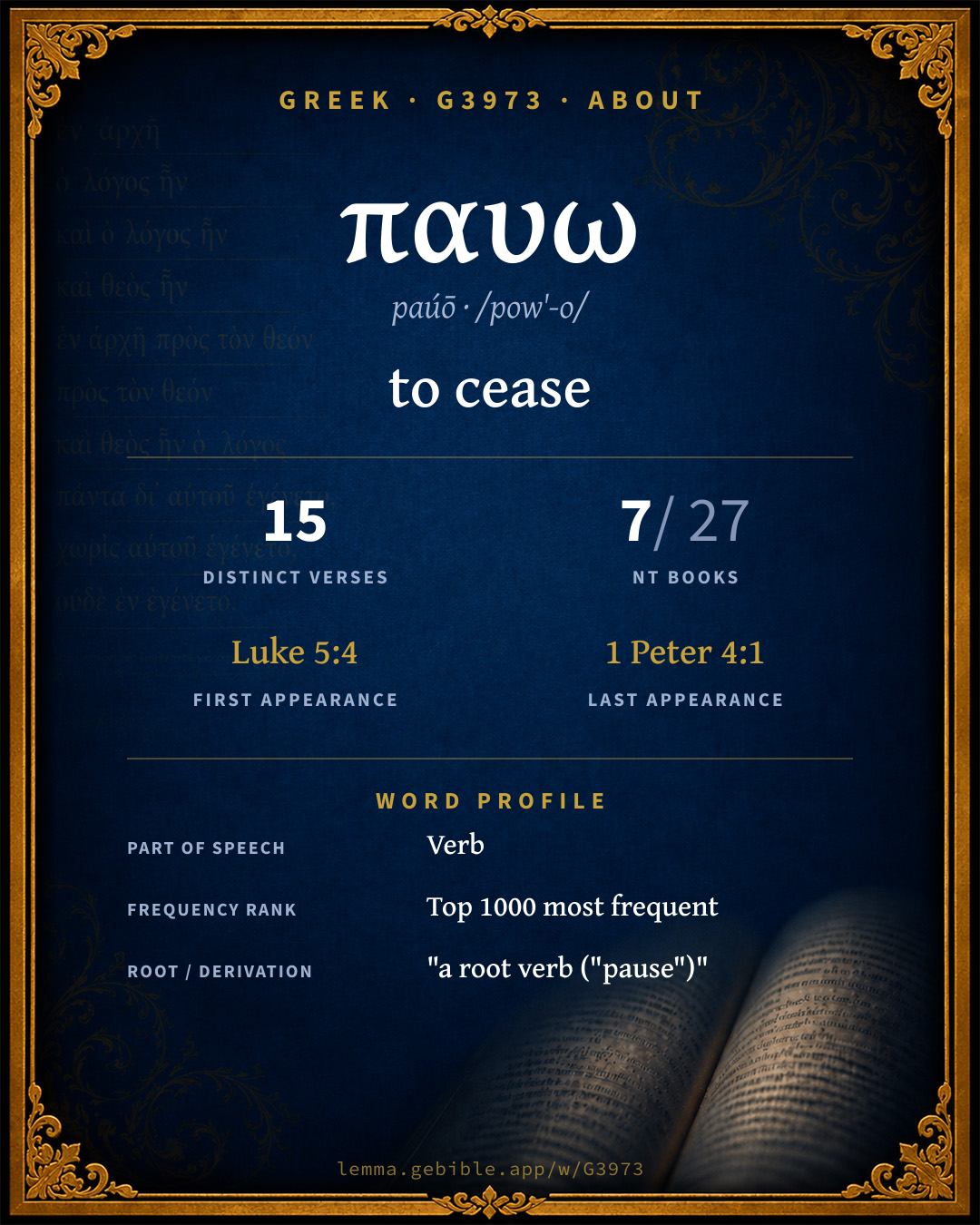
παύω
to cease
‘to cease’ is one of 4 main senses fuller range ↓
Full lexicon entry — Thayer's Greek Lexicon
From Thayer's Greek Lexicon
Where this word appears
See every Aorist-tense verb in the Greek New Testament →
Grammar key — what these labels mean
Part of speech
- Verb
- An action or state-of-being word.
Tense
- Aorist
- Action viewed as a simple whole, without regard to duration — often past (perfective aspect).
- Future
- Action expected in future time.
- Imperfect
- Continuous or repeated action in past time (“was writing”).
- Present
- Ongoing or general action in present time (imperfective aspect).
- Perfect
- A completed past action with continuing present results.
Voice
- Middle
- The subject acts on or for itself, or with special interest in the action.
- Active
- The subject performs the action.
- Middle deponent
- Middle in form but active in meaning.
- Passive
- The subject receives the action.
Mood
- Indicative
- States a fact or asks a factual question (the mood of reality).
- Imperative
- Expresses a command or request.
- Infinitive
- A verbal noun (“to write”), unmarked for person or number.
Person
- 3rd person
- The one spoken about (“he / she / it / they”).
- 1st person
- The speaker (“I / we”).
- 2nd person
- The one addressed (“you”).
Number
- Plural
- More than one.
- Singular
- One.
1 verse where G3973 appears in the Future tense in the Book of Acts. Filtered view — show all forms. Click any verse to open its interlinear word-by-word view. Verse text shown in the World English Bible for context — . Each verse’s Greek form is shown with its reference; the English is not keyword-highlighted, since the data carries no word-level English alignment. Use “Compare translations” on any verse to read it across multiple English versions. This concordance covers the Greek New Testament; Septuagint (Greek Old Testament) occurrences of this word are not indexed here.
Acts
About this entry
At a glance — auto-summarized from this page’s data, not written by a person. Every figure links to its source below. This summary describes the numbers; it doesn’t interpret them.
At its core, παυω (paúō) means “to cease.” Catalogued under 4 senses, its meaning is not single-sense. With 15 verses in 7 books, it is an uncommon word in the Greek New Testament. Its uses concentrate in Acts (40% of all occurrences). First canonically at Luke 5:4, it enters the text early. See the sense tree, 15-verse concordance, and the renderings breakdown below.
Gloss history
Strong's 1890 vs modern scholarship
About this word
Strong's G3973 catalogs a Greek word from the Greek New Testament.
These counts are not copied from any lexicon or concordance. They are computed here, from the morphology-tagged Greek New Testament. What Lemma adds →
- 15
- distinct verses
- The word appears in 15 distinct verses.
- 7 / 27
- NT books
- The word appears in 7 of 27 New Testament books.
- #768
- by frequency
- Top 1000 most frequent Greek words (rank 768 of 5,347 Greek words by occurrence).
View all 15 occurrences in the concordance →
By section of the New Testament
By traditional corpus
Conventional, traditional groupings — biblical authorship is debated, so this is a traditional corpus grouping, not an authorship claim. Some books belong to more than one corpus (Luke is in both the Gospels and the Lukan corpus, and so on), so these shares overlap and need not total 100%. Each figure is a share of the word’s 15 distinct verses.
- Lukan (Luke–Acts) 9 verses · 60%
- Gospels 3 verses · 20%
- Pauline corpus 3 verses · 20%
- General (Catholic) Epistles 2 verses · 13%
- Hebrews 1 verse · 7%
How translations render this word
Counts come from each version’s own published word-to-Strong’s tagging or interlinear alignment — an approximate guide to how each version renders this word, not a word-level alignment the data otherwise carries. Because each total is that version’s own tagged count, the per-version totals vary from one another and need not match the appearance or distinct-verse counts above. These counts may also differ from a printed concordance because Lemma counts each distinctly tagged rendering and does not collapse phrase taggings into a single head-word total. This is a fixed set of word-tagged versions (KJV, ASV, BSB, ULT) and does not change with the reading translation you choose elsewhere. Each version’s license is shown beside its name below (and on Sources).
- King James Version: Cease 3×, They ceased 2×
- American Standard Version: Cease 3×, They ceased 2×
- Berean Standard Bible: Stopped 2×
- unfoldingWord Literal Text: Stop 4×, Stopped 3×, He stopped 2×
King James Version Public Domain
Renders G3973 across 17 tagged occurrences — most commonly:
Plus 12 renderings that appear only once — usually multi-word phrases or single function words the recovered tagging swept in, not distinct renderings.
American Standard Version Public Domain
Renders G3973 across 18 tagged occurrences — most commonly:
Plus 13 renderings that appear only once — usually multi-word phrases or single function words the recovered tagging swept in, not distinct renderings.
Berean Standard Bible Public Domain
Renders G3973 across 15 tagged occurrences — most commonly:
Plus 13 renderings that appear only once — usually multi-word phrases or single function words the recovered tagging swept in, not distinct renderings.
unfoldingWord Literal Text CC BY-SA 4.0
Renders G3973 across 23 tagged occurrences — most commonly:
Plus 14 renderings that appear only once — usually multi-word phrases or single function words the recovered tagging swept in, not distinct renderings.
Senses in Thayer's
The 4 senses Thayer's distinguishes for this word, in lexicon order (not ranked by frequency or importance). The full entry — with sub-senses — is in the Lexicon Entry tab.
- to make to cease or desist
- to restrain a thing or person from something
- to cease, to leave off
- have got release from sin
Word origin
Origin: "a root verb ("pause")"
A primn. verb (pause); to stop (transitive or intransitive) that is restrain quit desist come to an end : - cease leave refrain.
— Strong’s Exhaustive Concordance (1890), public domain.
Forms in the corpus
The 12 distinct written forms G3973 takes in the Greek New Testament, most frequent first — each parse links to that tense’s occurrences in the concordance.
Septuagint usage
The same Greek word παυω appears 60 times in the Greek Old Testament (Septuagint), across 57 verses in 13 books.
- 60
- LXX occurrences
- Tagged occurrences of this Greek word in the Septuagint.
- 57
- verses
- Distinct Septuagint verses containing this word.
- 13 / 39
- OT books
- The word appears in 13 of the 39 Old Testament books.
Sample Septuagint occurrences
- Genesis 11:8 παύω
- Exodus 9:28 παύω
- Numbers 16:31 παύω
- Deuteronomy 20:9 παύω
- Joshua 7:26 παύω
- Judges 15:17 παύω
- 2 Samuel 15:24 παύω
- 1 Chronicles 21:22 παύω
- Job 6:7 παύω
- Psalms 33:14 παύω
- Proverbs 18:18 παύω
- Isaiah 1:16 παύω
Septuagint occurrences (same lexeme)
Every verse where the same Strong’s number (G3973) appears in the Greek Septuagint — showing the first 50 of 57. Verse text shown in the World English Bible for context; the Greek form is the matched word — the English is not keyword-highlighted.
- Genesis 11:8 παύω So Yahweh scattered them abroad from there on the surface of all the earth. They stopped building the city.
- Genesis 18:33 παύω Yahweh went his way, as soon as he had finished communing with Abraham, and Abraham returned to his place.
- Genesis 24:14 παύω Let it happen, that the young lady to whom I will say, 'Please let down your pitcher, that I may drink.' She will say, 'Drink, and I will also give your camels a drink.' Let the same be she who you have appointed for your servant Isaac. Thereby will I know that you have shown kindness to my master."
- Genesis 24:19 παύω When she had done giving him drink, she said, "I will also draw for your camels, until they have done drinking."
- Genesis 24:22 παύω It happened, as the camels had done drinking, that the man took a golden ring of half a shekel weight, and two bracelets for her hands of ten shekels weight of gold,
- Genesis 27:30 παύω It happened, as soon as Isaac had made an end of blessing Jacob, and Jacob had just gone out from the presence of Isaac his father, that Esau his brother came in from his hunting.
- Exodus 9:28 παύω Pray to Yahweh; for there has been enough of mighty thunderings and hail. I will let you go, and you shall stay no longer."
- Exodus 9:29 παύω Moses said to him, "As soon as I have gone out of the city, I will spread abroad my hands to Yahweh. The thunders shall cease, neither shall there be any more hail; that you may know that the earth is Yahweh's.
- Exodus 9:33 παύω Moses went out of the city from Pharaoh, and spread abroad his hands to Yahweh; and the thunders and hail ceased, and the rain was not poured on the earth.
- Exodus 9:34 παύω When Pharaoh saw that the rain and the hail and the thunders were ceased, he sinned yet more, and hardened his heart, he and his servants.
- Exodus 31:17 παύω It is a sign between me and the children of Israel forever; for in six days Yahweh made heaven and earth, and on the seventh day he rested, and was refreshed.'"
- Exodus 32:12 παύω Why should the Egyptians speak, saying, 'He brought them forth for evil, to kill them in the mountains, and to consume them from the surface of the earth?' Turn from your fierce wrath, and repent of this evil against your people.
- Numbers 16:31 παύω It happened, as he made an end of speaking all these words, that the ground split apart that was under them;
- Numbers 17:25 παύω
- Numbers 25:8 παύω and he went after the man of Israel into the pavilion, and thrust both of them through, the man of Israel, and the woman through her body. So the plague was stayed from the children of Israel.
- Deuteronomy 20:9 παύω It shall be, when the officers have made an end of speaking to the people, that they shall appoint captains of hosts at the head of the people.
- Deuteronomy 32:26 παύω I said, I would scatter them afar, I would make the memory of them to cease from among men;
- Joshua 7:26 παύω They raised over him a great heap of stones, to this day; and Yahweh turned from the fierceness of his anger. Therefore the name of that place was called "The valley of Achor" to this day.
- Joshua 8:24 παύω It happened, when Israel had made an end of killing all the inhabitants of Ai in the field, in the wilderness in which they pursued them, and they were all fallen by the edge of the sword, until they were consumed, that all Israel returned to Ai, and struck it with the edge of the sword.
- Judges 15:17 παύω It happened, when he had made an end of speaking, that he cast away the jawbone out of his hand; and that place was called Ramath Lehi.
- 2 Samuel 15:24 παύω Behold, Zadok also [came], and all the Levites with him, bearing the ark of the covenant of God; and they set down the ark of God; and Abiathar went up, until all the people had done passing out of the city.
- 1 Chronicles 21:22 παύω Then David said to Ornan, Give me the place of this threshing floor, that I may build thereon an altar to Yahweh: for the full price shall you give it me, that the plague may be stayed from the people.
- Job 6:7 παύω My soul refuses to touch them; They are as loathsome food to me.
- Job 6:26 παύω Do you intend to reprove words, Seeing that the speeches of one who is desperate are as wind?
- Job 14:13 παύω "Oh that you would hide me in Sheol, That you would keep me secret, until your wrath is past, That you would appoint me a set time, and remember me!
- Job 18:2 παύω "How long will you hunt for words? Consider, and afterwards we will speak.
- Job 29:9 παύω The princes refrained from talking, And laid their hand on their mouth;
- Job 31:40 παύω Let briars grow instead of wheat, And stinkweed instead of barley." The words of Job are ended.
- Job 37:19 παύω Teach us what we shall tell him; For we can't make our case by reason of darkness.
- Job 38:1 παύω Then Yahweh answered Job out of the whirlwind,
- Psalms 33:14 παύω From the place of his habitation he looks out on all the inhabitants of the earth,
- Psalms 36:8 παύω They shall be abundantly satisfied with the abundance of your house. You will make them drink of the river of your pleasures.
- Proverbs 18:18 παύω The lot settles disputes, And keeps strong ones apart.
- Proverbs 30:1 παύω The words of Agur the son of Jakeh, the oracle: The man says to Ithiel, To Ithiel and Ucal:
- Isaiah 1:16 παύω Wash yourselves, make yourself clean. Put away the evil of your doings from before my eyes; Cease to do evil.
- Isaiah 1:24 παύω Therefore the Lord, Yahweh of Hosts, The Mighty One of Israel, says: "Ah, I will get relief from my adversaries, And avenge myself of my enemies;
- Isaiah 10:25 παύω For yet a very little while, and the indignation [against you] shall be accomplished, and my anger [shall be directed] to his destruction.
- Isaiah 16:10 παύω Gladness is taken away, and joy out of the fruitful field; and in the vineyards there shall be no singing, neither joyful noise: nobody shall tread out wine in the presses; I have made the [vintage] shout to cease.
- Isaiah 24:8 παύω The mirth of tambourines ceases, the noise of those who rejoice ends, the joy of the harp ceases.
- Isaiah 24:11 παύω There is a crying in the streets because of the wine; all joy is darkened, the mirth of the land is gone.
- Isaiah 24:13 παύω For thus shall it be in the midst of the earth among the peoples, as the shaking of an olive tree, as the gleanings when the vintage is done.
- Isaiah 26:10 παύω Let favor be shown to the wicked, yet will he not learn righteousness; in the land of uprightness will he deal wrongfully, and will not see the majesty of Yahweh.
- Isaiah 32:10 παύω For days beyond a year shall you be troubled, you careless women; for the vintage shall fail, the harvest shall not come.
- Isaiah 33:8 παύω The highways lie waste, the wayfaring man ceases: [the enemy] has broken the covenant, he has despised the cities, he doesn't regard man.
- Isaiah 38:20 παύω Yahweh is [ready] to save me: Therefore we will sing my songs with stringed instruments All the days of our life in the house of Yahweh.
- Isaiah 57:10 παύω You were wearied with the length of your way; yet you didn't say, It is in vain: you found a reviving of your strength; therefore you weren't faint.
- Jeremiah 28:63 παύω
- Jeremiah 31:2 παύω Thus says Yahweh, The people who were left of the sword found favor in the wilderness; even Israel, when I went to cause him to rest.
- Jeremiah 32:24 παύω Behold, the mounds, they are come to the city to take it; and the city is given into the hand of the Chaldeans who fight against it, because of the sword, and of the famine, and of the pestilence; and what you have spoken has happened; and, behold, you see it.
- Jeremiah 33:3 παύω Call to me, and I will answer you, and will show you great things, and difficult, which you don't know.
These are occurrences of the same Greek lexeme (G3973) in the Septuagint — not a translation of any one Hebrew word. The store carries no word-level Hebrew↔Greek alignment, so no Hebrew original is asserted here. Counts come from the recovered LXX Strong's tagging — high-frequency vocabulary is well covered, while rare or late forms may be untagged — so they reflect tagged occurrences and may slightly undercount.