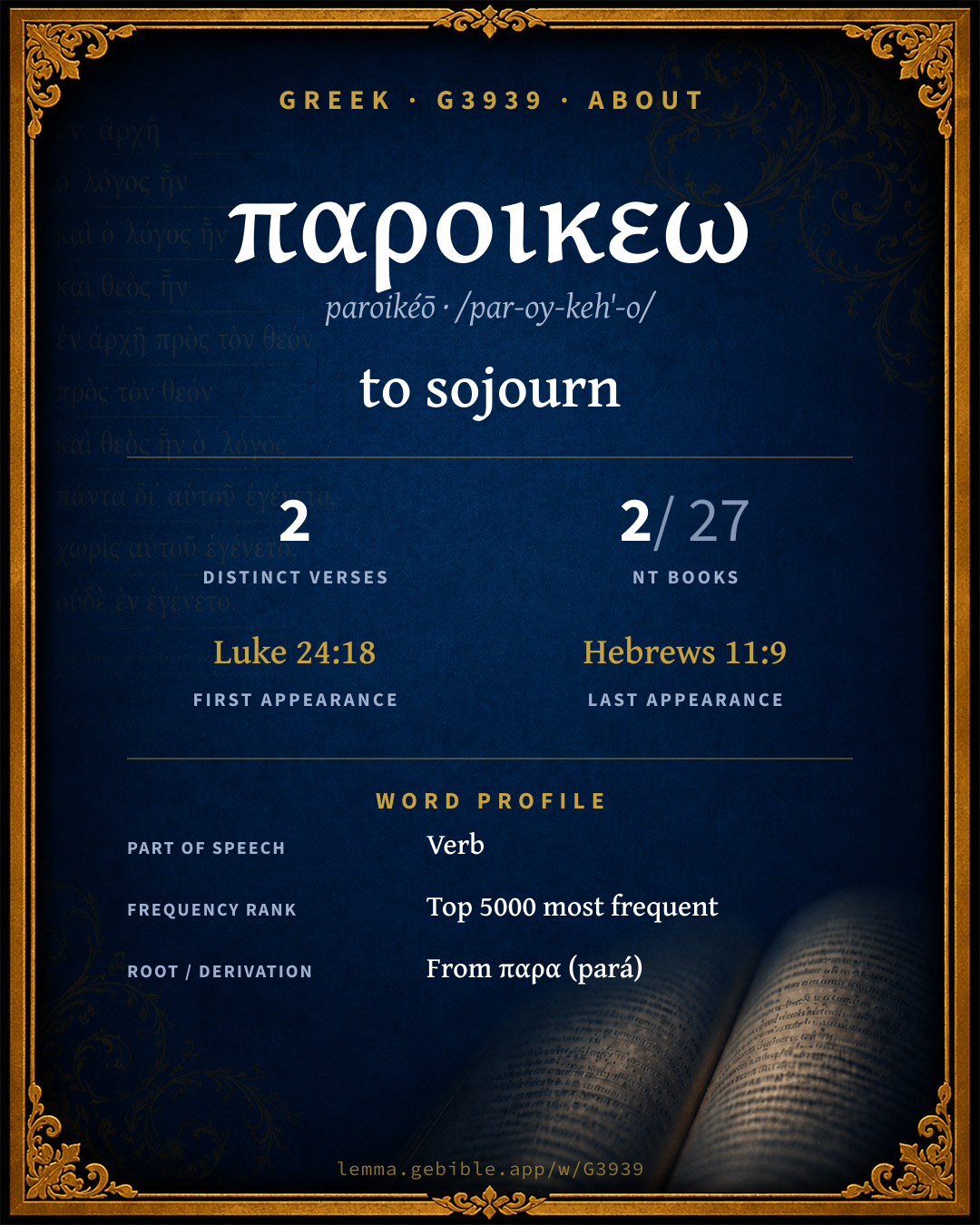
παροικέω
to sojourn
‘to sojourn’ is one of 2 main senses fuller range ↓
Full lexicon entry — Thayer's Greek Lexicon
From Thayer's Greek Lexicon
Where this word appears
See every Aorist-tense verb in the Greek New Testament →
Grammar key — what these labels mean
Part of speech
- Verb
- An action or state-of-being word.
Tense
- Aorist
- Action viewed as a simple whole, without regard to duration — often past (perfective aspect).
- Present
- Ongoing or general action in present time (imperfective aspect).
Voice
- Active
- The subject performs the action.
Mood
- Indicative
- States a fact or asks a factual question (the mood of reality).
Person
- 3rd person
- The one spoken about (“he / she / it / they”).
- 2nd person
- The one addressed (“you”).
Number
- Singular
- One.
Grammatical forms
- Verb, Aorist, Active, Indicative, 3rd person, Singular 1 time (50%)
- Verb, Present, Active, Indicative, 2nd person, Singular 1 time (50%)
Parsed forms decoded from the imported morphology (Robinson–Tischendorf, public domain), counted across 2 parsed occurrences — not distinct verses.
Every verse where G3939 appears — 2 distinct verses across 2 books. Click any verse to open its interlinear word-by-word view. Verse text shown in the World English Bible for context — . Each verse’s Greek form is shown with its reference; the English is not keyword-highlighted, since the data carries no word-level English alignment. Use “Compare translations” on any verse to read it across multiple English versions. This concordance covers the Greek New Testament; Septuagint (Greek Old Testament) occurrences of this word are not indexed here.
Luke 1 verse
Hebrews 1 verse
About this entry
At a glance — auto-summarized from this page’s data, not written by a person. Every figure links to its source below. This summary describes the numbers; it doesn’t interpret them.
“to sojourn” is the headline sense of the Greek verb παροικεω (paroikéō). It occurs a mere 2 verses across Scripture. It clusters heavily in Luke, which alone accounts for 50% of its uses. First canonically at Luke 24:18, it enters the text early. Catalogued under 2 senses, its meaning is not single-sense. The sections below give every sense, occurrence, and version rendering.
Gloss history
Strong's 1890 vs modern scholarship
About this word
Strong's G3939 catalogs a Greek word from the Greek New Testament.
These counts are not copied from any lexicon or concordance. They are computed here, from the morphology-tagged Greek New Testament. What Lemma adds →
- 2
- distinct verses
- The word appears in 2 distinct verses.
- 2 / 27
- NT books
- The word appears in 2 of 27 New Testament books.
- #2,678
- by frequency
- Top 5000 most frequent Greek words (rank 2,678 of 5,347 Greek words by occurrence).
View all 2 occurrences in the concordance →
By traditional corpus
Conventional, traditional groupings — biblical authorship is debated, so this is a traditional corpus grouping, not an authorship claim. Some books belong to more than one corpus (Luke is in both the Gospels and the Lukan corpus, and so on), so these shares overlap and need not total 100%. Each figure is a share of the word’s 2 distinct verses.
- Gospels 1 verse · 50%
- Lukan (Luke–Acts) 1 verse · 50%
- Hebrews 1 verse · 50%
How translations render this word
Counts come from each version’s own published word-to-Strong’s tagging or interlinear alignment — an approximate guide to how each version renders this word, not a word-level alignment the data otherwise carries. Because each total is that version’s own tagged count, the per-version totals vary from one another and need not match the appearance or distinct-verse counts above. These counts may also differ from a printed concordance because Lemma counts each distinctly tagged rendering and does not collapse phrase taggings into a single head-word total. This is a fixed set of word-tagged versions (KJV, ASV, BSB, ULT) and does not change with the reading translation you choose elsewhere. Each version’s license is shown beside its name below (and on Sources).
- King James Version: He sojourned 1×, Stranger 1×
- American Standard Version: Dost 1×, He became a sojourner 1×, Sojourn 1×
- Berean Standard Bible: He dwelt 1×, Visitor 1×
- unfoldingWord Literal Text: Are 1×, He lived 1×, Visiting 1×
King James Version Public Domain
Renders G3939 across 2 tagged occurrences — most commonly:
American Standard Version Public Domain
Renders G3939 across 3 tagged occurrences — most commonly:
Berean Standard Bible Public Domain
Renders G3939 across 2 tagged occurrences — most commonly:
unfoldingWord Literal Text CC BY-SA 4.0
Renders G3939 across 3 tagged occurrences — most commonly:
Senses in Thayer's
The 2 senses Thayer's distinguishes for this word, in lexicon order (not ranked by frequency or importance). The full entry — with sub-senses — is in the Lexicon Entry tab.
- to dwell beside (one) or in one's neighbourhood, to live near
- in the NT, to be or dwell in a place as a stranger, to sojourn
Word origin
Derived from παρα (pará) (G3844) — from.
Forms in the corpus
The 2 distinct written forms G3939 takes in the Greek New Testament, most frequent first — each parse links to that tense’s occurrences in the concordance.
| Form | Parsing | Example | Uses |
|---|---|---|---|
| παροικεῖς paroikeîs | Verb, Present, Active, Indicative, 2nd person, Singular | Luke 24:18 | 1 |
| παρῴκησεν parṓkēsen | Verb, Aorist, Active, Indicative, 3rd person, Singular | Hebrews 11:9 | 1 |
Same root — word family
Other Thayer's entries built from the same root as G3939, grouped by Strong’s listed origin. These share a root / origin per the lexicon — not necessarily a shared meaning. Each links to that word’s own entry.
Derives from
Shares the same root
- παραβαινω parabaínō G3845 to neglect
- παραβαλλω parabállō G3846 to place beside
- παραβιαζομαι parabiázomai G3849 to compel
- παραβουλευομαι parabouleúomai G3851 to consult wrongly
- παραγγελλω parangéllō G3853 to announce
- παραγινομαι paragínomai G3854 to appear
- παραγω parágō G3855 to pass by
- παραδειγματιζω paradeigmatízō G3856 to make example
- παραδεχομαι paradéchomai G3858 to receive
- παραδιατριβη paradiatribḗ G3859 empty business
- παραδιδωμι paradídōmi G3860 to deliver
- παραδοξος parádoxos G3861 strange
- παραζηλοω parazēlóō G3863 to provoke
- παραθαλασσιος parathalássios G3864 by the sea
- παραθεωρεω paratheōréō G3865 to compare
- παραινεω parainéō G3867 to exhort
- παραιτεομαι paraitéomai G3868 to beg pardon
- παρακαθιζω parakathízō G3869 to sit beside
- παρακαλεω parakaléō G3870 to call beside
- παρακαλυπτω parakalýptō G3871 to cover up
- παρακαταθηκη parakatathḗkē G3872 deposit
- παρακειμαι parákeimai G3873 to lie beside
- παρακολουθεω parakolouthéō G3877 to follow after
- παρακουω parakoúō G3878 to disobey
+51 more words share this root (not shown).
Proper names from this root
People and places named from this root — a name, not an additional meaning of the word.
Compare all same-root words → Showing 4 of 78 — not the complete family. 1 of the same-root words is a proper name (a person or place). They share a root, not necessarily a meaning.
Septuagint usage
The same Greek word παροικεω appears 53 times in the Greek Old Testament (Septuagint), across 50 verses in 18 books.
- 53
- LXX occurrences
- Tagged occurrences of this Greek word in the Septuagint.
- 50
- verses
- Distinct Septuagint verses containing this word.
- 18 / 39
- OT books
- The word appears in 18 of the 39 Old Testament books.
Sample Septuagint occurrences
- Genesis 12:10 παραοἰκέω
- Exodus 6:4 παραοἰκέω
- Numbers 20:15 παραοἰκέω
- Deuteronomy 5:14 παραοἰκέω
- Judges 5:17 παραοἰκέω
- Ruth 1:1 παραοἰκέω
- 2 Samuel 4:3 παραοἰκέω
- 2 Kings 8:1 παραοἰκέω
- 1 Chronicles 16:19 παραοἰκέω
- 2 Chronicles 15:9 παραοἰκέω
- Ezra 1:4 παραοἰκέω
- Psalms 30:14 παραοἰκέω
Septuagint occurrences (same lexeme)
Every verse where the same Strong’s number (G3939) appears in the Greek Septuagint. Verse text shown in the World English Bible for context; the Greek form is the matched word — the English is not keyword-highlighted.
- Genesis 12:10 παραοἰκέω There was a famine in the land. Abram went down into Egypt to live as a foreigner there, for the famine was sore in the land.
- Genesis 17:8 παραοἰκέω I will give to you, and to your seed after you, the land where you are traveling, all the land of Canaan, for an everlasting possession. I will be their God."
- Genesis 19:9 παραοἰκέω They said, "Stand back!" They said, "This one fellow came in to live as a foreigner, and he appoints himself a judge. Now will we deal worse with you, than with them!" They pressed hard on the man, even Lot, and drew near to break the door.
- Genesis 20:1 παραοἰκέω Abraham traveled from there toward the land of the South, and lived between Kadesh and Shur. He lived as a foriegner in Gerar.
- Genesis 21:23 παραοἰκέω Now therefore swear to me here by God that you will not deal falsely with me, nor with my son, nor with my son's son. But according to the kindness that I have done to you, you shall do to me, and to the land in which you have lived as a foreigner."
- Genesis 21:34 παραοἰκέω Abraham lived as a foreigner in the land of the Philistines many days.
- Genesis 24:37 παραοἰκέω My master made me swear, saying, 'You shall not take a wife for my son of the daughters of the Canaanites, in whose land I live,
- Genesis 26:3 παραοἰκέω Sojourn in this land, and I will be with you, and will bless you. For to you, and to your seed, I will give all these lands, and I will establish the oath which I swore to Abraham your father.
- Genesis 32:5 παραοἰκέω I have oxen, donkeys, flocks, men-servants, and maid-servants. I have sent to tell my lord, that I may find favor in your sight.'"
- Genesis 35:27 παραοἰκέω Jacob came to Isaac his father, to Mamre, to Kiriath Arba (the same is Hebron), where Abraham and Isaac lived as foreigners.
- Genesis 37:1 παραοἰκέω Jacob lived in the land of his father's travels, in the land of Canaan.
- Genesis 47:4 παραοἰκέω They said to Pharaoh, "We have come to live as foreigners in the land, for there is no pasture for your servants' flocks. For the famine is severe in the land of Canaan. Now therefore, please let your servants dwell in the land of Goshen."
- Genesis 47:9 παραοἰκέω Jacob said to Pharaoh, "The days of the years of my pilgrimage are one hundred thirty years. Few and evil have been the days of the years of my life, and they have not attained to the days of the years of the life of my fathers in the days of their pilgrimage."
- Exodus 6:4 παραοἰκέω I have also established my covenant with them, to give them the land of Canaan, the land of their travels, in which they lived as aliens.
- Exodus 20:10 παραοἰκέω but the seventh day is a Sabbath to Yahweh your God. You shall not do any work in it, you, nor your son, nor your daughter, your man-servant, nor your maid-servant, nor your cattle, nor your stranger who is within your gates;
- Numbers 20:15 παραοἰκέω how our fathers went down into Egypt, and we lived in Egypt a long time; and the Egyptians dealt ill with us, and our fathers:
- Deuteronomy 5:14 παραοἰκέω but the seventh day is a Sabbath to Yahweh your God: [in it] you shall not do any work, you, nor your son, nor your daughter, nor your man-servant, nor your maid-servant, nor your ox, nor your donkey, nor any of your cattle, nor your stranger who is within your gates; that your man-servant and your maid-servant may rest as well as you.
- Deuteronomy 18:6 παραοἰκέω If a Levite comes from any of your gates out of all Israel, where he lives as a foreigner, and comes with all the desire of his soul to the place which Yahweh shall choose;
- Deuteronomy 26:5 παραοἰκέω You shall answer and say before Yahweh your God, A Syrian ready to perish was my father; and he went down into Egypt, and sojourned there, few in number; and he became there a nation, great, mighty, and populous.
- Judges 5:17 παραοἰκέω Gilead abode beyond the Jordan: Dan, why did he remain in ships? Asher sat still at the haven of the sea, Abode by his creeks.
- Judges 17:7 παραοἰκέω There was a young man out of Bethlehem Judah, of the family of Judah, who was a Levite; and he sojourned there.
- Judges 17:8 παραοἰκέω The man departed out of the city, out of Bethlehem Judah, to sojourn where he could find [a place], and he came to the hill-country of Ephraim to the house of Micah, as he traveled.
- Judges 17:9 παραοἰκέω Micah said to him, Whence come you? He said to him, I am a Levite of Bethlehem Judah, and I go to sojourn where I may find [a place].
- Judges 17:11 παραοἰκέω The Levite was content to dwell with the man; and the young man was to him as one of his sons.
- Judges 19:1 παραοἰκέω It happened in those days, when there was no king in Israel, that there was a certain Levite sojourning on the farther side of the hill-country of Ephraim, who took to him a concubine out of Bethlehem Judah.
- Judges 19:16 παραοἰκέω Behold, there came an old man from his work out of the field at even: now the man was of the hill-country of Ephraim, and he sojourned in Gibeah; but the men of the place were Benjamites.
- Ruth 1:1 παραοἰκέω It happened in the days when the judges judged, that there was a famine in the land. A certain man of Bethlehem Judah went to sojourn in the country of Moab, he, and his wife, and his two sons.
- 2 Samuel 4:3 παραοἰκέω and the Beerothites fled to Gittaim, and have lived as foreigners there until this day).
- 2 Kings 8:1 παραοἰκέω Now Elisha had spoken to the woman, whose son he had restored to life, saying, Arise, and go you and your household, and sojourn wherever you can sojourn: for Yahweh has called for a famine; and it shall also come on the land seven years.
- 2 Kings 8:2 παραοἰκέω The woman arose, and did according to the word of the man of God; and she went with her household, and sojourned in the land of the Philistines seven years.
- 1 Chronicles 16:19 παραοἰκέω When you were but a few men in number, Yes, very few, and foreigners in it;
- 1 Chronicles 29:15 παραοἰκέω For we are strangers before you, and foreigners, as all our fathers were: our days on the earth are as a shadow, and there is no abiding.
- 2 Chronicles 15:9 παραοἰκέω He gathered all Judah and Benjamin, and those who sojourned with them out of Ephraim and Manasseh, and out of Simeon: for they fell to him out of Israel in abundance, when they saw that Yahweh his God was with him.
- Ezra 1:4 παραοἰκέω Whoever is left, in any place where he sojourns, let the men of his place help him with silver, and with gold, and with goods, and with animals, besides the freewill-offering for the house of God which is in Jerusalem.
- Psalms 30:14 παραοἰκέω
- Psalms 55:7 παραοἰκέω Behold, then I would wander far off. I would lodge in the wilderness." Selah.
- Psalms 60:5 παραοἰκέω So that your beloved may be delivered, Save with your right hand, and answer us.
- Psalms 93:17 παραοἰκέω
- Psalms 104:23 παραοἰκέω Man goes forth to his work, To his labor until the evening.
- Psalms 119:6 παραοἰκέω Then I wouldn't be disappointed, When I consider all of your commandments.
- Proverbs 3:29 παραοἰκέω Don't devise evil against your neighbor, Seeing he dwells securely by you.
- Isaiah 16:4 παραοἰκέω Let my outcasts dwell with you; as for Moab, be a covert to him from the face of the destroyer. For the extortioner is brought to nothing, destruction ceases, the oppressors are consumed out of the land.
- Isaiah 52:4 παραοἰκέω For thus says the Lord Yahweh, My people went down at the first into Egypt to sojourn there: and the Assyrian has oppressed them without cause.
- Jeremiah 6:25 παραοἰκέω Don't go forth into the field, nor walk by the way; for the sword of the enemy, [and] terror, are on every side.
- Jeremiah 27:40 παραοἰκέω
- Jeremiah 51:14 παραοἰκέω Yahweh of Hosts has sworn by himself, [saying], Surely I will fill you with men, as with the canker-worm; and they shall lift up a shout against you.
- Lamentations 4:15 παραοἰκέω Depart you, they cried to them, Unclean! depart, depart, don't touch! When they fled away and wandered, men said among the nations, They shall no more sojourn [here].
- Ezekiel 21:17 παραοἰκέω I will also strike my hands together, and I will cause my wrath to rest: I, Yahweh, have spoken it.
- Ezekiel 47:22 παραοἰκέω It shall happen, that you shall divide it by lot for an inheritance to you and to the strangers who sojourn among you, who shall father children among you; and they shall be to you as the home-born among the children of Israel; they shall have inheritance with you among the tribes of Israel.
- Hosea 10:5 παραοἰκέω The inhabitants of Samaria will be in terror for the calves of Beth Aven; For its people will mourn over it, Along with its priests who rejoiced over it, For its glory, because it has departed from it.
These are occurrences of the same Greek lexeme (G3939) in the Septuagint — not a translation of any one Hebrew word. The store carries no word-level Hebrew↔Greek alignment, so no Hebrew original is asserted here. Counts come from the recovered LXX Strong's tagging — high-frequency vocabulary is well covered, while rare or late forms may be untagged — so they reflect tagged occurrences and may slightly undercount.