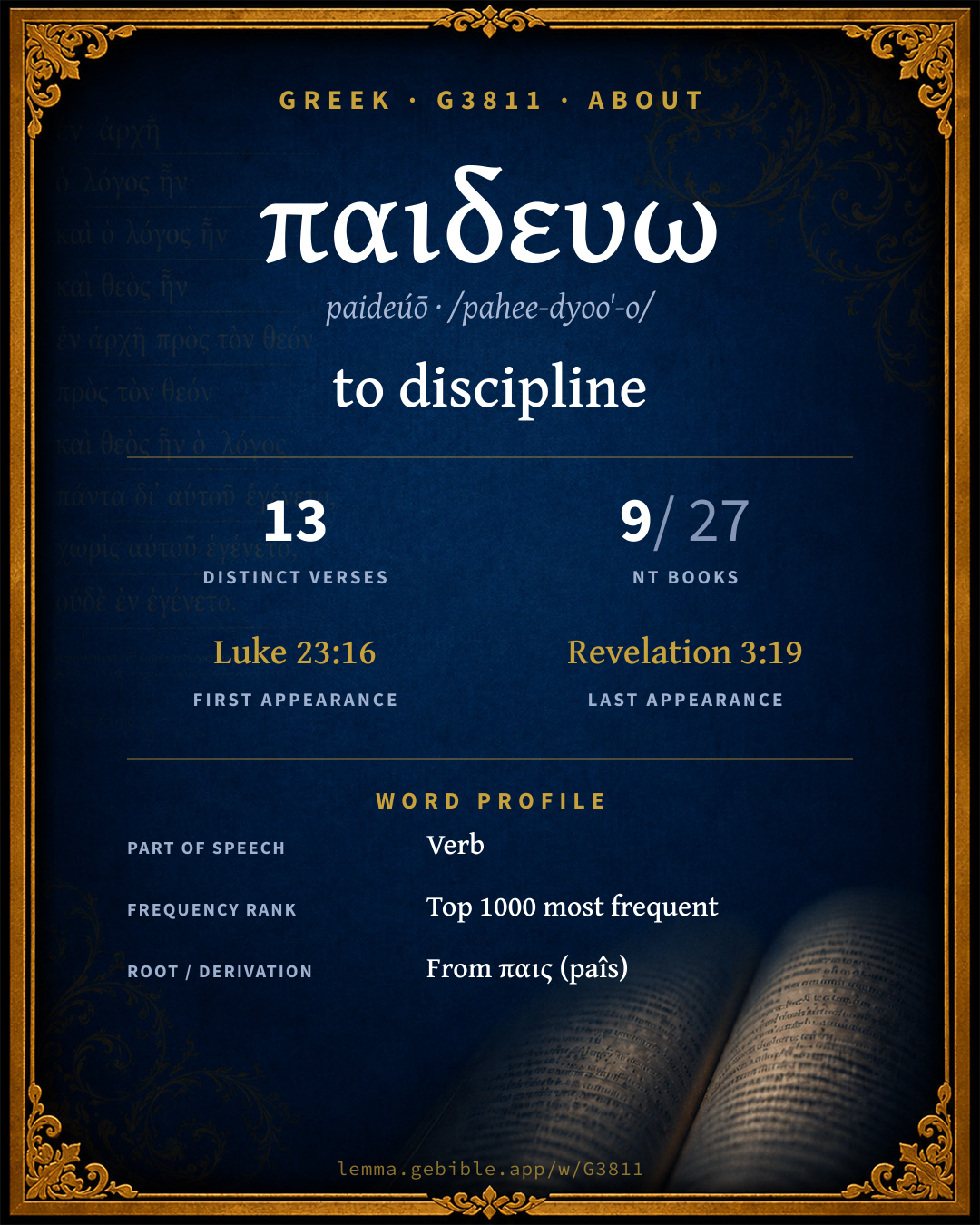
παιδεύω
to discipline
‘to discipline’ is one of 5 main senses fuller range ↓
Full lexicon entry — Thayer's Greek Lexicon
From Thayer's Greek Lexicon
Where this word appears
Grammar key — what these labels mean
Part of speech
- Verb
- An action or state-of-being word.
Tense
- Aorist
- Action viewed as a simple whole, without regard to duration — often past (perfective aspect).
- Present
- Ongoing or general action in present time (imperfective aspect).
- Imperfect
- Continuous or repeated action in past time (“was writing”).
- Perfect
- A completed past action with continuing present results.
Voice
- Active
- The subject performs the action.
- Passive
- The subject receives the action.
Mood
- Participle
- A verbal adjective (“writing,” “having written”).
- Indicative
- States a fact or asks a factual question (the mood of reality).
- Subjunctive
- Expresses probability, purpose, or possibility (the mood of contingency).
Case
- Nominative
- The case of the subject (and the predicate nominative).
- Accusative
- The case of the direct object and of extent.
Person
- 3rd person
- The one spoken about (“he / she / it / they”).
- 1st person
- The speaker (“I / we”).
Gender
- Masculine
- Grammatically masculine.
- Feminine
- Grammatically feminine.
Number
- Singular
- One.
- Plural
- More than one.
Every verse where G3811 appears in the Book of 1 Timothy — 1 distinct verse. Click any verse to open its interlinear word-by-word view. Verse text shown in the World English Bible for context — . Each verse’s Greek form is shown with its reference; the English is not keyword-highlighted, since the data carries no word-level English alignment. Use “Compare translations” on any verse to read it across multiple English versions. This concordance covers the Greek New Testament; Septuagint (Greek Old Testament) occurrences of this word are not indexed here.
1 Timothy
About this entry
At a glance — auto-summarized from this page’s data, not written by a person. Every figure links to its source below. This summary describes the numbers; it doesn’t interpret them.
The Greek verb παιδευω centers on the idea of “to discipline.” Lexicons map it across 5 senses. The Greek New Testament uses it across 13 verses — uncommon. First canonically at Luke 23:16, it enters the text early. Related forms include παις, παιδαγωγος and παιδαριον. For the data behind this summary, explore the sense tree and the renderings breakdown below.
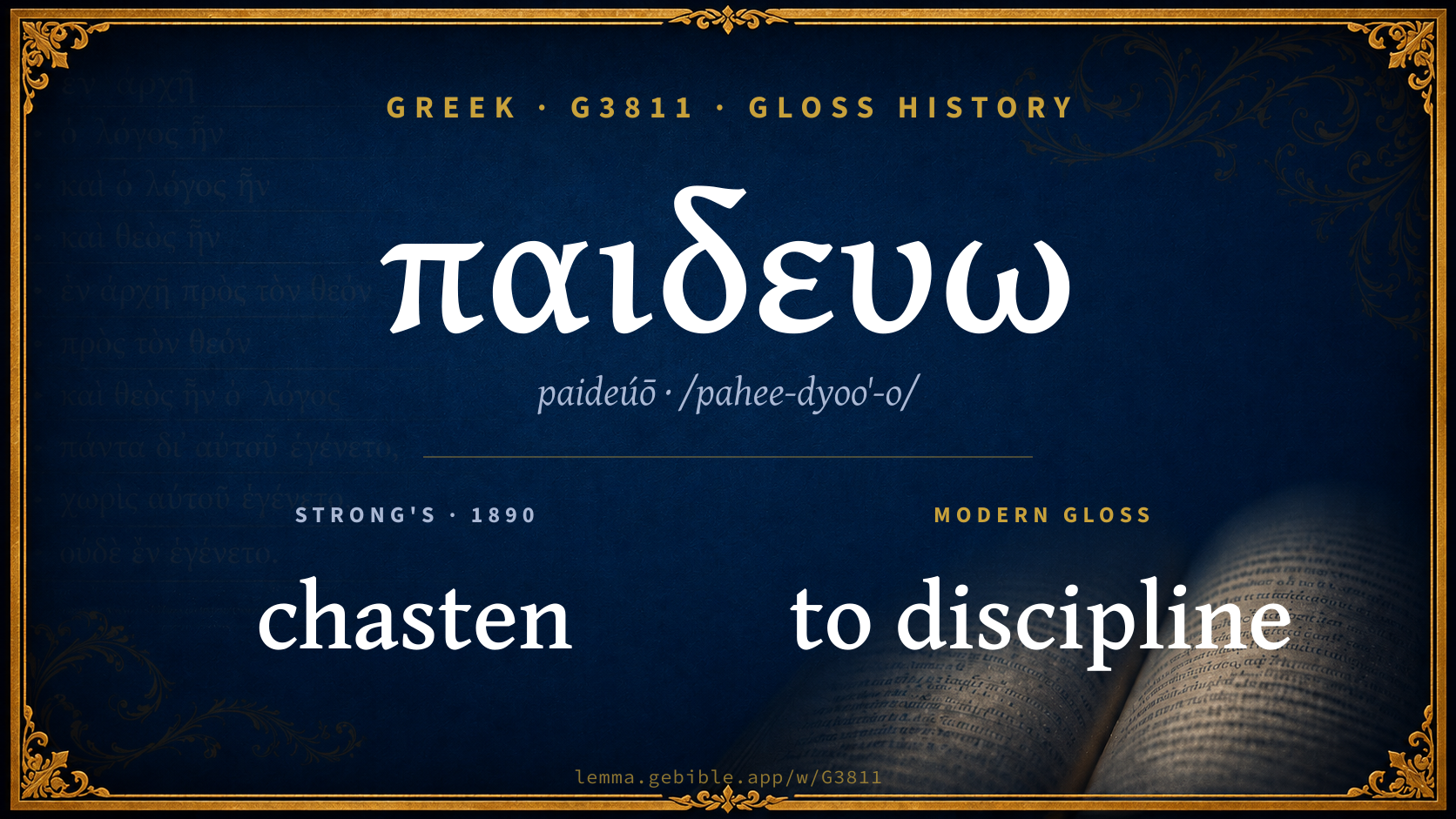
Gloss history
Strong's 1890 vs modern scholarship
About this word
Strong's G3811 catalogs a Greek word from the Greek New Testament.
These counts are not copied from any lexicon or concordance. They are computed here, from the morphology-tagged Greek New Testament. What Lemma adds →
- 13
- distinct verses
- The word appears in 13 distinct verses.
- 9 / 27
- NT books
- The word appears in 9 of 27 New Testament books.
- #863
- by frequency
- Top 1000 most frequent Greek words (rank 863 of 5,347 Greek words by occurrence).
View all 13 occurrences in the concordance →
By section of the New Testament
By traditional corpus
Conventional, traditional groupings — biblical authorship is debated, so this is a traditional corpus grouping, not an authorship claim. Some books belong to more than one corpus (Luke is in both the Gospels and the Lukan corpus, and so on), so these shares overlap and need not total 100%. Each figure is a share of the word’s 13 distinct verses.
- Pauline corpus 5 verses · 38%
- Lukan (Luke–Acts) 4 verses · 31%
- Hebrews 3 verses · 23%
- Gospels 2 verses · 15%
- Johannine 1 verse · 8%
- Revelation 1 verse · 8%
How translations render this word
Counts come from each version’s own published word-to-Strong’s tagging or interlinear alignment — an approximate guide to how each version renders this word, not a word-level alignment the data otherwise carries. Because each total is that version’s own tagged count, the per-version totals vary from one another and need not match the appearance or distinct-verse counts above. These counts may also differ from a printed concordance because Lemma counts each distinctly tagged rendering and does not collapse phrase taggings into a single head-word total. This is a fixed set of word-tagged versions (KJV, ASV, BSB, ULT) and does not change with the reading translation you choose elsewhere. Each version’s license is shown beside its name below (and on Sources).
- King James Version: Chastened 2×, Chastise 2×, I will 2×
- American Standard Version: Chastened 2×, Chastise 2×, I will 2×
- Berean Standard Bible: After i punish 1×, Be taught 1×, Discipline 1×
- unfoldingWord Literal Text: Discipline 2×, Having punished 2×
King James Version Public Domain
Renders G3811 across 15 tagged occurrences — most commonly:
Plus 9 renderings that appear only once — usually multi-word phrases or single function words the recovered tagging swept in, not distinct renderings.
American Standard Version Public Domain
Renders G3811 across 16 tagged occurrences — most commonly:
Plus 10 renderings that appear only once — usually multi-word phrases or single function words the recovered tagging swept in, not distinct renderings.
Berean Standard Bible Public Domain
Renders G3811 across 13 tagged occurrences — most commonly:
Plus other, less common renderings.
unfoldingWord Literal Text CC BY-SA 4.0
Renders G3811 across 15 tagged occurrences — most commonly:
Plus 11 renderings that appear only once — usually multi-word phrases or single function words the recovered tagging swept in, not distinct renderings.
Senses in Thayer's
The 5 senses Thayer's distinguishes for this word, in lexicon order (not ranked by frequency or importance). The full entry — with sub-senses — is in the Lexicon Entry tab.
- to be instructed or taught or learn
- to cause one to learn
- to chastise or castigate with words, to correct
- of God
- to chastise with blows, to scourge
Word origin
Derived from παις (paîs) (G3816) — child.
From G3816 ; to train up a child that is educate or (by implication) discipline (by punishment): - chasten (-ise) instruct learn teach.
— Strong’s Exhaustive Concordance (1890), public domain.
Forms in the corpus
The 11 distinct written forms G3811 takes in the Greek New Testament, most frequent first — each parse links to that tense’s occurrences in the concordance.
Same root — word family
Other Thayer's entries built from the same root as G3811, grouped by Strong’s listed origin. These share a root / origin per the lexicon — not necessarily a shared meaning. Each links to that word’s own entry.
Derives from
Shares the same root
- παιδαγωγος paidagōgós G3807 tutor
- παιδαριον paidárion G3808 boy
- παιδιον paidíon G3813 small child
- παιδισκη paidískē G3814 young girl
- παιζω paízō G3815 to play
Derived from this word
Compare all same-root words → Showing 4 of 9 — not the complete family. They share a root, not necessarily a meaning.
Septuagint usage
The same Greek word παιδευω appears 58 times in the Greek Old Testament (Septuagint), across 49 verses in 12 books.
- 58
- LXX occurrences
- Tagged occurrences of this Greek word in the Septuagint.
- 49
- verses
- Distinct Septuagint verses containing this word.
- 12 / 39
- OT books
- The word appears in 12 of the 39 Old Testament books.
Sample Septuagint occurrences
- Leviticus 26:18 παιδεύω
- Deuteronomy 4:36 παιδεύω
- 2 Samuel 22:48 παιδεύω
- 1 Kings 12:11 παιδεύω
- 2 Chronicles 10:11 παιδεύω
- Esther 2:7 παιδεύω
- Psalms 2:10 παιδεύω
- Proverbs 3:12 παιδεύω
- Isaiah 28:26 παιδεύω
- Jeremiah 2:19 παιδεύω
- Ezekiel 23:48 παιδεύω
- Hosea 7:12 παιδεύω
Septuagint occurrences (same lexeme)
Every verse where the same Strong’s number (G3811) appears in the Greek Septuagint. Verse text shown in the World English Bible for context; the Greek form is the matched word — the English is not keyword-highlighted.
- Leviticus 26:18 παιδεύω "'If you in spite of these things will not listen to me, then I will chastise you seven times more for your sins.
- Leviticus 26:23 παιδεύω "'If by these things you won't be reformed to me, but will walk contrary to me;
- Leviticus 26:28 παιδεύω then I will walk contrary to you in wrath; and I also will chastise you seven times for your sins.
- Deuteronomy 4:36 παιδεύω Out of heaven he made you to hear his voice, that he might instruct you: and on earth he made you to see his great fire; and you heard his words out of the midst of the fire.
- Deuteronomy 8:5 παιδεύω You shall consider in your heart that as a man chastens his son, so Yahweh your God chastens you.
- Deuteronomy 21:18 παιδεύω If a man have a stubborn and rebellious son, who will not obey the voice of his father, or the voice of his mother, and, though they chasten him, will not listen to them;
- Deuteronomy 22:18 παιδεύω The elders of that city shall take the man and chastise him;
- Deuteronomy 32:10 παιδεύω He found him in a desert land, In the waste howling wilderness; He compassed him about, he cared for him, He kept him as the apple of his eye.
- 2 Samuel 22:48 παιδεύω Even the God who executes vengeance for me, Who brings down peoples under me,
- 1 Kings 12:11 παιδεύω Now whereas my father did lade you with a heavy yoke, I will add to your yoke: my father chastised you with whips, but I will chastise you with scorpions.
- 1 Kings 12:14 παιδεύω and spoke to them after the counsel of the young men, saying, My father made your yoke heavy, but I will add to your yoke: my father chastised you with whips, but I will chastise you with scorpions.
- 2 Chronicles 10:11 παιδεύω Now whereas my father did lade you with a heavy yoke, I will add to your yoke: my father chastised you with whips, but I [will chastise you] with scorpions.
- 2 Chronicles 10:14 παιδεύω and spoke to them after the counsel of the young men, saying, My father made your yoke heavy, but I will add thereto: my father chastised you with whips, but I [will chastise you] with scorpions.
- Esther 2:7 παιδεύω He brought up Hadassah, who is, Esther, his uncle's daughter: for she had neither father nor mother, and the maiden was fair and beautiful; and when her father and mother were dead, Mordecai took her for his own daughter.
- Psalms 2:10 παιδεύω Now therefore be wise, you kings. Be instructed, you judges of the earth.
- Psalms 6:2 παιδεύω Have mercy on me, Yahweh, for I am faint. Yahweh, heal me, for my bones are troubled.
- Psalms 15:7 παιδεύω
- Psalms 37:2 παιδεύω For they shall soon be cut down like the grass, And wither like the green herb.
- Psalms 38:12 παιδεύω They also who seek after my life lay snares. Those who seek my hurt speak mischievous things, And meditate deceits all day long.
- Psalms 89:10 παιδεύω You have broken Rahab in pieces, like one of the slain. You have scattered your enemies with your mighty arm.
- Psalms 93:10 παιδεύω
- Psalms 93:12 παιδεύω
- Psalms 104:22 παιδεύω The sun rises, and they steal away, And lay down in their dens.
- Psalms 117:18 παιδεύω
- Psalms 140:5 παιδεύω The proud have hidden a snare for me, They have spread the cords of a net by the path. They have set traps for me. Selah.
- Proverbs 3:12 παιδεύω For whom Yahweh loves, he reproves; Even as a father reproves the son in whom he delights.
- Proverbs 5:13 παιδεύω Neither have I obeyed the voice of my teachers, Nor turned my ear to those who instructed me!
- Proverbs 9:7 παιδεύω He who corrects a mocker invites insult. He who reproves a wicked man invites abuse.
- Proverbs 10:4 παιδεύω He becomes poor who works with a lazy hand, But the hand of the diligent brings wealth.
- Proverbs 13:24 παιδεύω One who spares the rod hates his son, But one who loves him is careful to discipline him.
- Proverbs 19:18 παιδεύω Discipline your son, for there is hope; Don't be a willing party to his death.
- Proverbs 22:3 παιδεύω A prudent man sees danger, and hides himself; But the simple pass on, and suffer for it.
- Proverbs 23:13 παιδεύω Don't withhold correction from a child. If you punish him with the rod, he will not die.
- Proverbs 28:17 παιδεύω A man who is tormented by life blood will be a fugitive until death; No one will support him.
- Proverbs 29:17 παιδεύω Correct your son, and he will give you peace; Yes, he will bring delight to your soul.
- Proverbs 29:19 παιδεύω A servant can't be corrected by words. Though he understands, yet he will not respond.
- Proverbs 31:1 παιδεύω The words of king Lemuel; the oracle which his mother taught him.
- Isaiah 28:26 παιδεύω For his God does instruct him aright, [and] does teach him.
- Isaiah 46:3 παιδεύω Listen to me, house of Jacob, and all the remnant of the house of Israel, that have been borne [by me] from their birth, that have been carried from the womb;
- Jeremiah 2:19 παιδεύω Your own wickedness shall correct you, and your backsliding shall reprove you: know therefore and see that it is an evil thing and a bitter, that you have forsaken Yahweh your God, and that my fear is not in you, says the Lord, Yahweh of Hosts.
- Jeremiah 6:8 παιδεύω Be instructed, Jerusalem, lest my soul be alienated from you; lest I make you a desolation, a land not inhabited.
- Jeremiah 10:24 παιδεύω Yahweh, correct me, but in measure: not in your anger, lest you bring me to nothing.
- Jeremiah 26:28 παιδεύω
- Jeremiah 38:18 παιδεύω But if you will not go forth to the king of Babylon's princes, then shall this city be given into the hand of the Chaldeans, and they shall burn it with fire, and you shall not escape out of their hand.
- Ezekiel 23:48 παιδεύω Thus will I cause lewdness to cease out of the land, that all women may be taught not to do after your lewdness.
- Ezekiel 28:3 παιδεύω behold, you are wiser than Daniel; there is no secret that is hidden from you;
- Hosea 7:12 παιδεύω When they go, I will spread my net on them. I will bring them down like the birds of the sky. I will chastise them, as their congregation has heard.
- Hosea 7:14 παιδεύω They haven't cried to me with their heart, But they howl on their beds. They assemble themselves for grain and new wine. They turn away from me.
- Hosea 10:10 παιδεύω When it is my desire, I will chastise them; And the nations will be gathered against them, When they are bound to their two transgressions.
These are occurrences of the same Greek lexeme (G3811) in the Septuagint — not a translation of any one Hebrew word. The store carries no word-level Hebrew↔Greek alignment, so no Hebrew original is asserted here. Counts come from the recovered LXX Strong's tagging — high-frequency vocabulary is well covered, while rare or late forms may be untagged — so they reflect tagged occurrences and may slightly undercount.