1 Timothy 1:20

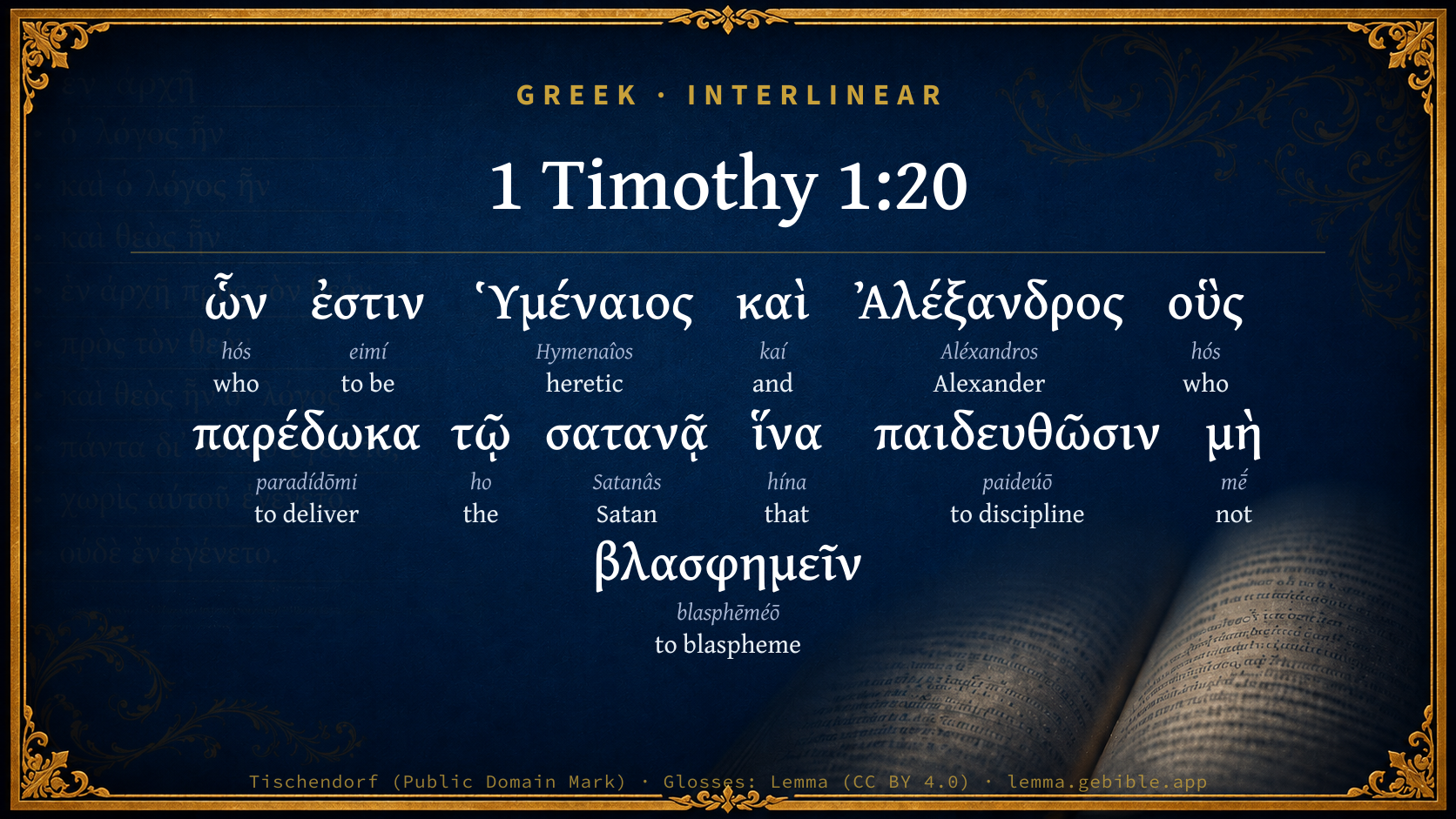
Greek (Tischendorf 8th ed.) 1 Timothy 1:20 appears in the Greek New Testament. The text above is from the Tischendorf 8th edition. Each word links to its Strong’s number and a concise gloss. Click any word for its full Thayer’s Greek Lexicon entry.
Download image
Cite this verse

1 Timothy 1:20 (World English Bible). Public Domain. Lemma interlinear Bible study tool, https://lemma.gebible.app/v/1-timothy/1/20.

Show BibTeX & RIS
BibTeX
RIS
English Translation
of whom is Hymenaeus and Alexander; whom I delivered to Satan, that they might be taught not to blaspheme.
World English Bible · Public Domain
Highlights
  • 1 first appearance in the Greek New Testament
Full analysis ↓
Download a study sheet

One document with this verse’s original text, its word-by-word gloss line, the meaning frame, cross-references with their text, attributed commentary, and full source and license credits — printable, and it pastes into notes with its structure intact.

This verse Autodidact and up

Study sheet (.html) Plain text (.txt)

A passage Seminary Student

Up to 50 verses in one chapter. A passage sheet keeps up to 6 commentary sources and 12 cross-references per verse, in the order this page ranks them, and says so on the sheet whenever that leaves anything out. Ask for a single verse and you get the Autodidact verse sheet above.

Everything on this page stays free to read, with no account — the sheet is a download of what is already on screen, not access to it.

Want to remove ads? Support Godless Engineer
Compare translations 3

The same verse in 3 English versions, stacked beneath the original-language interlinear above. Click any original word for its lexicon entry.

Each is an independent rendering of the whole verse — the interlinear is not word-aligned to these translations.

Highlighted words mark where these versions differ — a whole-verse word diff, not a word-by-word alignment.

  • World English Bible Public Domain
    of whom is Hymenaeus and Alexander; whom I delivered to Satan, that they might be taught not to blaspheme.
  • King James Version Public Domain
    Of whom is Hymenaeus and Alexander; whom I have delivered unto Satan, that they may learn not to blaspheme.
  • unfoldingWord Literal Text CC BY-SA 4.0
    of whom are Hymenaeus and Alexander, whom I have given over to Satan so that they may be taught not to blaspheme.

unfoldingWord Literal Text — © unfoldingWord, licensed CC BY-SA 4.0. Word-aligned USFM3 via Door43 (git.door43.org/unfoldingWord/en_ult).

Versions to compare (up to 4)

3 of 4 selected

Show all 19 translations

Every available English version of this verse, each an independent rendering of the whole verse.

  • World English Bible Public Domain
    of whom is Hymenaeus and Alexander; whom I delivered to Satan, that they might be taught not to blaspheme.
  • Berean Standard Bible Public Domain
    Among them are Hymenaeus and Alexander, whom I have handed over to Satan to be taught not to blaspheme.
  • Majority Standard Bible Public Domain
    Among them are Hymenaeus and Alexander, whom I have handed over to Satan to be taught not to blaspheme.
  • King James Version Public Domain
    Of whom is Hymenaeus and Alexander; whom I have delivered unto Satan, that they may learn not to blaspheme.
  • American Standard Version (1901) Public Domain
    of whom is Hymenaeus and Alexander; whom I delivered unto Satan, that they might be taught not to blaspheme.
  • Revised Version (1885) Public Domain
    of whom is Hymenaeus and Alexander; whom I delivered unto Satan, that they might be taught not to blaspheme.
  • Geneva Bible (1599) Public Domain
    Of whom is Hymeneus, and Alexander, whom I haue deliuered vnto Satan, that they might learne not to blaspheme.
  • Douay-Rheims (1899) Public Domain
    Of whom is Hymeneus and Alexander, whom I have delivered up to Satan, that they may learn not to blaspheme.
  • Young's Literal Translation Public Domain
    of whom are Hymenaeus and Alexander, whom I did deliver to the Adversary, that they might be instructed not to speak evil.
  • Literal Standard Version CC BY-SA 4.0
    of whom are Hymenaeus and Alexander, whom I delivered to Satan, that they might be instructed not to speak evil.
  • Unlocked Literal Bible CC BY-SA 4.0
    Such are Hymenaeus and Alexander, whom I gave over to Satan so that they may be taught not to blaspheme.
  • unfoldingWord Literal Text CC BY-SA 4.0
    of whom are Hymenaeus and Alexander, whom I have given over to Satan so that they may be taught not to blaspheme.
  • Darby Bible Public Domain
    of whom is Hymenaeus and Alexander, whom I have delivered to Satan, that they may be taught by discipline not to blaspheme.
  • World Messianic Bible Public Domain
    of whom are Hymenaeus and Alexander, whom I delivered to Satan that they might be taught not to blaspheme.
  • Webster's Bible Public Domain
    Of whom is Hymeneus and Alexander; whom I have delivered to Satan, that they may learn not to blaspheme.
  • Free Bible Version CC BY-SA 4.0
    Hymenaeus and Alexander are such people, and I have “handed them over to Satan” to teach them not to misrepresent God.
  • Bible in Basic English Public Domain
    Such are Hymenaeus and Alexander, whom I have given up to Satan, so that they may say no more evil words against God.
  • Text-Critical English NT CC BY 4.0
    Among them are Hymenaeus and Alexander, whom I have handed over to Satan so that they may learn not to blaspheme.
  • Tyndale New Testament (1534) Public Domain
    Of whose nombre is Himeneus and Alexander which I have delivered vnto Satan that they myght be taught not to blaspheme

Literal Standard Version (2020), Covenant Press — licensed CC BY-SA 4.0. Text via the HelloAO Bible API (eBible.org). Unlocked Literal Bible (unfoldingWord) — licensed CC BY-SA 4.0. Text via the HelloAO Bible API (eBible.org). unfoldingWord Literal Text — © unfoldingWord, licensed CC BY-SA 4.0. Word-aligned USFM3 via Door43 (git.door43.org/unfoldingWord/en_ult). Free Bible Version, Dr. Jonathan Gallagher — licensed CC BY-SA 4.0. Text via the HelloAO Bible API (eBible.org).

Word by word

More ways to search: Search by grammar → Find every occurrence → Compare this word →

Practice this passage: Drill this verse → Learn its vocabulary →

Ὑμέναιος
Hymenaîos
G5211
“heretic”
Noun, Nominative, Singular, Masculine
Part of Speech
Noun
Case
Nominative
Number
Singular
Gender
Masculine
Full Thayer's Definition

Origin: from Humen (the God of weddings)

TDNT: None

Hymenaeus = "belonging to marriage" 1. a heretic, one of the opponents of the apostle Paul
  1. ὧν hós G3739 “who” Relative pronoun, Genitive, Plural, Masculine
  2. ἐστιν eimí G1510 “to be” Verb, Present, Active, Indicative, 3rd person, Singular
  3. καὶ kaí G2532 “and” Conjunction
  4. Ἀλέξανδρος Aléxandros G223 “Alexander” Noun, Nominative, Singular, Masculine
  5. οὓς hós G3739 “who” Relative pronoun, Accusative, Plural, Masculine
  6. παρέδωκα paradídōmi G3860 “to deliver” Verb, Aorist, Active, Indicative, 1st person, Singular
  7. τῷ ho G3588 “the” Article, Dative, Singular, Masculine
  8. σατανᾷ Satanâs G4567 “Satan” Noun, Dative, Singular, Masculine
  9. ἵνα hína G2443 “that” Conjunction
  10. παιδευθῶσιν paideúō G3811 “to discipline” Verb, Aorist, Passive, Subjunctive, 3rd person, Plural
  11. μὴ mḗ G3361 “not” Particle, Negative
  12. βλασφημεῖν blasphēméō G987 “to blaspheme” Verb, Present, Active, Infinitive

About this verse

These counts appear in no published source. They are computed here, from the morphology-tagged text and Lemma’s own curated glosses. What Lemma adds →

13
words
12
distinct lemmas
Pauline Epistles
section

Notable vocabulary

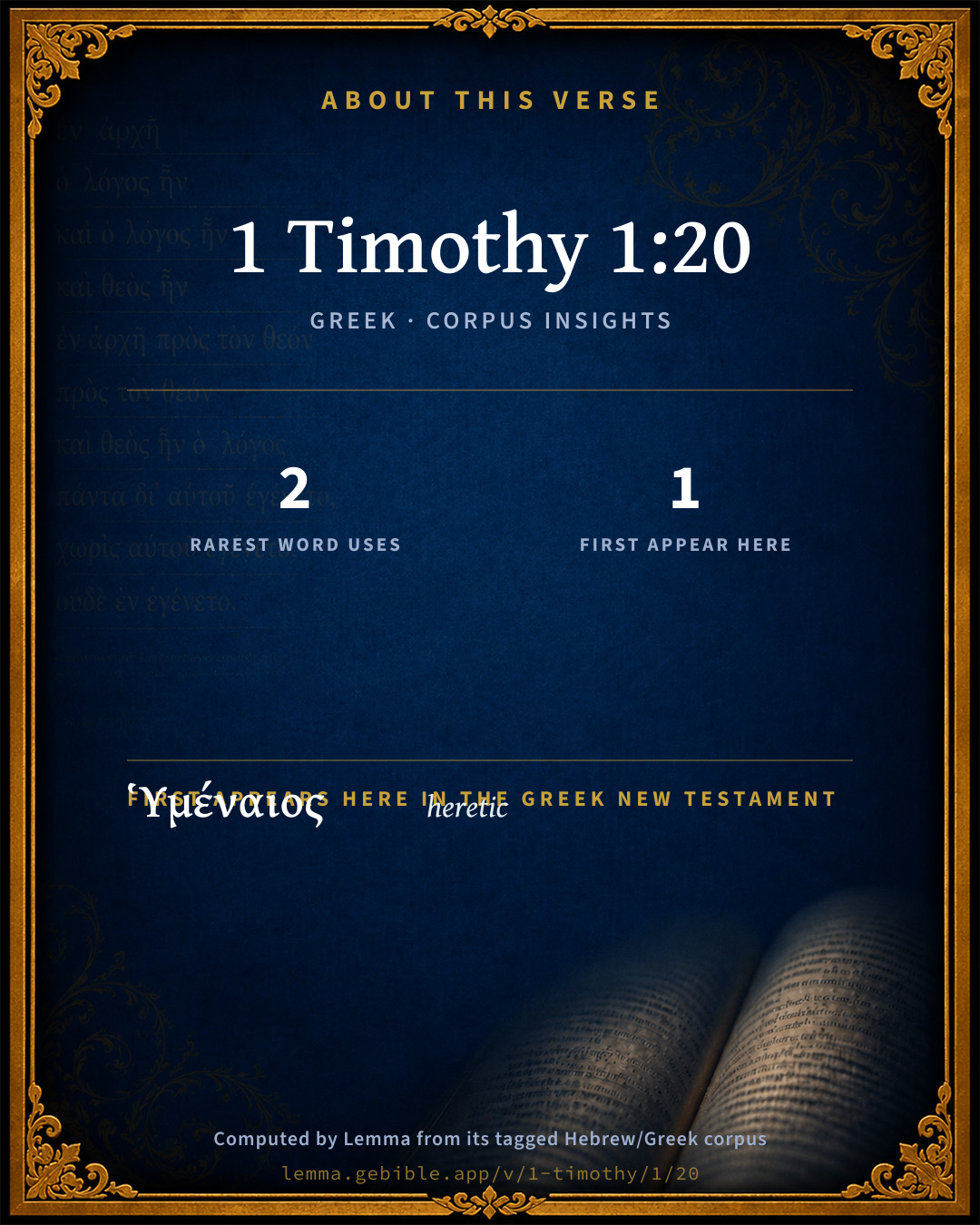
The rarest word here is Ὑμέναιος heretic G5211 — appearing just 2 times in the whole Greek New Testament.

First appearance in Scripture

This word makes its first canonical appearance in the Greek New Testament here:

  • Ὑμέναιος heretic G5211

Shared distinctive vocabulary

Ὑμέναιος heretic G5211 occurs in 2 verses of the Greek New Testament. Also found in:

Repetition

A word recurs within this verse:

Cross-references

15

Topical passages linked to 1 Timothy 1:20 in the Treasury of Scripture Knowledge — connected by theme and wording, ordered by reader-vote popularity; previews shown in the World English Bible.

  • 1 Corinthians 5:4–5 In the name of our Lord Jesus Christ, you being gathered together, and my spirit, with the power of our Lord Jesus Christ,
  • 1 Corinthians 11:32 But when we are judged, we are punished by the Lord, that we may not be condemned with the world.
  • 2 Timothy 2:17 and their word will consume like gangrene, of whom is Hymenaeus and Philetus;
  • 2 Thessalonians 3:15 Don't count him as an enemy, but admonish him as a brother.
  • Revelation 3:19 As many as I love, I reprove and chasten. Be zealous therefore, and repent.
  • Acts 19:33 They brought Alexander out of the multitude, the Jews putting him forward. Alexander beckoned with his hand, and would have made a defense to the people.
  • Revelation 13:5–6 A mouth speaking great things and blasphemy was given to him. Authority to make war for forty-two months was given to him.
  • Acts 13:45 But when the Jews saw the multitudes, they were filled with jealousy, and contradicted the things which were spoken by Paul, and blasphemed.
  • 2 Corinthians 10:6 and being in readiness to avenge all disobedience, when your obedience will be made full.
  • 2 Timothy 2:14 Remind them of these things, charging them in the sight of the Lord, that they don't argue about words, to no profit, to the subverting of those who hear.
  • 2 Timothy 3:2 For men will be lovers of self, lovers of money, boastful, arrogant, blasphemers, disobedient to parents, unthankful, unholy,
  • 2 Timothy 4:14–15 Alexander, the coppersmith, did much evil to me. The Lord will repay him according to his works,
  • Revelation 13:1 Then I stood on the sand of the sea. I saw a beast coming up out of the sea, having ten horns and seven heads. On his horns were ten crowns, and on his heads, blasphemous names.
  • Matthew 18:17 If he refuses to listen to them, tell it to the assembly. If he refuses to hear the assembly also, let him be to you as a Gentile or a tax collector.
  • 2 Corinthians 13:10 For this cause I write these things while absent, that I may not deal sharply when present, according to the authority which the Lord gave me for building up, and not for tearing down.

Cross-references courtesy of OpenBible.info (CC BY 4.0).

Commentary

Notes on 1 Timothy 1:20 from classic Christian and Jewish commentators (each source and its license shown beneath its notes). The classic Christian expositions comment on the surrounding passage and are grouped to its opening verse, so a note may address several verses; the Jewish commentaries on the Tanakh (Rashi and others) are per-verse, so they appear only where the commentator wrote on this verse.

Lemma curates 59 commentaries, every one of them public domain or Creative Commons licensed, each selected and text-cleaned for this edition rather than reprinted as found. About our sources →

Tyndale Open Study Notes

Tyndale Open Resources

1:20 Hymenaeus and Alexander might have been elders in Ephesus (see also 2 Tim 2:17; 4:14; cp. Acts 19:33; 20:29-31). • Paul handed them over to Satan by removing them from the church, the realm of the Spirit’s oversight (see also 2 Tim 2:25-26; Job 2:6; Matt 18:17-20; 1 Cor 5:2-5; 2 Cor 2:5-11). • blaspheme God: They attacked and defamed the true Good News, and thus God himself (see 1 Tim 1:13; cp. 6:1; Titus 2:5; 2 Pet 2:2).

Tyndale Open Study Notes — © Tyndale Open Resources, licensed CC BY-SA 4.0. Text via the HelloAO Bible API.

Bengel's Gnomon

Johann Albrecht Bengel

1Ti 1:20. Ὑμέναιος καὶ Ἀλέξανδρος, Hymenœus and Alexander) A reproof, with the names expressed: comp. on Hymenæus and Alexander, 2Ti 2:16-17; 2Ti 4:14-15.—οὓς, whom) though absent. They were at Ephesus; Paul was at Rome. This was the part of an apostle; it was the part of Timothy merely to avoid them and to be on his guard.—παρέδωκα, I have delivered) for [or to] the destruction of the flesh [1Co 5:5].—μὴ βλασφημεῖν) lest they should fall into blasphemy, and wholly complete their guilt by becoming more hurtful to themselves and others. [The danger of blasphemy is near at hand to the man who has made shipwreck of his faith. Satan might harass them: he could not force them to blaspheme.—V. g.]

—————

Bengel's Gnomon of the New Testament — English translation (T&T Clark, Edinburgh, 1860) — public domain. Text from a community e-Sword module.

Meyer's Critical & Exegetical Commentary

Heinrich August Wilhelm Meyer

1Ti_1:20. Ὧν ἐστὶν Ὑμέναιος καὶ Ἀλέξανδρος] In 2Ti_2:17, the apostle names two false teachers whose words eat like a cancer

Hymenaeus and Philetus. There is no ground for distinguishing between the Hymenaeus there and the one here mentioned. No difficulty is caused even by the fact that the one here is mentioned as a man cast out from the church, and the other merely as an example of error (de Wette); for Hymenaeus and Philetus are not so tenderly dealt with in the other passages as de Wette seems to think. As to Alexander, we must leave it unsettled whether he is the same as the one mentioned in 2Ti_4:14. The reasons are not decisive which seem to tell against the identity, viz. that in the other passage the surname ὁ χαλκεύς is added, and that he is mentioned there not as excommunicated, but rather as still coming in contact with the apostle; not as a heretic, but as an opponent (de Wette). It is, however, quite arbitrary to regard the Alexander (Act_19:33) who took part in the uproar at Ephesus as identical with the one mentioned here (see Meyer on the passage).[80]

ΟὛς ΠΑΡΈΔΩΚΑ Τῷ ΣΑΤΑΝᾷ] the same excommunication of which the apostle speaks in 1Co_5:5 (comp. Meyer on the passage). It is not simply excommunication from the church, but with the purpose of ensuring, through Satans means, ὌΛΕΘΡΟς Τῆς ΣΑΡΚΌς to the one excommunicated. This is shown not only by the formula itself, but also by the solemnity with which Paul there expresses himself. The added clause, ἽΝΑ ΠΑΙΔΕΥΘῶΣΙΝ Κ.Τ.Λ., makes it clear that here also the apostle had in mind ΕἸς ὌΛΕΘΡΟΝ Τ. ΣΑΡΚ., for that clause at the same time gives the purpose of the ΠΑΡΈΔΩΚΑ, which is the reformation (ἽΝΑ ΤῸ ΠΝΕῦΜΑ ΣΩΘῇ, 1Co_5:5), or at least the preservation, of the excommunicated man from ΒΛΑΣΦΗΜΕῖΝ.[81]

ΠΑΙΔΕΎΕΙΝ] in classical Greek equivalent to educate, especially by instruction, so also Act_7:22; Act_22:3, has elsewhere in the N. T. the meaning of punish in order to reform, i.e. chastise; comp. 2Ti_2:25; 1Co_11:32; 2Co_6:9, especially Heb_12:5-11. In Rev_3:19 it stands connected with ἐλέγχειν (in Luk_23:16; Luk_23:22, the purpose of reformation falls quite into the background).

The ὌΛΕΘΡΟς Τῆς ΣΑΡΚΌς is intended by the apostle to be a chastisement to the one named, that he may be kept from further reviling. The expression ΒΛΑΣΦΗΜΕῖΝ shows that they had not only suffered shipwreck in faith, but in their unbelief were on the point of proceeding actually to revile the Lord.

[80] Otto (pp. 98112) gives a very vivid and detailed picture of the tumult at Ephesus in which a certain Alexander took part, in order to prove the identity of the two Alexanders, and confirm his view regarding the date of the composition of this epistle. But even if the course of that tumult was as Otto describes it, with the aid of many arbitrary suppositions, still we can by no means infer the identity he maintains. In order to prove it, Otto does not despise many strange assumptions, such as, that the designation χαλκεύς (2Ti_4:14) was given to Alexander because he was one of those who manufactured the miniature silver temples; further, that he, deceived by the soothsayers, had made no objection to the union of the worship of Jehovah with heathen idolatry.

[81] In opposition to Hofmanns opinion, that neither here nor in the passage of Corinthians we are to think of an excommunication from the church, comp. Meyer on 1Co_5:5.

Meyer — Critical and Exegetical Commentary on the New Testament — English translation by Peter Christie, edited by Frederick Crombie (T&T Clark, 1880) — public domain. Text from a community e-Sword module.

Expositor's Greek Testament

ed. W. Robertson Nicoll

1Ti 1:20 . οὓς παρέδωκα τῷ Σατανᾷ : I have delivered (A.V.) expresses more accurately than I delivered (R.V.) the force of the aorist followed by the subjunctive: they were still under sentence of excommunication (see Field in loc .). The theory of the relation of the Church to non-Christians which underlies this phrase is expressed in 1Jn 5:19 , ἐκ τοῦ θεοῦ ἐσμεν , καὶ ὁ κόσμος ὅλος ἐν τῷ πονηρῷ κεῖται . The ἐξουσία τοῦ Σατανᾶ was “the darkness” over against “the light” of the Kingdom of God (Act 26:18 ). The conception is not popular among modern Christians. The two kingdoms, if there are two, have interpenetrated each other. The phraseology, here and in the parallel, 1Co 5:5 , is based on Job 2:6 , ἰδοὺ παραδίδωμί σοι σὐτόν . The name Σατανᾶς also occurs in chap. 1Ti 5:15 and in eight other places in the Pauline Epistles.

ἵνα παιδευθῶσι : The apostolic severity was not merely punitive; it was also corrective. The intention, at least, of excommunication was ἵνα τὸ πνεῦμα σωθῇ , 1Co 5:5 . So Chrys. We must not therefore render here, sarcastically, that they may learn , A.V., but that they might be taught or instructed . At the same time, it is unnatural to assume with Bengel that the ταιδεία was intended to keep them from blaspheming at all; St. Paul hoped that it might prevent a repetition of the sin. The term has more of the association of discipline here and in 1Co 11:32 , 2Co 6:9 , than in the other references.

βλασφημεῖν : It is absurd to suppose that St. Paul here refers to a railing disparagement of his own apostolic claims.

The Expositor's Greek Testament, edited by W. Robertson Nicoll (1897–1910) — public domain. Text from a community e-Sword module.

Geneva Bible (1599)

Geneva Bible translators

Cast out of the Church, and so delivered them to Satan.

Such as fall from God, and his religion, are not to be suffered in the Church, but rather ought to be excommunicated.

That by their smart they might learn what it is to blaspheme.

Geneva Bible (1599) marginal notes — public domain. Text via Bolls.life.

Jamieson, Fausset & Brown

Robert Jamieson, A. R. Fausset & David Brown

Hymenaeus--There is no difficulty in supposing him to be the Hymenæus of Ti2 2:17. Though "delivered over to Satan" (the lord of all outside the Church, Act 26:18, and the executor of wrath, when judicially allowed by God, on the disobedient, Co1 5:5; Co2 12:7), he probably was restored to the Church subsequently, and again troubled it. Paul, as an apostle, though distant at Rome pronounced the sentence to be executed at Ephesus, involving, probably, the excommunication of the offenders (Mat 18:17-18). The sentence operated not only spiritually, but also physically, sickness, or some such visitation of God, falling on the person excommunicated, in order to bring him to repentance and salvation. Alexander here is probably "the coppersmith" who did Paul "much evil" when the latter visited Ephesus. The "delivering him to Satan" was probably the consequence of his withstanding the apostle (Ti2 4:14-15); as the same sentence on Hymenæus was the consequence of "saying that the resurrection is past already" (Ti2 2:18; his putting away good conscience, naturally producing shipwreck concerning FAITH, Ti1 1:19. If one's religion better not his morals, his moral deficiencies will corrupt his religion. The rain which falls pure from heaven will not continue pure if it be received in an unclean vessel [ARCHBISHOP WHATELY]). It is possible that he is the Alexander, then a Jew, put forward by the Jews, doubtless against Paul, at the riot in Ephesus (Act 19:33).

that they may--not "might"; implying that the effect still continues--the sentence is as yet unremoved.

learn--Greek, "be disciplined," namely, by chastisement and suffering.

blaspheme--the name of God and Christ, by doings and teachings unworthy of their Christian profession (Rom 2:23-24; Jam 2:7). Though the apostles had the power of excommunication, accompanied with bodily inflictions, miraculously sent (Co2 10:8), it does not follow that fallible ministers now have any power, save that of excluding from church fellowship notorious bad livers.

Next: 1 Timothy Chapter 2

Jamieson, Fausset & Brown — Commentary Critical and Explanatory on the Whole Bible (1871) — public domain (CC PDM 1.0). Text via the HelloAO Bible API.

Adam Clarke's Commentary

Verse 20. Of whom is Hymeneus and Alexander] Who had the faith but thrust it away; who had a good conscience through believing, but made shipwreck of it. Hence we find that all this was not only possible, but did actually take place, though some have endeavoured to maintain the contrary; who, confounding eternity with a state of probation, have supposed that if a man once enter into the grace of God in this life, he must necessarily continue in it to all eternity. Thousands of texts and thousands of facts refute this doctrine.

Delivered unto Satan] For the destruction of the flesh, that the spirit might be saved in the day of the Lord Jesus. See what is noted on 1Co 5:5; what this sort of punishment was no man now living knows. There is nothing of the kind referred to in the Jewish writings. It seems to have been something done by mere apostolical authority, under the direction of the Spirit of God.

Hymeneus, it appears, denied the resurrection, see 2Ti 2:17-18; but whether this Alexander be the same with Alexander the coppersmith, 2Ti 4:14, or the Alexander, Ac 19:33, cannot be determined. Probably, he was the same with the coppersmith. Whether they were brought back to the acknowledgment of the truth does not appear. From what is said in the second epistle the case seems extremely doubtful. Let him who most assuredly standeth, take heed lest he fall.

He that is self-confident is already half fallen. He who professes to believe that God will absolutely keep him from falling finally, and neglects watching unto prayer, is not in a safer state. He who lives by the moment, walks in the light, and maintains his communion with God, is in no danger of apostasy.

Adam Clarke's Commentary on the Bible (1810–1826) — public domain. Text from a community e-Sword/MySword module.

John Calvin's Commentaries

20 Of whom are Hymenaeus and Alexander. The former will be again mentioned in the Second Epistle, in which the kind of “shipwreck” which he made is likewise described; for he said that the resurrection was past. (2 Timothy 2:17-18.) There is reason to believe that Alexander also was bewitched by an error so absurd. And shall we wonder at the present day, if any are deceived by the various enchantments of Satan, when we see that one of Paul’s companions perished by so dreadful a fall?

He mentions both of them to Timothy as persons whom he knew. For my own part, I have no doubt that this is the same Alexander that is mentioned by Luke, and who attempted, but without success, to quell the commotion. Now he was an Ephesian, and we have said that this Epistle was chiefly written for the sake of the Ephesians. We now learn what was his end; and hearing it, let us keep possession of our faith by a good conscience, that we may hold it safe to the last.

Whom I have delivered to Satan. As I mentioned in the exposition of another passage, (1 Corinthians 5:5,) there are some who interpret this to mean that extraordinary chastisement was inflicted on those persons; and they view this as referring to δυνάμεις, “the powers” mentioned by Paul in the same Epistle. (1 Corinthians 12:28.) For, as the apostles were endowed with the gift of healing, in order to testify the favor and kindness of God towards the godly, so against wicked and rebellious persons they were armed with power, either to deliver them to the devil to be tormented, or to inflict on them other chastisements. Of this “power,” Peter gave a display in Ananias and Sapphira, (Acts 5:1,) and Paul in the magician Bar-Jesus. (Acts 13:6.) But, for my own part, I choose rather to explain it as relating to excommunication; for the opinion that the incestuous Corinthian received any other chastisement than excommunication is not supported by any probable conjecture. And, if by excommunicating him, Paul delivered him to Satan, why should not the same mode of expression have a similar import in this passage? Besides, it explains very well the force of excommunication; for, since in the Church Christ holds the seat of his kingdom, out of the Church there is nothing but the dominion of Satan. Accordingly, he who is cast out of the Church must be placed, for a time, under the tyranny of Satan, until, being reconciled to the Church, he return to Christ. I make one exception, that, on account of the enormity of the offense, he might have pronounced a sentence of perpetual excommunication against them; but on that point I would not venture to make a positive assertion.

That they may learn not to blaspheme. What is the meaning of this last clause? For one who has been cast out of the Church takes upon himself greater freedom of acting, because, being freed from the yoke of ordinary discipline, he breaks out into louder insolence. I reply, to whatever extent they may indulge in their wickedness, yet the gate will be shut against them, so that they shall not contaminate the flock; for the greatest injury done by wicked men is, when they mingle with others under the presence of holding the same faith. The power of doing injury is taken from them, when they are branded with public infamy, so that none are so simple as not to know that these are irreligious and detestable men, and therefore their society is shunned by all. Sometimes, too, it happens that — being struck down by this mark of disgrace which has been put upon them — they become less daring and obstinate; and therefore, although this remedy sometimes renders them more wicked, yet it is not always ineffectual for subduing their fierceness.

John Calvin's Commentaries (1540-1563) — public domain. Text from the Calvin Translation Society English edition (1840s-50s) via the Christian Classics Ethereal Library (ccel.org). Calvin's coverage is partial (roughly two-thirds of the Bible); uncommented books and verses are honest gaps, never fabricated. The 19th-century editor's footnotes and remarks are omitted so the notes are faithfully Calvin's own voice.

Ellicott's Commentary for English Readers

(20) Of whom is Hymenæus and Alexander.—Here the Apostle names two, as examples of the utter shipwreck of all true faith—persons evidently well known to Timothy and the members of the Church at Ephesus. Hymenæus is probably identical with the heretic of that name, charged, in the Second Epistle to Timothy, with teaching that the resurrection was already passed, thus undermining the great hope which Christian faith so firmly laid hold of. In the second letter to the Presbyter presiding over the Ephesian congregations the fundamental error was specified on account of which this Hymenæus was excommunicated.

Alexander.—It would be unsafe positively to identify this person with the personal adversary of St. Paul alluded to in the Second Epistle, 2Ti_4:14, there spoken of as “Alexander the coppersmith,” or with the Alexander mentioned in Act_19:33. The name was a very common one. Of the Alexander of Act_19:33 we know nothing; from the circumstances in connection with which he is there mentioned, which took place some ten years before this Epistle was written, he seems to have been a Jew.

Whom I have delivered unto Satan.—In this fearful formula the offender is delivered over to Satan, the evil one. It is a solemn excommunication or expulsion from the Church, accompanied with the infliction of bodily disease or death. In ordinary cases, the offender was quietly expelled from the Christian society. But an Apostle, and only an Apostle, seems to have possessed the awful powers of inflicting bodily suffering in the forms of disease and death. Certain special instances of the exercise of these tremendous powers are recorded in the cases of Ananias and Sapphira, Elymas, the incestuous person at Corinth, and the men here alluded to. The fear of Simon Magus, related in Act_8:24, seems to have been aroused by his evident expectation that this well-known apostolic power would be put in force in his case. It is, however, noticeable that this punishment was not necessarily, in the case of disease, an irrevocable sentence. The true end and purpose of this, as of all divine punishments, was not revenge for the sin, but the ultimate recovery of the sinner.

A Bible Commentary for English Readers, edited by Charles John Ellicott (1878–1897) — public domain. Text from a community e-Sword module.

The Cambridge Bible for Schools and Colleges

gen. ed. J. J. S. Perowne

20. Hymeneus and Alexander] The name Hymenæus occurs again in 2Ti_2:17, and being uncommon and used in both places of an heretical person in the same locality may fairly be taken as referring to the same person; the heresy condemned is practically the same; ‘the profane babblings’ there representing the ‘vain talking’ of 1Ti_1:6 here, which is plainly echoed in 1Ti_1:19—the test of orthodoxy being ‘faith and a good conscience.’

The name Alexander also occurs again in 2Ti_4:14; but being common, and having a distinguishing addition there ‘the coppersmith,’ and referring rather to a personal enemy of St Paul than to a heretic, may more probably refer to a different person, possibly the Alexander of Act_19:33. Fairbairn adds reasonably ‘in the 2nd Epistle Philetus not Alexander is associated with Hymenæus, and Alexander is mentioned alone and apparently as a worker of evil, not at Ephesus but in Rome, though it is possible enough he may have belonged to the region of Asia.’

whom I have delivered unto Satan, that they may learn] The exact force of the tense is whom I delivered; of the mood, that they might be disciplined. In the N. T. the later usage holds of the subjunctive following the past tense instead of the optative and our idiom requires ‘might.’ A definite time and act of ‘delivering’ is thus seen to be referred to, explained by some ancient and modern commentators as being excommunication; e.g. Theod. Mops., Latin Version, “ecclesiae alienationem ‘traditionem Satanae’ vocans”; by others as the judicial infliction of bodily sickness or calamity, such as the blindness inflicted upon Elymas by St Paul, Act_13:11; by Ellicott and Fairbairn, as both combined. “The term” says Wordsworth (on 1Co_5:5, where the phrase is the same) “appears to have had its origin from consideration of the fact that physical evil is due to the agency of the Evil Spirit; cf. Job_2:6; Luk_13:16 : Mat_8:30-32 (add 2Co_12:7 ‘a messenger of Satan’). But St Paul states the aim and end of the sentence of excommunication against the incestuous Corinthian to be that by the punishment of the flesh, and consequent mortification of the fleshly lusts and appetites, ‘his spirit may be saved in the day of the Lord’; so in the case of Hymenæus and Alexander; and generally his spiritual weapons are given him for edification and not for destruction. Cf. 2Co_10:8.”

may learn] might be disciplined; the verb, meaning properly ‘to train,’ ‘educate,’ as in Act_7:22, is generally used of ‘training by chastisement,’ ‘correcting’; cf. 1Co_11:32, ‘when we are judged we are chastened of the Lord,’ where the reference is to the sickness and death sent as chastisement for the desecration of the Lord’s Table. Compare the old English use of ‘teach’ in Jdg_8:16, ‘he took the thorns of the wilderness and briars, and with them he taught the men of Succoth.’ Cf. the striking use in Luk_23:16, ‘I will therefore chastise him and let him go.’

The Cambridge Bible for Schools and Colleges (gen. ed. J. J. S. Perowne; Cambridge University Press, 1878–1918) — public domain. Text from a community e-Sword module.

John Gill's Exposition

Of whom is Hymenaeus and Alexander,.... The former of these is mentioned in Ti2 2:17 and that part of faith he made shipwreck of, or erred in, was the doctrine of the resurrection of the dead, whereby the faith of some nominal believers was overthrown; and this was attended with the putting away of a good conscience, he seemingly before had; for his profane and vain babblings increased to more ungodliness: the latter seems to be the same with Alexander the coppersmith, who did the apostle much evil, Ti2 4:14 and it may be is the same with him who was at Ephesus when the apostle was, there, Act 19:33 and where he might be now with Hymenaeus, with whom he might agree in his erroneous opinions, and therefore are particularly mentioned, Ephesus being the place where Timothy now was. It seems by their names that they were both Greeks; Alexander is a known name among the Greeks, since the times of Alexander the great, and even became common among the Jews; see Gill on Act 4:6, and Hymenaeus was a name among the Grecians, from Hymen, the Heathen god of marriage: one of this name is mentioned among those said to be raised from the dead by Aesculapius (q); there was also a bishop of Jerusalem of this name (r),

Whom I have delivered to Satan; not by excommunication, which is the act of a church, and not of a single person; but by an apostolical power he had of delivering the bodies of men into the hands of Satan, by him to be tortured and afflicted, in order to bring them to a sense of their sins, and as a chastisement and correction for them, and a token of God's displeasure at them; See Gill on Co1 5:5.

That they may learn not to blaspheme; or "that being chastised", corrected, or disciplined, "they might not blaspheme", as they had before done; either by words, contradicting, reviling, and scoffing at the doctrine of the resurrection; or by their unbecoming lives and conversations, giving themselves great liberty in sinning, supposing there was no truth in that doctrine; whereby they not only blasphemed the Christian religion themselves, but caused it to be evil spoken of by others,

(q) Apollodorus de Orig. Deor. l. 3. p. 172. (r) Euseb. Eccl. Hist. l. 7. c. 14. 30.

Next: 1 Timothy Chapter 2

John Gill's Exposition of the Whole Bible (1746–1763) — public domain (CC PDM 1.0). Text via the HelloAO Bible API.

Trapp's Complete Commentary

John Trapp

20 Of whom is Hymenaeus and Alexander; whom I have delivered unto Satan, that they may learn not to blaspheme.

Ver. 20. That ye may learn] Ut castigati discant; that being buffeted and bodily tormented by Satan, as Act 13:2; (for as yet there were no Christian magistrates), they may learn, παιδευθωσι.

Not to blaspheme] That is, not to hold erroneously, and to live scandalously, to the reproach of the gospel. Confer Pro 30:9.

John Trapp, A Commentary or Exposition upon All the Books of the Old and New Testament (1647–1656) — public domain. Text from a community e-Sword module.

Albert Barnes' Notes on the Bible

Of whom is Hymeneus and Alexander - Hymeneus is nowhere else mentioned in the New Testament, except in 2Ti 2:17, where he is mentioned in connection with Philetus as a very dangerous man. An Alexander is mentioned in Act 19:33, which some have supposed to be the same as the one referred to here. It is not certain, however, that the same person is intended; see the notes on that verse. In 2Ti 4:14, Alexander the coppersmith is mentioned as one who had done the apostle “much evil,” and there can be little doubt that he is the same person who is referred to here. One of the doctrines which Hymeneus held was, that the “resurrection was past already” 2Ti 2:18; but what doctrine Alexander held is unknown, It is not improbable, as he is mentioned here in connection with Hymeneus, that he maintained the same opinion, and in addition to that he appears to have been guilty of some personal injury to the apostle. Both also were guilty of blasphemy.

Whom I have delivered unto Satan - On the meaning of this expression, see the notes on 1Co 5:5.

That they may learn not to blaspheme - It cannot be supposed that Satan would undertake to teach them not to blaspheme, or that Paul put them under him as an instructor on that subject. The instructions of Satan tend rather to teach his followers to blaspheme, and none in his school fail to be apt scholars. The meaning here is, that Paul excommunicated them, and not improbably brought upon them, by giving them over to Satan, some physical maladies, that they might be reformed; compare notes on 1Co 5:5. It is not entirely clear what is meant by blaspheme in this place; compare notes on 1Ti 1:13. It cannot be supposed that they were open and bold blasphemers, for such could not have maintained a place in the church, but rather that they held doctrines which the apostle regarded as amounting to blasphemy; that is, doctrines which were in fact a reproach on the divine character. There are many doctrines held by people which are in fact a reflection on the divine character, and which amount to the same thing as blasphemy. A blasphemer openly expresses views of the divine character which are a reproach to God; an errorist expresses the same thing in another way - by teaching as true about God that which represents him in a false light, and, to suppose which, in fact, is a reproach. The spirit with which this is done in the two cases may be different; the thing itself may be the same. Let us be careful that we hold no views about God which are reproachful to him, and which, though we do not express it in words, may lead us to blaspheme him in our hearts.

Albert Barnes' Notes on the Bible (1834–1885) — public domain. Text from a community e-Sword/MySword module.

Haydock's Catholic Bible Commentary

I have delivered to Satan; whom I have excommunicated, that they may learn not to blaspheme, or speak against the truth of the faith. (Theophylactus) --- The devil frequently, at that time, took possession of, or afflicted the excommunicated with diseases and other temporal evils. (St. John Chrysostom)

George Leo Haydock (1774–1849), Haydock's Catholic Family Bible and Commentary, 1859 edition — public domain. Excludes Psalms (Douay-Rheims chapter numbering differs from Protestant) and Deuterocanonical books (Catholic canon only).

Matthew Poole's English Annotations

Of which men who have made shipwreck of a good conscience and concerning faith,

Hymenaeus and Alexander are two persons. Of Hymenaeus we read, 2Ti 2:17,18; he affirmed the resurrection was past, and overthrew the faith of many. Of Alexander we read, 2Ti 4:14; he was a great enemy to Paul, the same person, as some judge, mentioned Act 19:33, then a friend to Paul, but afterwards one who did him much harm.

Whom I have delivered unto Satan: we meet with the same phrase, 1Co 5:5; see the notes there. Some think by it is signified a peculiar power granted the apostles, God in those primitive times confirming regular excommunications, by letting Satan loose upon persons excommunicated to torture them; but we find nothing of this in Scripture. I rather think the sense is no more than, whom I excommunicated and cast out of the church, making them of the world again, (as the world is opposed to the church, and kingdom of Christ), which, for the greater terror, the apostle expresseth by this notion of being delivered to Satan, who is called the god of this world, & c.

That they may learn not to blaspheme: not that I might ruin and undo them, but that I might amend them by this exercise of discipline, teaching them to take heed of spreading damnable and pernicious errors to the reproach of God. Or, perhaps, with their perverse opinions (which is very ordinary) they mingled reproachful speeches concerning God.

Matthew Poole's English Annotations on the Holy Bible (1683–1685) — public domain. Text from a community e-Sword/MySword module.

Whedon's Commentary on the Bible

Daniel D. Whedon

20. Two of the mysterious some of 1Ti_1:3 seem here to be named, and a third in 2Ti_2:17, Philetus. Unquestionably the Hymeneus here and there are the same. Alexander as unquestionably is the coppersmith of 2Ti_4:14.

Delivered unto Satan—See note on 1Co_5:5. The consigning to Satan did not prevent Hymeneus from persisting in sin, as appears from the mention in the second epistle.

May learn—May be disciplined by punishment.

Not to blaspheme—For apostates are very apt to become blasphemers. And this phrase serves to show that the adoption of the fables and genealogies of 1Ti_1:4 was no mere speculative error, but led not only to folly, but to gross apostasy.

Creeds may be limitations to liberty, but they are also safeguards of the soul. When they are made simply a means of ecclesiastical despotism or bitter contention, great injury no doubt results. Yet the forms of doctrine adopted by the holy of past years, after the most intense study of the Scriptures, are to be treated with solemn respect and not discarded with levity. Our apostle here gives us one of the best brief tests of their excellence. Is their end, their purpose, their effect, faith and a good conscience? that is, a sound mind and a holy life?

Daniel D. Whedon (gen. ed.), Commentary on the Old and New Testaments (1874–1909) — public domain. Text from a community e-Sword module.

The Pulpit Commentary

Delivered for have delivered, A.V; might be taught for may learn, A.V Hymenaeus; probably the same as is mentioned 2Ti_2:17, 2Ti_2:18, as holding heretical doctrine concerning the resurrection, anti overthrowing the faith of some. It is an uncommon name, though borne by a Bishop of Alexandria in the second century, and by a Bishop of Jerusalem in the third. Alexander; doubtless the same as "Alexander the coppersmith" of 2Ti_4:14. I delivered unto Satan. The passages in Scripture which throw light on this difficult phrase are, chiefly, the following: the almost identical passage, 1 Corinthians Job_1:12 Job_2:6, Job_2:7; Luk_13:10; Act_5:5, 10 10:38 13:11; 1Co_11:30; 2Co_12:7; and, Heb_2:14. Putting these together, it appears that sickness and bodily infirmity and death are, within certain limits, in the power of Satan to inflict. And that the apostles were able, on fitting occasions, to hand over peccant members of the Church to this power of Satan, that by such discipline "the spirit might be saved." In the case of Hymenaeus and Alexander (as in that of the incestuous person at Corinth) the punishment incident on this delivery to Satan would appear to have been short or" death, but in the ease of the two first not to have had the effect of bringing them to a true repentance. Might be taught (paideuqwsi); viz. by correction and punishment, as children are taught. (Heb_12:6-8) The metaphor in the word kolafizein (2Co_12:7) is similar.

The Pulpit Commentary (1880–1919), ed. H.D.M. Spence-Jones & Joseph S. Exell — public domain. Text from a community e-Sword module.

John Wesley's Explanatory Notes

Whom - Though absent. I have delivered to Satan, that they may learn not to blaspheme - That by what they suffer they may be in some measure restrained, if they will not repent.

John Wesley, Explanatory Notes Upon the Whole Bible (1754–1765) — public domain. Text via the GEBible commentary corpus.

Fairbairn on Ezekiel, Jonah & the Pastoral Epistles

Patrick Fairbairn

Ver. 20. Of whom (the apostle adds) is Hymenaeus and Alexander. Both these names occur again in an unfavourable connection (Hymenaeus in 2Ti 2:17, and Alexander in 2Ti 4:14); and it is a question among commentators, whether the same persons are in each case denoted by them. In regard to Hymenaeus, there seems no proper reason for doubting the identity. For the name was by no means a common one; and that it should have been borne by two different persons, both in the same locality, and both exhibiting heretical tendencies, so near the beginning of the church, is against all probability. It has been alleged against this view (by Mosheim and others), that the Hymenaeus in the second epistle is spoken of in milder terms than the one here—in the later reference only as a dangerous errorist to be shunned, in the earlier as one cast out like “an abominable branch” from the communion of the faithful. But the different aspects under which the subject is contemplated in the two places, sufficiently account for the different sort of representation employed in each. In the second reference it is his erroneous teaching which is brought into prominence, and which is characterized as a denying of the doctrine of the resurrection, and a consequent overthrowing of the faith of those who listened to it,—in that point of view, surely, a strong enough statement, since it denounces Hymenaeus as erring in regard to one of the cardinal doctrines of Christianity, and thereby undermining what he should have striven to establish. Here, however, it is the diseased moral state of the man himself, and the disciplinary treatment which it called for, if there was to be any chance of arresting its progress, and saving him from perdition. But this representation concerning the person is no way incompatible with what is afterwards said respecting the doctrine. Both notices are brief; they give us only the more prominent features; but the probability is, from what we otherwise know, that the denial doctrinally of the literal resurrection was far from standing alone,—that it was simply an indication of that pretentious spiritualistic Gnosticism, which had its worst effect in the moral sophistication it wrought in the heart—distorting men’s views of the divine life, and blunting their consciences as to the essential distinctions between right and wrong, holiness and sin.—The Alexander who is here coupled with Hymenaeus may or may not be the same person who is mentioned in Second Timothy, designated there as the coppersmith, and a personal enemy of the apostle, “who did him much harm.” The name was a very common one, and may have belonged to several persons in the same church or neighbourhood at the period the apostle wrote. It tells also somewhat against the identification, that while both Hymenaeus and Alexander reappear in the second epistle as the names of false disciples, they are no longer connected together. Philetus is there associated with Hymenaeus; and Alexander is mentioned alone, and apparently as a worker of evil, not at Ephesus, but in Rome, though it is possible enough he may have belonged to the region of Asia. Our materials are too scanty to enable us to draw more definite conclusions.

How had the apostle dealt with such offenders? Whom (says he) I delivered over to Satan, that they might he disciplined (or taught by chastisement) not to blaspheme. The verb παιδεύω, though its primary meaning was to educate or train up, and it is sometimes so used in the New Testament (as in Act 7:22), yet usually bears, both in the Sept. and in the New Testament, the sense of scourging, correcting, or chastising with a view to reformation and improvement (Luk 23:16, Luk 23:22; Heb 12:6-7; 1Co 11:32; 2Co 6:9, etc.). A severe schooling of some sort is therefore meant here—a subduing and corrective discipline, having for its object the recovery of the persons subjected to it from their grievous backsliding, and being made to cease from blaspheming, that is, misrepresenting and calumniating: the truth of God. But what is to be understood of the kind of discipline itself, expressed in the very solemn and peculiar phraseology of delivering them over to Satan? It might seem as if this, were it really effected, must have precluded all hope of a better future, and was like consigning the parties concerned to utter perdition. So doubtless it would, if, according to the doctrine of Scripture and the truth of things, Satan were an absolutely independent as well as hostile power, who had an indefeasible right to retain whatever was given as a prey into his hand. But such is by no means the case. Satan is but a creature and an instrument—one who has a definite sphere to occupy and a power to exercise, in relation to the purposes of God’s moral government, but still only of a subordinate and ministerial kind. Thus, in Old Testament times. Job was for a season left to be bruised and afflicted by Satan; only, however, for a season, and in order that he might through the fiery ordeal be raised to a higher purity and a more serene bliss. David, also, in a time of carnal pride and security, was allowed to be tempted by Satan, so as to be thereby drawn into the vortex of severe retributory judgments, yet with the ultimate design of having the flesh destroyed and the spirit raised to a nobler elevation (1Ch 21:1; Psalms 30). In New Testament Scripture we are met with the numerous demoniacs on whom our Lord so frequently exercised His healing power; cases, indeed, respecting which as a whole we have very imperfect information, while yet we have no reason to doubt that in most, if not all of them, the demoniacal agency was of the nature of a chastisement, and was rendered subservient to great moral purposes for the individuals affected by it (see Mat 12:43-45). Still more nearly allied, perhaps, to the point in hand, was the giving up of Peter and his fellow-disciples to Satan for a season, that they might, for their obstinate blindness and corruption, be sifted as wheat (Luk 22:31-32). It was doubtless on the basis of such considerations and examples that St. Paul acted here, as previously, in a somewhat parallel case, at Corinth (1Co 5:5). In respect to that earlier occasion he told the Corinthians, since they had failed in their duty concerning it, that “in the name of the Lord Jesus he had adjudged the offending person to Satan for the destruction of the flesh:” he had done it by virtue of his apostolic function, yet so that the church might bring it home to the party concerned; as in this case also the church at Ephesus would certainly have to indorse and act upon the apostle’s judgment. The infliction in both cases is purposely left general; its object rather than its nature is indicated: it was for the destruction of the flesh. But this might partly be accomplished by the shame and mortification of a formal removal from the flock and guardianship of Christ to the desert world, partly by inward remorse and sorrow on account of the guilt incurred, by the sense of forlornness and desolation produced, and possibly also by some outward tribulations—sickness of body, or calamities of life—as salutary warnings and preludes of coming wrath. For the working of such bitter experiences Satan was the proper instrument—the antinomy, indeed, in his aim and immediate action of the Spirit of God, whose presence ever makes itself felt in all peace, and joy, and blessing; yet an antinomy which is capable of being turned by the benignant will and controlling agency of God into an ultimate harmony; since the destruction of the flesh effected by the one class of operations might through the other become a fit preparation for awakening in the soul convictions of sin and longings for salvation. So that the delivering to Satan was in the apostle’s intention and desire only an expedient for accomplishing a spiritual cure. It was the most solemn form of excommunication, and betokened that those against whom it was employed were in a most perilous condition—trembling on the brink of final impenitence, and if capable of being saved at all, saved only as by fire. The form, indeed, was such that it seems to have been regarded as fit for none but an apostle to use, as if he alone had the spiritual discernment to perceive when it should be done, or the authority requisite for doing it with effect. Hence, however common excommunication was in the ancient church, the authorities did not presume to give it this form, not even in the case of the greatest offenders (see Bingham, Ant. B. xvi. c. 2). At the same time, there can be no doubt that the apostolic practice in this respect tended materially to sustain the ancient church in enforcing that stringent discipline by which she was so long distinguished, but which was ultimately carried to an excess that ministered to prevailing errors.

Patrick Fairbairn — An Exposition of Ezekiel (1851), Jonah (1849), and The Pastoral Epistles (1874) — public domain. Text from a community e-Sword module.

Scofield Reference Notes

C. I. Scofield

Hymenaeus and Alexander

It is significant as bearing upon the seriousness of all false teaching, and particularly as related to resurrection, that Paul calls it blasphemy to teach that "the resurrection is past already" 2Ti 2:17; 2Ti 2:18.

The Scofield Reference Bible (1917 edition), notes by C. I. Scofield — public domain. Text from a community e-Sword module.

Burkitt's Expository Notes on the New Testament

William Burkitt

That is, of the number of those who have made shipwreck of faith and a good conscience are these two men. They made shipwreck of faith. But how: by renouncing Christianity expressly? No, but implicitly, by denying the resurrection, and maintaining such doctrines as utterly subverted and totally overthrew the faith.

Whom I have delivered unto Satan, that they may learn not to blaspheme.

That is, whom I have inflicted the church’s censure of excommunication upon, cast them out of the church, and delivered to Satan as God’s executioner, who oft-times tormented the person with greivous diseases and bodily pains, called elsewhere, the destruction of the flesh, 1Co 5:5

Learn hence, That excommunication rightly administered is a very solemn ordinance, a shutting out of heaven him who is justly cast out of the church’s communion here on earth.

But observe, The charitable intention of the apostle in denouncing this sentence of excommunication; it was, That they might learn not to blaspheme.

Mark, it was none of Satan’s desire, but the apostle’s that they might learn not to blaspheme. Satan was then God’s executioner, when the church wanted the countenance of the Christian magistrate; and his design was destruction, but the apostle’s was reformation; not to ruin, but reclaim.

Learn, That the end of the church’s censure, in particular if excommunication, is not to serve to the destruction of the censured, much less to the private revenge of the censurer; but to reform and reclaim the offender, that others may be warned, and the infection stayed: Of whom is Hymeneus and Alexander, whom I have delivered unto Satan, that they may learn not to blaspheme.

William Burkitt's Expository Notes on the New Testament (1700–1703) — public domain. Text from a community e-Sword module.

The People's New Testament

B. W. Johnson

20. Of whom is Hymenæus. He is mentioned as a heretical teacher in 2 Tim. 2:17. Of Alexander nothing is known. Delivered unto Satan. Excommunicated. Compare 1 Cor. 5:5.

B. W. Johnson's The People's New Testament with Notes (1889–1891) — public domain. Electronic text from the Christian Classics Ethereal Library (CCEL) ThML edition.

Cambridge Greek Testament for Schools and Colleges

20. EXAMPLES OF ‘SHIPWRECKS OF FAITH’

20. Υμέναιος. This is doubtless the same Hymenæus who is mentioned as a heretical teacher in 2Ti 2:17.

Ἀλέξανδρος. An Alexander is mentioned three times in connexion with Ephesus: (i.) here; (ii.) an Alexander was put forward as their spokesman by the Jews on the occasion of the uproar excited by the silversmiths at Ephesus (Act 19:33); (iii.) ‘Alexander the coppersmith’ (2Ti 4:14) who ‘did much evil’ to St Paul. The designation ὁ χαλκεύς suggests that there were at all events two men of the same name; and this appears again from the consideration that (i.) was a heretical Christian, while (ii.) was a Jew (Act 19:34). ὁ χαλκεύς might be either; but there are no sufficient data to determine the question.

παρέδωκα τῷ σατανᾷ. In 1Co 5:5 St Paul directs the Corinthian Church in the case of a certain notorious sinner, παραδοῦναι τὸν τοιοῦτον τῷ σατανᾷ εἰς ὄλεθρον τῆς σαρκός, ἵνα τὸ πνεῦμα σωθῇ κ.τ.λ.; and the formula to deliver to Satan has plainly the same significance there as here. It is certainly a disciplinary or remedial and not a merely punitive penalty in both cases (cp. Job 2:6, where a similar expression is used of Job’s sufferings, εἶπεν δὲ ὁ κύριος τῷ διαβόλῳ Ἰδοὺ παραδίδωμί σοι αὐτόν), and it was a penalty within the power of the Church to inflict. The aorist παρέδωκα here seems to indicate that St Paul’s action, whatever it was, took place at Ephesus at a definite time; and this marks its official character. It seems then best to suppose that the ‘delivering over to Satan’ was a spiritual penalty, like excommunication, the strong phrase resting on the principle that the kingdoms of Christ and of Satan are mutually exclusive (see Act 26:18; Col 1:13), and that this was accompanied by the supernatural infliction of bodily sickness, which it was believed would follow the authoritative sentence. The cases of Ananias and Sapphira (Act 5:1-11) and of Elymas (Act 13:11) witness to the power granted to the Apostles of calling down supernatural punishments on evil-doers in exceptional circumstances.

ἴνα παιδευθῶσιν. This is the purpose of the sentence, that they may be disciplined &c., in the English of the, either by supernatural penalties (ὄλεθρον τῆς σαρκός, 1Co 5:5) or by the mere fact of exclusion from the Christian society and consequent loss of privilege.

Cambridge Greek Testament for Schools and Colleges (Cambridge University Press, 1896; 21 vols, various authors incl. Carr, Maclear, Plummer, Farrar, Lumby, Moule, M. R. James, Simcox) — public domain. Text from a community e-Sword module.

International Critical Commentary

20. ὦν ἐστιν] SO 2Ti 1:15, 2Ti 2:18 only: in each case with two nominatives, perhaps implying some common action of the two.

Υ̓μέναιος] cf. 2Ti 2:18. Ἀλέξανδρος, perhaps the same as in 2Ti 4:14, but not the same as the Jew Alexander, Act 19:33.

οὓς παρέδωκα τῷ Σατανᾷ] The origin of this phrase seems to lie in Job 2:6 εἶπεν δὲ ὁ κύριος τῷ διαβόλῳ Ἰδοὺ παραδίδωμί σοι αὐτόν· μόνον τὴν ψυχὴν αὐτοῦ διαφύλαξον, where Satan is allowed to inflict any bodily suffering short of death on Job to test the sincerity of his religion. Hence it seems to have become a formal phrase for passing sentence, perhaps in the Jewish synagogue, certainly in the Christian Church; and it is also possible that the use may have been influenced by, it is at least illustrated by, the contemporary Pagan “execration-tablets” by which a person who had been wronged handed over the wrong-doer to the gods below, who inflicted bodily suffering upon him; cf. Greek Papyri in the British Museum, i. p. 75, νεκυδαίμον παραδίδωμί σοι τὸν δεῖνα . . . ὅπως …: so also of a form for exorcising a demon, παραδίδωμι σε εἰς τὸ μέλαν χάος ἐν ταῖς ἀπωλείαις, Pap. Paris. 574. In the same way a ceremonial or moral offence against the God was punished by infliction of disease; it was only healed after confession of the sin (Deissmann, Light from the East, p. 304; Sir W. Ramsay, ad loc., and in Expository Times, Oct.-Dec. 1898).

The punishment implied is either (i) an exercise of the power of Joh 20:23 ἄν τινων κρατῆτε τὰς ἁμαρτίας, κεκράτηνται, carrying with it exclusion from the society, cf. 2Th 3:14, 1Co 5:11, 3Jn 1:10 ἐκ τῆς ἐκκλησίας ἐκβάλλει: cf. Tert. Apol. 39 of the meetings of the Church for discipline, “judicatur magno cum pondere … si quis ita deliquerit ut a communications orationis et conventus et omnis sancti commercii relegetur,” so Chrys. ἐξεβάλλετο τοῦ κοινοῦ συνεδρίου: Theod. “abalienavi ab ecclesia”; or also (ii)the infliction of some bodily suffering: and the analogy of Job, of the Pagan tablets, of 1Co 11:30 διὰ τοῦτο ἐν ὑμῖν πολλοὶ ἀσθενεῖς καὶ ἄρρωστοι καὶ κοιμῶνται ἱκανοί (cf. Act 5:1-11, Act 13:11), makes it almost certain that this is included.

παρέδωκα] Seems to imply the action of the Apostle only, and if the infliction was only bodily suffering this would be probable, cf. Act 13:11; but the action of the whole community is not excluded; there would be no need to repeat the whole details to Timothy, and it is included in 1Co 5:3-5 where the language is equally individual, ἐγὼ . . . κέκρικα . . . παραδοῦναι.

μὴ βλασφημεῖν] Might include the thought not to speak evil of us, cf. 6:4, Tit 3:2; but as the warning is against false teaching, the main thought is not to speak evil of God, to misrepresent His truth, cf. 1Co 15:15.

πίστις—πιστεύειν—πιστός

A careful account of the previous history of these words will be found in Burton, Galatians, I.C.C., pp. 475-85; cf. also Hort on 1 P 1:21. Here it will be sufficient to note the usages in these Epistles and to compare them with the earlier Pauline letters.

πίστις = (a) faithfulness, Tit 2:10, and perhaps 1Ti 2:15, 1Ti 2:5:11, 2Ti 2:22; so Rom 3:3, Gal 5:22. In both groups the usage is rare.

(b) faith as the essential quality of each Christian life, so passim: as in St. Paul; but whereas St. Paul frequently adds a defining word—Ἰησοῦ Χριστοῦ, Ἰησοῦ, τοῦ υἱοῦ τοῦ θεοῦ, εἰς Χριστόν, ἐν τῷ κυρίῳ Ἰησοῦ, that is rare here, and the one phrase in which it occurs, ἡ πίστις ἡ ἐν Χρ. Ἰης. (I 3:13, II 1:13, 3:15), is slightly different: “the faith which is found in union with Christ.” The object of the faith no longer needs defining.

(c) the principle of faith as characteristic of Christianity, and as professed and taught: almost equal to “the Creed,” “the doctrines believed”; but it is doubtful whether it is ever quite equivalent to that. The strongest instances of this use are: I 4:1 ἀποστήσονταί τινες τῆς πίστεως: 4:6 ἐντρεφόμενος τοῖς λόγοις τῆς πίστεως: 5:8 τὴν πίστιν ἤρνηται: 6:10 ἀπεπλανήθησαν ἀπὸ τῆς πίστεως: II 3:8 ἀδόκιμοι περὶ τὴν πίστιν. More doubtful are I 1:2, 19, 3:9, 6:12, 21, II 4:7 τῆν πίστιν τετήρηκα: Tit 1:4 κατὰ κοινὴν πίστιν, 1:13.

This scarcely goes beyond St. Paul’s use of ἡ πίστις: cf. Rom 3:31, Rom 10:8 τὸ ῥῆμα τῆς πίστεως ὃ κηρύσσομεν: 12:6 κατὰ τὴν ἀναλογίαν τῆς πίστεως: 1Co 16:13 στήκετε ἐν τῇ πίστει: Gal 1:23 εὐαγγελίζεται τὴν πίστιν ἥν ποτε ἐπόρθει: 6:10 τοὺς οἰκείους τῆς πίστεως: Php 1:27 συναθλοῦντες τῇ πίστει τοῦ εὐαγγελίου: Col 2:7 βεβαιουμένοι τῇ πίστει καθὼς ἐδιδάχθητε. But the usage is more frequent here, and perhaps slightly more fixed.

πιστεύειν = (a) to entrust, commit to, 2Ti 1:12, and in passive I 1:11, Tit 1:3; so Rom 3:2, 1Co 9:17, Gal 2:7, 1Th 2:4.

(b) to believe, (i) c. dat. Tit 3:8 οἱ πεπιστευκότες θεῷ: cf. Rom 4:3; (ii) ἐπί with dative, I 1:16, cf. Rom 9:33, Rom 10:11.

Once in the passive, I 3:16; cf. 2Th 1:10 (si vera lectio).

In the verb there is no difference in usage.

πιστός = (a) trustworthy: I 1:12, 15, 3:1, 11, 4:9, II 2:2, 11, 13, Tit 1:6 (?) 9, 3:8; so 10 times in St. Paul.

(b) believing: I 4:3 τοῖς πιστοῖς: 4:10 πιστῶν: 4:12 τῶν πιστῶν: 5:16 εἴ τις πιστή: 6:2 bis, Tit 1:6 (?). This also is found in St. Paul but much more rarely, Gal 3:9, 2Co 6:15, and more doubtfully, Eph 1:1, Col 1:2; but never of οἱ πιστοί = the believers, the Christian body: yet οἱ ἄπιστοι is a regular title for “unbelievers.”

Similarly—

ἀπιστεῖν: Rom 3:8 only—probably “to be unbelieving,” though perhaps “unfaithful.”

2Ti 2:13 only—probably “to be unfaithful.”

ἀπιστία: St. Paul 4 times, Rom 3:3, Rom 3:4:20, Rom 3:11:20, Rom 3:23— “want of faith,” “state of unbelief.”

Past. Epp. 1Ti 1:13 only, in the same sense.

ἄπιστος: St. Paul 14 times, always, “unbelievers,” “heathen.”

Past. Epp. twice, 1Ti 5:8 “unbeliever,” Tit 1:15 “wanting in faith.”

There is then a slight difference from the Pauline letters, and a rather greater fixity of meaning. πίστις as the Christian quality is not felt to need a defining object: it approaches nearer to the meaning of a faith professed and taught; and πιστός has become the natural antithesis to “heathen”; οἱ πιστοί, a common term for the Christian Body. The difference is slight and conceivable within St. Paul’s own lifetime and in his own writing, but it is noteworthy; cf. also Parry, pp. ciii-cx.

καλός, ἀγαθός

The distinction between ἀγαθός, practically good, morally good (as opposed to κακός, πονηρός, φαῦλος), and καλός, æsthetically good, beautiful, good to men’s eyes (as opposed to αἰσχρός),1 is still present in Hellenistic Greek, though the contrast had been blurred. It is there, cf Gen 1:8ff. ἴδεν ὁ θεὸς ὅτι καλόν: Mat 5:16 ὅπως ἴδωσιν ὑμῶν τὰ καλὰ ἔργα: 1 P 2:12 ἐκ τῶν καλῶν ἔργων ἐποπτεύοντες: 1Ti 5:25 τὰ ἔργα τὰ καλὰ πρόδηλα: 6:12 τὴν καλὴν ὁμολογίαν ἐνώπιον πολλῶν μαρτύρων: Luk 8:15 καλῇ καὶ ἀγαθῇ. On the other hand, καλός appears as the antithesis of κακός (Heb 5:14), of πονηρός (Gen 2:9, Gen 2:17 τοῦ γινώσκειν καλὸν καὶ πονηρόν, Lev 27:10, Isa 5:20, Mic 3:2): and this is perhaps the most common usage of it in the N.T. It is clear then that the distinction cannot always be pressed: it may often be a mere desire for euphony or variety which decides the choice between the two words, except where there is a clear reference to the effect upon others.

A comparison of the Pastoral Epistles with St. Paul’s earlier letters is suggestive. St. Paul uses καλός 16 times, καλῶς 8, generally in the sense “practically” or “morally good”; cf. καλοποιεῖν, 2Th 3:13; κατεργάζεσθαι τὸ καλόν, Rom 7:18; τὸ καλὸν ποιεῖν, Rom 7:21, 2Co 13:7, Gal 6:9, a phrase not found in Pastoral Epistles. (The sense “good to sight,” καλὰ ἐνώπιον πάντων ἀνθρώπων, Rom 12:17, 2Co 8:21, is a quotation from Pro 3:4.) He never uses καλὰ ἔργα. The Pastoral Epistles use καλός 24 times, καλῶς 4; cf. καλοδιδασκάλος, Tit 2:3, and the phrase καλὸν ἔργον, καλὰ ἔργα, 7 times: often with reference to a deed as seen by others, I 2:3 ἐνώπιον τοῦ θεοῦ: 3:7 μαρτυρίαν καλὴν ἀπὸ τῶν ἔξωθεν: 5:10 ἐν ἔργοις καλοῖς μαρτυρουμένη, 5:25, 6:12 (v. supra): at other times with the idea of excellence in contrast to other specimens of the same class, I 1:18 τὴν καλὴν στρατείαν: 4:6 καλὸς διάκονος . . . τῆς καλῆς διδασκαλίας: 6:12 τὸν καλὸν ἀγῶνα τῆς πιστέως: cf. II 4:7. There is no essential difference between the two writers, between τὸ καλὸν ποιεῖν and τὰ καλὰ ἔργα as descriptions of the Christian life, and Pastoral Epistles also use frequently ἕργον ἀγαθόν, ἔργα ἀγαθά: the change of phraseology perhaps points to a different writer, but in any case is due to the growing sense in Christian teachers, so marked in 1 P, that the lives of Christians must be one of the chief means of winning the heathen to Christ: and this would be quite natural to St. Paul, always insistent on the duty of his converts to the heathen world, cf. Gal 6:10, Rom 12:18.

“No one English word will express καλός fully, the meaning changing with the context. Thus ‘every creature of God is good’ (1Ti 4:4), i.e. free from defilement, fit for human use, with the Creator’s stamp upon it. ‘The law is good’ (1Ti 1:8), valuable, working a good purpose, an excellent instrument in a teacher’s hand, if he use it in accordance with that purpose. One who desires a bishopric sets his heart on ‘a good task’ (1Ti 3:1), on an honourable post that sets him before the world’s eye, and that requires constant labour: he must rule his family with dignity and success (1Ti 3:4, cf. 5:17), he must have an excellent reputation from those without (1Ti 3:7): the deacon who gains distinction (καλῶς) acquires a distinguished position for higher service (1Ti 3:13, cf. 4:6). The widow must not only have taken part in every good work (ἔργῳ ἀγαθῷ), but be well reported of by others for striking deeds of charity, (ἔργοις καλοῖς, 1Ti 5:10). The Christian soldier must endure hardness as a well-trained soldier (2Ti 2:3), engaged in a noble struggle (τὸν καλὸν ἀγῶνα 1Ti 6:12, 2Ti 4:7) in the most honourable of all campaigns (1Ti 1:8). The doctrine which he preaches is attractive, winning, with the glow of healthy life upon it (1Ti 4:6, Tit 2:1, Tit 2:7). Timothy’s public profession had something heroic about it, as had that of his master (τὴν καλὴν ὁμολογίαν, 1Ti 6:12, 1Ti 6:13): Titus is to be an example of ‘excellent’ works (Tit 2:7): the rich are not only to do good (ἀγαθοεργεῖν), but to use their wealth for works of special excellence (ἐν ἔργοις καλοῖς), to lay up a ‘good’ foundation, one well-laid, a sound base for an eternal life (1Ti 6:18, 1Ti 6:19). All members of the Christian family are to take the lead in honest, honourable occupations (Tit 3:14), for this is the duty of those who believe in God, who had purified unto Himself a peculiar people for the very purpose that they should be zealous for works that should rise above the level of the world and exhibit the beauty of holiness (ζηλωψὴν καλῶν ἔργων, Tit 2:14, where Theodoret paraphrases καλῶν by τῶν ἐπαινουμένων ἔργων).”1

I.C.C. International Critical Commentary.

S.-H. The Epistle to the Romans, by Sanday and Headlam, in the I.C.C.

Pap. Oxyr. The Oxyrhynchus Papyri, ed. Grenfell and Hunt, vols. i.-xv., London, 1898-

J. Th. St. The Journal of Theological Studies, London, 1910-

Dittenberger, Sylloge Inscriptionum Grœcarum, ed. W. Dittenberger, 1888.

Orelli, Inscriptiones Latinœ Selectœ, I. II., ed. J. E. Orelli, 1828.

Pap. Paris. Paris Papyri, ed. Brunet de Presle, Paris, 1865.

1 Cf. Hort on Jas 2:7; “καλός is what is good as seen, as making a direct impression on those who come in contact with it: contrast ἀγαθός, which is good in result.”

1 From my St. Paul the Master Builder, p. 118.

International Critical Commentary — older volumes (1896–1929), various authors — public domain. Text from a community e-Sword module.

Vincent's Word Studies in the New Testament

Marvin R. Vincent

Hymenaeus and Alexander. Comp. 2Ti 2:17; 2Ti 4:14.

Have delivered unto Satan [παρεδωκα τω σατανα] . See on 1Co 5:5.

They may learn [παιδευθωσι] . Neither A. V. nor Rev. Gives the true force of the word, which is, may be taught by punishment or disciplined. See on Eph 6:4.

Marvin R. Vincent, Word Studies in the New Testament (1887–1900) — public domain. Text from a community e-Sword/MySword module.

Lesson kit

Teaching starters — assembled from the data on this page, not authored interpretation. Every prompt links to the verse data it draws on. Edit before teaching.

1 Timothy, in the Pauline Epistles, opens this verse with 13 words (12 distinct Greek lemmas). Its most distinctive word is Hymenaîos (“heretic”). A historical commentator’s framing appears above. Read the whole chapter for the surrounding context.

Discussion questions

  1. The word Hymenaîos carries the sense “heretic.” How does it shape the verse?
  2. The word “heretic” first appears here in Scripture. What is being introduced at this debut?
  3. 2 Timothy 2:17 shares the word «heretic» with this verse. How do the two illuminate each other?
  4. “who” occurs 2× in this one verse. What is the effect of the repetition?
  5. These translations render this verse differently; the difference is in the English rendering, not the original. What questions does that raise?
  6. Reading how Tyndale Open Study Notes and Bengel's Gnomon read this verse, where do the two commentators agree and where do they part?

Things to notice

  • 1 word makes its first canonical appearance in Scripture here.
  • These translations choose different wording for 8 words in this verse.
  • “who” occurs 2× in this single verse.
  • 12 distinct Greek lemmas span 13 words in this verse.

Reading settings

Reading text

Shown beneath each verse's original-language words.

Old Testament
Old Testament edition

Read the OT as the Masoretic Hebrew (MT) or the Greek Septuagint (LXX).

English shown for the Greek Septuagint (in the Hebrew ↔ Greek comparison).

Comparing translations? Open the Compare panel on any verse page to stack up to four side by side.