
Luke 23:16

Greek (Tischendorf 8th ed.) Luke 23:16 appears in the Greek New Testament. The text above is from the Tischendorf 8th edition. Each word links to its Strong’s number and a concise gloss. Click any word for its full Thayer’s Greek Lexicon entry.
Download image
Cite this verse

Luke 23:16 (World English Bible). Public Domain. Lemma interlinear Bible study tool, https://lemma.gebible.app/v/luke/23/16.

Show BibTeX & RIS
BibTeX
RIS
English Translation
I will therefore chastise him and release him."
World English Bible · Public Domain
Highlights
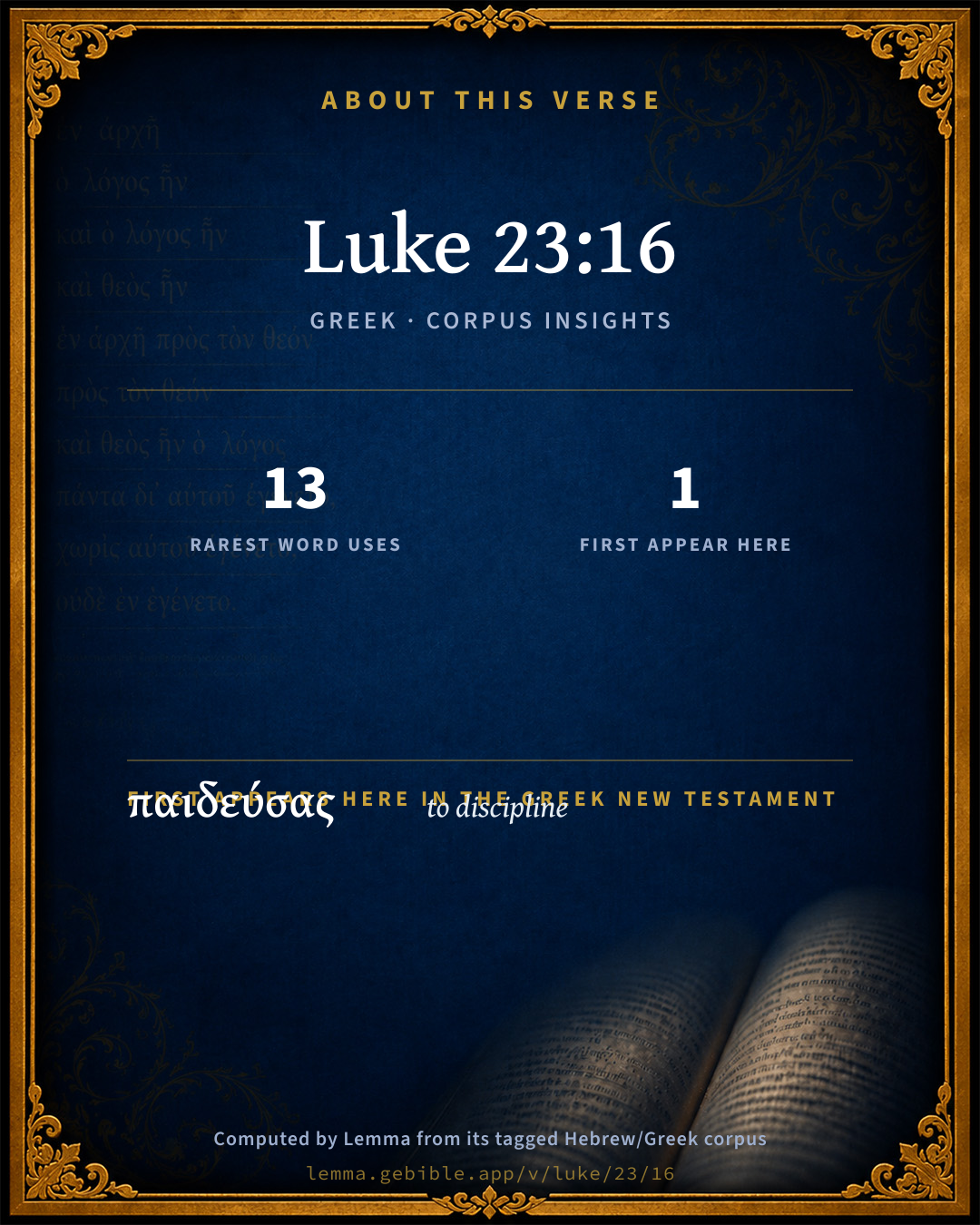
  • 1 first appearance in the Greek New Testament
Full analysis ↓
Download a study sheet

One document with this verse’s original text, its word-by-word gloss line, the meaning frame, cross-references with their text, attributed commentary, and full source and license credits — printable, and it pastes into notes with its structure intact.

This verse Autodidact and up

Study sheet (.html) Plain text (.txt)

A passage Seminary Student

Up to 50 verses in one chapter. A passage sheet keeps up to 6 commentary sources and 12 cross-references per verse, in the order this page ranks them, and says so on the sheet whenever that leaves anything out. Ask for a single verse and you get the Autodidact verse sheet above.

Everything on this page stays free to read, with no account — the sheet is a download of what is already on screen, not access to it.

Want to remove ads? Support Godless Engineer
Compare translations 3

The same verse in 3 English versions, stacked beneath the original-language interlinear above. Click any original word for its lexicon entry.

Each is an independent rendering of the whole verse — the interlinear is not word-aligned to these translations.

Highlighted words mark where these versions differ — a whole-verse word diff, not a word-by-word alignment.

  • World English Bible Public Domain
    I will therefore chastise him and release him."
  • King James Version Public Domain
    I will therefore chastise him, and release him.
  • unfoldingWord Literal Text CC BY-SA 4.0
    Therefore, having punished him, I will release him.”

unfoldingWord Literal Text — © unfoldingWord, licensed CC BY-SA 4.0. Word-aligned USFM3 via Door43 (git.door43.org/unfoldingWord/en_ult).

Versions to compare (up to 4)

3 of 4 selected

Show all 19 translations

Every available English version of this verse, each an independent rendering of the whole verse.

  • World English Bible Public Domain
    I will therefore chastise him and release him."
  • Berean Standard Bible Public Domain
    Therefore I will punish Him and release Him.”
  • Majority Standard Bible Public Domain
    Therefore I will punish Him and release Him.”
  • King James Version Public Domain
    I will therefore chastise him, and release him.
  • American Standard Version (1901) Public Domain
    I will therefore chastise him, and release him.
  • Revised Version (1885) Public Domain
    I will therefore chastise him, and release him.
  • Geneva Bible (1599) Public Domain
    I will therefore chastise him, and let him loose.
  • Douay-Rheims (1899) Public Domain
    I will chastise him therefore, and release him.
  • Young's Literal Translation Public Domain
    having chastised, therefore, I will release him,'
  • Literal Standard Version CC BY-SA 4.0
    having corrected, therefore, I will release Him,”
  • Unlocked Literal Bible CC BY-SA 4.0
    I will therefore punish him, and release him.”
  • unfoldingWord Literal Text CC BY-SA 4.0
    Therefore, having punished him, I will release him.”
  • Darby Bible Public Domain
    Having chastised him therefore, I will release him.
  • World Messianic Bible Public Domain
    I will therefore chastise him and release him.”
  • Webster's Bible Public Domain
    I will therefore chastise him, and release him.
  • Free Bible Version CC BY-SA 4.0
    So I will have him flogged and then release him.”
  • Bible in Basic English Public Domain
    And so I will give him punishment and let him go.
  • Text-Critical English NT CC BY 4.0
    Therefore I will have him flogged and then release him.”
  • Tyndale New Testament (1534) Public Domain
    I will therfore chasten him and let him lowsse.

Literal Standard Version (2020), Covenant Press — licensed CC BY-SA 4.0. Text via the HelloAO Bible API (eBible.org). Unlocked Literal Bible (unfoldingWord) — licensed CC BY-SA 4.0. Text via the HelloAO Bible API (eBible.org). unfoldingWord Literal Text — © unfoldingWord, licensed CC BY-SA 4.0. Word-aligned USFM3 via Door43 (git.door43.org/unfoldingWord/en_ult). Free Bible Version, Dr. Jonathan Gallagher — licensed CC BY-SA 4.0. Text via the HelloAO Bible API (eBible.org).

Word by word

More ways to search: Search by grammar → Find every occurrence → Compare this word →

Practice this passage: Drill this verse → Learn its vocabulary →

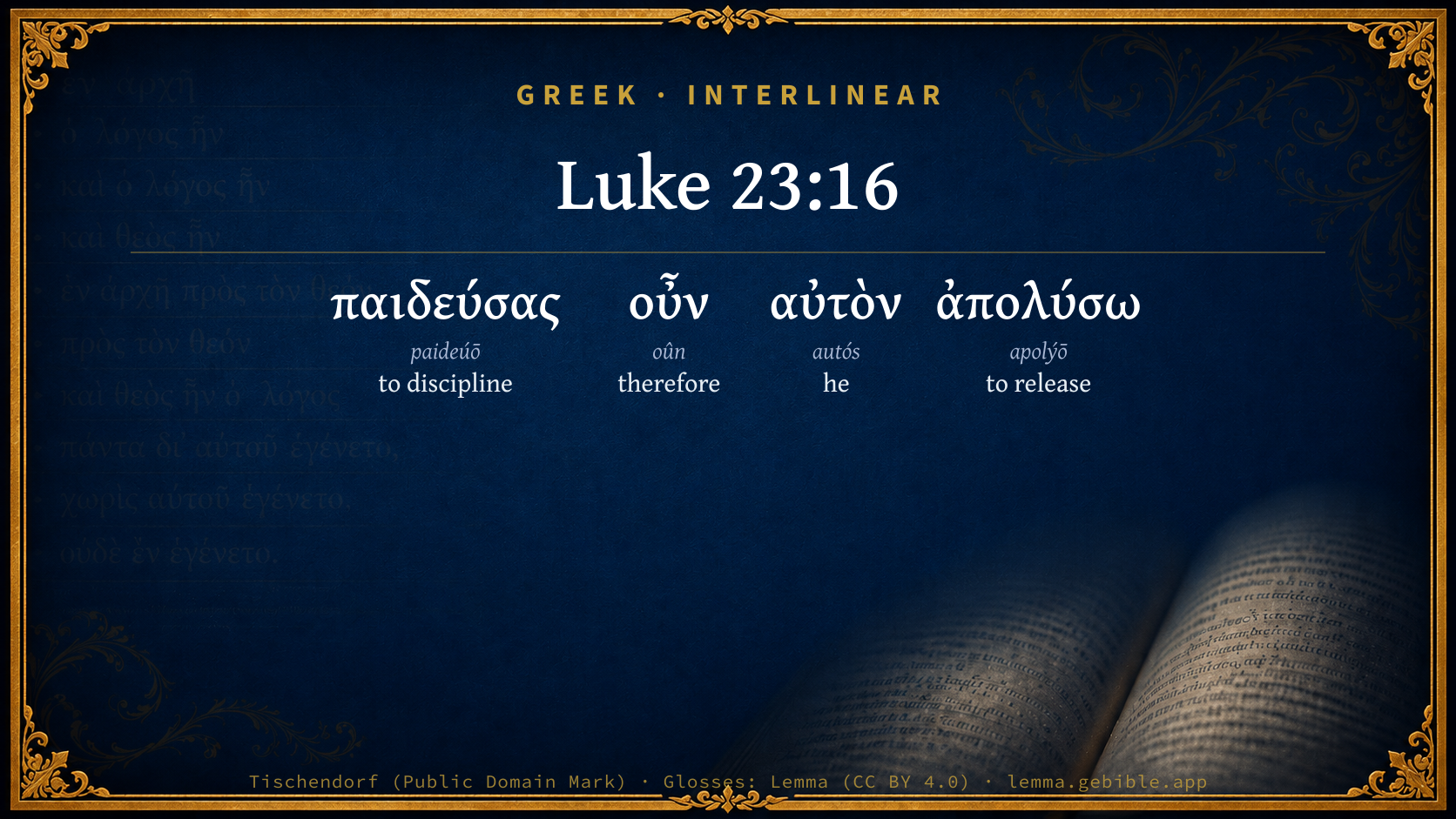
παιδεύσας
paideúō
G3811
“to discipline”
Verb, Aorist, Active, Participle, Nominative, Singular, Masculine
Part of Speech
Verb
Tense
Aorist
Voice
Active
Mood
Participle
Case
Nominative
Number
Singular
Gender
Masculine
Full Thayer's Definition

Origin: from G3816

TDNT: 14:56,8

1. to train children a. to be instructed or taught or learn b. to cause one to learn 2. to chastise a. to chastise or castigate with words, to correct 1. of those who are moulding the character of others by reproof and admonition b. of God 1. to chasten by the affliction of evils and calamities c. to chastise with blows, to scourge 1. of a father punishing his son 2. of a judge ordering one to be scourged
  1. οὖν oûn G3767 “therefore” Conjunction
  2. αὐτὸν autós G846 “he” Personal pronoun, Accusative, Singular, Masculine
  3. ἀπολύσω apolýō G630 “to release” Verb, Future, Active, Indicative, 1st person, Singular

About this verse

These counts appear in no published source. They are computed here, from the morphology-tagged text and Lemma’s own curated glosses. What Lemma adds →

4
words
4
distinct lemmas
Gospels
section

Notable vocabulary

The rarest word here is παιδεύσας to discipline G3811 — appearing just 13 times in the whole Greek New Testament.

First appearance in Scripture

This word makes its first canonical appearance in the Greek New Testament here:

  • παιδεύσας to discipline G3811

Shared distinctive vocabulary

παιδεύσας to discipline G3811 occurs in 13 verses of the Greek New Testament. Also found in:
Cross-references

7

Topical passages linked to Luke 23:16 in the Treasury of Scripture Knowledge — connected by theme and wording, ordered by reader-vote popularity; previews shown in the World English Bible.

  • Matthew 27:26 Then he released to them Barabbas, but Jesus he flogged and delivered to be crucified.
  • Luke 23:22 He said to them the third time, "Why? What evil has this man done? I have found no capital crime in him. I will therefore chastise him and release him."
  • Mark 15:15 Pilate, wishing to please the multitude, released Barabbas to them, and handed over Jesus, when he had flogged him, to be crucified.
  • Isaiah 53:5 But he was pierced for our transgressions, he was crushed for our iniquities; the punishment that brought our peace was on him; and by his wounds we are healed.
  • John 19:1–4 So Pilate then took Jesus, and flogged him.
  • Acts 5:40–41 They agreed with him. Summoning the apostles, they beat them and charged them not to speak in the name of Jesus, and let them go.
  • Acts 16:37 But Paul said to them, "They have beaten us publicly, without a trial, men who are Romans, and have cast us into prison! Do they now release us secretly? No, most assuredly, but let them come themselves and bring us out!"

Cross-references courtesy of OpenBible.info (CC BY 4.0).

Commentary

Notes on Luke 23:16 from classic Christian and Jewish commentators (each source and its license shown beneath its notes). The classic Christian expositions comment on the surrounding passage and are grouped to its opening verse, so a note may address several verses; the Jewish commentaries on the Tanakh (Rashi and others) are per-verse, so they appear only where the commentator wrote on this verse.

Lemma curates 59 commentaries, every one of them public domain or Creative Commons licensed, each selected and text-cleaned for this edition rather than reprinted as found. About our sources →

Tyndale Open Study Notes

Tyndale Open Resources

23:16-18 I will have him flogged (or I will teach him a lesson!): The Greek word can mean “instruct,” “punish,” or “discipline”; it refers to a relatively mild whipping given for lesser offenses. It was different from the severe flogging that Romans gave in preparation for crucifixion (see Matt 27:26; Mark 15:15).

Tyndale Open Study Notes — © Tyndale Open Resources, licensed CC BY-SA 4.0. Text via the HelloAO Bible API.

Bengel's Gnomon

Johann Albrecht Bengel

Luk 23:16. Παιδεύσας) Having chastised, viz. with scourging. A Meiosis [i.e. the term παιδεύσας is a softer expression than what Pilate really meant]. At this point Pilate began to concede more than he ought.

Bengel's Gnomon of the New Testament — English translation (T&T Clark, Edinburgh, 1860) — public domain. Text from a community e-Sword module.

Expositor's Greek Testament

ed. W. Robertson Nicoll

Luk 23:16 . παιδεύσας : doubtless used here in the Hellenistic sense of chastise, scourge a mild name for an ugly thing. The policy of the proposal Euthy. thus explains: “a moderate flagellation ( μετρίαν μαστίγωσιν ) to mitigate their wrath, that thinking they had gained their point they might cease from further madness”. A weak, futile policy. “Hic coepit nimium concedere” (Bengel). Fanaticism grows by concession (Schanz).

The Expositor's Greek Testament, edited by W. Robertson Nicoll (1897–1910) — public domain. Text from a community e-Sword module.

Geneva Bible (1599)

Geneva Bible translators

The wisdom of the flesh, of two evils chooseth the less, but God curseth such counsels.

Geneva Bible (1599) marginal notes — public domain. Text via Bolls.life.

Ellicott's Commentary for English Readers

(16) I will therefore chastise him.—The primary meaning of the word was to correct as children are corrected, thence to use the rod, as in Pro_19:18; Pro_29:17. As used here it implied the Roman punishment of scourging. Pilate was here, as throughout, halting between two opinions, convinced of the innocence of the Accused, yet afraid to oppose the people. Would it not be enough, he thought, that they should see Him treated as guilty of a minor offence? Would they not accept His release as part of the ceremonial of the day?

A Bible Commentary for English Readers, edited by Charles John Ellicott (1878–1897) — public domain. Text from a community e-Sword module.

The Cambridge Bible for Schools and Colleges

gen. ed. J. J. S. Perowne

16. I will therefore chastise him] This was the point at which Pilate began to yield to the fatal vacillation which soon passed into guilt and made it afterwards impossible for him to escape. He had just declared the prisoner absolutely innocent. To subject Him, therefore, to the horrible punishment of scourging merely to gratify the pride of the Jews, and to humble Him in their eyes (Deu_25:3), was an act of disgraceful illegality, which he must have felt to be most unworthy of the high Roman sense of ‘Justice’ The guilty dread which made Pilate a weak man is well illustrated by what Philo says of him (Leg. ad Caium, 38). But he was the unconscious fulfiller of prophecy (Isa_53:5). The restless eagerness of his various attempts to secure the acquittal of Jesus is brought out most forcibly by St John.

The Cambridge Bible for Schools and Colleges (gen. ed. J. J. S. Perowne; Cambridge University Press, 1878–1918) — public domain. Text from a community e-Sword module.

John Gill's Exposition

I will therefore chastise him,.... Give him some correction, as by scourging, or beating with rods: this he proposed, not because he thought him deserving of it, but in complaisance to the Jews; since it would look as if their charges were not altogether weak and groundless; and that Jesus was not entirely innocent: this would carry a show of guilt and punishment, and he hoped this might be thought sufficient, and so he should please them, and save Jesus from dying, which he much desired:

and release him; from his bonds, and let him go.

John Gill's Exposition of the Whole Bible (1746–1763) — public domain (CC PDM 1.0). Text via the HelloAO Bible API.

Trapp's Complete Commentary

John Trapp

16 I will therefore chastise him, and release him.

Ver. 16. I will therefore chastise him] And so he did, purposely to move pity, Joh 19:1, but all in vain: yea, though he afterwards presented him a pitiful spectacle, with "Behold the man."

John Trapp, A Commentary or Exposition upon All the Books of the Old and New Testament (1647–1656) — public domain. Text from a community e-Sword module.

Albert Barnes' Notes on the Bible

I will therefore chastise him - The word “chastise” here means to “scourge or to whip.” This was usually done before capital punishment, to increase the sufferings of the man condemned. It is not easy to see the reason why, if Pilate supposed Jesus to be “innocent,” he should propose publicly to scourge him. It was as “really” unjust to do that as it was to crucify him. But probably he expected by this to conciliate the minds of his accusers; to show them that he was willing to gratify them if it “could” be done with propriety; and perhaps he expected that by seeing him whipped and disgraced, and condemned to ridicule, to contempt, and to suffering, they would be satisfied. It is farther remarked that among the Romans it was competent for a magistrate to inflict a “slight” punishment on a man when a charge of gross offence was not fully made out, or where there was not sufficient testimony to substantiate the precise charge alleged. All this shows,

The palpable “injustice” of our Lord’s condemnation; The persevering malice and obstinacy of the Jews; and, The want of firmness in Pilate.

He should have released him at once; but the love of “popularity” led him to the murder of the Son of God. Man should do his duty in all situations; and he that, like Pilate, seeks only for public favor and popularity, will assuredly be led into crime.

Albert Barnes' Notes on the Bible (1834–1885) — public domain. Text from a community e-Sword/MySword module.

Haydock's Catholic Bible Commentary

It ws a very common punishment among the Jews to scourge those who had committed crimes for which death would have been too severe. According to the laws of the Hebrews, (Deuteronomy xxv. 3.) the number of blows could not exceed thirty-nine. Pilate dares not condemn Jesus to death, because he believes him innocent; yet not to disoblige the people and magistrates, who demanded his death, he takes a middle way, which, as is usual in such cases, satisfies neither party. He neither saves the innocent Victim, nor satisfies justice. In lieu of one punishment, Jesus suffers two. He is at length both scourged and crucified. (Calmet)

George Leo Haydock (1774–1849), Haydock's Catholic Family Bible and Commentary, 1859 edition — public domain. Excludes Psalms (Douay-Rheims chapter numbering differs from Protestant) and Deuterocanonical books (Catholic canon only).

Whedon's Commentary on the Bible

Daniel D. Whedon

16. Chastise him—The Romans had a customary chastisement preceding crucifixion; but this was a chastisement to save him from it. Pilate, like a true compromiser, hoped by this lesser punishment to satisfy the Jews.

Daniel D. Whedon (gen. ed.), Commentary on the Old and New Testaments (1874–1909) — public domain. Text from a community e-Sword module.

The Pulpit Commentary

Guilty compromise.

Twice (see ver. 22) Pilate made this offer to the Jews. He would chastise Jesus and release him; he would thus gratify them by putting the Object of their hatred to pain and humiliation, and he would satisfy his own conscience by saving an innocent man from the last extremity. It was a poor and a guilty compromise he proposed as a solution. If Jesus were as guilty as they claimed that he was, he deserved to die, and Pilate was in duty bound to condemn him to death; if he were innocent, he certainly ought not to have been subjected to the exposure and agony of scourging. It was a cowardly and ignoble endeavor to save himself at the expense either of public or of individual justice. Compromises are of very different character. There are compromises which are

I JUST, AND THEREFORE HONOURABLE. Two men in business have claims one against the other, and one cannot convince the other by argument; the proposal is made to adjust their respective claims by a compromise, each man consenting to forego something, the concession of the one being taken as a fair equivalent to that of the other: this is honorable to both. It very probably results in each man getting what is his due, and it saves both from the misery and expense of Litigation, and preserves good will and even friendship.

II WISE, AND THEREFORE COMMENDABLE. A society it may be of a distinctly religious character is divided by its members holding opposite opinions. Some advocate one course, the others urge a different one. The idea is suggested that a third course be adopted, which includes some features of the two; there is no serious principle involved, it is only a matter of procedure, a question of expediency. Then it will probably be found to be the wisdom of that society to accept the proposed compromise. Every one present has the double advantage of securing something which he approves, and (what is really better, if it could but be realized) that of yielding something to the wishes or the convictions of other people.

III GUILTY, AND THEREFORE CONDEMNABLE. Such was that of the text. Such have been innumerable others since then. All are guilty that are effected:

1. At the expense of truth. The teacher of Divine truth may bring his doctrine down to the level of his hearers" understanding; he may make known the great verities of the faith "in many portions" (polumerwv); but he may not, in order to "please men," distort or withhold the living truth of God. If he does that he shows himself unworthy of his office, and he exposes himself to the severe condemnation of his Divine Master.

2. At the expense of justice. However anxious we may be to preserve outward harmony, we may not, for the sake of peace, do any one man a wrong; may not asperse his character, injure his prospects, wound his spirit. Rather than do that, we must face the storm, and guide our bark as best we can.

3. At the expense of self-respect. If Pilate had been less hardened than he probably was, less accustomed to the infliction of human pain and shame, he would have gone back to the interior of his house ashamed of himself, as he thought of the lacerating scene that immediately followed that mockery of a trial. If we cannot yield without inflicting on our own soul a real spiritual injury, without doing (or leaving undone) an action the remembrance of which will not only shame but weaken us, then we must not compromise the matter in dispute. We must tell our tale, whatever it may be; we must make our motion, whomsoever it may offend; we must walk straight on in the road of rectitude, in the path of humanity. C.

The Pulpit Commentary (1880–1919), ed. H.D.M. Spence-Jones & Joseph S. Exell — public domain. Text from a community e-Sword module.

John Wesley's Explanatory Notes

I will therefore chastise him - Here Pilate began to give ground, which only encouraged them to press on. Matt. xxvii, 15; Mark xv, 6; John xviii, 39.

John Wesley, Explanatory Notes Upon the Whole Bible (1754–1765) — public domain. Text via the GEBible commentary corpus.

Cambridge Greek Testament for Schools and Colleges

16. παιδεύσας οὖν αὐτόν. This was the point at which Pilate began to yield to the fatal vacillation which soon passed into guilt and made it afterwards impossible for him to escape. He had just declared the prisoner absolutely innocent. To subject Him, therefore, to the horrible punishment of scourging merely to gratify the pride of the Jews, and to humble Him in their eyes (Deu 25:3), was an act of disgraceful illegality, which he must have felt to be most unworthy of the high Roman sense of ‘Justice.’ The guilty dread which made Pilate a weak man is well illustrated by what Philo says of him (Leg. ad Caium, 38). But he was the unconscious fulfiller of prophecy (Isa 53:5). The restless eagerness of his various attempts to secure the acquittal of Jesus is brought out most forcibly by St John.

Cambridge Greek Testament for Schools and Colleges (Cambridge University Press, 1896; 21 vols, various authors incl. Carr, Maclear, Plummer, Farrar, Lumby, Moule, M. R. James, Simcox) — public domain. Text from a community e-Sword module.

Alford’s Greek Testament

Henry Alford

16.] ‘Hic cœpit nimium concedere Pilatus,’ Bengel. If there be no fault in Him, why should He be corrected at all?—the Jews perceive their advantage, and from this moment follow it up.

Henry Alford, The Greek Testament (1849–1861) — public domain. Text from a community e-Sword module.

International Critical Commentary

16. παιδεύσας. He uses a light word to express the terrible flagellatio, in order to excuse the injustice to his own conscience, and to hide his inconsistency from them. It is no punishment, but a chastisement to warn Him to be more circumspect in future. But the priests would see that a judge who was willing to inflict this on an innocent person could be induced by further pressure to inflict death. Scourging was sometimes fatal: Hor. Sat. i. 2, 41; comp. i. 3, 119. Comp. Deu 22:18.

International Critical Commentary — older volumes (1896–1929), various authors — public domain. Text from a community e-Sword module.

Vincent's Word Studies in the New Testament

Marvin R. Vincent

Chastise [παιδευσας] . Originally to bring up a child [παις] . Hence, to instruct, so Act 7:22, of Moses instructed in the wisdom of the Egyptians; and Act 22:3, of Paul instructed in the law. To discipline or correct, as Heb 12:6, 7. The word is not synonymous with punish, since it always implies an infliction which contemplates the subject's amendment; and hence answers to chastise or chasten. So Heb 12:10; Rev 3:19. In popular speech chastise or punish are often confounded. Chasten is from the Latin castus, "pure," " chaste; " and to chasten is, properly, to purify. This meaning underlies even the use of the word by Pilate, who was not likely to be nice in his choice of words. Instead of punishing him with death, he will chastise him, in order to teach him better. So Wyc., I shall deliver him amended.

Marvin R. Vincent, Word Studies in the New Testament (1887–1900) — public domain. Text from a community e-Sword/MySword module.

Lesson kit

Teaching starters — assembled from the data on this page, not authored interpretation. Every prompt links to the verse data it draws on. Edit before teaching.

Luke, in the Gospels, opens this verse with 4 words (4 distinct Greek lemmas). Its most distinctive word is paideúō (“to discipline”). A historical commentator’s framing appears above. Read the whole chapter for the surrounding context.

Discussion questions

  1. What does “to discipline” (paideúō) contribute to the verse as a whole?
  2. This is the first place “to discipline” appears in Scripture (first appears here). What does its debut here establish?
  3. How does Luke 23:22, which shares the word «to discipline», read alongside this verse?
  4. These translations render this verse differently; the difference is in the English rendering, not the original. What questions does that raise?
  5. Compare how Tyndale Open Study Notes and Bengel's Gnomon read this verse. Where do they agree or differ?

Things to notice

  • 1 word makes its first canonical appearance in Scripture here.
  • These translations choose different wording for 3 words in this verse.
  • 4 distinct Greek lemmas span 4 words in this verse.

Reading settings

Reading text

Shown beneath each verse's original-language words.

Old Testament
Old Testament edition

Read the OT as the Masoretic Hebrew (MT) or the Greek Septuagint (LXX).

English shown for the Greek Septuagint (in the Hebrew ↔ Greek comparison).

Comparing translations? Open the Compare panel on any verse page to stack up to four side by side.