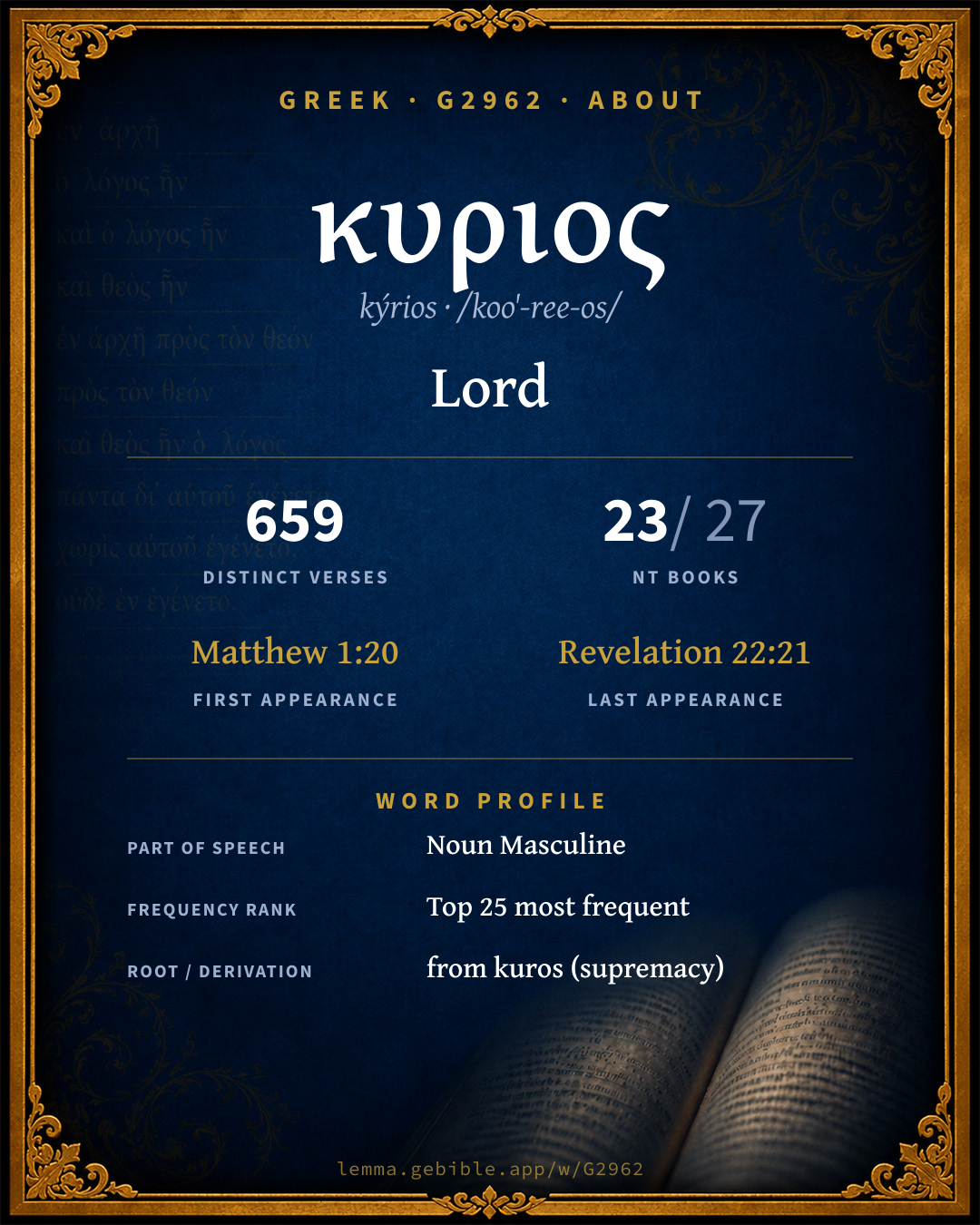
κύριος
Lord
Full lexicon entry — Thayer's Greek Lexicon
From Thayer's Greek Lexicon
Where this word appears
See every Genitive-case word in the Greek New Testament →
Grammar key — what these labels mean
Part of speech
- Noun
- A naming word — a person, place, thing, or idea.
Case
- Genitive
- The case of source, possession, or “of” — answers “whose / from what.”
- Nominative
- The case of the subject (and the predicate nominative).
- Vocative
- The case of direct address (“O Lord”).
- Dative
- The case of the indirect object, means, or location — “to / for / with / in.”
- Accusative
- The case of the direct object and of extent.
Gender
- Masculine
- Grammatically masculine.
Number
- Singular
- One.
- Plural
- More than one.
6 verses where G2962 appears in the Accusative case in the Book of 2 Corinthians. Filtered view — show all forms. Click any verse to open its interlinear word-by-word view. Verse text shown in the World English Bible for context — . Each verse’s Greek form is shown with its reference; the English is not keyword-highlighted, since the data carries no word-level English alignment. Use “Compare translations” on any verse to read it across multiple English versions. This concordance covers the Greek New Testament; Septuagint (Greek Old Testament) occurrences of this word are not indexed here.
2 Corinthians
- 2 Corinthians 3:16 κύριον n acc sg masc But whenever one turns to the Lord, the veil is taken away.
- 2 Corinthians 4:5 κύριον n acc sg masc For we don't preach ourselves, but Christ Jesus as Lord, and ourselves as your servants for Jesus' sake;
- 2 Corinthians 4:14 κύριον n acc sg masc knowing that he who raised the Lord Jesus will raise us also with Jesus, and will present us with you.
- 2 Corinthians 5:8 κύριον n acc sg masc We are of good courage, I say, and are willing rather to be absent from the body, and to be at home with the Lord.
- 2 Corinthians 11:17 κύριον n acc sg masc That which I speak, I don't speak according to the Lord, but as in foolishness, in this confidence of boasting.
- 2 Corinthians 12:8 κύριον n acc sg masc Concerning this thing, I begged the Lord three times that it might depart from me.
About this entry
At a glance — auto-summarized from this page’s data, not written by a person. Every figure links to its source below. This summary describes the numbers; it doesn’t interpret them.
“Lord” is the headline sense of the Greek name κυριος (kýrios). First canonically at Matthew 1:20, it enters the text early. It appears 659 verses across 23 books of the Greek New Testament, among its most common vocabulary. See 659-verse concordance and the renderings breakdown below.
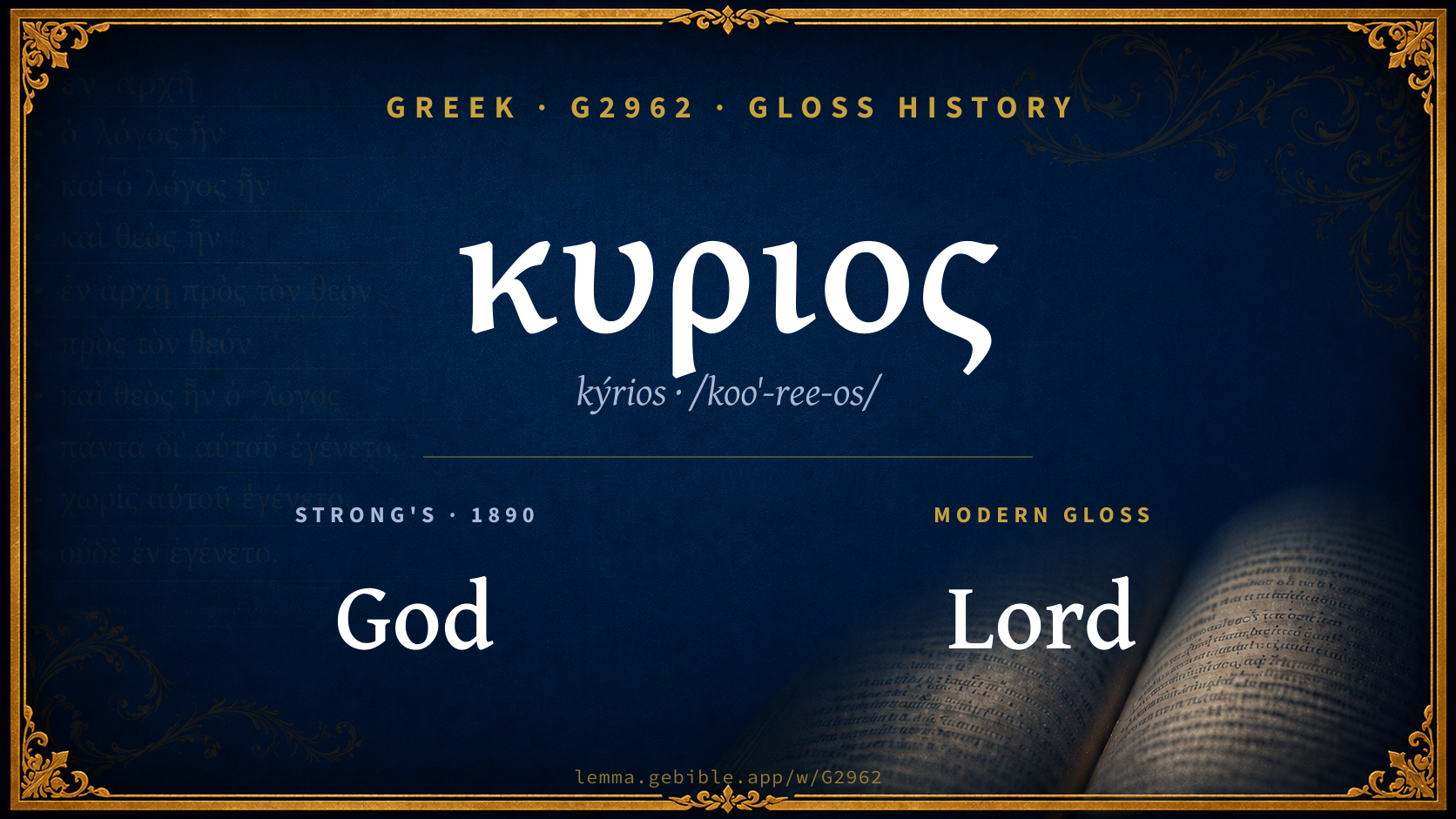
Gloss history
Strong's 1890 vs modern scholarship
About this word
Strong's G2962 catalogs a Greek word from the Greek New Testament.
These counts are not copied from any lexicon or concordance. They are computed here, from the morphology-tagged Greek New Testament. What Lemma adds →
- 659
- distinct verses
- The word appears in 659 distinct verses.
- 23 / 27
- NT books
- The word appears in 23 of 27 New Testament books.
- #24
- by frequency
- Top 25 most frequent Greek words (rank 24 of 5,347 Greek words by occurrence).
View all 659 occurrences in the concordance →
By section of the New Testament
By traditional corpus
Conventional, traditional groupings — biblical authorship is debated, so this is a traditional corpus grouping, not an authorship claim. Some books belong to more than one corpus (Luke is in both the Gospels and the Lukan corpus, and so on), so these shares overlap and need not total 100%. Each figure is a share of the word’s 659 distinct verses.
- Pauline corpus 246 verses · 37%
- Gospels 233 verses · 35%
- Lukan (Luke–Acts) 197 verses · 30%
- Johannine 71 verses · 11%
- General (Catholic) Epistles 41 verses · 6%
- Revelation 21 verses · 3%
- Hebrews 16 verses · 2%
How translations render this word
Counts come from each version’s own published word-to-Strong’s tagging or interlinear alignment — an approximate guide to how each version renders this word, not a word-level alignment the data otherwise carries. Because each total is that version’s own tagged count, the per-version totals vary from one another and need not match the appearance or distinct-verse counts above. These counts may also differ from a printed concordance because Lemma counts each distinctly tagged rendering and does not collapse phrase taggings into a single head-word total. This is a fixed set of word-tagged versions (KJV, ASV, BSB, ULT) and does not change with the reading translation you choose elsewhere. Each version’s license is shown beside its name below (and on Sources).
- King James Version: Lord 696×, Lord's 12×, Sir 10×
- American Standard Version: Lord 645×, Of 16×, Sir 9×
- Berean Standard Bible: Lord 610×, Master 42×, Lord’s 19×
- unfoldingWord Literal Text: Lord 641×, Of 60×, Master 49×
King James Version Public Domain
Renders G2962 across 748 tagged occurrences — most commonly:
Plus 12 renderings that appear only once — usually multi-word phrases or single function words the recovered tagging swept in, not distinct renderings.
American Standard Version Public Domain
Renders G2962 across 730 tagged occurrences — most commonly:
Plus 28 renderings that appear only once — usually multi-word phrases or single function words the recovered tagging swept in, not distinct renderings. Not rendered by a distinct English word in 3 further occurrences.
Berean Standard Bible Public Domain
Renders G2962 across 713 tagged occurrences — most commonly:
Plus 6 renderings that appear only once — usually multi-word phrases or single function words the recovered tagging swept in, not distinct renderings. Not rendered by a distinct English word in 3 further occurrences.
unfoldingWord Literal Text CC BY-SA 4.0
Renders G2962 across 794 tagged occurrences — most commonly:
Plus 5 renderings that appear only once — usually multi-word phrases or single function words the recovered tagging swept in, not distinct renderings.
Senses in Thayer's
The 1 sense Thayer's distinguishes for this word, in lexicon order (not ranked by frequency or importance). The full entry — with sub-senses — is in the Lexicon Entry tab.
- he to whom a person or thing belongs, about which he has power of deciding; master, lord
Word origin
Origin: from kuros (supremacy)
From κῦρος kuros ( supremacy ); supreme in authority that is (as noun) controller ; by implication Mr . (as a respectful title): - God Lord master Sir.
— Strong’s Exhaustive Concordance (1890), public domain.
Forms in the corpus
The 11 distinct written forms G2962 takes in the Greek New Testament, most frequent first — each parse links to that case’s occurrences in the concordance.
| Form | Parsing | Example | Uses |
|---|---|---|---|
| κυρίου kyríou | Noun, Genitive, Singular, Masculine | Matthew 1:20 | 240 |
| κύριος kýrios | Noun, Nominative, Singular, Masculine | Matthew 10:25 | 164 |
| κύριε kýrie | Noun, Vocative, Singular, Masculine | Matthew 7:21 | 116 |
| κυρίῳ kyríō | Noun, Dative, Singular, Masculine | Matthew 5:33 | 100 |
| κύριον kýrion | Noun, Accusative, Singular, Masculine | Matthew 4:7 | 68 |
| κύριός kýriós | Noun, Nominative, Singular, Masculine | Mark 2:28 | 12 |
| κύριοι kýrioi | Noun, Nominative, Plural, Masculine | Luke 19:33 | 6 |
| κυρίοις kyríois | Noun, Dative, Plural, Masculine | Matthew 6:24 | 5 |
| κυρίων kyríōn | Noun, Genitive, Plural, Masculine | Matthew 15:27 | 3 |
| κύριέ kýrié | Noun, Vocative, Singular, Masculine | Revelation 7:14 | 1 |
| κύριόν kýrión | Noun, Accusative, Singular, Masculine | John 20:13 | 1 |
Same root — word family
Other Thayer's entries built from the same root as G2962, grouped by Strong’s listed origin. These share a root / origin per the lexicon — not necessarily a shared meaning. Each links to that word’s own entry.
Derived from this word
- κυριακος kyriakós G2960 of the Lord
- κυριευω kyrieúō G2961 to rule
- κυριοτης kyriótēs G2963 dominion
- κυροω kyróō G2964 to ratify
Proper names from this root
People and places named from this root — a name, not an additional meaning of the word.
Compare all same-root words → Showing 4 of 7 — not the complete family. 2 of the same-root words are proper names (people or places). They share a root, not necessarily a meaning.
Bible dictionary
Public-domain dictionary articles matched to this entry by name (Lord). A biblical name can be shared by more than one person or place, so an article may treat several.
Easton's Bible Dictionary · M. G. Easton, 1897
There are various Hebrew and Greek words so rendered.
(1.) Heb. Jehovah, has been rendered in the English Bible LORD, printed in small capitals. This is the proper name of the God of the Hebrews. The form "Jehovah" is retained only in Ex. 6:3; Ps. 83:18; Isa. 12:2; 26:4, both in the Authorized and the Revised Version.
(2.) Heb. adon, means one possessed of absolute control. It denotes a master, as of slaves (Gen. 24:14, 27), or a ruler of his subjects (45:8), or a husband, as lord of his wife (18:12).
The old plural form of this Hebrew word is 'adonai. From a superstitious reverence for the name "Jehovah," the Jews, in reading their Scriptures, whenever that name occurred, always pronounced it 'Adonai.
(3.) Greek kurios, a supreme master, etc. In the LXX. this is invariably used for "Jehovah" and "Adonai."
(4.) Heb. ba'al, a master, as having domination. This word is applied to human relations, as that of husband, to persons skilled in some art or profession, and to heathen deities. "The men of Shechem," literally "the baals of Shechem" (Judg. 9:2, 3). These were the Israelite inhabitants who had reduced the Canaanites to a condition of vassalage (Josh. 16:10; 17:13).
(5.) Heb. seren, applied exclusively to the "lords of the Philistines" (Judg. 3:3). The LXX. render it by satrapies. At this period the Philistines were not, as at a later period (1 Sam. 21:10), under a kingly government. (See Josh. 13:3; 1 Sam. 6:18.) There were five such lordships, viz., Gath, Ashdod, Gaza, Ashkelon, and Ekron.
Smith's Bible Dictionary · William Smith, 1863
[God]
Classic public-domain reference works; full attribution on Sources.
Septuagint usage
The same Greek word κυριος appears 7,441 times in the Greek Old Testament (Septuagint), across 6,126 verses in 36 books.
- 7,441
- LXX occurrences
- Tagged occurrences of this Greek word in the Septuagint.
- 6,126
- verses
- Distinct Septuagint verses containing this word.
- 36 / 39
- OT books
- The word appears in 36 of the 39 Old Testament books.
Sample Septuagint occurrences
- Genesis 2:8 κύριος
- Exodus 3:2 κύριος
- Leviticus 1:1 κύριος
- Numbers 1:1 κύριος
- Deuteronomy 1:3 κύριος
- Joshua 1:1 κύριος
- Judges 1:1 κύριος
- Ruth 1:6 κύριος
- 1 Samuel 1:3 κύριος
- 2 Samuel 1:10 κύριος
- 1 Kings 1:2 κύριος
- 2 Kings 1:3 κύριος
Septuagint occurrences (same lexeme)
Every verse where the same Strong’s number (G2962) appears in the Greek Septuagint — showing the first 50 of 6,126. Verse text shown in the World English Bible for context; the Greek form is the matched word — the English is not keyword-highlighted.
- Genesis 2:8 κύριος Yahweh God planted a garden eastward, in Eden, and there he put the man whom he had formed.
- Genesis 2:15 κύριος Yahweh God took the man, and put him into the garden of Eden to dress it and to keep it.
- Genesis 2:16 κύριος Yahweh God commanded the man, saying, "Of every tree of the garden you may freely eat:
- Genesis 2:18 κύριος Yahweh God said, "It is not good that the man should be alone; I will make him a helper suitable for him."
- Genesis 2:22 κύριος He made the rib, which Yahweh God had taken from the man, into a woman, and brought her to the man.
- Genesis 3:1 κύριος Now the serpent was more subtle than any animal of the field which Yahweh God had made. He said to the woman, "Yes, has God said, 'You shall not eat of any tree of the garden?'"
- Genesis 3:8 κύριος They heard the voice of Yahweh God walking in the garden in the cool of the day, and the man and his wife hid themselves from the presence of Yahweh God among the trees of the garden.
- Genesis 3:9 κύριος Yahweh God called to the man, and said to him, "Where are you?"
- Genesis 3:13 κύριος Yahweh God said to the woman, "What is this you have done?" The woman said, "The serpent deceived me, and I ate."
- Genesis 3:14 κύριος Yahweh God said to the serpent, "Because you have done this, cursed are you above all cattle, and above every animal of the field. On your belly shall you go, and you shall eat dust all the days of your life.
- Genesis 3:21 κύριος Yahweh God made coats of skins for Adam and for his wife, and clothed them.
- Genesis 3:23 κύριος Therefore Yahweh God sent him forth from the garden of Eden, to till the ground from whence he was taken.
- Genesis 4:3 κύριος As time passed, it happened that Cain brought an offering to Yahweh from the fruit of the ground.
- Genesis 4:6 κύριος Yahweh said to Cain, "Why are you angry? Why has the expression of your face fallen?
- Genesis 4:13 κύριος Cain said to Yahweh, "My punishment is greater than I can bear.
- Genesis 4:15 κύριος Yahweh said to him, "Therefore whoever slays Cain, vengeance will be taken on him sevenfold." Yahweh appointed a sign for Cain, lest any finding him should strike him.
- Genesis 4:26 κύριος There was also born a son to Seth, and he named him Enosh. Then men began to call on Yahweh's name.
- Genesis 5:29 κύριος and he named him Noah, saying, "This same will comfort us in our work and in the toil of our hands, because of the ground which Yahweh has cursed."
- Genesis 6:3 κύριος Yahweh said, "My Spirit will not strive with man forever, because he also is flesh; yet will his days be one hundred twenty years."
- Genesis 6:5 κύριος Yahweh saw that the wickedness of man was great in the earth, and that every imagination of the thoughts of his heart was only evil continually.
- Genesis 6:8 κύριος But Noah found favor in Yahweh's eyes.
- Genesis 6:12 κύριος God saw the earth, and saw that it was corrupt, for all flesh had corrupted their way on the earth.
- Genesis 6:22 κύριος Thus Noah did. According to all that God commanded him, so he did.
- Genesis 7:1 κύριος Yahweh said to Noah, "Come with all of your household into the ark, for I have seen your righteousness before me in this generation.
- Genesis 7:5 κύριος Noah did everything that Yahweh commanded him.
- Genesis 7:16 κύριος Those who went in, went in male and female of all flesh, as God commanded him; and Yahweh shut him in.
- Genesis 8:15 κύριος God spoke to Noah, saying,
- Genesis 8:21 κύριος Yahweh smelled the sweet savor. Yahweh said in his heart, "I will not again curse the ground any more for man's sake, because the imagination of man's heart is evil from his youth; neither will I ever again strike everything living, as I have done.
- Genesis 9:12 κύριος God said, "This is the token of the covenant which I make between me and you and every living creature that is with you, for perpetual generations:
- Genesis 9:26 κύριος He said, "Blessed be Yahweh, the God of Shem; Let Canaan be his servant.
- Genesis 10:9 κύριος He was a mighty hunter before Yahweh. Therefore it is said, "Like Nimrod, a mighty hunter before Yahweh."
- Genesis 11:5 κύριος Yahweh came down to see the city and the tower, which the children of men built.
- Genesis 11:6 κύριος Yahweh said, "Behold, they are one people, and they have all one language; and this is what they begin to do. Now nothing will be withheld from them, which they intend to do.
- Genesis 11:8 κύριος So Yahweh scattered them abroad from there on the surface of all the earth. They stopped building the city.
- Genesis 11:9 κύριος Therefore the name of it was called Babel, because Yahweh confused the language of all the earth, there. From there, Yahweh scattered them abroad on the surface of all the earth.
- Genesis 12:1 κύριος Now Yahweh said to Abram, "Get out of your country, and from your relatives, and from your father's house, to the land that I will show you.
- Genesis 12:4 κύριος So Abram went, as Yahweh had spoken to him. Lot went with him. Abram was seventy-five years old when he departed out of Haran.
- Genesis 12:7 κύριος Yahweh appeared to Abram, and said, "I will give this land to your seed." He built an altar there to Yahweh, who appeared to him.
- Genesis 12:8 κύριος He left from there to the mountain on the east of Bethel, and pitched his tent, having Bethel on the west, and Ai on the east. There he built an altar to Yahweh, and called on the name of Yahweh.
- Genesis 13:4 κύριος to the place of the altar, which he had made there at the first. There Abram called on the name of Yahweh.
- Genesis 13:18 κύριος Abram moved his tent, and came and lived by the oaks of Mamre, which are in Hebron, and built an altar there to Yahweh.
- Genesis 15:1 κύριος After these things the word of Yahweh came to Abram in a vision, saying, "Don't be afraid, Abram. I am your shield, your exceedingly great reward."
- Genesis 15:4 κύριος Behold, the word of Yahweh came to him, saying, "This man will not be your heir, but he who will come forth out of your own body will be your heir."
- Genesis 15:8 κύριος He said, "Lord Yahweh, how will I know that I will inherit it?"
- Genesis 15:18 κύριος In that day Yahweh made a covenant with Abram, saying, "To your seed have I given this land, from the river of Egypt to the great river, the river Euphrates:
- Genesis 16:2 κύριος Sarai said to Abram," See now, Yahweh has restrained me from bearing. Please go in to my handmaid. It may be that I will obtain children by her." Abram listened to the voice of Sarai.
- Genesis 16:7 κύριος The angel of Yahweh found her by a fountain of water in the wilderness, by the fountain in the way to Shur.
- Genesis 16:8 κύριος He said, "Hagar, Sarai's handmaid, where did you come from? Where are you going?" She said, "I am fleeing from the face of my mistress Sarai."
- Genesis 16:9 κύριος The angel of Yahweh said to her, "Return to your mistress, and submit yourself under her hands."
- Genesis 16:10 κύριος The angel of Yahweh said to her, "I will greatly multiply your seed, that they will not be numbered for multitude."
These are occurrences of the same Greek lexeme (G2962) in the Septuagint — not a translation of any one Hebrew word. The store carries no word-level Hebrew↔Greek alignment, so no Hebrew original is asserted here. Counts come from the recovered LXX Strong's tagging — high-frequency vocabulary is well covered, while rare or late forms may be untagged — so they reflect tagged occurrences and may slightly undercount.