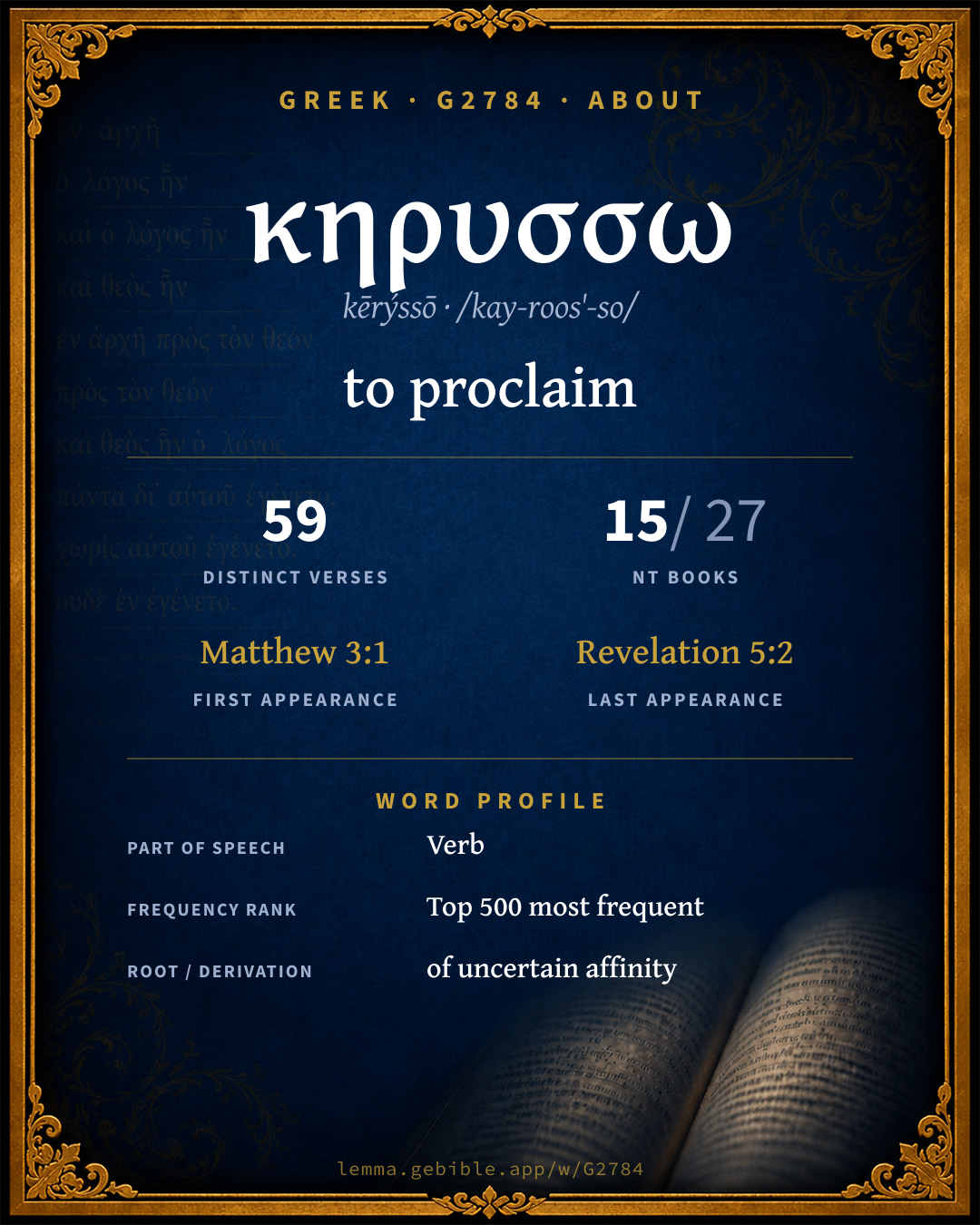
κηρύσσω
to proclaim
‘to proclaim’ is one of 3 main senses fuller range ↓
Full lexicon entry — Thayer's Greek Lexicon
From Thayer's Greek Lexicon
Where this word appears
See every Present-tense verb in the Greek New Testament →
Grammar key — what these labels mean
Part of speech
- Verb
- An action or state-of-being word.
Tense
- Present
- Ongoing or general action in present time (imperfective aspect).
- Aorist
- Action viewed as a simple whole, without regard to duration — often past (perfective aspect).
- Imperfect
- Continuous or repeated action in past time (“was writing”).
- Future
- Action expected in future time.
Voice
- Active
- The subject performs the action.
- Passive
- The subject receives the action.
Mood
- Participle
- A verbal adjective (“writing,” “having written”).
- Infinitive
- A verbal noun (“to write”), unmarked for person or number.
- Indicative
- States a fact or asks a factual question (the mood of reality).
- Imperative
- Expresses a command or request.
- Subjunctive
- Expresses probability, purpose, or possibility (the mood of contingency).
Case
- Nominative
- The case of the subject (and the predicate nominative).
- Genitive
- The case of source, possession, or “of” — answers “whose / from what.”
- Accusative
- The case of the direct object and of extent.
Person
- 1st person
- The speaker (“I / we”).
- 3rd person
- The one spoken about (“he / she / it / they”).
- 2nd person
- The one addressed (“you”).
Gender
- Masculine
- Grammatically masculine.
- Neuter
- Grammatically neuter.
Number
- Singular
- One.
- Plural
- More than one.
Grammatical forms 28 distinct
- Verb, Present, Active, Participle, Nominative, Singular, Masculine 13 times (21%)
- Verb, Present, Active, Infinitive 6 times (10%)
- Verb, Present, Active, Indicative, 1st person, Plural 4 times (7%)
- Verb, Aorist, Active, Infinitive 3 times (5%)
- Verb, Imperfect, Active, Indicative, 3rd person, Singular 3 times (5%)
- Verb, Aorist, Active, Indicative, 1st person, Plural 2 times (3%)
- Verb, Aorist, Active, Indicative, 3rd person, Plural 2 times (3%)
- Verb, Aorist, Active, Indicative, 3rd person, Singular 2 times (3%)
+20 more forms (26 occurrences)
Parsed forms decoded from the imported morphology (Robinson–Tischendorf, public domain), counted across 61 parsed occurrences — not distinct verses.
Every verse where G2784 appears — 59 distinct verses across 15 books. Click any verse to open its interlinear word-by-word view. Verse text shown in the World English Bible for context — . Each verse’s Greek form is shown with its reference; the English is not keyword-highlighted, since the data carries no word-level English alignment. Use “Compare translations” on any verse to read it across multiple English versions. This concordance covers the Greek New Testament; Septuagint (Greek Old Testament) occurrences of this word are not indexed here.
Matthew 9 verses
- Matthew 3:1 κηρύσσων pres act ptcp nom sg masc In those days, John the Baptizer came, preaching in the wilderness of Judea, saying,
- Matthew 4:17 κηρύσσειν pres act inf From that time, Jesus began to preach, and to say, "Repent! For the Kingdom of Heaven is at hand."
- Matthew 4:23 κηρύσσων pres act ptcp nom sg masc Jesus went about in all Galilee, teaching in their synagogues, preaching the Gospel of the Kingdom, and healing every disease and every sickness among the people.
- Matthew 9:35 κηρύσσων pres act ptcp nom sg masc Jesus went about all the cities and the villages, teaching in their synagogues, and preaching the Gospel of the Kingdom, and healing every disease and every sickness among the people.
- Matthew 10:7 κηρύσσετε pres act impv 2pl As you go, preach, saying, 'The Kingdom of Heaven is at hand!'
- Matthew 10:27 κηρύξατε aor act impv 2pl What I tell you in the darkness, speak in the light; and what you hear whispered in the ear, proclaim on the housetops.
- Matthew 11:1 κηρύσσειν pres act inf It happened that when Jesus had finished directing his twelve disciples, he departed from there to teach and preach in their cities.
- Matthew 24:14 κηρυχθήσεται fut pass ind 3sg This Gospel of the Kingdom will be preached in the whole world for a testimony to all the nations, and then the end will come.
- Matthew 26:13 κηρυχθῇ aor pass subj 3sg Most assuredly I tell you, wherever this Gospel is preached in the whole world, what this woman has done will also be spoken of as a memorial of her."
Mark 14 verses
- Mark 1:4 κηρύσσων pres act ptcp nom sg masc John came baptizing in the wilderness and preaching the baptism of repentance for forgiveness of sins.
- Mark 1:7 ἐκήρυσσεν impf act ind 3sg He preached, saying, "After me comes he who is mightier than I, the thong of whose sandals I am not worthy to stoop down and loosen.
- Mark 1:14 κηρύσσων pres act ptcp nom sg masc Now after John was taken into custody, Jesus came into Galilee, preaching the Gospel of the Kingdom of God,
- Mark 1:38 κηρύξω aor act subj 1sg He said to them, "Let's go elsewhere into the next towns, that I may preach there also, because for this reason I came forth."
- Mark 1:39 κηρύσσων pres act ptcp nom sg masc He went into their synagogues throughout all Galilee, preaching and casting out demons.
- Mark 1:45 κηρύσσειν pres act inf But he went out, and began to proclaim it much, and to spread about the matter, so that Jesus could no more openly enter into a city, but was outside in desert places: and they came to him from everywhere.
- Mark 3:14 κηρύσσειν pres act inf He appointed twelve, that they might be with him, and that he might send them out to preach,
- Mark 5:20 κηρύσσειν pres act inf He went his way, and began to proclaim in Decapolis how Jesus had done great things for him, and everyone marveled.
- Mark 6:12 ἐκήρυξαν aor act ind 3pl They went out and preached that people should repent.
- Mark 7:36 ἐκήρυσσον impf act ind 3pl He commanded them that they should tell no one, but the more he commanded them, so much the more widely they proclaimed it.
- Mark 13:10 κηρυχθῆναι aor pass inf The Gospel must first be preached to all the nations.
- Mark 14:9 κηρυχθῇ aor pass subj 3sg Most assuredly I tell you, wherever this Gospel may be preached throughout the whole world, that which this woman has done will also be spoken of for a memorial of her."
- Mark 16:15 κηρύξατε aor act impv 2pl He said to them, "Go into all the world, and preach the Gospel to the whole creation.
- Mark 16:20 ἐκήρυξαν aor act ind 3pl They went out, and preached everywhere, the Lord working with them, and confirming the word by the signs that followed. Amen.
Luke 8 verses
- Luke 3:3 κηρύσσων pres act ptcp nom sg masc He came into all the region around the Jordan, preaching the baptism of repentance for remission of sins.
- Luke 4:19 κηρύξαι κηρύξαι aor act inf aor act inf And to proclaim the acceptable year of the Lord."
- Luke 4:44 κηρύσσων pres act ptcp nom sg masc He was preaching in the synagogues of Galilee.
- Luke 8:1 κηρύσσων pres act ptcp nom sg masc It happened soon afterwards, that he went about through cities and villages, preaching and bringing the good news of the Kingdom of God. With him were the twelve,
- Luke 8:39 κηρύσσων pres act ptcp nom sg masc "Return to your house, and declare what great things God has done for you." He went his way, proclaiming throughout the whole city what great things Jesus had done for him.
- Luke 9:2 κηρύσσειν pres act inf He sent them forth to preach the Kingdom of God, and to heal the sick.
- Luke 12:3 κηρυχθήσεται fut pass ind 3sg Therefore whatever you have said in the darkness will be heard in the light. What you have spoken in the ear in the inner chambers will be proclaimed on the housetops.
- Luke 24:47 κηρυχθῆναι aor pass inf and that repentance and remission of sins should be preached in his name to all the nations, beginning at Jerusalem.
Acts 8 verses
- Acts 8:5 ἐκήρυσσεν impf act ind 3sg Philip went down to the city of Samaria, and proclaimed to them the Christ.
- Acts 9:20 ἐκήρυσσεν impf act ind 3sg Immediately in the synagogues he proclaimed the Christ, that he is the Son of God.
- Acts 10:37 ἐκήρυξεν aor act ind 3sg that spoken word you yourselves know, which was proclaimed throughout all Judea, beginning from Galilee, after the baptism which John preached;
- Acts 10:42 κηρύξαι aor act inf He charged us to preach to the people and to testify that this is he who is appointed by God as the Judge of the living and the dead.
- Acts 15:21 κηρύσσοντας pres act ptcp acc pl masc For Moses from generations of old has in every city those who preach him, being read in the synagogues every Sabbath."
- Acts 19:13 κηρύσσει pres act ind 3sg But some of the itinerant Jews, exorcists, took on themselves to name over those who had the evil spirits the name of the Lord Jesus, saying, "We adjure you by Jesus whom Paul preaches."
- Acts 20:25 κηρύσσων pres act ptcp nom sg masc Now, behold, I know that you all, among whom I went about preaching the Kingdom of God, will see my face no more.
- Acts 28:31 κηρύσσων pres act ptcp nom sg masc preaching the Kingdom of God, and teaching the things concerning the Lord Jesus Christ with all boldness, without hinderance.
Romans 4 verses
- Romans 2:21 κηρύσσων pres act ptcp nom sg masc You therefore who teach another, don't you teach yourself? You who preach that a man shouldn't steal, do you steal?
- Romans 10:8 κηρύσσομεν pres act ind 1pl But what does it say? "The word is near you, in your mouth, and in your heart;" that is, the word of faith, which we preach:
- Romans 10:14 κηρύσσοντος pres act ptcp gen sg masc How then will they call on him in whom they have not believed? How will they believe in him whom they have not heard? How will they hear without a preacher?
- Romans 10:15 κηρύξωσιν aor act subj 3pl And how will they preach unless they are sent? As it is written: "How beautiful are the feet of those who preach the Gospel of peace, Who bring glad tidings of good things!"
1 Corinthians 4 verses
- 1 Corinthians 1:23 κηρύσσομεν pres act ind 1pl but we preach Christ crucified; a stumbling block to Jews, and foolishness to Greeks,
- 1 Corinthians 9:27 κηρύξας aor act ptcp nom sg masc but I beat my body and bring it into submission, lest by any means, after I have preached to others, I myself should be rejected.
- 1 Corinthians 15:11 κηρύσσομεν pres act ind 1pl Whether then it is I or they, so we preach, and so you believed.
- 1 Corinthians 15:12 κηρύσσεται pres pass ind 3sg Now if Christ is preached, that he has been raised from the dead, how do some among you say that there is no resurrection of the dead?
2 Corinthians 3 verses
- 2 Corinthians 1:19 κηρυχθείς aor pass ptcp nom sg masc For the Son of God, Jesus Christ, who was preached among you by us, by me, Silvanus, and Timothy, was not "Yes and no," but in him is "Yes."
- 2 Corinthians 4:5 κηρύσσομεν pres act ind 1pl For we don't preach ourselves, but Christ Jesus as Lord, and ourselves as your servants for Jesus' sake;
- 2 Corinthians 11:4 κηρύσσει ἐκηρύξαμεν pres act ind 3sg aor act ind 1pl For if he who comes preaches another Jesus, whom we did not preach, or if you receive a different spirit, which you did not receive, or a different gospel, which you did not accept, you put up with that well enough.
Galatians 2 verses
- Galatians 2:2 κηρύσσω pres act ind 1sg I went up by revelation, and I laid before them the Gospel which I preach among the Gentiles, but privately before those who were respected, for fear that I might be running, or had run, in vain.
- Galatians 5:11 κηρύσσω pres act ind 1sg But I, brothers, if I still preach circumcision, why am I still persecuted? Then the stumbling-block of the cross has been removed.
Philippians 1 verse
Colossians 1 verse
1 Thessalonians 1 verse
1 Timothy 1 verse
2 Timothy 1 verse
1 Peter 1 verse
Revelation 1 verse
About this entry
At a glance — auto-summarized from this page’s data, not written by a person. Every figure links to its source below. This summary describes the numbers; it doesn’t interpret them.
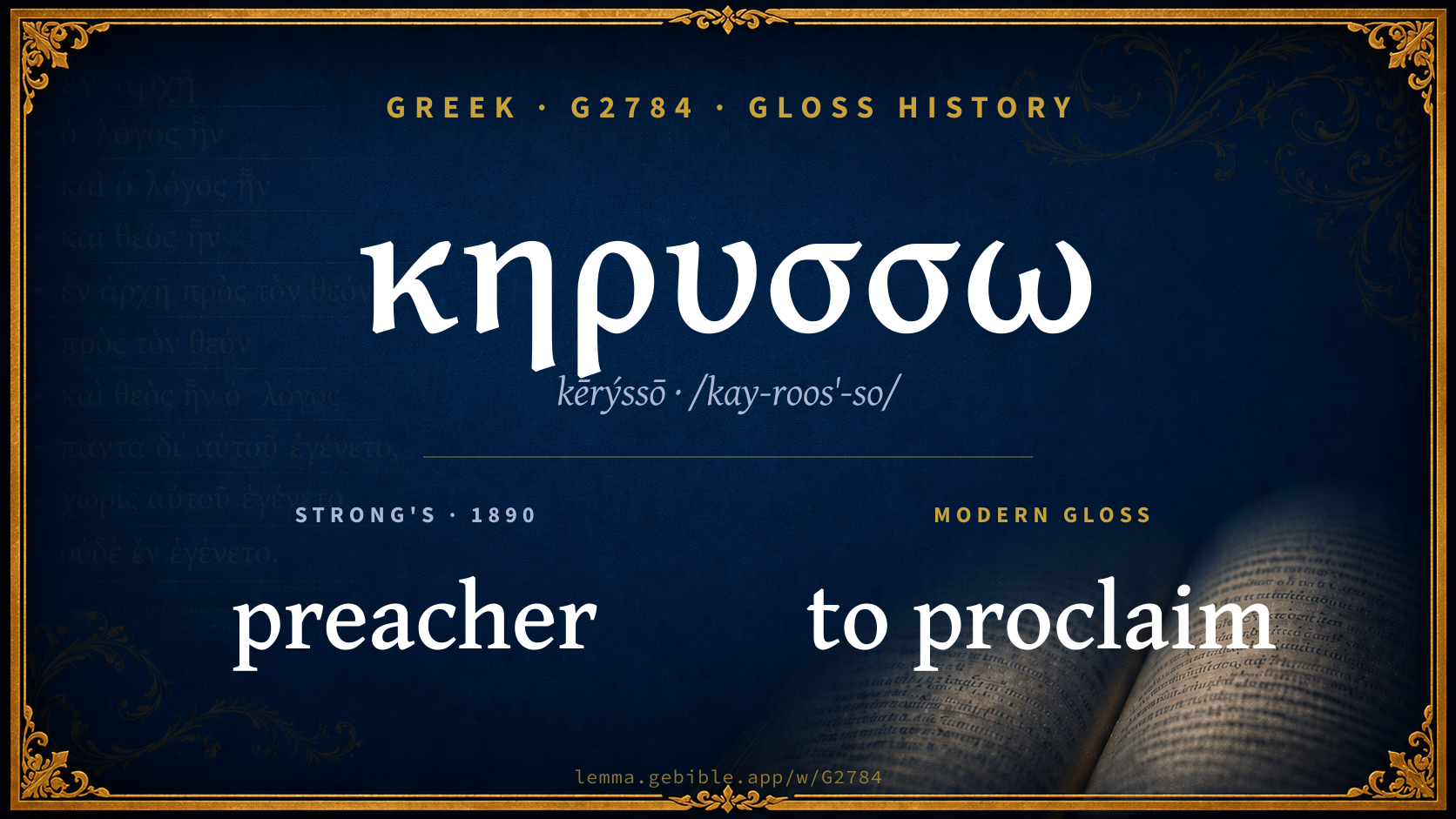
κηρυσσω — transliterated kērýssō — is a Greek verb carrying the sense “to proclaim.” Older and newer Bibles part ways — “preach” in the King James Version, “proclaim” (unfoldingWord Literal Text) in modern versions. See the renderings breakdown. It appears 59 verses across 15 books of the Greek New Testament, among its moderately common vocabulary. Its earliest occurrence is Matthew 3:1. Thayer's distinguishes 3 senses for it. Each statement above links to its evidence; the full detail follows below.
Gloss history
Strong's 1890 vs modern scholarship
About this word
Strong's G2784 catalogs a Greek word from the Greek New Testament.
These counts are not copied from any lexicon or concordance. They are computed here, from the morphology-tagged Greek New Testament. What Lemma adds →
- 59
- distinct verses
- The word appears in 59 distinct verses.
- 15 / 27
- NT books
- The word appears in 15 of 27 New Testament books.
- #267
- by frequency
- Top 500 most frequent Greek words (rank 267 of 5,347 Greek words by occurrence).
View all 59 occurrences in the concordance →
By section of the New Testament
By traditional corpus
Conventional, traditional groupings — biblical authorship is debated, so this is a traditional corpus grouping, not an authorship claim. Some books belong to more than one corpus (Luke is in both the Gospels and the Lukan corpus, and so on), so these shares overlap and need not total 100%. Each figure is a share of the word’s 59 distinct verses.
- Gospels 31 verses · 53%
- Pauline corpus 18 verses · 31%
- Lukan (Luke–Acts) 16 verses · 27%
- Johannine 1 verse · 2%
- General (Catholic) Epistles 1 verse · 2%
- Revelation 1 verse · 2%
How translations render this word
Counts come from each version’s own published word-to-Strong’s tagging or interlinear alignment — an approximate guide to how each version renders this word, not a word-level alignment the data otherwise carries. Because each total is that version’s own tagged count, the per-version totals vary from one another and need not match the appearance or distinct-verse counts above. These counts may also differ from a printed concordance because Lemma counts each distinctly tagged rendering and does not collapse phrase taggings into a single head-word total. This is a fixed set of word-tagged versions (KJV, ASV, BSB, ULT) and does not change with the reading translation you choose elsewhere. Each version’s license is shown beside its name below (and on Sources).
- King James Version: Preach 15×, Preached 8×, Preaching 8×
- American Standard Version: Preach 12×, Preaching 9×, Preached 6×
- Berean Standard Bible: Preach 12×, Preaching 8×, Proclaim 6×
- unfoldingWord Literal Text: Proclaim 10×, Preaching 9×, Preach 7×
King James Version Public Domain
Renders G2784 across 62 tagged occurrences — most commonly:
Plus 17 renderings that appear only once — usually multi-word phrases or single function words the recovered tagging swept in, not distinct renderings. Not rendered by a distinct English word in 1 further occurrence.
American Standard Version Public Domain
Renders G2784 across 62 tagged occurrences — most commonly:
Plus 21 renderings that appear only once — usually multi-word phrases or single function words the recovered tagging swept in, not distinct renderings.
Berean Standard Bible Public Domain
Renders G2784 across 61 tagged occurrences — most commonly:
Plus 15 renderings that appear only once — usually multi-word phrases or single function words the recovered tagging swept in, not distinct renderings.
unfoldingWord Literal Text CC BY-SA 4.0
Renders G2784 across 64 tagged occurrences — most commonly:
Plus 25 renderings that appear only once — usually multi-word phrases or single function words the recovered tagging swept in, not distinct renderings.
Senses in Thayer's
The 3 senses Thayer's distinguishes for this word, in lexicon order (not ranked by frequency or importance). The full entry — with sub-senses — is in the Lexicon Entry tab.
- to be a herald, to officiate as a herald
- to publish, proclaim openly: something which has been done
- used of the public proclamation of the gospel and matters pertaining to it…
Word origin
Origin: of uncertain affinity
Of uncertain affinity; to herald (as a public crier ) especially divine truth (the gospel): - preach (-er) proclaim publish.
— Strong’s Exhaustive Concordance (1890), public domain.
Forms in the corpus
The 28 distinct written forms G2784 takes in the Greek New Testament, most frequent first — each parse links to that tense’s occurrences in the concordance.
Same root — word family
Other Thayer's entries built from the same root as G2784, grouped by Strong’s listed origin. These share a root / origin per the lexicon — not necessarily a shared meaning. Each links to that word’s own entry.
Derived from this word
Compare all same-root words → They share a root, not necessarily a meaning.
Septuagint usage
The same Greek word κηρυσσω appears 26 times in the Greek Old Testament (Septuagint), across 26 verses in 14 books.
- 26
- LXX occurrences
- Tagged occurrences of this Greek word in the Septuagint.
- 26
- verses
- Distinct Septuagint verses containing this word.
- 14 / 39
- OT books
- The word appears in 14 of the 39 Old Testament books.
Sample Septuagint occurrences
- Genesis 41:43 κηρύσσω
- Exodus 32:5 κηρύσσω
- 2 Kings 10:20 κηρύσσω
- 2 Chronicles 20:3 κηρύσσω
- Esther 6:9 κηρύσσω
- Proverbs 1:21 κηρύσσω
- Isaiah 61:1 κηρύσσω
- Daniel 3:4 κηρύσσω
- Hosea 5:8 κηρύσσω
- Joel 1:14 κηρύσσω
- Jonah 1:2 κηρύσσω
- Micah 3:5 κηρύσσω
Septuagint occurrences (same lexeme)
Every verse where the same Strong’s number (G2784) appears in the Greek Septuagint. Verse text shown in the World English Bible for context; the Greek form is the matched word — the English is not keyword-highlighted.
- Genesis 41:43 κηρύσσω and he made him to ride in the second chariot which he had. They cried before him, "Bow the knee!" He set him over all the land of Egypt.
- Exodus 32:5 κηρύσσω When Aaron saw this, he built an altar before it; and Aaron made a proclamation, and said, "Tomorrow shall be a feast to Yahweh."
- Exodus 36:6 κηρύσσω Moses gave commandment, and they caused it to be proclaimed throughout the camp, saying, "Let neither man nor woman make anything else for the offering for the sanctuary." So the people were restrained from bringing.
- 2 Kings 10:20 κηρύσσω Jehu said, Sanctify a solemn assembly for Baal. They proclaimed it.
- 2 Chronicles 20:3 κηρύσσω Jehoshaphat feared, and set himself to seek to Yahweh; and he proclaimed a fast throughout all Judah.
- 2 Chronicles 24:9 κηρύσσω They made a proclamation through Judah and Jerusalem, to bring in for Yahweh the tax that Moses the servant of God laid on Israel in the wilderness.
- 2 Chronicles 36:22 κηρύσσω Now in the first year of Cyrus king of Persia, that the word of Yahweh by the mouth of Jeremiah might be accomplished, Yahweh stirred up the spirit of Cyrus king of Persia, so that he made a proclamation throughout all his kingdom, and [put it] also in writing, saying,
- Esther 6:9 κηρύσσω and let the clothing and the horse be delivered to the hand of one of the king's most noble princes, that they may array the man therewith whom the king delights to honor, and cause him to ride on horseback through the street of the city, and proclaim before him, Thus shall it be done to the man whom the king delights to honor.
- Esther 6:11 κηρύσσω Then took Haman the clothing and the horse, and arrayed Mordecai, and caused him to ride through the street of the city, and proclaimed before him, Thus shall it be done to the man whom the king delights to honor.
- Proverbs 1:21 κηρύσσω She calls at the head of noisy places. At the entrance of the city gates, she utters her words:
- Proverbs 8:1 κηρύσσω Doesn't wisdom cry out? Doesn't understanding raise her voice?
- Isaiah 61:1 κηρύσσω The Spirit of the Lord Yahweh is on me; because Yahweh has anointed me to preach good news to the humble; he has sent me to bind up the broken-hearted, to proclaim liberty to the captives, and the opening [of the prison] to those who are bound;
- Daniel 3:4 κηρύσσω Then the herald cried aloud, To you it is commanded, peoples, nations, and languages,
- Hosea 5:8 κηρύσσω "Blow the cornet in Gibeah, And the trumpet in Ramah! Sound a battle cry at Beth Aven, behind you, Benjamin!
- Joel 1:14 κηρύσσω Sanctify a fast. Call a solemn assembly. Gather the elders, And all the inhabitants of the land, to the house of Yahweh, your God, And cry to Yahweh.
- Joel 2:1 κηρύσσω Blow you the trumpet in Zion, And sound an alarm in my holy mountain! Let all the inhabitants of the land tremble, For the day of Yahweh comes, For it is close at hand:
- Joel 2:15 κηρύσσω Blow the trumpet in Zion! Sanctify a fast. Call a solemn assembly.
- Joel 4:9 κηρύσσω
- Jonah 1:2 κηρύσσω "Arise, go to Nineveh, that great city, and preach against it, for their wickedness has come up before me."
- Jonah 3:2 κηρύσσω "Arise, go to Nineveh, that great city, and preach to it the message that I give you."
- Jonah 3:4 κηρύσσω Jonah began to enter into the city a day's journey, and he cried out, and said, "Yet forty days, and Nineveh shall be overthrown!"
- Jonah 3:5 κηρύσσω The people of Nineveh believed God; and they proclaimed a fast, and put on sackcloth, from the greatest of them even to the least of them.
- Jonah 3:7 κηρύσσω He made a proclamation and published through Nineveh by the decree of the king and his nobles, saying, "Let neither man nor animal, herd nor flock, taste anything; let them not feed, nor drink water;
- Micah 3:5 κηρύσσω Thus says Yahweh concerning the prophets who lead my people astray; for those who feed their teeth, they proclaim, "Peace!" and whoever doesn't provide for their mouths, they prepare war against him:
- Zephaniah 3:14 κηρύσσω Sing, daughter of Zion! Shout, Israel! Be glad and rejoice with all your heart, daughter of Jerusalem.
- Zechariah 9:9 κηρύσσω Rejoice greatly, daughter of Zion! Shout, daughter of Jerusalem! Behold, your king comes to you! He is righteous, and having salvation; Lowly, and riding on a donkey, Even on a colt, the foal of a donkey.
These are occurrences of the same Greek lexeme (G2784) in the Septuagint — not a translation of any one Hebrew word. The store carries no word-level Hebrew↔Greek alignment, so no Hebrew original is asserted here. Counts come from the recovered LXX Strong's tagging — high-frequency vocabulary is well covered, while rare or late forms may be untagged — so they reflect tagged occurrences and may slightly undercount.