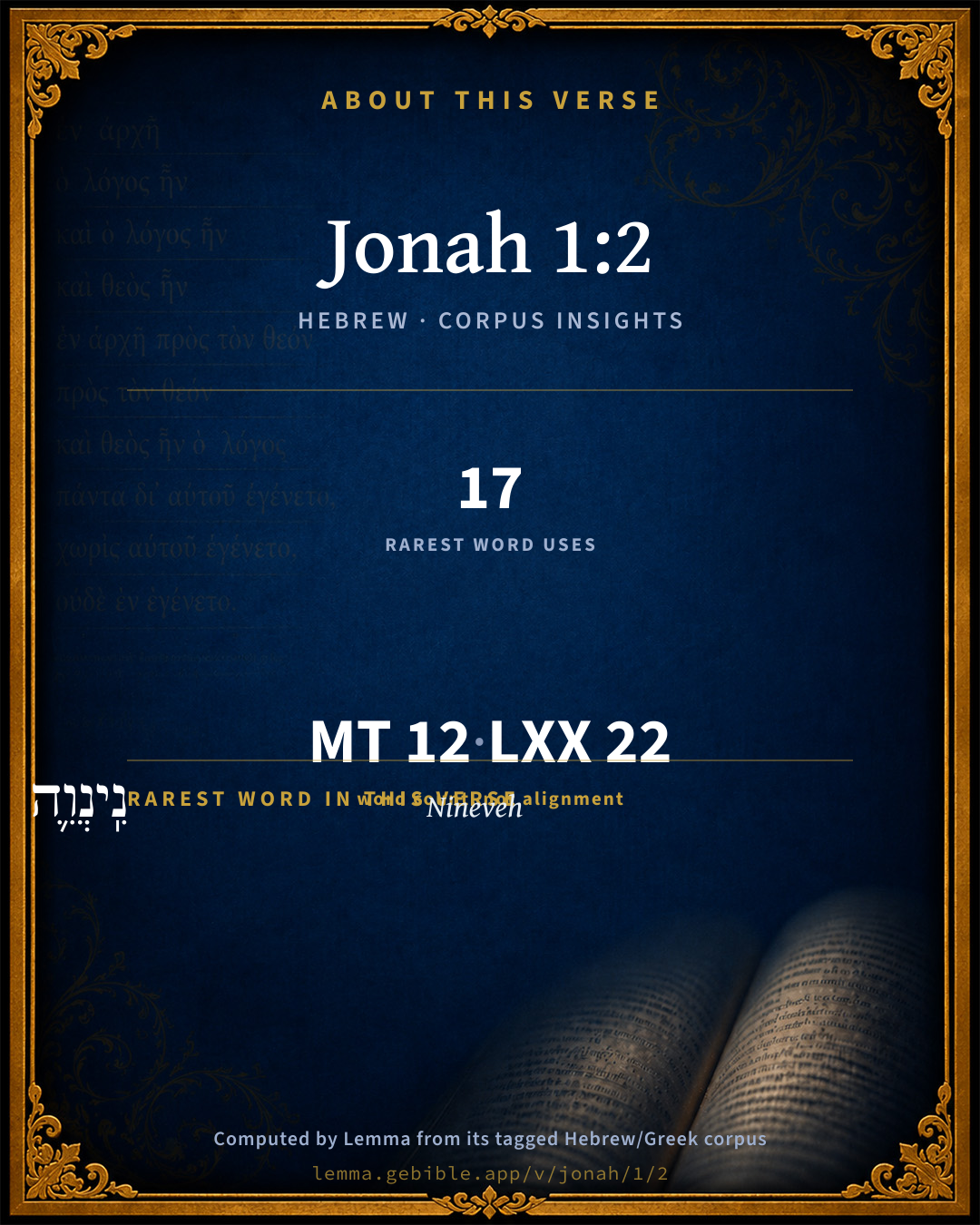
Jonah 1:2

Hebrew (Westminster Leningrad Codex) Jonah 1:2 appears in the Hebrew Old Testament. The text above is from the Westminster Leningrad Codex. Each word links to its Strong’s number, a concise gloss, and parsing drawn from the Open Scriptures Hebrew Bible morphology. Click any word for its full Brown-Driver-Briggs (BDB) entry.
Download image
Cite this verse

Jonah 1:2 (World English Bible). Public Domain. Lemma interlinear Bible study tool, https://lemma.gebible.app/v/jonah/1/2.

Show BibTeX & RIS
BibTeX
RIS
English Translation
"Arise, go to Nineveh, that great city, and preach against it, for their wickedness has come up before me."
World English Bible · Public Domain
Download a study sheet

One document with this verse’s original text, its word-by-word gloss line, the meaning frame, cross-references with their text, attributed commentary, and full source and license credits — printable, and it pastes into notes with its structure intact.

This verse Autodidact and up

Study sheet (.html) Plain text (.txt)

A passage Seminary Student

Up to 50 verses in one chapter. A passage sheet keeps up to 6 commentary sources and 12 cross-references per verse, in the order this page ranks them, and says so on the sheet whenever that leaves anything out. Ask for a single verse and you get the Autodidact verse sheet above.

Everything on this page stays free to read, with no account — the sheet is a download of what is already on screen, not access to it.

Want to remove ads? Support Godless Engineer
Compare translations 3

The same verse in 3 English versions, stacked beneath the original-language interlinear above. Click any original word for its lexicon entry.

Each is an independent rendering of the whole verse — the interlinear is not word-aligned to these translations.

Highlighted words mark where these versions differ — a whole-verse word diff, not a word-by-word alignment.

  • World English Bible Public Domain
    "Arise, go to Nineveh, that great city, and preach against it, for their wickedness has come up before me."
  • King James Version Public Domain
    Arise, go to Nineveh, that great city, and cry against it; for their wickedness is come up before me.
  • unfoldingWord Literal Text CC BY-SA 4.0
    “Get up, go to Nineveh, the great city, and call out against it, because their evil has risen up before my face.”

unfoldingWord Literal Text — © unfoldingWord, licensed CC BY-SA 4.0. Word-aligned USFM3 via Door43 (git.door43.org/unfoldingWord/en_ult).

Versions to compare (up to 4)

3 of 4 selected

Show all 18 translations

Every available English version of this verse, each an independent rendering of the whole verse.

  • World English Bible Public Domain
    "Arise, go to Nineveh, that great city, and preach against it, for their wickedness has come up before me."
  • Berean Standard Bible Public Domain
    “Get up! Go to the great city of Nineveh and preach against it, because its wickedness has come up before Me.”
  • Majority Standard Bible Public Domain
    “Get up! Go to the great city of Nineveh and preach against it, because its wickedness has come up before Me.”
  • King James Version Public Domain
    Arise, go to Nineveh, that great city, and cry against it; for their wickedness is come up before me.
  • American Standard Version (1901) Public Domain
    Arise, go to Nineveh, that great city, and cry against it; for their wickedness is come up before me.
  • Revised Version (1885) Public Domain
    Arise, go to Nineveh, that great city, and cry against it; for their wickedness is come up before me.
  • Geneva Bible (1599) Public Domain
    Arise, and goe to Nineueh, that great citie, and crye against it: for their wickednesse is come vp before mee.
  • Douay-Rheims (1899) Public Domain
    Arise, and go to Ninive the great city, and preach in it: for the wickedness thereof is come up before me.
  • Young's Literal Translation Public Domain
    `Rise, go unto Nineveh, the great city, and proclaim against it that their wickedness hath come up before Me.'
  • Literal Standard Version CC BY-SA 4.0
    “Rise, go to Nineveh, the great city, and proclaim against it that their wickedness has come up before Me.”
  • Unlocked Literal Bible CC BY-SA 4.0
    “Get up and go to Nineveh, that great city, and speak out against it, because their wickedness has risen up before me.”
  • unfoldingWord Literal Text CC BY-SA 4.0
    “Get up, go to Nineveh, the great city, and call out against it, because their evil has risen up before my face.”
  • Darby Bible Public Domain
    Arise, go to Nineveh, the great city, and cry against it; for their wickedness is come up before me.
  • World Messianic Bible Public Domain
    “Arise, go to Nineveh, that great city, and proclaim against it, for their wickedness has come up before me.”
  • Webster's Bible Public Domain
    Arise, go to Nineveh, that great city, and cry against it; for their wickedness is come up before me.
  • Free Bible Version CC BY-SA 4.0
    “Go immediately to the great city of Nineveh and condemn it because I have seen the wickedness of its people.”
  • Bible in Basic English Public Domain
    Up! go to Nineveh, that great town, and let your voice come to it; for their evil-doing has come up before me.
  • JPS Tanakh (1917) Public Domain
    'Arise, go to Nineveh, that great city, and proclaim against it; for their wickedness is come up before Me.'

Literal Standard Version (2020), Covenant Press — licensed CC BY-SA 4.0. Text via the HelloAO Bible API (eBible.org). Unlocked Literal Bible (unfoldingWord) — licensed CC BY-SA 4.0. Text via the HelloAO Bible API (eBible.org). unfoldingWord Literal Text — © unfoldingWord, licensed CC BY-SA 4.0. Word-aligned USFM3 via Door43 (git.door43.org/unfoldingWord/en_ult). Free Bible Version, Dr. Jonathan Gallagher — licensed CC BY-SA 4.0. Text via the HelloAO Bible API (eBible.org).

Word by word

More ways to search: Search by grammar → Find every occurrence → Compare this word →

Practice this passage: Drill this verse → Learn its vocabulary →

נִֽינְוֵ֛ה
Nîynᵉvêh
H5210
“Nineveh”
Noun, Proper
Part of Speech
Noun
Type
Proper
Full BDB Definition

Origin: of foreign origin

TWOT: None

Nineveh = "abode of Ninus" - capital of the ancient kingdom of Assyria; located on the east bank of the Tigris river, 550 miles (880 kilometers) from its mouth and 250 miles (400 kilometers) north of Babylon
  1. ק֠וּם qûwm H6965 “rise” Verb, Qal, Imperative, 2nd Person, Masculine, Singular
  2. לֵ֧ךְ yâlak H3212 “walk” Verb, Qal, Imperative, 2nd Person, Masculine, Singular
  3. אֶל ʼêl H413 “to” Preposition
  4. הָעִ֥יר ʻîyr H5892 “the · city” Particle, Definite Article + Noun, Common, Feminine, Singular, Absolute
  5. הַגְּדוֹלָ֖ה gâdôwl H1419 “the · great” Particle, Definite Article + Adjective, Adjective, Feminine, Singular, Absolute
  6. וּקְרָ֣א qârâʼ H7121 “and · call” Conjunction + Verb, Qal, Imperative, 2nd Person, Masculine, Singular
  7. עָלֶ֑יהָ ʻal H5921 “upon · her” Preposition + Suffix, Personal, 3rd Person, Feminine, Singular
  8. כִּֽי kîy H3588 “that” Conjunction
  9. עָלְתָ֥ה ʻâlâh H5927 “to go up” Verb, Qal, Perfect, 3rd Person, Feminine, Singular
  10. רָעָתָ֖ם raʻ H7451 “evil · their” Noun, Common, Feminine, Singular, Construct + Suffix, Personal, 3rd Person, Masculine, Plural
  11. לְפָנָֽי pânîym H6440 “to/for · face(s) · my” Preposition + Noun, Common, Both, Plural, Construct + Suffix, Personal, 1st Person, Common, Singular

About this verse

These counts appear in no published source. They are computed here, from the morphology-tagged text and Lemma’s own curated glosses. What Lemma adds →

12
words
12
distinct lemmas
Prophets
section

Notable vocabulary

The rarest word here is נִֽינְוֵ֛ה Nineveh H5210 — appearing just 17 times in the whole Hebrew Bible.

Shared distinctive vocabulary

נִֽינְוֵ֛ה Nineveh H5210 occurs in 16 verses of the Hebrew Bible. Also found in:

Grammatical profile

  • 4 verbs
  • 4 nouns
  • 1 adjective
  • 2 prepositions
  • 1 conjunction

Verb forms

  • ק֠וּם Qal · Imperative
  • לֵ֧ךְ Qal · Imperative
  • וּקְרָ֣א Qal · Imperative
  • עָלְתָ֥ה Qal · Perfect

Hebrew & Septuagint length

In English translation the verse runs 19 words from the Hebrew and 23 from the Septuagint (LXX English) — closely comparable.

A rough comparison of the two English renderings, which tokenize alike — not a word-level alignment.

Word counts can differ between the Hebrew and the Greek without any difference in meaning — e.g. the Hebrew direct-object marker אֵת has no separate Greek word, and Greek often adds the article ὁ.

In the original languages it is 12 Hebrew tokens and 22 Greek tokens — but the two are counted differently (Hebrew bundles its prefixes and suffixes into one token; the Greek is in lemma form), so that isn’t a like-for-like length.

Cross-references

17

Topical passages linked to Jonah 1:2 in the Treasury of Scripture Knowledge — connected by theme and wording, ordered by reader-vote popularity; previews shown in the World English Bible.

  • Genesis 18:20–21 Yahweh said, "Because the cry of Sodom and Gomorrah is great, and because their sin is very grievous,
  • Genesis 10:11 Out of that land he went forth into Assyria, and built Nineveh, Rehoboth Ir, Calah,
  • Isaiah 58:1 Cry aloud, don't spare, lift up your voice like a trumpet, and declare to my people their disobedience, and to the house of Jacob their sins.
  • Nahum 1:1 An oracle about Nineveh. The book of the vision of Nahum the Elkoshite.
  • Jonah 3:2 "Arise, go to Nineveh, that great city, and preach to it the message that I give you."
  • Jonah 4:11 Shouldn't I be concerned for Nineveh, that great city, in which are more than one hundred twenty thousand persons who can't discern between their right hand and their left hand; and also much cattle?"
  • Zephaniah 2:13–15 He will stretch out his hand against the north, destroy Assyria, and will make Nineveh a desolation, and dry like the wilderness.
  • Jeremiah 1:7–10 But Yahweh said to me, Don't say, I am a child; for to whoever I shall send you, you shall go, and whatever I shall command you, you shall speak.
  • Ezekiel 3:5–9 For you are not sent to a people of a strange speech and of a hard language, but to the house of Israel;
  • Revelation 18:5 for her sins have reached to the sky, and God has remembered her iniquities.
  • 2 Kings 19:36 So Sennacherib king of Assyria departed, and went and returned, and lived at Nineveh.
  • Ezra 9:6 and I said, my God, I am ashamed and blush to lift up my face to you, my God; for our iniquities are increased over our head, and our guiltiness is grown up to the heavens.
  • Ezekiel 2:7 You shall speak my words to them, whether they will hear, or whether they will forbear; for they are most rebellious.
  • Micah 3:8 But as for me, I am full of power by the Spirit of Yahweh, And of judgment, and of might, To declare to Jacob his disobedience, And to Israel his sin.
  • Nahum 2:1–3 He who dashes in pieces has come up against you. Keep the fortress! Watch the way! Strengthen your loins! Fortify your power mightily!
  • Matthew 10:18 Yes, and you will be brought before governors and kings for my sake, for a testimony to them and to the Gentiles.
  • James 5:4 Behold, the wages of the laborers who mowed your fields, which you have kept back by fraud, cry out, and the cries of those who reaped have entered into the ears of the Lord of Hosts.

Cross-references courtesy of OpenBible.info (CC BY 4.0).

Hebrew and Greek witnesses Masoretic Hebrew ↔ Greek Septuagint

The same verse in the two great witnesses to the Old Testament, shown verse-for-verse.

These are two independent witnesses, not word-aligned to each other, and the Septuagint is shown in lemma (dictionary) form.

Hebrew Jonah 1:2 Masoretic · Westminster Leningrad Codex

ק֠וּם לֵ֧ךְ אֶל נִֽינְוֵ֛ה הָעִ֥יר הַגְּדוֹלָ֖ה וּקְרָ֣א עָלֶ֑יהָ כִּֽי עָלְתָ֥ה רָעָתָ֖ם לְפָנָֽי

"Arise, go to Nineveh, that great city, and preach against it, for their wickedness has come up before me."

World English Bible · Public Domain

Greek LXX Jonah 1:2 Septuagint · lemma form

ἀναἵστημι καί πορεύομαι εἰς νινευη ὁ πόλις ὁ μέγας καί κηρύσσω ἐν αὐτός ὅτι ἀναβαίνω ὁ κραυγή ὁ κακία αὐτός πρός ἐγώ

Rise, and go to Nineve, the great city, and preach in it; for the cry of its wickedness is come up to me.

LXX2012 (modern English Septuagint) · Public Domain

On this verse, Haydock's Catholic Bible Commentary discusses the Septuagint’s reading. Read the note in Commentary ↓

Hebrew: Westminster Leningrad Codex (CC BY 4.0). Greek: Septuagint (public domain); English from LXX2012 (modern English Septuagint) (Public Domain). How the Septuagint differs from the Hebrew →

Targum (Aramaic paraphrase)

1

The Targum is the ancient Jewish Aramaic paraphrase of the Hebrew Scriptures — an interpretive translation, not the Hebrew text itself. Onkelos (literal) and Pseudo-Jonathan (expansive) render the Torah, and Jonathan the Prophets. Coverage is partial: where no permissively-licensed English translation exists for a verse, only the Aramaic is shown. This is verse-level text, not a word-by-word alignment to the Hebrew.

  1. Targum Jonathan Prophets (Joshua–Malachi)
    קוּם אֱזֵיל לְנִינְוֵה קַרְתָּא רַבְּתָא וְאִתְנַבֵּי עַלָהּ אֲרֵי סְלִיקַת בִּישַׁתְהוֹן קֳדָמָי:

    Get up, go down to Nineveh, the great city, and prophecy upon them, for their evil has risen before Me.

    Targum Jonathan — Aramaic: “Mikraot Gedolot” (public domain). English: “Sefaria Community Translation” (CC0 1.0 (public-domain dedication)); “London "Chaldee Paraphrase," 1871” (public domain). Text via Sefaria.

Commentary

Notes on Jonah 1:2 from classic Christian and Jewish commentators (each source and its license shown beneath its notes). The classic Christian expositions comment on the surrounding passage and are grouped to its opening verse, so a note may address several verses; the Jewish commentaries on the Tanakh (Rashi and others) are per-verse, so they appear only where the commentator wrote on this verse.

Lemma curates 59 commentaries, every one of them public domain or Creative Commons licensed, each selected and text-cleaned for this edition rather than reprinted as found. About our sources →

The Cambridge Bible for Schools and Colleges

gen. ed. J. J. S. Perowne

2. Nineveh] On the E. bank of the Tigris, the capital of the ancient kingdom and empire of Assyria, and “the most magnificent of all the capitals of the ancient world.” The building of it is mentioned as early as Gen_10:11. In the time of Jonah it appears to have been at the zenith of its glory.

that great city] See note on c. Jon_3:3, and Note B.

NOTE B. NINEVEH

It is evidently the design of the writer of this Book to give prominence to the vast size of Nineveh. when he speaks of it, it is with the constant addition, “the great city,” (Jon_1:2; Jon_3:2; Jon_4:11), and the addition is justified by the statements that it was “great to God,” that it was a city “of three days’ journey,” and that it contained “more than sixscore thousand persons unable to discern between their right hand and their left, and also much cattle” (Jon_4:11). In seeking to verify this description and to identify, with some reasonable degree of probability, the Nineveh of Jonah, we have first to determine what is meant by the expression “a city of three days’ journey.” It has been held that the “three days’ journey” describes the time that would be occupied in traversing the city from end to end; along “the ‘high street’ representing the greatest length or ‘the diameter’ of the town, which ran from one principal gate to the opposite extremity.” (Kalisch.) But unless we are prepared to regard the “figures given in the text” as “the natural hyperboles of a writer who lived long after the virtual destruction of the city, and who, moreover, was anxious to enhance the impressiveness of his story and lesson, by dwelling on the vastness of the population whose fate depended on their moral regeneration” (Ib.), we shall find it difficult to accept the gratuitous assumption that Nineveh is here described as a city “about fifty-five English miles in diameter,” with a “high street” fifty-five miles long. Nor is it more satisfactory to suppose that by a city of three days’ journey is meant a city which it would require three days to go all over. No intelligible idea of size could possibly be conveyed by such a definition. Adopting, then, the more reasonable view that the “three days’ journey” refers to the circumference of the city, and estimating a day’s journey at about twenty miles, we have Nineveh here described as comprising a circuit of about sixty miles. Whether this large area was inclosed by continuous walls we cannot certainly say. One ancient writer, indeed, (Diodorus Siculus) asserts that it was, and that the walls were “100 feet high, and broad enough for three chariots to drive abreast upon” (Dict. of Bible, Article Nineveh); and he, moreover, gives the dimensions of the city as an irregular quadrangle of about 60 miles in circuit. But without relying too much upon his testimony, which may be regarded as doubtful, we may conclude that an area such as has been described was sufficiently marked out to be known and spoken of as the city of Nineveh. This vast area was not, however, completely covered as in the case of our own cities, with streets and squares and buildings. That was a feature unusual, and almost unknown, in the ancient cities of the East. It was perhaps the feature which, belonging to Jerusalem by virtue of the deep ravines by which it was surrounded, and which “determined its natural boundaries,” and prevented its spreading abroad after the fashion of other oriental cities, called forth the surprise and admiration of the Jews after their return from Babylon. “Jerusalem,” they exclaim, “(unlike Babylon where we so long have dwelt) is built as a city which is compact together.” Like Babylon, Nineveh included not only parks and paradises, but fields under tillage and pastures for “much cattle” (Jon_4:11) in its wide embrace. The most probable site of the city thus defined will be seen by reference to the accompanying plan. It lies on the eastern bank of the Tigris in the fork formed by that river and the Ghazr Su and Great Zab, just above their confluence. The whole of this district abounds in heaps of ruins. Indeed, “they are found,” it is said, “in vast numbers throughout the whole region watered by the Tigris and Euphrates and their confluents, from the Taurus to the Persian Gulf.” “Such mounds,” it is added, “are especially numerous in the region to the east of the Tigris, in which Nineveh stood, and some of them must mark the ruins of the Assyrian capital.” (Dict. of the Bible.) Four of these great masses of ruins, which will be found marked on the plan, Kouyunjik, Nimrud, Karamless, Khorsabad, form together an irregular parallelogram of very similar dimensions to those mentioned in the text. From Kouyunjik (lying opposite Mosul) on the Eastern bank of the Tigris, a line drawn in a S. E. direction, parallel to the course of the river, to Nimrud is about eighteen miles. From Nimrud, in a northerly direction, to Karamless is about twelve. The opposite sides of the parallelogram, from Karamless to the most northerly point Khorsabad, and from Khorsabad to Kouyunjik again, are about the same. These four vast piles of buildings, with the area included in the parallelogram which they form, are now generally identified with the site of the Nineveh which Jonah visited. For fuller particulars the reader is referred to Smith’s Dictionary of the Bible, Article Nineveh, and to the well-known works of Mr Layard and Professor Rawlingson.

The Cambridge Bible for Schools and Colleges (gen. ed. J. J. S. Perowne; Cambridge University Press, 1878–1918) — public domain. Text from a community e-Sword module.

Trapp's Complete Commentary

John Trapp

Jon 1:2 Arise, go to Nineveh, that great city, and cry against it; for their wickedness is come up before me.

Ver. 2. Arise, go to Nineveh] Haec est vocatio prophetae, saith Oecolampadius: this was the prophet’s call, which he should have obeyed without bucking or shucking, delays or disputes, conferring, or consulting with flesh and blood, Gal 1:16. True it is, that in human governments, where reason is shut out, there tyranny is thrust in. As in the papacy (where the whore sitteth upon them, Rev 17:1, that is, useth them vilely and basely; sitteth upon their consciences, as Rachel did upon her father’s images), though their superiors command the friars a voyage to China or Peru, without dispute or delay they must presently set forward; to detract or disobey in this case is held breach of vow, equal to sacrilege: this is intolerable tyranny. But where God calleth or commandeth (as here), to ask a reason is presumption; to oppose reason is rebellion. Paul dared not but be obedient to the heavenly vision, Act 26:19. Jonah declined his apostleship (την αποστολην παρητησατο, as a father calleth it), but it had like to have cost him a choking; whereof, when in danger, he could confess that "They that observe lying vanities" (as he had done to his cost) "forsake their own mercy," Jon 2:8, are miserable by their own election. As for the expression here used, "Arise, go," it is hortantis particula, et studium notat; it is an encouraging and exciting particle. Up and be doing. Be "fervent in spirit; serving the Lord," Rom 12:11. Surge, age, summe Pater, said Mantuan to the Pope, exciting him to take up arms against the Turk. There is a curse to him that doeth the work of the Lord negligently, Jer 48:10, and a command to do it with all our might, Ecc 9:10.

Nineveh, that great city] Built by Ninus, and by him so named; as Adrianople, Constantinople, Charlestown, &c. A great city it was, indeed, never any so great; as consisting of three cities, and having more people within the walls, than are now in some one kingdom, saith an author. It was sixty miles about, saith Diodorus Siculus (Bunting saith Alcaire at this day is no less: Paulus Venetus saith Quinsay, in Tartary, is a hundred miles in circuit, but we are not bound to believe him. It is enough that Cambalu, the chief city there, is twenty-eight miles in compass). Nineveh was three days’ journey in Jonah’s days, fortified with a wall of a hundred feet high; and that also beautified, and beset with fifteen hundred towers, each of them erected to the height of two hundred feet. Thus far Diodorus, who also tells us that this great city received one ruin by the river Tigris, which, at an inundation, brake out upon the wall, and threw down two and a half miles of it, see Nah 1:8. Its last destruction was undertaken and ended by Nebuchadnezzar, as the Jews in their chronology testify. Herodotus saith, by Cyaxares, not by Astyages, as Jerome mistaketh him. If Sardanapalus were King of Nineveh when Jonah cried against it (as Corn. a Lapide contendeth), it was much that such an egregious voluptuary should so soon be wrought upon, as Jon 3:1-10. But he and his people soon relapsed to their former impiety; and were therefore destroyed, as Nahum had foretold; so that it may now be said of Nineveh, as once it was of another great city, in Strabo, magna civitas, magna solitudo. That great city is become a great desert, see Zep 2:15, it is nothing now but a sepulchre of itself, a little town of small trade, where Nestorius’s sect have taken their shelter, at the devotion of the Turk. It is become like that other Nineveh mentioned by Eusebius, quae est parvum quoddam in angulo Arabico oppidum, which is a certain little town in a corner of Arabia (Lib. de loc. Ebraic.).

And cry against it] Cry aloud with open mouth and full throat, sic clames, ut Stentora vincere possis. The voice said, Cry: but what should he cry? Isa 41:6-8. Cry that their wickedness is come up before me (so some), but that is not all. Cry, as Jon 3:5, Yet forty days and Nineveh shall be destroyed, for their wickedness is come, &c., their iniquity will be their ruin; tell them so from me, Isa 41:10-11.

Their wickedness is come up before me] Their pride, cruelty, and other many and bony sins, as Amos hath it, Amo 5:12. Of their idolatry we read not, and yet we doubt not; they declared their sins as Sodom, Isa 3:9, they set them upon the cliffs of the rocks, Eze 24:7-8; they did wickedly as they could, and filled not only the earth with their abominations, but the heaven also with the noise and stench thereof, to the annoying of God’s senses and the vexing of his soul; more than any filthy drunkard doth those that are sober, with his hooting and spewing. See Gen 4:10; Gen 18:20 Rev 18:5. {See Trapp on "Gen 4:10"} {See Trapp on "Gen 18:20"} {See Trapp on "Rev 18:5"}

John Trapp, A Commentary or Exposition upon All the Books of the Old and New Testament (1647–1656) — public domain. Text from a community e-Sword module.

The Biblical Illustrator

Joseph S. Exell

Jon_1:2

Go to Nineveh, that great city, and cry against it.

The comparative corruption of great cities proposition

That though by no means exclusively, yet in cities that are great and luxurious, integrity is exposed to peculiar snares, and depravity cherished to an extraordinary growth.

I. Explain this proposition.

1. We confine human depravity to no combination of circumstances. In some situations, it is true, the poison may evolve its noxious qualities more fully and freely than in others; but in one way or another it makes itself manifest in all. It is not intended to represent this depravity as in itself essential to our nature. Sin is not essential, but accidental, to our nature.

2. It should also be observed, that in great cities there are even advantages which are nowhere else to be so fully enjoyed. The children of this world, wise in their generation, instantly discern the advantages of city situations, in reference to their particular pursuits. Beside the civil and intellectual, there are moral and religious advantages which, in more sequestered situations, we can scarcely hope to enjoy. In cities there is an easy and regular access to the ordinances of grace.

3. There are peculiar temptations, to which more obscure situations are liable. In solitude the mind is in danger of being filled with prejudices, and the heart with passions, which at once destroy present tranquillity and endanger future well-being.

II. Illustrate the subject before us. That in populous cities corruption peculiarly prevails. Consider--

1. The multitude of transgressors.

2. The aggravated nature of the sins there particularly indulged.

3. The individual sinner usually attains a degree of presumptuous hardness, not common in less frequented scenes.

III. The causes from which this peculiar depravity proceeds.

1. The depravity of the heart is the groundwork of the whole.

2. Neglect of parental instruction.

3. The infectious power of example.

4. The chilling influence of the world.

5. The seducing influence of luxury. (James Simpson.)

Every man his call

This same event comes to every man. Do not suppose that Jonah is a lonely creature afar off in the ages somewhere, having an experience unique and incommunicable. The experience of Jonah is the experience of every good man. What is your call in life? To go wherever wickedness is, and cry against it. Nineveh has perished, but Ninevitish iniquity is upon our streets, is throwing its shadow upon our thresholds, is sending a keen wail of pain and blasphemy through the very air that blows about us. Every child of God is to be a protesting prophet. Every earnest man is to have no difficulty in finding the word of condemnation when he comes into the presence of sin. If we could realise this call, all the Lords people would be prophets. Is it not a burden to speak against wickedness? Where is the man that dare do it? It is easy to condemn wickedness generally. The difficulty is to say to the individual--Thou art the man. Almost anybody can stand up before a thousand people, and speak against iniquity in the mass. But he must be a lion from God that dare say to the individual criminal, I charge you, in the name of the Living One, with doing things that are wrong. Still, it is well that we should have men who stand up in the midst of cities, and who let the cities know that there are eyes upon them that see things in moral relationships, and aspects, and consequences: and woe betide the cities of the earth when the voice of the prophet is no longer heard in them. It is a harsh voice, it is a piercing cry; but believe it, and regeneration comes, and restora tion and lost peace return, and things are set right before the face of God. (Joseph Parker, D. D.)

Jonahs commission

The city to which he was com missioned was remarkable for its magnitude and its wickedness.

1. Nineveh was a great city in many respects.

(1) It was of great antiquity (Gen_10:9-12).

(2) It was great in respect of its power. It was the chief city of the mightiest monarchy in the world.

(3) In respect of its wealth.

(4) In respect of its extent. Probably sixty miles in circumference.

(5) In respect of its population. Probably 600,000 persons resided within its walls.

2. Nineveh was a guilty city. Cruelty was the characteristic vice. No man in Nineveh was secure from the violence to which its people were prone.

3. Nineveh was a Gentile city. It was this circumstance which chiefly rendered the commission addressed to Jonah so remarkable. It was so unusual that it startled Jonah. God displayed His interest in the welfare of mankind at large, even at that remote and unripe epoch. The Israelites were slow to learn that God did thus interest Himself in the welfare of the Gentiles. Now consider the disobedience of Jonah to the mandate addressed to him. The prophets object was to flee from the presence of the Lord; i.e., to get as far as possible beyond the range of those manifestations of the Divine presence which were peculiar to Palestine and its neighbourhood. Jonah sought to escape from such a consciousness of the Divine presence as he had been accustomed to experience in his own country, and may have regarded as peculiar to it. The presence of the Lord had become intolerable to Jonah from the moment that his want of sympathy with the Divine will in relation to Nineveh had become apparent to himself. Moreover, Jonah was an official of high rank in the theocracy, and his words may mean, I will resign my office rather than undertake this duty. But he had no right to resign the office he held in the service of Jehovah. His guilt and presumption are apparent; but have we not been as guilty and presumptuous as he; shrinking from duties that we knew were laid upon us? (Samuof Clift Burn.)

Jonah sent to Nineveh

A natural interpretation of the book is this,--Jonah had as great contempt for the heathen as his bigoted brethren of Israel. He was sent on a mission of mercy to his political enemies. As he had never learned to love his enemies, he fled from so distasteful a service. He was disciplined in the stomach of a fish till he was willing to deliver formally the commission given. He preached in Nineveh, still hating those who, if spared, might overthrow Israel. He was further disciplined by the lesson of the gourd. He at last learned the lesson of pity, and rejoiced in the good that accrued to his enemies, singing, Salvation is of the Lord.

I. The prophets commission to bless his enemies. About 825 b.c. God sent Jonah with a message to Nineveh, which was regarded by Israel as its natural enemy.

II. Jonahs refusal to accept a mission of mercy to his foes. Jonah was not a son of Satan, but a wilful servant of the Lord, who, by reason of false views, failed to comprehend Jehovahs broad policy in the government of this world.

III. How God humiliated His prophet before heathen sailors. Humiliating must have been the confession that he who knew move about holy things than all others on board was afraid to trust and obey his own God.

IV. How the heathen sailors made friends with Jonahs God. The prophets acknowledgment of his fear of Jehovah struck a nameless terror to the consciences of the crew. They did their best to save him from his fate, but all was in vain. When Jonah was cast overboard, and the storm ceased, they felt that Jonahs God was the true God, and must henceforth be their God. (Boston Homilies.)

God speaking to man in mercy, and man fleeing from God in disobedience

I. GOD SPEAKING TO MAN IN MERCY.

1. Here He speaks. The Word of the Lord. His Word to Jonah, like His word to all men, was clear, brief, weighty, practical.

2. Here He speaks to an individual. He speaks to all men in nature, conscience, history; but in sovereignty He singles some men out for special communications.

3. Here He speaks to an individual for the sake of a community. Arise, go to Nineveh, that great city. Why does God call it a great city? To men it was considered great, great in numbers, pomp, pretensions, masonry. But to God it could only be great in sin, for sin is a great thing to God; it is a black cloud in His universe. For the sake of this city, in order to effect its moral reformation, and therefore to save it, Jonah receives a commission. Arise, shake off thy languor, quit thyself for action, and to work out the ideas of the Infinite. No other creature on earth has this power.

(2) Gods method of helping humanity. God enlightens, purifies, and ennobles man by man. We have this treasure in earthen vessels.

II. Man fleeing from god in disobedience. But Jonah rose up to flee unto Tarshish, from the presence of the Lord. Here is a threefold revelation of man.

1. His moral freedom. God did not coerce Jonah, did not drive him to Nineveh. Man has power to resist God--a greater power, this, than can be found in all the heavenly orbs, or in the whole history of material organisms. This power invests man with all but infinite importance, links him to moral government. Ye do always resist the Spirit of God.

2. His daring depravity. Alas! men have not merely the power but the disposition to oppose God. This is their guilt and their ruin; it is what men are doing everywhere, trying to break the shackles of moral responsibility, trying to elude the Infinite.

3. His egregious folly. His endeavouring to escape from God was--

(1) Not merely an impulse, but a resolution. Had it been a sudden wish it would have been bad. He rose up. He rallied and marshalled his energies.

(2) Not merely a resolution, but an effort. He went down to Joppa. The probability is, that he went with the greatest speed to Joppa, the Jaffa of this day. When he reached the spot, how long he was about the quays in search of a suitable vessel.

(3) Not merely an effort, but a persevering effort. It was not one or two or three spasmodic efforts and then over. When he found a suitable vessel he paid the fare thereof. Ah, what fares men pay in the career of sin! (Homilist.)

Jonahs commission

1. When God has a work to do He is never at a loss for agents to accomplish His purposes. The Lord, on some occasions, fixes on instruments which appear to us the least suitable. All fitness is of God; He finds none fit for His service till He makes them so, and He can qualify the most defective. Should any ask why God fixed upon Jonah, and preferred him before any man on earth for this important service? We answer that God giveth no account of His matters; and though His footsteps are in the great deep, He never errs in judgment. The Word of the Lord came to Jonah. He knew who spoke to him, and what He said,--yet he was disobedient to the heavenly call.

2. The commission which God gave to Jonah. Great cities are great evils, seminaries of vice, and schools for profligacy. The more the fallen children of men herd together, the more deeply they corrupt one another. Cities may be great in many respects, and yet little in Gods account, because they are low in all real excellence.

3. Nineveh was ripe for destruction. Mark carefully, that all our sins go up before God, and are registered in His book of remembrance, with a view to the day of judgment. Cry against this great city. Their sins have cried long and loud against Me, and now My vengeance from heaven shall cry against them. When sinners kindle anger in the bosom of God, who is love itself, great must be their guilt, and tremendous will be their judgments when love turns to wrath. Nineveh is ripe for ruin; God is coming in His wrath against it; yet He halts by the way, and sends His messenger first, to say that He Himself is coming. (Thomas Jones, of Creaton.)

The reasons for Jonahs mission to Nineveh

Jonah was a suitable agent, but he was not indispensable. God called him, but He could do without him. To be the bearer of such a message as that which is here recorded could not in itself be pleasant, but it was highly honourable. To refuse to speak in such a case, at Divine bidding, was almost to take part with the wrong-doers, and is recorded in this book, by Jonahs own hand, to his personal discredit. There is but this one reason for the mission stated here; but there were at least several other reasons in reserve--some gently hinted, some unrevealed until ages afterwards. God, as we know, not only kindled in the indignation of justice against what was wrong, but He longed for the repentance of the wrong-doers, and for the manifestation of His mercy among them when thus penitent. He thought, too, of the future; of the use He would make of that people when His people should be led among them captive. As He sent Joseph into Egypt, He will send Jonah into Nineveh, to provide a remedy for a coming evil, a home for a captive people. He thought, too, of the far future of the world, and of the spiritual use to be made of the penitence of that wicked people in the proclamation of His mercy by the Gospel. He has made the Ninevites a pattern to all cities and ages--a proof that shall be known as long as history remains, that if a whole city, full of sinners, turn unto the Lord, they shall live. Whether Jonah knew much of these and such like reasons or not, it is certain that he knew quite enough to make the road to Nineveh, far and difficult as it might be, the Lords highway of duty and life to him; and any way else he could find, the devils road of crookedness, danger, and death. (A. Raleigh, D. D.)

The Biblical Illustrator, edited by Joseph S. Exell (c. 1880s–1900s) — public domain. Text from a community e-Sword module.

Tyndale Open Study Notes

Tyndale Open Resources

1:2 By Jonah’s day, Nineveh already had quite a long history (see Gen 10:12). It was a key city in the Assyrian Empire until its destruction in 612 BC (see Nah 1–3). Nineveh’s ruins are located across the Tigris River from the modern city of Mosul, Iraq. • great city: See study note on 3:3.

Tyndale Open Study Notes — © Tyndale Open Resources, licensed CC BY-SA 4.0. Text via the HelloAO Bible API.

Geneva Bible (1599)

Geneva Bible translators

For seeing the great obstination of the Israelites, he sent his Prophet to the Gentiles, that they might provoke them to repentance, or at least make them inexcusable: for Nineveh was the chief city of the Assyrians.

For as authors write, it contained in circuit about eight and forty miles, and had a thousand and five hundred towers, and at this time there were an hundred and twenty thousand children therein, Jonah 4:11.

Geneva Bible (1599) marginal notes — public domain. Text via Bolls.life.

Jamieson, Fausset & Brown

Robert Jamieson, A. R. Fausset & David Brown

to Nineveh--east of the Tigris, opposite the modern Mosul. The only case of a prophet being sent to the heathen. Jonah, however, is sent to Nineveh, not solely for Nineveh's good, but also to shame Israel, by the fact of a heathen city repenting at the first preaching of a single stranger, Jonah, whereas God's people will not repent, though preached to by their many national prophets, late and early. Nineveh means "the residence of Ninus," that is, Nimrod. , where the translation ought to be, "He (Nimrod) went forth into Assyria and builded Nineveh." Modern research into the cuneiform inscriptions confirms the Scripture account that Babylon was founded earlier than Nineveh, and that both cities were built by descendants of Ham, encroaching on the territory assigned to Shem (, , , ).

great city--four hundred eighty stadia in circumference, one hundred fifty in length, and ninety in breadth [DIODORUS SICULUS, 2.3]. Taken by Arbaces the Mede, in the reign of Sardanapalus, about the seventh year of Uzziah; and a second time by Nabopolassar of Babylon and Cyaxares the Mede in 625 B.C. See on .

cry-- (; ).

come up before me-- (; ; ; ; ); that is, their wickedness is so great as to require My open interposition for punishment.

Jamieson, Fausset & Brown — Commentary Critical and Explanatory on the Whole Bible (1871) — public domain (CC PDM 1.0). Text via the HelloAO Bible API.

Adam Clarke's Commentary

Verse 2. Go to Nineveh] This was the capital of the Assyrian empire, and one of the most ancient cities of the world, Ge 10:10-11; and one of the largest, as it was three days' journey in circumference. Ancient writers represent it as oblong; being in length one hundred and fifty stadia, and ninety in breadth, the compass being four hundred and eighty stadia. Now as the stadium is allowed to have been equal to our furlong, eight of which make a mile, this amounts to fifty-four English miles: see on Jon 3:3. But we must not suppose that all this space was covered with compact streets and buildings; it took in a considerable space of country, probably all the cultivated ground necessary to support all the inhabitants of that district. Calmet computes the measurement of the circumference to be equal to twenty-five French leagues. It is reported to have had walls one hundred feet high, and so broad that three chariots might run abreast upon them. It was situated on the Tigris, or a little to the west, or on the west side of that river. It was well peopled, and had at this time one hundred and twenty thousand persons in it reputed to be in a state of infancy, which on a moderate computation would make the whole number six hundred thousand persons. But some, supposing that persons not being able to distinguish their right hand from their left must mean children under two years of age, and reckoning one such child for every twenty persons from that age upwards, make the population amount to two millions five hundred thousand. Nor can this be considered an exaggerated estimate, when we know that London, not one-tenth of the size of ancient Nineveh, contains a population of upwards of one million. But calculations of this kind, relative to matters of such remote antiquity, are generally precarious, and not very useful: and ancient authors, though the only guides, are not always safe conductors. Mosul is generally supposed to be the same as the ancient Nineveh. It is in the province of Dearbekir, on the west bank of the Tigris.

Their wickedness is come up before me.] This is a personification of evil. It ascends from earth to heaven; and stands before the Supreme Judge, to bear witness against its own delinquency, and that of the persons whom it has seduced.

Adam Clarke's Commentary on the Bible (1810–1826) — public domain. Text from a community e-Sword/MySword module.

John Calvin's Commentaries

Arise, go to Nineveh, to that great city. Nineveh is called a great city, and not without reason; for it was in circumference, as heathen writers say, 400 stadia: and we shall see that Jonah was three whole days in going through the squares and streets of the city . It hence follows, that it was a very large city, and this all allow. Profane writers call it Ninus, and say that it is a name derived from its founder; for it was Ninus, the son of Betas, who built it. But more correct is their opinion, who think that נינוה Ninue, is a Hebrew word: and hence what Herodotus and Diodorus, and others of the same class, say, is certainly fabulous, both as to the origin of the city and as to the whole progress of the kingdom, and their legends can easily be disproved by testimonies from holy Scripture. It is at the same time admitted by all, that Nineveh was a very large and a well fortified city. Babylon was afterwards built by Semiramis, who had been the wife of Betas: after her husband’s death she wished to show that she also excelled in mind and industry, and that she had wisdom above her sex. But with regard to the founder of Nineveh, it is certain that the city was first built by Asshur: whether it was enlarged by Ninus, I know not: this, then, I leave as uncertain; for I wish not to contend about what is doubtful. But it is certain, from what Moses has said, that the founder of this city was Asshur, (Genesis 10:11.)

As to the largeness of the city, even if profane writers had not said a word, the testimony of Jonah ought to be sufficient to us. Now, since he is bidden to go and proceed to Nineveh, the Lord gives him some hope of success. He indeed wrought effectually by the hand of his servant, Nahum; who, though he continued at home, yet prophesied against the Ninevites; but with a different view, and for another end. For as the people were then miserably distressed, and saw the kingdom or monarchy of Assyria in a flourishing state, they must have despaired, had not some solace been afforded them. Hence Nahum showed that God would be a judge against the Ninevites; that though he for a time favored and spared them, there was yet impending over them the dreadful judgment of which he speaks. Nahum, then, was not given as a teacher to the Ninevites, but was only a proclaimer, that the Jews might strengthen their faith by this comfort — that they were not wholly rejected by the Lord, as he would some time avenge their wrongs. The case with Jonah was different: for he was sent to the city itself, to exhort the Ninevites to repent. Now the Lord, by speaking expressly of the largeness of the city, intended thus to prepare him with firmness, lest he should be frightened by the splendor, wealth, and power of that city: for we know how difficult it is to take in hand great and arduous undertakings, especially when we feel ourselves destitute of strength. When we have to do with many and powerful adversaries, we are not only debilitated, but our courage wholly vanishes away. Lest, then, the greatness of Nineveh should fill Jonah with terror, he is here prepared and armed with firmness. “Go then to Nineveh, and let not the power of that monarchy prevent thee to fulfill what I command thee; which is, to show to the Ninevites their sins, and to denounce on them destruction, if they repent not.”

We now then understand why Nineveh was called a great city: for had it not been for the reason just stated, it would not have been necessary that this should have been said to Jonah. The Israelites, I doubt not, knew well that it was a large city, and also possessed of strength and of a large number of men: but the Lord intended to set before his servant what might have been a hindrance to him in the discharge of his office; Go then to this great city. In short, God designed in this way to try Jonah, whether he would prefer his command to all the hindrances of this world. And it is a genuine proof of obedience when we simply obey God, however numerous the obstacles which may meet us and may be suggested to our minds, and though no escape may appear to us; yea, when we follow God, as it were with closed eyes, wherever he may lead us, and doubt not but that he will add strength to us, and stretch forth also his hand, whenever need may require, to remove all our difficulties. It was then the Lord’s purpose to deal thus with Jonah; as though he had said to him, “remember who I am, and be content with my authority; for I have ready at hand all resources; when any thing stands in your way, rely on my power, and execute what I command thee.” This is the import of the passage. Whenever then God demands any service from us, and we at the same time see that what the discharge of our duty demands is either difficult or apparently impossible, let this come to our minds, — that there is not anything in the whole world which ought not to give way to God’s command: we shall then gather courage and confidence, nor will anything be able to call us away from our duty and a right course, though the whole world were fighting against God.

It now follows, Cry against her; for ascended has their wickedness before my presence. Cry, he says, against her: it was an unpleasant undertaking to cry out against her immediately at the beginning. We indeed know that men take pride in their power: and as there was then but one monarchy in the world, the seat of which was at Nineveh, a teacher could hardly expect to obtain a patient hearing, though he excelled in gracefulness of manner, and had acquired reputation, and brought an agreeable message. But Jonah was a foreigner, one unknown, and destitute of authority; and still more, he was immediately to denounce destruction on the Ninevites, to cry aloud, to reprove, to make a vehement proclamation, to threaten. How difficult was all this? We hence see how hard a command it was when God charged his Prophet to cry against Nineveh.

It is now added, For their wickedness has ascended to me. By this clause God strengthens his servant Jonah; as though he said, “Thou wilt not, as an individual, have to contend with them, but I constitute thee as my herald, to summon them to my tribunal.” And no doubt it must have served much to animate Jonah, that he had not to deal with the Ninevites as an individual, but as the messenger of God: and it might also have had an influence on their minds, to know, that though no mortal inflicted punishment for their crimes, they yet could not escape the vengeance of God. This then is the reason why the Lord here declares that he would be the judge of Nineveh. And at the same time he reminds us, that though the Ninevites felicitated themselves, and also gained the plaudits of the whole world on account of their power, yet all this was of no moment, because their wickedness and iniquity had ascended into heaven. When therefore we are reproved, there is no reason that we should turn our eyes here and there towards men; we ought instantly to present ourselves to the scrutiny of God; nay, we ought ourselves to take in hand that voluntary examination which God requires. By so doing, we shall not feed our vices by foolishly deceiving ourselves, as hypocrites do, who ever look around them to the right hand and to the left, and never raise up their thoughts to heaven. Let us go on —

John Calvin's Commentaries (1540-1563) — public domain. Text from the Calvin Translation Society English edition (1840s-50s) via the Christian Classics Ethereal Library (ccel.org). Calvin's coverage is partial (roughly two-thirds of the Bible); uncommented books and verses are honest gaps, never fabricated. The 19th-century editor's footnotes and remarks are omitted so the notes are faithfully Calvin's own voice.

Ellicott's Commentary for English Readers

(2) Nineveh, that great city.—The size of Nineveh is throughout the book brought into prominent notice. (See Jon_3:2-3; Jon_4:11.) The traditions preserved in Greek and Roman writers dwell on the same feature; and modern researches among the huge mounds scattered along the left bank of the Tigris more than confirm the impression produced on the ancient world by the city, or rather group of cities, buried beneath them. (Comp. Gen_10:11.)

Cry.—A common word for a proclamation by a herald or a prophet. (Comp. Isa_40:6, &c.) The English word, in the sense of “proclaim,” lingers in the term “public crier.”

For their wickedness is come up before me.—“Every iniquity has its own voice at the hidden judgment seat of God” (S. Gregory, Mor. v. 20; quoted by Pusey). But, as Pusey remarks, the Hebrew implies especially evil-doing against others, that violence which in Jon_3:8 is recognised by the Ninevites themselves as their characteristic sin.

A Bible Commentary for English Readers, edited by Charles John Ellicott (1878–1897) — public domain. Text from a community e-Sword module.

John Gill's Exposition

Arise, go to Nineveh, that great city,.... That is, arise from the place where he was, and leave the business he was about, and prepare for a long journey to the place mentioned, and be as expeditious in it as possible. Nineveh was the metropolis of the Assyrian empire at this time; it was an ancient city built by Ashur, not by Nimrod; though he by some is said to go into Ashur or Assyria, and build it, Gen 10:11; and called it after the name of his son Ninus; for it signifies the mansion or palace of Ninus; and by most profane writers is called Ninus; according to Diodorus Siculus (m), and Strabo (n), it was built by Ninus himself in Assyria, in that part of it called by him Adiabena. It is said to be a great city, as it must, to be three days' journey in compass, and to have in it six score thousand infants, besides men and women, Jon 3:3. It is allowed by Strabo (o) to be larger than Babylon. Diodorus (p) says that it was in compass of sixty miles; and had a wall a hundred feet high, and so broad that three chariots or carriages might go abreast upon it; and it had, fifteen hundred towers, two hundred feet high. Aben Ezra calls it the royal city of Assyria, which is at this day destroyed; and the wise men of Israel, in the country of Greece, say it is called Urtia; but, whether so or not, he knew not:

and cry against it; or prophesy against it, as the Targum; he was to lift up his voice, and cry aloud, as he passed along in it, that the inhabitants might hear him; and the more to affect them, and to show that he was in earnest, and what he delivered was interesting to them, and of the greatest moment and importance: what he was to cry, preach, or publish, see Jon 3:2;

for their wickedness is come up before me; it was come to a very great height; it reached to the heavens; it was not only seen and known by the Lord, as all things are; but the cry of it was come up to him; it called aloud for vengeance, for immediate vengeance; the measure of it being filled up, and the inhabitants ripe for destruction; it was committed openly and boldly, with much impudence, in the sight of the Lord, as well as against him; and was no more to be suffered and connived at: it intends and includes their idolatry, bloodshed, oppression, rapine, fraud, and lying; see Jon 3:8.

(m) Bibliothec. l 2. p. 92. (n) Geograph. l. 16. p. 507. (o) Ut supra. (Geograph. l. 16. p. 507.) (p) Bibliothec. l. 2. p. 92.

John Gill's Exposition of the Whole Bible (1746–1763) — public domain (CC PDM 1.0). Text via the HelloAO Bible API.

Albert Barnes' Notes on the Bible

Arise, go to Nineveh, that great city - The Assyrian history, as far as it has yet been discovered, is very bare of events in regard to this period. We have as yet the names of three kings only for 150 years. But Assyria, as far as we know its history, was in its meridian. Just before the time of Jonah, perhaps ending in it, were the victorious reigns of Shalmanubar and Shamasiva; after him was that of Ivalush or Pul, the first aggressor upon Israel. It is clear that this was a time Of Assyrian greatness: since God calls it “that great city,” not in relation to its extent only, but its power. A large weak city would not have been called a “great city unto God” Jon 3:3.

And cry against it - The substance of that cry is recorded afterward, but God told to Jonah now, what message he was to cry aloud to it. For Jonah relates afterward, how he expostulated now with God, and that his expostulation was founded on this, that God was so merciful that He would not fulfill the judgment which He threatened. Faith was strong in Jonah, while, like Apostles “the sons of thunder,” before the Day of Pentecost, he knew not” what spirit he was of.” Zeal for the people and, as he doubtless thought, for the glory of God, narrowed love in him. He did not, like Moses, pray Exo 32:32, “or else blot me also out of Thy book,” or like Paul, desire even to be “an anathema from Christ” Rom 9:3 for his people’s sake, so that there might be more to love his Lord. His zeal was directed, like that of the rebuked Apostles, against others, and so it too was rebuked. But his faith was strong. He shrank back from the office, as believing, not as doubting, the might of God. He thought nothing of preaching, amid that multitude of wild warriors, the stern message of God. He was willing, alone, to confront the violence of a city of 600,000, whose characteristic was violence. He was ready, at God’s bidding, to enter what Nahum speaks of as a den of lions Nah 2:11-12; “The dwelling of the lions and the feeding-place of the young lions, where the lion did tear in pieces enough for his whelps, and strangled for his lionesses.” He feared not the fierceness of their lion-nature, but God’s tenderness, and lest that tenderness should be the destruction of his own people.

Their wickedness is come up before Me - So God said to Cain, Gen 4:10. “The voice of thy brother’s blood crieth unto Me from the ground:” and of Sodom Gen 18:20 :21, “The cry of Sodom and Gomorrah is great, because their sin is very grievous; the cry of it is come up unto Me.” The “wickedness” is not the mere mass of human sin, of which it is said 1Jo 5:19, “the whole world lieth in wickedness,” but evil-doing toward others. This was the cause of the final sentence on Nineveh, with which Nahum closes his prophecy, “upon whom hath not thy wickedness passed continually?” It bad been assigned as the ground of the judgment on Israel through Nineveh Hos 10:14-15. “So shall Bethel do unto you, on account of the wickedness of your wickedness.” It was the ground of the destruction by the flood Gen 6:5. “God saw that the wickedness of man was great upon the earth.” God represents Himself, the Great Judge, as sitting on His Throne in heaven, Unseen but All-seeing, to whom the wickedness and oppressiveness of man against man “goes up,” appealing for His sentence against the oppressor. The cause seems ofttimes long in pleading. God is long-suffering with the oppressor too, that if so be, he may repent. So would a greater good come to the oppressed also, if the wolf became a lamb. But meanwhile, “ every iniquity has its own voice at the hidden judgment seat of God.” Mercy itself calls for vengeance on the unmerciful.

Albert Barnes' Notes on the Bible (1834–1885) — public domain. Text from a community e-Sword/MySword module.

Haydock's Catholic Bible Commentary

Ninive, the capital city of the Assyrian empire. (Challoner) --- It was 150 stadia long and 90 broad, (Diodorus ii.) on the western bank of the Tigris. (Pliny, [Natural History?] vi. 13.) --- Mosul, which some mistake for it, stands on the northern side. See Genesis x. 10. At the time when Jonas preached, Ninive would contain about 600,000, chap. iv. 11. They were people less favoured by God, (Acts xiv. 15.; Calmet) but not abandoned. (Theodoret) --- God took sufficient care of all his creatures, and foretold many things relating to foreign nations. (Calmet) --- Romans iii. 29. (Worthington) --- For the. Septuagint add, "cry of," Genesis iv., and xviii. (Haydock)

George Leo Haydock (1774–1849), Haydock's Catholic Family Bible and Commentary, 1859 edition — public domain. Excludes Psalms (Douay-Rheims chapter numbering differs from Protestant) and Deuterocanonical books (Catholic canon only).

Matthew Poole's English Annotations

Arise; forthwith prepare thyself, and get all in readiness, and with hearty resolution set upon the work.

Go; so soon as thou art ready, set forward on thy journey, make not any delay.

Nineveh; the chief city or metropolis of the Assyrian kingdom, built by Asshur, Gen 10:11, if that verse be not better translated thus, He (i.e. Nimrod) went out into Assyria, and builded Nineveh; so Nimrod was the founder and first builder.

That great city: it may be easily conjectured a great city which was situate on such a river as Tigris is, had continued so many hundred years, from A.M. 1119, in which it was built, unto 3124, about which time Jonah was sent to preach against it; during which long growth it may be conceived as great as it is ordinarily described, one hundred and fifty furlongs in length, that is, eighteen miles and three quarters of our English measure, and eleven miles and one quarter of the same measure in breadth.

Cry against it; earnestly and publicly preach against the sins, and denounce the sudden ruin of that city unless they repent; so cry that all may hear, or at least all may come to the knowledge of what is threatened.

For their wickedness is come up before me: their many and great sins, as it is said of Cain’s sin when he had slain Abel, Gen 4:10, and Sodom’s sins, Gen 18:20,21, and the sins of oppressors, Jam 5:4, cry aloud, the cry enters heaven, and justice must no longer defer; yet I will give them warning; Jonah, go thou, and tell them plainly, their great sins shall be greatly punished.

Matthew Poole's English Annotations on the Holy Bible (1683–1685) — public domain. Text from a community e-Sword/MySword module.

The Pulpit Commentary

Nineveh, the capital of the kingdom of Assyria, is first mentioned in Gen_10:11, as founded by Nimrod. It stood on the left bank of the river Tigris, where it is joined by the Khosr, opposite to the present town of Mosul. The Assyrians had already become known in Syria. In B.C. 854 Shal-maneser II had defeated at Karkar twelve kings confederate against him, among whom is reckoned Ahab King of Israel. Long before his time, Tiglath-Pileser I had made a great expedition to the west, captured a town at the foot of Lebanon, and reached the coast of the Mediterranean Sea. Jehu was compelled to pay tribute to the Assyrians; and Rimmon-nirari, who reigned from B.C. 810 to 781, held the suzerainty of Phoenicia, Samaria, Edom, and Philistia. Jonah, therefore, knew well what his country might expect at the hands of this people. That great city. It is thus called in Jon_3:2, 3 4:11; and the epithet is added here in order to show to Jonah the importance of his mission. The size of Nineveh is variously estimated according to the sense attached to the name "Nineveh." This appellation may be restricted to Nineveh proper, or it may comprise the four cities which lay close together in the immediate neighbourhood of each ether, and whose remains are now known as the mounds of Kouyunjik, on the southwest, directly opposite to Mosul; Nimrud, about eighteen miles to the southeast; Karamless, twelve miles to the north; and Khorsabad, the most northerly, about the same distance both from Karamless and Kouyunjik. Khorsabad, however, was not built till some hundred years after Jonah"s time (Schrader, "Keilinschr.," p. 448). These cities are contained in an irregular parallelogram of some sixty miles in circumference. The following account of Nineveh proper is derived from Professor Rawlinson, "Ancient Monarchies," 1:252, etc.: "The ruins consist of two principal mounds, Nebbiyunus and Kouyunjik. The Kouyunjik mound, which lies nearly half a mile northwest of the others, is very much the more considerable of the two. Its shape is an irregular oval, elongated to a point towards the northeast. The surface is nearly flat; the sides slope at a steep angle, and are furrowed with numerous ravines worn in the soft material by the rains of some thirty centuries. The greatest height above the plain is ninety feet, and the area is estimated at a hundred acres. It is an artificial eminence, computed to contain 14, 500, 000 tons of earth, and on it were erected the palaces and temples of the Assyrian monarchs. The mound of Nebbi-yunus is at its base nearly triangular, and covers an area of nearly forty acres. It is loftier, and its sides are more precipitous than Kouyunjik, especially on the west, where it abutted on the wall of the city. The mass of earth is calculated at six and a half millions of tons. These two vast mounds are both in the same line, and abutted on the western wall of the city, which was some two and a half miles in length. Anciently it seems to have immediately overhung the Tigris, but the river has now receded to the west, leaving a plain of nearly a mile in width between its bank and the old rampart which evidently once followed the course of the river bank. The western wall is joined at fight angles by the northern rampart which runs in a straight line for seven thousand feet. At its other extremity the western wall forms a very obtuse angle with the southern, which impends over a deep ravine, and runs in a straight line for about a thousand yards, when it meets the eastern wall, which is the longest and the least regular of the four. The entire length of this side is sixteen thousand feet, or above three miles. It is divided into two portions by. the Stream of the Khosr-su; which, coming from the northwest, finds its way through the city and then across the low plain to the Tigris. The town is thus of an oblong shape, and the circuit of its walls is somewhat less than eight miles, and the area which they include is eighteen hundred acres. This, at the computation of something less than one hundred inhabitants per acre, would ascribe to Nineveh a population of one hundred and seventy-five thousand souls" (Rawlinson, "Anc. Men.," 1. ch. 1). Cry against it. The message is given in Jon_3:4. Thus the knowledge of the true God is made known among the Gentiles. Their wickedness; i.e., as Pusey notes, their evil doing towards others, as in Nah_3:19 (see Introduction, Is come up before me, and appeals for punishment, as Gen_4:10 Gen_18:20, Gen_18:21; Septuagint, Anebh h kraugh thv kakiav authv pro , "The cry of its wickedness is come up unto me.

Ver. 2. A city"s sin.

By its very nature sin is individual, personal; for it is the estrangement of the spiritual being and life from God. Yet, as men live in communities, and as these communities possess moral qualities and habits determined by the character of the component units, there is such a thing as the sin of a tribe, of a city of a nation. This is more obvious when it is remembered that states are personified in their rulers and representatives, whose words and actions must be taken as those of the community at large. The Scriptures, from the record of the Tower of Babel downwards, exhibit national responsibility as connected with national error and unfaithfulness. Among the lessons of this Book of Jonah, this lesson regarding a nation"s moral life and accountability is not the least valuable.

I A CITY"S SIN IS COMPATIBLE WITH ITS POLITICAL GREATNESS. Nineveh was "that great city." It was situated upon the noble river Tigris; it boasted a splendid and ancient history; it was of enormous extent, being, according to the historians, eighteen leagues in circumference; it had a population reckoned by hundreds of thousands; in short, it was one of the greatest and most famous of the cities of the ancient East, and was the capital of one of the most powerful of kingdoms. Recent discoveries have familiarized us with the civic life of the population of the city of Nineveh. Yet the wickedness of Nineveh was great. Magnitude, population, wealth, luxury, splendour, power, all are, alas! consistent with forgetfulness of God, and with rebellion against his authority who is King of kings and Lord of all the nations upon earth. How signally was this the case with pagan Rome! And are there not cities in professedly Christian lands, the abodes of power and of pleasure, whose sin cries aloud unto God?

II A CITY"S SIN IS OFTEN DISREGARDED BY HUMAN OBSERVERS, AND EVEN BY RULERS. The citizens take pride in their "gorgeous palaces," their "solemn temples," in magnificent public works, in stately ceremonies, in all the complicated apparatus of civilization, luxury, refinement, and enjoyment. The men in authority are content if outward order is observed, if regulations of police are respected, if the reports of health are satisfactory, if trade flourishes. But it is often forgotten that beneath this outward show of prosperity there may exist moral corruption and religious indifference, or even defiant infidelity. God may not be glorified; he may be hated and disobeyed. And yet no concern may be awakened, no contrition felt.

III A CITY"S SIN IS OBSERVED BY THE ALL-SEEING GOD. What graphic language is this, "Their wickedness is come up before me"! Under this old Hebrew idiom a great religious truth is discernible. Nothing escapes the notice of him who searcheth the hearts of the children of men.

Not only so. God looks upon the sins of the citizens, not as a statistician or a politician might look. He is grieved with men"s irreligion; he is "angry," i.e. , "with the wicked every day." We must not attribute to the Deity any emotions which would be unworthy of a human ruler. But it is not derogatory to God, it is honouring him, to think of him as distressed and dissatisfied with human rebellion, and to remember that his regard is that of a wise and righteous Ruler, who is concerned for the spiritual state of those whom he rules for their own good and for his glory.

IV A CITY"S SIN MUST BE MET BY A RIGHTEOUS TESTIMONY, REBUKE, AND WARNING. It must not be forgotten that men"s sins are often attributable to evil example, to common custom, to the force of habit, to forgetfulness and carelessness. For this reason is it needful that the preacher of righteousness should exhibit a just and lofty standard of national and individual virtue; that he should faithfully expose and denounce prevailing errors, follies, and injustice; and that he should remind men of their amenability to the tribunal of an Omniscient and Almighty Ruler. There is too little of this frank and fearless treatment of social corruption; the pulpit is to blame for this; and it is to be desired that Christian preachers should hear the Word of the Lord bidding them go and "cry against" the wickedness of great cities, and warn the citizens of the ruin they are bringing upon themselves. And above all is it important that the wicked should be summoned to repentance, and that the penitent should be directed to that Saviour who is the assurance of Divine pity, and the channel of Divine forgiveness, to all who come to him with contrite sorrow and with lowly faith.

The Pulpit Commentary (1880–1919), ed. H.D.M. Spence-Jones & Joseph S. Exell — public domain. Text from a community e-Sword module.

John Wesley's Explanatory Notes

That great city - It is said to have been one hundred and fifty furlongs in length, that is eighteen miles and three quarters, and eleven miles and one quarter in breadth.

John Wesley, Explanatory Notes Upon the Whole Bible (1754–1765) — public domain. Text via the GEBible commentary corpus.

Fairbairn on Ezekiel, Jonah & the Pastoral Epistles

Patrick Fairbairn

CHAPTER II. THE PROPHET’S COMMISSION TO GO TO NINEVEH—WHY GIVEN? AND FOR WHAT ENDS?

JONAH, we have already seen, was a prophet in the kingdom of Israel; and as the prophetical gift, like every other communication of the Spirit, was always bestowed for the special benefit of the visible church, we cannot doubt, that to be a witness to Israel was the great end and object of his mission. But the singular thing is, that when we turn to the Book of Jonah, which contains the record of his prophetical calling, we find no mention whatever made of Israel; the commission given him calls him away to another land, and requires him to transact with the inhabitants of a heathen city. The word that came to him was, “Arise, go to Nineveh, that great city, and cry against it; for their wickedness is come up before me.” The message, too, with which he was charged, appears in the circumstances scarcely less strange in regard to its matter, than in regard to the people to whom it was to be delivered. It was to be simply a cry against their heaven-daring iniquities, and an intimation that God was ready to come down to the execution of judgment. But why send such a message to Nineveh by this prophet, when there was so loud a call for it at home? The people of Israel, his own kinsmen, had now also reached a condition of almost hopeless profligacy and corruption; so that the cry of their iniquity must still more have gone up to the heavens, and called for the summary execution of divine wrath. Nor can we reasonably doubt, though the fact is not expressly recorded, that this prophet, after the example of those who preceded him in Israel, took many occasions in the course of his ministry to reprove the evil of the times, and to proclaim the certain approach of judgment. Yet it can as little be doubted, on the other hand, that the special work he had to do as a witness of heaven against the abounding iniquity, and a sign to Israel of the mind of God respecting it, consisted in the work committed to him as God’s ambassador to a people who lay altogether beyond the territory of Israel, and who had not hitherto been subjected to any peculiar moral treatment.

The appearance of strangeness, however, which this at first sight presents, will be found to vanish when the whole circumstances of the case are taken into consideration, and the bearing is seen which the singular work now to be wrought by God was designed and naturally fitted to have upon Israel. Why Nineveh in particular should have been chosen as the theatre of such an experiment—for this, indeed, we have no definite reason to assign beside the sovereignty of God; as there were, no doubt, many other cities at that time to which a similar message might with equal propriety have been sent. But there were two properties in the condition of Nineveh which rendered it peculiarly suitable for the great object contemplated by God; these were the magnitude of its population and resources, and the enormity of its crimes. In the word to Jonah, it is simply styled “that great city” (literally, “a great city of God”), an appellation which seems also to have been in familiar use among heathen writers. By these the most extraordinary accounts have been handed down of its grandeur and extent; it is even reported to have been “much greater than Babylon,” and to have been surrounded with walls “a hundred feet high, and so broad that three waggons might be driven on them abreast.” These walls, we are further informed, were fortified with 1500 towers at proper distances, each rising 200 feet in height, and rendering the whole so strong that the city was thought to be impregnable. That it should, therefore, have contained 120,000 little children, as we learn from the last chapter of Jonah, or an entire population approaching to a million, need not at all surprise us. It is also in perfect accordance with those other accounts derived from heathen sources, to have it spoken of as a city of three days’ journey; taking this in connection with the twofold fact, that a day’s journey in so hot a climate necessarily indicates a much shorter space than it does here, and that the cities of the East in ancient times comprehended in their circuit, as they often do still, many gardens and large spaces of vacant ground.

Finally, being situated on the banks of the Tigris, and occupying a position most convenient for an emporium of merchandise between Eastern and Western Asia, we are quite able to understand how such a magnificent city should have arisen there, and how the prophet Nahum should speak of her as having “multiplied her merchants above the stars of heaven,” and as revelling in wealth and luxury. (We have the fullest confirmation of the ancient accounts respecting Nineveh, in the recent elaborate and beautiful work of Mr Layard on Nineveh, and its remains: “The city had now attained the dimensions assigned to it in the book of Jonah, and by Diodorus Siculus. If we take the four great mounds of Nimroud, Kouyunjik, Khorsabad, and Karamles, as the corners of a square, it will be found that its four sides correspond pretty accurately with the 480 stadia, or 60 miles of the geographer.” He here mentions in a note, that “from the northern extremity of Kouyunjik to Nimroud is about 18 miles; the distance from Nimroud to Karamles, about 12; the opposite sides of the square, the same. Twenty miles is the day’s journey in the East; and we have consequently the three days’ journey of Jonah for the circumference of the city. The agreement of these measurements is remarkable.” “Within the space there are many large mounds, including the principal ruins in Assyria, and the face of the country is strewed with the remains of pottery, bricks, and other fragments. The space between the great public edifices was probably occupied by private houses, standing in the midst of gardens, and built at distances from one another, or forming streets, which enclosed gardens of considerable extent, and even arable land. The absence of the remains of such buildings may easily be accounted for There is, however, sufficient to indicate, that buildings were once spread over the space above described; for, besides the vast number of small mounds every where visible, scarcely a husbandman drives his plough over the soil without exposing the vestiges of former habitations. Existing ruins thus show, that Nineveh acquired its greatest extent in the time of the kings of the second dynasty; that is to say of the kings mentioned in Scripture. It was then that Jonah visited it, and the reports of its size and magnificence were carried to the West, and gave rise to the traditions, from which the Greek authors mainly derived the information handed down to us.”—Vol. ii., pp. 247-249.)

Considering the immense greatness which ancient Nineveh is thus known to have attained, and perceiving how large and populous cities invariably become nurseries of vice and corruption, it is precisely what we might have expected to learn, that the wickedness of Nineveh kept pace with its commercial importance and external greatness. The language used respecting it to Jonah, is quite similar to that employed at an earlier period concerning Sodom and Gomorrah, and denotes a state of flagrant immorality and vicious abandonment. They were no ordinary iniquities that were proceeding in the midst of it, but such as raised a cry that pierced the very heavens, and would no longer permit the righteous God, whose ears it entered, to look on as a silent spectator of the evil.

To send a messenger of heaven to such a city with a word of solemn rebuke and warning, supposing the mission not to be in vain, was a proceeding so unusual in its nature, and of so public a character, that it was evidently intended, as well as peculiarly fitted, to arrest the attention of others besides those whom it more immediately concerned. The pre-eminent greatness of the city, with its wide-spreading commerce and its unrivalled splendour, rendered it more than any other place, in that region of the world, a city set upon a hill; so that, whatever extraordinary result might be achieved there, it could not be as a thing done in a corner, but must send forth its report, as from a public theatre, to the nations around. Then its crying sins and abominations, while they rendered it peculiarly obnoxious to the condemnation of heaven, being found in connection with such gigantic strength and manifold resources, seemed to bid defiance to any attempt at reformation. Who could have ventured to predict on any grounds open to human calculation, that a city, at once so immersed in sin and so richly furnished with the means of security and defence, would quail before the voice of a single preacher of repentance, and that too the voice of a stranger? But if this one call to repentance, notwithstanding the unlikelihood of its success, should still prove effectual—if the prophet of Israel, after having so long laboured in vain among his own people, should, by a kind of stray effort in the streets of Nineveh, become first the reformer and then the saviour of a mighty nation, what a loud rebuke and what a solemn warning should the whole transaction administer to backsliding and impenitent Israel!—a people who had been long dealt with by special ambassadors of God, among whom an entire order of prophets for successive generations had been plying their high vocation; while yet no successful inroad had been made on the prevailing idolatry and corruption! Would it not seem as if God were acting toward them as the parent who, wearied with the long-continued and obstinate waywardness of a son, and now almost despairing of his recovery, should try once more to work upon the heart of the hardened profligate, by turning aside for a little to address himself to some wandering and neglected outcast? And, having found this wretched and homeless stranger ready to listen to the first word of wholesome counsel and rebuke, should then make his appeal to the home-born child by holding up the instructive example furnished by the other? “Does not the sight of this reclaimed outcast, so soon reclaimed, at length make thee ashamed of thy perverse and foolish behaviour? Wilt thou still stand out, as thou hast hitherto done, against a father’s advice and entreaty? What, then, can I do to thee more? What should I do, but henceforth leave thee to the fate of an outcast, no longer worthy to be called a child, and honour this recovered alien above thee, to thy perpetual shame and confusion?”

Such precisely, it will be remembered, was the use which our Lord made of the preaching of Jonah at Nineveh, and the success that attended it. He told the men of his own generation, among whom he had gone preaching the things of God’s kingdom, that the people of Nineveh would rise up in the judgment to condemn them, because they had repented at Jonah’s preaching; while He, a greater than Jonah, spoke only to cold and unconcerned hearts. But for the men who lived in the days of Jonah himself, the lesson came still closer; and the inference could scarcely fail to force itself on all but the most senseless and brutish minds, that the Lord, perceiving the hopelessness of any direct efforts, was now seeking to provoke his people to jealousy by the fruitful example of the Ninevites, and, at the same time, to press on their notice the imminent perils that surrounded their condition. Indeed, the procedure in respect to Nineveh was just an embodying of the principle so long before announced by Moses: “They have moved me to jealousy with that which is no god; they have provoked me to anger with their vanities: and I will move them to jealousy with those which are not a people; I will provoke them to anger with a foolish nation.” See Nineveh, he in a manner exclaimed, that hitherto no people of mine, that foolish nation, how they have bowed their hearts at my call, and broken off their sins by repentance at the first intimation of my threatened judgments; while you, my covenant-people, the children of my kingdom, have only despised my words, and hardened your hearts against my fear! How can I longer delay to vindicate my righteousness in your destruction? And if, in proceeding to do this, I should give to these penitent strangers the ascendancy over you, and honour them as the rod of mine anger to chastise your back-slidings, must not your own hearts discern the justice of the retribution?

This principle, from its very nature, could not possess a merely local or temporary place in the divine government, but is common to all ages. Accordingly, we find it again re-appearing at the beginning of the gospel, and even brought prominently into notice both in the words and the actions of our Lord. Not only did he make the appeal already mentioned, from the heedless and hardened impenitence around him, to the Ninevites under the preaching of Jonah; but when the centurion, a native heathen, came beseeching the interposition of his healing power in behalf of a dying servant, and giving utterance to a strength of faith at which Jesus himself is said to have marvelled, our Lord, seized the opportunity to declare, that this example of faith from a Gentile far surpassed what he had yet found in Israel; that many like examples of faith, however, were soon to arise among the different nations of the earth, who would thus attain to the heritage of Abraham, while the children of the kingdom, from the want of it, should go into perdition. “Verily, I say unto you, I have not found so great faith, no, not in Israel. And I say unto you, That many shall come from the east and west, and shall sit down with Abraham, and Isaac, and Jacob, in the kingdom of God. But the children of the kingdom shall be cast into outer darkness: there shall be weeping and gnashing of teeth.”— (Mat 8:11-12) Various parables, also, were spoken by our Lord, for the purpose chiefly of enforcing the same lesson; in particular, that of the royal marriage (Mat 22:1-14), and the parable of the wicked husbandmen (Mat 21:33-41), which was concluded by so direct and pointed an appeal to the Jewish hearers, as to leave no room to doubt regarding the contemplated change: “Therefore say I unto you, The kingdom of God shall be taken from you, and given to a nation bringing forth the fruits thereof.” This threatened expulsion of the Jews from the kingdom not only soon passed into a reality, but the footsteps of the divine procedure in accomplishing it followed exactly the same course as they had done in the days of Jonah. Grieved as the Lord now was with the wicked behaviour of the Jews, who even exceeded the measure of their fathers, he did not at once cast them off; but endeavoured, in the first instance, to shame them into repentance and amendment of life, as well as to warn them of impending danger, by presenting to their view all around them multitudes of converted heathens—persons who had once been wretched and depraved idolaters, but who had now become, through the gospel of his salvation, enlightened and spiritual believers. Had the eyes of the Jewish people not been utterly blinded, and themselves given up to a reprobate mind, they would have found in this, God’s last and loudest call to repentance, the final movements of the kingdom as regarded them, preparatory to its complete departure. But, instead of viewing the divine procedure in this light, their minds were only inflamed by it to a more bitter and settled enmity against the truth of God. The warnings of the past and the lessons of the present were alike lost upon them; and no alternative remained, but to take from them the appearance of what they had already ceased to possess, the reality—to put an end, by an outward change in their condition, to their formal relation to God, and send them forth into the world with the brand of aliens and outcasts.

The same principle, we need scarcely say, is often acted upon still, as well in regard to single individuals as to entire communities, by the removal of the candlestick out of its place, when the light has come to be neglected and despised, and the exaltation of the least favoured with outward privilege, over such as have been most favoured, to the peculiar blessings of the kingdom. This, however, has so often been made matter of illustration and remark, that we have no intention to dwell on it at present; but would rather draw attention to the important and fundamental truth—too much lost sight of by the greater part of those who handle the affairs of ancient Israel—on which the method of procedure now in question is based. That truth is, that God is not, neither was formerly any more than now, a respecter of persons; and that, when he chose the seed of Abraham and endowed them with peculiar promises of blessing, the objects of his regard and blessing were not simply the offspring of Abraham, but that portion of them who possessed his spirit of faith and obedience—his natural spiritual seed. This truth arises from the nature of God as the righteous and unchangeable Jehovah—every where and perpetually the same; so that he cannot be to one what he is not ready to be to another in like circumstances; and what manifestations he gives of himself in one place, or in one age of the world, these he is in substance constantly repeating in others. The revelation he gave of himself to Abraham speaks substantially the same language to all, even to the end of time and in the remotest corners of the earth, who occupy the same spiritual relation with the patriarch, but contains no assurance of blessing to persons differently related, not though they might be able to trace with the utmost certainty their descent from the loins of Abraham; for the personal relation being different, the nature of God’s manifestation can no longer be the same.

Now, the Israelites were in peculiar danger of forgetting this truth, after having received so much as a people of the promised goodness of God, and finding themselves securely settled in the land of Canaan. It then became one of their strongest temptations, and, as the event proved, their capital error, to conclude that natural descent from Abraham was all that was necessary to constitute their title to the inheritance they enjoyed; and that God was, in a manner, so pledged to them, his word of promise so bound up with their experience of good, that they could not, without dishonour to his faithfulness, be dispossessed of their territory, and supplanted by men of another nation. The right by which they thus sought to hold the land, and the general promise of blessing, was thrown upon a merely natural ground, which being for ever fixed and settled in the past, could not, they imagined, be materially affected by any thing that might take place in the future; their calling was a concluded transaction, and, happen what may, they must still be the chosen of God, and all besides outcasts and aliens.

There could not be a more fatal error; for as in God’s character the moral element ever holds the highest place, so must it always come most prominently out in his dealings toward his people; all must be subservient to the claims and interests of holiness. Therefore, foreseeing the danger to which Israel would be exposed in this respect, the Lord took every precaution from the first to prevent the error referred to from taking root among them. He made it clear as noonday to every spiritual eye, at the very commencement of their history, that while the promise was to run in the line of Abraham’s posterity, yet not there indiscriminately, only in so far as they breathed his spirit and trod in his footsteps. Hence the successive limitations in the seed of Abraham, as connected with the promise: not Ishmael, as being merely a child of nature, born after the flesh, but Isaac, the special gift of God; again, not Esau, the man of natural impulse and pleasure, but Jacob, the man of faith. These successive limitations manifestly did not happen at random—they were a revelation from God, to make plain to future times whom in these covenant transactions he understood by the seed of blessing, namely, the natural-spiritual offspring of Abraham; so that, if the natural only existed, the peculiar or covenant blessing failed. It was scarcely possible, indeed, for the distinction to be kept up so plainly afterwards, when the descendants of Jacob were formed into a nation, and when many, who were simply connected with him by natural descent, came unavoidably to be mixed up with those who were also spiritually his children. But it was evident, from what had been done at the commencement, that the distinction would still be kept up in the view of God. And not only so, but to render the distinction as far as possible manifest to the eye of sense—to show that they only who were Israelites indeed were entitled to an Israelite’s name and inheritance—and that if any others shared in the things outwardly belonging to it, it was from no title conferred on the part of God, but only from the faulty and imperfect administration of his will on the part of man:—with this view more immediately the law entered before the people were permitted to take possession of Canaan, and was formed, along with the original promise to Abraham, into a covenant engagement between them and God; so that, while the one presented them with a title to the inheritance, the other furnished them with a criterion for determining whether the title were actually theirs. For, given as the law was, in what light could its requirements of holiness be regarded, but as a representation of the character of those whom God owned to be the rightful inheritors of the land—the Jacob, as they are called in the 24th Psalm, or the generation of pious worshippers, whom alone God recognized as the seed of Jacob? And when, along with this law of holiness, the Lord coupled the stern injunction, so often repeated, that such as wilfully transgressed them were to be cut off from among their people, what could more clearly indicate that he considered all such as properly aliens—false children, on whom he had settled no dowery of blessing? (The injunction about cutting off transgressors from among the people of God, has often been referred to as a proof of the harsh spirit of Judaism—but quite falsely. It was an essential part of the Mosaic legislation; for the whole of this was constructed on the principle of its having to do with the true people of God, the seed of blessing, with the view of securing the continuance of such a seed, and their inheritance of the blessing. The land in which they were established was the Lord’s land—the people, therefore, must be his people, in character as well as name, and the ordinances adapted to persons in such a condition. Otherwise, the whole would necessarily have given a wrong impression of God, and conveyed a false instruction. Wilful transgressors were, ipso facto, cut off from the covenant, and should have been formally excluded or destroyed by the Church, just as now open sinners should be excommunicated, and must finally be destroyed.)

It is on this ground that the Psalmist David so often identifies his personal enemies—who were enemies to him only because he represented the cause of God—with the heathen or aliens. He could not regard them as properly belonging to the seed of Jacob, or occupying any other relation than that substantially of the uncircumcised. Thus, in Psalms 59, written on the occasion of Saul’s party watching David in the house with the design of killing him, he says of those merely domestic enemies: “They run and prepare themselves without my fault: awake to help me, and behold. Thou therefore, O Lord God of hosts, the God of Israel, awake to visit all the heathen: be not merciful to any wicked transgressors.” “Swords are in their lips; for who (say they) doth hear? But thou, O Lord, shalt laugh at them; thou shalt have all the heathen in derision.”— (See also Psa 9:5, Psa 9:15; Psa 10:16; Psa 102:8; Psa 144:11) And in like manner, when the people generally had become children of disobedience, as unquestionably was the case in the kingdom of Israel when Jonah lived, the Lord gave them distinctly to understand, that he disowned them as that seed of Abraham to whom he had given by a covenant engagement the inheritance of the land of Canaan, and that they were now related to him much as the surrounding heathen. The mission itself of Jonah to Nineveh virtually declared as much; for it obviously implied, that a heathen city afforded now as legitimate a field for the labours of an Israelitish prophet as the kingdom of Israel, while the result proved it to be a much more propitious soil. But what was only implied in this transaction was soon afterwards broadly announced by the prophet Amos, in the following cutting interrogations: “Are ye not as children of the Ethiopians unto me, O children of Israel? saith the Lord. Have not I brought up Israel out of the land of Egypt? and the Philistines from Caphtor? and the Syrians from Kir?” The one precisely as the other; you stand, as the present possessors of Canaan, exactly on a footing with those other nations in regard to their existing settlements; no more in your case than in theirs do the territorial changes that have taken place prove your connexion with the everlasting covenant of God; all is reduced now to the natural; the spiritual relation, and with that the title to the blessing, is gone.

It is of great importance to bear in mind this principle, which runs like a sacred thread through all God’s transactions with his ancient people, whether these transactions be viewed more directly in the bearing they have upon the natural descendants of Abraham, or more indirectly upon the world at large. In the former point of view, it shows, that while God for certain wise and important reasons, which had respect to the good of others as well as their own, chose Abraham and his offspring in a certain line to the enjoyment of peculiar privileges, there was nothing in his method of procedure arbitrary or capricious. He did not act as if determined to bless them, simply because they belonged to a particular race, and could trace their descent from the father of the faithful. St Peter announced no new principle in the house of Cornelius, when he said, “Of a truth I perceive that God is no respecter of persons;” but an old principle, on which God had acted toward Israel itself through all the history of the past, though Peter, like most of his countrymen, had been so blinded by prejudice as to have failed hitherto to perceive it. In the calling of Israel as a people, indeed, there was distinguishing grace, singling them out from the mass of the world to the enjoyment of peculiar advantages, but still no blind favouritism or foolish partiality; for the children of privilege could become the heirs of blessing only by yielding themselves as a spiritual seed to the Lord, and, if they failed in this, they entailed upon themselves a heavier doom. In a word, Canaan as a token of the divine favour and an inheritance of blessing, was the gift of Heaven only to believing and spiritual men; and, in so far as persons of a different description partook with them of the outward boon, it was only as the mixed multitude that followed Israel out of Egypt; they were there by sufferance only, and not by right or as proper denizens of the kingdom of God. It is only by keeping this in mind, that we can properly understand the nature of God’s covenant relation to the seed of Abraham, and see how, amid outward failures, he was still faithful to his promises. (The principle which we have just unfolded is in one particular aspect brought very prominently out by the apostle Paul in his Epistle to the Romans, viz., in reference to the blessing of justification, which belonged to Abraham and to his seed only as standing in faith; and it is by keeping clearly in view the principle itself, that we can properly understand and account for some of the expressions used, and especially those in chap. 3:30: “Seeing it is one God that shall justify the circumcision by (ἐκ) faith, and uncircumcision through (διὰ) faith.” The peculiarity here lies in the use of the two prepositions, which the commentators regard as synonymous; “and yet,” as Tholuck justly remarks, “the change can scarcely be thought to have been undesigned.” When he adds, however, that “perhaps it implies a gentle stroke of irony, of which we have elsewhere in St Paul’s writings still stronger examples,” he only shows how little he was able to find his way to the true solution. To come at this, we must bear in mind two things: first, that the apostle has in his eye an essential distinction between the circumcised and the uncircumcised, there having been all along a justified portion among the one, but not among the other; and then, that the justified among the circumcised were not all who possessed the outward sign—not the circumcision per se, but the circumcision who had faith. If we bear these things in mind, we shall easily perceive that there was an occasion for using different prepositions, and that the two actually employed are used in their proper and distinctive import. The preposition ἐκ, says Winer, with his usual accuracy, “is originally used in reference to such objects as come forth out of the interior of another, from within; and, transferred to internal relations, it denotes every source and cause out of which something emanates.”— (Gram., p. 296, 297) Now, it is precisely in this general sense, as denoting the relation from, or out of, that the preposition is used by the apostle in the passage before us. He is setting forth the identity in principle of God’s method of justifying the saved, as well among Jews as Gentiles: he is “the same God,”—the sameness of his procedure in the two cases proves him to be the same. For, in justifying the circumcision, it is not the circumcision as such, or all indiscriminately who belong to it, but only “the circumcision of (not by) faith;” that is, expressing the matter more fully, he justifies simply that portion of the circumcised who have their standing in faith, and out of that, as the ground of their spiritual being, have received the sign of circumcision. So also in justifying the uncircumcision, it is done “through faith,”—through this as the means of their entering into substantially the same condition as was possessed by the true or spiritual circumcision. The uncircumcised, as such, did not stand in faith; nor did they possess the privilege of a justified condition; they needed to be brought into this as a new state, and it was through faith that the transition could alone be made. The circumcised, on the other hand, were already in a justified state—if only their circumcision stood in faith, as the ground or root out of which it came. So that the prepositions are each used in their proper meaning, and there ia by no means, as is commonly alleged, a distinction without a difference. The statement simply is: The circumcised out of faith (as contradistinguished from those who are circumcised without faith) are justified; and so also are the uncircumcised, who through faith enter into the same spiritual condition. And the apostle then goes on to show, in chap. 4, how, in the case of the circumcised, it was not their being the circumcision alone, but their being the circumcision of faith, which secured their being in the condition of the justified. The other passages, where ἐκ πίστεως, and also ἐξ ἔργων, are used in connexion with justification.— (for example, Rom 1:17; Rom 3:20; Gal 2:16, &c)—are all to be interpreted in the same manner as above. The expressions are never synonymous, though constantly regarded so by commentators, διὰ πίστεως, διὰ ἔργων; but always point to the ground, or standing-point, out of which the individual is contemplated. Justification or salvation is of faith, not of works; the one is, the other is not, the condition out of which the benefit comes to the possession of the soul. Of course, if we look only to the general meaning, it is not materially different to say, that salvation is through faith, not through works, as the means of its attainment.)

It is necessary to add, however, that what has now been stated respecting the covenant of God, applies to it only in so far as it came into contact with man’s responsibilities and obligations of duty, not in its higher connexion with the ultimate designs and purposes of God. In this respect the covenant, standing simply in the sovereignty and power of divine grace, did infallibly secure a seed of blessing out of the natural posterity of Abraham, which was preserved through all backslidings and corruptions till the covenant was for ever ratified and made sure in Christ. And it seems to be implied in the reasoning of the apostle (Rom 11:25-32), that the grace of the covenant would still he continually securing an election from the natural seed, till the whole should be brought to a participation in the blessing. But of this only by the way.

The principle, however, on which God’s covenant with Abraham was founded and administered, as now represented, is not less important when viewed in respect to the world at large. For, the spiritual seed being throughout alone the seed of blessing, the spiritual element was thus clearly elevated above the natural, and determined to be the real bond of connexion with the covenant, which might exist without the natural, as well as the natural without the spiritual. The necessity of a spiritual relation to God could not be dispensed with; but where this existed, the accident of birth was not of essential moment. Wherever any one possessed Abraham’s faith, he could not fail to be received by an unchangeable and impartial God to the place and portion of a son of Abraham. It was just as competent for the people of Edom, or Moab, or Nineveh, to enter thus into the bond of Abraham’s covenant, as for any of his natural posterity; and, in dealing graciously with the one, the Lord at the same time stretched out his hand to the other. In manifest proof of this, not only were Abraham’s servants at the first circumcised, and thereby entitled to take up their standing with himself as heirs of blessing, but express provision was made in the law for strangers from the surrounding countries being circumcised and forming part of the Lord’s heritage.— (Exo 12:44; Deu 23:1-8) The temple also was, with the same view, named “the house of prayer for all nations” (1Ki 8:41-43; Isa 56:7); and examples of pious converts, such as the father-in-law of Moses, Euth, Ittai the Gittite, and thousands besides in the more flourishing periods of Israel’s history, were from time to time added to the number of Abraham’s seed. So that this seed, or the true Church of God in Old Testament times, though always Israelitish in name, was by no means exclusively Israelitish in origin, and that it did not consist more than was actually the case, of those converted naturalized Israelites—that all the surrounding nations, indeed, did not press into the kingdom of God, arose from no unwillingness on the part of God to receive them, but merely from their own unwillingness to come; for it was from the first his design, that they should see in Israel the way to blessing, and, like the young Moabite widow, should go “to put their trust under the wings of the Lord God of Israel.”

The principle on which the whole of this proceeded is as fresh and operative still, let it be remembered, as it ever was in days of old; it partakes of the un-changeableness of Jehovah. What he has at any time done for one, he is ready to repeat to others similarly situated. In his communications to the father of the faithful, we may discern an assurance of his goodness to ourselves, and a divine warrant to look for like manifestations of grace in our own experience. On the other hand, the evils threatened or inflicted upon those who lived in unbelief, or fell back from their covenant engagements, should sound as warnings in our ear not to be high-minded but to fear, and to remember that, if we stand in grace, still by grace only can we stand. And hence it is that the apostle Paul could so readily bring forward, in proof of the doctrine that God was calling a church, “not of the Jews only, but also of the Gentiles,” a passage from Hosea which was originally addressed to the natural Israel. “As he saith also in Hosea, I will call them my people, which were not my people; and her beloved, which was not beloved. And it shall come to pass, that in the place where it was said unto them, Ye are not my people; there shall they be called the children of the living God.”— (Rom 9:24-26) This, we are to bear in mind, the apostle cites as a direct and conclusive proof that Gentile or uncircumcised believers were as certainly called of God as converted Jews. And the only conceivable ground on which he could do so, is simply this, that God’s communications of mercy and judgment to ancient Israel were a revelation to mankind at large; and that as Israel, in apostatizing, fell substantially into the condition of the heathen, so the promise of his reception again, on conversion, into the family of God, was equally a promise of the reception of all believing Gentiles into the same family. For God would otherwise have acted from caprice, and his dealings could not have been, what, however, they must always be, the manifestations of his own holy and unchangeable nature.

Patrick Fairbairn — An Exposition of Ezekiel (1851), Jonah (1849), and The Pastoral Epistles (1874) — public domain. Text from a community e-Sword module.

Scofield Reference Notes

C. I. Scofield

Nineveh

(See Scofield "Nah 1:1")

The Scofield Reference Bible (1917 edition), notes by C. I. Scofield — public domain. Text from a community e-Sword module.

Rashi

Rabbi Shlomo Yitzchaki (Rashi)

and proclaim against—My proclamation.

Rashi on the Tanakh — English translations: “The Judaica Press complete Tanach with Rashi, translated by A. J. Rosenberg” (CC BY 4.0); “Pentateuch with Rashi's commentary by M. Rosenbaum and A.M. Silbermann, 1929-1934” (public domain); “The Metsudah Tanach series, Lakewood, N.J” (CC BY 4.0); and “The Book of Joshua, Metsudah Publications, 1997” (CC BY 4.0). Text via Sefaria.

Ibn Ezra

Rabbi Abraham ibn Ezra

Nineveh - the royal seat of Assyria, which is a ruin today. And the sages of Israel in Greece say that it is the city called Ortei [Ortygia, Sicily?], but I do not know. Note that God did not command Jonah to say "In forty days..." only that "their evil has come before Me." And those who explain that Jonah feared that he would be called a false prophet - by God forgiving them their evil - are incorrect, because God did not say this reason until the second time, where it says: 'the proclamation that I speak to you," - and that is when God says it will be forty days. Moreover, how could a prophet rebel against God's command out of his fear that the people of Nineveh would call him a false prophet? How would that harm him? Would he dwell among them? Further, the people of Nineveh weren't stupid. Why would God send a prophet to them for them to repent, and if they refused, the decree against them would be fulfilled - if they knew that this was so, that if they repent, God would forgive their evil - why would they then call Jonah a false prophet?! Our sages of blessed memory were correct when they said that Jonah was distressed, for Israel's sake, that the people of Nineveh would escape [their fate]. [...] The people of Nineveh had once been God-fearing, and had only begun to do evil in Jonah's time. And were it not that they used to be God-fearing, God would not have sent a prophet to them. We see that they did a complete, even unparalleled teshuvah, and we do not find any text that says they tore down their altars to Baal or their idols. And so we learn that they were not idolaters.

Ibn Ezra on the Tanakh — English translations: “Sefaria Community Translation” (CC0 1.0 (public-domain dedication)); “Yalkut, Sifsei Chachomim Chumash, Metsudah Publications, 2009” (CC BY 4.0); and “Commentary of Ibn Ezra on Isaiah - trans. by M. Friedlander, 1873” (public domain). Text via Sefaria.

Lesson kit

Teaching starters — assembled from the data on this page, not authored interpretation. Every prompt links to the verse data it draws on. Edit before teaching.

Jonah, in the Prophets, opens this verse with 12 words (12 distinct Hebrew lemmas). Its most distinctive word is Nîynᵉvêh (“Nineveh”). A historical commentator’s framing appears above. Read the whole chapter for the surrounding context.

Discussion questions

  1. What does “Nineveh” (Nîynᵉvêh) contribute to the verse as a whole?
  2. How does Genesis 10:11, which shares the word «Nineveh», read alongside this verse?
  3. These translations render this verse differently. What is at stake in choosing one wording over another?
  4. «ק֠וּם» is a Qal Imperative verb. How does that grammatical form shape the action described?
  5. Compare how The Cambridge Bible for Schools and Colleges and Trapp's Complete Commentary read this verse. Where do they agree or differ?

Things to notice

Reading settings

Reading text

Shown beneath each verse's original-language words.

Old Testament
Old Testament edition

Read the OT as the Masoretic Hebrew (MT) or the Greek Septuagint (LXX).

English shown for the Greek Septuagint (in the Hebrew ↔ Greek comparison).

Comparing translations? Open the Compare panel on any verse page to stack up to four side by side.