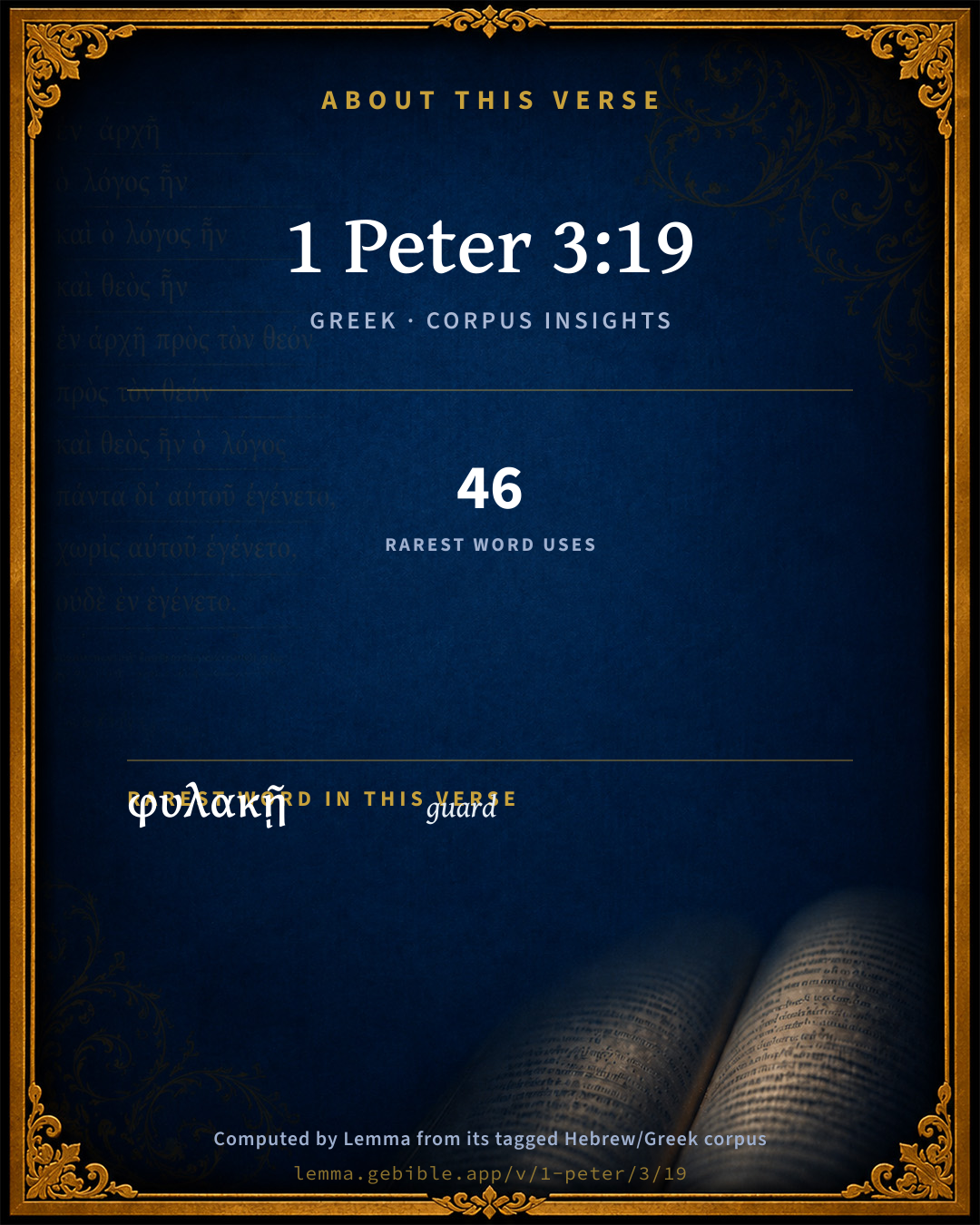
1 Peter 3:19

Greek (Tischendorf 8th ed.) 1 Peter 3:19 appears in the Greek New Testament. The text above is from the Tischendorf 8th edition. Each word links to its Strong’s number and a concise gloss. Click any word for its full Thayer’s Greek Lexicon entry.
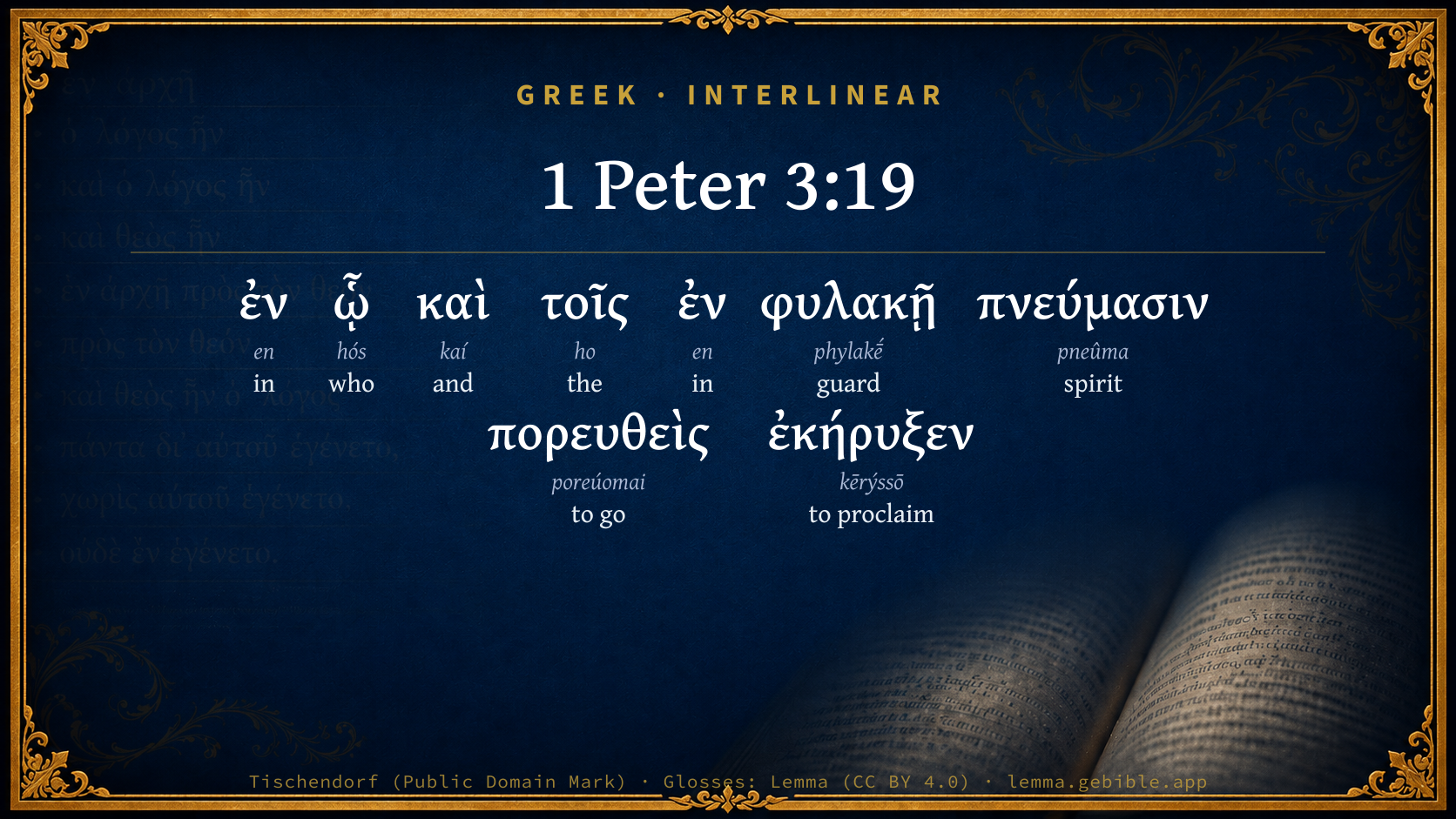
Download image
Cite this verse

1 Peter 3:19 (World English Bible). Public Domain. Lemma interlinear Bible study tool, https://lemma.gebible.app/v/1-peter/3/19.

Show BibTeX & RIS
BibTeX
RIS
English Translation
in which he also went and preached to the spirits in prison,
World English Bible · Public Domain
Download a study sheet

One document with this verse’s original text, its word-by-word gloss line, the meaning frame, cross-references with their text, attributed commentary, and full source and license credits — printable, and it pastes into notes with its structure intact.

This verse Autodidact and up

Study sheet (.html) Plain text (.txt)

A passage Seminary Student

Up to 50 verses in one chapter. A passage sheet keeps up to 6 commentary sources and 12 cross-references per verse, in the order this page ranks them, and says so on the sheet whenever that leaves anything out. Ask for a single verse and you get the Autodidact verse sheet above.

Everything on this page stays free to read, with no account — the sheet is a download of what is already on screen, not access to it.

Want to remove ads? Support Godless Engineer
Compare translations 3

The same verse in 3 English versions, stacked beneath the original-language interlinear above. Click any original word for its lexicon entry.

Each is an independent rendering of the whole verse — the interlinear is not word-aligned to these translations.

Highlighted words mark where these versions differ — a whole-verse word diff, not a word-by-word alignment.

  • World English Bible Public Domain
    in which he also went and preached to the spirits in prison,
  • King James Version Public Domain
    By which also he went and preached unto the spirits in prison;
  • unfoldingWord Literal Text CC BY-SA 4.0
    in which also he proclaimed, having gone to the spirits in prison,

unfoldingWord Literal Text — © unfoldingWord, licensed CC BY-SA 4.0. Word-aligned USFM3 via Door43 (git.door43.org/unfoldingWord/en_ult).

Versions to compare (up to 4)

3 of 4 selected

Show all 19 translations

Every available English version of this verse, each an independent rendering of the whole verse.

  • World English Bible Public Domain
    in which he also went and preached to the spirits in prison,
  • Berean Standard Bible Public Domain
    in whom He also went and preached to the spirits in prison
  • Majority Standard Bible Public Domain
    in whom He also went and preached to the spirits in prison
  • King James Version Public Domain
    By which also he went and preached unto the spirits in prison;
  • American Standard Version (1901) Public Domain
    in which also he went and preached unto the spirits in prison,
  • Revised Version (1885) Public Domain
    in which also he went and preached unto the spirits in prison,
  • Geneva Bible (1599) Public Domain
    By the which hee also went, and preached vnto the spirits that are in prison.
  • Douay-Rheims (1899) Public Domain
    In which also coming he preached to those spirits that were in prison:
  • Young's Literal Translation Public Domain
    in which also to the spirits in prison having gone he did preach,
  • Literal Standard Version CC BY-SA 4.0
    by which, having gone, He also preached to the spirits in prison,
  • Unlocked Literal Bible CC BY-SA 4.0
    By the Spirit, he went and preached to the spirits who are now in prison.
  • unfoldingWord Literal Text CC BY-SA 4.0
    in which also he proclaimed, having gone to the spirits in prison,
  • Darby Bible Public Domain
    in which also going he preached to the spirits [which are] in prison,
  • World Messianic Bible Public Domain
    in whom he also went and preached to the spirits in prison,
  • Webster's Bible Public Domain
    By which also he went and preached to the spirits in prison;
  • Free Bible Version CC BY-SA 4.0
    He went to speak to those “imprisoned”
  • Bible in Basic English Public Domain
    By whom he went to the spirits in prison, preaching to those
  • Text-Critical English NT CC BY 4.0
    in which he went and preached to the spirits in prison,
  • Tyndale New Testament (1534) Public Domain
    In which sprete he also wet and preached vnto the spretes that were in preson

Literal Standard Version (2020), Covenant Press — licensed CC BY-SA 4.0. Text via the HelloAO Bible API (eBible.org). Unlocked Literal Bible (unfoldingWord) — licensed CC BY-SA 4.0. Text via the HelloAO Bible API (eBible.org). unfoldingWord Literal Text — © unfoldingWord, licensed CC BY-SA 4.0. Word-aligned USFM3 via Door43 (git.door43.org/unfoldingWord/en_ult). Free Bible Version, Dr. Jonathan Gallagher — licensed CC BY-SA 4.0. Text via the HelloAO Bible API (eBible.org).

Word by word

More ways to search: Search by grammar → Find every occurrence → Compare this word →

Practice this passage: Drill this verse → Learn its vocabulary →

φυλακῇ
phylakḗ
G5438
“guard”
Noun, Dative, Singular, Feminine
Part of Speech
Noun
Case
Dative
Number
Singular
Gender
Feminine
Full Thayer's Definition

Origin: from G5442

TDNT: 13:01,1

1. guard, watch a. a watching, keeping watch 1. to keep watch b. persons keeping watch, a guard, sentinels c. of the place where captives are kept, a prison d. of the time (of night) during which guard was kept, a watch i.e. a period of time during which part of the guard was on duty, and at the end of which others relieved them. As the earlier Greeks divided the night commonly into three parts, so, previous to the exile, the Israelites also had three watches in a night; subsequently, however, after they became subject to the Romans, they adopted the Roman custom of dividing the night into four watches
  1. ἐν en G1722 “in” Preposition
  2. ᾧ hós G3739 “who” Relative pronoun, Dative, Singular, Neuter
  3. καὶ kaí G2532 “and” Conjunction
  4. τοῖς ho G3588 “the” Article, Dative, Plural, Neuter
  5. ἐν en G1722 “in” Preposition
  6. πνεύμασιν pneûma G4151 “spirit” Noun, Dative, Plural, Neuter
  7. πορευθεὶς poreúomai G4198 “to go” Verb, Aorist, Passive deponent, Participle, Nominative, Singular, Masculine
  8. ἐκήρυξεν kērýssō G2784 “to proclaim” Verb, Aorist, Active, Indicative, 3rd person, Singular

About this verse

These counts appear in no published source. They are computed here, from the morphology-tagged text and Lemma’s own curated glosses. What Lemma adds →

9
words
8
distinct lemmas
General Epistles
section

Shared distinctive vocabulary

φυλακῇ guard G5438 occurs in 45 verses of the Greek New Testament. Also found in:

Repetition

A word recurs within this verse:

Cross-references

8

Topical passages linked to 1 Peter 3:19 in the Treasury of Scripture Knowledge — connected by theme and wording, ordered by reader-vote popularity; previews shown in the World English Bible.

  • 1 Peter 4:6 For to this end was the Gospel preached even to the dead, that they might be judged indeed as men in the flesh, but live as to God in the spirit.
  • Isaiah 61:1 The Spirit of the Lord Yahweh is on me; because Yahweh has anointed me to preach good news to the humble; he has sent me to bind up the broken-hearted, to proclaim liberty to the captives, and the opening [of the prison] to those who are bound;
  • Isaiah 42:7 to open the blind eyes, to bring out the prisoners from the dungeon, and those who sit in darkness out of the prison-house.
  • Isaiah 49:9 saying to those who are bound, Go forth; to those who are in darkness, Show yourselves. They shall feed in the ways, and on all bare heights shall be their pasture.
  • Nehemiah 9:30 Yet many years did you bear with them, and testified against them by your Spirit through your prophets: yet would they not give ear: therefore gave you them into the hand of the peoples of the lands.
  • Revelation 20:7 And after the thousand years, Satan will be released from his prison,
  • 1 Peter 1:11–12 searching for who or what kind of time the Spirit of Christ, which was in them, pointed to, when he predicted the sufferings of Christ, and the glories that would follow them.
  • Revelation 19:10 I fell down before his feet to worship him. He said to me, "Look! Don't do it! I am a fellow bondservant with you and with your brothers who hold the testimony of Jesus. Worship God, for the testimony of Jesus is the Spirit of Prophecy."

Cross-references courtesy of OpenBible.info (CC BY 4.0).

Commentary

Notes on 1 Peter 3:19 from classic Christian and Jewish commentators (each source and its license shown beneath its notes). The classic Christian expositions comment on the surrounding passage and are grouped to its opening verse, so a note may address several verses; the Jewish commentaries on the Tanakh (Rashi and others) are per-verse, so they appear only where the commentator wrote on this verse.

Lemma curates 59 commentaries, every one of them public domain or Creative Commons licensed, each selected and text-cleaned for this edition rather than reprinted as found. About our sources →

Albert Barnes' Notes on the Bible

By which - Evidently by the Spirit referred to in the previous verse - ἐν ᾧ en hō - the divine nature of the Son of God; that by which he was “quickened” again, after he had been put to death; the Son of God regarded as a Divine Being, or in that same nature which afterward became incarnate, and whose agency was employed in quickening the man Christ Jesus, who had been put to death. The meaning is, that the same “Spirit” which was efficacious in restoring him to life, after he was put to death, was that by which he preached to the spirits in prison.

He went - To wit, in the days of Noah. No particular stress should be laid here on the phrase “he went.” The literal sense is, “he, having gone, preached,” etc. πορευθεὶς poreutheis. It is well known that such expressions are often redundant in Greek writers, as in others. So Herodotus, “to these things they spake, saying” - for they said. “And he, speaking, said;” that is, he said. So Eph 2:17, “And came and preached peace,” etc. Mat 9:13, “but go and learn what that meaneth,” etc. So God is often represented as coming, as descending, etc., when he brings a message to mankind. Thus, Gen 11:5, “The Lord came down to see the city and the tower.” Exo 19:20, “the Lord came down upon Mount Sinai.” Num 11:25, “the Lord came down in a cloud.” 2Sa 22:10, “he bowed the heavens and came down.” The idea, however, would be conveyed by this language that he did this personally, or by himself, and not merely by employing the agency of another. It would then be implied here, that though the instrumentality of Noah was employed, yet that it was done not by the Holy Spirit, but by him who afterward became incarnate. On the supposition, therefore, that this whole passage refers to his preaching to the antediluvians in the time of Noah, and not to the “spirits” after they were confined in prison, this is language which the apostle would have properly and probably used. If that supposition meets the full force of the language, then no argument can be based on it in proof that he went to preach to them after their death, and while his body was lying in the grave.

And preached - The word used here (ἐκήρυξεν ekēruxen) is of a general character, meaning to make a proclamation of any kind, as a crier does, or to deliver a message, and does not necessarily imply that it was the gospel which was preached, nor does it determine anything in regard to the nature of the message. It is not affirmed that he preached the gospel, for if that specific idea had been expressed it would have been rather by another word - εὐαγγελίζω euangelizō. The word used here would be appropriate to such a message as Noah brought to his contemporaries, or to any communication which God made to people. See Mat 3:1; Mat 4:17; Mar 1:35; Mar 5:20; Mar 7:36. It is implied in the expression, as already remarked, that he did this himself; that it was the Son of God who subsequently became incarnate, and not the Holy Spirit, that did this; though the language is consistent with the supposition that he did it by the instrumentality of another, to wit, Noah. “Qui facit per alium, facit per se.” God really proclaims a message to mankind when he does it by the instrumentality of the prophets, or apostles, or other ministers of religion; and all that is necessarily implied in this language would be met by the supposition that Christ delivered a message to the antediluvian race by the agency of Noah. No argument, therefore, can be derived from this language to prove that Christ went and personally preached to those who were confined in hades or in prison.

Unto the spirits in prison - That is, clearly, to the spirits now in prison, for this is the fair meaning of the passage. The obvious sense is, that Peter supposed there were “spirits in prison” at the time when he wrote, and that to those same spirits the Son of God had at some time “preached,” or had made some proclamation respecting the will of God. Since this is the only passage in the New Testament upon which the Roman Catholic doctrine of purgatory is supposed to rest, it is important to ascertain the fair meaning of the language here employed. There are three obvious inquiries in ascertaining its signification. Who are referred to by “spirits?” What is meant by “in prison?” Was the message brought to them while in the prison, or at some previous period?

I. Who are referred to by spirits? The specification in the next verse determines this. They were those “who were sometimes disobedient, when once the long-suffering of God waited in the days of Noah.” No others are specified; and if it should be maintained that this means that he went down to hell (Hades), or to Sheol, and preached to those who are confined there, it could be inferred from this passage only that he preached to that portion of the lost spirits confined there which belonged to the particular generation in which Noah lived. Why he should do this; or how there should be such a separation made in hades that it could be done; or what was the nature of the message which he delivered to that portion, are questions which it is impossible for any man who bolds to the opinion that Christ went down to hell after his death to preach, to answer. But if it means that he preached to those who lived in the days of Noah, while they were yet alive, the question will be asked why are they called “spirits?”

Were they spirits then, or were they people like others? To this the answer is easy. Peter speaks of them as they were when he wrote; not as they had been, or were at the time when the message was preached to them. The idea is, that to those spirits who were then in prison who had formerly lived in the days of Noah, the message had been in fact delivered. It was not necessary to speak of them precisely as they were at the time when it was delivered, but only in such a way as to identify them. We should use similar language now. If we saw a company of men in prison who had seen better days - a multitude now drunken, and debased, and poor, and riotous - it would not be improper to say that “the prospect of wealth and honor was once held out to this ragged and wretched multitude. All that is needful is to identify them as the same persons who once had this prospect. In regard to the inquiry, then, who these “spirits” were, there can be no difference of opinion. They were that wicked race which lived in the days of Noah. There is no allusion in this passage to any other; there is no intimation that to any others of those “in prison” the message here referred to had been delivered.

II. What is meant by prison here? Purgatory, or the limbus patrum, say the Romanists - a place in which departed souls are supposed to be confined, and in which their final destiny may still be effected by the purifying fires which they endure, by the prayers of the living, or by a message in some way conveyed to their gloomy abodes - in which such sins may be expiated as do not deserve eternal damnation. The Syriac here is “in Sheol,” referring to the abodes of the dead, or the place in which departed spirits are supposed to dwell. The word rendered “prison,” (φυλακῇ phulakē,) means properly “watch, guard” - the act of keeping watch, or the guard itself; then watchpost, or station; then a place where anyone is watched or guarded, as a prison; then a watch in the sense of a division of the night, as the morning watch. It is used in the New Testament, with reference to the future world, only in the following places: 1Pe 3:19, “Preached unto the spirits in prison;” and Rev 20:7, “Satan shall be loosed put of his prison.”

An idea similar to the one here expressed may be found in 2Pe 2:4, though the word prison does not there occur: “God spared not the angels that sinned, but cast them down to hell, and delivered them into chains of darkness, to be reserved unto judgment;” and in Jud 1:6, “And the angels which kept not their first estate, but left their own habitation, he hath reserved in everlasting chains, under darkness, unto the judgment of the great day.” The allusion, in the passage before us, is undoubtedly to confinement or imprisonment in the invisible world; and perhaps to those who are reserved there with reference to some future arrangement - for this idea enters commonly into the use of the word prison. There is, however, no specification of the place where this is; no intimation that it is purgatory - a place where the departed are supposed to undergo purification; no intimation that their condition can be affected by anything that we can do; no intimation that those particularly referred to differ in any sense from the others who are confined in that world; no hint that they can be released by any prayers or sacrifices of ours. This passage, therefore, cannot be adduced to support the Roman Catholic doctrine of purgatory, because:

(1)The essential ideas which enter into the doctrine of purgatory are not to be found in the word used here;

(2)There is no evidence in the fair interpretation of the passage that any message is borne to them while in prison;

(3)There is not the slightest hint that they can be released by any prayers or offerings of those who dwell on the earth. The simple idea is that of persons confined as in a prison; and the passage will prove only that in the time when the apostle wrote there were those wire were thus confined.

III. Was the message brought to them while in prison, or at some previous period? The Romanists say that it was while in prison; that Christ, after he was put to death in the body, was still kept alive in his spirit, and went and proclaimed his gospel to those who were in prison. So Bloomfield maintains, (in loc.,) and so (Ecumenius and Cyril, as quoted by Bloomfield. But against this view there are plain objections drawn from the language of Peter himself:

(1) As we have seen, the fair interpretation of the passage “quickened by the Spirit,” is not that he was kept alive as to his human soul, but that he, after being dead, was made alive by his own divine energy.

(2) If the meaning be that he went and preached after his death, it seems difficult to know why the reference is to those only who “had been disobedient in the days of Noah.” Why were they alone selected for this message? Are they separate from others? Were they the only ones in purgatory who could be beneficially affected by his preaching? On the other method of interpretation, we can suggest a reason why they were particularly specified. But how can we on this?

(3) The language employed does not demand this interpretation. Its full meaning is met by the interpretation that Christ once preached to the spirits then in prison, to wit, in the days of Noah; that is, that he caused a divine message to be borne to them. Thus, it would be proper to say that “Whitefield came to America, and preached to the souls in perdition;” or to go among the graves of the first settlers of New Haven, and say, “Davenport came from England to preach to the dead men around us.”

(4) This interpretation accords with the design of the apostle in inculcating the duty of patience and forbearance in trials; in encouraging those whom he addressed to be patient in their persecutions. See the analysis of the chapter. With this object in view, there was entire propriety in directing them to the long-suffering and forbearance evinced by the Saviour, through Noah. He was opposed, reviled, disbelieved, and, we may suppose, persecuted. It was to the purpose to direct them to the fact that he was saved as the result of his steadfastness to Him who had commanded him to preach to that ungodly generation. But what pertinency would there have been in saying that Christ went down to hell, and delivered some sort of a message there, we know not what, to those who are confined there?

Albert Barnes' Notes on the Bible (1834–1885) — public domain. Text from a community e-Sword/MySword module.

Joseph Benson's Commentary

1Pe 3:19-20. By which also — That is, by which Spirit; he went and preached — Πορευθεις εκηρυξεν, having gone, he preached, namely, in and by Noah, who spake by the Spirit of Christ, (1Pe 1:11,) and of the Father, who said, (Gen 6:3,) referring to the men of that generation, My Spirit shall not always strive with man. Hence Noah is called a preacher of righteousness: 2Pe 2:5. “By attributing the preaching of the ancient prophets to Christ, the apostle hath taught us, that from the beginning the economy of man’s redemption has been under the direction of Christ. To the spirits in prison — That is, which were in prison when St. Peter wrote this epistle. They were men in the flesh when Christ preached to them by his Spirit speaking in Noah; but after they were dead, their spirits were shut up in the infernal prison, detained, like the fallen angels, (Jdg 1:6,) unto the judgment of the great day; which sometime — Ποτε, once, or formerly, were disobedient, when the long-suffering of God waited — For their repentance; in the days of Noah — During the long space of one hundred and twenty years; while the ark was preparing — During which time Noah warned them all to repent, and flee from the wrath to come. Wherein — In which ark; few, that is, eight souls — Namely, Noah and his wife, with their three sons and their wives; were saved by water — Or, were carried safely through the water; namely, the waters of the flood, which bare up the ark in which they were enclosed. Some suppose that the persons here spoken of are said to have been in prison in the days of Noah, by the same figure of speech, by which the persons to whom Christ preached in the days of his flesh, are called captives in prison, Luk 4:18. “Christ’s preaching to the antediluvians by Noah, their destruction for their disobedience to that preaching, and the preservation of Noah and his family in the ark, are all fitly mentioned, to show that it hath been God’s way from the beginning of the world, when the wickedness of men became general, to oppose it, by raising up prophets to reprove them, and warn them of their danger; and after waiting for their repentance to no purpose, to destroy them; while he delivered the righteous from the evils to which they were exposed, by manifest interpositions of his power. These things teach us, that we should not think the worse of the gospel, because it hath been rejected by many; nor of ourselves, because we are persecuted by the wicked. On the other hand, by the punishment of the antediluvians, and of the Jews who crucified our Lord; wicked men and persecutors are taught to dread the judgments of God.” — Macknight.

Joseph Benson's Commentary on the Old and New Testaments (1811–1818) — public domain. Text from a community e-Sword module.

Tyndale Open Study Notes

Tyndale Open Resources

3:19-20 This difficult passage has been widely interpreted in three ways: (1) One interpretation holds that it refers to the spirits of people who have died and that Christ, after his resurrection, preached the Good News to these spirits. However, the idea that people might hear the Good News and respond after their deaths is not found elsewhere in the New Testament, and this meaning of spirits is not the most likely. (2) A second interpretation sees 3:19-20 as describing Christ’s preaching through Noah to people who are now spirits in prison. This interpretation does justice to 3:20 but does not fit well in the discussion of Christ’s death and resurrection (3:18). (3) In the third interpretation, the spirits in prison are evil spiritual beings. Jewish tradition, based on Gen 6:1-4, held that many angels fell in the time of Noah (see also Jude 1:6; 1 Enoch 6–10). Peter’s point would then be that Christ proclaimed his victory over the evil spiritual powers after his resurrection (cp. 1 Pet 3:22).

Tyndale Open Study Notes — © Tyndale Open Resources, licensed CC BY-SA 4.0. Text via the HelloAO Bible API.

Bengel's Gnomon

Johann Albrecht Bengel

1Pe 3:19. Ἐν ᾧ) in which spirit. Christ had to do with the living, in the flesh; with spirits, in spirit. He Himself has efficacy with the living and the dead. There are wonders in that invisible world. In a subject full of mystery, we ought not to dismiss from it the proper signification of the language employed, because it has no parallel passages. For they, to whom each mystery has first been revealed, have most nobly believed the word of God even without parallel passages. For instance, our Saviour only once said, This is My body. The mystery respecting the change of those who shall be alive at the coming of the Lord, is only once written.—τοῖς—πνεύυασι, to the spirits) Peter does not say that all the spirits were in that place of confinement, for many might have been in a more gloomy place; but he means, that Christ preached to all who were in confinement.—ἐν φυλακῇ, in guard) The guilty are punished in prison; they are kept in guard, until they experience what the Judge is about to do. The expression about the state of those living under the Old Testament, Gal 3:23, bears some analogy to this.—πυεύμασι, to the spirits) of the dead. Comp. Heb 12:23. He does not call them souls, as in the next verse.—πορευθεὶς, going) namely, to those spirits. The same word is used in 1Pe 3:22. Those spirits were not in the tomb of Jesus: He went to them.—ἐκήρυξεν, He preached) By this preaching, which followed close upon His being quickened, Christ showed Himself both alive, even then, and righteous. Peter would not say, εὐηγγελίσατο, He preached the Gospel, if even ever so much the preaching of grace only were here designed: for the hearers had fallen asleep before the times of the Gospel; therefore he uses a word of wider meaning, He preached (or published). Noah, a preacher of righteousness, was despised, 2Pe 2:5; but Christ was a more powerful preacher, who, when quickened in spirit, vindicated His own righteousness, which was not believed by them of former times, and openly refuted their unbelief, 1Ti 3:16. If he were speaking of preaching by Noah, the word sometime would either be altogether omitted, or be joined with the word preached. This preaching was a prelude to the general judgment; comp. ch. 1Pe 4:5; and the term “preaching” itself is to be taken in its wider sense, that it may be understood to have been to some a preaching of the Gospel, as Hutter says, to their consolation, which is more peculiarly the office of Christ; to others, and perhaps the greater part, a publishing of the law, for their terror. For if the judgment itself shall be a cause of joy to some, assuredly this preaching was not a subject of dread to all. The author of the Adumbrations, which are assigned to Clement of Alexandria and to Cassiodorus, says, They saw not His form, but heard the sound of His voice. Calvin, in his Institutes, 2d Book, ch. 16:9, says, For the context also leads to this conclusion, that the faithful, who had died before that time, were sharers of the same grace with us: because it enhances the power of His death from this circumstance, that it penetrated even to the dead; while the souls of the righteous obtained an immediate view of that visitation, which they had anxiously expected, on the contrary, it was more plainly revealed to the lost, that they are altogether excluded from salvation. And though Peter does not speak with such distinctness, it must not thus be understood as though he mixed together the righteous and the wicked without any difference, but he only wishes to teach, that a perception of the death of Christ was common to both.

Bengel's Gnomon of the New Testament — English translation (T&T Clark, Edinburgh, 1860) — public domain. Text from a community e-Sword module.

Meyer's Critical & Exegetical Commentary

Heinrich August Wilhelm Meyer

1Pe_3:19. With this verse a new paragraphextending to 1Pe_3:22 inclusivebegins, closely connected by ἐν ᾧ (i.e. πνεύματι) with what precedes, and in which reference is made to the glory of Him who was quickened according to the Spirit. It may appear singular that in this passage Peter should make mention of those who were unbelieving in the days of Noah, and of baptism as the antitype of the water of the deluge; but this may be explained from the circumstance that he looks on the deluge as a type of the approaching judgment. It must be observed that it is not so much the condemnation of the unbelieving, as the salvation of believers that the apostle has here in his mind.

ἐν ᾧ καὶ κ.τ.λ.] in which (spirit) He also went and preached unto the spirits in prison (to them), which sometime were unbelieving when, etc. The close connection of these words with what immediately precedesby ἐν ᾧ, sc. πνεύματι,favours the view that ἐκήρυξε refers to an act of Christ which, as the ζωοποιηθεὶς πνεύματι, He performed after His death, and that with reference to the spirits ἐν φυλακῇ of the unbelievers who had perished in the deluge. This is the view of the oldest Fathers of the Greek and Latin Church; as also of the greater number of later and modern theologians. Augustin, however, opposed it, and considered ἐκήρυξεν as referring to a preaching by Christ ἐν πνεύματι, long before His incarnation, in the days of Noah, to the people of that generation, upon whom the judgment of the deluge came because of their unbelief.[205] This view, after being adopted by several theologians of the Middle Ages, became prevalent in the Reformed Church. In recent times, it has been defended more especially by Schweizer, Wichelhaus, Besser, and Hofmann. The chief arguments which those who maintain it advance in opposition to that first mentioned, are the following:(1) The idea that Christ preached to the spirits ἐν φυλακῇ would be an isolated one occurring nowhere else in Scripture; and, further, preaching such as this, if conceived as judicial, would have been entirely useless, whilst, looked on as a proclamation of salvation, it would stand in contradiction to the uniform teaching of Scripture regarding the state of man after death. To this, however, it must be replied, that isolated ideas are to be found expressed here and there in Scripture, and that the reconciliation of the idea of a salvation offered to the spirits ἐν φυλακῇ with the other doctrines of Scripture, can at most be termed a problem difficult of solution; nor must it be forgotten that the eschatological doctrines comprehend within them very many problems. (2) This view does not correspond with the tendency of the entire passage from 1Pe_3:17 to 1Pe_3:22, and therefore does not fit into the train of thought. But this assertion is to the point only if those who make it have themselves correctly understood the tendency of the passage, which in this instance they have not done. (3) It cannot be understood how Peter comes so suddenly to speak of the spirits in prison. But, in reply, it may be urged, with at least equal justification, that it is not easy to understand how Peter comes so suddenly to speak of an act of Christ before His incarnation. (4) The want of the article before ἀπειθήσασι compels us to translate this participle not: which sometime were unbelieving, but: when they sometime were unbelieving. This, however, is not the case, since the participle, added with adjectival force to a substantive, is often enough joined to the latter without an article. If Peter had put the words πορευθεὶς ἐκήρυξε, before τοῖς … πνεύμασι, no difficulty would have presented itself in the translation under dispute (the sometime unbelieving spirits in prison). The translation to which preference is given is grammatically untenable.[206]

Finally, appeal has been made to the fact that καί is placed after ἐν ᾧ, indeed even to ἐν ᾧ itself; but a correct explanation offers no justification for so doing. Besides the close connection of the relative clause with that immediately preceding, the following points favour the interpretation attacked:(1) The correspondence of the πνεύματι to be supplied to ἐν ᾧ with the subsequent πνεύμασιν; (2) πορευθείς, which must be taken in the same sense as the πορευθείς in 1Pe_3:22; (3) The fact that ποτέ does not stand with ἐκήρυξε, but in 1Pe_3:20 with ἀπειθήσασιν, which shows that the ἀπειθεῖν took place previous to the κηρύσσειν; and, lastly, (4) The circumstance that had Peter closed his sentence with ἐκήρυξεν, it could have occurred to no one that Peter was here speaking of a preaching of Christ which took place in a time long gone by.

ἐν ᾧ] is not equivalent to διό (αἰτιολογικῶς with reference to ἔπαθε, Theophylact); but whilst ᾧ refers back to πνεύματι, ἐν ᾧ states in what condition Christ accomplished that which is mentioned in what follows,

He accomplished it not ἐν σαρκί (for after the σάρξ He was put to death), but ἐν πνεύματι (for after the πνεῦμα He was made alive). ἐν stands here in a position similar to that which it holds in Rom_8:8, where, however, σάρξ and πνεῦμα form an ethical antithesis, which here is not the case. Hofmann wrongly attributes to ἐν here an instrumental force equivalent to by means of; he is induced to do solely by his explanation of the πνεύματι to be supplied. Although it is evident that πνεύματι here must be taken in no sense different from that of the foregoing πνεύματι, Hofmann nevertheless holds it to be identical with the πνεῦμα Χριστοῦ mentioned in chap. 1Pe_1:11, while he himself says that the πνεύματι subjoined to ζωοποιηθείς cannot be understood of the Holy Ghost.[207]

Peter says, then, that Christ, in the Spirit according to which He was made alive, preached to the spirits ἘΝ ΦΥΛΑΚῇ, which cannot be understood to mean anything else than that He did it as a ΠΝΕῦΜΑ (in His pneumatical condition). Fronmüller erroneously interprets: in the existence-form of a spirit separated from the body; for the quickened Christ lives not as a simple spirit, but is in possession of a glorified spiritual body.

ΚΑῚ ΤΟῖς ἘΝ ΦΥΛΑΚῇ ΠΝΕΎΜΑΣΙ ΠΟΡΕΥΘΕῚς ἘΚΉΡΥΞΕΝ] By ΤᾺ … ΠΝΕΎΜΑΤΑ are to be understood, neither angels (Heb_1:14[208]) nor men living upon the earth (as Wichelhaus explains), but the souls of men already dead, as in Heb_12:23, which in Rev_6:9; Rev_20:4, Wis_3:1, are called ψυχαί. ἐν φυλακῇ designates not only the place, but denotes also the condition in which the πνεύματα are. Hofmann wronglybecause in opposition to the uniform usage in the N. T.denies all local reference to the expression, and would therefore translate ἐν φυλακῇ by in durance. The meaning is, that the πνεύματα were in prison as prisoners.[209] The expression occurs in the N. T. with the article and without it, and its more precise force here is clear from the passages: Rev_20:7; 2Pe_2:4; Jud_1:6. It does not denote generally the kingdom of the dead (Lactant. Inst. I. 7, c. 21: omnes [animae] in una communique custodia detinentur), but that part of it, which serves as abode for the souls of the ungodly until the day of judgment.[210] The dative depends, indeed, on ἘΚΉΡΥΞΕΝ, not on ΠΟΡΕΥΘΕΊς; but the addition of the latter word gives prominence to the fact that Christ went to those spirits, and preached to them in that place where they were. Hofmann is not altogether wrong when, in support of his own view of the passage, he says: the operation of the spirit of Christ, by which Noah was made the organ of His proclamation, might be termed a going and preaching on the part of Christ (comp. especially the passage, Eph_2:17 : ἘΛΘῺΝ ΕὐΗΓΓΕΛΊΣΑΤΟ; see Meyer in loc., to which Hofmann might have appealed). But that πορευθείς cannot be so taken here is shown by the ΠΟΡΕΥΘΕΊς in 1Pe_3:22, with which it must be identical in sense.[211] ἐκήρυξε is the same verb as that so often used in the N. T. of the preaching (not the teaching) of Christ and His apostles. Usually it is accompanied by an object (τὸ εὐαγγέλιον, τὴν βασιλείαν τοῦ Θεοῦ, Χριστόν, or the like); but it is frequently, as here, used absolutely, cf. Mat_11:1; Mar_1:38, etc.

It cannot be concluded, with Zezschwitz, from the connection of this relative clause with ζωοποιηθεὶς πνεύματι, that ζωοποίησιν illam spiritualem quasi fundamentum fuisse concionis idemque argumentum; nor does the word itself disclose either the contents or the purpose of that preaching; but since Christ is called the κήρυξας without the addition of any more precise qualification, it must be concluded that the contents and design of this κήρυγμα are in harmony with the κήρυγμα of Christ elsewhere. It is accordingly arbitrary, and in contradiction to Christs significance for the work of redemption, to assume that this preaching consisted in the proclamation of the coming judgment (Flacius, Calov., Buddeus, Hollaz, Wolf, Aretius, Zezschwitz, Schott, etc.), and was a praedicatio damnatoria.[212] Wiesinger justly asks: This concio damnatoriawhat does it mean in general, what here especially?

It is unjustifiable to deny, with some commentators, that the apostle regarded this πορευθεὶς ἐκήρυξε as an actual reality.[213]

καί, following ἐν ᾧ, must not be explained, as Schweizer does, in this way, that Peter, wishing to hold up Christ to his readers as a pattern of how they should conduct themselves under suffering, adduces two examples, 1Pe_3:19 ff., His death on the cross, and His preaching; the whole structure of the clauses, as well as their contents, contradicts this. Nor can it be explained, as Hofmann assumes, from the antithesis between us whom Christ wished to bring to God, and those who as spirits are in durance. This would hold good only if, in 1Pe_3:18, it were affirmed that Christ did the same to us as to those spirits, that is, preached to us. It is likewise incorrect to take καί as equivalent to even (Wiesinger, Fronmüller); for a distinction between these spirits and others is nowhere hinted at. καί is put rather in order to show prominently that what is said in this verse coincides with the ζωοποιηθεὶς πνεύματι of 1Pe_3:18. Zezschwitz: ut notio, quae in enunciatione ἐν ᾧ latet (ζωοπ. πνεύματι) urgeatur.

[205] It must be observed, that whilst Hofmann considers the preaching of Christ as having taken place through Noah, Schweizer most decidedly disputes this, and is of the opinion that it was addressed to Noah himself as well as to his contemporaries. In support of this, he very rightly appeals to the fact that Noah is not hereas 2Pe_2:5termed a κῆρυξ. But he does not say by whom this preaching must be considered to have taken place.

[206] Hofmann, indeed, says that since the expression is not τοῖς ἀπειθήσασι, the translation should not be those spirits in durance, which sometime were disobedient; but he grants that, from a grammatical point of view, it remains doubtful whether ποτέ signifies the past as related to the time of Christs preaching, or the past as regards the present of the writer.

[207] Hofmann says that the accusation made against him, that he effaces the distinction between πνεῦμα as a term used to designate the precise nature of Christ, and πνεῦμα as the third Person in the Trinity, is the result of that confusion of ideas by which in the Spirit and as a Spirit are understood to mean the same thing. But it must be replied that rather is the identification of two different ideas, contained in his interpretation, the result of the confusion of ideas, leading him as it does to hide the difference by defining πνεῦμα as the Spirit of Christs life.

[208] Baur (Tüb. theol. Jahrb. 1856, H. 2, p. 215) understands it to mean the ἄγγελοι ἁμαρτήσαντες, 2Pe_2:4, who, according to Gen_6:1 ff., had fallen previous to the deluge. This interpretation is sufficiently contradicted by ver. 20.

[209] The interpretation of Wichelhauswho by circumlocution explains τὰ ἐν φυλ. πνεύματα as equal to οἱ ἀπειθοῦντες τηρούμενοι, φρουρουμένοι εἰς ἡμέραν τοῦ κατακλυσμοῦis altogether erroneous.

[210] Justin (Dial. c. Tryph. c. 5): τὰς μὲν τῶν εὐσεβῶν (ψυχὰς) ἐν κρείττονί που χώρῳ μένειν, τὰς δʼ ἀδίκους καὶ πονηροὺς ἐν χείρονι τὸν τῆς κρίσεως ἐνδεχομένας χρόνον.

[211] Luthardt so thoroughly recognises the vis of this πορευθείς, that he says he should interpret the passage as Hofmann does, if the πορευθείς did not prevent him from doing so.Besides, it is certain that the coming of the Holy Spirit is at the same time a coming of Christ; but it must not be overlooked that in the N. T. it is nowhere indicated as being a coming of Christ ἐν πνεύματι.

[212] Hollaz: Fuit praedicatio Christi in inferno non evangelica, quae hominibus tantum in regno gratiae annunciatur, sed legalis elenchthica, terribilis eaque tum verbalis, qua ipsos aeterna supplicia promeritos esse convincit, tum realis, qua immanem terrorem iis incussit. This interpretation, which, has its origin in dogmatic views, Zezschwitz seeks to found on exegesis by characterizing the idea of judgment as the leading conception of the whole passage, to which, however, the context gives no warrant, and also by maintaining that otherwise Peter would have used the word εὐαγγελίζειν, or a compound of ἀγγέλλειν. It is certainly correct when Schott and Köhler say that κηρύσσειν is not in itself equal to εὐαγγελίζειν; but it does not follow that it may not be applied to a message of salvation. It must be remembered that Christs aim, even as a preacher of judgment, ever was the accomplishment of salvation, as he declared Luk_19:10; Joh_12:47.

[213] Thus Picus Mirandola says: Christus non veraciter et quantum ad realem praesentiam descendit ad inferos, sed solum quoad effectum. Cf., too, J. R. Lavater, de descensu Christi ad inf. lib. I. c. 9.Many interpreters unwarrautably weaken at least ἐκήρυξε, in so far as to make it synonymous with showed Himself, or, at any rate, they say that the preaching of Christ was potius realiter, quam verbaliter. This the author of the article, Die Höllenfahrt Christi, in the Erlanger Zeitschrift für Protest. 1856, should not have sanctioned. Schott is not free from this arbitrary method of interpretation, in that he characterizes κηρύσσειν as a bearing witness to oneself, not only in word, but also in deed, and calls this bearing witness to and showing forth of Himself by Christ in the glory of His mediatorial person, a concio damnatoria.

Meyer — Critical and Exegetical Commentary on the New Testament — English translation by Peter Christie, edited by Frederick Crombie (T&T Clark, 1880) — public domain. Text from a community e-Sword module.

Cambridge Greek Testament for Schools and Colleges

19 (d) This activity was not confined merely to the unrighteous who are alive like yourselves. In His Spirit thus quickened by death He journeyed to the underworld. He descended into Hell there to proclaim (good) tidings to the spirits in prison. 20 Of these the most notorious and typical examples were the spirits of those who suffered in the flesh as a punishment for evil-doing in the olden days of Noah, when they rejected God’s long continued offer of mercy all through those years while the ark was being prepared.

[In the book of Henoch (x.lxxxix. etc. see Charles, Eschatology) from which St Peter appears to borrow several phrases in the Epistle, there is constant reference to the Flood; and the spirits of those who were judged in this life are assigned a separate place in Sheol (c. 12). For the idea that bodily suffering, even when it is a punishment for sin, may be a factor in the salvation of the soul, cf. 1Co 5:5, “To deliver unto Satan for the destruction of the flesh that the spirit may be saved in the day of the Lord Jesus”; 1Ti 1:20, “Whom I have delivered unto Satan that they may learn (by chastisement, παιδευθῶσι) not to blaspheme.” Also 1Co 11:32, “When we are judged (with sickness and death) we are chastened of the Lord that we may not be condemned with the world.”

Again in the statement that “it will be more tolerable for Sodom and Gomorrah in the day of judgment” our Lord implies that the inhabitants of those cities must not be regarded as eternally damned because they were so terribly judged in the flesh. For further ideas about “the Harrowing of Hell” see additional note (p. 83).]

(e) In the Flood the same water which drowned the guilty world floated the ark and so saved Noah and his family from perishing. Water was not only the means by which the defilements of the world were cleansed but was also the medium by which Noah and his family passed from the old world into the new, as it were through death into a new resurrection life. 21 Thus the Flood may be regarded as the copy of the spiritual reality of “death unto sin and new birth unto righteousness” which is now represented in Baptism. When we pass beneath the water of Baptism we represent the drowning of the old sinful self, the putting off of the filth of the flesh. But the saving efficacy of Baptism lies in the new birth unto righteousness, the profession (in answer to interrogation) of having a good conscience toward God, which is represented by our emerging from the water, claiming to share in the resurrection of Jesus Christ.

In every case therefore suffering and death are factors in the termination of the regime of sin and the attainment of a new life. In Christ’s case we find that by dying in the flesh once and for all for sins (not His own but those of others) He was thereby quickened in spirit for new and wider service. In the case of those who perished in the Flood their judgment in the flesh led to their receiving the good tidings of Christ bidding them to live in the Spirit (cf. 1Pe 4:6). In the case of Noah and his family the water of destruction was the means of their salvation; and the same lesson of dying in order to live is taught in Baptism.

22 (f) There remains one further thought that suffering culminates in final glory. The Lord who rose from the dead is now seated at the right hand of God exalted above angels, principalities and powers. So we too “if we suffer with Him shall also be glorified with Him.” 1Pe 4:1 This conception of suffering in the flesh as a termination of the regime of sin, a quickening of the spirit for new service and a factor in attaining glory, was the armour with which Christ equipped Himself in His earthly life (cf. Heb 12:2, “For the joy which was set before him he endured the cross despising the shame.” Heb 5:8, “He learned obedience by the things that He suffered.”) Let it be your armour also in meeting persecution and equipping yourselves for service. In your Baptism you claim ideally to have shared in Christ’s death, and any sufferings in the flesh which you may have to undergo are only helping to make that ideal a reality for you, helping to terminate the regime of sin, 2 that the time which remains for you to live in the flesh should be no longer devoted to the lusts of men but to the will of God. 3 I say “the time which remains,” for that which is past, your old heathen days, is all too long to have worked out the wishes of the Gentiles, walking as you have done (πεπορευμένους—perfect participle) in wanton immoralities, lusts, wine-bibbings, revellings, drinking-bouts, and unlawful idolatries. 4 Your heathen neighbours no doubt regard you as fanatics, and revile you for refusing to plunge headlong into the same excess of prodigal recklessness with them. 5 But (like Noah’s contemporaries) they will have to render an account to God, whose judgment is in perfect readiness both for the living and the dead. 6 Such judgment of the dead is perfectly just because they also received the message of good tidings, and the purport of the message to them was the same which God gives to you. Your suffering in the flesh is a call to live in the spirit. Their judgment in the flesh after the pattern of men was a call to live in the spirit after the pattern of God.

19. ἐν ᾧ most naturally means, in that human spirit thus quickened by death and not the divine Spirit of Christ in which He had all along been working in the world, cf. 1Pe 1:11.

πνεύμασι is used of the dead in Heb 12:23, “the spirits of just men made perfect” and this interpretation is here confirmed by νεκροῖς in 1Pe 4:6. It naturally seems to mean that those who heard Christ’s message were in a disembodied state, as He himself also was.

φυλακῇ sometimes means sentry-watch but far more commonly prison and is almost certainly so used here.

πορευθεὶς naturally suggests a change of sphere and is frequently used of the Ascension, as in 1Pe 3:22. So here it seems to refer to the descent into Hell, and we thus have a natural chronological sequence θανατωθεὶς—ζωοποιηθεὶς—πορευθεὶς—(διʼ ἀναστάσεως) πορευθεὶς εἰς οὐρανόν.

ἐκήρυξεν is constantly used of preaching the Gospel but never of proclaiming bad tidings. So here it probably means good tidings, cf. εὐηγγελίσθη νεκροῖς, 1Pe 4:6.

ADDITIONAL NOTE B

ON 1Pe 3:19

Other interpretations of this confessedly difficult passage are

A. That it does refer to the descent into Hell, but (1) the “preaching” was a proclamation of condemnation and not an offer of pardon. The objections to this view are that in 1Pe 4:6 (which most probably refers to the same “preaching”) good tidings (εὐαγγελίσθη) is stated to have been preached to the dead. Also κηρύσσειν is the word used in the Gospels of “proclaiming the Gospel of the kingdom” Mat 4:23, “preaching repentance” Mat 4:17, “preaching deliverance to the captives … and proclaiming the acceptable year of the Lord” Luk 4:18-19. In the Acts and Epistles it is constantly used of preaching the Gospel or preaching Christ, but there is no instance of its use for proclaiming condemnation, and it would be hardly intelligible in that sense here without some words to explain it.

Or (2) that the good news was only preached in Hades to the spirits of the righteous, such as Abel, Abraham and other O.T. saints. This was a favourite idea in early writers (e.g. the Gospel of Nicodemus, Irenaeus, Hippolytus, Tertullian). But the context expressly defines the spirits to be “those who were disobedient in the days of Noah.” There is no hint whatever that O.T. saints in general are intended, and ἐν φυλακῇ could hardly mean in God’s safe keeping (cf. “The souls of the righteous are in the hands of God”) nor, as Calvin suggested, the watch tower from which the souls of the righteous in Hades were eagerly looking for the advent of their deliverer.

Or (3) that the passage does refer to those who perished in the Flood, but only to those who turned to God in their dying agony. But St Peter makes no allusion whatever to their repentance, but only to their disobedience.

Or (4) a more tenable interpretation would be to explain “the spirits in prison” as meaning evil angels whose influence was paramount in the world in the days of Noah, cf. Gen 6:2, “The sons of God saw that the daughters of men were fair,” etc. This seems to have been generally understood of immoral intercourse between angels and women, which caused the destruction of the world by the Flood. In the Book of Henoch there are constant references to this sin of the angels, and in Chapter lxvii. “the angels who have shewn injustice and who led astray are shewn to Noah inclosed in a flaming valley, but the waters of judgment are a healing of the angels and a death to their bodies.” St Peter seems to shew traces of the Book of Henoch in other passages and there is some slight similarity between this description in Henoch and St Peter’s words, 1Pe 4:6 “judged in the flesh after the pattern of men but living in the spirit after the pattern of God.” St Jude, who quotes the Book of Henoch by name, says, 1Pe 3:6, “Angels which left their proper habitation, he hath kept in everlasting bonds under darkness unto the judgment of the great day.” But this would give no support to the view that the spirit of Christ preached to them during His descent into Hell.

B. Another interpretation, supported in one passage by Augustine and also by Aquinas and Bishop Pearson, is that the passage does not refer to the descent into Hell at all, but to the preaching of the Spirit of Christ in the world in the preaching of Noah. In 1Pe 1:11 the Spirit of Christ is described as working in the prophets of the O.T., and it is true that it was by the indwelling Spirit of Christ that Noah was a preacher (κήρυξ) of righteousness.

But the objections to this view are:

(1) That it destroys the natural sequence of thought in the passage, in which θανατωθείς, ζωοποιηθείς, πορευθείς, ἐκήρυξε seem most naturally to describe successive stages in the work of Christ, whereas this view would refer the “preaching” to the distant past.

(2) πορευθείς like πορευθεὶς εἰς οὐρανὸν in 22 suggests the idea of a “journey” or change of sphere such as the descent into Hades rather than the omnipresent work of Christ in the world before the Incarnation. At the same time we must not introduce too materialistic ideas of space in dealing with the unseen world either of Hades or of Heaven.

(3) The recipients of the proclamation are described as πνεύμασιν ἐν φυλακῇ and this can hardly mean “those who were living men at the time when they received the message but are now spirits in the prison-house of Hades.” Nor is it likely that the contemporaries of Noah in their lifetime would be described as “spirits confined in the prison-house of sin and unbelief or in the prison-house of the body.”

(4) The spirit in which Christ preached is identified with that in which He was quickened by the death of His flesh, and thus most naturally means His human spirit—whereas His work in the world in the days of Noah could only be that of His divine Spirit.

Cambridge Greek Testament for Schools and Colleges (Cambridge University Press, 1896; 21 vols, various authors incl. Carr, Maclear, Plummer, Farrar, Lumby, Moule, M. R. James, Simcox) — public domain. Text from a community e-Sword module.

Geneva Bible (1599)

Geneva Bible translators

A secret objection: Christ indeed might do this, but what is that to us? yet (saith the Apostle) for Christ hath showed forth this virtue in all ages both to the preservation of the godly, were they never so few and miserable, and to revenge the rebellion of his enemies, as it appeareth by the history of the flood: for Christ is he which in those days (when God through his patience appointed a time of repentance to the world) was present not in corporal presence, but by his divine virtue, preaching repentance even by the mouth of Noah himself who then prepared the Ark, to those disobedient spirits which are now in prison waiting for the full recompence of their rebellion, and saved those few (that is, eight only persons) in the water.

By the virtue of which Spirit, that is to say of the divinity: therefore this word, Spirit, cannot in this place be taken for the soul, unless we say, that Christ was raised up again, and quickened by the virute of his soul.

He calleth them Spirits, in respect of his time, not in respect of the time that they were in the flesh.

Geneva Bible (1599) marginal notes — public domain. Text via Bolls.life.

Adam Clarke's Commentary

Verse 19. By which] Spirit, his own Divine energy and authority.

He went and preached] By the ministry of Noah, one hundred and twenty years.

Unto the spirits in prison] The inhabitants of the antediluvian world, who, having been disobedient, and convicted of the most flagrant transgressions against God, were sentenced by his just law to destruction. But their punishment was delayed to see if they would repent; and the long-suffering of God waited one hundred and twenty years, which were granted to them for this purpose; during which time, as criminals tried and convicted, they are represented as being in prison-detained under the arrest of Divine justice, which waited either for their repentance or the expiration of the respite, that the punishment pronounced might be inflicted. This I have long believed to be the sense of this difficult passage, and no other that I have seen is so consistent with the whole scope of the place. That the Spirit of God did strive with, convict, and reprove the antediluvians, is evident from Ge 6:3: My Spirit shall not always strive with man, forasmuch as he is flesh; yet his days shall be one hundred and twenty years. And it was by this Spirit that Noah became a preacher of righteousness, and condemned that ungodly world, Heb 11:7, who would not believe till wrath-Divine punishment, came upon them to the uttermost. The word πνευμασι, spirits, is supposed to render this view of the subject improbable, because this must mean disembodied spirits; but this certainly does not follow, for the spirits of just men made perfect, Heb 12:23, certainly means righteous men, and men still in the Church militant; and the Father of spirits, Heb 12:9, means men still in the body; and the God of the spirits of all flesh, Nu 16:22; Nu 27:16, means men not in a disembodied state.

But even on this word there are several various readings; some of the Greek MSS. read πνευματι, in spirit, and one πνευματι αγιω, in the Holy Spirit. I have before me one of the first, if not the very first edition of the Latin Bible; and in it the verse stands thus: In quo et hiis, qui in carcere erant, SPIRITUALITER veniens praedicavit; "by which he came spiritually, and preached to them that were in prison."

In two very ancient MSS. of the Vulgate before me, the clause is thus: In quo et his qui in carcere erant SPIRITU venient praedicavit; "in which, coming by the Spirit, he preached to those who were in prison." This is the reading also in the Complutensian Polyglot.

Another ancient MS. in my possession has the words nearly as in the printed copy: In quo et hiis qui in carcere CONCLUSI erant SPIRITUALITER veniens praedicavit; "in which, coming spiritually, he preached to those who were SHUT UP in prison."

Another MS., written about A. D. 1370, is the same as the printed copy.

The common printed Vulgate is different from all these, and from all the MSS. of the Vulgate which I have seen in reading spiritibus, "to the spirits."

In my old MS. Bible, which contains the first translation into English ever made, the clause is the following: In whiche thing and to hem that weren closid togyder in prison, hi commynge in Spirit, prechide. The copy from which this translation was taken evidently read conclusi erdnt, with one of the MSS. quoted above, as closid togyder proves.

I have quoted all these authorities from the most authentic and correct copies of the Vulgate, to show that from them there is no ground to believe that the text speaks of Christ's going to hell to preach the Gospel to the damned, or of his going to some feigned place where the souls of the patriarchs were detained, to whom he preached, and whom he delivered from that place and took with him to paradise, which the Romish Church holds as an article of faith.

Though the judicious Calmet holds with his Church this opinion, yet he cannot consider the text of St. Peter as a proof of it. I will set down his own words: Le sentiment qui veut que Jesus Christ soit descendu aux enfers, pour annoncer sa venue aux anciens patriarches, et pour les tirer de cette espece de prison, ou ils Pattendoient si long tems, est indubitable; et nous le regardons comme un article de notre foi: mais on peut douter que ce soit le sens de Saint Pierre en cet endroit. "The opinion which states that Jesus Christ descended into hell, to announce his coming to the ancient patriarchs, and to deliver them from that species of prison, where they had so long waited for him, is incontrovertible; and we (the Catholics) consider it as an article of our faith: but we may doubt whether this be the meaning of St. Peter in this place."

Some think the whole passage applies to the preaching of the Gospel to the Gentiles; but the interpretation given above appears to me, after the fullest consideration, to be the most consistent and rational, as I have already remarked.

Adam Clarke's Commentary on the Bible (1810–1826) — public domain. Text from a community e-Sword/MySword module.

John Calvin's Commentaries

19 By which also Peter added this, that we might know that the vivifying power of the Spirit of which he spoke, was not only put forth as to Christ himself, but is also poured forth with regard to us, as Paul shews in Romans 5:5. He then says, that Christ did not rise only for himself, but that he made known to others the same power of his Spirit, so that it penetrated to the dead. It hence follows, that we shall not less feel it in vivifying whatever is mortal in us.

But as the obscurity of this passage has produced, as usual, various explanations, I shall first disprove what has been brought forward by some, and secondly, we shall seek its genuine and true meaning.

Common has been the opinion that Christ’s descent into hell is here referred to; but the words mean no such thing; for there is no mention made of the soul of Christ, but only that he went by the Spirit: and these are very different things, that Christ’s soul went, and that Christ preached by the power of the Spirit. Then Peter expressly mentioned the Spirit, that he might take away the notion of what may be called a real presence.

Others explain this passage of the apostles, that Christ by their ministry appeared to the dead, that is, to unbelievers. I, indeed, allow that Christ by means of his apostles went by his Spirit to those who were kept as it were in prison; but this exposition appears incorrect on several accounts: First, Peter says that Christ went to spirits, by which he means souls separated from their bodies, for living men are never called spirits; and secondly, what Peter repeats in the fourth chapter on the same subject, does not admit of such an allegory. Therefore the words must be properly understood of the dead. Thirdly, it seems very strange, that Peter, speaking of the apostles, should immediately, as though forgetting himself, go back to the time of Noah. Certainly this mode of speaking would be most unsuitable. Then this explanation cannot be right.

Moreover, the strange notion of those who think that unbelievers as to the coming of Christ, were after his death freed from their sin, needs no long refutation; for it is an indubitable doctrine of Scripture, that we obtain not salvation in Christ except by faith; then there is no hope left for those who continue to death unbelieving. They speak what is somewhat more probable, who say, that the redemption obtained by Christ availed the dead, who in the time of Noah were long unbelieving, but repented a short time before they were drowned by the deluge. They then understood that they suffered in the flesh the punishment due to their perverseness, and yet were saved by Christ, so that they did not perish for ever. But this interpretation cannot stand; it is indeed inconsistent with the words of the passage, for Peter ascribes salvation only to the family of Noah, and gives over to ruin all who were not within the ark.

I therefore have no doubt but Peter speaks generally, that the manifestation of Christ’s grace was made to godly spirits, and that they were thus endued with the vital power of the Spirit. Hence there is no reason to fear that it will not flow to us. But it may be inquired, Why he puts in prison the souls of the godly after having quitted their bodies? It seems to me that φυλακὴ rather means a watchtower in which watchmen stand for the purpose of watching, or the very act of watching, for it is often so taken by Greek authors; and the meaning would be very appropriate, that godly souls were watching in hope of the salvation promised them, as though they saw it afar off. Nor is there a doubt but that the holy fathers in life, as well as after death, directed their thoughts to this object. But if the word prison be preferred, it would not be unsuitable; for, as while they lived, the Law, according to Paul, (Galatians 3:23,) was a sort of prison in which they were kept; so after death they must have felt the same desire for Christ; for the spirit of liberty had not as yet been fully given. Hence this anxiety of expectation was to them a kind of prison.

John Calvin's Commentaries (1540-1563) — public domain. Text from the Calvin Translation Society English edition (1840s-50s) via the Christian Classics Ethereal Library (ccel.org). Calvin's coverage is partial (roughly two-thirds of the Bible); uncommented books and verses are honest gaps, never fabricated. The 19th-century editor's footnotes and remarks are omitted so the notes are faithfully Calvin's own voice.

Ellicott's Commentary for English Readers

(19) By which.—If “by the Spirit” had been right in the former verse, this translation might have stood here, though the word is literally in; for “in” is often used to mean “in the power of,” “on the strength of:” e.g., Rom_8:15. But as that former rendering is untenable, we must here keep strictly to in which—i.e., in spirit. This might mean either of two things: (1) “spiritually speaking,” “so far as thought and sympathy goes,” as, for instance, 1Co_5:3, Col_2:5; or else (2) “in spirit,” as opposed to “in the body”—i.e., “out of the body” (2Co_12:2; comp. Rev_1:10), as a disembodied spirit. We adopt the latter rendering without hesitation, for reasons which will be clearer in the next Note.

He went and preached unto the spirits in prison.—There are two main ways of interpreting this mysterious passage. (1) The spirits are understood as being now in prison, in consequence of having rejected His preaching to them while they were still on earth. According to this interpretation—which has the support of such names as Pearson, Hammond, Barrow, and Leighton (though he afterwards modified his opinion). among ourselves, besides divers great theologians of other countries, including St. Thomas Aquinas on the one hand and Beza on the other—it was “in spirit,” i.e., mystically speaking, our Lord Himself who, in and through the person of Noah, preached repentance to the old world. Thus the passage is altogether dissociated from the doctrine of the descent into hell; and the sense (though not the Greek) would be better expressed by writing, He had gone and preached unto the spirits (now) in prison. In this case, however, it is difficult to see the purpose of the digression, or what could have brought the subject into St. Peter’s mind. (2) The second interpretation—which is that of (practically) all the Fathers, and of Calvin, Luther (finally), Bellarmine, Bengel, and of most modern scholars—refers the passage to what our Lord did while His body was dead. This is the most natural construction to put upon the words “in which also” (i.e., in spirit). It thus gives point to the saying that He was “quickened in spirit,” which would otherwise be left very meaningless. The “spirits” here will thus correspond with “in spirit” there. It is the only way to assign any intelligible meaning to the words “He went and” to suppose that He “went” straight from His quickening in spirit—i.e., from His death. It is far the most natural thing to suppose that the spirits were in prison at the time when Christ went and preached to them. We take it, then, to mean that, directly Christ’s human spirit was disengaged from the body, He gave proof of the new powers of purely spiritual action thus acquired by going off to the place, or state, in which other disembodied spirits were (who would have been incapable of receiving direct impressions from Him had He not Himself been in the purely spiritual condition), and conveyed to them certain tidings: He “preached” unto them. What was the substance of this preaching we are not here told, the word itself (which is not the same as, e.g., in 1Pe_1:25) only means to publish or proclaim like a crier or herald; and as the spirits are said to have been disobedient and in prison, some have thought that Christ went to proclaim to them the certainty of their damnation! The notion has but to be mentioned to be rejected with horror; but it may be pointed out also that in 1Pe_4:6, which refers back to this passage, it is distinctly called a “gospel;” and it would be too grim to call that a gospel which (in Calvin’s words) “made it more clear and patent to them that they were shut out from all salvation!” He brought good tidings, therefore, of some kind to the “prison” and the spirits in it. And this “prison” must not be understood (with Bp. Browne, Articles, p. 95) as merely “a place of safe keeping,” where good spirits might be as well as bad, though etymologically this is imaginable. The word occurs thirty-eight times in the New Testament in the undoubted sense of a “prison,” and not once in that of a place of protection, though twice (Rev_18:2) it is used in the derived sense of “a cage.”

A Bible Commentary for English Readers, edited by Charles John Ellicott (1878–1897) — public domain. Text from a community e-Sword module.

The Cambridge Bible for Schools and Colleges

gen. ed. J. J. S. Perowne

19. by which also he went and preached unto the spirits in prison] We enter here on a passage of which widely different interpretations have been given. It seems best in dealing with it to give in the first place what seems to be the true sequence of thought, and afterwards to examine the other views which appear to the present writer less satisfactory. It is obvious that every word will require a careful study in its relation to the context. (1) For “by which” we ought to read “in which.” It was not by the instrumentality of the Holy Spirit, but in His human spirit as distinct from the flesh, that He who had preached to men living in the flesh on earth now went and preached to the spirits that had an existence separate from the flesh. (2) The word “went” is, in like manner, full of significance. It comes from the Apostle who was the first to proclaim that the “spirit” or “soul” of Christ had passed into Hades, but had not been left there (Act_2:31). It agrees with the language of St Paul in the Epistle to which we have found so many references in this Epistle, that He had “descended first into the lower parts of the earth,” i.e. into the region which the current belief of the time recognised as the habitation of the disembodied spirits of the dead (Eph_4:9). It harmonises with the language of the Apostle who was St Peter’s dearest friend when he records the language in which the risen Lord had spoken of Himself as having “the keys of Hades and of death,” as having been dead, but now “alive for evermore” (Rev_1:18). Taking all these facts together, we cannot see in the words anything but an attestation of the truth which the Church Catholic has received in the Apostles’ Creed, that Christ “died and was buried and descended into Hell.” And if we accept the record of St Peter’s speeches in the Acts as a true record, and compare the assured freedom and clearness of his teaching there with his imperfect insight into the character of our Lord’s work during the whole period of His ministry prior to the Resurrection, we can scarcely fail to see in his interpretation of the words “thou shalt not leave my soul in hell,” the first-fruits of the method of prophetic interpretation which he had learnt from our Lord Himself when He expounded to His disciples the things that were written concerning Himself in the Law, and the Prophets, and the Psalms (Luk_24:44), when He spoke to them of “the things pertaining to the kingdom of God” (Act_1:3). In the special truth on which the Apostle now lays stress, we must see, unless we think of him as taking up a legendary tradition, as writing either what had been revealed to him, “not by flesh and blood, but by his Father in heaven” (Mat_16:17), or as reporting what he had himself heard from the lips of the risen Lord. Of the two views the latter seems every way the more probable, and accepting it, we have to remember also that it was a record in which he was guided by the teaching of the Spirit.

And he “went and preached.” The latter word is used throughout the Gospels of the work of Christ as proclaiming “the Gospel of the kingdom” (Mat_4:23), preaching “repentance” (Mat_4:17), and the glad tidings of remission of sins as following upon repentance. It would do violence to all true methods of interpretation to assume that the Apostle, who had been converted by that preaching and had afterwards been a fellow-worker in it, would use the word in any other meaning now. We cannot think of the work to which the Spirit of Christ went as that of proclaiming an irrevocable sentence of condemnation. This interpretation, resting adequately on its own grounds, is, it need hardly be said, confirmed almost beyond the shadow of a doubt by the words of ch. 1Pe_4:6, that “the Gospel was preached also to the dead.” Those to whom He thus preached were “spirits.” The context determines the sense of this word as denoting that element of man’s personality which survives when the body perishes. So, in Heb_12:23, we read of “the spirits of just men made perfect;” and the same sense attaches to the words in Luk_24:37; Luk_24:39, Act_23:8-9, and in the “spirits and souls of the righteous” in the Benedicite Omnia Opera. And these spirits are in “prison.” The Greek word, as applied to a place, can hardly have any other meaning than that here given (see Mat_14:3; Mat_14:10, Mar_6:17; Mar_6:27, Luk_21:12), and in Rev_20:7 it is distinctly used of the prison-house of Satan. The “spirits in prison” cannot well mean anything but disembodied souls, under a greater or less degree of condemnation, waiting for their final sentence, and undergoing meanwhile a punishment retributive or corrective (see note on 2Pe_2:9). Had the Apostle stopped there we might have thought of the preaching of which he speaks as having been addressed to all who were in such a prison. The prison itself may be thought of as part of Hades contrasted with the Paradise of God, which was opened, as in Luk_23:43, Rev_2:7, to the penitent and the faithful.

The Cambridge Bible for Schools and Colleges (gen. ed. J. J. S. Perowne; Cambridge University Press, 1878–1918) — public domain. Text from a community e-Sword module.

John Gill's Exposition

The like figure whereunto even baptism doth also now save us,.... The ark, and deliverance by it, as it was a type of Christ, and salvation by him, so it was a figure of baptism, and baptism was the antitype of that; or there is something in these which correspond, and answer to, and bear a resemblance to each other: as the ark was God's ordinance, and not man's invention, so is baptism, it is of heaven, and not of men; and as the ark, while it was preparing, was the scorn and derision of men, so is this ordinance of the Gospel; it was rejected with disdain by the Scribes and Pharisees, as it still is by many; and as the ark, when Noah and his family were shut up in it by God, represented a burial, and they seemed, as it were, to be buried in it, it was a lively emblem of baptism, which is expressed by a burial, Rom 6:4 and as they in the ark had the great deep broke up under them, and the windows of heaven opened over them, pouring out waters upon them, they were, as it were, immersed in, and were covered with water, this fitly figured baptism by immersion; nor were there any but adult persons that entered into the ark, nor should any be baptized but believers; to which may be added, that as the one saved by water, so does the other; for it is water baptism which is here designed, which John practised, Christ gave a commission for, and his disciples administered: it saves not as a cause, for it has no causal influence on, nor is it essential to salvation. Christ only is the cause and author of eternal salvation; and as those only that were in the ark were saved by water, so those only that are in Christ, and that are baptized into Christ, and into his death, are saved by baptism; not everyone that is baptized, but he that believeth, and is baptized, shall be saved, Mar 16:16, for baptism

is not the putting away of the filth of the flesh; the design of it is not to take off the sordid flesh, as circumcision did; or in a ceremonious way, outwardly, to sanctify to the purifying of the flesh, as the Jewish baptisms did; see Heb 9:10, or to take away either original or actual sin; this only the blood of Christ can do; and it is not a mere external cleansing of the body:

but the answer of a good conscience towards God; the Vulgate Latin renders it, "the interrogation of a good conscience"; referring, it may be, to the interrogations that used to be put to those who desired baptism; as, dost thou renounce Satan? dost thou believe in Christ? see Act 8:36, others render it, "the stipulation of a good conscience"; alluding also to the ancient custom of obliging those that were baptized to covenant and agree to live an holy life and conversation, to renounce the devil and all his works, and the pomps and vanities of this world; and baptism does certainly lay an obligation on men to walk in newness of life; see Rom 6:4, the Ethiopic version renders it, "confession of God"; and to this the Syriac version agrees, rendering it, "confessing God with a pure conscience"; for, to baptism, profession of faith in Christ, and of the doctrine of Christ in a pure conscience, is requisite; and in baptism persons make a public confession of God, and openly put on Christ before men: the sense seems plainly this; that then is baptism rightly performed, and its end answered, when a person, conscious to himself of its being an ordinance of Christ, and of his duty to submit to it, does do so upon profession of his faith in Christ, in obedience to his command, and "with" a view to his glory; in doing which he discharges a good conscience towards God: and being thus performed, it saves,

by the resurrection of Jesus Christ; being a means of leading the faith of the baptized person, as to the blood of Christ, for pardon and cleansing, so to the resurrection of Christ, to justification; see Act 2:38, moreover, the sense of the passage may be this, that baptism is a like figure as the ark of Noah was; that as the entrance of Noah and his family into the ark was an emblem of a burial, so their coming out of it was a figure of the resurrection; and just such a figure is baptism, performed by immersion, both of the resurrection of Christ from the dead, and of the resurrection of saints to walk in newness of life. The Arabic version renders the whole verse thus; "of which thing baptism is now a type saving us, not by removing the filth of the flesh only, but by exhilarating a good conscience towards God, by the resurrection of Jesus Christ".

John Gill's Exposition of the Whole Bible (1746–1763) — public domain (CC PDM 1.0). Text via the HelloAO Bible API.

Trapp's Complete Commentary

John Trapp

19 By which also he went and preached unto the spirits in prison;

Ver. 19. He went and preached] Righteousness, i.e. repentance, 2Pe 2:5, and the faith of the gospel, 1Pe 4:6, whereby some of those many that perished in the waters arrived at heaven, Nunquam sero, si serio. Christ went to them as an ambassador sent by his Father, and spake to their hearts.

John Trapp, A Commentary or Exposition upon All the Books of the Old and New Testament (1647–1656) — public domain. Text from a community e-Sword module.

Haydock's Catholic Bible Commentary

In which (to wit, soul or spirit) also he came, and preached to those spirits who were in prison. The true and common interpretation of this place seems to be, that the soul of Christ, after the separation from the body and before the resurrection, descended to a place in the interior parts of the earth, called hell in that which we call the apostles’ creed, (sometimes called Abraham’s bosom, sometimes Limbus Patrum [Limbo of the Fathers], a place where were detained all the souls of the patriarchs, prophets, and just men, as it were in prison) and preached to these spirits in this prison; i.e. brought them this happy news, that he who was their Redeemer, who opened as it were heaven’s gates. Among these were many who had been formerly at first incredulous in the time of Noe [Noah], who would not take warning from his preparing and building the ark, but it may be reasonably supposed that many of them repented of their sins when they saw the danger approaching, and before they perished by the waters of the deluge, so that they died at least not guilty of eternal damnation; because, though they were sinners, yet they worshipped the true God, for we do not find any proofs of idolatry before the deluge. These then, and all the souls of the just, Christ descended to free from their captivity, from their prison, and to lead them at his ascension triumphant with him into heaven. The Church of England cannot quarrel with this exposition, which seems altogether conformable to the third of their thirty-nine articles, which at present runs thus: "As Christ died for us, and was buried, so also it is to be believed that he went down into hell." It is thus expressed in the articles under queen Elizabeth, in the year 1562; and in the articles put out ten years before, in the year 1552, in the fourth year of king Edward the sixth, the words were: "that the body of Christ lay in the grave until his resurrection, but the spirit which he gave up was with the spirits which were detained in prison, or in hell, and preached to them, as the place in St. Peter testifieth. Dr. Pearson on the fifth article of the creed, writes thus: "There is nothing which the Fathers agree in more, than as to a local and real descent of the soul of Christ into the infernal parts, unto the habitation of the souls departed....This was the general opinion of the Church, as may appear by the testimonies of those ancient writers, who lived successively and wrote in several ages, and delivered this exposition in such express terms as are not capable of any other interpretation." Thus Dr. Pearson. He cites the Fathers. See the edition, in the year 1683, p. 237. (Witham) --- Prison. See here a proof of a third place, or middle state of souls: for these spirits in prison, to whom Christ went to preach after his death, were not in heaven, nor yet in the hell of the damned; because heaven is no prison, and Christ did not go to preach to the damned. (Challoner) --- St. Augustine, in his 99th epistle, confesses that his text is replete with difficulties. This he declares is clear, beyond all doubt, that Jesus Christ descended in soul after his death into the regions below, and concludes with these words: Quis ergo nisi infidelis negaverit fuisse apud inferos Christum? In this prison souls would not be detained unless they were indebted to divine justice, nor would salvation be preached to them unless they were in a state that was capable of receiving salvation.

George Leo Haydock (1774–1849), Haydock's Catholic Family Bible and Commentary, 1859 edition — public domain. Excludes Psalms (Douay-Rheims chapter numbering differs from Protestant) and Deuterocanonical books (Catholic canon only).

Matthew Poole's English Annotations

By which also; by which Spirit, mentioned in the end of the former verse, i.e. by, or in, his Divine nature, the same by which he was quickened.

He; Christ. This notes the person that went and preached, as the former doth the nature in which, and so shows that what is here spoken of the person of Christ, is to be understood of him according to his Divine nature.

Went; or, came, viz. from heaven, by all anthropopathy, by which figure God is often in Scripture said to go forth, Isa 26:21, to come down, Mic 1:3, and go down, Gen 18:21; Exo 3:8; which two latter places are best understood of the Second Person. This therefore here notes in Christ not a change of place, but a special operation, and testification of his presence.

And preached; viz. by Noah, inspired by him, that he might be a preacher of righteousness, to warn a wicked generation of approaching judgment, and exhort them to repentance.

Unto the spirits; souls of men departed, which are frequently called spirits, Ecc 12:7; Act 7:59; Heb 12:23.

In prison; i.e. in hell, so it is taken, Pro 27:20; compare with Mat 5:25; Luk 12:58, where prison is mentioned as a type or representation of hell; and the Syriac renders the word by Sheol, which signifies sometimes the grave and sometimes hell. See the like expression, 2Pe 2:4,5; Jude 1:6.

Matthew Poole's English Annotations on the Holy Bible (1683–1685) — public domain. Text from a community e-Sword/MySword module.

Whedon's Commentary on the Bible

Daniel D. Whedon

19. By which—Better, In which, namely, his pre-existent divine nature.

He went—Literally, having gone. Alford supposes local transference and personal preaching; but the case is parallelled in Eph_2:17, “And came [by the Holy Spirit] and preached [through the apostles] peace to you which were afar off, and to them that were nigh.” So Christ went by the Holy Spirit, and preached, through Noah, to the antediluvians. He is the Jehovah who sent his Spirit to do his office of awaking to repentance the ungodly of that generation, (Gen_6:3,) and to speak through Noah.

Preached—This is not ευαγγελιζω, the ordinary word for preaching the gospel, but κηρυσσω, to proclaim as a herald, to publish, to announce, to preach. It is used sixty times in the New Testament, and in every instance what is preached or published must be sought in the context. It never, in itself, means to preach the gospel.

The spirits in prison—The disembodied spirits of men who had been disobedient… in the days of Noah, and were in prison at the time when St. Peter wrote. The object is to identify the men to whom Christ preached; and they are spoken of as they were at the time, not of the preaching, but of this identification. The word prison is always used in a bad sense, and denotes the department of hades in which the wicked are shut up, 2Pe_2:4; Jud_1:6; Rev_20:7. To these persons, when on the earth, Noah, “a preacher of righteousness,” (2Pe_2:5,) under the inspiration of the Spirit of Christ, preached the law of repentance and godly living for a hundred and twenty years, and preached in vain. That the apostle never dreamed of them as enjoying in their prison a second day of grace, is plain from his mention of them as, like the fallen angels, a specimen of those who are reserved (guarded in prison) unto the day of judgment, and a proof as well of the certain perdition of the ungodly, 2Pe_2:4-9. The purpose of this digression was to show that the Christ who suffered and rose again, strove, in the earlier ages of the world, to bring men to God, as well as in the days of his passion; and, perhaps, also, as Wordsworth suggests, to confute the notion of certain heretics that the God of the Old Testament was less merciful than the God of the New.

This passage has received very various interpretations, from Augustine downward; but the weight of interpretation seems to accord with that above given. The descent into hell, with its object, some have thought they found here; and the theories thence resulting very widely differ. Some hold that Christ entered paradise and triumphantly announced his completed redemption; others add to this, the release of the Old Testament saints; some hold that he went to Tartarus as conqueror and judge, denouncing condemnation upon the ungodly there confined; others, that, as redeemer and judge, he preached to both the good and the bad; and others still, as Alford, Fronmuller in Lange, and Wordsworth, that he preached the gospel of salvation to the ungodly antediluvians; the last insisting that it was a unique case, and not repeated or continued, and the first, that it is continued to others who die impenitent. Upon this we remark:

1. That Christ “descended into hell,” (hades,) though not directly asserted in this passage, nor other scripture, appears plainly from the use of Psa_16:10 by St. Peter in Act_2:27-31. That his human soul, released from its connexion with the body by death, entered the world of departed spirits, as do the souls of all men, and was subject to all the laws and conditions of that world until the third morning, is a true doctrine. But let it not be made to carry what does not belong to it. The one important point in it is, that the soul of Christ did not remain in that world, but on the third day came forth for the resurrection. Yet, be it remembered, our Lord was in paradise, the blessed side of hades, whither the penitent thief accompanied him, as was promised on the cross.

2. Of Christ’s employment in that world we have no intimation, unless in the present passage, which our interpretation, necessitated by the force of the word quickened, forbids. He entered that world as do other men, with the humble, prayerful cry upon his lips, “Father, into thy hands I commend my spirit,” (Luk_23:46,) and with the limitations of a man, as he had passed his whole earthly life. That saints and angels welcomed him as personally, though not yet officially, victorious, and that he partook of a higher bliss than when on earth, we can well believe. But not even his human soul could bridge over the awful, impassable gulf between paradise and the prison-house of hades, of which Father Abraham said to the rich man, “They which would pass from hence to you, cannot; neither can they pass to us, that would come from thence.” Luk_16:26. This is one of the inexorable laws of the realm of the dead, which some of the above-mentioned theories forget when they imagine Christ’s human spirit crossing to preach to the lost, or the lost accepting salvation and passing the “great gulf” into paradise, which our Lord himself, in the words cited, declares impossible.

3. If Christ, in person, preached in hades to the antediluvians there imprisoned, by the well-known law, exceptio probat regulam—the exception proves the rule—the specification of the persons to whom he preached, namely, the disobedient of Noah’s time, excludes all others from the message. This view suggests at once most serious difficulties. Why preach to the antediluvians of Noah’s time, whom St. Peter classes with fallen angels and Sodomites, reserved unto judgment, (2Pe_2:4-9,) and not to all antediluvians? and, indeed, why to antediluvians alone, and not to all who have died disobedient? How should the selection be so effected as to exclude others from the hearing? What was the nature of the proclamation? Was it a message of wrath or of mercy? If salvation was offered, why to those particular sinners who had so persistently sinned against light and long-suffering, to the exclusion of all other sinners? And what would be the judgment of those excluded upon the partial goodness which made so limited an offer? These are pertinent questions that should be answered before the theory is accepted.

4. These representations of Christ entering the world of spirits as a triumphant conqueror, and there doing the work of judge and saviour, overlook the important fact that he was still in his state of humiliation. “Being found in fashion as a man, he humbled himself, and became obedient unto death, even the death of the cross.” Php_2:8. He had voluntarily gone down to the lowest depths of self-humiliation in his death on the cross, and there he remained until the moment of his resurrection, the beginning of his exaltation. Death was conqueror, and still held him in its grasp. The shame of the cross was upon him. The curse which he took upon himself had crushed him in the sight of the universe; and he still lay under it where he fell. The atonement, in itself, was complete in his dying; but, however exultingly the wonderful story, soon to be made glorious, might be told in paradise, its application, and the proclamation of it as an accomplished and valid fact, required the precedent deliverance from the curse by the resurrection. Only so, as it seems to us, was the “all power” (Mat_28:18) won to authoritatively condemn as judge, or to offer mercy as redeemer. Then, indeed, was he Conqueror and Lord; and with an authority to be gainsaid by none, his salvation could thenceforth be preached. Some, indeed, hold that his preaching in hades was after his resurrection; but not even that view can remove the difficulties, nor can it be gathered from this passage.

5. The doctrine here dissented from is contrary to the whole tenor of Scripture, which confines its offers of salvation to the present life, and connects the decisions of the final judgment with the characters and acts of men as they are in this world, and not as they may be formed after death. See Mat_7:21-23; Mat_10:32-33; Mat_25:31-46; Mar_8:38; Luk_16:25-26; Rom_2:6; 2Co_5:10; Heb_9:27; Rev_2:10. An interpretation which is at war with the analogy of faith cannot be safe or true.

Daniel D. Whedon (gen. ed.), Commentary on the Old and New Testaments (1874–1909) — public domain. Text from a community e-Sword module.

The Pulpit Commentary

By which also he went and preached unto the spirits in prison; rather, in which (en w+). The Lord was no longer in the flesh; the component parts of his human nature were separated by death; his flesh lay in the grave. As he had gone about doing good in the flesh, so now he went in the spirit in his holy human spirit. He went. The Greek word (poreuqeiv) occurs again in ver. 22, "who is gone into heaven." It must have the same meaning in both places; in ver. 22 it asserts a change of locality; it must do the like here. There it is used of the ascent into heaven; it can scarcely mean here that, without any such change of place, Christ preached, not in his own Person, but through Noah or the apostles. Compare St. Paul"s words in, Eph_4:9 (the Epistle which seems to have been so much in St. Peter"s thoughts) "Now that he ascended, what is it but that he also descended first into the lower parts of the earth?" And preached (ejkhruxen). It is the word constantly used of the Lord from the time when "Jesus began to preach (khrussein), and to say, Repent: for the kingdom of heaven is at hand". (Mat_4:17) Then, himself in our human flesh, he preached to men living in the flesh to a few of his own age and country. Now the range of his preaching was extended; himself in the spirit, he preached to spirits: "Pneumati pneumasi; spiritu, spiritibus." says Bengel; congruens sermo. " He preached also to the spirits; not only once to living men, but now also to spirits, even to them. The kai calls for attention; it implies a new and additional fact; it emphasizes the substantive (kaimasin). The preaching and the condition of the hearers are mentioned together; they were spirits when they heard the preaching. It seems impossible to understand these words of preaching through Noah or the apostles to men who passed afterwards into the state of disembodied spirits. And he preached in the spirit. The words seem to limit the preaching to the time when the Lord"s soul was left in. (Act_2:27) Huther, indeed, says that as both expressions (qanatwqeiv and zwsopoihqeiv) apply to Christ in his entire Person, consisting of body and soul, what follows must not be conceived as an activity which he exercised in his spirit only, and whilst separated from his body." But does qanatwqeiv apply to body and soul? Men "are not able to kill the soul." And is it true, as Huther continues, that the first words of this verse are not opposed to the view that Christ preached in his glorified body, "inasmuch as in this body the Lord is no longer ejn sarki, but entirely ejn pneumati"? Indeed, we are taught that flesh and blood cannot inherit the kingdom of God; "and that that which is sown a natural body is raised a spiritual body" (swma pneumatikon); but Christ himself said of his resurrection-body, "A spirit hath not flesh and bones, as ye see me (Luk_24:39) He preached to "the spirits in prison (ejn fulakh)." (For fulakh, comp. Rev_20:7; Mat_5:25, etc.) It cannot mean the whole realm of the dead, but only that part of Hades in which the souls of the ungodly are reserved unto the day of judgment. Bengel says, "In carcere puniuntur sontes: in custodia servantur, dum experiantur quid facturus sit judex?" But it seems doubtful whether this distinction between fulakh and desmwthrion can be pressed; in Rev_20:7 fulakh is used of the prison of Satan, though, indeed, that prison is not the a]bussov into which he will be cast at the last.

Vers. 19, 21.

The crucified Savior quickened in spirit preaching to the spirits in prison.

We have already seen that through our Lord"s sufferings he secured quickened spiritual power influence over spirits in prison, and ascension to heavenly authority. This passage reveals him quickened in spirit, preaching to the "spirits in prison." Now, if that be the apostle"s line of thought, the correct meaning of this passage, whatever it be, will fall in naturally with it. May I venture to show why I cannot accept either of two common explanations of these words? It is thought by some that after our Lord"s death (possibly in the interval between his death and resurrection) his disembodied spirit passed into the unseen world, and preached the gospel to the disobedient dead. Now, if that be the proper meaning of the words, if they cannot mean anything else, we must accept it. That the words taken by themselves will bear that meaning cannot probably be denied: then why should we hesitate to adopt it? I might remind you that as far as those three days are concerned, we seem to be told that they were spent in Paradise with the Father and the redeemed. "This day," he said to the penitent thief, "thou shalt be with me in Paradise;" "Father," he said, "into thy hands I commend my spirit: and having said thus, he gave up the spirit." Then, if this passage does mean that Christ preached to the dead, it only speaks of the dead in the days of Noah; it seems incredible that these comparative few should be singled out from the great mass of mankind for so great a blessing. I might remind you, too, that if these words mean that the impenitent dead have a second chance, they stand alone in Scripture, at least as far as I am aware. But weightier than all is the fact that the plain teaching of this book is to the contrary. I know the tenacity with which we cling to the hope that those who have never heard the gospel shall yet hear it, if not here, hereafter; and that many have cherished this hope, partly on the strength of these words. My hope of that is not less because I do not see it encouraged here. I know God well enough, and I know this book well enough, to know that no man will be condemned because of Adam"s sin; through Christ every man stands on a fair footing; the condemning sin is rejection. Then the Savior must be presented to each hereafter, if not here. I cling to the hope that the preaching of the Savior on the other side of the grave will bring multitudes to heaven who died without a gospel. But for you who have the gospel now, this is your day of grace; with you, salvation is now or never. It has been supposed that these words refer to Christ, by his Spirit, preaching in the days of Noah to men who were then on earth, but who, when the apostle wrote, were in the unseen world in prison." But there are two fatal objections to this meaning one is, that there is nothing here about God the Spirit, as I have already shown; and the other is that such a meaning is foreign to the drift of thought in the chapter. It is not easy to see what room there is in that for the interjection of a reference to the Spirit of God striving with men nearly three thousand years before; it seems altogether irrelevant to the apostle"s argument that alone condemns it.

I WHAT, THEN, IS THE MEANING OF THE PASSAGE? There is no necessity to refer the words, "spirits in prison," to those who have passed into the unseen world; for in Scripture the ungodly are constantly spoken of as in a state of imprisonment, bondage, captivity. "Spirits in prison" may then be said to be a frequent designation of the unredeemed on earth; indeed, the very word "redemption" carries this idea. Some may object that the context seems to imply that the spirits referred to are the spirits of the dead. Not necessarily so. If we refer the expression not to certain individuals, but to the whole lost race, the difficulty vanishes. Christ did not preach to the same persons that were disobedient before the Flood, but to the same race, the same spiritual condition. But did Christ thus preach? Certainly, through his servants. It has been said that the more correct title of the Acts of the Apostles would be the Acts of the Risen Lord. But why this reference to the days of Noah? If you look through Peter"s Epistles you will see that he seems to have regarded the Flood as a dividing-line between two worlds, which afford points of contrast. We have this contrast here. The power of God over "spirits in prison" was straitened formerly, after all the years through which his long-suffering waited, only "few, that is eight souls, were saved;" but since Christ suffered for sins, this is the record," The same day there were added to the Church about three thousand souls;" and the record ends with the great multitude which no man can number, standing before the throne, and before the Lamb.

II THE DESIGNATION OF THOSE TO WHOM CHRIST PREACHED, "SPIRITS IN PRISON." "Spirits:" what are they? Ah! who can tell? Immortal natures, whose greatness is not hinted at in the frail tabernacle in which they dwell. Spirits never destined to find their home in the dust, or their joys on earth, but to rise in the free vast world of spirits to the Father of spirits, wearing his likeness, fulfilling his will, sharing his glory, standing before his throne. Think of these in prison, bound by the fetters of sin, groping in darkness, in the narrow chamber of an ever-narrowing life bound, with Satan for the gaoler. The power with which the crucified Christ preached to these. The power over men and on men"s behalf which our Lord possesses, he acquired through his cross; only if he were "lifted up" would he be able to draw all men unto him.

III THE FREEDOM IN THE CLEANSING OF THE CONSCIENCE WHICH RESULTED FROM HIS PREACHING. The twenty-first verse is very complicated; the mixture of metaphor, too, is not in accord with modern ideas, but it is frequent in Scripture. Here there are two incongruous figures blended, but the idea is this: Peter had said that Noah was saved by water, and he adds as it were, "And by the way it is water that saves you, that which is typified in the water of baptism, not the putting away of the filth of the flesh, but the interrogation of a good conscience towards God, through the resurrection of Christ. Sin is the great bond that holds Satan"s captives fast sin in the conscience; there is no freedom for the soul till that is removed. Salvation, i.e. freedom, comes through cleansing (water); cleansing comes through a crucified Savior; "the blood of Jesus Christ, God"s Son, cleanses us from all sin." Brethren, therein lies Christ"s delivering power. C.N.

The Pulpit Commentary (1880–1919), ed. H.D.M. Spence-Jones & Joseph S. Exell — public domain. Text from a community e-Sword module.

John Wesley's Explanatory Notes

By which Spirit he preached - Through the ministry of Noah. To the spirits in prison - The unholy men before the flood, who were then reserved by the justice of God, as in a prison, till he executed the sentence upon them all; and are now also reserved to the judgment of the great day.

John Wesley, Explanatory Notes Upon the Whole Bible (1754–1765) — public domain. Text via the GEBible commentary corpus.

The People's New Testament

B. W. Johnson

19, 20. In which also he went and preached to the spirits in prison. Revision. The facts stated are (1) That Christ, put to death in the flesh, but made alive in the spirit, went and preached. (2) This preaching of Christ in the spirit was to spirits. (3) Those spirits were in prison. The Greek word used for prison, denotes a place of custody, not a place of punishment. These spirits (verse 20) were (4) aforetime disobedient. This states why they were held in prison. (5) The time of their disobedience is stated. It was while the

long-suffering of God waited in the days of Noah. They had then refused to obey the call to repentance. It is stated in Gen. 6:3, that the long suffering of God waited 120 years. This difficult passage has been given two interpretations. The more common view is that Jesus, after his suffering, during the interval before his resurrection, went without the body in a spirit form, to these antediluvians and preached to them. If this view is correct, it only teaches that an offer of salvation was then made to these disobedient ones who had never before heard of Christ before their final judgment. It furnishes no comfort to those that have an opportunity and reject it in this life. It only shows that one opportunity is given to all. The other view is that Christ went “in spirit” in the person of Noah and by him preached to those who were afterwards held in prison on account of their disobedience. The first view seems more in harmony with the context; the second furnishes fewer theological difficulties. Wherein few, that is, eight souls. Only eight souls out of a great multitude were saved; these were saved through water, since it bore up the ark. The word rendered “through,” means “by means of.”

B. W. Johnson's The People's New Testament with Notes (1889–1891) — public domain. Electronic text from the Christian Classics Ethereal Library (CCEL) ThML edition.

Alford’s Greek Testament

Henry Alford

19.] in which (viz. πνεύματι, in the spirit, according to which His new life was. ἐν ᾧ, not simply ᾧ this time: see below) He also went and preached (πορευθείς of a local transference here, just as below in ver. 22, πορευθεὶς εἰς οὐρανόν: and ἐκήρυξεν of a preaching good news, nearly = εὐηγγελίσατο, as in all other places of the N. T.) to the spirits in prison (the disembodied spirits, which were kept shut up (Jud 1:6: 2Pe 2:4) in the place of the departed awaiting the final judgment: in Scheol, as Syr.),

Henry Alford, The Greek Testament (1849–1861) — public domain. Text from a community e-Sword module.

Vincent's Word Studies in the New Testament

Marvin R. Vincent

By which [εν ω] . Wrong. Rev., correctly, in which : in the spiritual form of life; in the disembodied spirit.

Went and preached [πορευθεις εκηρυξεν] . The word went, employed as usual of a personal act; and preached, in its ordinary New - Testament sense of proclaiming the Gospel.

To the spirits [πνευμασιν] . As in Heb 12:23, of disembodied spirits, though the word yucai, souls, is used elsewhere (Rev 6:9; Rev 20:4).

In prison [εν φυλακη] . Authorities differ, some explaining by 2Pe 2:4; Jude 1:6; Rev 20:7, as the final abode of the lost. Excepting in the last passage, the word occurs nowhere else in the New Testament in a metaphorical sense. It is often translated watch (Mt 14:25; Luk 2:8); hold and cage (Rev 18:2). Other explain as Hades, the kingdom of the dead generally.

Marvin R. Vincent, Word Studies in the New Testament (1887–1900) — public domain. Text from a community e-Sword/MySword module.

Lesson kit

Teaching starters — assembled from the data on this page, not authored interpretation. Every prompt links to the verse data it draws on. Edit before teaching.

1 Peter, in the General Epistles, opens this verse with 9 words (8 distinct Greek lemmas). Its most distinctive word is phylakḗ (“guard”). A historical commentator’s framing appears above. Read the whole chapter for the surrounding context.

Discussion questions

  1. The word phylakḗ carries the sense “guard.” How does it shape the verse?
  2. Matthew 5:25 shares the word «guard» with this verse. How do the two illuminate each other?
  3. “in” occurs 2× in this one verse. What is the effect of the repetition?
  4. The translations on this page render this verse differently — a whole-verse word diff, not a word-by-word alignment. What might account for the different wordings?
  5. Reading how Albert Barnes' Notes on the Bible and Joseph Benson's Commentary read this verse, where do the two commentators agree and where do they part?

Things to notice

  • These translations choose different wording for 5 words in this verse.
  • “in” occurs 2× in this single verse.
  • 8 distinct Greek lemmas span 9 words in this verse.

Reading settings

Reading text

Shown beneath each verse's original-language words.

Old Testament
Old Testament edition

Read the OT as the Masoretic Hebrew (MT) or the Greek Septuagint (LXX).

English shown for the Greek Septuagint (in the Hebrew ↔ Greek comparison).

Comparing translations? Open the Compare panel on any verse page to stack up to four side by side.