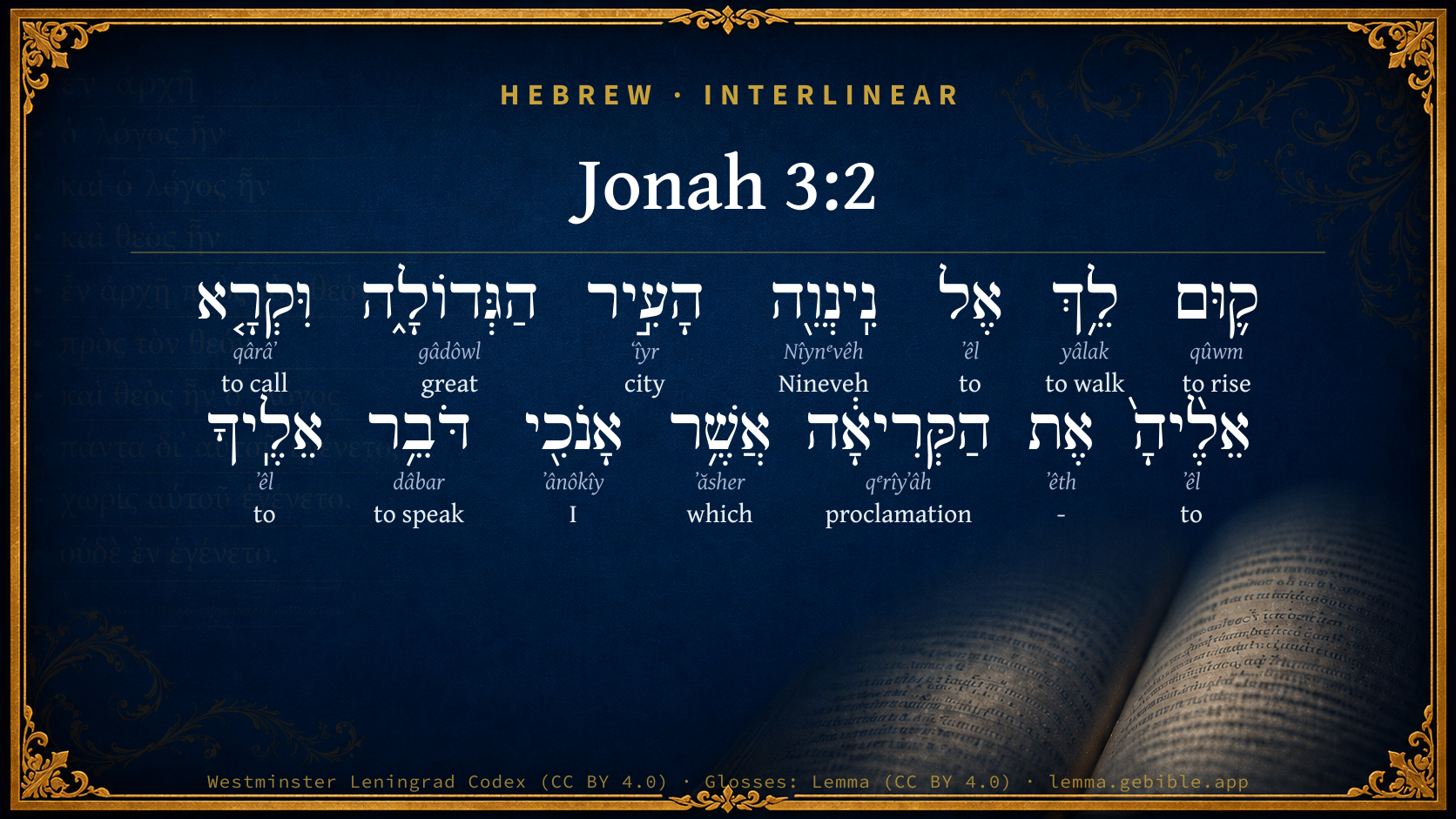
Jonah 3:2

Hebrew (Westminster Leningrad Codex) Jonah 3:2 appears in the Hebrew Old Testament. The text above is from the Westminster Leningrad Codex. Each word links to its Strong’s number, a concise gloss, and parsing drawn from the Open Scriptures Hebrew Bible morphology. Click any word for its full Brown-Driver-Briggs (BDB) entry.
Download image
Cite this verse

Jonah 3:2 (World English Bible). Public Domain. Lemma interlinear Bible study tool, https://lemma.gebible.app/v/jonah/3/2.

Show BibTeX & RIS
BibTeX
RIS
English Translation
"Arise, go to Nineveh, that great city, and preach to it the message that I give you."
World English Bible · Public Domain
Highlights
  • 1 hapax legomenon — only here in the Hebrew Bible
  • 1 first appearance in the Hebrew Bible
Full analysis ↓
Download a study sheet

One document with this verse’s original text, its word-by-word gloss line, the meaning frame, cross-references with their text, attributed commentary, and full source and license credits — printable, and it pastes into notes with its structure intact.

This verse Autodidact and up

Study sheet (.html) Plain text (.txt)

A passage Seminary Student

Up to 50 verses in one chapter. A passage sheet keeps up to 6 commentary sources and 12 cross-references per verse, in the order this page ranks them, and says so on the sheet whenever that leaves anything out. Ask for a single verse and you get the Autodidact verse sheet above.

Everything on this page stays free to read, with no account — the sheet is a download of what is already on screen, not access to it.

Want to remove ads? Support Godless Engineer
Compare translations 3

The same verse in 3 English versions, stacked beneath the original-language interlinear above. Click any original word for its lexicon entry.

Each is an independent rendering of the whole verse — the interlinear is not word-aligned to these translations.

Highlighted words mark where these versions differ — a whole-verse word diff, not a word-by-word alignment.

  • World English Bible Public Domain
    "Arise, go to Nineveh, that great city, and preach to it the message that I give you."
  • King James Version Public Domain
    Arise, go unto Nineveh, that great city, and preach unto it the preaching that I bid thee.
  • unfoldingWord Literal Text CC BY-SA 4.0
    “Get up, go to Nineveh, the great city, and proclaim to it the proclamation that I tell to you.”

unfoldingWord Literal Text — © unfoldingWord, licensed CC BY-SA 4.0. Word-aligned USFM3 via Door43 (git.door43.org/unfoldingWord/en_ult).

Versions to compare (up to 4)

3 of 4 selected

Show all 18 translations

Every available English version of this verse, each an independent rendering of the whole verse.

  • World English Bible Public Domain
    "Arise, go to Nineveh, that great city, and preach to it the message that I give you."
  • Berean Standard Bible Public Domain
    “Get up! Go to the great city of Nineveh and proclaim to it the message that I give you.”
  • Majority Standard Bible Public Domain
    “Get up! Go to the great city of Nineveh and proclaim to it the message that I give you.”
  • King James Version Public Domain
    Arise, go unto Nineveh, that great city, and preach unto it the preaching that I bid thee.
  • American Standard Version (1901) Public Domain
    Arise, go unto Nineveh, that great city, and preach unto it the preaching that I bid thee.
  • Revised Version (1885) Public Domain
    Arise, go unto Nineveh, that great city, and preach unto it the preaching that I bid thee.
  • Geneva Bible (1599) Public Domain
    Arise, goe vnto Nineueh that great citie, and preach vnto it the preaching, which I bid thee.
  • Douay-Rheims (1899) Public Domain
    Arise, and go to Ninive the great city: and preach in it the preaching that I bid thee.
  • Young's Literal Translation Public Domain
    `Rise, go unto Nineveh, the great city, and proclaim unto it the proclamation that I am speaking unto thee;'
  • Literal Standard Version CC BY-SA 4.0
    “Rise, go to Nineveh, the great city, and proclaim to it the proclamation that I am speaking to you”;
  • Unlocked Literal Bible CC BY-SA 4.0
    “Get up, go to Nineveh, that great city, and proclaim to it the message that I command you to give.”
  • unfoldingWord Literal Text CC BY-SA 4.0
    “Get up, go to Nineveh, the great city, and proclaim to it the proclamation that I tell to you.”
  • Darby Bible Public Domain
    Arise, go to Nineveh, the great city, and preach unto it the preaching that I shall bid thee.
  • World Messianic Bible Public Domain
    “Arise, go to Nineveh, that great city, and proclaim to it the message that I give you.”
  • Webster's Bible Public Domain
    Arise, go to Nineveh, that great city, and preach to it the preaching that I bid thee.
  • Free Bible Version CC BY-SA 4.0
    “Go immediately to the great city of Nineveh and announce the message I'm giving you.”
  • Bible in Basic English Public Domain
    Up! go to Nineveh, that great town, and give it the word which I have given you.
  • JPS Tanakh (1917) Public Domain
    'Arise, go unto Nineveh, that great city, and make unto it the proclamation that I bid thee.'

Literal Standard Version (2020), Covenant Press — licensed CC BY-SA 4.0. Text via the HelloAO Bible API (eBible.org). Unlocked Literal Bible (unfoldingWord) — licensed CC BY-SA 4.0. Text via the HelloAO Bible API (eBible.org). unfoldingWord Literal Text — © unfoldingWord, licensed CC BY-SA 4.0. Word-aligned USFM3 via Door43 (git.door43.org/unfoldingWord/en_ult). Free Bible Version, Dr. Jonathan Gallagher — licensed CC BY-SA 4.0. Text via the HelloAO Bible API (eBible.org).

Word by word

More ways to search: Search by grammar → Find every occurrence → Compare this word →

Practice this passage: Drill this verse → Learn its vocabulary →

הַקְּרִיאָ֔ה
qᵉrîyʼâh
H7150
“the · proclamation”
Particle, Definite Article + Noun, Common, Feminine, Singular, Absolute
Part of Speech
Particle + Noun
Type
Common
Gender
Feminine
Number
Singular
State
Absolute
Full BDB Definition

Origin: from H7121

TWOT: 2063c

proclamation, preaching
  1. ק֛וּם qûwm H6965 “rise” Verb, Qal, Imperative, 2nd Person, Masculine, Singular
  2. לֵ֥ךְ yâlak H3212 “walk” Verb, Qal, Imperative, 2nd Person, Masculine, Singular
  3. אֶל ʼêl H413 “to” Preposition
  4. נִֽינְוֵ֖ה Nîynᵉvêh H5210 “Nineveh” Noun, Proper
  5. הָעִ֣יר ʻîyr H5892 “the · city” Particle, Definite Article + Noun, Common, Feminine, Singular, Absolute
  6. הַגְּדוֹלָ֑ה gâdôwl H1419 “the · great” Particle, Definite Article + Adjective, Adjective, Feminine, Singular, Absolute
  7. וִּקְרָ֤א qârâʼ H7121 “and · call” Conjunction + Verb, Qal, Imperative, 2nd Person, Masculine, Singular
  8. אֵלֶ֨יהָ֙ ʼêl H413 “to · her” Preposition + Suffix, Personal, 3rd Person, Feminine, Singular
  9. אֶת ʼêth H853 “-” Particle, Direct Object
  10. אֲשֶׁ֥ר ʼăsher H834 “which” Particle, Relative
  11. אָנֹכִ֖י ʼânôkîy H595 “I” Pronoun, Personal, 1st Person, Common, Singular
  12. דֹּבֵ֥ר dâbar H1696 “speaking” Verb, Qal, Participle Active, Masculine, Singular, Absolute
  13. אֵלֶֽיךָ ʼêl H413 “to · you” Preposition + Suffix, Personal, 2nd Person, Masculine, Singular

About this verse

These counts appear in no published source. They are computed here, from the morphology-tagged text and Lemma’s own curated glosses. What Lemma adds →

14
words
12
distinct lemmas
Prophets
section

Notable vocabulary

1 hapax legomenon — a word that appears only here in the entire Hebrew Bible:

  • הַקְּרִיאָ֔ה proclamation H7150

First appearance in Scripture

This word makes its first canonical appearance in the Hebrew Bible here:

  • הַקְּרִיאָ֔ה proclamation H7150

Shared distinctive vocabulary

נִֽינְוֵ֖ה Nineveh H5210 occurs in 16 verses of the Hebrew Bible. Also found in:

Grammatical profile

  • 4 verbs
  • 3 nouns
  • 1 adjective
  • 1 pronoun
  • 3 prepositions
  • 2 particles

Verb forms

  • ק֛וּם Qal · Imperative
  • לֵ֥ךְ Qal · Imperative
  • וִּקְרָ֤א Qal · Imperative
  • דֹּבֵ֥ר Qal · Participle Active

Repetition

A word recurs within this verse — often emphatic in Hebrew:

  • אֶל to H413 ×3

Hebrew & Septuagint length

In English translation the verse runs 17 words from the Hebrew and 22 from the Septuagint (LXX English) — closely comparable.

A rough comparison of the two English renderings, which tokenize alike — not a word-level alignment.

Word counts can differ between the Hebrew and the Greek without any difference in meaning — e.g. the Hebrew direct-object marker אֵת has no separate Greek word, and Greek often adds the article ὁ.

In the original languages it is 14 Hebrew tokens and 23 Greek tokens — but the two are counted differently (Hebrew bundles its prefixes and suffixes into one token; the Greek is in lemma form), so that isn’t a like-for-like length.

Cross-references

9

Topical passages linked to Jonah 3:2 in the Treasury of Scripture Knowledge — connected by theme and wording, ordered by reader-vote popularity; previews shown in the World English Bible.

  • Jeremiah 1:17 You therefore gird up your loins, and arise, and speak to them all that I command you: don't be dismayed at them, lest I dismay you before them.
  • Ezekiel 2:7 You shall speak my words to them, whether they will hear, or whether they will forbear; for they are most rebellious.
  • Jonah 1:2 "Arise, go to Nineveh, that great city, and preach against it, for their wickedness has come up before me."
  • Jonah 3:3 So Jonah arose, and went to Nineveh, according to the word of Yahweh. Now Nineveh was an exceedingly great city, three days' journey across.
  • Jeremiah 15:19–21 Therefore thus says Yahweh, If you return, then will I bring you again, that you may stand before me; and if you take forth the precious from the vile, you shall be as my mouth: they shall return to you, but you shall not return to them.
  • Ezekiel 3:17 Son of man, I have made you a watchman to the house of Israel: therefore hear the word at my mouth, and give them warning from me.
  • Zephaniah 2:13–15 He will stretch out his hand against the north, destroy Assyria, and will make Nineveh a desolation, and dry like the wilderness.
  • Matthew 3:8 Therefore bring forth fruit worthy of repentance!
  • John 5:14 Afterward Jesus found him in the temple, and said to him, "Behold, you are made well. Sin no more, so that nothing worse happens to you."

Cross-references courtesy of OpenBible.info (CC BY 4.0).

Hebrew and Greek witnesses Masoretic Hebrew ↔ Greek Septuagint

The same verse in the two great witnesses to the Old Testament, shown verse-for-verse.

These are two independent witnesses, not word-aligned to each other, and the Septuagint is shown in lemma (dictionary) form.

Hebrew Jonah 3:2 Masoretic · Westminster Leningrad Codex

ק֛וּם לֵ֥ךְ אֶל נִֽינְוֵ֖ה הָעִ֣יר הַגְּדוֹלָ֑ה וִּקְרָ֤א אֵלֶ֨יהָ֙ אֶת הַקְּרִיאָ֔ה אֲשֶׁ֥ר אָנֹכִ֖י דֹּבֵ֥ר אֵלֶֽיךָ

"Arise, go to Nineveh, that great city, and preach to it the message that I give you."

World English Bible · Public Domain

Greek LXX Jonah 3:2 Septuagint · lemma form

ἀναἵστημι καί πορεύομαι εἰς νινευη ὁ πόλις ὁ μέγας καί κηρύσσω ἐν αὐτός κατά ὁ κήρυγμα ὁ ἔμπροσθεν ὅς ἐγώ λαλέω πρός σύ

Rise, go to Nineve, the great city, and preach in it according to the former preaching which I spoke to you of.

LXX2012 (modern English Septuagint) · Public Domain

On this verse, The Pulpit Commentary discusses the Septuagint’s reading. Read the note in Commentary ↓

Hebrew: Westminster Leningrad Codex (CC BY 4.0). Greek: Septuagint (public domain); English from LXX2012 (modern English Septuagint) (Public Domain). How the Septuagint differs from the Hebrew →

Targum (Aramaic paraphrase)

1

The Targum is the ancient Jewish Aramaic paraphrase of the Hebrew Scriptures — an interpretive translation, not the Hebrew text itself. Onkelos (literal) and Pseudo-Jonathan (expansive) render the Torah, and Jonathan the Prophets. Coverage is partial: where no permissively-licensed English translation exists for a verse, only the Aramaic is shown. This is verse-level text, not a word-by-word alignment to the Hebrew.

  1. Targum Jonathan Prophets (Joshua–Malachi)
    קוּם אֱזֵיל לְנִינְוֵה קַרְתָּא רַבְּתָא וְאִתְנַבֵּי עֲלָהּ יַת נְבוּאֲתָא דִי אֲנָא מְמַלֵיל עִמָךְ:

    Get up, go down to Nineveh, the great city, and prophecy upon them the prophecy that I command you.

    Targum Jonathan — Aramaic: “Mikraot Gedolot” (public domain). English: “Sefaria Community Translation” (CC0 1.0 (public-domain dedication)); “London "Chaldee Paraphrase," 1871” (public domain). Text via Sefaria.

Commentary

Notes on Jonah 3:2 from classic Christian and Jewish commentators (each source and its license shown beneath its notes). The classic Christian expositions comment on the surrounding passage and are grouped to its opening verse, so a note may address several verses; the Jewish commentaries on the Tanakh (Rashi and others) are per-verse, so they appear only where the commentator wrote on this verse.

Lemma curates 59 commentaries, every one of them public domain or Creative Commons licensed, each selected and text-cleaned for this edition rather than reprinted as found. About our sources →

Trapp's Complete Commentary

John Trapp

Jon 3:2 Arise, go unto Nineveh, that great city, and preach unto it the preaching that I bid thee.

Ver. 2. Arise, go unto Nineveh] Begin again, and take better heed; as that Nazarite was to do that had defiled the head of his consecration, Num 6:9; Num 6:12.

Unto Nineveh, that great city] {See Trapp on "Jon 1:2"} There was no city since, by the estimation of Diodorus, had the like compass of ground or stateliness of walls; the height thereof being a hundred feet, the breadth able to receive three carts abreast, adorned with fifteen hundred turrets. Some think (as Annius and Berosus) that those three cities spoken of, Gen 10:11-12, Rehoboth, Calah, and Resen, were all included in Nineveh, and they conceive it thus; that when Nimrod had built Babylon, Ninus, disdaining his government, went into the fields of Asshur, and there erected a city after his own name. Raphael Volaterranus saith it was eight years in building, ten thousand men working at it. Quintilian saith, that great Milan, ancient Ravenna, brave Bononia, noble Naples, and other great cities of Italy, are but towers to Rome: but what was Rome to Nineveh? and yet Lipsius hath written a treatise of Rome’s greatness; and when the Emperor Constantine came to Rome, and beheld the companies that entertained him, he repeated a saying of Cineas, the Epirote, that he had seen so many kings as citizens; but, viewing the building of the city, he thought, naturam vires omnes in urbem unam effudisse, that nature had showed the utmost of what she could do in that one great city. {See Trapp on "Jon 3:3"}

And preach unto it the preaching] Heb. Proclaim unto it (or against it) the proclamation that I say to thee, that I have formerly put into thy mouth, and do now so again, sc. that their wickedness is come up before me, and I am even upon the way toward them to punish it grievously. Flagitium et flagellum sunt sicut acus et filium, Who ever waxed fierce against God and prospered? Job 9:4. This wicked men must be boldly told, Isa 3:11, however they take it; neither may God’s ministers steal away the word, Jer 23:30, or keep back from the people any part of God’s counsel, Act 20:27, "handling the word of God deceitfully; but by manifestation of the truth commend themselves to every man’s conscience in the sight of God," 2Co 4:2, as becometh his ambassadors.

John Trapp, A Commentary or Exposition upon All the Books of the Old and New Testament (1647–1656) — public domain. Text from a community e-Sword module.

Adam Clarke's Commentary

Verse 2. And preach unto it the preaching] וקרא את הקריאה vekera eth hakkeriah, "And cry the cry that I bid thee." Be my herald, and faithfully deliver my message. The word κηρυξ in Greek answers to the Hebrew קורא kore: both signifying a crier, a herald, a preacher; one that makes proclamation with a loud and earnest cry. Such was John Baptist, Isa 40:3; such was Jesus Christ, Joh 7:18-37; and such were all his apostles. And such earnestness becomes a ministry that has to do with immortal souls, asleep and dead in sin, hanging on the brink of perdition, and insensible of their state. The soft-speaking, gentle-toned, unmoved preacher, is never likely to awaken souls. As we preach, so the people hear; scarcely receiving any counsels that appear to have no importance by the manner in which they are delivered. But this earnestness is widely different from that noisy, blustering, screaming rant, that manifests more of the turbulence of disorderly passions, than of the real inspired influence of the Spirit of God.

Adam Clarke's Commentary on the Bible (1810–1826) — public domain. Text from a community e-Sword/MySword module.

John Calvin's Commentaries

The command now follows, Arise, go to Nineveh, to that great city, and preach there the preaching which I command thee. God again repeats what we have observed at the be ginning, — that Nineveh was a great city, that Jonah might provide himself with an invincible courage of mind, and come there well prepared: for it often happens, that many boldly undertake an office, but soon fail, because difficulties had not been sufficiently foreseen by them. Hence, when men find more hardships than they thought of at the beginning, they nearly faint, at least they despond. The Lord, therefore, expressly foretold Jonah how difficult would be his employment; as though he said, “I send thee, a man unknown, and of no rank, and a stranger, to denounce ruin on men, not a few in number, but on a vast multitude, and to carry on a contest with the noblest city, and so populous, that it may seem to be a region of itself.”

We now then understand why this character of the city was added; it was, that Jonah might gird up himself for the contest, that he might not afterwards fail in the middle of his course. This fear indeed frightened him at the beginning, so that he shunned the call of God; but he is not now moved in any degree by the greatness of the city, but resolutely follows where the Lord leads. We hence see, that faith, when once it gains the ascendancy in our hearts, surmounts all obstacles and despises all the greatness of the world; for it is immediately added —

John Calvin's Commentaries (1540-1563) — public domain. Text from the Calvin Translation Society English edition (1840s-50s) via the Christian Classics Ethereal Library (ccel.org). Calvin's coverage is partial (roughly two-thirds of the Bible); uncommented books and verses are honest gaps, never fabricated. The 19th-century editor's footnotes and remarks are omitted so the notes are faithfully Calvin's own voice.

Ellicott's Commentary for English Readers

III.

THE PROPHET FULFILS HIS COMMISSION.

ITS RESULT.

(2) Preach.—In Jon_1:2 the word is rendered “cry.”

A Bible Commentary for English Readers, edited by Charles John Ellicott (1878–1897) — public domain. Text from a community e-Sword module.

The Cambridge Bible for Schools and Colleges

gen. ed. J. J. S. Perowne

2. that great city] Calvin explains this repeated mention of the greatness of Nineveh (comp. Jon_1:2), as intended to prepare Jonah for the magnitude of the task before him, lest when he came face to face with it he should be appalled and draw back. But perhaps the true key is to be found in Jon_4:11, where the same expression “the great city” occurs as an argument for God’s compassion. It is on no mean errand of mercy, not to save a few only from destruction, that I bid you go.

preach unto it the preaching] Lit., cry to it the crying. The word is rendered cry, Jon_1:2.

The Cambridge Bible for Schools and Colleges (gen. ed. J. J. S. Perowne; Cambridge University Press, 1878–1918) — public domain. Text from a community e-Sword module.

John Gill's Exposition

Arise, go unto Nineveh, that great city,.... So it is called; See Gill on Jon 1:2. The order runs in the same words as before; and the same discouragements are presented to Jonah, taken from the greatness of the city, the number of its inhabitants, its being the metropolis of the Assyrian empire, and the seat of the greatest monarch on earth, to try his faith; but these had not the like effect as before; for he had now another spirit given him, not of fear, but of a sound mind; he considered he was sent by a greater King, and that more were they that were on his side than the inhabitants of this place, who might possibly be against him:

and preach unto it the preaching that I bid thee; that he had bid him before, declaring and exposing their wickedness, and telling them that in a short time their city would be destroyed. Jonah must not be gratified with any alteration in the message; but he must go with it as it had before been given, or what he now bid, or should bid him; the word of the Lord must be spoken just as it is delivered; nothing must be added to it, or taken from it; the whole counsel of God must be declared; prophets and ministers must preach, not as men bid them, but as God bids them. The Targum is,

"prophesy against it the prophecy which I speak with thee.''

John Gill's Exposition of the Whole Bible (1746–1763) — public domain (CC PDM 1.0). Text via the HelloAO Bible API.

Albert Barnes' Notes on the Bible

Arise, go to Nineveh that great city, and preach (or cry) unto it - God says to Jonah the self-same words which He had said before; only perhaps He gives him an intimation of His purpose of mercy, in that he says no more, “cry against her,” but “cry unto her.” He might “cry against” one doomed to destruction; to “cry unto her,” seems to imply that she had some interest in, and so some hope from, this cry. “The preaching that I bid thee.” This is the only notice which Jonah relates that God took of his disobedience, in that He charged him to obey exactly what He commanded . “He does not say to him, why didst thou not what I commanded?” He had rebuked him in deed; He amended him and upbraided him not . “The rebuke of that shipwreck and the swallowing by the fish sufficed, so that he who had not felt the Lord commanding, might understand Him, delivering.”

Jonah might have seemed unworthy to be again inspired by God. But “whom the Lord loveth, He chasteneth;” whom He chasteneth, He loveth . “The hard discipline, the severity and length of the scourge, were the earnests of a great trust and a high destination.” He knew him to be changed into another man, and, by one of His most special favors, gives him that same trust which he had before deserted . “As Christ, when risen, commended His sheep to Peter, wiser now and more fervent, so to Jonah risen He commends the conversion of Nineveh. For so did Christ risen bring about the conversion of the pagan, by sending His Apostles, each into large provinces, as Jonah was sent alone to a large city” . “He bids him declare not only the sentence of God, but in the same words; not to consider his own estimation or the ears of his hearers, nor to mingle soothing with severe words, and convey the message ingeniously, but with all freedom and severity to declare openly what was commanded him. This plainness, though, may be less acceptable to people or princes, is ofttimes more useful, always more approved by God. Nothing should be more sacred to the preacher of God’s word, than truth and simplicity and inviolable sanctity in delivering it. Now alas, all this is changed into vain show at the will of the multitude and the breath of popular favor.”

Albert Barnes' Notes on the Bible (1834–1885) — public domain. Text from a community e-Sword/MySword module.

Haydock's Catholic Bible Commentary

Bid thee before, or when thou shalt be there. (Calmet) --- He seems to have retired to Jerusalem. (Menochius)

George Leo Haydock (1774–1849), Haydock's Catholic Family Bible and Commentary, 1859 edition — public domain. Excludes Psalms (Douay-Rheims chapter numbering differs from Protestant) and Deuterocanonical books (Catholic canon only).

Matthew Poole's English Annotations

Arise, go unto Nineveh, that great city; see Amo 1:2; great in extent of ground, in strength of its fortifications, height and breadth of its walls, and multitude of its towers; great in the multitude of its numbers, and riches of its citizens, and every whit as great in the multitude of its sins: but let nothing retard or discourage thee, arise and go.

Preach, publicly, plainly, boldly; cry, Amo 1:2.

Unto it, i.e. against it, publish the near approaching ruin of it, preach to them the necessity of their repentance, and awaken them to it by the terrors of the Lord.

The preaching that I bid thee; either which I did bid thee at first, as Amo 1:2, or what I shall suggest and communicate to thee when thou art come thither.

Matthew Poole's English Annotations on the Holy Bible (1683–1685) — public domain. Text from a community e-Sword/MySword module.

The Pulpit Commentary

That great city. (see note on Jon_1:2) Preaching; rendered "cry" in Jon_1:2; Septuagint, khrugma . This time the proclamation is unto it, as interested in the message, not "against it," as doomed to destruction (Pusey).

Ver. 2. City preaching.

In Palestine there were no great cities. The population was scattered through pastoral regions or gathered in small and unimportant towns. This fact gave a character to the national life of the Hebrews and to their national religiousness. It was a strange experience for a Jew like Jonah to be brought into contact with city life upon a grand, colossal scale. We modern Englishmen are more familiar with, this development of human existence and activity. We need to study the relations of religion to city life, its occupations, temptations, and opportunities.

I THE PREACHER IN A GREAT CITY NEEDS TO HAVE HIS IMAGINATION AND HIS HEART FILLED WITH AN IMPRESSION OF ITS MAGNITUDE AND IMPORTANCE. In the view of the Almighty all things earthly may well seem diminutive; yet Jehovah is represented as commissioning Jonah to preach unto Nineveh great city." The population, the wealth, the industry, the political importance of a metropolis should be pondered by one who is required to discharge a public ministry among its inhabitants. Thus he will be more likely to rise to the due height of seriousness, of sympathy. He who labours in "an exceeding great city" needs to fill his soul with a conviction of the spiritual necessities and the spiritual possibilities of such a population.

II THE PREACHER IN A GREAT CITY NERDS TO FULFIL A MINISTRY OF WITNESS. "Cry unto it the cry." Such is the exact language in which Jehovah commissioned his servant. In the university, the private chapel, the select and cultivated congregation, there may be room for argumentative, emotional, poetical, or philosophical preaching. What a great city needs is a voice, a cry, a preaching, in the proper sense of that word. A plain and powerful witness to man"s sin and need, to God"s grace and power to save, a summons to repentance and surrender, such is what the population of a great city for the most part needs.

III THE PREACHER IN A GREAT CITY NEEDS AN UNMISTAKABLE DIVINE COMMISSION AND MESSAGE. "The preaching that I bid thee, such was to be the burden of the prophet"s utterances. It is only the Word of the Lord which should be proclaimed by the minister of religion in any position, in all circumstances. But when standing in the midst of a great metropolis, how can a man, justly sensible of his own ignorance and powerlessness, proceed in his ministry, unless he is assured that the Lord has sent him, unless he can commence his testimony with the preface, "Thus saith the Lord"?

The preaching that God bids.

1. Not the message of our own imagination.

2. Not what me, desire and what will be palatable to them.

3. But what God bids. To the messenger he gives the message from his Word; by his Spirit.

His gospel not altered, not added to, not diminished is to be preached "to every creature." With faithfulness, simplicity, persistence whether men hear or whether men forbear. Like Luther, "I can do no other; God help me! G.T.C.

The Pulpit Commentary (1880–1919), ed. H.D.M. Spence-Jones & Joseph S. Exell — public domain. Text from a community e-Sword module.

Scofield Reference Notes

C. I. Scofield

Nineveh

(See Scofield "Nah 1:1")

The Scofield Reference Bible (1917 edition), notes by C. I. Scofield — public domain. Text from a community e-Sword module.

Radak

Rabbi David Kimhi (Radak)

"Get up...[call out] that which I speak"- [Meaning,] that I spoke to you already and also that which I am now speaking to you, that you should call out to it [the city] that it will be overturned because of their evil.

Radak on the Tanakh — English translations: “Sefaria Community Translation” (CC0 1.0 (public-domain dedication)); “Eliyahu Munk, HaChut Hameshulash” (CC BY 4.0); “Rabbi Mike Feuer, Jerusalem Anthology” (CC BY 4.0); and “R. David Kimhi on the first book of Psalms, Translated by R.G. Finch, London, 1919” (public domain). Text via Sefaria.

Ibn Ezra

Rabbi Abraham ibn Ezra

"Get up"- He [God] is showing him [Yonah] that he did not go a way that distanced him from Nineveh [since the fish spat him out on the shore of Nineveh], [therefore] if He sends him a second time, he will go.

Ibn Ezra on the Tanakh — English translations: “Sefaria Community Translation” (CC0 1.0 (public-domain dedication)); “Yalkut, Sifsei Chachomim Chumash, Metsudah Publications, 2009” (CC BY 4.0); and “Commentary of Ibn Ezra on Isaiah - trans. by M. Friedlander, 1873” (public domain). Text via Sefaria.

Lesson kit

Teaching starters — assembled from the data on this page, not authored interpretation. Every prompt links to the verse data it draws on. Edit before teaching.

Jonah, in the Prophets, opens this verse with 14 words (12 distinct Hebrew lemmas). Its most distinctive word is qᵉrîyʼâh (“proclamation”). A historical commentator’s framing appears above. Read the whole chapter for the surrounding context.

Discussion questions

  1. The word qᵉrîyʼâh carries the sense “proclamation.” How does it shape the verse?
  2. 1 word here appears nowhere else in the Hebrew Bible. Why might the author reach for such rare wording?
  3. This is the first place “proclamation” appears in Scripture (first appears here). What does its debut here establish?
  4. How does Genesis 10:11, which shares the word «Nineveh», read alongside this verse?
  5. What does the repetition of “to” (3× in this one verse) do in this verse?
  6. The translations on this page render this verse differently — a whole-verse word diff, not a word-by-word alignment. What might account for the different wordings?
  7. «ק֛וּם» is a Qal Imperative verb. How does that grammatical form shape the action described?
  8. Compare how Trapp's Complete Commentary and Adam Clarke's Commentary read this verse. Where do they agree or differ?

Things to notice

  • 1 word in this verse appears nowhere else in the Hebrew Bible.
  • 1 word makes its first canonical appearance in Scripture here.
  • This verse counts 14 Hebrew ↔ 23 Greek words.
  • These translations choose different wording for 12 words in this verse.
  • “to” occurs 3× in this single verse.

Reading settings

Reading text

Shown beneath each verse's original-language words.

Old Testament
Old Testament edition

Read the OT as the Masoretic Hebrew (MT) or the Greek Septuagint (LXX).

English shown for the Greek Septuagint (in the Hebrew ↔ Greek comparison).

Comparing translations? Open the Compare panel on any verse page to stack up to four side by side.