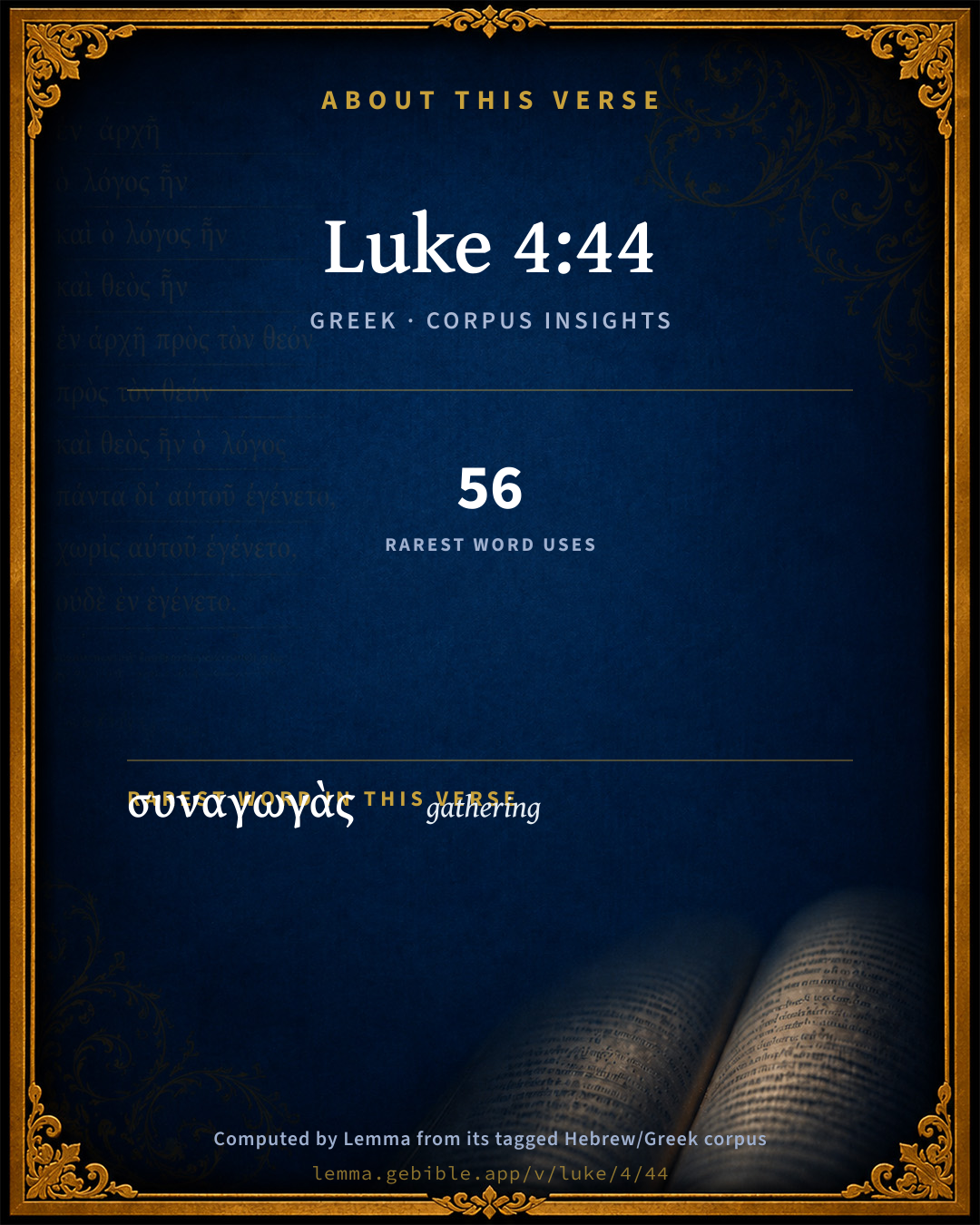
Luke 4:44

Greek (Tischendorf 8th ed.) Luke 4:44 appears in the Greek New Testament. The text above is from the Tischendorf 8th edition. Each word links to its Strong’s number and a concise gloss. Click any word for its full Thayer’s Greek Lexicon entry.
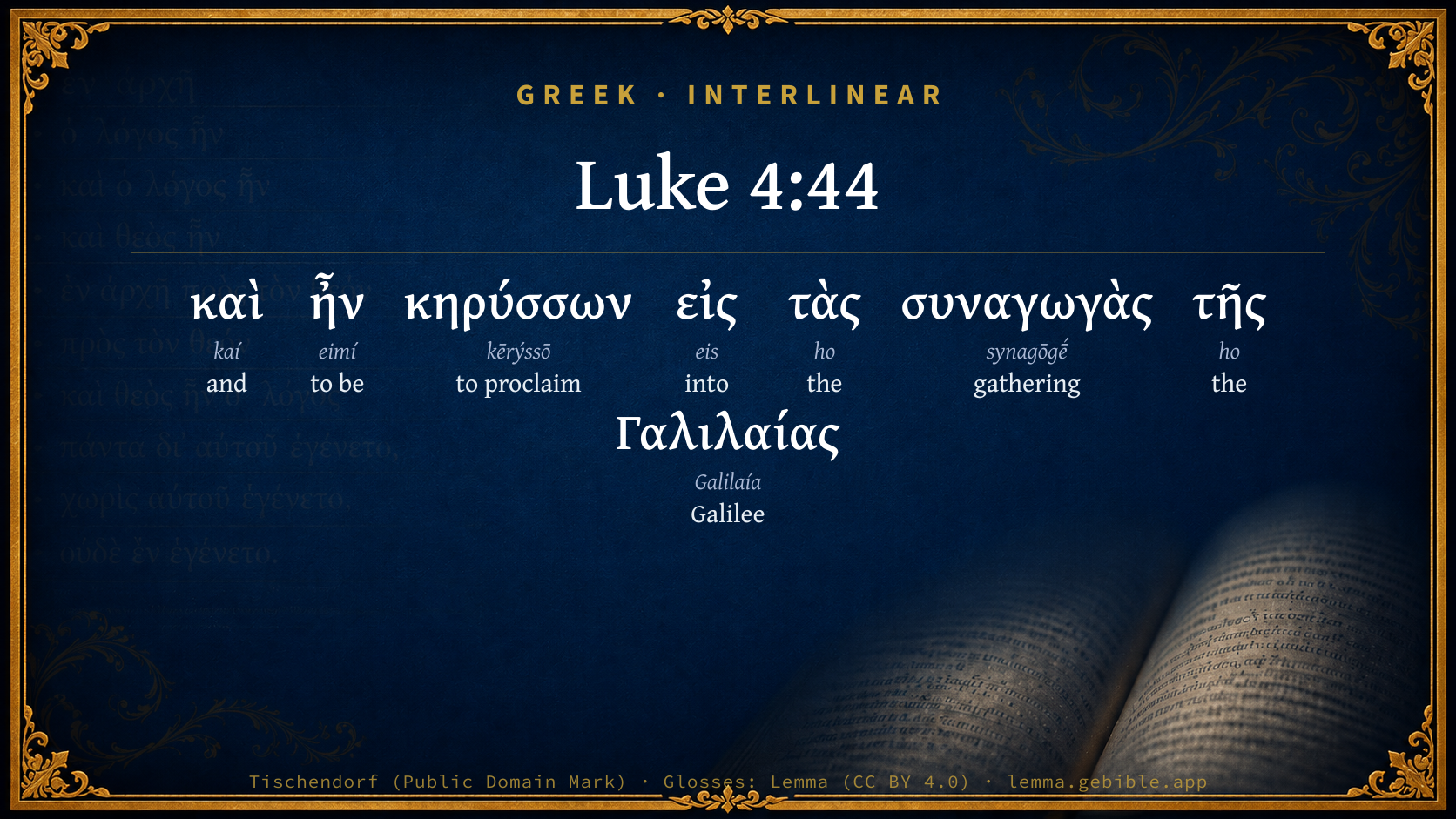
Download image
Cite this verse

Luke 4:44 (World English Bible). Public Domain. Lemma interlinear Bible study tool, https://lemma.gebible.app/v/luke/4/44.

Show BibTeX & RIS
BibTeX
RIS
English Translation
He was preaching in the synagogues of Galilee.
World English Bible · Public Domain
Download a study sheet

One document with this verse’s original text, its word-by-word gloss line, the meaning frame, cross-references with their text, attributed commentary, and full source and license credits — printable, and it pastes into notes with its structure intact.

This verse Autodidact and up

Study sheet (.html) Plain text (.txt)

A passage Seminary Student

Up to 50 verses in one chapter. A passage sheet keeps up to 6 commentary sources and 12 cross-references per verse, in the order this page ranks them, and says so on the sheet whenever that leaves anything out. Ask for a single verse and you get the Autodidact verse sheet above.

Everything on this page stays free to read, with no account — the sheet is a download of what is already on screen, not access to it.

Want to remove ads? Support Godless Engineer
Compare translations 3

The same verse in 3 English versions, stacked beneath the original-language interlinear above. Click any original word for its lexicon entry.

Each is an independent rendering of the whole verse — the interlinear is not word-aligned to these translations.

Highlighted words mark where these versions differ — a whole-verse word diff, not a word-by-word alignment.

  • World English Bible Public Domain
    He was preaching in the synagogues of Galilee.
  • King James Version Public Domain
    And he preached in the synagogues of Galilee.
  • unfoldingWord Literal Text CC BY-SA 4.0
    And he was preaching in the synagogues in Judea.

unfoldingWord Literal Text — © unfoldingWord, licensed CC BY-SA 4.0. Word-aligned USFM3 via Door43 (git.door43.org/unfoldingWord/en_ult).

Versions to compare (up to 4)

3 of 4 selected

Show all 19 translations

Every available English version of this verse, each an independent rendering of the whole verse.

  • World English Bible Public Domain
    He was preaching in the synagogues of Galilee.
  • Berean Standard Bible Public Domain
    And He continued to preach in the synagogues of Judea.
  • Majority Standard Bible Public Domain
    And He continued to preach in the synagogues of Galilee.
  • King James Version Public Domain
    And he preached in the synagogues of Galilee.
  • American Standard Version (1901) Public Domain
    And he was preaching in the synagogues of Galilee.
  • Revised Version (1885) Public Domain
    And he was preaching in the synagogues of Galilee.
  • Geneva Bible (1599) Public Domain
    And hee preached in the Synagogues of Galile.
  • Douay-Rheims (1899) Public Domain
    And he was preaching in the synagogues of Galilee.
  • Young's Literal Translation Public Domain
    and he was preaching in the synagogues of Galilee.
  • Literal Standard Version CC BY-SA 4.0
    and He was preaching in the synagogues of Galilee.
  • Unlocked Literal Bible CC BY-SA 4.0
    Then he continued to preach in the synagogues throughout Judea.
  • unfoldingWord Literal Text CC BY-SA 4.0
    And he was preaching in the synagogues in Judea.
  • Darby Bible Public Domain
    And he was preaching in the synagogues of Galilee.
  • World Messianic Bible Public Domain
    He was proclaiming in the synagogues of Galilee.
  • Webster's Bible Public Domain
    And he preached in the synagogues of Galilee.
  • Free Bible Version CC BY-SA 4.0
    So Jesus went on traveling around, teaching the good news in the synagogues of Judea.
  • Bible in Basic English Public Domain
    And he was teaching in the Synagogues of Galilee.
  • Text-Critical English NT CC BY 4.0
    So he continued preaching in the synagogues of Galilee.
  • Tyndale New Testament (1534) Public Domain
    And he preached in the synagoges of Galile.

Literal Standard Version (2020), Covenant Press — licensed CC BY-SA 4.0. Text via the HelloAO Bible API (eBible.org). Unlocked Literal Bible (unfoldingWord) — licensed CC BY-SA 4.0. Text via the HelloAO Bible API (eBible.org). unfoldingWord Literal Text — © unfoldingWord, licensed CC BY-SA 4.0. Word-aligned USFM3 via Door43 (git.door43.org/unfoldingWord/en_ult). Free Bible Version, Dr. Jonathan Gallagher — licensed CC BY-SA 4.0. Text via the HelloAO Bible API (eBible.org).

Word by word

More ways to search: Search by grammar → Find every occurrence → Compare this word →

Practice this passage: Drill this verse → Learn its vocabulary →

συναγωγὰς
synagōgḗ
G4864
“gathering”
Noun, Accusative, Plural, Feminine
Part of Speech
Noun
Case
Accusative
Number
Plural
Gender
Feminine
Full Thayer's Definition

Origin: from (the reduplicated form of) G4863

TDNT: 20:18,1

1. a bringing together, gathering (as of fruits), a contracting 2. in the NT, an assembling together of men, an assembly of men 3. a synagogue a. an assembly of Jews formally gathered together to offer prayers and listen to the reading and expositions of the scriptures; assemblies of that sort were held every sabbath and feast day, afterwards also on the second and fifth days of every week; name transferred to an assembly of Christians formally gathered together for religious purposes b. the buildings where those solemn Jewish assemblies are held. Synagogues seem to date their origin from the Babylonian exile. In the times of Jesus and the apostles every town, not only in Palestine, but also among the Gentiles if it contained a considerable number of Jewish inhabitants, had at least one synagogue, the larger towns several or even many. These were also used for trials and inflicting punishment.
  1. καὶ kaí G2532 “and” Conjunction
  2. ἦν eimí G1510 “to be” Verb, Imperfect, Active, Indicative, 3rd person, Singular
  3. κηρύσσων kērýssō G2784 “to proclaim” Verb, Present, Active, Participle, Nominative, Singular, Masculine
  4. εἰς eis G1519 “into” Preposition
  5. τὰς ho G3588 “the” Article, Accusative, Plural, Feminine
  6. τῆς ho G3588 “the” Article, Genitive, Singular, Feminine
  7. Γαλιλαίας Galilaía G1056 “Galilee” Noun, Genitive, Singular, Feminine

About this verse

These counts appear in no published source. They are computed here, from the morphology-tagged text and Lemma’s own curated glosses. What Lemma adds →

8
words
7
distinct lemmas
Gospels
section

Shared distinctive vocabulary

συναγωγὰς gathering G4864 occurs in 56 verses of the Greek New Testament. Also found in:

Repetition

A word recurs within this verse:

Cross-references

3

Topical passages linked to Luke 4:44 in the Treasury of Scripture Knowledge — connected by theme and wording, ordered by reader-vote popularity; previews shown in the World English Bible.

  • Matthew 4:23 Jesus went about in all Galilee, teaching in their synagogues, preaching the Gospel of the Kingdom, and healing every disease and every sickness among the people.
  • Mark 1:39 He went into their synagogues throughout all Galilee, preaching and casting out demons.
  • Luke 4:15 He taught in their synagogues, being glorified by all.

Cross-references courtesy of OpenBible.info (CC BY 4.0).

Where the printed editions differ

1 variant

Places in this verse where the major printed Greek editions disagree on the wording in a way that affects the translation — a comparison of editions, not a manuscript-by-manuscript collation. The editions are the modern critical texts (Nestlé-Aland 28/27, SBL, Westcott-Hort, Tregelles, Tyndale House) and the traditional texts behind the KJV (the Textus Receptus and the Byzantine/Majority text). It is not a claim about which reading is original.

  1. Different wording
    Ἰουδαίας.¶

    “of Judea.”

    In NA28NA27TynSBLWH Not in TregTRByz

    Γαλιλαίας (Galilaias) 'of Galilee' occurs in traditional manuscripts (Treg+TR+Byz) instead of Ἰουδαίας.¶ (Ioudaias) 'of Judea.' in older manuscripts (NA28+NA27+Tyn+SBL+WH)

Textual data: Translators Amalgamated Greek New Testament (STEPBible TAGNT) · CC BY 4.0.

Commentary

Notes on Luke 4:44 from classic Christian and Jewish commentators (each source and its license shown beneath its notes). The classic Christian expositions comment on the surrounding passage and are grouped to its opening verse, so a note may address several verses; the Jewish commentaries on the Tanakh (Rashi and others) are per-verse, so they appear only where the commentator wrote on this verse.

Lemma curates 59 commentaries, every one of them public domain or Creative Commons licensed, each selected and text-cleaned for this edition rather than reprinted as found. About our sources →

Tyndale Open Study Notes

Tyndale Open Resources

4:44 Luke probably used Judea in the general sense of “the land of the Jews,” since Jesus’ ministry was then in Galilee in the north (see 5:1), not south in Judea.

Tyndale Open Study Notes — © Tyndale Open Resources, licensed CC BY-SA 4.0. Text via the HelloAO Bible API.

Bengel's Gnomon

Johann Albrecht Bengel

Luk 4:44. Ταῖς συναγωγαῖς, the synagogues) all of them.

Bengel's Gnomon of the New Testament — English translation (T&T Clark, Edinburgh, 1860) — public domain. Text from a community e-Sword module.

Ellicott's Commentary for English Readers

(44) He preached.—Literally, was preaching.

A Bible Commentary for English Readers, edited by Charles John Ellicott (1878–1897) — public domain. Text from a community e-Sword module.

The Cambridge Bible for Schools and Colleges

gen. ed. J. J. S. Perowne

44. he preached] Rather, He was preaching, implying a continued ministry.

of Galilee] Here א, B, C, L and other uncials have the important various reading “of Judaea.” If this reading be correct, it is another of the many indications that the Synoptists assume and imply that Judaean ministry which St John alone narrates.

The Cambridge Bible for Schools and Colleges (gen. ed. J. J. S. Perowne; Cambridge University Press, 1878–1918) — public domain. Text from a community e-Sword module.

Haydock's Catholic Bible Commentary

Our divine Redeemer frequented the Jewish synagogue, to shew he was no seducer. If he had inhabited wilds and deserts, it might have been objected to him, that he concealed himself, like an impostor, from the sight of men. (St. John Chrysostom, in cat. Græc. Pat. hom. in Matt.)

====================

George Leo Haydock (1774–1849), Haydock's Catholic Family Bible and Commentary, 1859 edition — public domain. Excludes Psalms (Douay-Rheims chapter numbering differs from Protestant) and Deuterocanonical books (Catholic canon only).

Cambridge Greek Testament for Schools and Colleges

44. ἦν κηρύσσων. ‘He was preaching,’ implying a continued ministry.

τῆς Γαλιλαίας. Here אBCL and other uncials have the important various reading “of Judaea.” If this reading be correct, it is another of the many indications that the Synoptists assume and imply that Judaean ministry which St John alone narrates. Godet on very insufficient grounds calls it an absurd reading.

Cambridge Greek Testament for Schools and Colleges (Cambridge University Press, 1896; 21 vols, various authors incl. Carr, Maclear, Plummer, Farrar, Lumby, Moule, M. R. James, Simcox) — public domain. Text from a community e-Sword module.

Alford’s Greek Testament

Henry Alford

44.] See Mat 4:23-25 and notes.

καὶ ἦν κηρ.… is a formal close to this section of the narrative, and chronologically separates it from what follows.

The reading τῆς Ἰουδαίας must, on any intelligible critical principles, be adopted; and Tregelles can hardly be acquitted of inconsistency with his own usual practice, in rejecting it. It is utterly inconceivable that it should have been a correction, seeing that Γαλιλαίας stands firm, with no various reading, in ║ Mark, from which the rec. reading here has come. (See however Mar 1:28, where 1 has Ἰουδαίας for Γαλιλαίας: and Isa 9:1, where εἰς τὰ μέρη τῆς Ἰουδαίας is added to the Hebrew, by א and one other uncial ms.) This view is confirmed by the fact that two evangelistaria here read τοῖς Ἰουδαίοις; one, τῶν Ἰουδαίων, both being attempts to escape from the difficulty of τῆς Ἰουδαίας; while one adopts αὐτῶν, part of the sentence in ║ Mark. So far, however, being plain, I confess that all attempts to explain the fact seem to me futile. The three Evangelists relate no ministry in Judæa, with this single exception. And our narrative is thus brought into the most startling discrepancy with that of St. Mark, in which unquestionably the same portion of the sacred history is related. Still, these are considerations which must not weigh in the least degree with the critic. It is his province simply to track out what is the sacred text, not what, in his own feeble and partial judgment, it ought to have been.

Henry Alford, The Greek Testament (1849–1861) — public domain. Text from a community e-Sword module.

International Critical Commentary

44. Καὶ ἦν κηρύσσων εἰς τὰς συναγωγὰς τῆς Ἰουδαίας. This statement forms a conclusion to the section (14-44); and the analytical tense indicates that what is stated continued for some time.

Both Lk. and Mk. have εἰς τὰσσυναγωγάς, which in both cases has been altered into the easier ἐν ταῖς συναγωγαῖς. The εἰς may be explained as a pregn. constr., “He went into the synagogues and preached there” or as expressing the motion or direction of the preaching (Mar 4:15; Joh 8:26).Comp. ἐς τὸν δῆμον ταῦτα λέγωσιν (Thuc. 5:45, 1). It seems probable that the reading Ἰουδαίας (א B C L Q R) is the original one, which has been corrected to Γαλιλαίας (A D X Γ Δ Λ Π) on account of its difficulty. But, as in 1:5 and 7:17, Judæa may here mean the whole country of the Jews, Palestine. Lk. often uses Ἱουδαία in this sense (23:5; Act 2:9, Act 2:10:37, Act 2:11:1, Act 2:29, Act 2:26:20; comp. Gal 1:22). Classic writers use the term in much the same manner. Strabo means by it all the region from Lebanon southwards. Syr-Sin. has “of Judæa.”.

1 “Sympathy with the sinner in his trial does not depend on the experience of sin, but on the experience of the strength of the temptation to sin, which only the sinless can know in its full intensity. He who falls yields before the last strain” (Wsctt. on Heb 2:18). See Neander, L. J. C. §§ 46, 47, PP. 77, 78.

1 Le baptême et la tentation se succèdent l’un à l’autre dans la réalité de l’histoire, comme dans le récit des Evangélistes. Ces deux faits inséparables, qui s’éciairent en s’opposant dans un contraste uigoreux, sont le urai prélude de la vie du Christ. L’un est la manifestation de l’ Esprit de Dieu, l’autre, celle de l’esprit du mal; l’un nous montre la filiation divine de Jésus, l’autre, sa nature humaine uouée à la lutte et à l’épreuve; l’un nous réuèle la force infinie avec laquelle il agira, l’autre, l’obstacle qu’il saura renverser; l’un nous enseigne sa intime, l’autre, la loi de son action (Didon, p. 225).

RV. Revised Version.

AV. Authorized Version.

Trench, Trench, New Testament Synonyms.

1 The fasts of Moses and Elijah were of similar duration (Deu 9:9; Deu_1 K. 19:8). The number forty in Scripture is connected with suffering. The Deluge lasted forty days and nights (Gen 7:4, Gen 7:12). The Israelites wandered for forty years (Num 14:33, Num 32:13). Egypt is to lie waste forty years (Eze 29:11). Ezekiel is to bear the iniquity of the house of Judah (i.e. the penalty for that iniquity) forty days, each day representing a year (4:6). Offenders received forty stripes as a maximum (Deu 25:3). A mother was unclean for forty days after childbirth (Lev 12:1-4). Perhaps we are to understand that the fast of the Ninevites lasted forty days.

1 Dubitavit de illo demonum princeps, eumque tentavit, an Christus esset explorans (De civ. Del, 9:21)

2 Latham, Pastor Pastorum, p. 113.

Win. Winer, Grammar of N.T. Greek (the page refers to Moulton’s edition).

1 Trench quotes from Ambrose: Non enim quasi Deus utitur potestare (quid enim mihi proderat), sed quasi homo commune sibi arcessit auxilium.

A A. Cod. Alexandrinus, sæc. v. Once in the Patriarchal Library at Alexandria; sent by Cyril Lucar as a present to Charles 1. in 1628, and now in the British Museum. Complete.

D D. Cod. Bezae, sæc. vi. Given by Beza to the University Library at Cambridge 1581. Greek and Latin. Contains the whole Gospel.

2 It is worth noting that A. V., which follows those texts that insert“Τπαγε ὀπίσω μου, Σατανᾶ in ver. 8, renders the words “Get rhee behind Me, Satan”. there, and “Get rhee hence, Satan” in Mt.

Jos. Josephus.

Wsctt. Westcott.

Beng. Bengel.

1 In this connexion a remark of Père Didon is worth quoting. Of the traditional scene of the Temptation he says that there Christ avait sous les yeux ce chemin de jèricho à Jèrusalem qüil devait suivre, un iour, avec ses discibles, pour alley àla mort (Jésus Christ Ch. iii. p. 209).

Eus. Eusebius of Cæsarea

1 See Edersh. L. & T. 1. p. 304; Latham, Pastor Pastorum, p.140.

WH. Westcott and Hort.

1 On synagogues see Edersh. L. & T. 1. pp. 430-450, Hist. of Jewish Nation, pp. 100-129, ed. 1896; Schürer, Jewish People in the T. of J.C. ii. 2, pp. 52-89; Hausrath, N. T. Times, 1. PP. 84-93; Plumptre in D.B.; Leyrer in Herzog, Pro_1; Strack in Herzog, Pro_2; and other authorities in Schürer.

1 We have no right to infer from this incident that the Hebrew Bible could still be understood by the people. Nothing is said about interpretation; but we cannot assume that it did not take place. Mar 15:34 is evidence of some knowledge of O.T. in Aramaic. See Classical Review, May 1894, p, 216,against Kautzsch, Grammatik des biblishen Aramaäischen, p. 19.

2 Comp. Ἀναστὰς δέ τις τῶν ἐπειροτάτων ὑφηγεῖται τἄριστα καὶ συνοίσοντα οἶς ἄπας ὁ βίος ἐπιδώσει πρὸς τὸ βέλτιον (Philo, De Septenario, 6, ). See also the fragments a Philo in Eus. Præp Evang. 8:7, 12, 13, and 8:12:10 ed.Gaisford. These three passages give us Philo’s account of the Synagogus services.

אԠא Cod. Sinaiticus, sæc. iv. Brought by Tischendorf from the Convent of St. Catherine on Mt. Sinai; now at St. Petersburg. Contains the whole Gospel complete.

B B. Cod. Vaticanus, sæc. 4. In the Vatican Library certainly since 15331 (Batiffol, La Vaticane de Paul 3, etc., p. 86).

L L. Cod. Regius Parisiensis, sæc. viii. National Library at Paris. Contains the whole Gospel.

1 Scrivener, int. to Crit. of N.T. 1. pp. 12, 13, 4th ed. The evidence against the clause ἰάσααθαι … τὴν καρδίαν here (in א A Q of LXX τῇ καρδία̣) is decisive. Itisomitted by א B D L Ξ, 13-69, 33, most MSS. Of Lat. Vet. and best MSS, of Vulg., most MSS. of Bob. Aeth. Arm. Syr-Sin., Orig. Eus. etc., all the best editors and RV. See Sanday, App. ad N.T. p. 117.

Vulg. Vulgate.

1 On be uncertainty respecting the length of the ministry, and the contures respecting it made by early Christians, see Iren. Hær. 2:22; Eus. H.E. 1:10; Sanday in the Expositor, Ist series, 11. p. 16.

1 “Jesus acknowledged the Old Testament in its full extent and its perfect sacredness. The Scripture cannot be broken, He says (Joh 10:35), and forthwith draws His argument from the wording of it. Of course He can only have meant by this the Scripture in the form in which it was handed down, and He must have regarded it exactly as His age did (comp. 11:51). Any kind of superior knowledge in these matters would merely have made Him incapable of placing Himself on a level with His hearers respecting the use of Scripture, or would have compelled Him to employ a far-reaching accommodation, the very idea of which involves internal untruthfulness. All, therefore, that is narrated in Scripture He accepted absolutely as actual history, and He regarded the several books as composed by the men to whom they were ascribed by tradition (B. Weiss, Leben Jesu, 1:3, 5, En g. tr. 2. pp. 62, 63).

1 Comp. Augustine’s descreption of his indifference to the preaching of Amborse,although charmed with his winning style: Rerum incuriosus et contemptor adstabam et delectabar suavitate sermonis (In Eze 33:32).

V. de J. Vie de Jésus.

Crem. Cremer, Lexicon of New Testament Greek.

Wetst. Wetstein.

Alf. Alford.

Cov. Coverdale.

L. and S. Liddell and Scott, Lexicon.

Sin. Sinaitic.

1 Even Godet is among these. La majestgé de sa personae et la farmeteé de sa personne et la fermetédeson regard imposeèrent à fes ses furieux. L’historieracante plusieurs traits semblables (i. p. 327, 3ème ed.). Better Didon : Une force divine le gardait (p. 312, ed. 1891).See Hase, Gesch. Jesu, p. 445, ed. 1891.

Edersh. Edersheim, Life and Times of Jesus the Messiah.

Tert. Tertullian.

1 Of the cinq petites villes dont l’ humanité parlera eternellementt autant que de Rome et d’ Athénes, Renan considers the identification of Magala (Medjdel) alone as certain. Of Caphamahum, Chorazin, Dalmanutha, and Bethsaida he says, Il est douteux qu’on arrive jamais sur ce sol profondement dévasté, à fixerles places où I’ humanité voudrait venir baiser l’ empreinte de ses pieds (Vie de Jésus, p.142,ed.1863).

D. B. Smith’s Dictionary of the Bible, 2nd edition.

Syr Syriac.

Luth. Luther.

Tyn. Tyndale.

Rhem. Rheims (or Douay).

1 The form δύνω to be Ionic, but occurs once or twice in Attic prose (Veitch, s.v.). Except ἔδυσεν or ἐδυ in Mar 1:32, the word does not occur again in N.T. It is freq. in LXX (Jdg 14:18; 2Sa 2:24; 1Ki 22:36; 2Ch 18:34, etc.). It means “sink into, enter,” πόντον or the like being expressed or understood. Lk, never uses the unclassical ὀψία (9:12, 22:14, 23:54, 24:29),which occurs often in Mt. and Mk. and twice in Jn.

C

C. Cod. Ephraemi Rescriptus, sæc. 5. In the National Library at Paris. Contains the following portions of the Gospel: 1:2-2:5, 2:42-3:21, 4:25-6:4, 6:37-7:16, or 17, 8:28-12:3, 19:42-20:27, 21:21-22:19, 23:25-24:7, 24:46-53.

These four MSS. are parts of what were once complete Bibles, and are designated by the same letter throughout the LXX and N.T.

X X. Cod. Monacensis, sæc. ix. In the University Library at Munich. Contains 1:1-37, 2:19-3:38, 4:21-10:37, 11:1-18:43, 20:46-24:53.

R R. Cod. Nitriensis Rescriptus, sæc. 8. Brought from a convent in the Nitrian desert about 1847, and now in the British Museum. Contains 1:1-13, 1:69-2:4, 16-27, 4:38-5:5, 5:25-6:8, 18-36, 39, 6:49-7:22, 44, 46, 47, 8:5-15, 8:25-9:1, 12-43, 10:3-16, 11:5-27, 12:4-15, 40-52, 13:26-14:1, 14:12-15:1, 15:13-16:16, 17:21-18:10, 18:22-20:20, 20:33-47, 21:12-22:15, 42-56, 22:71-23:11, 38-51. By a second hand 15:19-21.

Δ̠Δ. Cod. Sangallensis, sæc. ix. In the monastery of St. Gall in Switzerland. Greek and Latin. Contains the whole Gospel.

International Critical Commentary — older volumes (1896–1929), various authors — public domain. Text from a community e-Sword module.

Lesson kit

Teaching starters — assembled from the data on this page, not authored interpretation. Every prompt links to the verse data it draws on. Edit before teaching.

Luke, in the Gospels, opens this verse with 8 words (7 distinct Greek lemmas). Its most distinctive word is synagōgḗ (“gathering”). A historical commentator’s framing appears above. Read the whole chapter for the surrounding context.

Discussion questions

  1. What does “gathering” (synagōgḗ) contribute to the verse as a whole?
  2. How does Matthew 4:23, which shares the word «gathering», read alongside this verse?
  3. What does the repetition of “the” (2× in this one verse) do in this verse?
  4. The translations on this page render this verse differently — a whole-verse word diff, not a word-by-word alignment. What might account for the different wordings?
  5. Compare how Tyndale Open Study Notes and Bengel's Gnomon read this verse. Where do they agree or differ?

Things to notice

  • These translations choose different wording for 4 words in this verse.
  • “the” occurs 2× in this single verse.
  • 7 distinct Greek lemmas span 8 words in this verse.

Reading settings

Reading text

Shown beneath each verse's original-language words.

Old Testament
Old Testament edition

Read the OT as the Masoretic Hebrew (MT) or the Greek Septuagint (LXX).

English shown for the Greek Septuagint (in the Hebrew ↔ Greek comparison).

Comparing translations? Open the Compare panel on any verse page to stack up to four side by side.