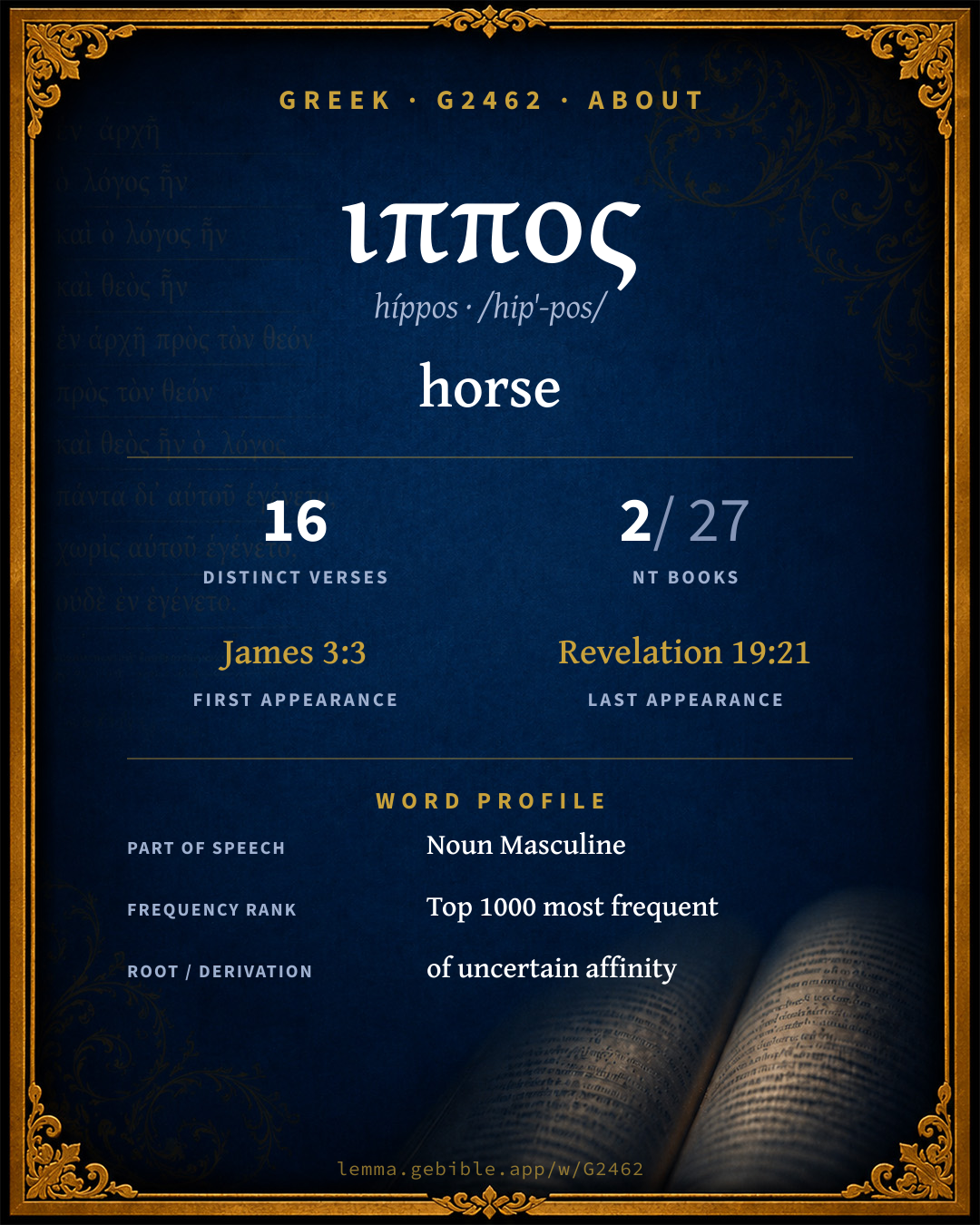
ἵππος
horse
Full lexicon entry — Thayer's Greek Lexicon
From Thayer's Greek Lexicon
Where this word appears
See every Genitive-case word in the Greek New Testament →
Grammar key — what these labels mean
Part of speech
- Noun
- A naming word — a person, place, thing, or idea.
Case
- Genitive
- The case of source, possession, or “of” — answers “whose / from what.”
- Nominative
- The case of the subject (and the predicate nominative).
- Dative
- The case of the indirect object, means, or location — “to / for / with / in.”
- Accusative
- The case of the direct object and of extent.
Gender
- Masculine
- Grammatically masculine.
Number
- Plural
- More than one.
- Singular
- One.
1 verse where G2462 appears in the Accusative case in the Book of Revelation. Filtered view — show all forms. Click any verse to open its interlinear word-by-word view. Verse text shown in the World English Bible for context — . Each verse’s Greek form is shown with its reference; the English is not keyword-highlighted, since the data carries no word-level English alignment. Use “Compare translations” on any verse to read it across multiple English versions. This concordance covers the Greek New Testament; Septuagint (Greek Old Testament) occurrences of this word are not indexed here.
Revelation
About this entry
At a glance — auto-summarized from this page’s data, not written by a person. Every figure links to its source below. This summary describes the numbers; it doesn’t interpret them.
ιππος (híppos) is a Greek noun most often rendered “horse.” It clusters heavily in Revelation, which alone accounts for 94% of its uses. It turns up in 16 verses across 2 books, an uncommon footprint. It first appears in James 3:3. From the same root come ιππευς and ιππικον. The sections below give every sense, occurrence, and version rendering.
Gloss history
Strong's 1890 vs modern scholarship
About this word
Strong's G2462 catalogs a Greek word from the Greek New Testament.
These counts are not copied from any lexicon or concordance. They are computed here, from the morphology-tagged Greek New Testament. What Lemma adds →
- 16
- distinct verses
- The word appears in 16 distinct verses.
- 2 / 27
- NT books
- The word appears in 2 of 27 New Testament books.
- #697
- by frequency
- Top 1000 most frequent Greek words (rank 697 of 5,347 Greek words by occurrence).
View all 16 occurrences in the concordance →
Most concentrated in
- Revelation 15 verses 94%
- James 1 verse 6%
By section of the New Testament
By traditional corpus
Conventional, traditional groupings — biblical authorship is debated, so this is a traditional corpus grouping, not an authorship claim. Some books belong to more than one corpus (Luke is in both the Gospels and the Lukan corpus, and so on), so these shares overlap and need not total 100%. Each figure is a share of the word’s 16 distinct verses.
- Johannine 15 verses · 94%
- Revelation 15 verses · 94%
- General (Catholic) Epistles 1 verse · 6%
How translations render this word
Counts come from each version’s own published word-to-Strong’s tagging or interlinear alignment — an approximate guide to how each version renders this word, not a word-level alignment the data otherwise carries. Because each total is that version’s own tagged count, the per-version totals vary from one another and need not match the appearance or distinct-verse counts above. These counts may also differ from a printed concordance because Lemma counts each distinctly tagged rendering and does not collapse phrase taggings into a single head-word total. This is a fixed set of word-tagged versions (KJV, ASV, BSB, ULT) and does not change with the reading translation you choose elsewhere. Each version’s license is shown beside its name below (and on Sources).
- King James Version: Horse 8×, Horses 7×
- American Standard Version: Horse 7×, Horses 7×
- Berean Standard Bible: Horses 10×, Horse 7×
- unfoldingWord Literal Text: Horses 10×, Horse 7×, A 4×
King James Version Public Domain
Renders G2462 across 16 tagged occurrences — most commonly:
Plus 1 rendering that appears only once — usually multi-word phrases or single function words the recovered tagging swept in, not distinct renderings.
American Standard Version Public Domain
Renders G2462 across 15 tagged occurrences — most commonly:
Plus 1 rendering that appears only once — usually multi-word phrases or single function words the recovered tagging swept in, not distinct renderings.
Berean Standard Bible Public Domain
Renders G2462 across 17 tagged occurrences — most commonly:
unfoldingWord Literal Text CC BY-SA 4.0
Renders G2462 across 21 tagged occurrences — most commonly:
Senses in Thayer's
The 1 sense Thayer's distinguishes for this word, in lexicon order (not ranked by frequency or importance). The full entry — with sub-senses — is in the Lexicon Entry tab.
- a horse
Word origin
Origin: of uncertain affinity
Of uncertain affinity; a horse : - horse.
— Strong’s Exhaustive Concordance (1890), public domain.
Forms in the corpus
The 5 distinct written forms G2462 takes in the Greek New Testament, most frequent first — each parse links to that case’s occurrences in the concordance.
| Form | Parsing | Example | Uses |
|---|---|---|---|
| ἵππων híppōn | Noun, Genitive, Plural, Masculine | James 3:3 | 7 |
| ἵππος híppos | Noun, Nominative, Singular, Masculine | Revelation 6:2 | 5 |
| ἵπποις híppois | Noun, Dative, Plural, Masculine | Revelation 9:7 | 2 |
| ἵππου híppou | Noun, Genitive, Singular, Masculine | Revelation 19:19 | 2 |
| ἵππους híppous | Noun, Accusative, Plural, Masculine | Revelation 9:17 | 1 |
Same root — word family
Other Thayer's entries built from the same root as G2462, grouped by Strong’s listed origin. These share a root / origin per the lexicon — not necessarily a shared meaning. Each links to that word’s own entry.
Derived from this word
Compare all same-root words → They share a root, not necessarily a meaning.
Septuagint usage
The same Greek word ιππος appears 157 times in the Greek Old Testament (Septuagint), across 146 verses in 29 books.
- 157
- LXX occurrences
- Tagged occurrences of this Greek word in the Septuagint.
- 146
- verses
- Distinct Septuagint verses containing this word.
- 29 / 39
- OT books
- The word appears in 29 of the 39 Old Testament books.
Sample Septuagint occurrences
- Genesis 14:11 ἵππος
- Exodus 9:3 ἵππος
- Deuteronomy 11:4 ἵππος
- Joshua 11:4 ἵππος
- Judges 5:22 ἵππος
- 2 Samuel 15:1 ἵππος
- 1 Kings 2:46 ἵππος
- 2 Kings 2:11 ἵππος
- 1 Chronicles 18:4 ἵππος
- 2 Chronicles 1:16 ἵππος
- Ezra 2:66 ἵππος
- Esther 6:8 ἵππος
Septuagint occurrences (same lexeme)
Every verse where the same Strong’s number (G2462) appears in the Greek Septuagint — showing the first 50 of 146. Verse text shown in the World English Bible for context; the Greek form is the matched word — the English is not keyword-highlighted.
- Genesis 14:11 ἵππος They took all the goods of Sodom and Gomorrah, and all their food, and went their way.
- Genesis 14:16 ἵππος He brought back all the goods, and also brought back his relative, Lot, and his goods, and the women also, and the people.
- Genesis 14:21 ἵππος The king of Sodom said to Abram, "Give me the people, and take the goods to yourself."
- Genesis 47:17 ἵππος They brought their cattle to Joseph, and Joseph gave them bread in exchange for the horses, and for the flocks, and for the herds, and for the donkeys: and he fed them with bread in exchange for all their cattle for that year.
- Genesis 49:17 ἵππος Dan will be a serpent in the way, An adder in the path, That bites the horse's heels, So that his rider falls backward.
- Exodus 9:3 ἵππος behold, the hand of Yahweh is on your cattle which are in the field, on the horses, on the donkeys, on the camels, on the herds, and on the flocks with a very grievous pestilence.
- Exodus 14:7 ἵππος and he took six hundred chosen chariots, and all the chariots of Egypt, and captains over all of them.
- Exodus 14:9 ἵππος The Egyptians pursued after them: all the horses and chariots of Pharaoh, his horsemen, and his army; and overtook them encamping by the sea, beside Pihahiroth, before Baal Zephon.
- Exodus 14:17 ἵππος I, behold, I will harden the hearts of the Egyptians, and they shall go in after them: and I will get myself honor over Pharaoh, and over all his host, over his chariots, and over his horsemen.
- Exodus 14:18 ἵππος The Egyptians shall know that I am Yahweh, when I have gotten myself honor over Pharaoh, over his chariots, and over his horsemen."
- Exodus 14:23 ἵππος The Egyptians pursued, and went in after them into the midst of the sea: all of Pharaoh's horses, his chariots, and his horsemen.
- Exodus 15:1 ἵππος Then Moses and the children of Israel sang this song to Yahweh, and said, "I will sing to Yahweh, for he has triumphed gloriously: The horse and his rider he has thrown into the sea.
- Exodus 15:19 ἵππος For the horses of Pharaoh went in with his chariots and with his horsemen into the sea, and Yahweh brought back the waters of the sea on them; but the children of Israel walked on dry land in the midst of the sea.
- Exodus 15:21 ἵππος Miriam answered them, "Sing to Yahweh, for he has triumphed gloriously: The horse and his rider he has thrown into the sea."
- Deuteronomy 11:4 ἵππος and what he did to the army of Egypt, to their horses, and to their chariots; how he made the water of the Red Sea to overflow them as they pursued after you, and how Yahweh has destroyed them to this day;
- Deuteronomy 17:16 ἵππος Only he shall not multiply horses to himself, nor cause the people to return to Egypt, to the end that he may multiply horses; because Yahweh has said to you, You shall henceforth return no more that way.
- Deuteronomy 20:1 ἵππος When you go forth to battle against your enemies, and see horses, and chariots, [and] a people more than you, you shall not be afraid of them; for Yahweh your God is with you, who brought you up out of the land of Egypt.
- Joshua 11:4 ἵππος They went out, they and all their hosts with them, much people, even as the sand that is on the sea-shore in multitude, with horses and chariots very many.
- Joshua 11:6 ἵππος Yahweh said to Joshua, Don't be afraid because of them; for tomorrow at this time will I deliver them up all slain before Israel: you shall hamstring their horses, and burn their chariots with fire.
- Joshua 11:9 ἵππος Joshua did to them as Yahweh bade him: he hamstrung their horses, and burnt their chariots with fire.
- Joshua 17:16 ἵππος The children of Joseph said, The hill-country is not enough for us: and all the Canaanites who dwell in the land of the valley have chariots of iron, both they who are in Beth-shean and its towns, and they who are in the valley of Jezreel.
- Joshua 17:18 ἵππος but the hill-country shall be yours; for though it is a forest, you shall cut it down, and the goings out of it shall be yours; for you shall drive out the Canaanites, though they have chariots of iron, and though they are strong.
- Joshua 24:6 ἵππος I brought your fathers out of Egypt: and you came to the sea; and the Egyptians pursued after your fathers with chariots and with horsemen to the Red Sea.
- Judges 5:22 ἵππος Then did the horse hoofs stamp By reason of the prancings, the prancings of their strong ones.
- 2 Samuel 15:1 ἵππος It happened after this, that Absalom prepared him a chariot and horses, and fifty men to run before him.
- 1 Kings 2:46 ἵππος So the king commanded Benaiah the son of Jehoiada; and he went out, and fell on him, so that he died. The kingdom was established in the hand of Solomon.
- 1 Kings 5:1 ἵππος Hiram king of Tyre sent his servants to Solomon; for he had heard that they had anointed him king in the room of his father: for Hiram was ever a lover of David.
- 1 Kings 10:25 ἵππος They brought every man his tribute, vessels of silver, and vessels of gold, and clothing, and armor, and spices, horses, and mules, a rate year by year.
- 1 Kings 10:26 ἵππος Solomon gathered together chariots and horsemen: and he had a thousand and four hundred chariots, and twelve thousand horsemen, that he bestowed in the chariot cities, and with the king at Jerusalem.
- 1 Kings 10:28 ἵππος The horses which Solomon had were brought out of Egypt; and the king's merchants received them in droves, each drove at a price.
- 1 Kings 10:29 ἵππος A chariot came up and went out of Egypt for six hundred [shekels] of silver, and a horse for one hundred fifty; and so for all the kings of the Hittites, and for the kings of Syria, did they bring them out by their means.
- 1 Kings 12:24 ἵππος Thus says Yahweh, You shall not go up, nor fight against your brothers the children of Israel: return every man to his house; for this thing is of me. So they listened to the word of Yahweh, and returned and went their way, according to the word of Yahweh.
- 1 Kings 16:9 ἵππος His servant Zimri, captain of half his chariots, conspired against him. Now he was in Tirzah, drinking himself drunk in the house of Arza, who was over the household in Tirzah:
- 1 Kings 18:5 ἵππος Ahab said to Obadiah, Go through the land, to all the springs of water, and to all the brooks: peradventure we may find grass and save the horses and mules alive, that we not lose all the animals.
- 1 Kings 21:1 ἵππος It happened after these things, that Naboth the Jezreelite had a vineyard, which was in Jezreel, hard by the palace of Ahab king of Samaria.
- 1 Kings 21:20 ἵππος Ahab said to Elijah, Have you found me, my enemy? He answered, I have found you, because you have sold yourself to do that which is evil in the sight of Yahweh.
- 1 Kings 21:21 ἵππος Behold, I will bring evil on you, and will utterly sweep you away and will cut off from Ahab every man-child, and him who is shut up and him who is left at large in Israel:
- 1 Kings 21:25 ἵππος (But there was none like Ahab, who did sell himself to do that which was evil in the sight of Yahweh, whom Jezebel his wife stirred up.
- 1 Kings 22:4 ἵππος He said to Jehoshaphat, Will you go with me to battle to Ramoth-gilead? Jehoshaphat said to the king of Israel, I am as you are, my people as your people, my horses as your horses.
- 2 Kings 2:11 ἵππος It happened, as they still went on, and talked, that behold, [there appeared] a chariot of fire, and horses of fire, which parted them both apart; and Elijah went up by a whirlwind into heaven.
- 2 Kings 3:7 ἵππος He went and sent to Jehoshaphat the king of Judah, saying, The king of Moab has rebelled against me: will you go with me against Moab to battle? He said, I will go up: I am as you are, my people as your people, my horses as your horses.
- 2 Kings 5:9 ἵππος So Naaman came with his horses and with his chariots, and stood at the door of the house of Elisha.
- 2 Kings 6:14 ἵππος Therefore sent he there horses, and chariots, and a great host: and they came by night, and surrounded the city.
- 2 Kings 6:15 ἵππος When the servant of the man of God was risen early, and gone forth, behold, a host with horses and chariots was round about the city. His servant said to him, Alas, my master! how shall we do?
- 2 Kings 6:17 ἵππος Elisha prayed, and said, Yahweh, Please open his eyes, that he may see. Yahweh opened the eyes of the young man; and he saw: and, behold, the mountain was full of horses and chariots of fire round about Elisha.
- 2 Kings 7:6 ἵππος For the Lord had made the host of the Syrians to hear a noise of chariots, and a noise of horses, even the noise of a great host: and they said one to another, Behold, the king of Israel has hired against us the kings of the Hittites, and the kings of the Egyptians, to come on us.
- 2 Kings 7:7 ἵππος Therefore they arose and fled in the twilight, and left their tents, and their horses, and their donkeys, even the camp as it was, and fled for their life.
- 2 Kings 7:10 ἵππος So they came and called to the porter of the city; and they told them, saying, We came to the camp of the Syrians, and, behold, there was no man there, neither voice of man, but the horses tied, and the donkeys tied, and the tents as they were.
- 2 Kings 7:13 ἵππος One of his servants answered, Please let some take five of the horses that remain, which are left in the city (behold, they are as all the multitude of Israel who are left in it; behold, they are as all the multitude of Israel who are consumed); and let us send and see.
- 2 Kings 7:14 ἵππος They took therefore two chariots with horses; and the king sent after the host of the Syrians, saying, Go and see.
These are occurrences of the same Greek lexeme (G2462) in the Septuagint — not a translation of any one Hebrew word. The store carries no word-level Hebrew↔Greek alignment, so no Hebrew original is asserted here. Counts come from the recovered LXX Strong's tagging — high-frequency vocabulary is well covered, while rare or late forms may be untagged — so they reflect tagged occurrences and may slightly undercount.