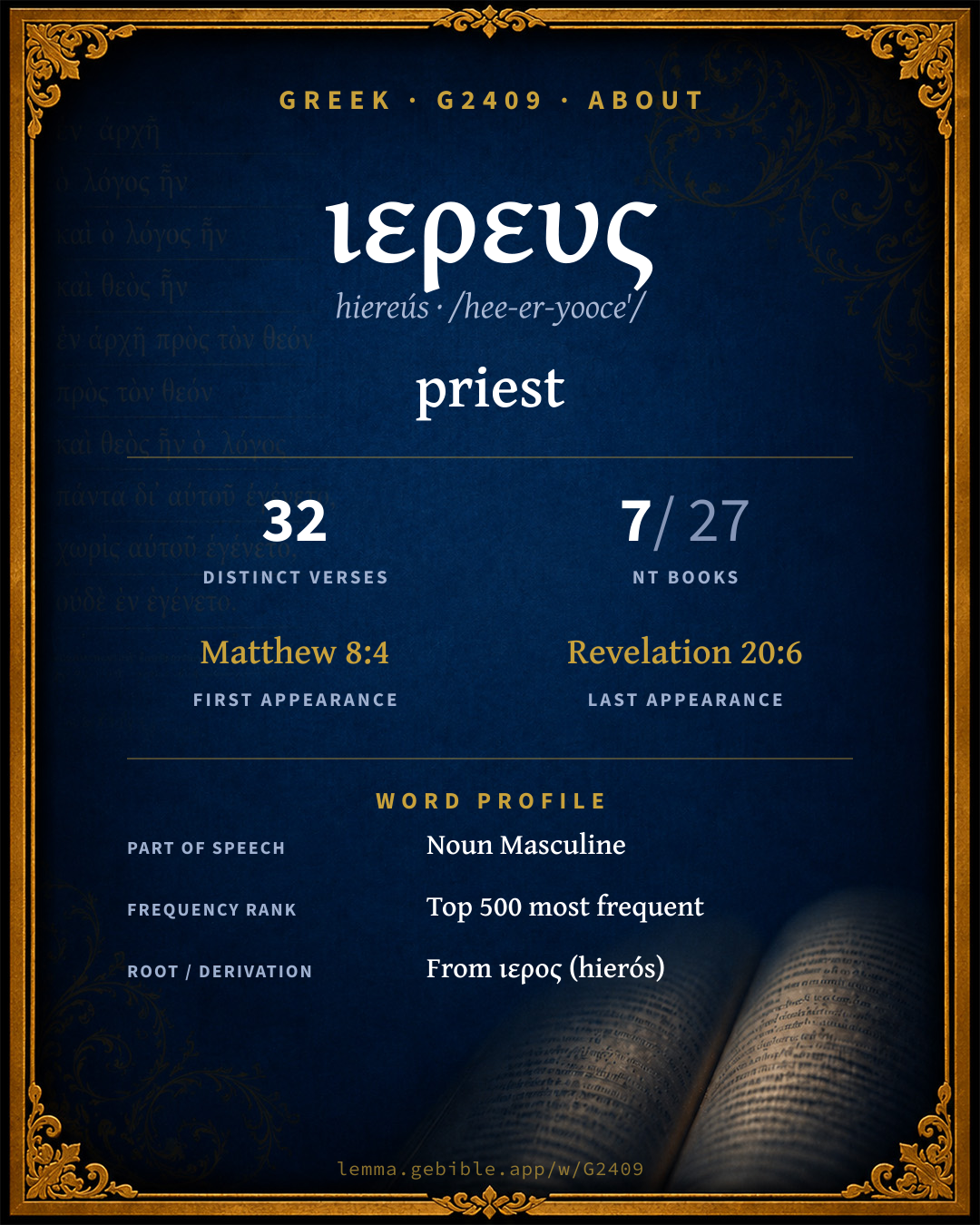
ἱερεύς
priest
‘priest’ is one of 2 main senses fuller range ↓
Full lexicon entry — Thayer's Greek Lexicon
From Thayer's Greek Lexicon
Where this word appears
See every Nominative-case word in the Greek New Testament →
Grammar key — what these labels mean
Part of speech
- Noun
- A naming word — a person, place, thing, or idea.
Case
- Nominative
- The case of the subject (and the predicate nominative).
- Accusative
- The case of the direct object and of extent.
- Dative
- The case of the indirect object, means, or location — “to / for / with / in.”
- Genitive
- The case of source, possession, or “of” — answers “whose / from what.”
Gender
- Masculine
- Grammatically masculine.
Number
- Singular
- One.
- Plural
- More than one.
2 verses where G2409 appears in the Dative case in the Book of Luke. Filtered view — show all forms. Click any verse to open its interlinear word-by-word view. Verse text shown in the World English Bible for context — . Each verse’s Greek form is shown with its reference; the English is not keyword-highlighted, since the data carries no word-level English alignment. Use “Compare translations” on any verse to read it across multiple English versions. This concordance covers the Greek New Testament; Septuagint (Greek Old Testament) occurrences of this word are not indexed here.
Luke
- Luke 5:14 ἱερεῖ n dat sg masc He charged him to tell no one, "But go your way, and show yourself to the priest, and offer for your cleansing according to what Moses commanded, for a testimony to them."
- Luke 17:14 ἱερεῦσιν n dat pl masc When he saw them, he said to them, "Go and show yourselves to the priests." It happened that as they went, they were cleansed.
About this entry
At a glance — auto-summarized from this page’s data, not written by a person. Every figure links to its source below. This summary describes the numbers; it doesn’t interpret them.
The Greek noun ιερευς centers on the idea of “priest.” Its earliest occurrence is Matthew 8:4. The Greek New Testament uses it across 32 verses — moderately common. Hebrews dominates its distribution — 14 of 32 verses. Thayer's distinguishes 2 senses for it. Dig into 32-verse concordance and the renderings breakdown below.
Gloss history
Strong's 1890 vs modern scholarship
About this word
Strong's G2409 catalogs a Greek word from the Greek New Testament.
These counts are not copied from any lexicon or concordance. They are computed here, from the morphology-tagged Greek New Testament. What Lemma adds →
- 32
- distinct verses
- The word appears in 32 distinct verses.
- 7 / 27
- NT books
- The word appears in 7 of 27 New Testament books.
- #438
- by frequency
- Top 500 most frequent Greek words (rank 438 of 5,347 Greek words by occurrence).
View all 32 occurrences in the concordance →
By section of the New Testament
By traditional corpus
Conventional, traditional groupings — biblical authorship is debated, so this is a traditional corpus grouping, not an authorship claim. Some books belong to more than one corpus (Luke is in both the Gospels and the Lukan corpus, and so on), so these shares overlap and need not total 100%. Each figure is a share of the word’s 32 distinct verses.
- Hebrews 14 verses · 44%
- Gospels 12 verses · 38%
- Lukan (Luke–Acts) 9 verses · 28%
- Johannine 4 verses · 13%
- Revelation 3 verses · 9%
How translations render this word
Counts come from each version’s own published word-to-Strong’s tagging or interlinear alignment — an approximate guide to how each version renders this word, not a word-level alignment the data otherwise carries. Because each total is that version’s own tagged count, the per-version totals vary from one another and need not match the appearance or distinct-verse counts above. These counts may also differ from a printed concordance because Lemma counts each distinctly tagged rendering and does not collapse phrase taggings into a single head-word total. This is a fixed set of word-tagged versions (KJV, ASV, BSB, ULT) and does not change with the reading translation you choose elsewhere. Each version’s license is shown beside its name below (and on Sources).
- King James Version: Priests 15×, Priest 13×, Art a priest 3×
- American Standard Version: Priest 12×, Priests 12×, Thou art a priest 3×
- Berean Standard Bible: Priest 16×, Priests 15×
- unfoldingWord Literal Text: Priest 16×, Priests 16×, A 3×
King James Version Public Domain
Renders G2409 across 32 tagged occurrences — most commonly:
Plus 1 rendering that appears only once — usually multi-word phrases or single function words the recovered tagging swept in, not distinct renderings.
American Standard Version Public Domain
Renders G2409 across 31 tagged occurrences — most commonly:
Plus 4 renderings that appear only once — usually multi-word phrases or single function words the recovered tagging swept in, not distinct renderings.
Berean Standard Bible Public Domain
Renders G2409 across 31 tagged occurrences — most commonly:
unfoldingWord Literal Text CC BY-SA 4.0
Renders G2409 across 35 tagged occurrences — most commonly:
Senses in Thayer's
The 2 senses Thayer's distinguishes for this word, in lexicon order (not ranked by frequency or importance). The full entry — with sub-senses — is in the Lexicon Entry tab.
- a priest, one who offers sacrifices and in general in busied with sacred rites
- metaph. of Christians…
Word origin
Derived from ιερος (hierós) (G2413) — sacred.
From G2413 ; a priest (literally or figuratively): - (high) priest.
— Strong’s Exhaustive Concordance (1890), public domain.
Forms in the corpus
The 7 distinct written forms G2409 takes in the Greek New Testament, most frequent first — each parse links to that case’s occurrences in the concordance.
| Form | Parsing | Example | Uses |
|---|---|---|---|
| ἱερεῖς hiereîs | Noun, Nominative, Plural, Masculine | Matthew 12:5 | 12 |
| ἱερεὺς hiereùs | Noun, Nominative, Singular, Masculine | Acts 14:13 | 8 |
| ἱερεύς hiereús | Noun, Nominative, Singular, Masculine | Luke 1:5 | 3 |
| ἱερεῖ hiereî | Noun, Dative, Singular, Masculine | Matthew 8:4 | 3 |
| ἱερέα hieréa | Noun, Accusative, Singular, Masculine | Hebrews 7:11 | 2 |
| ἱερέων hieréōn | Noun, Genitive, Plural, Masculine | Acts 6:7 | 2 |
| ἱερεῦσιν hiereûsin | Noun, Dative, Plural, Masculine | Matthew 12:4 | 2 |
Same root — word family
Other Thayer's entries built from the same root as G2409, grouped by Strong’s listed origin. These share a root / origin per the lexicon — not necessarily a shared meaning. Each links to that word’s own entry.
Derives from
Shares the same root
Derived from this word
Proper names from this root
People and places named from this root — a name, not an additional meaning of the word.
Compare all same-root words → Showing 4 of 7 — not the complete family. 1 of the same-root words is a proper name (a person or place). They share a root, not necessarily a meaning.
Septuagint usage
The same Greek word ιερευς appears 763 times in the Greek Old Testament (Septuagint), across 657 verses in 29 books.
- 763
- LXX occurrences
- Tagged occurrences of this Greek word in the Septuagint.
- 657
- verses
- Distinct Septuagint verses containing this word.
- 29 / 39
- OT books
- The word appears in 29 of the 39 Old Testament books.
Sample Septuagint occurrences
- Genesis 14:18 ἱερεύς
- Exodus 2:16 ἱερεύς
- Leviticus 1:5 ἱερεύς
- Numbers 3:3 ἱερεύς
- Deuteronomy 17:9 ἱερεύς
- Joshua 3:3 ἱερεύς
- Judges 17:5 ἱερεύς
- 1 Samuel 1:3 ἱερεύς
- 2 Samuel 8:17 ἱερεύς
- 1 Kings 1:7 ἱερεύς
- 2 Kings 10:11 ἱερεύς
- 1 Chronicles 9:2 ἱερεύς
Septuagint occurrences (same lexeme)
Every verse where the same Strong’s number (G2409) appears in the Greek Septuagint — showing the first 50 of 657. Verse text shown in the World English Bible for context; the Greek form is the matched word — the English is not keyword-highlighted.
- Genesis 14:18 ἱερεύς Melchizedek king of Salem brought forth bread and wine: and he was priest of God Most High.
- Genesis 41:45 ἱερεύς Pharaoh called Joseph's name Zaphenath-paneah; and he gave him Asenath, the daughter of Potiphera priest of On as a wife. Joseph went out over the land of Egypt.
- Genesis 41:50 ἱερεύς To Joseph were born two sons before the year of famine came, whom Asenath, the daughter of Potiphera priest of On, bore to him.
- Genesis 46:20 ἱερεύς To Joseph in the land of Egypt were born Manasseh and Ephraim, whom Asenath, the daughter of Potiphera, priest of On, bore to him.
- Genesis 47:22 ἱερεύς Only he didn't buy the land of the priests, for the priests had a portion from Pharaoh, and ate their portion which Pharaoh gave them. That is why they didn't sell their land.
- Genesis 47:26 ἱερεύς Joseph made it a statute concerning the land of Egypt to this day, that Pharaoh should have the fifth. Only the land of the priests alone didn't become Pharaoh's.
- Exodus 2:16 ἱερεύς Now the priest of Midian had seven daughters. They came and drew water, and filled the troughs to water their father's flock.
- Exodus 3:1 ἱερεύς Now Moses was keeping the flock of Jethro, his father-in-law, the priest of Midian, and he led the flock to the back of the wilderness, and came to God's mountain, to Horeb.
- Exodus 18:1 ἱερεύς Now Jethro, the priest of Midian, Moses' father-in-law, heard of all that God had done for Moses, and for Israel his people, how that Yahweh had brought Israel out of Egypt.
- Exodus 19:22 ἱερεύς Let the priests also, who come near to Yahweh, sanctify themselves, lest Yahweh break forth on them."
- Exodus 19:24 ἱερεύς Yahweh said to him, "Go down and you shall bring Aaron up with you, but don't let the priests and the people break through to come up to Yahweh, lest he break forth on them."
- Exodus 29:30 ἱερεύς Seven days shall the son who is priest in his place put them on, when he comes into the tent of meeting to minister in the holy place.
- Exodus 35:19 ἱερεύς the finely worked garments, for ministering in the holy place, the holy garments for Aaron the priest, and the garments of his sons, to minister in the priest's office.'"
- Exodus 36:8 ἱερεύς All the wise-hearted men among those who did the work made the tent with ten curtains; of fine twined linen, blue, purple, and scarlet, with cherubim, the work of the skillful workman, they made them.
- Exodus 37:19 ἱερεύς three cups made like almond-blossoms in one branch, a bud and a flower, and three cups made like almond-blossoms in the other branch, a bud and a flower: so for the six branches going out of the lampstand.
- Leviticus 1:5 ἱερεύς He shall kill the bull before Yahweh. Aaron's sons, the priests, shall present the blood and sprinkle the blood around on the altar that is at the door of the Tent of Meeting.
- Leviticus 1:7 ἱερεύς The sons of Aaron the priest shall put fire on the altar, and lay wood in order on the fire;
- Leviticus 1:8 ἱερεύς and Aaron's sons, the priests, shall lay the pieces, the head, and the fat in order on the wood that is on the fire which is on the altar;
- Leviticus 1:9 ἱερεύς but its innards and its legs he shall wash with water. The priest shall burn the whole on the altar, for a burnt offering, an offering made by fire, of a sweet savor to Yahweh.
- Leviticus 1:11 ἱερεύς He shall kill it on the north side of the altar before Yahweh. Aaron's sons, the priests, shall sprinkle its blood around on the altar.
- Leviticus 1:12 ἱερεύς He shall cut it into its pieces, with its head and its fat. The priest shall lay them in order on the wood that is on the fire which is on the altar,
- Leviticus 1:13 ἱερεύς but the innards and the legs he shall wash with water. The priest shall offer the whole, and burn it on the altar. It is a burnt offering, an offering made by fire, of a sweet savor to Yahweh.
- Leviticus 1:15 ἱερεύς The priest shall bring it to the altar, and wring off its head, and burn it on the altar; and its blood shall be drained out on the side of the altar;
- Leviticus 1:17 ἱερεύς He shall tear it by its wings, but shall not divide it apart. The priest shall burn it on the altar, on the wood that is on the fire. It is a burnt offering, an offering made by fire, of a sweet savor to Yahweh.
- Leviticus 2:2 ἱερεύς He shall bring it to Aaron's sons the priests; and he shall take his handful of its fine flour, and of its oil, with all its frankincense; and the priest shall burn the memorial of it on the altar, an offering made by fire, of a sweet savor to Yahweh.
- Leviticus 2:8 ἱερεύς You shall bring the meal offering that is made of these things to Yahweh: and it shall be presented to the priest, and he shall bring it to the altar.
- Leviticus 2:9 ἱερεύς The priest shall take from the meal offering its memorial, and shall burn it on the altar, an offering made by fire, of a sweet savor to Yahweh.
- Leviticus 2:16 ἱερεύς The priest shall burn as its memorial, part of its bruised grain, and part of its oil, along with all its frankincense: it is an offering made by fire to Yahweh.
- Leviticus 3:2 ἱερεύς He shall lay his hand on the head of his offering, and kill it at the door of the tent of meeting: and Aaron's sons the priests shall sprinkle the blood on the altar round about.
- Leviticus 3:5 ἱερεύς Aaron's sons shall burn it on the altar on the burnt offering, which is on the wood that is on the fire: it is an offering made by fire, of a sweet savor to Yahweh.
- Leviticus 3:8 ἱερεύς and he shall lay his hand on the head of his offering, and kill it before the tent of meeting: and Aaron's sons shall sprinkle its blood on the altar round about.
- Leviticus 3:11 ἱερεύς The priest shall burn it on the altar: it is the food of the offering made by fire to Yahweh.
- Leviticus 3:13 ἱερεύς and he shall lay his hand on its head, and kill it before the tent of meeting; and the sons of Aaron shall sprinkle its blood on the altar round about.
- Leviticus 3:16 ἱερεύς The priest shall burn them on the altar: it is the food of the offering made by fire, for a sweet savor; all the fat is Yahweh's.
- Leviticus 4:5 ἱερεύς The anointed priest shall take some of the blood of the bull, and bring it to the Tent of Meeting.
- Leviticus 4:6 ἱερεύς The priest shall dip his finger in the blood, and sprinkle some of the blood seven times before Yahweh, before the veil of the sanctuary.
- Leviticus 4:7 ἱερεύς The priest shall put some of the blood on the horns of the altar of sweet incense before Yahweh, which is in the tent of meeting; and he shall pour out all the blood of the bull out at the base of the altar of burnt offering, which is at the door of the Tent of Meeting.
- Leviticus 4:10 ἱερεύς as it is taken off of the ox of the sacrifice of peace offerings. The priest shall burn them on the altar of burnt offering.
- Leviticus 4:16 ἱερεύς The anointed priest shall bring of the blood of the bull to the Tent of Meeting:
- Leviticus 4:17 ἱερεύς and the priest shall dip his finger in the blood, and sprinkle it seven times before Yahweh, before the veil.
- Leviticus 4:18 ἱερεύς He shall put some of the blood on the horns of the altar which is before Yahweh, that is in the Tent of Meeting; and the rest of the blood he shall pour out at the base of the altar of burnt offering, which is at the door of the Tent of Meeting.
- Leviticus 4:20 ἱερεύς Thus shall he do with the bull; as he did with the bull of the sin offering, so shall he do with this; and the priest shall make atonement for them, and they shall be forgiven.
- Leviticus 4:25 ἱερεύς The priest shall take some of the blood of the sin offering with his finger, and put it on the horns of the altar of burnt offering. He shall pour out the rest of its blood at the base of the altar of burnt offering.
- Leviticus 4:26 ἱερεύς All its fat he shall burn on the altar, like the fat of the sacrifice of peace offerings; and the priest shall make atonement for him concerning his sin, and he will be forgiven.
- Leviticus 4:30 ἱερεύς The priest shall take some of its blood with his finger, and put it on the horns of the altar of burnt offering; and the rest of its blood he shall pour out at the base of the altar.
- Leviticus 4:31 ἱερεύς All its fat he shall take away, like the fat is taken away from off of the sacrifice of peace offerings; and the priest shall burn it on the altar for a sweet savor to Yahweh; and the priest shall make atonement for him, and he will be forgiven.
- Leviticus 4:34 ἱερεύς The priest shall take some of the blood of the sin offering with his finger, and put it on the horns of the altar of burnt offering; and all the rest of its blood he shall pour out at the base of the altar.
- Leviticus 4:35 ἱερεύς All its fat he shall take away, like the fat of the lamb is taken away from the sacrifice of peace offerings; and the priest shall burn them on the altar, on the offerings of Yahweh made by fire; and the priest shall make atonement for him concerning his sin that he has sinned, and he will be forgiven.
- Leviticus 5:6 ἱερεύς and he shall bring his trespass offering to Yahweh for his sin which he has sinned, a female from the flock, a lamb or a goat, for a sin offering; and the priest shall make atonement for him concerning his sin.
- Leviticus 5:8 ἱερεύς He shall bring them to the priest, who shall first offer the one which is for the sin offering, and wring off its head from its neck, but shall not sever it completely.
These are occurrences of the same Greek lexeme (G2409) in the Septuagint — not a translation of any one Hebrew word. The store carries no word-level Hebrew↔Greek alignment, so no Hebrew original is asserted here. Counts come from the recovered LXX Strong's tagging — high-frequency vocabulary is well covered, while rare or late forms may be untagged — so they reflect tagged occurrences and may slightly undercount.