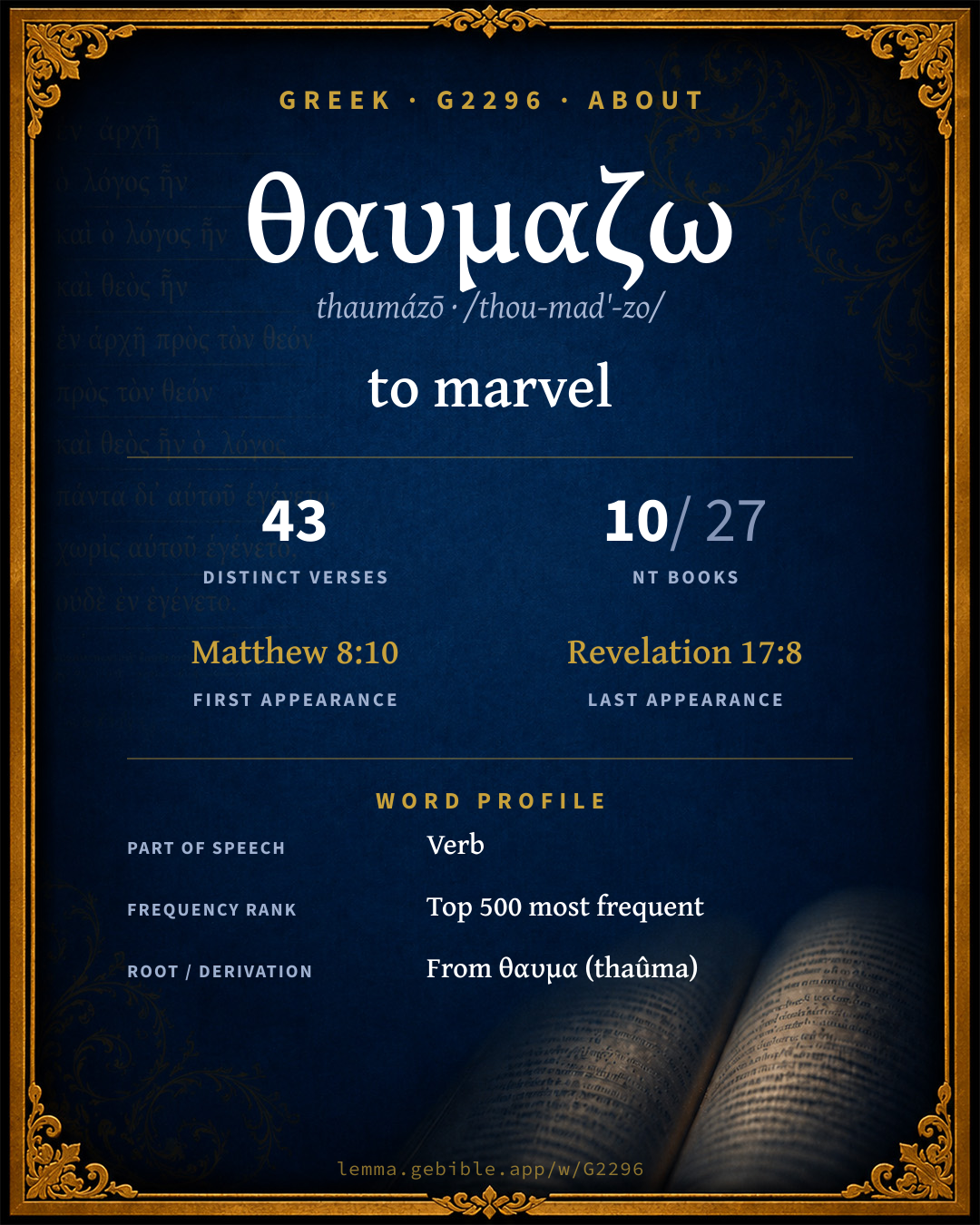
θαυμάζω
to marvel
‘to marvel’ is one of 2 main senses fuller range ↓
Full lexicon entry — Thayer's Greek Lexicon
From Thayer's Greek Lexicon
Where this word appears
See every Aorist-tense verb in the Greek New Testament →
Grammar key — what these labels mean
Part of speech
- Verb
- An action or state-of-being word.
Tense
- Aorist
- Action viewed as a simple whole, without regard to duration — often past (perfective aspect).
- Imperfect
- Continuous or repeated action in past time (“was writing”).
- Present
- Ongoing or general action in present time (imperfective aspect).
- Future
- Action expected in future time.
Voice
- Active
- The subject performs the action.
- Passive
- The subject receives the action.
- Middle
- The subject acts on or for itself, or with special interest in the action.
Mood
- Indicative
- States a fact or asks a factual question (the mood of reality).
- Imperative
- Expresses a command or request.
- Infinitive
- A verbal noun (“to write”), unmarked for person or number.
- Participle
- A verbal adjective (“writing,” “having written”).
- Subjunctive
- Expresses probability, purpose, or possibility (the mood of contingency).
Case
- Genitive
- The case of source, possession, or “of” — answers “whose / from what.”
- Nominative
- The case of the subject (and the predicate nominative).
Person
- 3rd person
- The one spoken about (“he / she / it / they”).
- 2nd person
- The one addressed (“you”).
- 1st person
- The speaker (“I / we”).
Gender
- Masculine
- Grammatically masculine.
Number
- Plural
- More than one.
- Singular
- One.
Grammatical forms 17 distinct
- Verb, Aorist, Active, Indicative, 3rd person, Plural 8 times (19%)
- Verb, Imperfect, Active, Indicative, 3rd person, Plural 8 times (19%)
- Verb, Aorist, Active, Indicative, 3rd person, Singular 7 times (16%)
- Verb, Present, Active, Indicative, 2nd person, Plural 3 times (7%)
- Verb, Present, Active, Imperative, 2nd person, Plural 2 times (5%)
- Verb, Present, Active, Infinitive 2 times (5%)
- Verb, Present, Active, Participle, Genitive, Plural, Masculine 2 times (5%)
- Verb, Present, Active, Participle, Nominative, Plural, Masculine 2 times (5%)
+9 more forms (9 occurrences)
Parsed forms decoded from the imported morphology (Robinson–Tischendorf, public domain), counted across 43 parsed occurrences — not distinct verses.
Every verse where G2296 appears — 43 distinct verses across 10 books. Click any verse to open its interlinear word-by-word view. Verse text shown in the World English Bible for context — . Each verse’s Greek form is shown with its reference; the English is not keyword-highlighted, since the data carries no word-level English alignment. Use “Compare translations” on any verse to read it across multiple English versions. This concordance covers the Greek New Testament; Septuagint (Greek Old Testament) occurrences of this word are not indexed here.
Matthew 7 verses
- Matthew 8:10 ἐθαύμασεν aor act ind 3sg When Jesus heard it, he marveled, and said to those who followed, "Most assuredly I tell you, I haven't found so great a faith, not even in Israel.
- Matthew 8:27 ἐθαύμασαν aor act ind 3pl The men marveled, saying, "What kind of man is this, that even the wind and the sea obey him?"
- Matthew 9:33 ἐθαύμασαν aor act ind 3pl When the demon was cast out, the mute man spoke. The multitudes marveled, saying, "Nothing like this has ever been seen in Israel!"
- Matthew 15:31 θαυμάσαι aor act inf so that the multitude wondered when they saw the mute speaking, injured whole, lame walking, and blind seeing--and they glorified the God of Israel.
- Matthew 21:20 ἐθαύμασαν aor act ind 3pl When the disciples saw it, they marveled, saying, "How did the fig tree immediately wither away?"
- Matthew 22:22 ἐθαύμασαν aor act ind 3pl When they heard it, they marveled, and left him, and went away.
- Matthew 27:14 θαυμάζειν pres act inf He gave him no answer, not even one word, so that the governor marveled greatly.
Mark 5 verses
- Mark 5:20 ἐθαύμαζον impf act ind 3pl He went his way, and began to proclaim in Decapolis how Jesus had done great things for him, and everyone marveled.
- Mark 6:6 ἐθαύμασεν aor act ind 3sg He marveled because of their unbelief. He went around the villages teaching.
- Mark 12:17 ἐξεθαύμαζον impf act ind 3pl Jesus answered them, "Render to Caesar the things that are Caesar's, and to God the things that are God's." They marveled greatly at him.
- Mark 15:5 θαυμάζειν pres act inf But Jesus made no further answer, so that Pilate marveled.
- Mark 15:44 ἐθαύμαζεν aor act ind 3sg Pilate marveled if he were already dead; and summoning the centurion, he asked him whether he had been dead long.
Luke 12 verses
- Luke 1:21 ἐθαύμαζον impf act ind 3pl The people were waiting for Zacharias, and they marveled that he delayed in the temple.
- Luke 1:63 ἐθαύμασαν aor act ind 3pl He asked for a writing tablet, and wrote, "His name is John." They all marveled.
- Luke 2:18 ἐθαύμασαν aor act ind 3pl All who heard it wondered at the things which were spoken to them by the shepherds.
- Luke 2:33 θαυμάζοντες pres act ptcp nom pl masc Joseph and his mother were marveling at the things which were spoken concerning him,
- Luke 4:22 ἐθαύμαζον impf act ind 3pl All testified about him, and wondered at the gracious words which proceeded out of his mouth, and they said, "Isn't this Joseph's son?"
- Luke 7:9 ἐθαύμασεν aor act ind 3sg When Jesus heard these things, he marveled at him, and turned and said to the multitude who followed him, "I tell you, I have not found such great faith, no, not in Israel."
- Luke 8:25 ἐθαύμασαν aor act ind 3pl He said to them, "Where is your faith?" Being afraid they marveled, saying one to another, "Who is this, then, that he commands even the winds and the water, and they obey him?"
- Luke 9:43 θαυμαζόντων pres act ptcp gen pl masc They were all astonished at the majesty of God. But while all were marveling at all the things which Jesus did, he said to his disciples,
- Luke 11:14 ἐθαύμασαν aor act ind 3pl He was casting out a demon, and it was mute. It happened, when the demon had gone out, the mute man spoke; and the multitudes marveled.
- Luke 11:38 ἐθαύμασεν aor act ind 3sg When the Pharisee saw it, he marveled that he had not first washed himself before dinner.
- Luke 20:26 θαυμάσαντες aor act ptcp nom pl masc They weren't able to trap him in his words before the people. They marveled at his answer, and were silent.
- Luke 24:41 θαυμαζόντων pres act ptcp gen pl masc While they still didn't believe for joy, and wondered, he said to them, "Do you have anything here to eat?"
John 6 verses
- John 3:7 θαυμάσῃς aor act subj 2sg Don't marvel that I said to you, 'You must be born anew.'
- John 4:27 ἐθαύμαζον impf act ind 3pl At this, his disciples came. They marveled that he was speaking with a woman; yet no one said, "What are you looking for?" or, "Why do you speak with her?"
- John 5:20 θαυμάζετε pres act ind 2pl For the Father has affection for the Son, and shows him all things that he himself does. He will show him greater works than these, that you may marvel.
- John 5:28 θαυμάζετε pres act impv 2pl Don't marvel at this, for the hour comes, in which all that are in the tombs will hear his voice,
- John 7:15 ἐθαύμαζον impf act ind 3pl The Jews therefore marveled, saying, "How does this man know letters, having never been educated?"
- John 7:21 θαυμάζετε pres act ind 2pl Jesus answered them, "I did one work, and you all marvel because of it.
Acts 5 verses
- Acts 2:7 ἐθαύμαζον impf act ind 3pl They were all amazed and marveled, saying to one another, "Behold, aren't all these who speak Galileans?
- Acts 3:12 θαυμάζετε pres act ind 2pl When Peter saw it, he responded to the people, "You men of Israel, why do you marvel at this man? Why do you fasten your eyes on us, as though by our own power or godliness we had made him walk?
- Acts 4:13 ἐθαύμαζον impf act ind 3pl Now when they saw the boldness of Peter and John, and had perceived that they were unlearned and ignorant men, they marveled. They recognized that they had been with Jesus.
- Acts 7:31 ἐθαύμαζεν aor act ind 3sg When Moses saw it, he wondered at the sight. As he came close to see, a voice of the Lord came to him,
- Acts 13:41 θαυμάσατε aor act impv 2pl 'Behold, you scoffers, and wonder, and perish; For I work a work in your days, A work which you will in no way believe, if one declares it to you.'"
Galatians 1 verse
2 Thessalonians 1 verse
1 John 1 verse
Jude 1 verse
Revelation 4 verses
- Revelation 13:3 ἐθαύμασεν aor act ind 3sg One of his heads looked like it had been wounded fatally. His fatal wound was healed, and the whole earth marveled at the beast.
- Revelation 17:6 ἐθαύμασα aor act ind 1sg I saw the woman drunken with the blood of the saints, and with the blood of the martyrs of Jesus. When I saw her, I wondered with great amazement.
- Revelation 17:7 ἐθαύμασας aor act ind 2sg The angel said to me, "Why do you wonder? I will tell you the mystery of the woman, and of the beast that carries her, which has the seven heads and the ten horns.
- Revelation 17:8 θαυμάσονται fut mid ind 3pl The beast that you saw was, and is not; and is about to come up out of the abyss and to go into destruction. Those who dwell on the earth and whose names have not been written in the book of life from the foundation of the world will marvel when they see that the beast was, and is not, and shall be present.
About this entry
At a glance — auto-summarized from this page’s data, not written by a person. Every figure links to its source below. This summary describes the numbers; it doesn’t interpret them.
θαυμαζω (thaumázō) is a Greek verb most often rendered “to marvel.” Where the King James Version says “marvelled,” newer translations reach for “were amazed” (Berean Standard Bible) and “marveled” (unfoldingWord Literal Text); the renderings breakdown has the detail. The Greek New Testament uses it across 43 verses — moderately common. Luke dominates its distribution — 12 of 43 verses. Its lexical range runs to 2 senses. The sections below give every sense, occurrence, and version rendering.
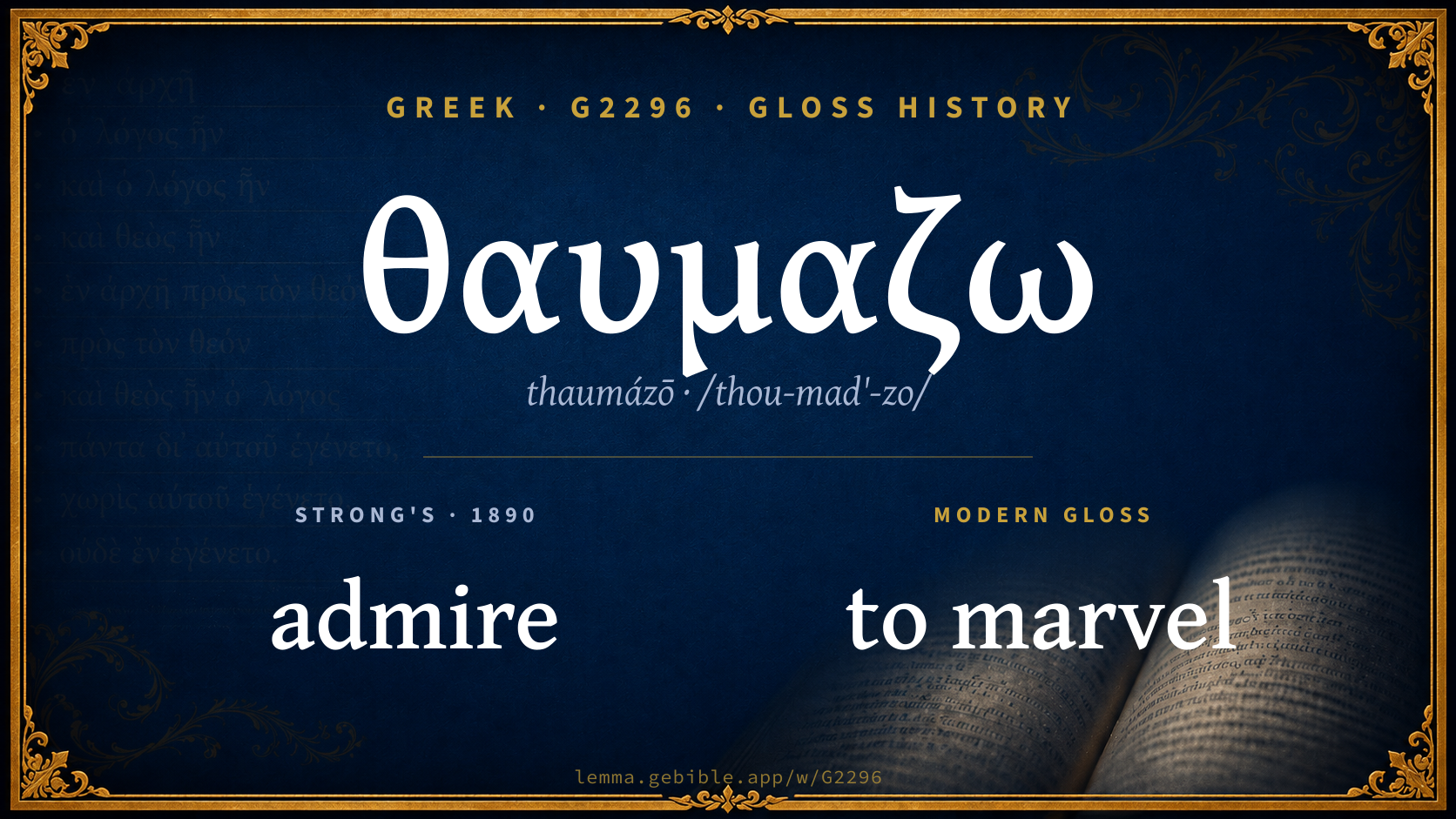
Gloss history
Strong's 1890 vs modern scholarship
About this word
Strong's G2296 catalogs a Greek word from the Greek New Testament.
These counts are not copied from any lexicon or concordance. They are computed here, from the morphology-tagged Greek New Testament. What Lemma adds →
- 43
- distinct verses
- The word appears in 43 distinct verses.
- 10 / 27
- NT books
- The word appears in 10 of 27 New Testament books.
- #347
- by frequency
- Top 500 most frequent Greek words (rank 347 of 5,347 Greek words by occurrence).
View all 43 occurrences in the concordance →
By section of the New Testament
By traditional corpus
Conventional, traditional groupings — biblical authorship is debated, so this is a traditional corpus grouping, not an authorship claim. Some books belong to more than one corpus (Luke is in both the Gospels and the Lukan corpus, and so on), so these shares overlap and need not total 100%. Each figure is a share of the word’s 43 distinct verses.
- Gospels 30 verses · 70%
- Lukan (Luke–Acts) 17 verses · 40%
- Johannine 11 verses · 26%
- Revelation 4 verses · 9%
- Pauline corpus 2 verses · 5%
- General (Catholic) Epistles 2 verses · 5%
How translations render this word
Counts come from each version’s own published word-to-Strong’s tagging or interlinear alignment — an approximate guide to how each version renders this word, not a word-level alignment the data otherwise carries. Because each total is that version’s own tagged count, the per-version totals vary from one another and need not match the appearance or distinct-verse counts above. These counts may also differ from a printed concordance because Lemma counts each distinctly tagged rendering and does not collapse phrase taggings into a single head-word total. This is a fixed set of word-tagged versions (KJV, ASV, BSB, ULT) and does not change with the reading translation you choose elsewhere. Each version’s license is shown beside its name below (and on Sources).
- King James Version: Marvelled 9×, Wondered 8×, They marvelled 6×
- American Standard Version: Marvelled 7×, They marvelled 7×, It 6×
- Berean Standard Bible: Were amazed 5×, Amazed 4×, Amazement 4×
- unfoldingWord Literal Text: Marveled 8×, Be amazed 3×, Do 3×
King James Version Public Domain
Renders G2296 across 46 tagged occurrences — most commonly:
Plus 15 renderings that appear only once — usually multi-word phrases or single function words the recovered tagging swept in, not distinct renderings. Not rendered by a distinct English word in 2 further occurrences.
American Standard Version Public Domain
Renders G2296 across 46 tagged occurrences — most commonly:
Plus 15 renderings that appear only once — usually multi-word phrases or single function words the recovered tagging swept in, not distinct renderings.
Berean Standard Bible Public Domain
Renders G2296 across 44 tagged occurrences — most commonly:
Plus 20 renderings that appear only once — usually multi-word phrases or single function words the recovered tagging swept in, not distinct renderings.
unfoldingWord Literal Text CC BY-SA 4.0
Renders G2296 across 49 tagged occurrences — most commonly:
Plus 21 renderings that appear only once — usually multi-word phrases or single function words the recovered tagging swept in, not distinct renderings.
Senses in Thayer's
The 2 senses Thayer's distinguishes for this word, in lexicon order (not ranked by frequency or importance). The full entry — with sub-senses — is in the Lexicon Entry tab.
- to wonder, wonder at, marvel
- to be wondered at, to be had in admiration
Word origin
Derived from θαυμα (thaûma) (G2295) — wonder.
From G2295 ; to wonder ; by implication to admire : - admire have in admiration marvel wonder.
— Strong’s Exhaustive Concordance (1890), public domain.
Forms in the corpus
The 18 distinct written forms G2296 takes in the Greek New Testament, most frequent first — each parse links to that tense’s occurrences in the concordance.
Same root — word family
Other Thayer's entries built from the same root as G2296, grouped by Strong’s listed origin. These share a root / origin per the lexicon — not necessarily a shared meaning. Each links to that word’s own entry.
Derives from
Shares the same root
Derived from this word
Compare all same-root words → They share a root, not necessarily a meaning.
Septuagint usage
The same Greek word θαυμαζω appears 31 times in the Greek Old Testament (Septuagint), across 31 verses in 14 books.
- 31
- LXX occurrences
- Tagged occurrences of this Greek word in the Septuagint.
- 31
- verses
- Distinct Septuagint verses containing this word.
- 14 / 39
- OT books
- The word appears in 14 of the 39 Old Testament books.
Sample Septuagint occurrences
- Genesis 19:21 θαυμάζω
- Leviticus 19:15 θαυμάζω
- Deuteronomy 10:17 θαυμάζω
- 2 Samuel 1:26 θαυμάζω
- 2 Kings 5:1 θαυμάζω
- 2 Chronicles 19:7 θαυμάζω
- Job 13:10 θαυμάζω
- Psalms 47:6 θαυμάζω
- Proverbs 18:5 θαυμάζω
- Ecclesiastes 5:7 θαυμάζω
- Isaiah 9:14 θαυμάζω
- Jeremiah 4:9 θαυμάζω
Septuagint occurrences (same lexeme)
Every verse where the same Strong’s number (G2296) appears in the Greek Septuagint. Verse text shown in the World English Bible for context; the Greek form is the matched word — the English is not keyword-highlighted.
- Genesis 19:21 θαυμάζω He said to him, "Behold, I have granted your request concerning this thing also, that I will not overthrow the city of which you have spoken.
- Leviticus 19:15 θαυμάζω "'You shall do no injustice in judgment: you shall not be partial to the poor, nor show favoritism to the great; but in righteousness shall you judge your neighbor.
- Leviticus 26:32 θαυμάζω I will bring the land into desolation; and your enemies that dwell therein will be astonished at it.
- Deuteronomy 10:17 θαυμάζω For Yahweh your God, he is God of gods, and Lord of lords, the great God, the mighty, and the awesome, who doesn't regard persons, nor takes reward.
- Deuteronomy 28:50 θαυμάζω a nation of fierce facial expressions, that shall not regard the person of the old, nor show favor to the young,
- 2 Samuel 1:26 θαυμάζω I am distressed for you, my brother Jonathan: Very pleasant have you been to me: Your love to me was wonderful, Passing the love of women.
- 2 Kings 5:1 θαυμάζω Now Naaman, captain of the host of the king of Syria, was a great man with his master, and honorable, because by him Yahweh had given victory to Syria: he was also a mighty man of valor, [but he was] a leper.
- 2 Chronicles 19:7 θαυμάζω Now therefore let the fear of Yahweh be on you; take heed and do it: for there is no iniquity with Yahweh our God, nor respect of persons, nor taking of bribes.
- 2 Chronicles 26:15 θαυμάζω He made in Jerusalem engines, invented by skillful men, to be on the towers and on the battlements, with which to shoot arrows and great stones. His name spread far abroad; for he was marvelously helped, until he was strong.
- Job 13:10 θαυμάζω He will surely reprove you If you secretly show partiality.
- Job 21:5 θαυμάζω Look at me, and be astonished. Lay your hand on your mouth.
- Job 22:8 θαυμάζω But as for the mighty man, he had the earth. The honorable man, he lived in it.
- Job 32:22 θαυμάζω For I don't know how to give flattering titles; Or else my Maker would soon take me away.
- Job 34:19 θαυμάζω Who doesn't respect the persons of princes, Nor regards the rich more than the poor; For they all are the work of his hands.
- Job 41:1 θαυμάζω "Can you draw out Leviathan with a fishhook? Or press down his tongue with a cord?
- Job 42:11 θαυμάζω Then came there to him all his brothers, and all his sisters, and all those who had been of his acquaintance before, and ate bread with him in his house. They comforted him, and consoled him concerning all the evil that Yahweh had brought on him. Everyone also gave him a piece of money, and everyone a ring of gold.
- Psalms 47:6 θαυμάζω Sing praise to God, sing praises. Sing praises to our King, sing praises.
- Proverbs 18:5 θαυμάζω To be partial to the faces of the wicked is not good, Nor to deprive the innocent of justice.
- Ecclesiastes 5:7 θαυμάζω For in the multitude of dreams there are vanities, as well as in many words: but you must fear God.
- Isaiah 9:14 θαυμάζω Therefore Yahweh will cut off from Israel head and tail, palm-branch and rush, in one day.
- Isaiah 14:16 θαυμάζω Those who see you shall gaze at you, they shall consider you, [saying], "Is this the man who made the earth to tremble, who shook kingdoms;
- Isaiah 41:23 θαυμάζω Declare the things that are to come hereafter, that we may know that you are gods: yes, do good, or do evil, that we may be dismayed, and see it together.
- Isaiah 52:5 θαυμάζω Now therefore, what do I here, says Yahweh, seeing that my people is taken away for nothing? those who rule over them do howl, says Yahweh, and my name continually all the day is blasphemed.
- Isaiah 52:15 θαυμάζω so shall he sprinkle many nations; kings shall shut their mouths at him: for that which had not been told them shall they see; and that which they had not heard shall they understand.
- Isaiah 61:6 θαυμάζω But you shall be named the priests of Yahweh; men shall call you the ministers of our God: you shall eat the wealth of the nations, and in their glory shall you boast yourselves.
- Jeremiah 4:9 θαυμάζω It shall happen at that day, says Yahweh, that the heart of the king shall perish, and the heart of the princes; and the priests shall be astonished, and the prophets shall wonder.
- Daniel 3:91 θαυμάζω
- Daniel 4:10 θαυμάζω Thus were the visions of my head on my bed: I saw, and, behold, a tree in the midst of the earth; and the height of it was great.
- Daniel 4:12 θαυμάζω The leaves of it were beautiful, and the fruit of it much, and in it was food for all: the animals of the field had shadow under it, and the birds of the sky lived in the branches of it, and all flesh was fed from it.
- Daniel 6:13 θαυμάζω Then answered they and said before the king, That Daniel, who is of the children of the captivity of Judah, doesn't regard you, O king, nor the interdict that you have signed, but makes his petition three times a day.
- Habakkuk 1:5 θαυμάζω "Look among the nations, watch, and wonder marvelously; for I am working a work in your days, which you will not believe though it is told you.
These are occurrences of the same Greek lexeme (G2296) in the Septuagint — not a translation of any one Hebrew word. The store carries no word-level Hebrew↔Greek alignment, so no Hebrew original is asserted here. Counts come from the recovered LXX Strong's tagging — high-frequency vocabulary is well covered, while rare or late forms may be untagged — so they reflect tagged occurrences and may slightly undercount.