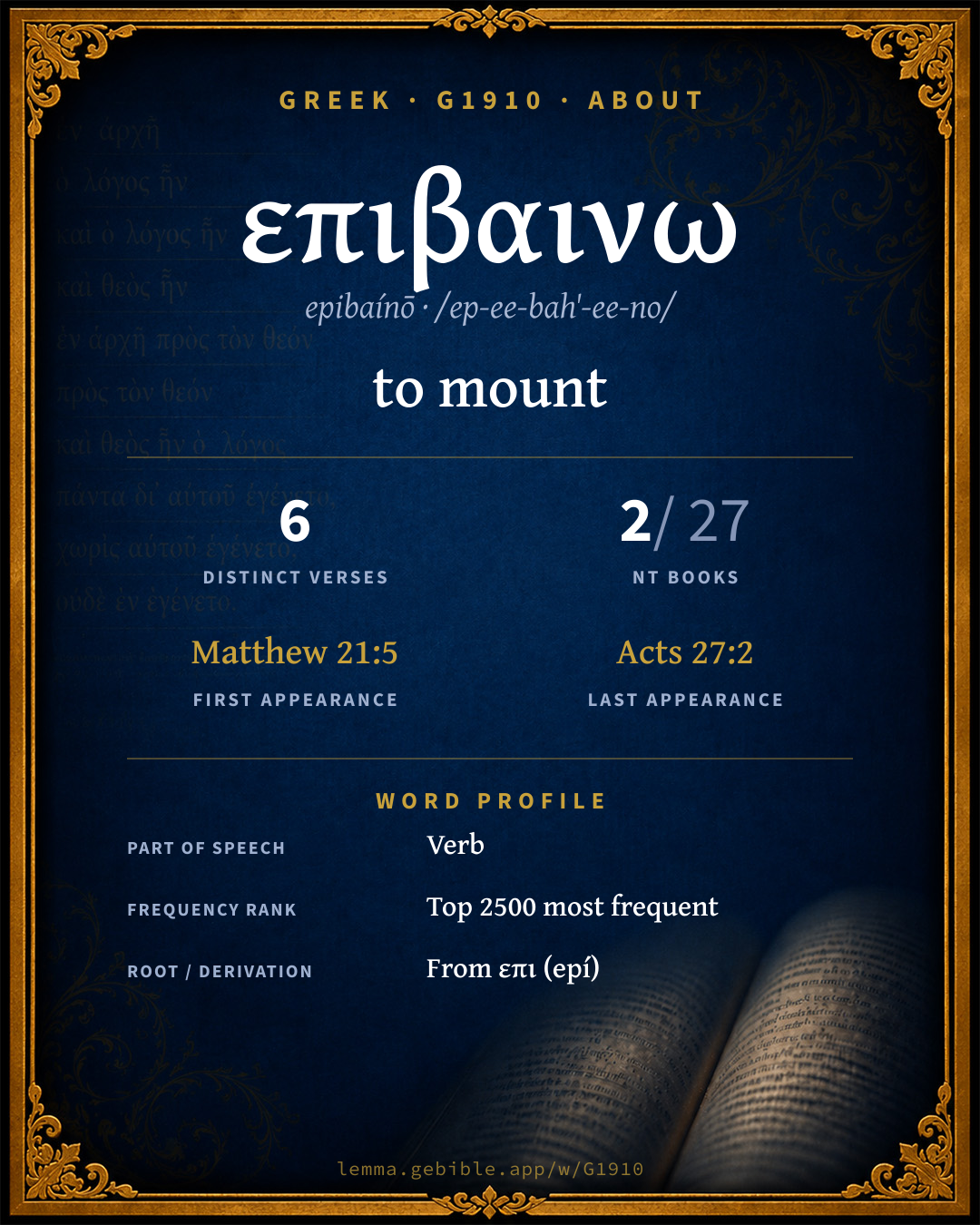
ἐπιβαίνω
to mount
‘to mount’ is one of 3 main senses fuller range ↓
Full lexicon entry — Thayer's Greek Lexicon
From Thayer's Greek Lexicon
Where this word appears
See every Aorist-tense verb in the Greek New Testament →
Grammar key — what these labels mean
Part of speech
- Verb
- An action or state-of-being word.
Tense
- Aorist
- Action viewed as a simple whole, without regard to duration — often past (perfective aspect).
- Present
- Ongoing or general action in present time (imperfective aspect).
- Perfect
- A completed past action with continuing present results.
Voice
- Active
- The subject performs the action.
Mood
- Participle
- A verbal adjective (“writing,” “having written”).
- Indicative
- States a fact or asks a factual question (the mood of reality).
- Infinitive
- A verbal noun (“to write”), unmarked for person or number.
Case
- Nominative
- The case of the subject (and the predicate nominative).
Person
- 1st person
- The speaker (“I / we”).
Gender
- Masculine
- Grammatically masculine.
Number
- Singular
- One.
Grammatical forms
- Verb, Aorist, Active, Participle, Nominative, Singular, Masculine 3 times (50%)
- Verb, Aorist, Active, Indicative, 1st person, Singular 1 time (17%)
- Verb, Present, Active, Infinitive 1 time (17%)
- Verb, Perfect, Active, Participle, Nominative, Singular, Masculine 1 time (17%)
Parsed forms decoded from the imported morphology (Robinson–Tischendorf, public domain), counted across 6 parsed occurrences — not distinct verses.
Every verse where G1910 appears — 6 distinct verses across 2 books. Click any verse to open its interlinear word-by-word view. Verse text shown in the World English Bible for context — . Each verse’s Greek form is shown with its reference; the English is not keyword-highlighted, since the data carries no word-level English alignment. Use “Compare translations” on any verse to read it across multiple English versions. This concordance covers the Greek New Testament; Septuagint (Greek Old Testament) occurrences of this word are not indexed here.
Matthew 1 verse
Acts 5 verses
- Acts 20:18 ἐπέβην aor act ind 1sg When they had come to him, he said to them, "You yourselves know, from the first day that I set foot in Asia, how I was with you all the time,
- Acts 21:2 ἐπιβάντες aor act ptcp nom sg masc Having found a ship crossing over to Phoenicia, we went aboard, and set sail.
- Acts 21:4 ἐπιβαίνειν pres act inf Having found disciples, we stayed there seven days. These said to Paul through the Spirit, that he should not go up to Jerusalem.
- Acts 25:1 ἐπιβὰς aor act ptcp nom sg masc Festus therefore, having come into the province, after three days went up to Jerusalem from Caesarea.
- Acts 27:2 ἐπιβάντες aor act ptcp nom sg masc Embarking in a ship of Adramyttium, which was about to sail to places on the coast of Asia, we put to sea; Aristarchus, a Macedonian of Thessalonica, being with us.
About this entry
At a glance — auto-summarized from this page’s data, not written by a person. Every figure links to its source below. This summary describes the numbers; it doesn’t interpret them.
At its core, επιβαινω (epibaínō) means “to mount.” Its uses cluster heavily in Acts (83% of all occurrences). Spanning 6 verses in 2 books, it ranks among the uncommon words of the Greek New Testament. It first appears in Matthew 21:5. Ranging over 3 senses, it is not a single-sense word. Dig into 6-verse concordance and the renderings breakdown below.
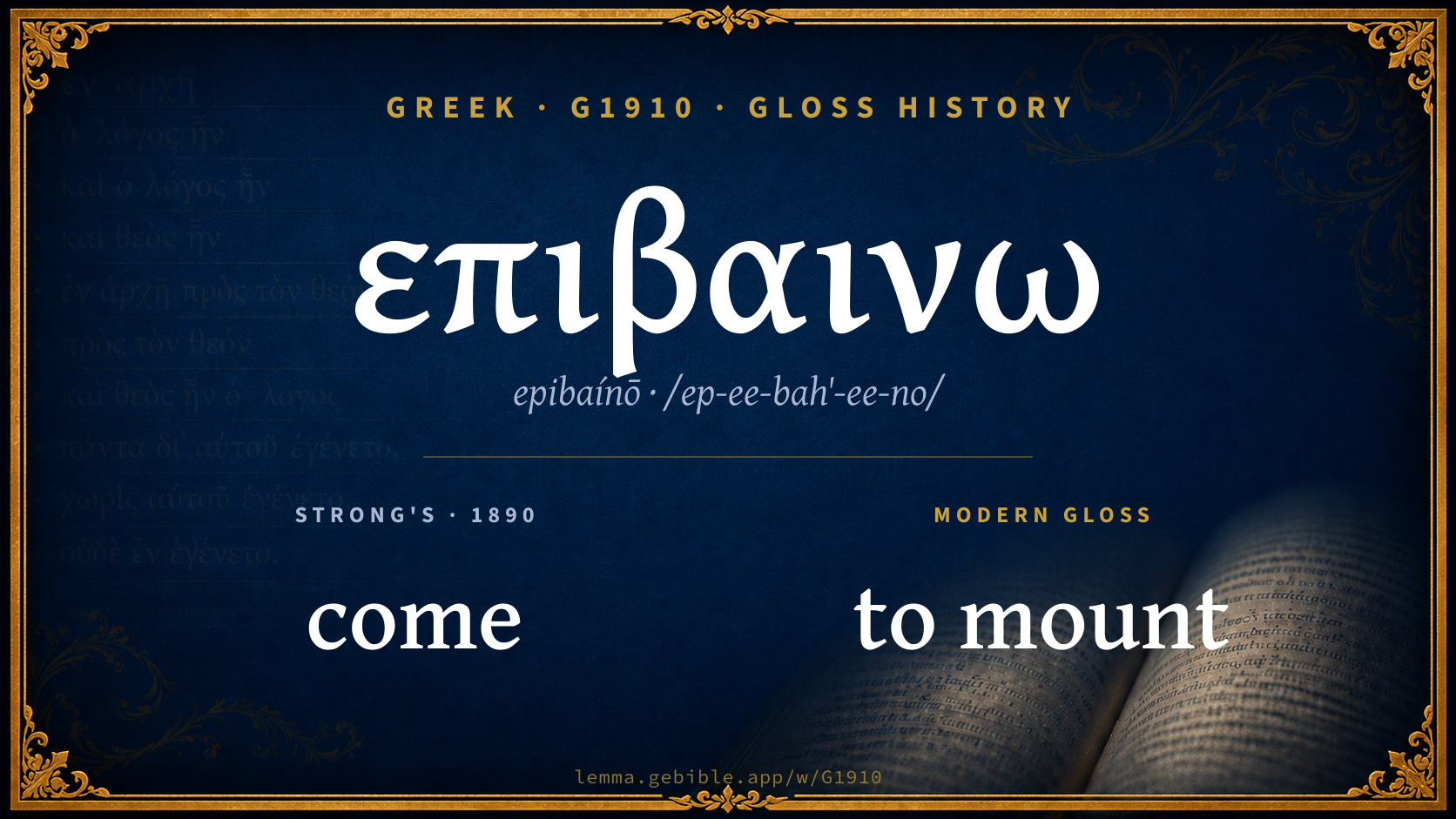
Gloss history
Strong's 1890 vs modern scholarship
About this word
Strong's G1910 catalogs a Greek word from the Greek New Testament.
These counts are not copied from any lexicon or concordance. They are computed here, from the morphology-tagged Greek New Testament. What Lemma adds →
- 6
- distinct verses
- The word appears in 6 distinct verses.
- 2 / 27
- NT books
- The word appears in 2 of 27 New Testament books.
- #1,476
- by frequency
- Top 2500 most frequent Greek words (rank 1,476 of 5,347 Greek words by occurrence).
View all 6 occurrences in the concordance →
By traditional corpus
Conventional, traditional groupings — biblical authorship is debated, so this is a traditional corpus grouping, not an authorship claim. Some books belong to more than one corpus (Luke is in both the Gospels and the Lukan corpus, and so on), so these shares overlap and need not total 100%. Each figure is a share of the word’s 6 distinct verses.
- Lukan (Luke–Acts) 5 verses · 83%
- Gospels 1 verse · 17%
How translations render this word
Counts come from each version’s own published word-to-Strong’s tagging or interlinear alignment — an approximate guide to how each version renders this word, not a word-level alignment the data otherwise carries. Because each total is that version’s own tagged count, the per-version totals vary from one another and need not match the appearance or distinct-verse counts above. These counts may also differ from a printed concordance because Lemma counts each distinctly tagged rendering and does not collapse phrase taggings into a single head-word total. This is a fixed set of word-tagged versions (KJV, ASV, BSB, ULT) and does not change with the reading translation you choose elsewhere. Each version’s license is shown beside its name below (and on Sources).
- King James Version: Entering 1×, I came 1×, Sitting 1×
- American Standard Version: Board 1×, Having come 1×, I set foot 1×
- Berean Standard Bible: We boarded 2×
- unfoldingWord Literal Text: Going aboard 1×, Having boarded 1×, Having set foot 1×
King James Version Public Domain
Renders G1910 across 6 tagged occurrences — most commonly:
American Standard Version Public Domain
Renders G1910 across 6 tagged occurrences — most commonly:
Berean Standard Bible Public Domain
Renders G1910 across 6 tagged occurrences — most commonly:
Plus 4 renderings that appear only once — usually multi-word phrases or single function words the recovered tagging swept in, not distinct renderings.
unfoldingWord Literal Text CC BY-SA 4.0
Renders G1910 across 6 tagged occurrences — most commonly:
Senses in Thayer's
The 3 senses Thayer's distinguishes for this word, in lexicon order (not ranked by frequency or importance). The full entry — with sub-senses — is in the Lexicon Entry tab.
- to embark in
- to go aboard (a ship)
- to set foot in, enter
Word origin
Derived from επι (epí) (G1909) — upon.
Forms in the corpus
The 5 distinct written forms G1910 takes in the Greek New Testament, most frequent first — each parse links to that tense’s occurrences in the concordance.
| Form | Parsing | Example | Uses |
|---|---|---|---|
| ἐπιβάντες epibántes | Verb, Aorist, Active, Participle, Nominative, Singular, Masculine | Acts 21:2 | 2 |
| ἐπέβην epébēn | Verb, Aorist, Active, Indicative, 1st person, Singular | Acts 20:18 | 1 |
| ἐπιβαίνειν epibaínein | Verb, Present, Active, Infinitive | Acts 21:4 | 1 |
| ἐπιβεβηκὼς epibebēkṑs | Verb, Perfect, Active, Participle, Nominative, Singular, Masculine | Matthew 21:5 | 1 |
| ἐπιβὰς epibàs | Verb, Aorist, Active, Participle, Nominative, Singular, Masculine | Acts 25:1 | 1 |
Same root — word family
Other Thayer's entries built from the same root as G1910, grouped by Strong’s listed origin. These share a root / origin per the lexicon — not necessarily a shared meaning. Each links to that word’s own entry.
Derives from
Shares the same root
- επαγγελλω epangéllō G1861 to announce
- επαγω epágō G1863 to bring upon
- επαγωνιζομαι epagōnízomai G1864 to contend
- επαθροιζω epathroízō G1865 to gather together
- επαινεω epainéō G1867 to approve
- επαινος épainos G1868 approval
- επαιρω epaírō G1869 to lift up
- επαισχυνομαι epaischýnomai G1870 to be ashamed
- επαιτεω epaitéō G1871 to ask repeatedly
- επακουω epakoúō G1873 to give ear to
- επακροαομαι epakroáomai G1874 to listen to
- επαν epán G1875 after
- επαναγκες epánankes G1876 necessarily
- επαναγω epanágō G1877 to lead back
- επαναμιμνησκω epanamimnḗskō G1878 to remind
- επαναπαυομαι epanapaúomai G1879 to rest upon
- επανερχομαι epanérchomai G1880 to return
- επανισταμαι epanístamai G1881 to raise up against
- επανορθωσις epanórthōsis G1882 correction
- επανω epánō G1883 above
- επαρκεω eparkéō G1884 to avail
- επαρχια eparchía G1885 office of governor
- επαυλις épaulis G1886 farm
- επαυριον epaúrion G1887 the next day
+110 more words share this root (not shown).
Proper names from this root
People and places named from this root — a name, not an additional meaning of the word.
Compare all same-root words → Showing 4 of 137 — not the complete family. 1 of the same-root words is a proper name (a person or place). They share a root, not necessarily a meaning.
Septuagint usage
The same Greek word επιβαινω appears 50 times in the Greek Old Testament (Septuagint), across 50 verses in 22 books.
- 50
- LXX occurrences
- Tagged occurrences of this Greek word in the Septuagint.
- 50
- verses
- Distinct Septuagint verses containing this word.
- 22 / 39
- OT books
- The word appears in 22 of the 39 Old Testament books.
Sample Septuagint occurrences
- Genesis 24:61 ἐπιβαίνω
- Leviticus 15:9 ἐπιβαίνω
- Numbers 22:22 ἐπιβαίνω
- Deuteronomy 1:36 ἐπιβαίνω
- Joshua 1:3 ἐπιβαίνω
- Judges 5:10 ἐπιβαίνω
- 1 Samuel 5:5 ἐπιβαίνω
- 2 Samuel 18:9 ἐπιβαίνω
- 1 Kings 13:13 ἐπιβαίνω
- 2 Kings 4:24 ἐπιβαίνω
- Ezra 12:12 ἐπιβαίνω
- Esther 6:8 ἐπιβαίνω
Septuagint occurrences (same lexeme)
Every verse where the same Strong’s number (G1910) appears in the Greek Septuagint. Verse text shown in the World English Bible for context; the Greek form is the matched word — the English is not keyword-highlighted.
- Genesis 24:61 ἐπιβαίνω Rebekah arose with her ladies. They rode on the camels, and followed the man. The servant took Rebekah, and went his way.
- Leviticus 15:9 ἐπιβαίνω "'Whatever saddle he who has the discharge rides on shall be unclean.
- Numbers 22:22 ἐπιβαίνω God's anger was kindled because he went; and the angel of Yahweh placed himself in the way for an adversary against him. Now he was riding on his donkey, and his two servants were with him.
- Numbers 22:30 ἐπιβαίνω The donkey said to Balaam, Am I not your donkey, on which you have ridden all your life long to this day? was I ever wont to do so to you? and he said, No.
- Deuteronomy 1:36 ἐπιβαίνω save Caleb the son of Jephunneh: he shall see it; and to him will I give the land that he has trodden on, and to his children, because he has wholly followed Yahweh.
- Deuteronomy 11:25 ἐπιβαίνω There shall no man be able to stand before you: Yahweh your God shall lay the fear of you and the dread of you on all the land that you shall tread on, as he has spoken to you.
- Deuteronomy 33:26 ἐπιβαίνω There is none like God, Jeshurun, Who rides on the heavens for your help, In his excellency on the skies.
- Deuteronomy 33:29 ἐπιβαίνω Happy are you, Israel: Who is like you, a people saved by Yahweh, The shield of your help, The sword of your excellency! Your enemies shall submit themselves to you; You shall tread on their high places.
- Joshua 1:3 ἐπιβαίνω Every place that the sole of your foot shall tread on, to you have I given it, as I spoke to Moses.
- Joshua 14:9 ἐπιβαίνω Moses swore on that day, saying, Surely the land whereon your foot has trodden shall be an inheritance to you and to your children forever, because you have wholly followed Yahweh my God.
- Joshua 15:6 ἐπιβαίνω and the border went up to Beth Hoglah, and passed along by the north of Beth Arabah; and the border went up to the stone of Bohan the son of Reuben;
- Judges 5:10 ἐπιβαίνω Tell [of it], you who ride on white donkeys, You who sit on rich carpets, You who walk by the way.
- Judges 10:4 ἐπιβαίνω He had thirty sons who rode on thirty donkey colts, and they had thirty cities, which are called Havvoth Jair to this day, which are in the land of Gilead.
- Judges 12:14 ἐπιβαίνω He had forty sons and thirty sons' sons, who rode on seventy donkey colts: and he judged Israel eight years.
- 1 Samuel 5:5 ἐπιβαίνω Therefore neither the priests of Dagon, nor any who come into Dagon's house, tread on the threshold of Dagon in Ashdod, to this day.
- 1 Samuel 25:20 ἐπιβαίνω It was so, as she rode on her donkey, and came down by the covert of the mountain, that behold, David and his men came down toward her; and she met them.
- 1 Samuel 25:42 ἐπιβαίνω Abigail hurried, and arose, and rode on a donkey, with five ladies of hers who followed her; and she went after the messengers of David, and became his wife.
- 1 Samuel 30:17 ἐπιβαίνω David struck them from the twilight even to the evening of the next day: and there not a man of them escaped, except four hundred young men, who rode on camels and fled.
- 2 Samuel 18:9 ἐπιβαίνω Absalom happened to meet the servants of David. Absalom was riding on his mule, and the mule went under the thick boughs of a great oak, and his head caught hold of the oak, and he was taken up between the sky and earth; and the mule that was under him went on.
- 2 Samuel 19:27 ἐπιβαίνω He has slandered your servant to my lord the king; but my lord the king is as an angel of God: do therefore what is good in your eyes.
- 1 Kings 13:13 ἐπιβαίνω He said to his sons, Saddle me the donkey. So they saddled him the donkey; and he rode thereon.
- 2 Kings 4:24 ἐπιβαίνω Then she saddled a donkey, and said to her servant, Drive, and go forward; don't slacken me the riding, except I bid you.
- 2 Kings 9:25 ἐπιβαίνω Then said [Jehu] to Bidkar his captain, Take up, and cast him in the portion of the field of Naboth the Jezreelite; for remember how that, when I and you rode together after Ahab his father, Yahweh laid this burden on him:
- Ezra 12:12 ἐπιβαίνω
- Esther 6:8 ἐπιβαίνω let royal clothing be brought which the king uses to wear, and the horse that the king rides on, and on the head of which a crown royal is set:
- Job 6:21 ἐπιβαίνω For now you are nothing. You see a terror, and are afraid.
- Job 30:21 ἐπιβαίνω You have turned to be cruel to me. With the might of your hand you persecute me.
- Psalms 17:11 ἐπιβαίνω They have now surrounded us in our steps. They set their eyes to cast us down to the earth.
- Psalms 67:5 ἐπιβαίνω Let the peoples praise you, God. Let all the peoples praise you.
- Psalms 67:34 ἐπιβαίνω
- Psalms 75:7 ἐπιβαίνω But God is the judge. He puts down one, and lifts up another.
- Psalms 90:13 ἐπιβαίνω Relent, Yahweh! How long? Have compassion on your servants!
- Proverbs 21:22 ἐπιβαίνω A wise man scales the city of the mighty, And brings down the strength of its confidence.
- Jeremiah 10:10 ἐπιβαίνω But Yahweh is the true God; he is the living God, and an everlasting King: at his wrath the earth trembles, and the nations are not able to abide his indignation.
- Jeremiah 17:25 ἐπιβαίνω then shall there enter in by the gates of this city kings and princes sitting on the throne of David, riding in chariots and on horses, they, and their princes, the men of Judah, and the inhabitants of Jerusalem; and this city shall remain forever.
- Jeremiah 18:15 ἐπιβαίνω For my people have forgotten me, they have burned incense to false [gods]; and they have been made to stumble in their ways, in the ancient paths, to walk in byways, in a way not built up;
- Jeremiah 22:4 ἐπιβαίνω For if you do this thing indeed, then shall there enter in by the gates of this house kings sitting on the throne of David, riding in chariots and on horses, he, and his servants, and his people.
- Jeremiah 26:4 ἐπιβαίνω You shall tell them, Thus says Yahweh: If you will not listen to me, to walk in my law, which I have set before you,
- Jeremiah 26:9 ἐπιβαίνω Why have you prophesied in the name of Yahweh, saying, This house shall be like Shiloh, and this city shall be desolate, without inhabitant? All the people were gathered to Jeremiah in the house of Yahweh.
- Jeremiah 27:21 ἐπιβαίνω yes, thus says Yahweh of Hosts, the God of Israel, concerning the vessels that are left in the house of Yahweh, and in the house of the king of Judah, and at Jerusalem:
- Ezekiel 10:18 ἐπιβαίνω The glory of Yahweh went forth from over the threshold of the house, and stood over the cherubim.
- Amos 4:13 ἐπιβαίνω For, behold, he who forms the mountains, And creates the wind, And declares to man what is his thought; Who makes the morning darkness, And treads on the high places of the Earth: Yahweh, the God of hosts, is his name."
- Micah 1:3 ἐπιβαίνω For, behold, Yahweh comes forth out of his place, And will come down and tread on the high places of the earth.
- Micah 5:4 ἐπιβαίνω He shall stand, and shall shepherd in the strength of Yahweh, In the majesty of the name of Yahweh his God: And they will live, for then he will be great to the ends of the earth.
- Micah 5:5 ἐπιβαίνω He will be our peace when Assyria invades our land, And when he marches through our fortresses, Then we will raise against him seven shepherds, And eight leaders of men.
- Nahum 3:17 ἐπιβαίνω Your guards are like the locusts, and your officials like the swarms of locusts, which settle on the walls on a cold day, but when the sun appears, they flee away, and their place is not known where they are.
- Habakkuk 2:1 ἐπιβαίνω I will stand at my watch, and set myself on the ramparts, and will look out to see what he will say to me, and what I will answer concerning my complaint.
- Habakkuk 3:8 ἐπιβαίνω Was Yahweh displeased with the rivers? Was your anger against the rivers, Or your wrath against the sea, That you rode on your horses, On your chariots of salvation?
- Zechariah 1:8 ἐπιβαίνω "I had a vision in the night, and, behold, a man riding on a red horse, and he stood among the myrtle trees that were in a ravine; and behind him there were red, brown, and white horses.
- Zechariah 9:9 ἐπιβαίνω Rejoice greatly, daughter of Zion! Shout, daughter of Jerusalem! Behold, your king comes to you! He is righteous, and having salvation; Lowly, and riding on a donkey, Even on a colt, the foal of a donkey.
These are occurrences of the same Greek lexeme (G1910) in the Septuagint — not a translation of any one Hebrew word. The store carries no word-level Hebrew↔Greek alignment, so no Hebrew original is asserted here. Counts come from the recovered LXX Strong's tagging — high-frequency vocabulary is well covered, while rare or late forms may be untagged — so they reflect tagged occurrences and may slightly undercount.