
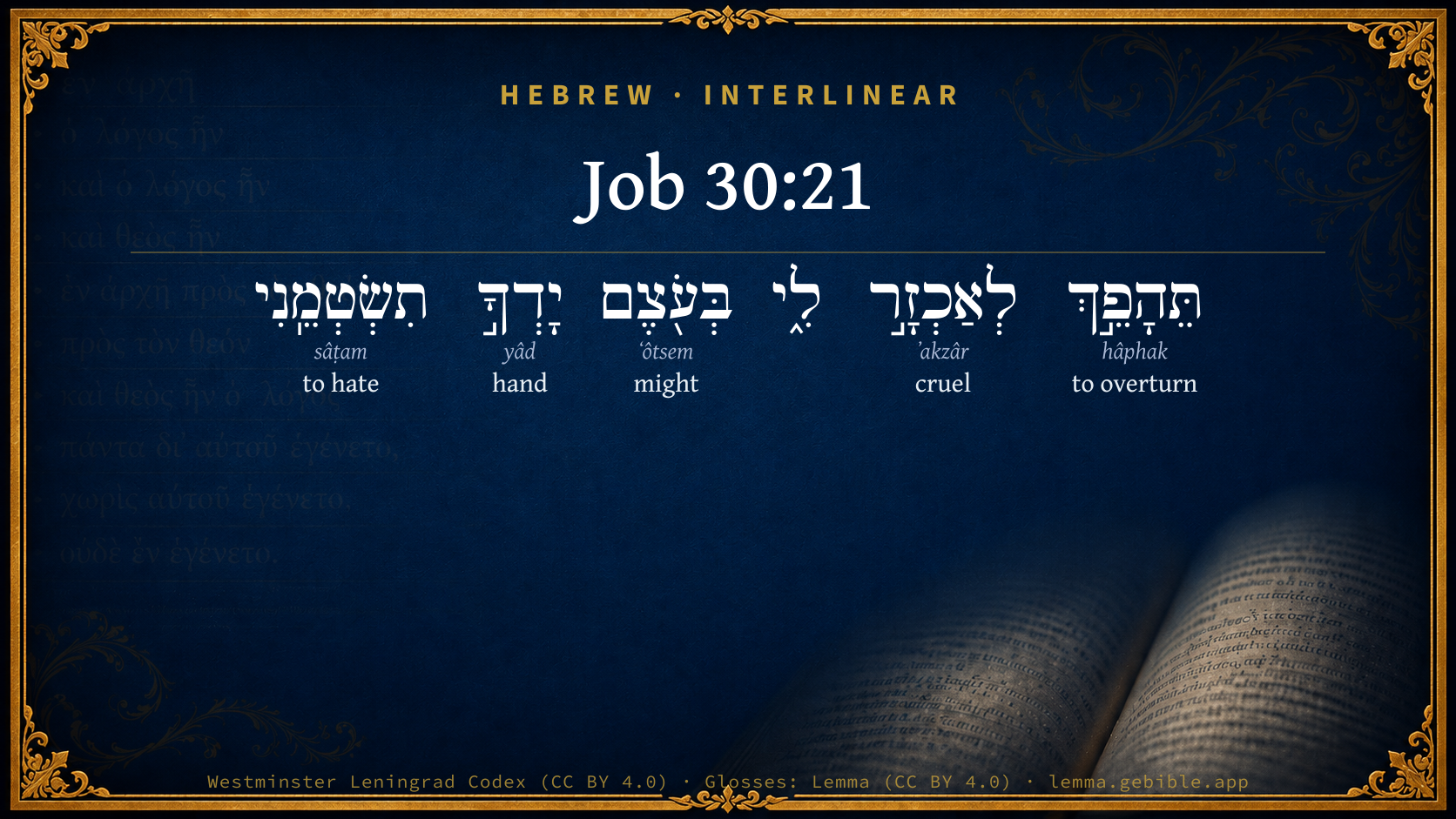
Job 30:21

Hebrew (Westminster Leningrad Codex) Job 30:21 appears in the Hebrew Old Testament. The text above is from the Westminster Leningrad Codex. Each word links to its Strong’s number, a concise gloss, and parsing drawn from the Open Scriptures Hebrew Bible morphology. Click any word for its full Brown-Driver-Briggs (BDB) entry.
Download image
Cite this verse

Job 30:21 (World English Bible). Public Domain. Lemma interlinear Bible study tool, https://lemma.gebible.app/v/job/30/21.

Show BibTeX & RIS
BibTeX
RIS
English Translation
You have turned to be cruel to me. With the might of your hand you persecute me.
World English Bible · Public Domain
Download a study sheet

One document with this verse’s original text, its word-by-word gloss line, the meaning frame, cross-references with their text, attributed commentary, and full source and license credits — printable, and it pastes into notes with its structure intact.

This verse Autodidact and up

Study sheet (.html) Plain text (.txt)

A passage Seminary Student

Up to 50 verses in one chapter. A passage sheet keeps up to 6 commentary sources and 12 cross-references per verse, in the order this page ranks them, and says so on the sheet whenever that leaves anything out. Ask for a single verse and you get the Autodidact verse sheet above.

Everything on this page stays free to read, with no account — the sheet is a download of what is already on screen, not access to it.

Want to remove ads? Support Godless Engineer
Compare translations 3

The same verse in 3 English versions, stacked beneath the original-language interlinear above. Click any original word for its lexicon entry.

Each is an independent rendering of the whole verse — the interlinear is not word-aligned to these translations.

Highlighted words mark where these versions differ — a whole-verse word diff, not a word-by-word alignment.

  • World English Bible Public Domain
    You have turned to be cruel to me. With the might of your hand you persecute me.
  • King James Version Public Domain
    Thou art become cruel to me: with thy strong hand thou opposest thyself against me.
  • unfoldingWord Literal Text CC BY-SA 4.0
    You have changed to cruel to me; with the strength of your hand you attack me.

unfoldingWord Literal Text — © unfoldingWord, licensed CC BY-SA 4.0. Word-aligned USFM3 via Door43 (git.door43.org/unfoldingWord/en_ult).

Versions to compare (up to 4)

3 of 4 selected

Show all 18 translations

Every available English version of this verse, each an independent rendering of the whole verse.

  • World English Bible Public Domain
    You have turned to be cruel to me. With the might of your hand you persecute me.
  • Berean Standard Bible Public Domain
    You have ruthlessly turned on me; You oppose me with Your strong hand.
  • Majority Standard Bible Public Domain
    You have ruthlessly turned on me; You oppose me with Your strong hand.
  • King James Version Public Domain
    Thou art become cruel to me: with thy strong hand thou opposest thyself against me.
  • American Standard Version (1901) Public Domain
    Thou art turned to be cruel to me; With the might of thy hand thou persecutest me.
  • Revised Version (1885) Public Domain
    Thou art turned to be cruel to me: with the might of thy hand thou persecutest me.
  • Geneva Bible (1599) Public Domain
    Thou turnest thy selfe cruelly against me, and art enemie vnto mee with the strength of thine hand.
  • Douay-Rheims (1899) Public Domain
    Thou art changed to be cruel toward me, and in the hardness of thy hand thou art against me.
  • Young's Literal Translation Public Domain
    Thou art turned to be fierce to me, With the strength of Thy hand, Thou oppresest me.
  • Literal Standard Version CC BY-SA 4.0
    You are turned to be fierce to me, || With the strength of Your hand, || You oppress me.
  • Unlocked Literal Bible CC BY-SA 4.0
    You have changed and become cruel to me; with the strength of your hand you persecute me.
  • unfoldingWord Literal Text CC BY-SA 4.0
    You have changed to cruel to me; with the strength of your hand you attack me.
  • Darby Bible Public Domain
    Thou art changed to a cruel one to me; with the strength of thy hand thou pursuest me.
  • World Messianic Bible Public Domain
    You have turned to be cruel to me. With the might of your hand you persecute me.
  • Webster's Bible Public Domain
    Thou hast become cruel to me: with thy strong hand thou opposest thyself against me.
  • Free Bible Version CC BY-SA 4.0
    You have turned cruel to me; you use your power to make me suffer.
  • Bible in Basic English Public Domain
    You have become cruel to me; the strength of your hand is hard on me.
  • JPS Tanakh (1917) Public Domain
    Thou art turned to be cruel to me; with the might of Thy hand Thou hatest me.

Literal Standard Version (2020), Covenant Press — licensed CC BY-SA 4.0. Text via the HelloAO Bible API (eBible.org). Unlocked Literal Bible (unfoldingWord) — licensed CC BY-SA 4.0. Text via the HelloAO Bible API (eBible.org). unfoldingWord Literal Text — © unfoldingWord, licensed CC BY-SA 4.0. Word-aligned USFM3 via Door43 (git.door43.org/unfoldingWord/en_ult). Free Bible Version, Dr. Jonathan Gallagher — licensed CC BY-SA 4.0. Text via the HelloAO Bible API (eBible.org).

Word by word

More ways to search: Search by grammar → Find every occurrence → Compare this word →

Practice this passage: Drill this verse → Learn its vocabulary →

About this verse

These counts appear in no published source. They are computed here, from the morphology-tagged text and Lemma’s own curated glosses. What Lemma adds →

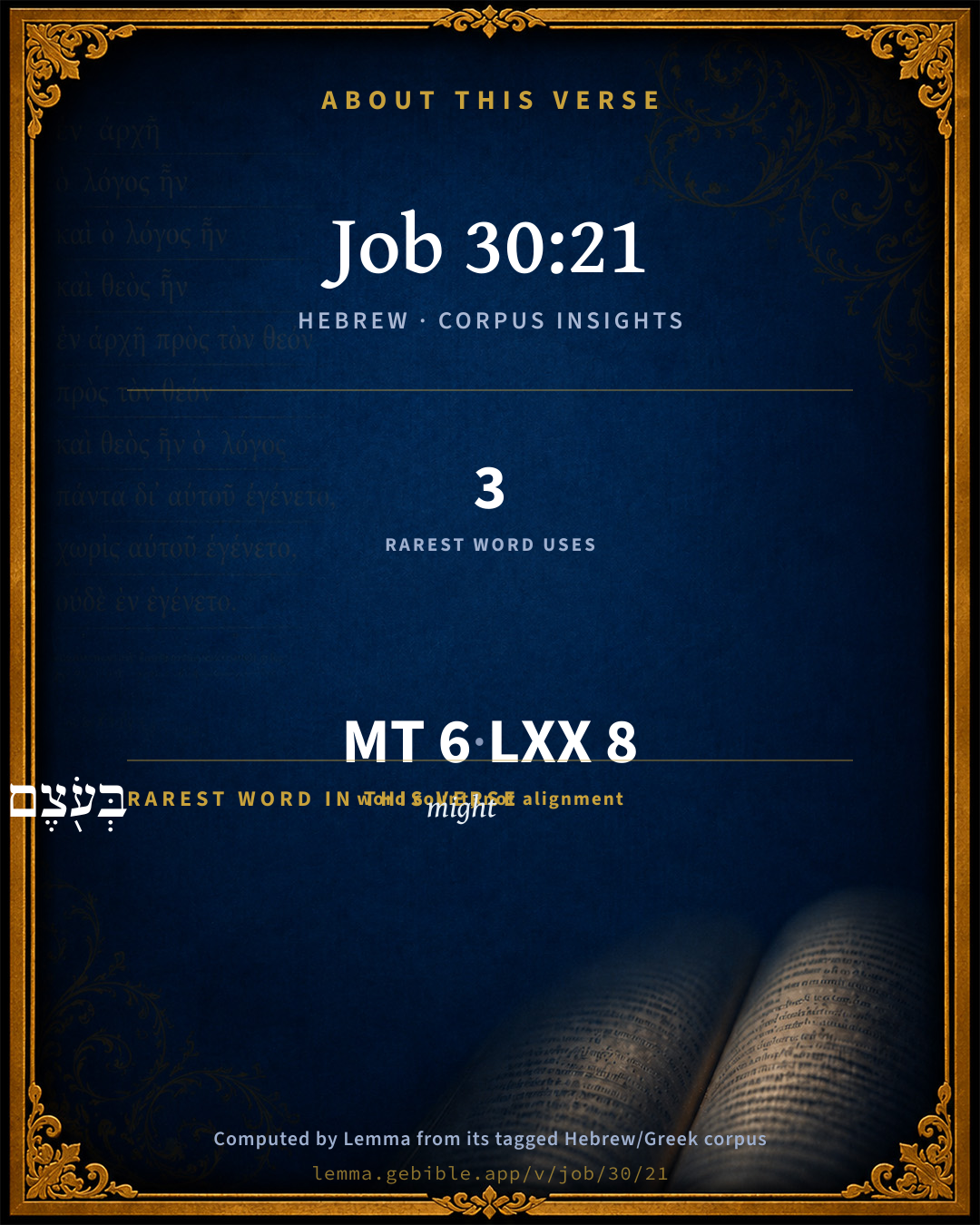
6
words
5
distinct lemmas
Wisdom
section

Notable vocabulary

The rarest word here is בְּעֹ֖צֶם might H6108 — appearing just 3 times in the whole Hebrew Bible.

Shared distinctive vocabulary

בְּעֹ֖צֶם might H6108 occurs in 3 verses of the Hebrew Bible. Also found in:

Grammatical profile

  • 2 verbs
  • 2 nouns
  • 1 adjective
  • 1 preposition

Verb forms

  • תֵּהָפֵ֣ךְ Niphal · Imperfect
  • תִשְׂטְמֵֽנִי Qal · Imperfect

Hebrew & Septuagint length

In English translation the verse runs 17 words from the Hebrew and 14 from the Septuagint (LXX English) — closely comparable.

A rough comparison of the two English renderings, which tokenize alike — not a word-level alignment.

Word counts can differ between the Hebrew and the Greek without any difference in meaning — e.g. the Hebrew direct-object marker אֵת has no separate Greek word, and Greek often adds the article ὁ.

In the original languages it is 6 Hebrew tokens and 8 Greek tokens — but the two are counted differently (Hebrew bundles its prefixes and suffixes into one token; the Greek is in lemma form), so that isn’t a like-for-like length.

Cross-references

13

Topical passages linked to Job 30:21 in the Treasury of Scripture Knowledge — connected by theme and wording, ordered by reader-vote popularity; previews shown in the World English Bible.

  • Job 10:14–17 If I sin, then you mark me. You will not acquit me from my iniquity.
  • Job 16:9–14 He has torn me in his wrath, and persecuted me; He has gnashed on me with his teeth: My adversary sharpens his eyes on me.
  • Job 10:3 Is it good to you that you should oppress, That you should despise the work of your hands, And smile on the counsel of the wicked?
  • Job 19:6–9 Know now that God has subverted me, And has surrounded me with his net.
  • 1 Peter 5:6 Humble yourselves therefore under the mighty hand of God, that he may exalt you in due time;
  • Job 6:9 Even that it would please God to crush me; That he would let loose his hand, and cut me off!
  • Job 7:20–21 If I have sinned, what do I do to you, you watcher of men? Why have you set me as a mark for you, So that I am a burden to myself?
  • Job 13:25–28 Will you harass a driven leaf? Will you pursue the dry stubble?
  • Job 19:22 Why do you persecute me as God, And are not satisfied with my flesh?
  • Job 23:6 Would he contend with me in the greatness of his power? No, but he would listen to me.
  • Psalms 77:7–9 "Will the Lord reject us forever? Will he be favorable no more?
  • Psalms 89:13 You have a mighty arm. Your hand is strong, and your right hand is exalted.
  • Jeremiah 30:14 All your lovers have forgotten you; they don't seek you: for I have wounded you with the wound of an enemy, with the chastisement of a cruel one, for the greatness of your iniquity, because your sins were increased.

Cross-references courtesy of OpenBible.info (CC BY 4.0).

Hebrew and Greek witnesses Masoretic Hebrew ↔ Greek Septuagint

The same verse in the two great witnesses to the Old Testament, shown verse-for-verse.

These are two independent witnesses, not word-aligned to each other, and the Septuagint is shown in lemma (dictionary) form.

Hebrew Job 30:21 Masoretic · Westminster Leningrad Codex

תֵּהָפֵ֣ךְ לְאַכְזָ֣ר לִ֑י בְּעֹ֖צֶם יָדְךָ֣ תִשְׂטְמֵֽנִי

You have turned to be cruel to me. With the might of your hand you persecute me.

World English Bible · Public Domain

Greek LXX Job 30:21 Septuagint · lemma form

ἐπιβαίνω δέ ἐγώ ἀνελεημόνως χείρ κραταιός ἐγώ μαστιγόω

They attacked me also without mercy: you have scourged me with a strong hand.

LXX2012 (modern English Septuagint) · Public Domain

On this verse, Albert Barnes' Notes on the Bible discusses the Septuagint’s reading. Read the note in Commentary ↓

Hebrew: Westminster Leningrad Codex (CC BY 4.0). Greek: Septuagint (public domain); English from LXX2012 (modern English Septuagint) (Public Domain). How the Septuagint differs from the Hebrew →

Commentary

Notes on Job 30:21 from classic Christian and Jewish commentators (each source and its license shown beneath its notes). The classic Christian expositions comment on the surrounding passage and are grouped to its opening verse, so a note may address several verses; the Jewish commentaries on the Tanakh (Rashi and others) are per-verse, so they appear only where the commentator wrote on this verse.

Lemma curates 59 commentaries, every one of them public domain or Creative Commons licensed, each selected and text-cleaned for this edition rather than reprinted as found. About our sources →

Trapp's Complete Commentary

John Trapp

Job 30:21 Thou art become cruel to me: with thy strong hand thou opposest thyself against me.

Ver. 21. Thou art become cruel to me] Mutatus es mihi in tyrannum, thou art turned tyrant towards me, so Brentius rendereth it; and the like he had said before, Job 16:13; Job 19:8-10, out of the vehemency of his pain, and the sense of his flesh, which should have been silenced, and faith exalted; the property whereof is to pick one contrary out of another (as life out of death, assurance of deliverance out of deepest distresses, Deu 32:36), and to persuade the heart that God concealeth his love, out of increased love, and in very faithfulness afflicteth his darlings, that he may be true to their souls, Psa 119:75.

With thy strong hand thou opposest thyself against me] Thou hatest me, Satanically hatest me; Intestinum odium exerces adversum me (Tremell.); and accordingly thou dost practise all thy might upon me. Thus Job in his heat; and that he may not seem to rage without reason, he subjoineth.

John Trapp, A Commentary or Exposition upon All the Books of the Old and New Testament (1647–1656) — public domain. Text from a community e-Sword module.

Albert Barnes' Notes on the Bible

Thou art become cruel to me - Margin, turned to be. This language, applied to God, seems to be harsh and irreverent, and it may well be inquired whether the word cruel does not express an idea which Job did not intend. The Hebrew word אכזר 'akzâr, is from an obsolete root כזר - not found in Hebrew. The Arabic root, nearly the same as this, means to break with violence; to rout as an enemy; then to be enraged. In the Syriac, the primary idea is, that of a soldier, and thence it may refer to such acts of violence as a soldier commonly commits. The word occurs in Hebrew in the following places, and is translated in the following manner. It is rendered “cruel” in Deu 32:33; Job 30:21; Pro 5:9; Pro 11:17; Pro 12:10; Pro 17:11; Pro 27:4; Isa 13:9; Jer 6:23; Jer 50:42; Jer 30:14; and fierce in Job 41:10. Jerome renders it, mutatus mihi in crudelem - “thou art changed so as to become cruel to me;” the Septuagint renders it, ἀνελεημόως aneleēmonōs - unmerciful; Luther, Du bist mir verwandelt in einem Grausamen - “thou art changed to me into a cruel one;” and so Umbreit, Noyes, and translators generally. Perhaps the word fierce, severe or harsh, would express the idea; still it must be admitted that Job, in the severity of his sufferings, is often betrayed into language which cannot be a model for us, and which we cannot vindicate.

With thy strong hand - Margin, the strength. So the Hebrew. The hand is the instrument by which we accomplish anything; and hence, anything which God does is traced to his hand.

Thou opposest thyselph against me - - תשׂטמני tiśâṭamēniy. The word שׂטם śâṭam, means to lie in wait for anyone; to lay snares; to set a trap; see Job 16:9, where the same word occurs, and where it is rendered “who hateth me,” but where it would be better rendered he pursues, or persecutes me. The meaning is, that God had become his adversary, or had set himself against him. There was a severity in his dealings with him as if he had become a foe.

Albert Barnes' Notes on the Bible (1834–1885) — public domain. Text from a community e-Sword/MySword module.

The Biblical Illustrator

Joseph S. Exell

Job_30:21

Thou art become cruel to me.

Jobs grievance against God

He says that God, who formerly had been kind to him, was now become cruel in His actings and dispensations toward him; and whereas He was wont to support him, He did now employ His power, as an enemy, in opposition to him. Job, in expressing his sorrow and resentments, is too pathetic, and expresseth much passion and weakness, for which he is reproved by Elihu. Considering this complaint in itself, it teacheth--

1. It is the way of Gods people to take up God as their chief party in all their troubles.

2. God may seem, for a time, not only not to hear godly supplicants, but even to be a severe foe to them. Thou art become cruel.

3. It is a character of a godly man, that he is sadly afflicted with any sign of Gods indignation, or even with the want of an evidence of Gods favour and affection in trouble. Wicked men look rather to their lot in itself, without minding Gods favour, or anger, in it.

4. Whether the wicked think of Gods favour, who never knew it, yet the want of it will be sad to the godly, who have tasted by experience how sweet it is.

5. As Gods power, when He lets it forth in effects, is irresistible and unsupportable for any creature to endure it, however fools do harden themselves, so godly men will soon groan under the apprehension thereof. It is indeed a characteristic of godly men that they are sensible of their own weakness, and therefore are soon made to stoop under the mighty hand of God. Learn--

(1)

All men by nature are apt to have hard thoughts of God in trouble.

(2) Temptation may overdrive, even such as are truly godly, to speak that which is unbecoming, yea, worse than they think.

(3) When godly men are ready to complain of God without cause, or to give credit to sense, they will readily find their complaints grow upon their hand. (George Hutcheson.)

Misunderstanding God

The only safe, sure way of avoiding this terrible peril is to study reverently and carefully what He has told us about Himself. It is a common temptation to accept the statements of others when they have the semblance of authority, and are asserted stoutly, as if they must be true. We may, and we ought, each of us, to become personally acquainted with our Heavenly Father. But our only hope of learning to know Him lies in patiently, lovingly, studying His character as revealed to us in Jesus Christ. His providences, too, often are such that we misunderstand them. Few of us are allowed to walk only in the light of conscious, joyous peace. Most of us sometimes are at a loss how to interpret the Divine dealings with us. There are occasions in some lives when God Himself seems to render it almost impossible to obey Him. Undoubtedly the object of such trying experiences is to develop a mightier faith. There must be always one possible next step forward in the path of duty; or, if there be actually none, this must be because the time to take it has not come, and patient, prayerful waiting is the present duty. We may misunderstand the meaning of what is ordained for us, but we need not misunderstand its purpose. Those who have a faith strong enough to feel that behind the tangled scheme of human affairs God sits calmly directing all things, are wisest and happiest. His providences are meant to teach this, at the least. When the last analysis has been worked out it becomes apparent that the great central, fundamental evil which we most need to guard against, is this of misunderstanding our Heavenly Father. If we can learn to see things from His point of view, to look upon life, duty, pleasure, eternity, as He looks upon them, we shall be assured of safety and peace. Otherwise we never can be. (Christian Age.)

The Biblical Illustrator, edited by Joseph S. Exell (c. 1880s–1900s) — public domain. Text from a community e-Sword module.

Geneva Bible (1599)

Geneva Bible translators

He speaketh not thus to accuse God, but to declare the vehemency of his affliction, whereby he was carried beside himself.

Geneva Bible (1599) marginal notes — public domain. Text via Bolls.life.

Adam Clarke's Commentary

Verse 21. Thou art become cruel to me] Thou appearest to treat me with cruelty. I cry for mercy, trust in thy goodness, and am still permitted to remain under my afflictions.

Thou opposest thyself] Instead of helping, thou opposest me; thou appearest as my enemy.

Adam Clarke's Commentary on the Bible (1810–1826) — public domain. Text from a community e-Sword/MySword module.

John Gill's Exposition

Thou art become cruel to me,.... Or "turned", or "changed" (g), to be cruel to me. Job suggests that God had been kind and gracious to him, both in a way of providence, and in showing special love and favour to him, in a very distinguishing manner; but now he intimates his affections were changed and altered, and these were alienated from him, and his love was turned into an hatred of him; this is one of the unbecoming expressions which dropped from his lips concerning God; for the love of God to his people is never changed; it remains invariable and unalterable, in all dispensations, in every state and condition into which they come; there may be some of God's dispensations towards them, which may have the appearance of severity in them; and he may make use of instruments to chastise them, which may use them cruelly; but even then his heart yearns towards them, and, being full of compassion, delivers out of their hands, and saves them, Jer 30:14;

with thy strong hand thou opposest thyself against me; God has a strong hand and arm, and none like him, and sometimes he puts forth the strength of it, and exerts his mighty power in afflicting his people, and his hand presses them sore, and they can scarcely stand up under it; and then it becomes them to humble themselves under the mighty hand of God, and patiently bear it; and sometimes they take him to be their adversary, an enemy unto them, and filled with hatred of them, indignation against them, setting himself with all his might and main to ruin and destroy them; and this is a sad case indeed, to have such apprehensions of God, though unjust ones; for, as if God be for us, who shall be against us? so if he be against us, it signifies little who is for us; for there is no contending with him, Job 9:3.

(g) "mutatus es", V. L. Tigurine version; "versus es", Beza, Piscator; so Drusius, Cocceius, Vatablus, Michaelis, Mercerus, Schultens.

John Gill's Exposition of the Whole Bible (1746–1763) — public domain (CC PDM 1.0). Text via the HelloAO Bible API.

Matthew Poole's English Annotations

Become cruel, Heb. turned to be cruel; as if thou hadst changed thy very nature, which is kind, and merciful, and gracious; and such thou hast been formerly in thy carriage to me; but now thou art grown severe, and rigorous, and inexorable.

Thou opposest thyself against me; thy power wherewith I hoped and expected that thou wouldst have supported me under my troubles thou usest against me.

Matthew Poole's English Annotations on the Holy Bible (1683–1685) — public domain. Text from a community e-Sword/MySword module.

Whedon's Commentary on the Bible

Daniel D. Whedon

21. Harsh and unjustifiable charges against God, which Elihu justly reproves, Job_33:10.

Daniel D. Whedon (gen. ed.), Commentary on the Old and New Testaments (1874–1909) — public domain. Text from a community e-Sword module.

The Pulpit Commentary

Thou art become cruel to me; literally, thou art turned to be cruel to me. In other words, "Thou art changed to me, and art become cruel to me." Job never forgets that for long years God was gracious and kind to him, "made him and fashioned him together round about," "clothed him with skin and flesh, and fenced him with bones and sinews," "granted him life and favour, and by his visitation preserved his spirit"; (Job_10:9-12) but the recollection brings, perhaps, as much of pain. as of pleasure with it. One of our poets says"Joy"s recollection is no longer joy; But sorrow"s memory is a sorrow still. At any rate, the contrast between past joy and present suffering adds a pang to tile latter. With thy strong hand thou opposest thyself against me; literally, with the might of thy hand dost thou persecute me (see the Revised Version). Haec noster irreverentius" (Schultens); comp. Job_19:6-13.

Charging God with cruelty.

At the first onset of his afflictions it could be said of the patriarch, "In all this Job sinned not, nor charged God foolishly". (Job_1:22) But the aggravation of his troubles, followed by the vexatious advice of his friends, has since then more than once forced unwise words from his lips, and now he is directly charging God with becoming cruel to him.

I GOD"S ACTION MAY APPEAR CRUEL TO MAN. God permits or inflicts pain. When man cries for relief, relief does not come at least in the way expected. It is not easy to see why the suffering is sent. To us it seems unnecessary. We think we could have done our duty better without it. There appears to be an iron fate bearing down upon us regardless of our needs, or deserts, or helplessness. This is brought home to us with peculiar poignancy, under the most trying circumstances.

1. An accumulation of troubles. One man has more than his share of them. Blow follows blow. The fallen is crushed. Tender wounds are chafed. This was Job"s experience.

2. The suffering of the innocent. Bad men are seen to be flourishing while good men are in distress. This looks like indifference to moral claims.

3. The overthrow of the useful. Job had been a most helpful man in his time; his downfall meant the cessation of his kind services for many people in trouble. We see valuable lives cut off or made useless, while mischievous people thrive and grow fat.

4. The refusal to deliver. Job had not been proud, unbelieving, self-contained. He had prayed. But God appeared not to hear or regard him (ver. 20).

II GOD IS NEVER CRUEL TO MAN. Job was now charging God foolishly. We have to judge of a man"s character by his deeds till we know him. Then, if we become fully assured that he is good, we reverse the process, and estimate any dubious-looking conduct by the clear character of the man In the same way, after we have come to know that God is a true Father, that his nature is love, our wisest course is not to fling off our faith, and charge God with cruelty when he deals with us in what looks to us like a harsh manner. He cannot be false to his nature. But our eyes are dim; our sight is short; our self-centred experience perverts our judgment. We have to learn to trust the constant character of God when we cannot understand his present conduct.

III NARROW RELIGIOUS VIEWS LEAD TO UNJUST CHARGES AGAINST GOD. Job"s three friends were to a large extent responsible for the patriarch"s condition of mind, in which he was driven to charge God with cruelty. They had set up an impossible rule, and the evident falsehood of it had driven Job to desperation. A harsh orthodoxy is responsible for very much unbelief. Self-elected advocates of God have thus a good deal of mischief to answer for. In attempting to defend the Divine government some of these people have presented it in a very ugly light. Whilst they have been dinning their formal precepts into men"s ears on what they regard as the authority of revelation, they have been rousing a spirit of revolt, till what is most Divine in man, his conscience, has risen up and protested against their dogmas. From the days of Job till our own time theology has too often darkened the world"s idea of God. If we turn from man to God himself, we shall discover that he is better than his advocates represent him to be. When it is our duty to speak of religion, let us be careful not to fall into the error of Job"s friends, and generate hard thoughts of God by narrow, un-Christ-like teachings. W.F.A.

The Pulpit Commentary (1880–1919), ed. H.D.M. Spence-Jones & Joseph S. Exell — public domain. Text from a community e-Sword module.

John Wesley's Explanatory Notes

Turned - As if thou hadst changed thy very nature, which is kind, and merciful, and gracious.

John Wesley, Explanatory Notes Upon the Whole Bible (1754–1765) — public domain. Text via the GEBible commentary corpus.

Lesson kit

Teaching starters — assembled from the data on this page, not authored interpretation. Every prompt links to the verse data it draws on. Edit before teaching.

Job, in the Wisdom, opens this verse with 6 words (5 distinct Hebrew lemmas). Its most distinctive word is ʻôtsem (“might”). A historical commentator’s framing appears above. Read the whole chapter for the surrounding context.

Discussion questions

  1. The word ʻôtsem carries the sense “might.” How does it shape the verse?
  2. How does Deuteronomy 8:17, which shares the word «might», read alongside this verse?
  3. The translations on this page render this verse differently — a whole-verse word diff, not a word-by-word alignment. What might account for the different wordings?
  4. «תֵּהָפֵ֣ךְ» is a Niphal Imperfect verb. How does that grammatical form shape the action described?
  5. Compare how Trapp's Complete Commentary and Albert Barnes' Notes on the Bible read this verse. Where do they agree or differ?

Things to notice

Reading settings

Reading text

Shown beneath each verse's original-language words.

Old Testament
Old Testament edition

Read the OT as the Masoretic Hebrew (MT) or the Greek Septuagint (LXX).

English shown for the Greek Septuagint (in the Hebrew ↔ Greek comparison).

Comparing translations? Open the Compare panel on any verse page to stack up to four side by side.