
Zechariah 1:8

Hebrew (Westminster Leningrad Codex) Zechariah 1:8 appears in the Hebrew Old Testament. The text above is from the Westminster Leningrad Codex. Each word links to its Strong’s number, a concise gloss, and parsing drawn from the Open Scriptures Hebrew Bible morphology. Click any word for its full Brown-Driver-Briggs (BDB) entry.
Download image
Cite this verse

Zechariah 1:8 (World English Bible). Public Domain. Lemma interlinear Bible study tool, https://lemma.gebible.app/v/zechariah/1/8.

Show BibTeX & RIS
BibTeX
RIS
English Translation
"I had a vision in the night, and, behold, a man riding on a red horse, and he stood among the myrtle trees that were in a ravine; and behind him there were red, brown, and white horses.
World English Bible · Public Domain
Highlights
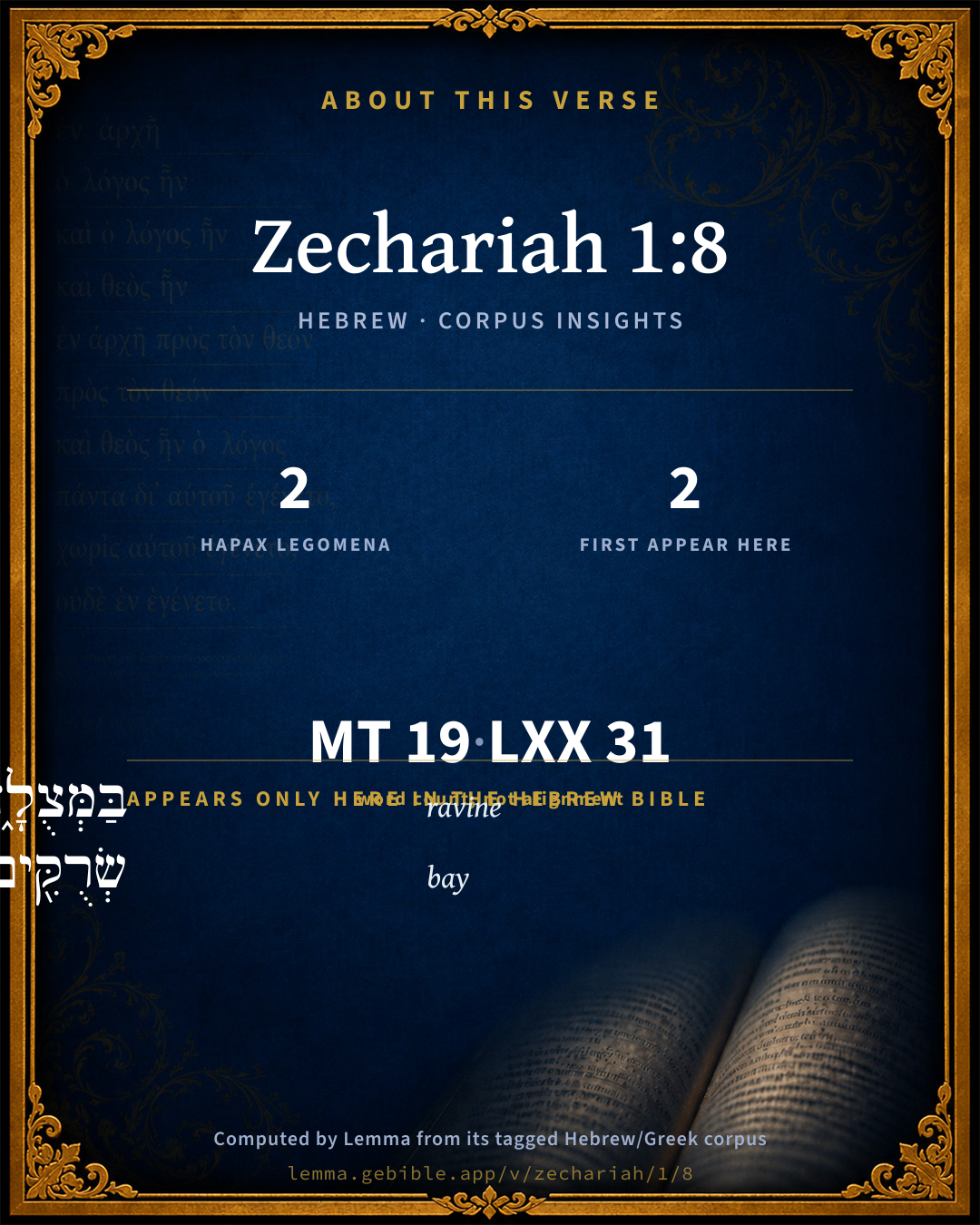
  • 2 hapax legomena — only here in the Hebrew Bible
  • 2 first appearances in the Hebrew Bible
Full analysis ↓
Download a study sheet

One document with this verse’s original text, its word-by-word gloss line, the meaning frame, cross-references with their text, attributed commentary, and full source and license credits — printable, and it pastes into notes with its structure intact.

This verse Autodidact and up

Study sheet (.html) Plain text (.txt)

A passage Seminary Student

Up to 50 verses in one chapter. A passage sheet keeps up to 6 commentary sources and 12 cross-references per verse, in the order this page ranks them, and says so on the sheet whenever that leaves anything out. Ask for a single verse and you get the Autodidact verse sheet above.

Everything on this page stays free to read, with no account — the sheet is a download of what is already on screen, not access to it.

Want to remove ads? Support Godless Engineer
Compare translations 3

The same verse in 3 English versions, stacked beneath the original-language interlinear above. Click any original word for its lexicon entry.

Each is an independent rendering of the whole verse — the interlinear is not word-aligned to these translations.

Highlighted words mark where these versions differ — a whole-verse word diff, not a word-by-word alignment.

  • World English Bible Public Domain
    "I had a vision in the night, and, behold, a man riding on a red horse, and he stood among the myrtle trees that were in a ravine; and behind him there were red, brown, and white horses.
  • King James Version Public Domain
    I saw by night, and behold a man riding upon a red horse, and he stood among the myrtle trees that were in the bottom; and behind him were there red horses, speckled, and white.
  • unfoldingWord Literal Text CC BY-SA 4.0
    I saw in the night, and behold, a man riding on a red horse, and he was standing among the myrtle trees that in the deep valley, and behind him red, reddish-brown, and white horses.

unfoldingWord Literal Text — © unfoldingWord, licensed CC BY-SA 4.0. Word-aligned USFM3 via Door43 (git.door43.org/unfoldingWord/en_ult).

Versions to compare (up to 4)

3 of 4 selected

Show all 18 translations

Every available English version of this verse, each an independent rendering of the whole verse.

  • World English Bible Public Domain
    "I had a vision in the night, and, behold, a man riding on a red horse, and he stood among the myrtle trees that were in a ravine; and behind him there were red, brown, and white horses.
  • Berean Standard Bible Public Domain
    I looked out into the night and saw a man riding on a red horse. He was standing among the myrtle trees in the hollow, and behind him were red, sorrel, and white horses.
  • Majority Standard Bible Public Domain
    I looked out into the night and saw a man riding on a red horse. He was standing among the myrtle trees in the hollow, and behind him were red, sorrel, and white horses.
  • King James Version Public Domain
    I saw by night, and behold a man riding upon a red horse, and he stood among the myrtle trees that were in the bottom; and behind him were there red horses, speckled, and white.
  • American Standard Version (1901) Public Domain
    I saw in the night, and, behold, a man riding upon a red horse, and he stood among the myrtle-trees that were in the bottom; and behind him there were horses, red, sorrel, and white.
  • Revised Version (1885) Public Domain
    I saw in the night, and behold a man riding upon a red horse, and he stood among the myrtle trees that were in the bottom; and behind him there were horses, red, sorrel, and white.
  • Geneva Bible (1599) Public Domain
    I saw by night, and behold a man riding vpon a red horse, and hee stood among the mirre trees, that were in a bottome, and behinde him were there red horses speckeled and white.
  • Douay-Rheims (1899) Public Domain
    I saw by night, and behold a man riding upon a red horse, and he stood among the myrtle trees, that were in the bottom: and behind him were horses, red, speckled, and white.
  • Young's Literal Translation Public Domain
    I have seen by night, and lo, one riding on a red horse, and he is standing between the myrtles that `are' in the shade, and behind him `are' horses, red, bay, and white.
  • Literal Standard Version CC BY-SA 4.0
    I have seen by night, and behold, one riding on a red horse, and he is standing between the myrtles that [are] in the shade, and behind him [are] horses, red, bay, and white.
  • Unlocked Literal Bible CC BY-SA 4.0
    “I saw in the night, and, look! a man was riding on a red horse, and he was among the myrtle trees that are in the valley; and behind him there were red, reddish-brown, and white horses.”
  • unfoldingWord Literal Text CC BY-SA 4.0
    I saw in the night, and behold, a man riding on a red horse, and he was standing among the myrtle trees that in the deep valley, and behind him red, reddish-brown, and white horses.
  • Darby Bible Public Domain
    I saw by night, and behold, a man riding upon a red horse, and he stood among the myrtle-trees that were in the low valley; and behind him were red, bay, and white horses.
  • World Messianic Bible Public Domain
    “I had a vision in the night, and behold, a man riding on a red horse, and he stood among the myrtle trees that were in a ravine; and behind him there were red, brown, and white horses.
  • Webster's Bible Public Domain
    I saw by night, and behold a man riding upon a red horse, and he stood among the myrtle-trees that were in the bottom; and behind him were there red horses, speckled, and white.
  • Free Bible Version CC BY-SA 4.0
    During the night I saw a man sitting on a red horse that stood among some myrtle trees in a narrow valley. Behind him were red, brown, and white horses with their riders.
  • Bible in Basic English Public Domain
    I saw in the night a man on a red horse, between the mountains in the valley, and at his back were horses, red, black, white, and of mixed colours.
  • JPS Tanakh (1917) Public Domain
    I saw in the night, and behold a man riding upon a red horse, and he stood among the myrtle-trees that were in the bottom; and behind him there were horses, red, sorrel, and white.

Literal Standard Version (2020), Covenant Press — licensed CC BY-SA 4.0. Text via the HelloAO Bible API (eBible.org). Unlocked Literal Bible (unfoldingWord) — licensed CC BY-SA 4.0. Text via the HelloAO Bible API (eBible.org). unfoldingWord Literal Text — © unfoldingWord, licensed CC BY-SA 4.0. Word-aligned USFM3 via Door43 (git.door43.org/unfoldingWord/en_ult). Free Bible Version, Dr. Jonathan Gallagher — licensed CC BY-SA 4.0. Text via the HelloAO Bible API (eBible.org).

Word by word

More ways to search: Search by grammar → Find every occurrence → Compare this word →

Practice this passage: Drill this verse → Learn its vocabulary →

בַּמְּצֻלָ֑ה
mᵉtsullâh
H4699
“in/at the · ravine”
Preposition, Determined + Noun, Common, Feminine, Singular, Absolute
Part of Speech
Preposition + Noun
Type
Common
Gender
Feminine
Number
Singular
State
Absolute
Full BDB Definition

Origin: from H6751

TWOT: 1889c

ravine, basin, hollow - apparently a place near Jerusalem
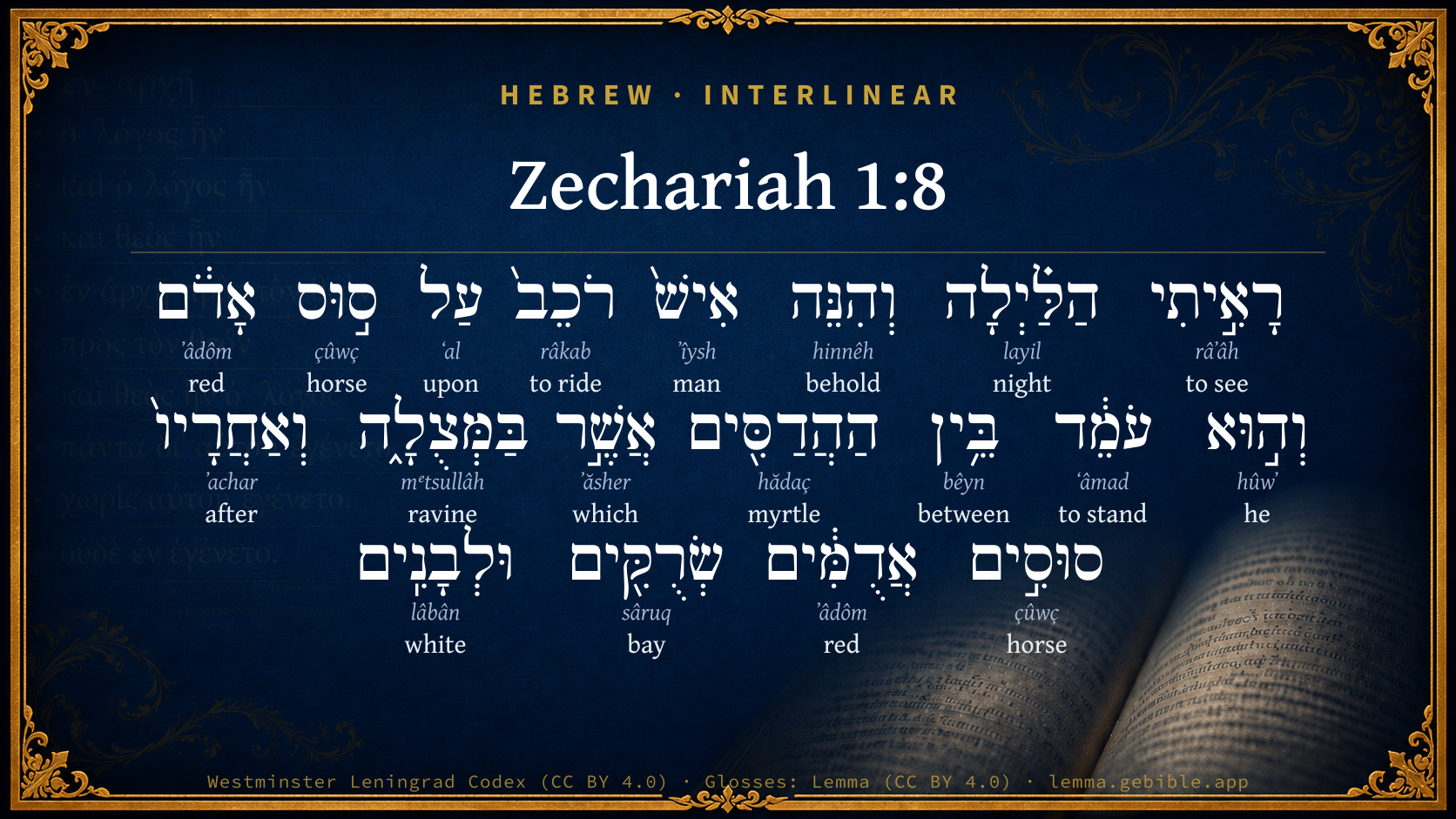
  1. רָאִ֣יתִי râʼâh H7200 “to see” Verb, Qal, Perfect, 1st Person, Common, Singular
  2. הַלַּ֗יְלָה layil H3915 “the · night” Particle, Definite Article + Noun, Common, Masculine, Singular, Absolute
  3. וְהִנֵּה hinnêh H2009 “and · behold” Conjunction + Particle, Demonstrative
  4. אִישׁ֙ ʼîysh H376 “man” Noun, Common, Masculine, Singular, Absolute
  5. רֹכֵב֙ râkab H7392 “riding” Verb, Qal, Participle Active, Masculine, Singular, Absolute
  6. עַל ʻal H5921 “upon” Preposition
  7. ס֣וּס çûwç H5483 “horse” Noun, Common, Masculine, Singular, Absolute
  8. אָדֹ֔ם ʼâdôm H122 “red” Adjective, Adjective, Masculine, Singular, Absolute
  9. וְה֣וּא hûwʼ H1931 “and · he” Conjunction + Pronoun, Personal, 3rd Person, Masculine, Singular
  10. עֹמֵ֔ד ʻâmad H5975 “standing” Verb, Qal, Participle Active, Masculine, Singular, Absolute
  11. בֵּ֥ין bêyn H996 “between” Preposition
  12. הַהֲדַסִּ֖ים hădaç H1918 “the · myrtles” Particle, Definite Article + Noun, Common, Masculine, Plural, Absolute
  13. אֲשֶׁ֣ר ʼăsher H834 “which” Particle, Relative
  14. וְאַחֲרָיו֙ ʼachar H310 “and · after · him” Conjunction + Preposition + Suffix, Personal, 3rd Person, Masculine, Singular
  15. סוּסִ֣ים çûwç H5483 “horses” Noun, Common, Masculine, Plural, Absolute
  16. אֲדֻמִּ֔ים ʼâdôm H122 “red” Adjective, Adjective, Masculine, Plural, Absolute
  17. שְׂרֻקִּ֖ים sâruq H8320 “bay” Adjective, Adjective, Masculine, Plural, Absolute
  18. וּלְבָנִֽים lâbân H3836 “and · white” Conjunction + Adjective, Adjective, Masculine, Plural, Absolute

About this verse

These counts appear in no published source. They are computed here, from the morphology-tagged text and Lemma’s own curated glosses. What Lemma adds →

19
words
17
distinct lemmas
Prophets
section

Notable vocabulary

2 hapax legomena — words that appear only here in the entire Hebrew Bible:

  • בַּמְּצֻלָ֑ה ravine H4699
  • שְׂרֻקִּ֖ים bay H8320

First appearance in Scripture

These words make their first canonical appearance in the Hebrew Bible here:

  • בַּמְּצֻלָ֑ה ravine H4699
  • שְׂרֻקִּ֖ים bay H8320

Shared distinctive vocabulary

הַהֲדַסִּ֖ים myrtle H1918 occurs in 6 verses of the Hebrew Bible. Also found in:

Grammatical profile

  • 3 verbs
  • 6 nouns
  • 4 adjectives
  • 1 pronoun
  • 3 prepositions
  • 2 particles

Verb forms

  • רָאִ֣יתִי Qal · Perfect
  • רֹכֵב֙ Qal · Participle Active
  • עֹמֵ֔ד Qal · Participle Active

Repetition

Words recur within this verse — often emphatic in Hebrew:

  • ס֣וּס horse H5483 ×2
  • אָדֹ֔ם red H122 ×2

Hebrew & Septuagint length

In English translation the verse runs 38 words from the Hebrew and 32 from the Septuagint (LXX English) — closely comparable.

A rough comparison of the two English renderings, which tokenize alike — not a word-level alignment.

Word counts can differ between the Hebrew and the Greek without any difference in meaning — e.g. the Hebrew direct-object marker אֵת has no separate Greek word, and Greek often adds the article ὁ.

In the original languages it is 19 Hebrew tokens and 31 Greek tokens — but the two are counted differently (Hebrew bundles its prefixes and suffixes into one token; the Greek is in lemma form), so that isn’t a like-for-like length.

Cross-references

19

Topical passages linked to Zechariah 1:8 in the Treasury of Scripture Knowledge — connected by theme and wording, ordered by reader-vote popularity; previews shown in the World English Bible.

  • Revelation 6:4 Another came forth, a red horse. To him who sat on it was given power to take peace from the earth, and that they should kill one another. There was given to him a great sword.
  • Isaiah 55:13 Instead of the thorn shall come up the fir tree; and instead of the brier shall come up the myrtle tree: and it shall be to Yahweh for a name, for an everlasting sign that shall not be cut off.
  • Isaiah 41:19 I will put in the wilderness the cedar, the acacia, and the myrtle, and the oil tree; I will set in the desert the fir tree, the pine, and the box tree together:
  • Zechariah 13:7 "Awake, sword, against my shepherd, And against the man who is close to me," says Yahweh of Hosts. Strike the shepherd, and the sheep will be scattered; And I will turn my hand against the little ones.
  • Revelation 2:1 To the angel of the assembly in Ephesus write: "He who holds the seven stars in his right hand, he who walks among the seven golden lampstands says these things:
  • Genesis 20:3 But God came to Abimelech in a dream of the night, and said to him, "Behold, you are a dead man, because of the woman whom you have taken. For she is a man's wife."
  • Joshua 5:13 It happened, when Joshua was by Jericho, that he lifted up his eyes and looked, and, behold, there stood a man over against him with his sword drawn in his hand: and Joshua went to him, and said to him, Are you for us, or for our adversaries?
  • 1 Kings 3:5 In Gibeon Yahweh appeared to Solomon in a dream by night; and God said, Ask what I shall give you.
  • Job 4:13 In thoughts from the visions of the night, When deep sleep falls on men,
  • Psalms 45:3–4 Gird your sword on your thigh, mighty one: Your splendor and your majesty.
  • Isaiah 57:15 For thus says the high and lofty One who inhabits eternity, whose name is Holy: I dwell in the high and holy place, with him also who is of a contrite and humble spirit, to revive the spirit of the humble, and to revive the heart of the contrite.
  • Isaiah 63:1–4 Who is this who comes from Edom, with dyed garments from Bozrah? this who is glorious in his clothing, marching in the greatness of his strength? I who speak in righteousness, mighty to save.
  • Daniel 2:19 Then was the secret revealed to Daniel in a vision of the night. Then Daniel blessed the God of heaven.
  • Daniel 7:2 Daniel spoke and said, I saw in my vision by night, and, behold, the four winds of the sky broke forth on the great sea.
  • Daniel 7:13 I saw in the night-visions, and, behold, there came with the clouds of the sky one like a son of man, and he came even to the ancient of days, and they brought him near before him.
  • Zechariah 6:2–7 In the first chariot were red horses; in the second chariot black horses;
  • Revelation 19:19–21 I saw the beast, and the kings of the earth, and their armies, gathered together to make war against him who sat on the horse, and against his army.
  • Song of Solomon 2:16 My beloved is mine, and I am his. He browses among the lilies.
  • Song of Solomon 6:2 My beloved has gone down to his garden, To the beds of spices, To feed in the gardens, and to gather lilies.

Cross-references courtesy of OpenBible.info (CC BY 4.0).

Hebrew and Greek witnesses Masoretic Hebrew ↔ Greek Septuagint

The same verse in the two great witnesses to the Old Testament, shown verse-for-verse.

These are two independent witnesses, not word-aligned to each other, and the Septuagint is shown in lemma (dictionary) form.

Hebrew Zechariah 1:8 Masoretic · Westminster Leningrad Codex

רָאִ֣יתִי הַלַּ֗יְלָה וְהִנֵּה אִישׁ֙ רֹכֵב֙ עַל ס֣וּס אָדֹ֔ם וְה֣וּא עֹמֵ֔ד בֵּ֥ין הַהֲדַסִּ֖ים אֲשֶׁ֣ר בַּמְּצֻלָ֑ה וְאַחֲרָיו֙ סוּסִ֣ים אֲדֻמִּ֔ים שְׂרֻקִּ֖ים וּלְבָנִֽים

"I had a vision in the night, and, behold, a man riding on a red horse, and he stood among the myrtle trees that were in a ravine; and behind him there were red, brown, and white horses.

World English Bible · Public Domain

Greek LXX Zechariah 1:8 Septuagint · lemma form

ὁράω ὁ νύξ καί ἰδού ἀνήρ ἐπιβαίνω ἐπί ἵππος πυρρός καί οὗτος ἵστημι ἀνά μέσος ὁ δύο ὄρος ὁ κατάσκιος καί ὀπίσω αὐτός ἵππος πυρρός καί ψαρός καί ποικίλος καί λευκός

I saw by night, and behold a man mounted on a red horse, and he stood between the shady mountains; and behind him were red horses, and grey, and piebald, and white.

LXX2012 (modern English Septuagint) · Public Domain

On this verse, Keil & Delitzsch discusses the Septuagint’s reading. Read the note in Commentary ↓

Hebrew: Westminster Leningrad Codex (CC BY 4.0). Greek: Septuagint (public domain); English from LXX2012 (modern English Septuagint) (Public Domain). How the Septuagint differs from the Hebrew →

Targum (Aramaic paraphrase)

1

The Targum is the ancient Jewish Aramaic paraphrase of the Hebrew Scriptures — an interpretive translation, not the Hebrew text itself. Onkelos (literal) and Pseudo-Jonathan (expansive) render the Torah, and Jonathan the Prophets. Coverage is partial: where no permissively-licensed English translation exists for a verse, only the Aramaic is shown. This is verse-level text, not a word-by-word alignment to the Hebrew.

  1. Targum Jonathan Prophets (Joshua–Malachi)
    חֲזֵיתִי בְּלֵילְיָא וְהָא גְבַר רָכִיב עַל סוּסֵי סִמוֹק וְהוּא קָאֵים בֵּין אִילָנַיָא דַהֲדַסַיָא דִי בְּבָבֶל וּבַתְרוֹהִי סוּסְוָן סוּמְקִין קְוָחִין וְחִוְרְיָן:

    (no public-domain English translation for this verse)

    Targum Jonathan — Aramaic: “Mikraot Gedolot” (public domain). English: “Sefaria Community Translation” (CC0 1.0 (public-domain dedication)); “London "Chaldee Paraphrase," 1871” (public domain). Text via Sefaria.

Commentary

Notes on Zechariah 1:8 from classic Christian and Jewish commentators (each source and its license shown beneath its notes). The classic Christian expositions comment on the surrounding passage and are grouped to its opening verse, so a note may address several verses; the Jewish commentaries on the Tanakh (Rashi and others) are per-verse, so they appear only where the commentator wrote on this verse.

Lemma curates 59 commentaries, every one of them public domain or Creative Commons licensed, each selected and text-cleaned for this edition rather than reprinted as found. About our sources →

Trapp's Complete Commentary

John Trapp

Zec 1:8 I saw by night, and behold a man riding upon a red horse, and he stood among the myrtle trees that [were] in the bottom; and behind him [were there] red horses, speckled, and white.

Ver. 8. I saw by night] The usual time for such revelations. It may note, moreover, the obscurity of the prophecy; hence also the mention of myrtle trees, low and shady, and that in a bottom, as Calvin conceiveth; and all this that he might give a taste of good hope to the Jews by little and little.

And behold a man riding upon a red horse] Not Alexander the Great, riding upon his horse Bucephalus, and translating the empire from the Persians to the Grecians, as Arias Montanus conceited it; but the man Christ Jesus, 1Ti 2:5, the Captain of the Lord’s host, Jos 4:14, and of our salvation, Heb. ii. 0.

Riding upon a red horse] In the same sense, saith one, that this colour is given to his garments, Isa 63:1-3, and to the angel’s horse, Rev 6:4. The wild bull, saith another, of all things, cannot abide any red colour. Therefore the hunter for the nonce, standing before a tree, puts on a red garment; whom when the bull seeth, he runneth at him as hard as he can drive; but the hunter, stepping aside, the bull’s horns stick fast in the tree; as, when David slipped aside, Saul’s spear stuck fast in the wall. Such a hunter is Christ; he, lifted up upon the tree of his cross, had his garment dipped and dyed in his own blood, as one that cometh with red garments from Bozrah. Therefore the devil and his angels (like wild bulls of Bashan) ran at him with all their force (in that three-hours’ darkness especially), but he, delivering himself as a mighty conqueror, their horns stick fast, as it were, in his cross; as Abraham’s ram, by his horns, stuck fast in the brier.

And he stood among the myrtle trees that were in the bottom] Myrrh trees some render it. Here Christ, that horseman and head of his Church, keepeth himself, as touched with the feeling of our infirmities, Heb 4:15, as suffering and sorrowing with his people, who are fitly compared to myrtles, that grow in a shady grove, in valleys and bottoms, and by waters’ sides, et amantes littora myrtos (Virg. Georg.). "Blessed are ye that sow beside all waters," Isa 32:20. Myrtles also are odoriferous, and precious, Isa 41:19; Isa 55:13; so are the saints, Isa 43:4 Col 4:6, they cast a good scent wherever they go, by the grace of God that is in them; as Alexander the Great is said to do, by the excellent temperament of his body. Lastly, Lev 23:40 cf. Neh 8:15, the Jews, at their joyful feast of tabernacles, used myrtle branches among others, to testify their thankfulness for a settlement in the promised land, after so long wandering in the wilderness. The Gentiles also in their solemn feasts, interludes, and - cingebant tempera myrto, wore garlands made of myrtles. Let us keep the feast; let us keep holy day (εορταζωμεν), saith the apostle, 1Co 5:8, who himself did over abound exceedingly with joy, had an exuberance of it, at that constant feast of a good conscience, 2Co 7:4. Diogenes could say that a good man keeps holy day all the year about. Christ crowneth the calendar of his people’s lives with continual, festivals here how much more in heaven! Pliny tells us that ex myrto facta est ovantium corona, subinde et triumphantium; of myrtle was made, among the Romans, the crown or garland of those that did shout for victory, or ride in triumph.

And behind him were there red horses] i.e. Horsemen: Nam nimis crassum est illud commentum, fuisse locatos equos, saith Calvin here. These horsemen are angels, as Zec 1:10, deputed to several offices and executions, for judgment, for mercy, or both; shadowed by the various colours of their horses.

John Trapp, A Commentary or Exposition upon All the Books of the Old and New Testament (1647–1656) — public domain. Text from a community e-Sword module.

Keil & Delitzsch

C. F. Keil & F. Delitzsch

Zac 1:8. "I saw by night, and behold a man riding upon a red horse, and he stood among the myrtles which were in the hollow; and behind him red, speckled, and white horses. Zac 1:9. And I said, What are these, my lord? Then the angel that talked with me said to me, I will show thee what these are. Zac 1:10. And the man who stood among the myrtles answered and said, These are they whom Jehovah hath sent to go through the earth. Zac 1:11. And they answered the angel of Jehovah who stood among the myrtles, and said, We have gone through the earth, and, behold, the whole earth sits still, and at rest. Zac 1:12. Then the angel of Jehovah answered and said, Jehovah of hosts, how long wilt Thou not have compassion upon Jerusalem and the cities of Judah, with whom Thou hast been angry these seventy years? Zac 1:13. And Jehovah answered the angel that talked with me good words, comforting words. Zac 1:14. And the angel that talked with me said to me, Preach, and say, Thus saith Jehovah of hosts, I have been jealous for Jerusalem and Zion with great jealousy, Zac 1:15 and with great wrath I am angry against the nations at rest: for I had been angry for a little, but they helped for harm. Zac 1:16. Therefore thus saith Jehovah, I turn again to Jerusalem with compassion: my house shall be built in it, is the saying of Jehovah of hosts, and the measuring line shall be drawn over Jerusalem. Zac 1:17. Preach as yet, and say, Thus saith Jehovah of hosts, My cities shall yet swell over with good, and Jehovah will yet comfort Zion, and will yet choose Jerusalem." The prophet sees, during the night of the day described in Zac 1:7 (הלּילה is the accusative of duration), in an ecstatic vision, not in a dream but in a waking condition, a rider upon a red horse in a myrtle-bush, stopping in a deep hollow, and behind him a number of riders upon red, speckled, and white horses (sūsı̄m are horses with riders, and the reason why the latter are not specially mentioned is that they do not appear during the course of the vision as taking any active part, whilst the colour of their horses is the only significant feature). At the same time he also sees, in direct proximity to himself, an angel who interprets the vision, and farther off (Zac 1:11) the angel of Jehovah also standing or stopping among the myrtle-bushes, and therefore in front of the man upon a red horse, to whom the riders bring a report, that they have gone through the earth by Jehovah's command and have found the whole earth quiet and at rest; whereupon the angel of Jehovah addresses a prayer to Jehovah for pity upon Jerusalem and the cities of Judah, and receives a good consolatory answer, which the interpreting angel conveys to the prophet, and the latter publicly proclaims in Zac 1:14-17.

The rider upon the red horse is not to be identified with the angel of Jehovah, nor the latter with the angelus interpres. It is true that the identity of the rider and the angel of Jehovah, which many commentators assume, is apparently favoured by the circumstance that they are both standing among the myrtles (‛ōmēd, stood; see Zac 1:8, Zac 1:10, and Zac 1:11); but all that follows from this is that the rider stopped at the place where the angel of Jehovah was standing, i.e., in front of him, to present a report to him of the state of the earth, which he had gone through with his retinue. This very circumstance rather favours the diversity of the two, inasmuch as it is evident from this that the rider upon the red horse was simply the front one, or leader of the whole company, who is brought prominently forward as the spokesman and reporter. If the man upon the red horse had been the angel of Jehovah Himself, and the troop of horsemen had merely come to bring information to the man upon the red horse, the troop of horsemen could not have stood behind him, but would have stood either opposite to him or in front of him. And the different epithets applied to the two furnish a decisive proof that the angel of the Lord and "the angel that talked with me" are not one and the same. The angel, who gives or conveys to the prophet the interpretation of the vision, is constantly called "the angel that talked with me," not only in Zac 1:9, where it is preceded by an address on the part of the prophet to this same angel, but also in Zac 1:13 and Zac 1:14, and in the visions which follow (Zac 2:2, Zac 2:7; Zac 4:1, Zac 4:4; Zac 5:5, Zac 5:10; Zac 6:4), from which it is perfectly obvious that הדּבר בּי denotes the function which this angel performs in these visions (dibber be, signifying the speaking of God or of an angel within a man, as in Hos 1:2; Hab 2:1; Num 12:6, Num 12:8). His occupation, therefore, was to interpret the visions to the prophet, and convey the divine revelations, so that he was only an angelus interpres or collocutor. This angel appears in the other visions in company with other angels, and receives instructions from them (Zac 2:5-8); and his whole activity is restricted to the duty of conveying higher instructions to the prophet, and giving him an insight into the meaning of the visions, whereas the angel of Jehovah stands on an equality with God, being sometimes identified with Jehovah, and at other times distinguished from Him. (Compare the remarks upon this subject in the comm. on Genesis, Pent. pp. 118ff.) In the face of these facts, it is impossible to establish the identity of the two by the arguments that have been adduced in support of it. It by no means follows from Zac 1:9, where the prophet addresses the mediator as "my lord," that the words are addressed to the angel of the Lord; for neither he nor the angelus interpres has been mentioned before; and in the visions persons are frequently introduced as speaking, according to their dramatic character, without having been mentioned before, so that it is only from what they say or do that it is possible to discover who they are. Again, the circumstance that in Zac 1:12 the angel of the Lord presents a petition to the Supreme God on behalf of the covenant nation, and that according to Zac 1:13 Jehovah answers the angelus interpres in good, comforting words, does not prove that he who receives the answer must be the same person as the intercessor: for it might be stated in reply to this, as it has been by Vitringa, that Zechariah has simply omitted to mention that the answer was first of all addressed to the angel of the Lord, and that it was through him that it reached the mediating angel; or we might assume, as Hengstenberg has done, that "Jehovah addressed the answer directly to the mediating angel, because the angel of the Lord had asked the question, not for his own sake, but simply for the purpose of conveying consolation and hope through the mediator to the prophet, and through him to the nation generally."

There is no doubt that, in this vision, both the locality in which the rider upon the red horse, with his troop, and the angel of the Lord had taken up their position, and also the colour of the horses, are significant. But they are neither of them easy to interpret. Even the meaning of metsullâh is questionable. Some explain it as signifying a "shady place," from צל, a shadow; but in that case we should expect the form metsillâh. There is more authority for the assumption that metsullâh is only another form for metsūlâh, which is the reading in many codd., and which ordinarily stands for the depth of the sea, just as in Exo 15:10 tsâlal signifies to sink into the deep. The Vulgate adopts this rendering: in profundo. Here it signifies, in all probability, a deep hollow, possibly with water in it, as myrtles flourish particularly well in damp soils and by the side of rivers (see Virgil, Georg. ii. 112, iv. 124). The article in bammetsullâh defines the hollow as the one which the prophet saw in the vision, not the ravine of the fountain of Siloah, as Hofmann supposes (Weissagung u. Erfllung, i. p. 333). The hollow here is not a symbol of the power of the world, or the abyss-like power of the kingdoms of the world (Hengstenberg and M. Baumgarten), as the author of the Chaldee paraphrase in Babele evidently thought; for this cannot be proved from such passages as Zac 10:1-12 :16, Isa 44:27, and Psa 107:24. In the myrtle-bushes, or myrtle grove, we have no doubt a symbol of the theocracy, or of the land of Judah as a land that was dear and lovely in the estimation of the Lord (cf. Dan 8:9; Dan 11:16), for the myrtle is a lovely ornamental plant. Hence the hollow in which the myrtle grove was situated, can only be a figurative representation of the deep degradation into which the land and people of God had fallen at that time. There is a great diversity of opinion as to the significance of the colour of the horses, although all the commentators agree that the colour is significant, as in Zac 6:2. and Rev 6:2., and that this is the only reason why the horses are described according to their colours, and the riders are not mentioned at all. About two of the colours there is no dispute. אדום, red, the colour of the blood; and לבן, white, brilliant white, the reflection of heavenly and divine glory (Mat 17:2; Mat 28:3; Act 1:10), hence the symbol of a glorious victory (Rev 6:2). The meaning of seruqqı̄m is a disputed one. The lxx have rendered it ψαροὶ καὶ ποικίλοι, like בּרדּים אמצּים in Zac 6:3; the Itala and Vulgate, varii; the Peshito, versicolores. Hence sūsı̄m seruqqı̄m would correspond to the ἵππος χλωρός of Rev 6:8. The word seruqqı̄m only occurs again in the Old Testament in Isa 16:8, where it is applied to the tendrils or branches of the vine, for which sōrēq (Isa 5:2; Jer 2:21) or serēqâh (Gen 49:11) is used elsewhere. On the other hand, Gesenius (Thes. s.v.) and others defend the meaning red, after the Arabic ašqaru, the red horse, the fox, from šaqira, to be bright red; and Koehler understands by sūsı̄m seruqqı̄m, bright red, fire-coloured, or bay horses. But this meaning cannot be shown to be in accordance with Hebrew usage: for it is a groundless conjecture that the vine branch is called sōrēq from the dark-red grapes (Hitzig on Isa 5:2); and the incorrectness of it is evident from the fact, that even the Arabic šaqira does not denote dark-red, but bright, fiery red. The Arabic translator has therefore rendered the Greek πυῤῥός by Arab. ašqaru in Sol 5:9; but πυῤῥός answers to the Hebrew אדום, and the lxx have expressed sūsı̄m 'ădummı̄m by ἵπποι πυῤῥοί both here and in Zac 6:2. If we compare this with ch. Zac 6:2, where the chariots are drawn by red ('ădummı̄m, πυῤῥοί), black (shechōrı̄m, μέλανες), white (lebhânı̄m, λευκοί), and speckled (beruddı̄m, ψαροί) horses, and with Revelation 6, where the first rider has a white horse (λευκός), the second a red one (πυῥῥός), the third a black one (μέλας), the fourth a pale horse (χλωρός), there can be no further doubt that three of the colours of the horses mentioned here occur again in the two passages quoted, and that the black horse is simply added as a fourth; so that the seruqqı̄m correspond to the beruddı̄m of Zac 6:3, and the ἵππος χλωρός of Rev 6:8, and consequently sârōq denotes that starling kind of grey in which the black ground is mixed with white, so that it is not essentially different from bârōd, speckled, or black covered with white spots (Gen 31:10, Gen 31:12).

By comparing these passages with one another, we obtain so much as certain with regard to the meaning of the different colours, - namely, that the colours neither denote the lands and nations to which the riders had been sent, as Hvernick, Maurer, Hitzig, Ewald, and others suppose; nor the three imperial kingdoms, as Jerome, Cyril, and others have attempted to prove. For, apart from the fact that there is no foundation whatever for the combination proposed, of the red colour with the south as the place of light, or of the white with the west, the fourth quarter of the heavens would be altogether wanting. Moreover, the riders mentioned here have unquestionably gone through the earth in company, according to Zac 1:8 and Zac 1:11, or at any rate there is no intimation whatever of their having gone through the different countries separately, according to the colour of their respective horses; and, according to Zac 6:6, not only the chariot with the black horses, but that with the white horses also, goes into the land of the south. Consequently the colour of the horses can only be connected with the mission which the riders had to perform. This is confirmed by Revelation 6, inasmuch as a great sword is there given to the rider upon the red horse, to take away peace from the earth, that they may kill one another, and a crown to the rider upon the white horse, who goes forth conquering and to conquer (Rev 6:2), whilst the one upon the pale horse receives the name of Death, and has power given to him to slay the fourth part of the earth with sword, famine, and pestilence (Rev 6:8). It is true that no such effects as these are attributed to the riders in the vision before us, but this constitutes no essential difference. To the prophet's question, mâh-'ēlleh, what are these? i.e., what do they mean? the angelus interpres, whom he addresses as "my lord" ('ădōnı̄), answers, "I will show thee what these be;" whereupon the man upon the red horse, as the leader of the company, gives this reply: "These are they whom Jehovah hath sent to go through the earth;" and then proceeds to give the angel of the Lord the report of their mission, viz., "We have been through the earth, and behold all the earth sitteth still and at rest." The man's answer (vayya‛an, Zac 1:10) is not addressed to the prophet or to the angelus interpres, but to the angel of the Lord mentioned in Zac 1:11, to whom the former, with his horsemen (hence the plural, "they answered," in Zac 1:11), had given a report of the result of their mission. The verb ‛ânâh, to answer, refers not to any definite question, but to the request for an explanation contained in the conversation between the prophet and the interpreting angel. חארץ, in Zac 1:10 and Zac 1:11, is not the land of Judah, or any other land, but the earth. The answer, that the whole earth sits still and at rest (ישׁבת ושׁקטת denotes the peaceful and secure condition of a land and its inhabitants, undisturbed by any foe; cf. Zac 7:7; Ch1 4:40, and Jdg 18:27), points back to Hag 2:7-8, Hag 2:22-23. God had there announced that for a little He would shake heaven and earth, the whole world and all nations, that the nations would come and fill His temple with glory. The riders sent out by God now return and report that the earth is by no means shaken and in motion, but the whole world sits quiet and at rest. We must not, indeed, infer from this account that the riders were all sent for the simple and exclusive purpose of obtaining information concerning the state of the earth, and communicating it to the Lord. For it would have been quite superfluous and unmeaning to send out an entire troop, on horses of different colours, for this purpose alone. Their mission was rather to take an active part in the agitation of the nations, if any such existed, and guide it to the divinely appointed end, and that in the manner indicated by the colour of their horses; viz., according to Revelation 6, those upon the red horses by war and bloodshed; those upon the starling-grey, or speckled horses, by famine, pestilence, and other plagues; and lastly, those upon the white horses, by victory and the conquest of the world.

In the second year of Darius there prevailed universal peace; all the nations of the earlier Chaldaean empire were at rest, and lived in undisturbed prosperity. Only Judaea, the home of the nation of God, was still for the most part lying waste, and Jerusalem was still without walls, and exposed in the most defenceless manner to all the insults of the opponents of the Jews. Such a state of things as this necessarily tended to produce great conflicts in the minds of the more godly men, and to confirm the frivolous in their indifference towards the Lord. As long as the nations of the world enjoyed undisturbed peace, Judah could not expect any essential improvement in its condition. Even though Darius had granted permission for the building of the temple to be continued, the people were still under the bondage of the power of the world, without any prospect of the realization of the glory predicted by the earlier prophets (Jer. 31; Isaiah 40), which was to dawn upon the nation of God when redeemed from Babylon. Hence the angel of the Lord addresses the intercessory prayer to Jehovah in Zac 1:12 : How long wilt Thou not have compassion upon Jerusalem, etc.? For the very fact that the angel of the Lord, through whom Jehovah had formerly led His people and brought them into the promised land and smitten all the enemies before Israel, now appears again, contains in itself one source of consolation. His coming was a sign that Jehovah had not forsaken His people, and His intercession could not fail to remove every doubt as to the fulfilment of the divine promises. The circumstance that the angel of Jehovah addresses an intercessory prayer to Jehovah on behalf of Judah, is no more a disproof of his essential unity with Jehovah, than the intercessory prayer of Christ in John 17 is a disproof of His divinity. The words, "over which Thou hast now been angry for seventy years," do not imply that the seventy years of the Babylonian captivity predicted by Jeremiah (Jer 25:11 and Jer 29:10) were only just drawing to a close. They had already expired in the first year of the reign of Cyrus (Ch2 36:22; Ezr 1:1). At the same time, the remark made by Vitringa, Hengstenberg, and others, must not be overlooked, - namely, that these seventy years were completed twice, inasmuch as there were also (not perhaps quite, but nearly) seventy years between the destruction of Jerusalem and of the temple, and the second year of Darius. Now, since the temple was still lying in ruins in the second year of Darius, notwithstanding the command to rebuild it that had been issued by Cyrus (Hag 1:4), it might very well appear as though the troubles of the captivity would never come to an end. Under such circumstances, the longing for an end to be put to the mournful condition of Judah could not fail to become greater and greater; and the prayer, "Put an end, O Lord, put an end to all our distress," more importunate than ever.

Jehovah replied to the intercession of the angel of the Lord with good and comforting words. Debhârı̄m tōbhı̄m are words which promise good, i.e., salvation (cf. Jos 23:14; Jer 29:10). So far as they set before the people the prospect of the mitigation of their distress, they are nichummı̄m, consolations. The word nichummı̄m is a substantive, and in apposition to debhârı̄m. Instead of the form nichummı̄m, the keri has the form nichumı̄m, which is grammatically the more correct of the two, and which is written still more accurately nichūmı̄m in some of the codd. in Kennicott. The contents of these words, which are addressed to the interpreting angel either directly or through the medium of the angel of Jehovah, follow in the announcement which the latter orders the prophet to make in Zac 1:14-17. קרא (Zac 1:14) as in Isa 40:6. The word of the Lord contains two things: (1) the assurance of energetic love on the part of God towards Jerusalem (Zac 1:14, Zac 1:15); and (2) the promise that this love will show itself in the restoration and prosperity of Jerusalem (Zac 1:16, Zac 1:17). קנּא, to be jealous, applied to the jealousy of love as in Joe 2:18; Num 25:11, Num 25:13, etc., is strengthened by קנאה גדולה. Observe, too, the use of the perfect קנּאתי, as distinguished from the participle קצף. The perfect is not merely used in the sense of "I have become jealous," expressing the fact that Jehovah was inspired with burning jealousy, to take Jerusalem to Himself (Koehler), but includes the thought that God has already manifested this zeal, or begun to put it in action, namely by liberating His people from exile. Zion, namely the mountain of Zion, is mentioned along with Jerusalem as being the site on which the temple stood, so that Jerusalem only comes into consideration as the capital of the kingdom. Jehovah is also angry with the self-secure and peaceful nations. The participle qōtsēph designates the wrath as lasting. Sha'ănân, quiet and careless in their confidence in their own power and prosperity, which they regard as secured for ever. The following word, אשׁר, quod, introduces the reason why God is angry, viz., because, whereas He was only a little angry with Israel, they assisted for evil. מעט refers to the duration, not to the greatness of the anger (cf. Isa 54:8). עזרוּ לרעה, they helped, so that evil was the result (לרעה as in Jer 44:11), i.e., they assisted not only as the instruments of God for the chastisement of Judah, but so that harm arose from it, inasmuch as they endeavoured to destroy Israel altogether (cf. Isa 47:6). It is no ground of objection to this definition of the meaning of the words, that לרעה in that case does not form an appropriate antithesis to מעט, which relates to time (Koehler); for the fact that the anger only lasted a short time, was in itself a proof that God did not intend to destroy His people. To understand עזרוּ לרעה as only referring to the prolonged oppression and captivity, does not sufficiently answer to the words. Therefore (lâkhēn, Zac 1:16), because Jehovah is jealous with love for His people, and very angry with the heathen, He has now turned with compassion towards Jerusalem. The perfect שׁבתּי is not purely prophetic, but describes the event as having already commenced, and as still continuing. This compassion will show itself in the fact that the house of God is to be built in Jerusalem, and the city itself restored, and all the obstacles to this are to be cleared out of the way. The measuring line is drawn over a city, to mark off the space it is to occupy, and the plan upon which it is to be arranged. The chethib קוה bihtehc , probably to be read קוה, is the obsolete form, which occurs again in Kg1 7:23 and Jer 31:39, and was displaced by the contracted form קו (keri). But the compassion of God will not be restricted to this. The prophet is to proclaim still more ("cry yet," Zac 1:17, referring to the "cry" in Zac 1:14). The cities of Jehovah, i.e., of the land of the Lord, are still to overflow with good, or with prosperity. Pūts, to overflow, as in Pro 5:16; and תּפוּצנּה for תּפוּצינה (vid., Ewald, 196, c). The last two clauses round off the promise. When the Lord shall restore the temple and city, then will Zion and Jerusalem learn that He is comforting her, and has chosen her still. The last thought is repeated in Zac 2:1-13 :16 and Zac 3:2.

In this vision it is shown to the prophet, and through him to the people, that although the immediate condition of things presents no prospect of the fulfilment of the promised restoration and glorification of Israel, the Lord has nevertheless already appointed the instruments of His judgment, and sent them out to overthrow the nations of the world, that are still living at rest and in security, and to perfect His Zion. The fulfilment of this consolatory promise is neither to be transferred to the end of the present course of this world, as is supposed by Hofmann (Weiss. u. Erfll. i. 335), who refers to Zac 14:18-19 in support of this, nor to be restricted to what was done in the immediate future for the rebuilding of the temple and of the city of Jerusalem. The promise embraces the whole of the future of the kingdom of God; so that whilst the commencement of the fulfilment is to be seen in the fact that the building of the temple was finished in the sixth year of Darius, and Jerusalem itself was also restored by Nehemiah in the reign of Artaxerxes, these commencements of the fulfilment simply furnished a pledge that the glorification of the nation and kingdom of God predicted by the earlier prophets would quite as assuredly follow.

Keil & Delitzsch — Biblical Commentary on the Old Testament (1861–1891) — public domain (CC PDM 1.0). Text via the HelloAO Bible API. (Old Testament only.)

Scofield Reference Notes

C. I. Scofield

I saw

The "man" (Zec 1:8) is the "my lord," "the angel that talked with me" (Zec 1:9), and "the angel of the Lord" (Zec 1:10; Zec 1:11). The "man" "stood among the myrtle trees" (Zec 1:8). The prophet addresses him as "my lord" (cf) Gen 19:2 but when the "man" answers he perceives that he has addressed an angel--"the angel that talked with me" (Zec 1:9). In Zec 1:10 the being of the vision is again "the man that stood among the myrtle trees." In Zec 1:11 he is called "the angel of the Lord," and to him the (riders on the) "red horses, speckled with white" say: "We have walked to and fro," etc. Then (Zec 1:12) "the angel of the Lord" (i.e. the "man," "my lord," "the angel that talked with me") intercedes for the land against a world at ease. The date of the intercession was at the end of the 70 years’ captivity of Judah. Zec 1:9-12.

Taken as a whole Zec 1:8-17 Zechariah’s first vision reveals Judah in dispersion; Jerusalem under adverse possession; and the Gentile nations at rest about it. This condition still continues, and Jehovah’s answer to the intercession of the angel sweeps on to the end-time of Gentile domination, when "the Lord shall yet comfort Zion," etc. (Zec 1:16; Zec 1:17).

Isa 40:1-5. See "Kingdom (O.T.)" (See Scofield "Gen 1:26") See Scofield "Zec 12:8".

red horse Cf. Rev 6:4. The whole Gentile period is characterized by the red horse, i.e. "sword."; Dan 9:26; Mat 24:6; Mat 24:7.

The Scofield Reference Bible (1917 edition), notes by C. I. Scofield — public domain. Text from a community e-Sword module.

Tyndale Open Study Notes

Tyndale Open Resources

1:8 The vision during the night follows a standard pattern: an introductory statement, a description of the vision, the prophet’s request for an interpretation, and an angelic explanation. • The myrtle trees were probably in the wooded Kidron valley outside of Jerusalem. The Lord had symbolically returned to the city’s outskirts but had not yet entered Jerusalem because the Temple was still under construction. • The colors of the red, brown, and white horses are not significant to this vision’s meaning. These angelic riders patrolled the earth (1:10), showing God’s continuing concern over Jerusalem.

Tyndale Open Study Notes — © Tyndale Open Resources, licensed CC BY-SA 4.0. Text via the HelloAO Bible API.

Geneva Bible (1599)

Geneva Bible translators

These signified the divers offices of God’s Angels by whom God sometimes punisheth and sometimes comforteth and bringeth forth his works in divers sorts.

This vision signifieth the restoration of the Church: but as yet it should not appear to man’s eyes, which is here meant by the night, by the bottom, and by the myrrh trees which are black, and give a dark shadow, yet he compareth God to a King, who hath his posts and messengers abroad by whom he still worketh his purpose and bringeth his matters to pass.

Who was the chief among the rest of the horsemen.

Geneva Bible (1599) marginal notes — public domain. Text via Bolls.life.

Jamieson, Fausset & Brown

Robert Jamieson, A. R. Fausset & David Brown

by night--The Jews begin their day with sunset; therefore the night which preceded the twenty-fourth day of the month is meant (Zac 1:7).

a man--Jehovah, the second person of the Trinity, manifested in man's form, an earnest of the incarnation; called the "angel of Jehovah" (Zac 1:11-12), "Jehovah the angel of the covenant" (Mal 3:1; compare Gen 16:7 with Zac 1:13; Gen 22:11 with Zac 1:12; Exo 3:2 with Zac 1:4). Being at once divine and human, He must be God and man in one person.

riding--implying swiftness in executing God's will in His providence; hastening to help His people.

red horse--the color that represents bloodshed: implying vengeance to be inflicted on the foes of Israel (compare Kg2 3:22; Isa 63:1-2; Rev 6:4); also fiery zeal.

among the myrtle trees--symbol of the Jewish Church: not a stately cedar, but a lowly, though fragrant, myrtle. It was its depressed state that caused the Jews to despond; this vision is designed to cheer them with better hopes. The uncreated angel of Jehovah's presence standing (as His abiding place, Psa 132:14) among them, is a guarantee for her safety, lowly though she now be.

in the bottom--in a low place or bottom of a river; alluding to Babylon near the rivers Euphrates and Tigris, the scene of Judah's captivity. The myrtle delights in low places and the banks of waters [PEMBELLUS]. MAURER translates, from a different root, "in a shady place."

red horses--that is, horsemen mounted on red horses; Zac 1:10-11, confirm this view.

speckled . . . white--The "white" implies triumph and victory for Judah; "speckled" (from a root "to intertwine"), a combination of the two colors white and red (bay [MOORE]), implies a state of things mixed, partly prosperous, partly otherwise [HENDERSON]; or, the connection of the wrath (answering to the "red") about to fall on the Jews' foes, and triumph (answering to the "white") to the Jews themselves in God's arrangements for His people [MOORE]. Some angels ("the red horses") exercised offices of vengeance; others ("the white"), those of joy; others ("the speckled"), those of a mixed character (compare Zac 6:2-3). God has ministers of every kind for promoting the interests of His Church.

Jamieson, Fausset & Brown — Commentary Critical and Explanatory on the Whole Bible (1871) — public domain (CC PDM 1.0). Text via the HelloAO Bible API.

Adam Clarke's Commentary

Verse 8. I saw by night] The time was emblematical of the affliction under which the Jews groaned.

A man] An angel in the form of a man: supposed to have been the Lord Jesus; who seems to have appeared often in this way, as a prelude to his incarnation; see Jos 5:13; Eze 1:26; Da 7:13; Da 10:5. The same, probably, that appeared to Joshua with a drawn sword, as the captain of the Lord's host. Jos 5:13-15.

A red horse] An emblem of war and bloodshed.

Among the myrtle trees] This tree was an emblem of peace; intimating that all war was shortly to end. But some think these trees are emblematical of the true followers of Christ.

And behind him were there red horses] Probably pointing out the different orders of angels in the heavenly host, which are employed by Christ in the defence of his Church. The different colours may point out the gradations in power, authority, and excellence, of the angelic natures which are employed between Christ and men.

Adam Clarke's Commentary on the Bible (1810–1826) — public domain. Text from a community e-Sword/MySword module.

John Calvin's Commentaries

The Prophet says, that a vision was given him; and he saw a horseman among the myrtles sitting on a red horse; and with him there were horses red, variegated and white, and having no doubt riders. So I understand the passage; for extremely gross is the idea that the horses spoke. There were then, as it were, a troop of horsemen; but the Prophet says, that one appeared as the chief leader, who was accompanied by others. In the meantime an angel stood at the side of the Prophet, who led him, and showed to him his concern for the holy city and the chosen people. He then adds, that these horsemen had returned from an expedition; for they had been sent to review the whole world and its different parts. He therefore says, that they had returned from their journey, and also that the whole earth was quiet, that men enjoyed peace and tranquillity everywhere. At length he adds, that the angel of God cried out, How long, Jehovah, wilt thou not show mercy to Jerusalem? For the angel, touched with grief on hearing that all the heathens were enjoying rest, expostulates with God; for it seemed a very unbecoming and strange thing that the faithful alone should be oppressed with adversities, while others lived in peace and enjoyed their pleasures. There follows at length an answer from God, as we shall presently see.

But let us now enquire the Prophet’s design. I regard this as the object — that horsemen were presented to the Prophet, that he might know that God does not remain shut up in heaven and neglect the affairs of men; but that he has, as it were, swift horses, so that he knows what things are everywhere carried on. As then kings having horses at command, send their riders here and there, and bid them soon to return to them that they may know what to do; so the Prophet ascribes here to God the character of a chief sovereign, who inquires respecting all the affairs of men. It is indeed certain, that God receives no information from angels, for nothing is hid from him: nay, all things were fully known to him before he created angels. God, therefore, needs no such helps in order to know what is going on from the rising to the setting sun; but such a mode of speaking often occurs in scripture; and it is a common thing, that God assumes the character of man in order that he may more familiarly instruct us. Let us then especially bear in mind, that the riders who appeared to the Prophet were angels, who are ever ready to serve God. And they were sent here and there, not that they might declare to God any thing unknown to him, but that we may believe that God cares for human affairs; and that though angels appear not to us they are always engaged, and survey the world, so that nothing is done without the knowledge and will of God. This is one thing.

The Prophet says also, that the vision was given him in the night: he refers no doubt to what actually took place, and also to the manner in which he was taught; for though the vision was not given in vain, yet God meant that it should not be plain, in order that he might give by little and little a glimpse of hope to the Jews. As then God did not intend to exhibit in full light what he afterwards in due time taught them, the vision appeared in the night. And to the same purpose is what he says respecting the angels, that they were in a dark or deep place, and that they were among the myrtles. For to consider what is here said allegorically seems to me frivolous. I will, therefore, not refinedly discuss here the nature of myrtles: but as we know that the trees are dark and afford a thick shade, God intended, I have no doubt, by the sight of them, to produce an effect on the Prophet’s mind, so that he might understand that the prophecy was yet obscure, and that the time for a plain and clear revelation was not come. There were then horsemen among the myrtles, that is, under these dark and shady trees; and also in a deep place and in a thick shade. We see how aptly these things correspond. Some think that by their colors is designated the state of the people, being that of sorrow and of joy; for though quietness in part was restored to the people, yet much darkness remained and much perplexity in their affairs: but as this idea is probable, I do not reject it, provided we retain what I have stated, that the obscurity of the Prophecy is noted by the deep valley and the myrtles.

There was one more eminent than the rest, and in this there is nothing unusual; for when God sends forth a company of angels, he gives the lead to some one: and this is the reason why one is described here as more illustrious than all the others. If we regard this angel to be Christ, the idea is consistent with the common usage of Scripture; for Christ, we know, being the head of angels, ever exercises such dominion over them, that in obeying God they do nothing but under his authority. It may be then that one angel assumed here a pre-eminence over the rest, that the Prophet might think of the Redeemer, who exercises power over angels and the whole Church.

With regard to the different colors the Prophet no doubt understood that they designated the offices allotted to angels, as some convey God’s benefits, and others come armed with scourges and swords. For what was the design of the vision in which some riders appeared on white horses, some on red, and some on bay, (or, on those of a mixed color, which is more probable,) except that God intended to show that he sent angels, not only that they might survey the state of things, but that they might also come to chastise men, or to be ministers of his benefits? Besides, it was God’s purpose, as I have already hinted, to make it known, that nothing is carried on in this world but what is known by angels, who are his emissaries and agents.

John Calvin's Commentaries (1540-1563) — public domain. Text from the Calvin Translation Society English edition (1840s-50s) via the Christian Classics Ethereal Library (ccel.org). Calvin's coverage is partial (roughly two-thirds of the Bible); uncommented books and verses are honest gaps, never fabricated. The 19th-century editor's footnotes and remarks are omitted so the notes are faithfully Calvin's own voice.

Ellicott's Commentary for English Readers

(8) I saw.—Not in a dream, but apparently, from Zec_4:1, awake, in an ecstatic vision.

By night.—Better, on this night. LXX., τὴν νύκτα. It was during the night of the twenty-fourth of Sebat that the prophet saw this series of visions. The expression does not mean that in his vision it appeared to be night.

Red horse, and . . . the bottom.—Better, bay horse, and he was standing among the myrtles that were in a certain hollow. The construction of the Hebrew shows beyond controversy that “the man that stood among the myrtles” and “the angel of the Lord” (Zec_1:11) are identical. On the appellation, “the angel of the Lord,” see Note on Gen_16:7. Angels, when they assume the human form, are often called “men”—e.g., in Gen_18:2. There can be no doubt but that “horses” means horses with riders. Commentators endeavour to attach special significance to the expression, “the myrtles which were in the hollow.” Some see in “the myrtles” a symbol of the pious; others of the theocracy, or of the land of Judah, and take “the hollow” as a figurative representation of Babylon, or of the deep degradation into which the land and people of God had fallen at that time. Similarly with respect to the colour of the horses: some suppose that the colours either denote the lands and nations to which the riders had been sent, or the three imperial kingdoms, Babylonian, Medo-Persian, and Græco-Macedonian (Kliefoth), or as connected with the various missions which the rider had to perform. The following are specimens of such interpretation—(1) that of Keil: The riders on red horses are to cause war and bloodshed; those on pale-grey (seruqqîm) to cause hunger, famine, and pestilence; those on white go to conquest. But this explanation takes no account of the single horseman on the red (bay) horse. Moreover victory implies bloodshed, as much as does war, so that there is no practical distinction made between the red and the white horses. (2) Ewald deprives “the man standing among the myrtles” of his horse, then he renders the colours of the horses bright-red, brown, grey, and supplies dark-red, from his interpretation of Zech. vi, 3. Having thus arranged the colours to his fancy, he compares this vision with that of the chariots in Zechariah 6, and sees in the colours the mission of the riders to the four quarters of heaven. The red denotes the east; the brown (the black of Zechariah 6) the north; the grey, the west; the dark-red, the south. (3) Vitringa interprets the three colours as follows: red, times of war; varicoloured, times of varying distress and prosperity; white, times of complete prosperity, which were sent on the Jewish people. (4) That of Kliefoth, mentioned above. (5) Rabbi Mosheh Alshekh, the cabbalist, interprets red of the company of Gabriel which inclines to Strict Justice; seruqqîm of that of Raphael (who is the angel of healing after smiting, that is Justice tempered with Mercy); white of that of Michael who inclines to Free Grace. But all these suppositions are purely conjectural, utterly unsuitable, and perfectly unnecessary. In a vision or a parable we must not expect to find something in the interpretation to correspond with each detail of the figurative representation: the setting must not be confounded with the gem. So, in this case, we are of opinion that the fact that the horsemen were standing among the myrtles in a certain hollow is mentioned merely as a natural incident; for where would a body of scouts so naturally come to a halt, especially in the East, where shade and herbage are scarce, and where travellers always strive to escape as much as possible the observation of hostile tribes, as under the cool and protecting shadow of a grove of myrtles growing in a hollow place? LXX., for “among the myrtles which were in a certain hollow,” ἀνὰ μέσον τῶν δύο ὀρέων τῶν κατασκίων, misreading seemingly the word for “myrtles,” and taking the word for “hollow” as from a similar root meaning “to be shady.”

Red.—Better, bay. (Comp. Zec_6:2.)

Speckled, or, starling grey, is, perhaps, the meaning of the Hebrew word seruqqîm, which occurs only once again—viz., in Isa_16:8, and there in the sense of vine-tendrils; nothing certain is known of it as an adjective of colour. The meanings given by the Authorised Version and ourself are merely conjectural, and derived (unsatisfactorily) from a comparison of this passage with Zec_1:3 and Rev_6:3. We are almost inclined to suggest that the word is a corruption of shechorîm, “black” (see Zechariah 6). The colours seem to be mentioned as those most commonly found among horses, in order to give a more realistic form to the vision, or perhaps, rather, because the prophet actually so saw them. The writer of Revelation has (Revelation 6) adopted the colours mentioned in Zechariah 6, and himself given to them a special significance in his own writings. But to interpret Zechariah in this case by the light of the Book of Revelation, as some commentators have done, would be most uncritical. The colours in LXX. of this chapter are πυρροί, ψαροὶ καὶ ποικίλοι, λευκοί. In Zechariah 6 they are πυρροί, μέλανες, λευκοί, ποικίλοι ψαροί. In Revelation 6 the colours are λευκός, πυρρός, μέλας, χλωρός.

A Bible Commentary for English Readers, edited by Charles John Ellicott (1878–1897) — public domain. Text from a community e-Sword module.

The Cambridge Bible for Schools and Colleges

gen. ed. J. J. S. Perowne

8. by night] or, in the night, R. V. As the Jewish day began at sunset, this would be the night preceding the twenty-fourth day of the month. If so, Zechariah may have recited these visions to the people for their encouragement, on the very day on which, five months before, they had re-commenced their work on the Temple. Hag_1:14-15.

a man riding upon a red horse] There is some difficulty in deciding how many persons take part in this vision. If, however, we suppose them to have been

The Cambridge Bible for Schools and Colleges (gen. ed. J. J. S. Perowne; Cambridge University Press, 1878–1918) — public domain. Text from a community e-Sword module.

John Gill's Exposition

I saw by night,.... Or, "that night" (m); the night of the twenty fourth of Sebat; a proper and usual time for visions; and it may denote the obscurity of the vision, as it was in some respects to the prophet; and the state of the church at this time, it being a night season with it, and in a low estate; and the care that the Lord, who is Israel's Keeper, has of them in such seasons, being in the midst of them:

and behold! this is prefixed to the vision, to denote the wonderfulness of it, and to excite attention to it; there being something in it not only amazing, but of moment and importance:

a man riding upon a red horse; not any mere "man", as Alexander on his Bucephalus, as Abarbinel interprets it; and so Arias Montanus, as Sanctius on the place observes; though the time this vision refers to, and the state of the Jews then, will not admit of such an interpretation; for at this time all the earth was still and at rest, there were no wars in it, Zac 1:11 which agrees not with the times of Alexander, and of his reign, which was wholly spent in war; and the whole world in a manner was involved in it by him; but best agrees with the times of Cyrus and Darius, after they had subdued the Babylonian monarchy: besides, the Jews were now in a very low estate, like a grove of myrtle trees in a bottom, plain, or valley; and not only surrounded and overtopped by other states and kingdoms, which were greatly superior to them; but oppressed by their enemies, who hindered them in the rebuilding of their city and temple; whereas this was not their case in the times of Alexander, when they were in better circumstances, and which were two hundred years after this; nor was he so very beneficial and serviceable to the Jews, as to be represented, in such a vision, as in the midst of them, for their relief and protection; but an angel of the Lord is here meant, as this man is expressly called, Zac 1:11 and not a created angel; for he is distinguished from the angel that talked with the prophet, Zac 1:9. The Jews, as Jerom relates, think that the Angel Michael is meant, by whom they understand a created angel; for otherwise, if they took him to be, as he is, the Son of God, the Archangel, the Head of principalities, who is, as his name signifies, like unto God, and equal to him, it would not be amiss: and it is usual for a divine Person to be called the Angel of the Lord, as was he that called to Abraham when sacrificing his son, and to Moses out of the bush; and who went before the Israelites in the wilderness, and who is called the Angel of God's presence, and the messenger and Angel of the covenant; and the ancient Jews themselves own that a divine Person is here meant; for, on quoting these words, "I saw a man", &c. they say (n), there is no man but the holy blessed God; as it is said, "the Lord is a man of war, the Lord is his name"; and though he is distinguished from the Lord of hosts, Zac 1:12, the reason of this (or otherwise it is the title of this angel also, see Hos 12:4,) is because he here appears in the form of a man; and because of his office as an intercessor and advocate for his people, Zac 1:12 a character which well agrees with Christ, who is the advocate with the Father for his saints, and whoever lives to make intercession for them, and is always heard and answered with good and comfortable words: and he is called a "man"; not that he is a mere man, or was really man when this vision was seen; but he then appeared in a human form, because he should become man, and quickly would be, as it was purposed, prophesied, and agreed he should be: and he is represented as "riding", to denote his majesty and glory as a king, or as a general of an army, in which he rode prosperously; see Psa 45:4 as also his readiness, swiftness, and haste he made to help and save his people; as the people of the Jews, in this their present time of distress, being opposed and hindered in building their city, in particular; so, in general, all his people, in whatsoever case or circumstances they may be: thus riding, when ascribed to a divine Person, is an emblem of haste and quick dispatch, to assist and relieve the distressed; see Deu 33:26 so Christ, who here appears as a man, was ready and forward, in the council and covenant of grace, to agree to become man, and be the surety of his people, and die in their place and stead, in order to save them: his frequent appearances in a human form, before his incarnation, show how willing and ready he was really to assume the human nature; and as soon as the time appointed for it was up, he tarried not; when the fulness of time was come, God sent him, and he came at once, and immediately; and as soon as possible he went about the business he came upon, took delight and pleasure in it, was constant at it till he had finished it; and even his sufferings and death, which were disagreeable to nature, considered in themselves, were wished and longed for, and cheerfully submitted to by him: and he is quick in all his motions to help his people in all their times of need; nor can any difficulties prevent him giving an early and speedy relief; he comes to them leaping on the mountains, and skipping on the hills; and at the last day he will come quickly to put them into the possession of salvation he has wrought out for them; and will be a swift witness for them, and against wicked men that hate them, and oppose them: and he is upon a "red horse", signifying either his incarnation, and his bloody sufferings and death; and his taking peace from the earth when on it, not intentionally, but eventually, through the wickedness of men; see Rev 6:4 or his indignation against his enemies, and his wrath and vengeance upon them, and the destruction of them; and may have a particular reference to those who opposed the building of the temple; see Isa 63:1,

and he stood among the myrtle trees which were in the bottom: by the "myrtle trees" may be meant the Israelites, as Kimchi interprets it; and that either as in Babylon, which he supposes is designed by "the bottom"; agreeably to the Targum, which paraphrases the words, "and he stood among the myrtle trees which are in Babylon"; or rather, as now returned to their own land; and so may denote the low estate and condition in which they were when they began to rebuild the temple, being feeble, and opposed by their enemies, mightier than they; but yet, inasmuch as the Lord was in the midst of them, they had encouragement to go on in the work, as is suggested in Hag 2:3, though the saints and people of God in general may be here meant by the "myrtle trees"; and the ancient Jews (o) interpret them of the righteous, saying, there are no myrtle trees but the righteous; and give this as a reason why Esther was called Hadassah, Est 2:7 which signifies a myrtle tree, because this is the name of the righteous (p); and these may fitly be compared to such trees for their goodliness and beauty to look at, for their sweet and fragrant smell, for their verdure and greenness, and for their flourishing in valleys and watery places (q), signified here by "the bottom"; all which is true of the saints, who are pleasant plants, comely through Christ's comeliness; whose graces, when in exercise, send forth a sweet smell; whose prayers are odours, and whose good works are acceptable, being done in faith; whose leaves never wither, and who flourish much, being planted by the river of divine love; and in whom the grace of God ever remains, and they persevere in grace to the end: these may be said to be "in the bottom"; or in a low estate; not only before conversion, but after; when corruptions prevail, temptations are strong, grace is weak; God hides his face, Christ is absent, and the Spirit withdraws his influences; and so it is true of the church in general, when under persecution, or pestered with false teachers, and when the life and power of religion are almost gone; and yet even then Christ stands in the midst of them, to sympathize with them, and as ready to help and assist them, to deliver them out of their troubles, to protect them from their enemies, and to restore them to their former state and condition. A grove of myrtle trees in a plain, in which they delight, being dark and shady, is thought by some to be an emblem of this world, in which there is a mixture of good and bad men; and of the care of Providence over human affairs, consulting the good of man, especially the raising up of the church of God out of a low estate by Christ, and his apostles, and other ministers of the word, performing their offices, according to the different abilities and gifts God has bestowed upon them (r):

and behind him were there red horses, speckled and white; that is, with riders on them. Some (s) Jewish writers interpret this vision of the four kingdoms; and understand by the red horse with the man upon it, in the former clause, the Babylonian monarchy, of which Nebuchadnezzar was the head; and, by these three sorts here, the Medes, Greeks, and Romans, by inverting the order of them; they interpreting the white horses with the riders on them of the Medes and Persians; who were kind to the Jews, and under whom they were dismissed from their captivity, and their temple rebuilt: the speckled, or those of different colours, the Macedonians or Grecians; some of which were friends, and kind and benevolent to the Jews; and others cruel persecutors of them; and the red, the Romans, who were bloody, and slew multitudes of them, and destroyed their city and temple: but others, as Jerom observes, who relates the above sense, keep the order of the text, and explain the particulars of it thus; the red horse on which the man rode, and the red horses behind him, of the Assyrians and Chaldeans, who were sanguine; the one carried away the ten tribes under Shalmaneser; and the other the two tribes of Judah and Benjamin, burning the city of Jerusalem, and laying waste the temple; the speckled, or those of various colours, the Medes and Persians; some of whom were mild and gentle, as Cyrus, and Darius the son of Hystaspes, and Ahasuerus, whom the Greeks call Artaxerxes, under whom was the history of Esther; and others were cruel, as Cambyses, &c.: those who think that Alexander the great is meant on the red horse suppose that those that succeeded him are meant by the other horses of various colours; namely, the Lagidae and the Seleucidae, or the kings of Egypt and Syria, who were sometimes very fierce and furious, and sometimes very friendly to the Jews; at least different kings, and at different times: but it seems better to interpret them of saints, the godly and faithful followers of Christ; not only the godly among the Jews, who were made as his goodly horse in the battle, Zac 10:3 but the church and people of God in general, who are compared to a company of horses in Pharaoh's chariot, Sol 1:9, for their strength, courage, serviceableness, and the value Christ has them: thus, as he is elsewhere represented as riding on a white horse, under the Gospel dispensation, as the general of an army, and mighty conqueror; so the armies of heaven that follow him on white horses, and clothed in white, are the called, and faithful, and chosen, Rev 17:14 and some of these being described by red horses, with riders on them, may signify, such who have been called to shed their blood, and lay down their lives, for Christ and his Gospel, and their profession of it, even the martyrs of Jesus; and others by speckled horses, or of various colours, may intend such professors of religion, who, though not called to die for Christ, yet suffer persecution in various ways, both by reproach and affliction; and whose lives may be a chequered work of comforts and troubles, of prosperity and adversity: and others by white horses may point at such who are not only clothed with fine linen, clean and white, the righteousness of the saints; and who are more than conquerors through Christ, who has loved them, which are characters common to all saints; but who enjoy a great deal of liberty, peace, and prosperity, all their days. Some (t) restrain this to the apostles of Christ, and succeeding ministers of the word; and observe, that as horses carry men and other things into the various parts of the world, so the ministers of the Gospel bear the name of Christ, and carry his Gospel into the whole world; and as horses do not go into any part of it of themselves, but as they are directed by their masters, so the Gospel ministers are sent under the direction of Christ, some here, and some there; and as horses going through towns and villages are mostly annoyed by the barking of dogs, which yet they regard not, so as to stop their speed; thus likewise faithful preachers are followed with the calumnies of wicked men, with their scoffs and jeers, reproaches and persecutions; but none of these things move them, or cause them to desist from their work; and as Christ the Son of God stood among these horses, so he is, and has promised to be, with his ministering servants unto the end of the world; and as they are like horses, docile and laborious, so the various colours of these may have respect to them; some of whom are called to resist even unto blood; and others to various trials; as well as they have different gifts, and are of different usefulness, and all of them at last victorious over their enemies; and are under Christ their Head, and are ready to do his will in whatsoever he directs them; though the more commonly received opinion is, that angels are designed, and as it seems from Zac 1:10 compared with Zac 6:1 see also Kg2 2:11 signified by horses, for their strength, courage, swiftness, serviceableness, and disposition for war; and these different colours may represent the different state and condition of the nations with whom they were concerned, and to whom they were sent, as cruel or kind, to the people of God; and their different employments and services, both to help the saints, and render vengeance to their enemies; and the various offices they perform, with respect to Christ and his people, in things temporal and spiritual; and the place and situation of these horses being "behind" Christ may denote his superiority over them: he is superior to all monarchs and monarchies, kingdoms and states; he is King of kings, and Lord of lords; the kingdoms of this world are his, and he is the Governor among the nations; they are all behind and under him, and disposed of by him at his pleasure; and he can restrain them, when he thinks fit, from doing any harm to his people: he is superior to all men, even the best and greatest; he is the Head of the church, and King of saints; and it is their business, and even their honour and privilege, to follow him whithersoever he goes: and he is superior to angels, has a more excellent name and nature than they, is the Creator and Maker of them, and is worshipped by them; and even, as Mediator, is in a greater office, and in a higher place, at the right hand of God, than they are; they are at his beck and command, and at hand to be sent forth on all occasions to do his business, to minister for him, and to his people; they are his servants, and devoted to his service, and are ready to do his pleasure.

(m) "hac nocte", Drusius. (n) T. Bab. Sanhedrin, fol. 93. 1. Pesikta Rabbati apud Yalkut Simeoni, par. 2. fol. 85. 4. (o) T. Bab. Sanhedrin, fol. 93. 1. (p) T. Bab. Megilla, fol. 13. 1. (q) "----Et amantes littora myrtos." Virgil. Georgic. l. 4. (r) Vid. Levin. Lemnii Herb. Bibl. Explicat. c. 39. p. 108. (s) In Abendana, Not. in Miclol Yophi in loc. (t) Vid. Frantzii Hist. Animal. Sacr. par. 1. c. 12. p. 130, 131.

John Gill's Exposition of the Whole Bible (1746–1763) — public domain (CC PDM 1.0). Text via the HelloAO Bible API.

Albert Barnes' Notes on the Bible

I saw in the night - that is, that following on “the twenty-fourth day.” The darkness of the night perhaps was chosen, as agreeing with the dimness of the restored condition. Night too is, Dionysius), “through the silence of the senses and of the fancy, more suited for receiving divine revelations.”

A man riding upon a red horse - The man is an angel of God, appearing in form of man, as Daniel says, “The man Gabriel, whom I had seen in the vision at the beginning, touched me” Dan 9:21. He is doubtless the same who appeared to Joshua in form of man, preparing thereby for the revelation of God manifest in the flesh - He, before whom Joshua fell on his face and in him worshiped God, through whom also God required the same tokens of reverence as He had from Moses. “Joshua lifted up his eyes, and looked, and behold there stood a man over against him with a sword drawn in his hand, who said, as Captain of the Lord’s host am I come” (Jos 5:13-15. See the note on “the Angel of the Lord” in Dr. Pusey’s Daniel the Prophet, pp. 519-525). He rides here, as Leader of the host who follow Him; to Him the others report, and He instructs the Angel who instructs the prophet. Red, being the color of blood, symbolizes doubtless “the vengeance of God to be inflicted on the enemies of the Jews for their sins committed against the Jews” (Dionysius), exceeding the measure of chastisement allowed by God. It probably was Michael Dan 10:13, who is entitled in Daniel, “your prince Dan 10:21, the great prince which standeth up for the children of thy people” .

And he was standing - Almost as we say, stationary, abiding in that one place. The description is repeated Zec 1:10 apparently as identifying this angel, and so he and the “angel of the Zec 1:11 Lord” are probably one.

The myrtle trees - from their fragrance and lowness, probably symbolize the Church, as at once yielding a sweet odor, and in a low estate, or lowly. The natural habits of the myrtle make it the fitter symbol.

And behind him - The relation of the Angel as their chief is represented by their following him. This is consistent with their appearing subsequently as giving report to him. The red and white horses are well-known symbols of war and glory, whence He who sits on “the white horse” Rev 6:2 in the revelations, “went forth conquering and to conquer.” The remaining color is somewhat uncertain. If it be ashen gray, it would correspond to the pale horse of the revelations, and the union of the two colors, black and white, is calculated to be a symbol of a chequered state of things, whereas a mingled color like “chestnut” is not suggestive of any symbol.

Albert Barnes' Notes on the Bible (1834–1885) — public domain. Text from a community e-Sword/MySword module.

Haydock's Catholic Bible Commentary

A man. An angel in the shape of a man. It was probably St. Michael, the guardian angel of the Church of God. (Challoner) --- It is plain that he was an angel, ver. 11. (Worthington) --- He appears in obscurity, to shew the distress of the nation. (Calmet) --- Among. Septuagint, "between two shady mountains." (Haydock)

George Leo Haydock (1774–1849), Haydock's Catholic Family Bible and Commentary, 1859 edition — public domain. Excludes Psalms (Douay-Rheims chapter numbering differs from Protestant) and Deuterocanonical books (Catholic canon only).

Matthew Poole's English Annotations

I saw: in a vision God communicates his word, mind, or will to the prophet.

By night; either literally, it was by night that Zechariah had this vision, or with this it may note the obscurity and mysteriousness of the vision, for it may be emblematical, as the myrtles and the bottom are.

Behold; mark well what I saw, as now I relate it to you.

A man; one in human shape, Christ Jesus in shape of a man so he appeared to Ezekiel, Eze 1:26; 40:3, and to Daniel, Dan 7:13.

Riding; in a posture of readiness, speed, and resolution to help his people, and to appear for them in some tokens of greatness and majesty, Psa 45:4.

Upon a red horse: both the beast is noted, a horse, bold, strong, speedy, and gallant; and the colour is noted also; in the same colour he appeared to Isaiah, see Isa 63:1-3; Rev 6:4. This colour is a symbol of his coming to avenge his own just quarrel, and the unjust dealings of his and his people’s enemies.

He stood among the myrtle trees; he posteth himself in a convenient place to observe and be ready, (as needful,) among humble, verdant, fragrant, pleasant, and much-valued trees, emblem of the flourishing, fruitful, and excellent saints and servants of God.

In the bottom: this bottom or low valley, in which the myrtles grew, (probably on some river’s bank,) is an emblem of the church in a low, mourning, afflicted state; then it is most verdant, and fragrant as these trees, or as spices bruised in a mortar.

Behind him; Christ was, as beseems a captain, in the head; the rest, as his soldiers or servants, are behind attending on him.

Red horses; horses of the same colour, not without their riders, though they are not expressed; but it is a synecdoche, horses and horsemen are both intended, and these are angels, Zec 1:10. Now the colour of these horses is,

1. Red, denoting probably the bloody condition of states and kingdoms by wars one against another, either when God punisheth his church, or when he avengeth himself and his church on his enemies and hers; which will appear on a survey of the times past, when Assyrian, Babylonian, Persian, Grecian, or Roman empires did successively by wars do God’s work, his strange work, &c.; Isa 10; Isa 14.

2. Speckled; a mixed colour, made up of white, red, and black, as some guess, an emblem of affairs of different complexion; not all prosperous, nor all unprosperous; not all dark, nor all light, as the day the prophet describes neither day nor night; such times did the Jews know, during the seventy prophetic weeks, from the beginning of them to the Messiah’s coming.

3. White; an emblem of the best days and state the church should be in, so Rev 19:11,14, and the empire too with it.

Matthew Poole's English Annotations on the Holy Bible (1683–1685) — public domain. Text from a community e-Sword/MySword module.

Whedon's Commentary on the Bible

Daniel D. Whedon

8. I saw — In a vision or trance (compare Isaiah 6), one of the means by which God communicated his truth to the prophets (compare Num_12:6; see on Amo_7:1; Nah_1:1).

By night — Visions usually came during the night (1Sa_3:3; 1Ki_3:5; Act_16:9). Since the Hebrew day began at sunset, this was probably during the night preceding the twenty-fourth day.

Behold — Calls attention to the first object that met his eye. The following appear as dramatis personae in the first vision: 1. The prophet; 2. The interpreting angel, who is present in all the visions; 3. The man riding upon the red horse; 4. The men riding upon the red, speckled, and white horses; 5. The angel of Jehovah; 6. Jehovah himself.

A man riding upon a red horse — This was the first being observed by the prophet, but the man was not alone, he was followed by a group of horsemen.

Among the myrtle trees — The leader stopped in a grove of myrtle trees, because there was the one to whom the report had to be given. The fact that “the angel of Jehovah” also was among the myrtle trees is no reason for identifying the two; the latter was there first, the former stopped because the report was intended for the angel. LXX. reads wrongly, “between the mountains” (compare Zec_6:1). That myrtles grew near Jerusalem is shown by Neh_8:15, where it is said that myrtle branches were gathered for the feast of tabernacles.

In the bottom — The meaning of the last word is somewhat obscure; various translations have been suggested; margin R.V., “shady place”; but the common rendering is to be preferred. The reference is probably to some valley at the foot of the temple hill, in which was a myrtle grove, well known to the contemporaries of the prophet, though the spot cannot be identified to-day. Attempts have been made to assign symbolical meanings to the myrtle trees and to the bottom. Keil, for example, considers the former a “symbol of the theocracy, or of the land of Judah as a land that was dear and lovely in the esteem of the Lord”; of the latter he says that it “can be only a figurative representation of the deep degradation into which the land and the people of God had fallen at that time.” Since the heavenly interpreter gives no symbolical meaning to these features, his earthly counterparts may do well to follow his example; it seems best to consider these elements mere incidents in the picture, without special symbolical significance.

Red… speckled… white — For the second R.V. reads “sorrel.” The meaning of the Hebrew so translated is uncertain; the corresponding Arabic word is used of chestnut or bay horses, and this is the meaning which should probably be given to the Hebrew. Chapter Zec_6:3, and Rev_6:8, to which appeal has been made by some, are of no assistance in determining the meaning, since there is no close connection between them and this passage. Whatever may be true of other passages, here the colors are without symbolic meaning; they are only incidents introduced to make the picture complete.

Daniel D. Whedon (gen. ed.), Commentary on the Old and New Testaments (1874–1909) — public domain. Text from a community e-Sword module.

The Pulpit Commentary

I saw by night; in the night; i.e. the night of the twenty-fourth day (ver. 7). The visions were seen in this one night at short intervals. There is nothing to make one suppose that they came in dreams. (Isa_29:7) The prophet is awake, but whether he sees these scenes with his bodily eyes, or was rapt in ecstasy, cannot be decided. A man riding upon a red horse. This is the Angel of Jehovah, mentioned again in ver. 10 and in ver. 11, in both of which places the description, "that stood among the myrtle trees," serves to identify him. He is different from the interpreting angel, and is the leader of the company of horsemen that follow him. Keil and Wright consider that the rider on the red horse cannot be identified with the Angel of Jehovah, because otherwise he would have been represented as standing opposite to the other horsemen to receive the information which they brought him, and they would not have been spoken of as "behind" hint. But the expression in ver. 8 may mean merely that the prophet sets his eyes first on the leader and then on the attendants. Or in ver. 10 he is the spokesman who begins the account of the riders" doings, which these themselves complete in ver. 11. Thus there are in the scene only

(1) the prophet;

(2) the angel rider and his attendants; and

(3) the interpreting angel.

The red colour of the horse is supposed to represent war and bloodshed, as in Rev_6:4; but this seems unsuitable in this piece, where nothing of the kind is intimated, but rather the contrary (ver. 11). It is, indeed, impossible to affix any satisfactory explanation to the colour. If, as we may well suppose, this personage is the Angel of the covenant, who was the leader and guide of the Israelites, (comp. Jos_5:13) his standing in the valley among the myrtles may represent the depressed and humbled condition of the chosen people, which yet was well pleasing unto God, like the sweet scent of odoriferous myrtles is agreeable to men. The myrtle trees. The myrtle is indigenous in the hilly regions of Northern Palestine, and is still seen in the glens near Jerusalem, though no longer on the Mount of Olives, where the returned captives found it when celebrating their first Feast of Tabernacles. (Neh_8:15) In the bottom; the valley. Myrtles love such places. "Amantes littora myrtos" (Virgil, "Georg.," 4:124). The term would suit the valley of the Kidron. Others render, "the shady place," or "the tabernacle," but not so appropriately. LXX, anameson twn Alex., 860 orewn twn kataskiwn , "between the shady mountains." The Greek translators seem to have borrowed their reading from ch. 6., where the chariots issue from between two mountains of brass. Behind him were them red horses; i.e. horses mounted by riders (ver. 11). Speckled. It is not clear what colour is meant by this word. The Revised Version gives sorrel; Wright, "bay or chestnut;" LXX, qaroi kai poililoi : "dapple-grey and spotted;" Vulgate, varii. The Septuagint Version is probably a double rendering. The word occurs elsewhere only in Isa_16:8, where it is applied to the tendrils of the vitae. What is intended by the different colours of the horses is a matter of great dispute, and cannot be known. There is some reason for considering that they represent the world powers at this particular period the Babylonian, the Medo-Persian, the Greek; three of those concerning which Daniel prophesied; the fourth, the Roman, not having yet come in view. The notion of tutelary angels, presiding over countries, was familiar to the Hebrew mind. (see Dan_10:12, Dan_10:13, Dan_10:20, Dan_10:21) These horsemen are evidently not post couriers, but warriors on military service.

Vers. 8-13. The Church and Christ.

The vision may suggest

I THE BIDDEN RICHES OF THE CHURCH. "Myrtle in the bottom" symbolizes the Church in a low condition. Obscure, despised by the world; but fresh, fragrant, and beautiful in the sight of God. The object of increasing care. Grand future.

II THE GLORY OF THE CHURCH"S HEAD. Christ supreme. All forces are under his control. The resources of heaven and earth are at his disposal. He is ever on the watch. He scans the horizon with clear, far seeing eye. He is always quick to do what he deems best for the defence and good of his people. Here is comfort for times of depression and fear. We have our personal troubles. We are distressed because of the state of the Church, and the slow progress of religion in the world. But let us take courage. Christ is Head over all things for the Church. In the darkest hour, when we pray, the heavens are opened. We behold Christ on the throne, and cry with the holy angels, "Alleluia: for the Lord God omnipotent reigneth". F. (cf. Eph_1:16-23)

The Pulpit Commentary (1880–1919), ed. H.D.M. Spence-Jones & Joseph S. Exell — public domain. Text from a community e-Sword module.

John Wesley's Explanatory Notes

A man - Christ Jesus in the shape of a man. Riding - In a posture of readiness. A red horse - This colour is a symbol of his coming to avenge himself on his enemies. The myrtle-trees - He posted himself in a convenient place to observe and be ready, among verdant, fragrant trees, emblems of the saints of God. In the bottom - This bottom or valley in which the myrtles grew, is an emblem of the church in a low, afflicted state. Behind him - Christ was, as becomes a captain, at the head, the rest, as his soldiers, are behind attending on him. Red horses - Horses and horsemen, and those are angels, ver. 10. And the colour of these horses is red, probably denoting the bloody condition of states and kingdoms, by wars one against another when God punisheth his church, or when he avengeth himself. Speckled - Of a mixt colour; perhaps an emblem of affairs, not all dark, nor all light, such as those during the last seventy prophetic weeks. White - An emblem of the best days of the church.

John Wesley, Explanatory Notes Upon the Whole Bible (1754–1765) — public domain. Text via the GEBible commentary corpus.

Rashi

Rabbi Shlomo Yitzchaki (Rashi)

I saw tonight Our Sages explained [this phrase as] they explained [it] in the Aggadah of the chapter entitled “Helek” (Sanh. 93a), but the sequence of the chapter and the language do not fit it.

and behold! A man an angel.

on a red horse This is an allusion that He would exact retribution upon the Chaldeans, Media, and Persia with the sword and with blood, as He says (verse 15 below): “And I was very wroth with the nations.”

and after him were red, etc., horses prepared for the mission of the Omnipresent. That there were among them [horses of] many sorts of colors was a [means of] praise for him. black do not know what color this is. Jonathan rendered קְוָחִין.

among the myrtles that were in the pool Among the myrtle trees of Babylon.

Rashi on the Tanakh — English translations: “The Judaica Press complete Tanach with Rashi, translated by A. J. Rosenberg” (CC BY 4.0); “Pentateuch with Rashi's commentary by M. Rosenbaum and A.M. Silbermann, 1929-1934” (public domain); “The Metsudah Tanach series, Lakewood, N.J” (CC BY 4.0); and “The Book of Joshua, Metsudah Publications, 1997” (CC BY 4.0). Text via Sefaria.

Lesson kit

Teaching starters — assembled from the data on this page, not authored interpretation. Every prompt links to the verse data it draws on. Edit before teaching.

Zechariah, in the Prophets, opens this verse with 19 words (17 distinct Hebrew lemmas). Its most distinctive word is mᵉtsullâh (“ravine”). A historical commentator’s framing appears above. Read the whole chapter for the surrounding context.

Discussion questions

  1. The word mᵉtsullâh carries the sense “ravine.” How does it shape the verse?
  2. This verse holds 2 words here found nowhere else in the Hebrew Bible. What might the rare words draw attention to?
  3. 2 words here appear for the first time in Scripture. What is being introduced at this debut?
  4. Nehemiah 8:15 shares the word «myrtle» with this verse. How do the two illuminate each other?
  5. “horse” occurs 2× in this one verse. What is the effect of the repetition?
  6. These translations render this verse differently; the difference is in the English rendering, not the original. What questions does that raise?
  7. The verb «רָאִ֣יתִי» is Qal Perfect. How does its form color the action?
  8. Reading how Trapp's Complete Commentary and Keil & Delitzsch read this verse, where do the two commentators agree and where do they part?

Things to notice

  • 2 words in this verse appear nowhere else in the Hebrew Bible.
  • 2 words make their first canonical appearance in Scripture here.
  • This verse counts 19 Hebrew ↔ 31 Greek words.
  • These translations choose different wording for 14 words in this verse.
  • “horse” occurs 2× in this single verse.

Reading settings

Reading text

Shown beneath each verse's original-language words.

Old Testament
Old Testament edition

Read the OT as the Masoretic Hebrew (MT) or the Greek Septuagint (LXX).

English shown for the Greek Septuagint (in the Hebrew ↔ Greek comparison).

Comparing translations? Open the Compare panel on any verse page to stack up to four side by side.