
Judges 10:4

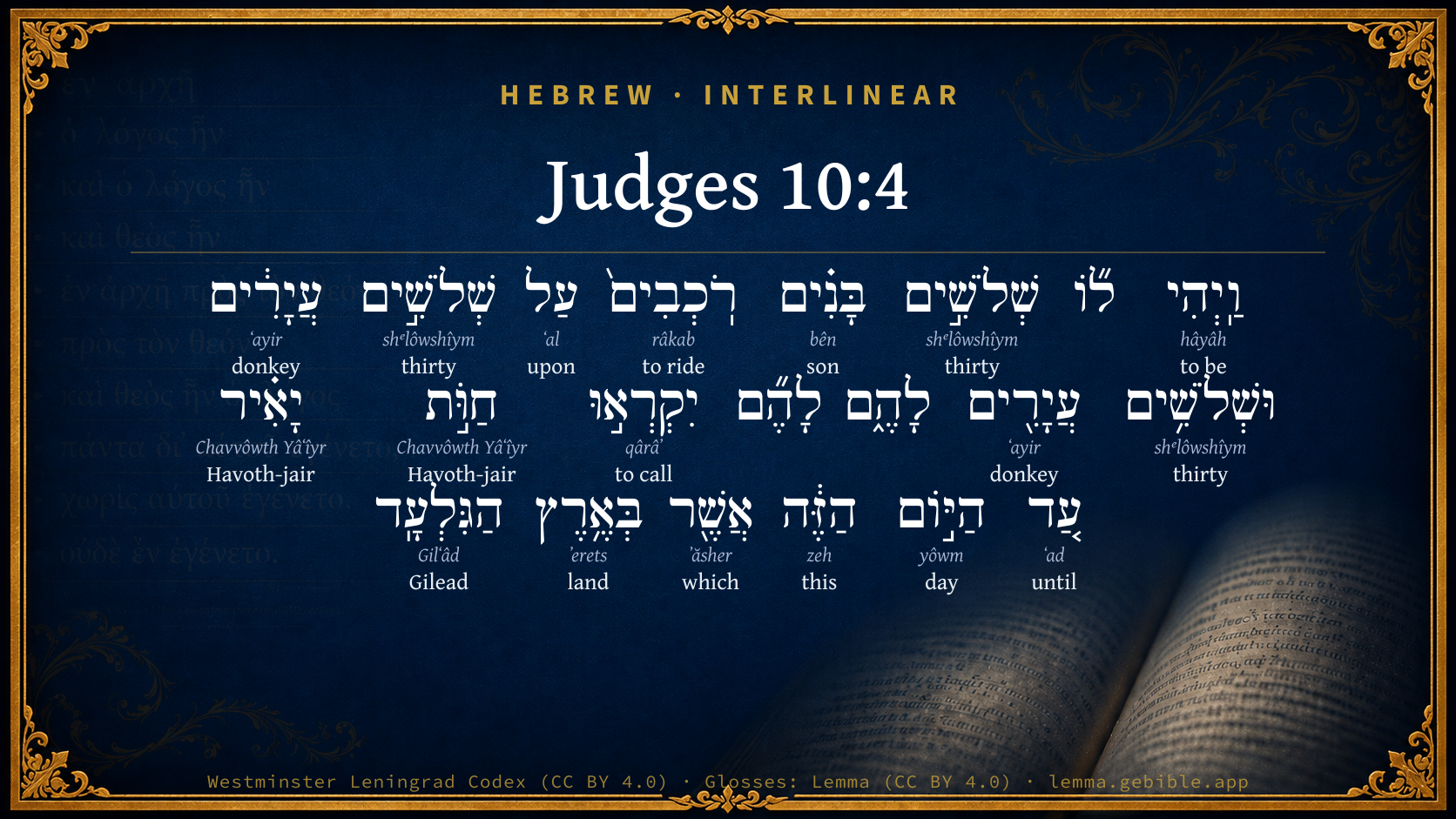
Hebrew (Westminster Leningrad Codex) Judges 10:4 appears in the Hebrew Old Testament. The text above is from the Westminster Leningrad Codex. Each word links to its Strong’s number, a concise gloss, and parsing drawn from the Open Scriptures Hebrew Bible morphology. Click any word for its full Brown-Driver-Briggs (BDB) entry.
Download image
Cite this verse

Judges 10:4 (World English Bible). Public Domain. Lemma interlinear Bible study tool, https://lemma.gebible.app/v/judges/10/4.

Show BibTeX & RIS
BibTeX
RIS
English Translation
He had thirty sons who rode on thirty donkey colts, and they had thirty cities, which are called Havvoth Jair to this day, which are in the land of Gilead.
World English Bible · Public Domain
Download a study sheet

One document with this verse’s original text, its word-by-word gloss line, the meaning frame, cross-references with their text, attributed commentary, and full source and license credits — printable, and it pastes into notes with its structure intact.

This verse Autodidact and up

Study sheet (.html) Plain text (.txt)

A passage Seminary Student

Up to 50 verses in one chapter. A passage sheet keeps up to 6 commentary sources and 12 cross-references per verse, in the order this page ranks them, and says so on the sheet whenever that leaves anything out. Ask for a single verse and you get the Autodidact verse sheet above.

Everything on this page stays free to read, with no account — the sheet is a download of what is already on screen, not access to it.

Want to remove ads? Support Godless Engineer
Compare translations 3

The same verse in 3 English versions, stacked beneath the original-language interlinear above. Click any original word for its lexicon entry.

Each is an independent rendering of the whole verse — the interlinear is not word-aligned to these translations.

Highlighted words mark where these versions differ — a whole-verse word diff, not a word-by-word alignment.

  • World English Bible Public Domain
    He had thirty sons who rode on thirty donkey colts, and they had thirty cities, which are called Havvoth Jair to this day, which are in the land of Gilead.
  • King James Version Public Domain
    And he had thirty sons that rode on thirty ass colts, and they had thirty cities, which are called Havothjair unto this day, which are in the land of Gilead.
  • unfoldingWord Literal Text CC BY-SA 4.0
    And it was to him 30 sons, riding on 30 donkeys. And 30 cities to them, they call them Havvoth Jair to this day, which in the land of Gilead.

unfoldingWord Literal Text — © unfoldingWord, licensed CC BY-SA 4.0. Word-aligned USFM3 via Door43 (git.door43.org/unfoldingWord/en_ult).

Versions to compare (up to 4)

3 of 4 selected

Show all 18 translations

Every available English version of this verse, each an independent rendering of the whole verse.

  • World English Bible Public Domain
    He had thirty sons who rode on thirty donkey colts, and they had thirty cities, which are called Havvoth Jair to this day, which are in the land of Gilead.
  • Berean Standard Bible Public Domain
    He had thirty sons who rode on thirty donkeys. And they had thirty towns in the land of Gilead, which to this day are called Havvoth-jair.
  • Majority Standard Bible Public Domain
    He had thirty sons who rode on thirty donkeys. And they had thirty towns in the land of Gilead, which to this day are called Havvoth-jair.
  • King James Version Public Domain
    And he had thirty sons that rode on thirty ass colts, and they had thirty cities, which are called Havothjair unto this day, which are in the land of Gilead.
  • American Standard Version (1901) Public Domain
    And he had thirty sons that rode on thirty ass colts, and they had thirty cities, which are called Havvoth-jair unto this day, which are in the land of Gilead.
  • Revised Version (1885) Public Domain
    And he had thirty sons that rode on thirty ass colts, and they had thirty cities, which are called Havvoth-jair unto this day, which are in the land of Gilead.
  • Geneva Bible (1599) Public Domain
    And he had thirtie sonnes that rode on thirtie assecolts, and they had thirtie cities, which are called Hauoth-Iair vnto this day, and are in the land of Gilead.
  • Douay-Rheims (1899) Public Domain
    Having thirty sons that rode on thirty ass colts, and were princes of thirty cities, which from his name were called Havoth Jair, that is, the towns of Jair, until this present day in the land of Galaad.
  • Young's Literal Translation Public Domain
    and he hath thirty sons riding on thirty ass-colts, and they have thirty cities, (they call them Havoth-Jair unto this day), which `are' in the land of Gilead;
  • Literal Standard Version CC BY-SA 4.0
    and he has thirty sons riding on thirty donkey-colts, and they have thirty cities (they call them Havoth-Jair to this day), which [are] in the land of Gilead;
  • Unlocked Literal Bible CC BY-SA 4.0
    He had thirty sons who rode on thirty donkeys, and they had thirty cities, which are called Havvoth Jair to this day, which are in the land of Gilead.
  • unfoldingWord Literal Text CC BY-SA 4.0
    And it was to him 30 sons, riding on 30 donkeys. And 30 cities to them, they call them Havvoth Jair to this day, which in the land of Gilead.
  • Darby Bible Public Domain
    And he had thirty sons who rode on thirty asses; and they had thirty cities, called Hav'voth-ja'ir to this day, which are in the land of Gilead.
  • World Messianic Bible Public Domain
    He had thirty sons who rode on thirty donkey colts. They had thirty cities, which are called Havvoth Jair to this day, which are in the land of Gilead.
  • Webster's Bible Public Domain
    And he had thirty sons that rode on thirty ass colts, and they had thirty cities, which are called Havoth-jair to this day, which are in the land of Gilead.
  • Free Bible Version CC BY-SA 4.0
    He had thirty sons who rode thirty donkeys. They had thirty towns in the land of Gilead, which to this day are called the Towns of Jair.
  • Bible in Basic English Public Domain
    And he had thirty sons, who went on thirty young asses; and they had thirty towns in the land of Gilead, which are named Havvoth-Jair to this day.
  • JPS Tanakh (1917) Public Domain
    And he had thirty sons that rode on thirty ass colts, and they had thirty cities, which are called Havvoth-jair unto this day, which are in the land of Gilead.

Literal Standard Version (2020), Covenant Press — licensed CC BY-SA 4.0. Text via the HelloAO Bible API (eBible.org). Unlocked Literal Bible (unfoldingWord) — licensed CC BY-SA 4.0. Text via the HelloAO Bible API (eBible.org). unfoldingWord Literal Text — © unfoldingWord, licensed CC BY-SA 4.0. Word-aligned USFM3 via Door43 (git.door43.org/unfoldingWord/en_ult). Free Bible Version, Dr. Jonathan Gallagher — licensed CC BY-SA 4.0. Text via the HelloAO Bible API (eBible.org).

Word by word

More ways to search: Search by grammar → Find every occurrence → Compare this word →

Practice this passage: Drill this verse → Learn its vocabulary →

חַוֺּ֣ת
Chavvôwth Yâʻîyr
H2334
“Havoth-jair of”
Noun, Common, Feminine, Plural, Construct
Part of Speech
Noun
Type
Common
Gender
Feminine
Number
Plural
State
Construct
Full BDB Definition

Origin: from the plural of H2333 and a modification of H3265

TWOT: None

Havoth-jair = "villages of Jair" - certain villages on the east of Jordan, in Gilead or Bashan, which were taken by Jair, the son of Manasseh, and called after his name; 60 or 23 or 30 cities in total
  1. וַֽיְהִי hâyâh H1961 “and · to be” Conjunction + Verb, Qal, Sequential Imperfect, 3rd Person, Masculine, Singular
  2. שְׁלֹשִׁ֣ים shᵉlôwshîym H7970 “thirty” Adjective, Cardinal number, Both, Plural, Absolute
  3. בָּנִ֗ים bên H1121 “sons” Noun, Common, Masculine, Plural, Absolute
  4. רֹֽכְבִים֙ râkab H7392 “riding” Verb, Qal, Participle Active, Masculine, Plural, Absolute
  5. עַל ʻal H5921 “upon” Preposition
  6. שְׁלֹשִׁ֣ים shᵉlôwshîym H7970 “thirty” Adjective, Cardinal number, Both, Plural, Absolute
  7. עֲיָרִ֔ים ʻayir H5895 “donkeys” Noun, Common, Masculine, Plural, Absolute
  8. וּשְׁלֹשִׁ֥ים shᵉlôwshîym H7970 “and · thirty” Conjunction + Adjective, Cardinal number, Both, Plural, Absolute
  9. עֲיָרִ֖ים ʻayir H5895 “donkeys” Noun, Common, Masculine, Plural, Absolute
  10. יִקְרְא֣וּ qârâʼ H7121 “to call” Verb, Qal, Imperfect, 3rd Person, Masculine, Plural
  11. יָאִ֗יר Chavvôwth Yâʻîyr H2334 “Havoth-jair” Noun, Proper
  12. עַ֚ד ʻad H5704 “until” Preposition
  13. הַיּ֣וֹם yôwm H3117 “the · day” Particle, Definite Article + Noun, Common, Masculine, Singular, Absolute
  14. הַזֶּ֔ה zeh H2088 “the · this” Particle, Definite Article + Pronoun, Demonstrative, Masculine, Singular
  15. אֲשֶׁ֖ר ʼăsher H834 “which” Particle, Relative
  16. בְּאֶ֥רֶץ ʼerets H776 “in/at · land of” Preposition + Noun, Common, Both, Singular, Construct
  17. הַגִּלְעָֽד Gilʻâd H1568 “the · Gilead” Particle, Definite Article + Noun, Proper

About this verse

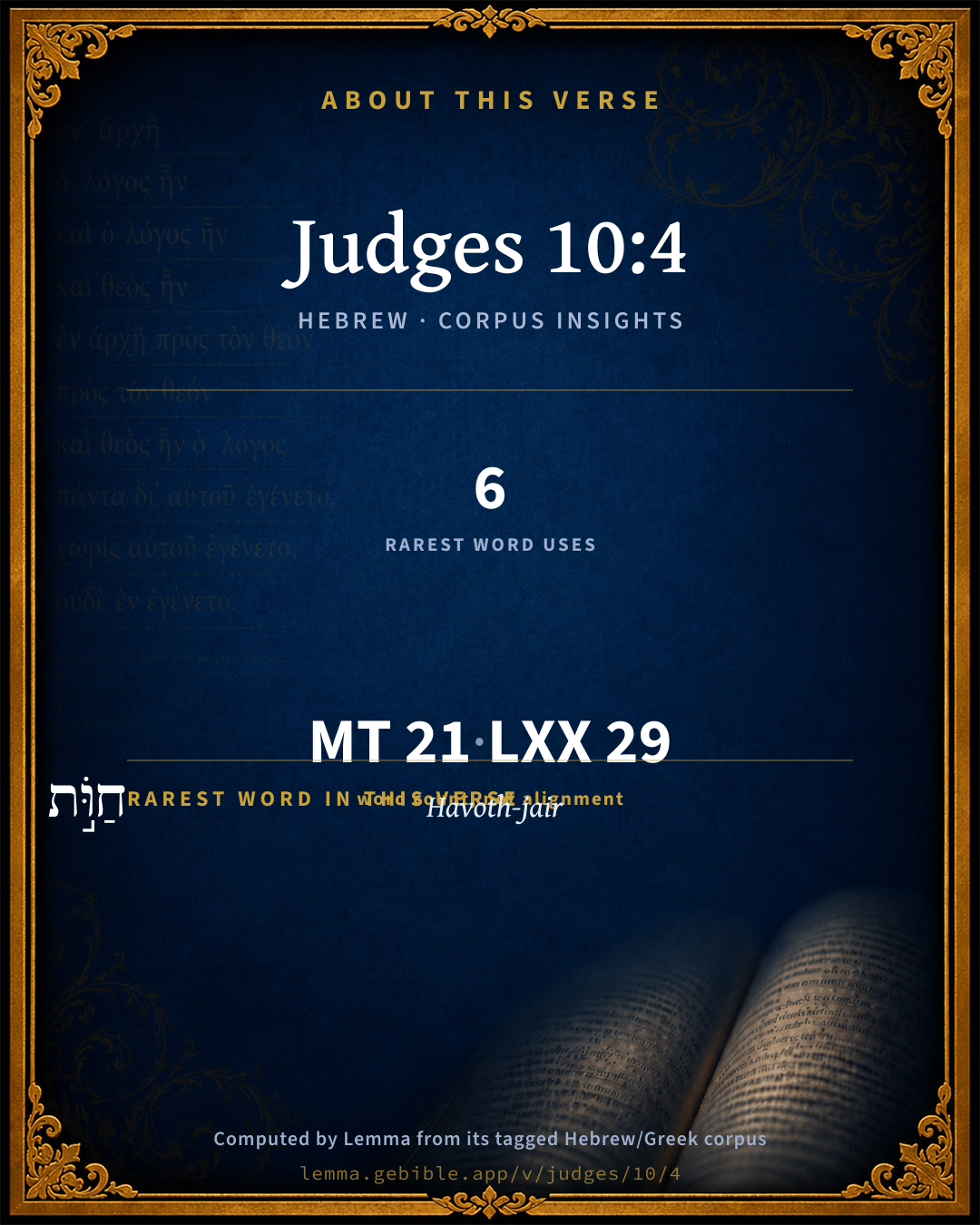
These counts appear in no published source. They are computed here, from the morphology-tagged text and Lemma’s own curated glosses. What Lemma adds →

21
words
14
distinct lemmas
Historical
section

Notable vocabulary

The rarest word here is חַוֺּ֣ת Havoth-jair H2334 — appearing just 6 times in the whole Hebrew Bible.

Shared distinctive vocabulary

חַוֺּ֣ת Havoth-jair H2334 occurs in 3 verses of the Hebrew Bible. Also found in:

Grammatical profile

  • 3 verbs
  • 8 nouns
  • 3 adjectives
  • 1 pronoun
  • 5 prepositions
  • 1 particle

Verb forms

  • וַֽיְהִי Qal · Sequential Imperfect
  • רֹֽכְבִים֙ Qal · Participle Active
  • יִקְרְא֣וּ Qal · Imperfect

Repetition

Words recur within this verse — often emphatic in Hebrew:

  • שְׁלֹשִׁ֣ים thirty H7970 ×3
  • עֲיָרִ֔ים donkey H5895 ×2
  • חַוֺּ֣ת Havoth-jair H2334 ×2

Hebrew & Septuagint length

In English translation the verse runs 30 words from the Hebrew and 28 from the Septuagint (LXX English) — closely comparable.

A rough comparison of the two English renderings, which tokenize alike — not a word-level alignment.

Word counts can differ between the Hebrew and the Greek without any difference in meaning — e.g. the Hebrew direct-object marker אֵת has no separate Greek word, and Greek often adds the article ὁ.

In the original languages it is 21 Hebrew tokens and 29 Greek tokens — but the two are counted differently (Hebrew bundles its prefixes and suffixes into one token; the Greek is in lemma form), so that isn’t a like-for-like length.

Cross-references

4

Topical passages linked to Judges 10:4 in the Treasury of Scripture Knowledge — connected by theme and wording, ordered by reader-vote popularity; previews shown in the World English Bible.

  • Numbers 32:41 Jair the son of Manasseh went and took the towns of it, and called them Havvoth Jair.
  • Deuteronomy 3:14 Jair the son of Manasseh took all the region of Argob, to the border of the Geshurites and the Maacathites, and called them, even Bashan, after his own name, Havvoth Jair, to this day.)
  • Judges 5:10 Tell [of it], you who ride on white donkeys, You who sit on rich carpets, You who walk by the way.
  • Judges 12:14 He had forty sons and thirty sons' sons, who rode on seventy donkey colts: and he judged Israel eight years.

Cross-references courtesy of OpenBible.info (CC BY 4.0).

Hebrew and Greek witnesses Masoretic Hebrew ↔ Greek Septuagint

The same verse in the two great witnesses to the Old Testament, shown verse-for-verse.

These are two independent witnesses, not word-aligned to each other, and the Septuagint is shown in lemma (dictionary) form.

Hebrew Judges 10:4 Masoretic · Westminster Leningrad Codex

וַֽיְהִי ל֞וֹ שְׁלֹשִׁ֣ים בָּנִ֗ים רֹֽכְבִים֙ עַל שְׁלֹשִׁ֣ים עֲיָרִ֔ים וּשְׁלֹשִׁ֥ים עֲיָרִ֖ים לָהֶ֑ם לָהֶ֞ם יִקְרְא֣וּ חַוֺּ֣ת יָאִ֗יר עַ֚ד הַיּ֣וֹם הַזֶּ֔ה אֲשֶׁ֖ר בְּאֶ֥רֶץ הַגִּלְעָֽד

He had thirty sons who rode on thirty donkey colts, and they had thirty cities, which are called Havvoth Jair to this day, which are in the land of Gilead.

World English Bible · Public Domain

Greek LXX Judges 10:4 Septuagint · lemma form

καί εἰμί αὐτός τριάκοντα καί δύο υἱός ἐπιβαίνω ἐπί τριάκοντα δύο πῶλος καί τριάκοντα δύο πόλις αὐτός καί καλέω αὐτός ἔπαυλις ιαϊρ ἕως ὁ ἡμέρα οὗτος ἐν γῆ γαλαάδ

And he had thirty-two sons riding on thirty-two colts, and they had thirty-two cities; and they called them Jair's towns until this day in the land of Galaad.

LXX2012 (modern English Septuagint) · Public Domain

On this verse, Ellicott's Commentary for English Readers discusses the Septuagint’s reading. Read the note in Commentary ↓

Hebrew: Westminster Leningrad Codex (CC BY 4.0). Greek: Septuagint (public domain); English from LXX2012 (modern English Septuagint) (Public Domain). How the Septuagint differs from the Hebrew →

Targum (Aramaic paraphrase)

1

The Targum is the ancient Jewish Aramaic paraphrase of the Hebrew Scriptures — an interpretive translation, not the Hebrew text itself. Onkelos (literal) and Pseudo-Jonathan (expansive) render the Torah, and Jonathan the Prophets. Coverage is partial: where no permissively-licensed English translation exists for a verse, only the Aramaic is shown. This is verse-level text, not a word-by-word alignment to the Hebrew.

  1. Targum Jonathan Prophets (Joshua–Malachi)
    וַהֲווֹ לֵיהּ תְּלָתִין בְּנִין רְכִיבִין עַל תְּלָתִין עוּלִין וּתְלָתִין קִרְוִין לְהוֹן לְהוֹן קְרַן כַּפְּרָנֵי יָאִיר עַד יוֹמָא הָדֵין דִי בְּאַרְעָא דְגִלְעָד:

    (no public-domain English translation for this verse)

    Targum Jonathan — Aramaic: “Mikraot Gedolot” (public domain). English: “Sefaria Community Translation” (CC0 1.0 (public-domain dedication)); “London "Chaldee Paraphrase," 1871” (public domain). Text via Sefaria.

Commentary

Notes on Judges 10:4 from classic Christian and Jewish commentators (each source and its license shown beneath its notes). The classic Christian expositions comment on the surrounding passage and are grouped to its opening verse, so a note may address several verses; the Jewish commentaries on the Tanakh (Rashi and others) are per-verse, so they appear only where the commentator wrote on this verse.

Lemma curates 59 commentaries, every one of them public domain or Creative Commons licensed, each selected and text-cleaned for this edition rather than reprinted as found. About our sources →

Trapp's Complete Commentary

John Trapp

Jdg 10:4 And he had thirty sons that rode on thirty ass colts, and they had thirty cities, which are called Havothjair unto this day, which [are] in the land of Gilead.

Ver. 4. And he had thirty sons.] A happy man if they all proved towardly: otherwise he might be put to wish as Augustus did, Utinam aut caelebs vixissem, aut orbus periissem.

That rode on thirty ass colts.] Jair therefore was a man of quality, likely, for birth and wealth: and so fitter for government, ordinarily. See Ecc 10:17. By the laws of England, noblemen may not be bound to the peace; because it is supposed that the peace is always bound to them, and that of their own accord they will both preserve and promote it.

John Trapp, A Commentary or Exposition upon All the Books of the Old and New Testament (1647–1656) — public domain. Text from a community e-Sword module.

Geneva Bible (1599)

Geneva Bible translators

Or, the towns of Jair, as Deut. 3:14.

Signifying, they were men of authority.

Geneva Bible (1599) marginal notes — public domain. Text via Bolls.life.

Jamieson, Fausset & Brown

Robert Jamieson, A. R. Fausset & David Brown

he had thirty sons that rode on thirty ass colts--This is a characteristic trait of Eastern manners in those early times; and the grant of a village to each of his thirty sons was a striking proof of his extensive possessions. His having thirty sons is no conclusive evidence that he had more than one wife, much less that he had more than one at a time. There are instances, in this country, of men having as many children by two successive wives.

Jamieson, Fausset & Brown — Commentary Critical and Explanatory on the Whole Bible (1871) — public domain (CC PDM 1.0). Text via the HelloAO Bible API.

Adam Clarke's Commentary

Verse 4. He had thirty sons, c.] It appears that there was both peace and prosperity during the time that Jair governed Israel he had, it seems, provided for his family, and given a village to each of his thirty sons; which were, in consequence, called Havoth Jair or the villages of Jair. Their riding on thirty ass colts seems to intimate that they were persons of consideration, and kept up a certain dignity in their different departments.

Adam Clarke's Commentary on the Bible (1810–1826) — public domain. Text from a community e-Sword/MySword module.

Ellicott's Commentary for English Readers

(4) Had thirty sons.—An indication of his rank and position, which assumed an ostentatious polygamy. (Comp. Jdg_8:30.)

That rode on thirty ass colts.—Comp. Jdg_5:10; see on Jdg_12:14. Implying that Jair was able to bring up his numerous household in wealth. The horse was little used in Palestine—for which, indeed, it is little suited—till the days of Solomon (1Ki_4:26), and its introduction was always discouraged by the prophets (Deu_17:16; Jos_11:6-9; Psa_33:17, &c). There is a curious play of words on Jair (yair), “ass-colts” (ayârîm), and “cities,” which ought to be arîm, but is purposely altered for the sake of the paronomasia. (See on Jdg_15:16.) Such plays on words in serious narratives point to a very early form of literature—but probably they then rose from some popular proverb. The LXX., like Josephus, writing for Gentiles, who did not understand the value attached to asses in Palestine, almost always euphemise the word into “colts,” or “foals” (pôlous), which here enables them happily to keep up the play of words with “cities” (poleis).

Thirty cities, which are called Havoth-jair.—Havoth means villages (LXX., epauleis), and since they are here called “cities,” and thirty are named, we must suppose that this Jair (if he was a different person from the other) had increased the number of the villages originally wrested from Og from twenty-three to thirty (Num_32:41; Deu_3:14; 1Ch_2:22. In the latter passage the Jair there mentioned is spoken of as a son of Segub, and a great-grandson of Manasseh).

Unto this day.—Jdg_1:26.

A Bible Commentary for English Readers, edited by Charles John Ellicott (1878–1897) — public domain. Text from a community e-Sword module.

The Cambridge Bible for Schools and Colleges

gen. ed. J. J. S. Perowne

4. he had thirty sons] Cf. Jdg_12:9; Jdg_12:14. The ‘sons’ are expressly connected with the thirty settlements of the clan. Numerous descendants indicated power and wealth.

that rode on thirty ass colts] A mark of rank; cf. Jdg_12:14, 2Ki_4:22, Zec_9:9; see on Jdg_5:10.

Havvoth-jair] i.e. tent-villages (LXX ἐπαύλεις) of Jair; cf. Arab. ḥiwâ = ‘a group of tents near together.’ Long after the tents of nomads had given place to permanent dwellings or ‘cities’ the old name still survived. The Havvoth-jair are frequently mentioned, but the accounts of them are not all consistent. Here and in Num_32:41 they are said to have been situated in Gilead; 1Ki_4:13 (prob. borrowed from Num. l.c.) and 1Ch_2:22 agree with this. But according to Deu_3:14, followed by Jos_13:30, they lay in Bashan; the statement, however, seems to be due to an attempt to harmonize Deu_3:13 f. with Num_32:39; Num_32:41 (Driver, Deut., p. 55). Again, the capture and naming of these towns is dated in different periods, in the time of Moses according to Num. l.c., and in the time of the Judges here. But the inconsistency lies only on the surface. Num_32:39-42 is an ancient fragment incorporated into a later account (JE and P) of the conquest of E. Jordan, apparently for the purpose of bringing Manasseh’s occupation of this district within the Mosaic period; the fragment closely resembles the brief traditions preserved in Judges 1 and may be taken to refer to the same period, viz. that of the Judges, to which the present verse assigns the episode. Later on the Havvoth-jair seem to have passed into the hands of another race, cf. 1Ch_2:23 (RV.), which probably reflects the conditions of a subsequent age. The difference in the numbers of the villages, thirty, thirty-two (LXX here), twenty-three (1Ch_2:22), is not important.

The Cambridge Bible for Schools and Colleges (gen. ed. J. J. S. Perowne; Cambridge University Press, 1878–1918) — public domain. Text from a community e-Sword module.

John Gill's Exposition

And he had thirty sons that rode upon thirty ass colts,.... Which to ride on in those times was reckoned honourable, and on which judges rode in their circuit, Jdg 5:10 and such might be these sons of Jair, who were appointed under him to ride about, and do justice in the several parts of the country, as Samuel's sons were judges under him, Sa1 8:1,

and they had thirty cities, which are called Havothjair unto this day, which are in the land of Gilead; or the villages of Jair. There were some of this name that belonged to Jair, a son of Manasseh, in the times of Moses, Num 32:41 and these may be the same, at least some of them; for they were but twenty three he had, whereas these were thirty, Ch1 2:22 and these coming by inheritance to this Jair, a descendant of the former, and he being of the same name, and these cities perhaps repaired and enlarged by him, the name of them was continued and established, for it is not reasonable to suppose, as some have done, that this is the same Jair that lived in the times of Moses, who, if so, must have lived more than three hundred years, an age men did not live to in those times.

John Gill's Exposition of the Whole Bible (1746–1763) — public domain (CC PDM 1.0). Text via the HelloAO Bible API.

Haydock's Catholic Bible Commentary

Havoth Jair. This name was now confirmed to these towns, which they had formerly received from another Jair, Numbers xxxii. 41. (Challoner) --- Sixty are there specified, and only 30 here, which might either be the same, or different from those villages to which the former Jair had left his name. Grotius thinks that judge Jair was the son of Segub, who left 23 cities to him. These, with seven belonging to his grandfather, Hesron, make up the number here specified, 1 Paralipomenon ii. 22. --- The Hebrew does not say that these 30 cities were called after the judge: "they had 30 cities, which are called Havoth Jair," &c. (Calmet) --- Some copies of the Septuagint add "two" to the number of sons, asses, and cities, as if there had been 32 of each. In other respects they agree with the original. It was formerly a mark of distinction to ride on fair asses, chap. v. 10. (Haydock) --- St. Jerome thinks that horses were prohibited, as they were in Egypt, without the king’s leave. But we nowhere find this law recorded , (Calmet) and it is not universally true that it existed. (Menochius) (Hieropolit. iii. 15.) --- Some have inferred from Jair’s children having 30 cities, that he exercised a sovereign authority over Israel: but he might only give his children the authority of magistrates in them, as Samuel did, 1 Kings viii. (Estius) --- We know not by what means Jair was raised to the chief command, nor what he did for the benefit of the people. He is supposed to be the same who is called Bedan, 1 Kings xii. 11. Serarius; Usher, &c.); though others think that Bedan is a title of Samson. He was of the tribe of Manasses in Galaad. Having kept the people under due restraint during his administration, they burst forth, like a torrent, at his death, and, on all sides, abandoned themselves to a multiplicity of idols, so that God made some difficulty in restoring them again to favour. (Haydock) --- Cornelius a Lapide thinks that they had begun to relapse 18 years before the death of Jair, and were, consequently, chastised by the Ammonites. Serarius is of a contrary opinion, though Houbigant rather inclines to the former sentiment, as it is not said that Jair gave rest to the land, nor more than Samgar. (Haydock)

George Leo Haydock (1774–1849), Haydock's Catholic Family Bible and Commentary, 1859 edition — public domain. Excludes Psalms (Douay-Rheims chapter numbering differs from Protestant) and Deuterocanonical books (Catholic canon only).

Matthew Poole's English Annotations

Rode on ass colts, because horses were scarce there, and were not to be multiplied by the king himself, Deu 17:16. Hence their kings and kings’ children used to ride upon mules, 2Sa 13:29; 18:9; 1Ki 1:33,38,39. Compare Jdg 5:10; 12:14.

Havoth-jair.

Object. These villages were called so before this time from another

Jair, Num 32:41; Deu 3:14.

Answ. They are not said to be now first called by that name, but to be still so called, because the old name was revived and confirmed upon this occasion; as Sheba is said to be called Beer-sheba, upon an occasion mentioned Gen 26:33, though it was so called before upon a more ancient occasion, Gen 21:31. Possibly this Jair had enlarged or fortified these towns, and so they were justly denominated from him, no less than from the former.

Matthew Poole's English Annotations on the Holy Bible (1683–1685) — public domain. Text from a community e-Sword/MySword module.

Whedon's Commentary on the Bible

Daniel D. Whedon

4. Thirty sons… thirty ass colts… thirty cities — These facts are mentioned to show the power, dignity, and wealth of the house of Jair.

Havoth-jair — That is, villages of Jair. These villages, possessed by Jair’s sons, were called after their father’s name even at the time when the Book of Judges was written. They probably comprised the same “towns” which Jair, the son of Manasseh, took in the days of Moses, (Num_32:41; Deu_3:14,) and called by this very name. Their number may have been increased so as to furnish one for each of the thirty sons of this Gileadite judge. This name was not now given them for the first time, but was a bringing into use again of an old name which had, perhaps, become partially forgotten.

Daniel D. Whedon (gen. ed.), Commentary on the Old and New Testaments (1874–1909) — public domain. Text from a community e-Sword module.

The Pulpit Commentary

Thirty ass colts. The number and dignity of these knightly sons of Jair shows that Jair himself, like Gideon, (Jud_1:8:30) assumed the state of a prince. The word in Hebrew for ass colts is identical with that for cities, as here pointed, and this play upon the words belongs to the same turn of mind as produced Jotham"s fable and Samson"s riddle. (Jud_1:14:14)

The Pulpit Commentary (1880–1919), ed. H.D.M. Spence-Jones & Joseph S. Exell — public domain. Text from a community e-Sword module.

John Wesley's Explanatory Notes

And he had thirty sons - They were itinerant Judges, who rode from place to place, as their father's deputies to administer justice. Havoth-jair - These villages were called so before this time from another Jair, but the old name was revived and confirmed upon this occasion.

John Wesley, Explanatory Notes Upon the Whole Bible (1754–1765) — public domain. Text via the GEBible commentary corpus.

Scofield Reference Notes

C. I. Scofield

Havothjair

Or, The villages of Jair. Num 32:41.

The Scofield Reference Bible (1917 edition), notes by C. I. Scofield — public domain. Text from a community e-Sword module.

Rashi

Rabbi Shlomo Yitzchaki (Rashi)

Thoroughbreds.עוּלִין, the choicest horses.

They owned thirty towns. They owned thirty unwalled municipalities. This is why they are described as עַיָרִים, "towns", meaning the same as עַיָירָוֹת.

Rashi on the Tanakh — English translations: “The Judaica Press complete Tanach with Rashi, translated by A. J. Rosenberg” (CC BY 4.0); “Pentateuch with Rashi's commentary by M. Rosenbaum and A.M. Silbermann, 1929-1934” (public domain); “The Metsudah Tanach series, Lakewood, N.J” (CC BY 4.0); and “The Book of Joshua, Metsudah Publications, 1997” (CC BY 4.0). Text via Sefaria.

Lesson kit

Teaching starters — assembled from the data on this page, not authored interpretation. Every prompt links to the verse data it draws on. Edit before teaching.

Judges, in the Historical, opens this verse with 21 words (14 distinct Hebrew lemmas). Its most distinctive word is Chavvôwth Yâʻîyr (“Havoth-jair”). A historical commentator’s framing appears above. Read the whole chapter for the surrounding context.

Discussion questions

  1. What does “Havoth-jair” (Chavvôwth Yâʻîyr) contribute to the verse as a whole?
  2. How does Numbers 32:41, which shares the word «Havoth-jair», read alongside this verse?
  3. What does the repetition of “thirty” (3× in this one verse) do in this verse?
  4. These translations render this verse differently. What is at stake in choosing one wording over another?
  5. «וַֽיְהִי» is a Qal Sequential Imperfect verb. How does that grammatical form shape the action described?
  6. Compare how Trapp's Complete Commentary and Geneva Bible (1599) read this verse. Where do they agree or differ?

Things to notice

Reading settings

Reading text

Shown beneath each verse's original-language words.

Old Testament
Old Testament edition

Read the OT as the Masoretic Hebrew (MT) or the Greek Septuagint (LXX).

English shown for the Greek Septuagint (in the Hebrew ↔ Greek comparison).

Comparing translations? Open the Compare panel on any verse page to stack up to four side by side.