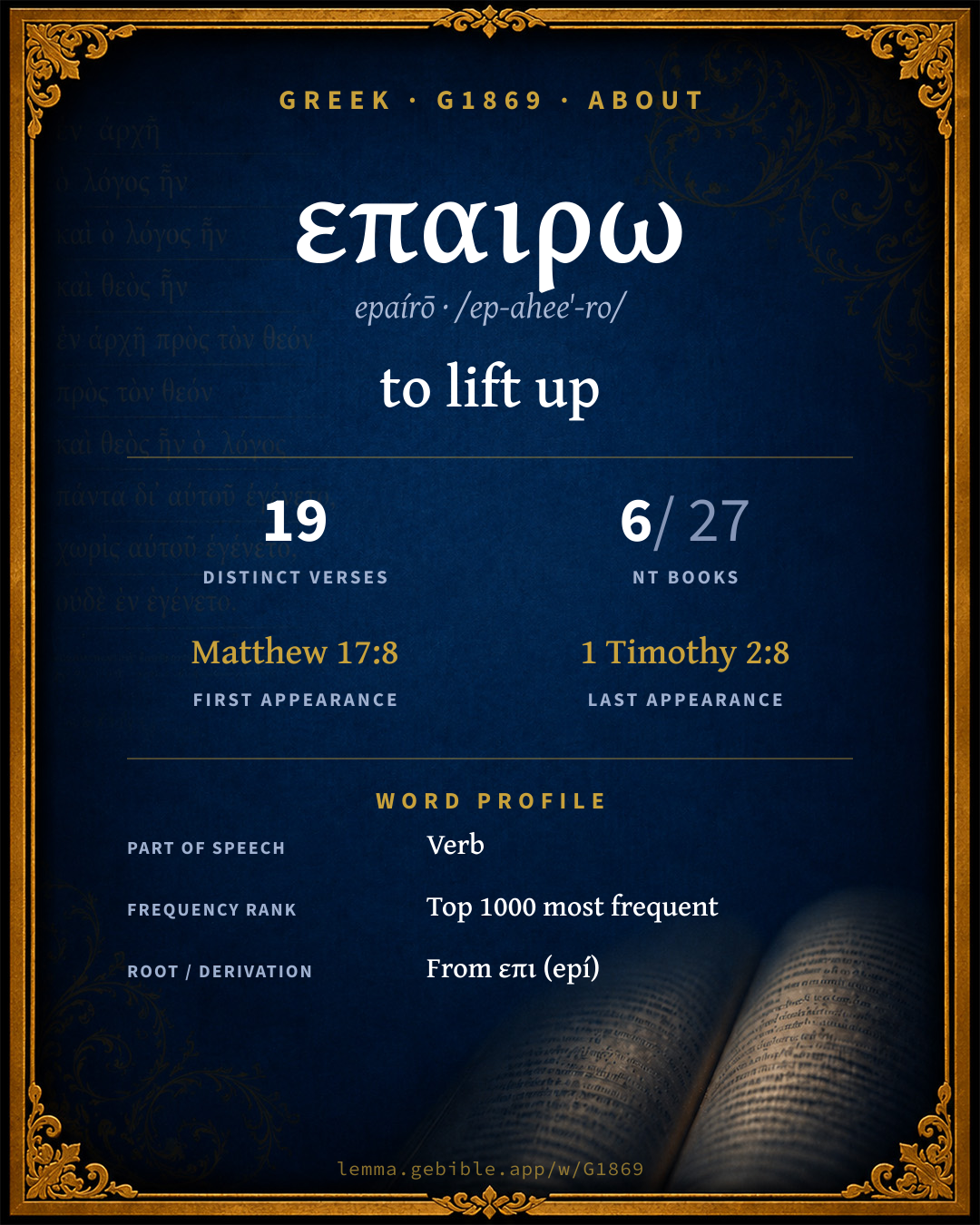
ἐπαίρω
to lift up
also: raise up, raise on high fuller range ↓
Full lexicon entry — Thayer's Greek Lexicon
From Thayer's Greek Lexicon
Where this word appears
See every Aorist-tense verb in the Greek New Testament →
Grammar key — what these labels mean
Part of speech
- Verb
- An action or state-of-being word.
Tense
- Aorist
- Action viewed as a simple whole, without regard to duration — often past (perfective aspect).
- Present
- Ongoing or general action in present time (imperfective aspect).
- Perfect
- A completed past action with continuing present results.
Voice
- Active
- The subject performs the action.
- Passive
- The subject receives the action.
- Middle
- The subject acts on or for itself, or with special interest in the action.
Mood
- Participle
- A verbal adjective (“writing,” “having written”).
- Indicative
- States a fact or asks a factual question (the mood of reality).
- Imperative
- Expresses a command or request.
- Infinitive
- A verbal noun (“to write”), unmarked for person or number.
Case
- Nominative
- The case of the subject (and the predicate nominative).
- Accusative
- The case of the direct object and of extent.
Person
- 3rd person
- The one spoken about (“he / she / it / they”).
- 2nd person
- The one addressed (“you”).
Gender
- Masculine
- Grammatically masculine.
- Feminine
- Grammatically feminine.
- Neuter
- Grammatically neuter.
Number
- Singular
- One.
- Plural
- More than one.
Every verse where G1869 appears in the Book of John — 4 distinct verses. Click any verse to open its interlinear word-by-word view. Verse text shown in the World English Bible for context — . Each verse’s Greek form is shown with its reference; the English is not keyword-highlighted, since the data carries no word-level English alignment. Use “Compare translations” on any verse to read it across multiple English versions. This concordance covers the Greek New Testament; Septuagint (Greek Old Testament) occurrences of this word are not indexed here.
John
- John 4:35 ἐπάρατε aor act impv 2pl Don't you say, 'There are yet four months until the harvest?' Behold, I tell you, lift up your eyes, and look at the fields, that they are white for harvest already.
- John 6:5 ἐπάρας aor act ptcp nom sg masc Jesus therefore lifting up his eyes, and seeing that a great multitude was coming to him, said to Philip, "Where are we to buy bread, that these may eat?"
- John 13:18 ἐπῆρκεν perf act ind 3sg I don't speak concerning all of you. I know whom I have chosen. But that the Scripture may be fulfilled, 'He who eats bread with me has lifted up his heel against me.'
- John 17:1 ἐπάρας aor act ptcp nom sg masc Jesus said these things, and lifting up his eyes to heaven, he said, "Father, the time has come. Glorify your Son, that your Son may also glorify you;
About this entry
At a glance — auto-summarized from this page’s data, not written by a person. Every figure links to its source below. This summary describes the numbers; it doesn’t interpret them.
At its core, επαιρω (epaírō) means “to lift up.” Scripture first uses it in Matthew 17:8. With 19 verses in 6 books, it is an uncommon word in the Greek New Testament. Its uses concentrate in Luke (32% of all occurrences). Ranging over 2 senses, its meaning includes “raise up” and “raise on high”. Each statement above links to its evidence; the full detail follows below.
Gloss history
Strong's 1890 vs modern scholarship

About this word
Strong's G1869 catalogs a Greek word from the Greek New Testament.
These counts are not copied from any lexicon or concordance. They are computed here, from the morphology-tagged Greek New Testament. What Lemma adds →
- 19
- distinct verses
- The word appears in 19 distinct verses.
- 6 / 27
- NT books
- The word appears in 6 of 27 New Testament books.
- #644
- by frequency
- Top 1000 most frequent Greek words (rank 644 of 5,347 Greek words by occurrence).
View all 19 occurrences in the concordance →
By section of the New Testament
By traditional corpus
Conventional, traditional groupings — biblical authorship is debated, so this is a traditional corpus grouping, not an authorship claim. Some books belong to more than one corpus (Luke is in both the Gospels and the Lukan corpus, and so on), so these shares overlap and need not total 100%. Each figure is a share of the word’s 19 distinct verses.
- Gospels 11 verses · 58%
- Lukan (Luke–Acts) 11 verses · 58%
- Johannine 4 verses · 21%
- Pauline corpus 3 verses · 16%
How translations render this word
Counts come from each version’s own published word-to-Strong’s tagging or interlinear alignment — an approximate guide to how each version renders this word, not a word-level alignment the data otherwise carries. Because each total is that version’s own tagged count, the per-version totals vary from one another and need not match the appearance or distinct-verse counts above. These counts may also differ from a printed concordance because Lemma counts each distinctly tagged rendering and does not collapse phrase taggings into a single head-word total. This is a fixed set of word-tagged versions (KJV, ASV, BSB, ULT) and does not change with the reading translation you choose elsewhere. Each version’s license is shown beside its name below (and on Sources).
- King James Version: Lifted up 6×, Lift up 3×
- American Standard Version: Lifted up 4×, Lifting up 4×, Lift up 3×
- Berean Standard Bible: Lift up 3×, He lifted up 2×, They lifted up 2×
- unfoldingWord Literal Text: Having lifted up 4×, Lifting up 4×, Lift up 3×
King James Version Public Domain
Renders G1869 across 19 tagged occurrences — most commonly:
Plus 10 renderings that appear only once — usually multi-word phrases or single function words the recovered tagging swept in, not distinct renderings.
American Standard Version Public Domain
Renders G1869 across 19 tagged occurrences — most commonly:
Plus 4 renderings that appear only once — usually multi-word phrases or single function words the recovered tagging swept in, not distinct renderings.
Berean Standard Bible Public Domain
Renders G1869 across 19 tagged occurrences — most commonly:
Plus 12 renderings that appear only once — usually multi-word phrases or single function words the recovered tagging swept in, not distinct renderings.
unfoldingWord Literal Text CC BY-SA 4.0
Renders G1869 across 20 tagged occurrences — most commonly:
Plus 9 renderings that appear only once — usually multi-word phrases or single function words the recovered tagging swept in, not distinct renderings.
Senses in Thayer's
The 2 senses Thayer's distinguishes for this word, in lexicon order (not ranked by frequency or importance). The full entry — with sub-senses — is in the Lexicon Entry tab.
- to lift up, raise up, raise on high
- metaph. to be lifted up with pride, to exalt one's self
Word origin
Derived from επι (epí) (G1909) — upon.
Forms in the corpus
The 12 distinct written forms G1869 takes in the Greek New Testament, most frequent first — each parse links to that tense’s occurrences in the concordance.
Same root — word family
Other Thayer's entries built from the same root as G1869, grouped by Strong’s listed origin. These share a root / origin per the lexicon — not necessarily a shared meaning. Each links to that word’s own entry.
Derives from
Shares the same root
- επαγγελλω epangéllō G1861 to announce
- επαγω epágō G1863 to bring upon
- επαγωνιζομαι epagōnízomai G1864 to contend
- επαθροιζω epathroízō G1865 to gather together
- επαινεω epainéō G1867 to approve
- επαινος épainos G1868 approval
- επαισχυνομαι epaischýnomai G1870 to be ashamed
- επαιτεω epaitéō G1871 to ask repeatedly
- επακουω epakoúō G1873 to give ear to
- επακροαομαι epakroáomai G1874 to listen to
- επαν epán G1875 after
- επαναγκες epánankes G1876 necessarily
- επαναγω epanágō G1877 to lead back
- επαναμιμνησκω epanamimnḗskō G1878 to remind
- επαναπαυομαι epanapaúomai G1879 to rest upon
- επανερχομαι epanérchomai G1880 to return
- επανισταμαι epanístamai G1881 to raise up against
- επανορθωσις epanórthōsis G1882 correction
- επανω epánō G1883 above
- επαρκεω eparkéō G1884 to avail
- επαρχια eparchía G1885 office of governor
- επαυλις épaulis G1886 farm
- επαυριον epaúrion G1887 the next day
- επαυτοφωρω epautophṓrōi G1888 caught in the act
+110 more words share this root (not shown).
Proper names from this root
People and places named from this root — a name, not an additional meaning of the word.
Compare all same-root words → Showing 4 of 137 — not the complete family. 1 of the same-root words is a proper name (a person or place). They share a root, not necessarily a meaning.
Septuagint usage
The same Greek word επαιρω appears 60 times in the Greek Old Testament (Septuagint), across 59 verses in 23 books.
- 60
- LXX occurrences
- Tagged occurrences of this Greek word in the Septuagint.
- 59
- verses
- Distinct Septuagint verses containing this word.
- 23 / 39
- OT books
- The word appears in 23 of the 39 Old Testament books.
Sample Septuagint occurrences
- Genesis 7:17 ἐπιαἴρω
- Exodus 7:20 ἐπιαἴρω
- Numbers 6:26 ἐπιαἴρω
- Judges 2:4 ἐπιαἴρω
- Ruth 1:9 ἐπιαἴρω
- 1 Samuel 20:33 ἐπιαἴρω
- 2 Samuel 5:12 ἐπιαἴρω
- 1 Kings 1:5 ἐπιαἴρω
- 2 Kings 9:32 ἐπιαἴρω
- 1 Chronicles 21:16 ἐπιαἴρω
- 2 Chronicles 25:19 ἐπιαἴρω
- Ezra 4:19 ἐπιαἴρω
Septuagint occurrences (same lexeme)
Every verse where the same Strong’s number (G1869) appears in the Greek Septuagint — showing the first 50 of 59. Verse text shown in the World English Bible for context; the Greek form is the matched word — the English is not keyword-highlighted.
- Genesis 7:17 ἐπιαἴρω The flood was forty days on the earth. The waters increased, and lifted up the ark, and it was lifted up above the earth.
- Genesis 13:10 ἐπιαἴρω Lot lifted up his eyes, and saw all the plain of the Jordan, that it was well watered every where, before Yahweh destroyed Sodom and Gomorrah, like the garden of Yahweh, like the land of Egypt, as you go to Zoar.
- Exodus 7:20 ἐπιαἴρω Moses and Aaron did so, as Yahweh commanded; and he lifted up the rod, and struck the waters that were in the river, in the sight of Pharaoh, and in the sight of his servants; and all the waters that were in the river were turned to blood.
- Exodus 10:13 ἐπιαἴρω Moses stretched forth his rod over the land of Egypt, and Yahweh brought an east wind on the land all that day, and all the night; and when it was morning, the east wind brought the locusts.
- Exodus 14:16 ἐπιαἴρω Lift up your rod, and stretch out your hand over the sea, and divide it: and the children of Israel shall go into the midst of the sea on dry ground.
- Exodus 17:11 ἐπιαἴρω It happened, when Moses held up his hand, that Israel prevailed; and when he let down his hand, Amalek prevailed.
- Numbers 6:26 ἐπιαἴρω Yahweh lift up his face toward you, And give you peace.'
- Numbers 20:11 ἐπιαἴρω Moses lifted up his hand, and struck the rock with his rod twice: and water came forth abundantly, and the congregation drank, and their cattle.
- Judges 2:4 ἐπιαἴρω It happened, when the angel of Yahweh spoke these words to all the children of Israel, that the people lifted up their voice, and wept.
- Judges 9:7 ἐπιαἴρω When they told it to Jotham, he went and stood on the top of Mount Gerizim, and lifted up his voice, and cried, and said to them, Listen to me, you men of Shechem, that God may listen to you.
- Judges 11:1 ἐπιαἴρω Now Jephthah the Gileadite was a mighty man of valor, and he was the son of a prostitute: and Gilead became the father of Jephthah.
- Ruth 1:9 ἐπιαἴρω Yahweh grant you that you may find rest, each of you in the house of her husband. Then she kissed them, and they lifted up their voice, and wept.
- Ruth 1:14 ἐπιαἴρω They lifted up their voice, and wept again: and Orpah kissed her mother-in-law, but Ruth joined with her.
- 1 Samuel 20:33 ἐπιαἴρω Saul cast his spear at him to strike him. By this Jonathan knew that his father was determined to put David to death.
- 2 Samuel 5:12 ἐπιαἴρω David perceived that Yahweh had established him king over Israel, and that he had exalted his kingdom for his people Israel's sake.
- 2 Samuel 13:36 ἐπιαἴρω It happened, as soon as he had made an end of speaking, that behold, the king's sons came, and lifted up their voice, and wept: and the king also and all his servants wept very sore.
- 2 Samuel 18:24 ἐπιαἴρω Now David was sitting between the two gates: and the watchman went up to the roof of the gate to the wall, and lifted up his eyes, and looked, and, behold, a man running alone.
- 2 Samuel 20:21 ἐπιαἴρω The matter is not so: but a man of the hill-country of Ephraim, Sheba the son of Bichri by name, has lifted up his hand against the king, even against David; deliver him only, and I will depart from the city. The woman said to Joab, Behold, his head shall be thrown to you over the wall.
- 1 Kings 1:5 ἐπιαἴρω Then Adonijah the son of Haggith exalted himself, saying, I will be king: and he prepared him chariots and horsemen, and fifty men to run before him.
- 1 Kings 11:27 ἐπιαἴρω This was the reason why he lifted up his hand against the king: Solomon built Millo, and repaired the breach of the city of David his father.
- 1 Kings 12:24 ἐπιαἴρω Thus says Yahweh, You shall not go up, nor fight against your brothers the children of Israel: return every man to his house; for this thing is of me. So they listened to the word of Yahweh, and returned and went their way, according to the word of Yahweh.
- 2 Kings 9:32 ἐπιαἴρω He lifted up his face to the window, and said, Who is on my side? who? There looked out to him two or three eunuchs.
- 2 Kings 14:10 ἐπιαἴρω You have indeed struck Edom, and your heart has lifted you up: glory of it, and abide at home; for why should you meddle to [your] hurt, that you should fall, even you, and Judah with you?
- 2 Kings 18:29 ἐπιαἴρω Thus says the king, Don't let Hezekiah deceive you; for he will not be able to deliver you out of his hand:
- 2 Kings 19:10 ἐπιαἴρω Thus shall you speak to Hezekiah king of Judah, saying, Don't let your God in whom you trust deceive you, saying, Jerusalem shall not be given into the hand of the king of Assyria.
- 1 Chronicles 21:16 ἐπιαἴρω David lifted up his eyes, and saw the angel of Yahweh standing between earth and the sky, having a drawn sword in his hand stretched out over Jerusalem. Then David and the elders, clothed in sackcloth, fell on their faces.
- 2 Chronicles 25:19 ἐπιαἴρω You say, Behold, you have struck Edom; and your heart lifts you up to boast: abide now at home; why should you meddle to [your] hurt, that you should fall, even you, and Judah with you?
- Ezra 4:19 ἐπιαἴρω I decreed, and search has been made, and it is found that this city of old time has made insurrection against kings, and that rebellion and sedition have been made therein.
- Ezra 18:6 ἐπιαἴρω
- Job 31:21 ἐπιαἴρω If I have lifted up my hand against the fatherless, Because I saw my help in the gate:
- Job 41:18 ἐπιαἴρω His sneezing flashes forth light, His eyes are like the eyelids of the morning.
- Psalms 8:2 ἐπιαἴρω From the lips of babes and infants you have established strength, Because of your adversaries, that you might silence the enemy and the avenger.
- Psalms 23:7 ἐπιαἴρω
- Psalms 23:9 ἐπιαἴρω
- Psalms 27:9 ἐπιαἴρω Don't hide your face from me. Don't put your servant away in anger. You have been my help. Don't abandon me, Neither forsake me, God of my salvation.
- Psalms 36:35 ἐπιαἴρω
- Psalms 46:10 ἐπιαἴρω "Be still, and know that I am God. I will be exalted among the nations. I will be exalted in the earth."
- Psalms 72:18 ἐπιαἴρω Praise be to Yahweh God, the God of Israel, Who alone does marvelous deeds.
- Psalms 73:3 ἐπιαἴρω For I was envious of the arrogant, When I saw the prosperity of the wicked.
- Psalms 74:6 ἐπιαἴρω Now all its carved work They break down with hatchet and hammers.
- Psalms 92:3 ἐπιαἴρω With the ten-stringed lute, with the harp, And with the melody of the lyre.
- Psalms 101:11 ἐπιαἴρω
- Psalms 105:26 ἐπιαἴρω He sent Moses, his servant, And Aaron, whom he had chosen.
- Psalms 133:2 ἐπιαἴρω It is like the precious oil on the head, That ran down on the beard, Even Aaron's beard; That came down on the edge of his robes;
- Proverbs 3:5 ἐπιαἴρω Trust in Yahweh with all your heart, And don't lean on your own understanding.
- Proverbs 19:18 ἐπιαἴρω Discipline your son, for there is hope; Don't be a willing party to his death.
- Proverbs 24:17 ἐπιαἴρω Don't rejoice when your enemy falls. Don't let your heart be glad when he is overthrown;
- Proverbs 30:13 ἐπιαἴρω There is a generation, oh how lofty are their eyes! Their eyelids are lifted up.
- Isaiah 6:1 ἐπιαἴρω In the year that king Uzziah died, I saw the Lord sitting on a throne, high and lifted up; and his train filled the temple.
- Isaiah 6:4 ἐπιαἴρω The foundations of the thresholds shook at the voice of him who called, and the house was filled with smoke.
These are occurrences of the same Greek lexeme (G1869) in the Septuagint — not a translation of any one Hebrew word. The store carries no word-level Hebrew↔Greek alignment, so no Hebrew original is asserted here. Counts come from the recovered LXX Strong's tagging — high-frequency vocabulary is well covered, while rare or late forms may be untagged — so they reflect tagged occurrences and may slightly undercount.