
Psalms 105:26

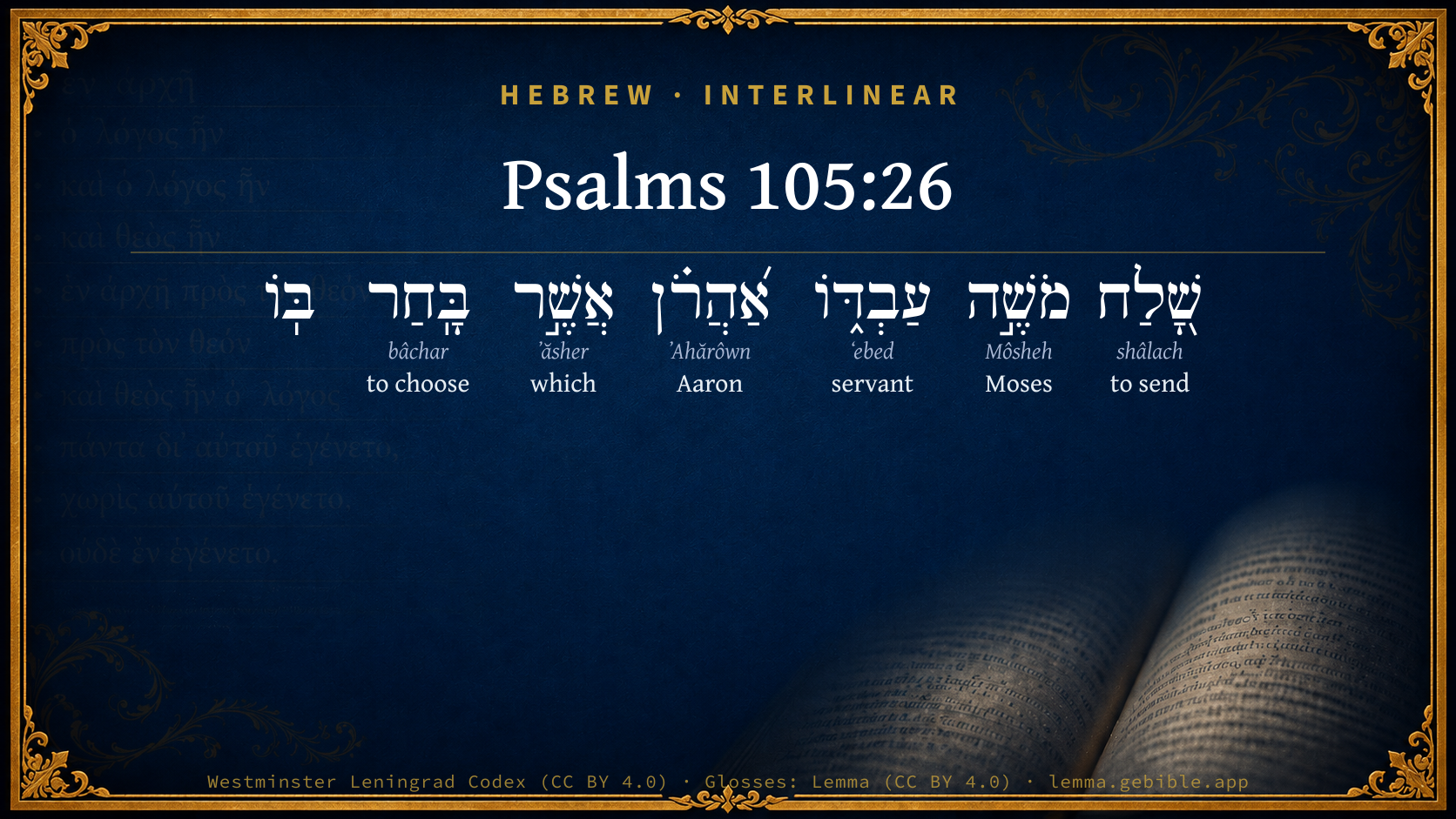
Hebrew (Westminster Leningrad Codex) Psalms 105:26 appears in the Hebrew Old Testament. The text above is from the Westminster Leningrad Codex. Each word links to its Strong’s number, a concise gloss, and parsing drawn from the Open Scriptures Hebrew Bible morphology. Click any word for its full Brown-Driver-Briggs (BDB) entry.
Download image
Cite this verse

Psalms 105:26 (World English Bible). Public Domain. Lemma interlinear Bible study tool, https://lemma.gebible.app/v/psalms/105/26.

Show BibTeX & RIS
BibTeX
RIS
English Translation
He sent Moses, his servant, And Aaron, whom he had chosen.
World English Bible · Public Domain
Download a study sheet

One document with this verse’s original text, its word-by-word gloss line, the meaning frame, cross-references with their text, attributed commentary, and full source and license credits — printable, and it pastes into notes with its structure intact.

This verse Autodidact and up

Study sheet (.html) Plain text (.txt)

A passage Seminary Student

Up to 50 verses in one chapter. A passage sheet keeps up to 6 commentary sources and 12 cross-references per verse, in the order this page ranks them, and says so on the sheet whenever that leaves anything out. Ask for a single verse and you get the Autodidact verse sheet above.

Everything on this page stays free to read, with no account — the sheet is a download of what is already on screen, not access to it.

Want to remove ads? Support Godless Engineer
Compare translations 3

The same verse in 3 English versions, stacked beneath the original-language interlinear above. Click any original word for its lexicon entry.

Each is an independent rendering of the whole verse — the interlinear is not word-aligned to these translations.

Highlighted words mark where these versions differ — a whole-verse word diff, not a word-by-word alignment.

  • World English Bible Public Domain
    He sent Moses, his servant, And Aaron, whom he had chosen.
  • King James Version Public Domain
    He sent Moses his servant; and Aaron whom he had chosen.
  • unfoldingWord Literal Text CC BY-SA 4.0
    He sent Moses, his servant, Aaron, whom he had chosen him.

unfoldingWord Literal Text — © unfoldingWord, licensed CC BY-SA 4.0. Word-aligned USFM3 via Door43 (git.door43.org/unfoldingWord/en_ult).

Versions to compare (up to 4)

3 of 4 selected

Show all 18 translations

Every available English version of this verse, each an independent rendering of the whole verse.

  • World English Bible Public Domain
    He sent Moses, his servant, And Aaron, whom he had chosen.
  • Berean Standard Bible Public Domain
    He sent Moses His servant, and Aaron, whom He had chosen.
  • Majority Standard Bible Public Domain
    He sent Moses His servant, and Aaron, whom He had chosen.
  • King James Version Public Domain
    He sent Moses his servant; and Aaron whom he had chosen.
  • American Standard Version (1901) Public Domain
    He sent Moses his servant, `And' Aaron whom he had chosen.
  • Revised Version (1885) Public Domain
    He sent Moses his servant, and Aaron whom he had chosen.
  • Geneva Bible (1599) Public Domain
    Then sent he Moses his seruant, and Aaron whom he had chosen.
  • Douay-Rheims (1899) Public Domain
    He sent Moses his servant: Aaron the man whom he had chosen.
  • Young's Literal Translation Public Domain
    He hath sent Moses His servant, Aaron whom He had fixed on.
  • Literal Standard Version CC BY-SA 4.0
    He has sent His servant Moses, || Aaron whom He had fixed on.
  • Unlocked Literal Bible CC BY-SA 4.0
    He sent Moses, his servant, and Aaron, whom he had chosen.
  • unfoldingWord Literal Text CC BY-SA 4.0
    He sent Moses, his servant, Aaron, whom he had chosen him.
  • Darby Bible Public Domain
    He sent Moses his servant, [and] Aaron whom he had chosen:
  • World Messianic Bible Public Domain
    He sent Moses, his servant, and Aaron, whom he had chosen.
  • Webster's Bible Public Domain
    He sent Moses his servant; and Aaron whom he had chosen.
  • Free Bible Version CC BY-SA 4.0
    He sent his servant Moses, together with Aaron, whom he had chosen.
  • Bible in Basic English Public Domain
    He sent Moses, his servant, and Aaron, the man of his selection.
  • JPS Tanakh (1917) Public Domain
    He sent Moses His servant, and Aaron whom He had chosen.

Literal Standard Version (2020), Covenant Press — licensed CC BY-SA 4.0. Text via the HelloAO Bible API (eBible.org). Unlocked Literal Bible (unfoldingWord) — licensed CC BY-SA 4.0. Text via the HelloAO Bible API (eBible.org). unfoldingWord Literal Text — © unfoldingWord, licensed CC BY-SA 4.0. Word-aligned USFM3 via Door43 (git.door43.org/unfoldingWord/en_ult). Free Bible Version, Dr. Jonathan Gallagher — licensed CC BY-SA 4.0. Text via the HelloAO Bible API (eBible.org).

Word by word

More ways to search: Search by grammar → Find every occurrence → Compare this word →

Practice this passage: Drill this verse → Learn its vocabulary →

About this verse

These counts appear in no published source. They are computed here, from the morphology-tagged text and Lemma’s own curated glosses. What Lemma adds →

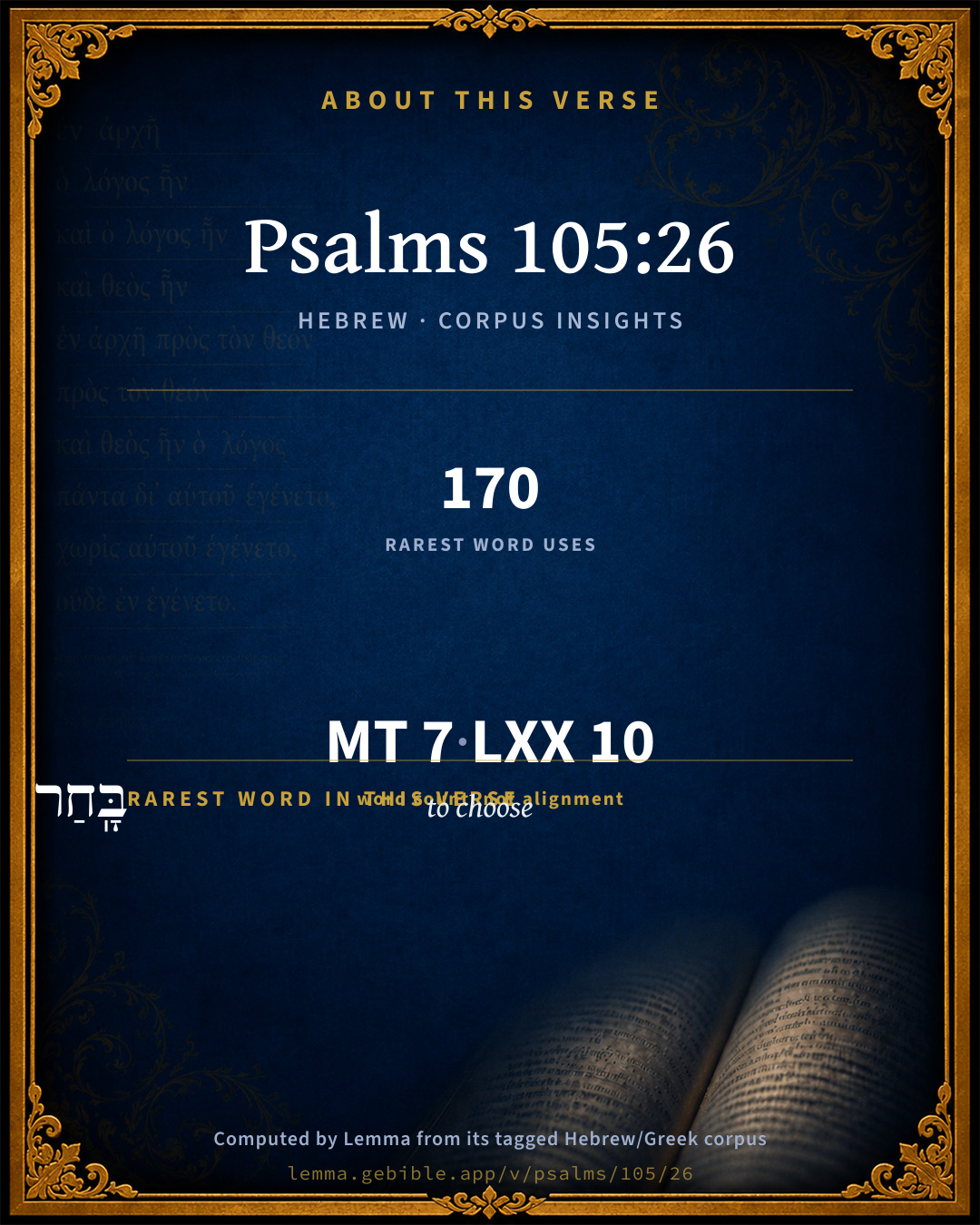
7
words
6
distinct lemmas
Wisdom
section

Grammatical profile

  • 2 verbs
  • 3 nouns
  • 1 preposition
  • 1 particle

Verb forms

  • שָׁ֭לַח Qal · Perfect
  • בָּֽחַר Qal · Perfect

Hebrew & Septuagint length

In English translation the verse runs 11 words from the Hebrew and 12 from the Septuagint (LXX English) — closely comparable.

A rough comparison of the two English renderings, which tokenize alike — not a word-level alignment.

Word counts can differ between the Hebrew and the Greek without any difference in meaning — e.g. the Hebrew direct-object marker אֵת has no separate Greek word, and Greek often adds the article ὁ.

In the original languages it is 7 Hebrew tokens and 10 Greek tokens — but the two are counted differently (Hebrew bundles its prefixes and suffixes into one token; the Greek is in lemma form), so that isn’t a like-for-like length.

Cross-references

20

Topical passages linked to Psalms 105:26 in the Treasury of Scripture Knowledge — connected by theme and wording, ordered by reader-vote popularity; previews shown in the World English Bible.

  • Exodus 3:10 Come now therefore, and I will send you to Pharaoh, that you may bring forth my people, the children of Israel, out of Egypt."
  • Exodus 7:1 Yahweh said to Moses, "Behold, I have made you as God to Pharaoh; and Aaron your brother shall be your prophet.
  • Exodus 28:1–2 "Bring Aaron your brother, and his sons with him, near to you from among the children of Israel, that he may minister to me in the priest's office, even Aaron, Nadab and Abihu, Eleazar and Ithamar, Aaron's sons.
  • Exodus 28:12 You shall put the two stones on the shoulder-pieces of the ephod, to be stones of memorial for the children of Israel: and Aaron shall bear their names before Yahweh on his two shoulders for a memorial.
  • Exodus 28:29–38 Aaron shall bear the names of the children of Israel in the breastplate of judgment on his heart, when he goes in to the holy place, for a memorial before Yahweh continually.
  • Exodus 29:5–46 You shall take the garments, and put on Aaron the coat, the robe of the ephod, the ephod, and the breastplate, and dress him with the skillfully woven band of the ephod;
  • Numbers 16:40 to be a memorial to the children of Israel, to the end that no stranger, who isn't of the seed of Aaron, comes near to burn incense before Yahweh; that he not be as Korah, and as his company: as Yahweh spoke to him by Moses.
  • Exodus 4:12–14 Now therefore go, and I will be with your mouth, and teach you what you shall speak."
  • Exodus 6:11 "Go in, speak to Pharaoh king of Egypt, that he let the children of Israel go out of his land."
  • Exodus 6:26–27 These are that Aaron and Moses, to whom Yahweh said, "Bring out the children of Israel from the land of Egypt according to their hosts."
  • Exodus 7:12 For they cast down every man his rod, and they became serpents: but Aaron's rod swallowed up their rods.
  • Leviticus 8:7–36 He put the coat on him, tied the sash on him, clothed him with the robe, put the ephod on him, and he tied the skillfully woven band of the ephod on him, and fastened it to him with it.
  • Numbers 16:5–11 and he spoke to Korah and to all his company, saying, In the morning Yahweh will show who are his, and who is holy, and will cause him to come near to him: even him whom he shall choose will he cause to come near to him.
  • Numbers 16:47–48 Aaron took as Moses spoke, and ran into the midst of the assembly; and, behold, the plague was begun among the people: and he put on the incense, and made atonement for the people.
  • Numbers 17:5–8 It shall happen, that the rod of the man whom I shall choose shall bud: and I will make to cease from me the murmurings of the children of Israel, which they murmur against you.
  • Joshua 24:5 I sent Moses and Aaron, and I plagued Egypt, according to that which I did in the midst of it: and afterward I brought you out.
  • 1 Samuel 12:6 Samuel said to the people, It is Yahweh who appointed Moses and Aaron, and that brought your fathers up out of the land of Egypt.
  • Psalms 77:20 You led your people like a flock, By the hand of Moses and Aaron.
  • Micah 6:4 For I brought you up out of the land of Egypt, And redeemed you out of the house of bondage. I sent before you Moses, Aaron, and Miriam.
  • Acts 7:34–35 I have surely seen the affliction of my people that is in Egypt, and have heard their groaning. I have come down to deliver them. Now come, I will send you into Egypt.'

Cross-references courtesy of OpenBible.info (CC BY 4.0).

Hebrew and Greek witnesses Masoretic Hebrew ↔ Greek Septuagint

The same verse in the two great witnesses to the Old Testament, shown verse-for-verse.

You’re reading Greek Psalm 104 (Hebrew Psalm 105). The Septuagint counts the superscription, so verse numbers can differ from the Hebrew — chapter-level alignment, not verse-by-verse. Numbering follows Rahlfs.

These are two independent witnesses, not word-aligned to each other, and the Septuagint is shown in lemma (dictionary) form.

Hebrew Psalms 105:26 Masoretic · Westminster Leningrad Codex

שָׁ֭לַח מֹשֶׁ֣ה עַבְדּ֑וֹ אַ֝הֲרֹ֗ן אֲשֶׁ֣ר בָּֽחַר בּֽוֹ

He sent Moses, his servant, And Aaron, whom he had chosen.

World English Bible · Public Domain

Greek LXX Greek Psalm 104:26 Septuagint · lemma form

ἐκ ἀποστέλλω μωυσῆς ὁ δοῦλος αὐτός ἀαρών ὅς ἐκλέγω αὐτός

He sent forth Moses his servant, and Aaron whom he had chosen.

LXX2012 (modern English Septuagint) · Public Domain

Hebrew: Westminster Leningrad Codex (CC BY 4.0). Greek: Septuagint (public domain); English from LXX2012 (modern English Septuagint) (Public Domain). How the Septuagint differs from the Hebrew →

Commentary

Notes on Psalms 105:26 from classic Christian and Jewish commentators (each source and its license shown beneath its notes). The classic Christian expositions comment on the surrounding passage and are grouped to its opening verse, so a note may address several verses; the Jewish commentaries on the Tanakh (Rashi and others) are per-verse, so they appear only where the commentator wrote on this verse.

Lemma curates 59 commentaries, every one of them public domain or Creative Commons licensed, each selected and text-cleaned for this edition rather than reprinted as found. About our sources →

Trapp's Complete Commentary

John Trapp

Psa 105:26 He sent Moses his servant; [and] Aaron whom he had chosen.

Ver. 26. He sent Moses his servant] Quando duplieantur lateres, venit Moses, say the Jews at this day.

And Aaron, &c.] God usually sendeth his by two and two, for mutual helps and comfort.

John Trapp, A Commentary or Exposition upon All the Books of the Old and New Testament (1647–1656) — public domain. Text from a community e-Sword module.

Joseph Benson's Commentary

Psa 105:26-27. He sent Moses, &c. — “When the tyranny and oppression of Pharaoh were at the highest, and Israel cried unto Jehovah because of the bondage, he remembered his promise to Abraham, and sent Moses, with Aaron, to effect that mighty deliverance, which was to be the grand pledge and figure of our redemption by Jesus Christ.” They showed his signs among them — Hebrew, דברי אתותיו, dibree othothaiv, the words of his signs; an emphatical expression. First they boldly declared the word and will of God concerning the several plagues, and then they actually inflicted them.

Joseph Benson's Commentary on the Old and New Testaments (1811–1818) — public domain. Text from a community e-Sword module.

J. A. Alexander on Psalms

Joseph Addison Alexander

26. (Psa 105:26) He sent Moses his servant (and) Aaron whom he chose. The meaning is not Moses (who was) his servant, or (because he was) his servant, but (to be) his servant, his instrument in the great work of delivering his people. See above, on ver. 6 (Psa 105:6), and on Psa 18:1; Psa 36:1; Psa 78:70.

Joseph Addison Alexander, The Psalms Translated and Explained (1850) — public domain. Text from a community e-Sword module.

Tyndale Open Study Notes

Tyndale Open Resources

105:26-36 The psalmist recounts the story of Moses and the plagues in Egypt (Exod 7:20–12:30).

Tyndale Open Study Notes — © Tyndale Open Resources, licensed CC BY-SA 4.0. Text via the HelloAO Bible API.

John Calvin's Commentaries

26 He sent Moses his servant Here the prophet briefly adverts to such things regarding the deliverance of the people as were worthy of particular notice. Had the Egyptians of their own accord suffered the people to depart, neither the service of Moses nor miracles would have been required. God then appointed that their deliverance should take place in such a way, as would render the denial of his being its author impossible. Moses is called the servant of the Lord, to teach us that he was not self-elected to his office, and that he attempted nothing by his own authority, but, being the minister of God, executed the office with which he had been intrusted. The same thing is expressed still more plainly with respect to Aaron, when he is said to have been chosen What is attributed to each of these eminent men in particular, applies equally to both, and therefore the sentence ought to be explained thus: God sent Moses and Aaron, his servants, not because of their own intrinsic fitness, or because they spontaneously offered to him their service, but because he chose them. This passage teaches us, that those who are engaged in active and useful service for the Church, are not prepared exclusively by their own exertions, or framed to it by their own talents, but are stirred up thereto by God. Moses was a man of heroic virtue: but, considered merely in himself, he was nothing. Accordingly, the prophet would have all that is accounted worthy of remembrance in Moses, as well as in Aaron, to be ascribed to God alone. Thus it appears that whatever men do for the welfare of the Church, they owe the power of doing it to God, who, of his free goodness, has been pleased thus to honor them.

John Calvin's Commentaries (1540-1563) — public domain. Text from the Calvin Translation Society English edition (1840s-50s) via the Christian Classics Ethereal Library (ccel.org). Calvin's coverage is partial (roughly two-thirds of the Bible); uncommented books and verses are honest gaps, never fabricated. The 19th-century editor's footnotes and remarks are omitted so the notes are faithfully Calvin's own voice.

The Cambridge Bible for Schools and Colleges

gen. ed. J. J. S. Perowne

26. Moses his servant] Exo_14:31, and often.

The Cambridge Bible for Schools and Colleges (gen. ed. J. J. S. Perowne; Cambridge University Press, 1878–1918) — public domain. Text from a community e-Sword module.

John Gill's Exposition

He sent Moses his servant,.... Into Egypt, to deliver his people Israel out of the hands of the Egyptians; in which, as in other things, he approved himself to be a faithful servant to the Lord; of this mission of his, see Exo 3:10. In this he was a type of Christ, who appeared in the form of a servant, and really was one; God's righteous servant as Mediator, though his Son as a divine Person; sent by him to redeem his people out of worse than Egyptian bondage, from sin, Satan, the law, its curse and condemnation.

And Aaron whom he had chosen; to go along with Moses, to be a mouth for him, and a prophet to him, Exo 4:16, who also was a type of Christ, being a priest and good spokesman, chosen and called of God, a holy and an anointed one. The Targum is,

"in whom he was well pleased.''

John Gill's Exposition of the Whole Bible (1746–1763) — public domain (CC PDM 1.0). Text via the HelloAO Bible API.

Albert Barnes' Notes on the Bible

He sent Moses his servant - He sent Moses to be his servant in delivering his people; that is, to accomplish the work which he had designed should be done.

And Aaron whom he had chosen - whom he had selected to perform an important work in delivering his people from bondage.

Albert Barnes' Notes on the Bible (1834–1885) — public domain. Text from a community e-Sword/MySword module.

Matthew Poole's English Annotations

To be the companion and interpreter of Moses in this expedition, of which see Exo 3:10; 4:12, &c. This clause he adds, to show that Aaron was no less called and chosen by God to this work than Moses, which otherwise was not so evident from the history; or this clause may belong to both Moses and Aaron.

Matthew Poole's English Annotations on the Holy Bible (1683–1685) — public domain. Text from a community e-Sword/MySword module.

The Treasury of David

Charles H. Spurgeon

Ver. 26. He sent Moses his servant; and Aaron whom he had chosen. When the oppression was at the worst, Moses came. For the second time we have here the expression, "he sent"; he who sent Joseph sent also Moses and his eloquent brother. The Lord had the men in readiness and all he had to do was to commission them and thrust them forward. They were two, for mutual comfort and strength, even as the apostles and the seventy in our Lord's day were sent forth two and two. The men differed, and so the one became the supplement of the other, and together they were able to accomplish far more than if they had been exactly alike: the main point was that they were both sent, and hence both clothed with divine might.

Ver. 26. Moses and Aaron. God usually sendeth his servants by two and two for mutual helps and comfort. John Trapp.

Psalms 105:27*

Charles H. Spurgeon's The Treasury of David (1869–1885) — public domain. Psalms only. Text from a community e-Sword/MySword module.

The Pulpit Commentary

He sent Moses his servant. The mission of Moses is related in Exo_3:10-18 Exo_4:1-9. And Aaron whom he had chosen. (For Aaron"s mission, see Exo_4:14-17)

The Pulpit Commentary (1880–1919), ed. H.D.M. Spence-Jones & Joseph S. Exell — public domain. Text from a community e-Sword module.

Lesson kit

Teaching starters — assembled from the data on this page, not authored interpretation. Every prompt links to the verse data it draws on. Edit before teaching.

Psalms, in the Wisdom, opens this verse with 7 words (6 distinct Hebrew lemmas). Its most distinctive word is bâchar (“to choose”). A historical commentator’s framing appears above. Read the whole chapter for the surrounding context.

Discussion questions

  1. The word bâchar carries the sense “to choose.” How does it shape the verse?
  2. Exodus 3:10 shares this passage’s theme. How do the two illuminate each other?
  3. These translations render this verse differently; the difference is in the English rendering, not the original. What questions does that raise?
  4. The verb «שָׁ֭לַח» is Qal Perfect. How does its form color the action?
  5. Reading how Trapp's Complete Commentary and Joseph Benson's Commentary read this verse, where do the two commentators agree and where do they part?

Things to notice

Reading settings

Reading text

Shown beneath each verse's original-language words.

Old Testament
Old Testament edition

Read the OT as the Masoretic Hebrew (MT) or the Greek Septuagint (LXX).

English shown for the Greek Septuagint (in the Hebrew ↔ Greek comparison).

Comparing translations? Open the Compare panel on any verse page to stack up to four side by side.