
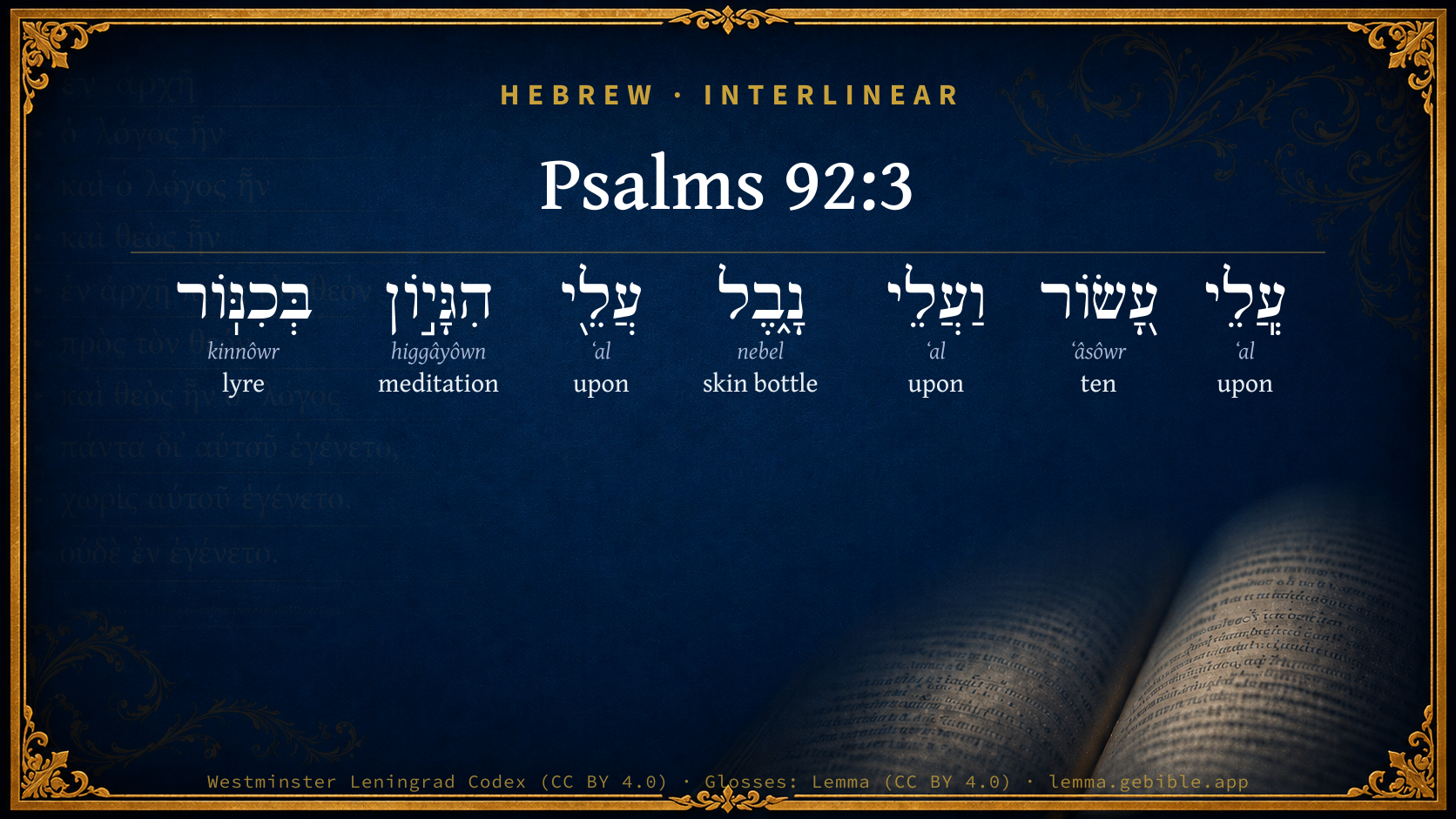
Psalms 92:3

Hebrew (Westminster Leningrad Codex) Psalms 92:3 appears in the Hebrew Old Testament. The text above is from the Westminster Leningrad Codex. Each word links to its Strong’s number, a concise gloss, and parsing drawn from the Open Scriptures Hebrew Bible morphology. Click any word for its full Brown-Driver-Briggs (BDB) entry.
Download image
Cite this verse

Psalms 92:3 (World English Bible). Public Domain. Lemma interlinear Bible study tool, https://lemma.gebible.app/v/psalms/92/3.

Show BibTeX & RIS
BibTeX
RIS
English Translation
With the ten-stringed lute, with the harp, And with the melody of the lyre.
World English Bible · Public Domain
Download a study sheet

One document with this verse’s original text, its word-by-word gloss line, the meaning frame, cross-references with their text, attributed commentary, and full source and license credits — printable, and it pastes into notes with its structure intact.

This verse Autodidact and up

Study sheet (.html) Plain text (.txt)

A passage Seminary Student

Up to 50 verses in one chapter. A passage sheet keeps up to 6 commentary sources and 12 cross-references per verse, in the order this page ranks them, and says so on the sheet whenever that leaves anything out. Ask for a single verse and you get the Autodidact verse sheet above.

Everything on this page stays free to read, with no account — the sheet is a download of what is already on screen, not access to it.

Want to remove ads? Support Godless Engineer
Compare translations 3

The same verse in 3 English versions, stacked beneath the original-language interlinear above. Click any original word for its lexicon entry.

Each is an independent rendering of the whole verse — the interlinear is not word-aligned to these translations.

Highlighted words mark where these versions differ — a whole-verse word diff, not a word-by-word alignment.

  • World English Bible Public Domain
    With the ten-stringed lute, with the harp, And with the melody of the lyre.
  • King James Version Public Domain
    Upon an instrument of ten strings, and upon the psaltery; upon the harp with a solemn sound.
  • unfoldingWord Literal Text CC BY-SA 4.0
    with a ten and with a lyre; with a melody on a harp.

unfoldingWord Literal Text — © unfoldingWord, licensed CC BY-SA 4.0. Word-aligned USFM3 via Door43 (git.door43.org/unfoldingWord/en_ult).

Versions to compare (up to 4)

3 of 4 selected

Show all 18 translations

Every available English version of this verse, each an independent rendering of the whole verse.

  • World English Bible Public Domain
    With the ten-stringed lute, with the harp, And with the melody of the lyre.
  • Berean Standard Bible Public Domain
    with the ten-stringed harp and the melody of the lyre.
  • Majority Standard Bible Public Domain
    with the ten-stringed harp and the melody of the lyre.
  • King James Version Public Domain
    Upon an instrument of ten strings, and upon the psaltery; upon the harp with a solemn sound.
  • American Standard Version (1901) Public Domain
    With an instrument of ten strings, and with the psaltery; With a solemn sound upon the harp.
  • Revised Version (1885) Public Domain
    With an instrument of ten strings, and with the psaltery; with a solemn sound upon the harp.
  • Geneva Bible (1599) Public Domain
    Vpon an instrument of tenne strings, and vpon the viole with the song vpon the harpe.
  • Douay-Rheims (1899) Public Domain
    To shew forth thy mercy in the morning, and thy truth in the night:
  • Young's Literal Translation Public Domain
    On ten strings and on psaltery, On higgaion, with harp.
  • Literal Standard Version CC BY-SA 4.0
    On ten strings and on stringed instrument, || On higgaion, with harp.
  • Unlocked Literal Bible CC BY-SA 4.0
    with a harp of ten strings and with the melody of the lyre.
  • unfoldingWord Literal Text CC BY-SA 4.0
    with a ten and with a lyre; with a melody on a harp.
  • Darby Bible Public Domain
    Upon an instrument of ten strings and upon the lute; upon the Higgaion with the harp.
  • World Messianic Bible Public Domain
    with the ten-stringed lute, with the harp, and with the melody of the lyre.
  • Webster's Bible Public Domain
    \\92:2\\To show forth thy loving-kindness in the morning, and thy faithfulness every night.
  • Free Bible Version CC BY-SA 4.0
    to the music of a ten-stringed harp and the melody of a lyre.
  • Bible in Basic English Public Domain
    On a ten-corded instrument, and on an instrument of music with a quiet sound.
  • JPS Tanakh (1917) Public Domain
    (92-4) With an instrument of ten strings, and with the psaltery; with a solemn sound upon the harp.

Literal Standard Version (2020), Covenant Press — licensed CC BY-SA 4.0. Text via the HelloAO Bible API (eBible.org). Unlocked Literal Bible (unfoldingWord) — licensed CC BY-SA 4.0. Text via the HelloAO Bible API (eBible.org). unfoldingWord Literal Text — © unfoldingWord, licensed CC BY-SA 4.0. Word-aligned USFM3 via Door43 (git.door43.org/unfoldingWord/en_ult). Free Bible Version, Dr. Jonathan Gallagher — licensed CC BY-SA 4.0. Text via the HelloAO Bible API (eBible.org).

Word by word

More ways to search: Search by grammar → Find every occurrence → Compare this word →

Practice this passage: Drill this verse → Learn its vocabulary →

About this verse

These counts appear in no published source. They are computed here, from the morphology-tagged text and Lemma’s own curated glosses. What Lemma adds →

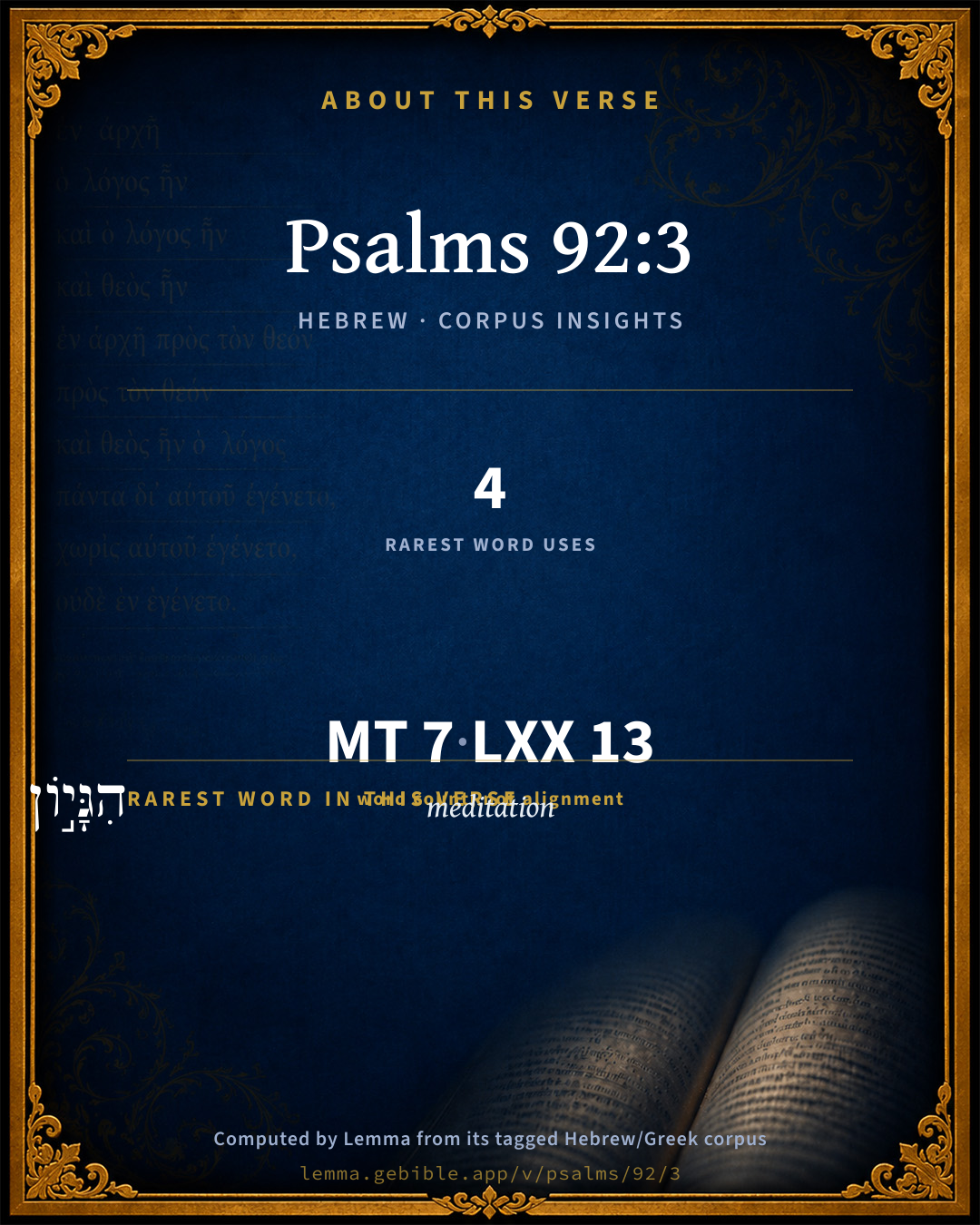
7
words
5
distinct lemmas
Wisdom
section

Notable vocabulary

The rarest word here is הִגָּי֣וֹן meditation H1902 — appearing just 4 times in the whole Hebrew Bible.

Shared distinctive vocabulary

הִגָּי֣וֹן meditation H1902 occurs in 4 verses of the Hebrew Bible. Also found in:

Grammatical profile

  • 4 nouns
  • 3 prepositions

Repetition

A word recurs within this verse — often emphatic in Hebrew:

  • עֲֽלֵי upon H5921 ×3

Hebrew & Septuagint length

In English translation the verse runs 14 words from the Hebrew and 12 from the Septuagint (LXX English) — closely comparable.

A rough comparison of the two English renderings, which tokenize alike — not a word-level alignment.

Word counts can differ between the Hebrew and the Greek without any difference in meaning — e.g. the Hebrew direct-object marker אֵת has no separate Greek word, and Greek often adds the article ὁ.

In the original languages it is 7 Hebrew tokens and 13 Greek tokens — but the two are counted differently (Hebrew bundles its prefixes and suffixes into one token; the Greek is in lemma form), so that isn’t a like-for-like length.

Cross-references

14

Topical passages linked to Psalms 92:3 in the Treasury of Scripture Knowledge — connected by theme and wording, ordered by reader-vote popularity; previews shown in the World English Bible.

  • Psalms 33:2 Give thanks to Yahweh with the lyre. Sing praises to him with the harp of ten strings.
  • 1 Chronicles 13:8 David and all Israel played before God with all their might, even with songs, and with harps, and with psalteries, and with tambourines, and with cymbals, and with trumpets.
  • 2 Chronicles 23:5 and a third part shall be at the king's house; and a third part at the gate of the foundation: and all the people shall be in the courts of the house of Yahweh.
  • Nehemiah 12:27 At the dedication of the wall of Jerusalem they sought the Levites out of all their places, to bring them to Jerusalem, to keep the dedication with gladness, both with giving thanks, and with singing, with cymbals, psalteries, and with harps.
  • Psalms 68:25 The singers went before, the minstrels followed after, In the midst of the ladies playing with tambourines,
  • 1 Samuel 10:5 After that you shall come to the hill of God, where is the garrison of the Philistines: and it shall happen, when you are come there to the city, that you shall meet a band of prophets coming down from the high place with a psaltery, and a tambourine, and a pipe, and a harp, before them; and they will be prophesying:
  • Psalms 9:16 Yahweh has made himself known. He has executed judgment. The wicked is snared by the work of his own hands. Meditation. Selah.
  • 1 Chronicles 15:16 David spoke to the chief of the Levites to appoint their brothers the singers, with instruments of music, psalteries and harps and cymbals, sounding aloud and lifting up the voice with joy.
  • 1 Chronicles 25:6 All these were under the hands of their father for song in the house of Yahweh, with cymbals, psalteries, and harps, for the service of the house of God; Asaph, Jeduthun, and Heman being under the order of the king.
  • 2 Chronicles 29:25 He set the Levites in the house of Yahweh with cymbals, with psalteries, and with harps, according to the commandment of David, and of Gad the king's seer, and Nathan the prophet; for the commandment was of Yahweh by his prophets.
  • Psalms 81:2–3 Raise a song, and bring here the tambourine, The pleasant lyre with the harp.
  • Psalms 149:3 Let them praise his name in the dance! Let them sing praises to him with tambourine and harp!
  • Psalms 150:3–5 Praise him with the sounding of the trumpet! Praise him with harp and lyre!
  • Psalms 57:8 Wake up, my glory! Wake up, psaltery and harp! I will wake up the dawn.

Cross-references courtesy of OpenBible.info (CC BY 4.0).

Hebrew and Greek witnesses Masoretic Hebrew ↔ Greek Septuagint

The same verse in the two great witnesses to the Old Testament, shown verse-for-verse.

You’re reading Greek Psalm 91 (Hebrew Psalm 92). The Septuagint counts the superscription, so verse numbers can differ from the Hebrew — chapter-level alignment, not verse-by-verse. Numbering follows Rahlfs.

These are two independent witnesses, not word-aligned to each other, and the Septuagint is shown in lemma (dictionary) form.

Hebrew Psalms 92:3 Masoretic · Westminster Leningrad Codex

עֲֽלֵי עָ֭שׂוֹר וַעֲלֵי נָ֑בֶל עֲלֵ֖י הִגָּי֣וֹן בְּכִנּֽוֹר

With the ten-stringed lute, with the harp, And with the melody of the lyre.

World English Bible · Public Domain

Greek LXX Greek Psalm 91:3 Septuagint · lemma form

ὁ ἀναἀγγέλλω ὁ πρωΐ ὁ ἔλεος σύ καί ὁ ἀλήθεια σύ κατά νύξ

on a lute of ten strings, with a song on the harp.

LXX2012 (modern English Septuagint) · Public Domain

Hebrew: Westminster Leningrad Codex (CC BY 4.0). Greek: Septuagint (public domain); English from LXX2012 (modern English Septuagint) (Public Domain). How the Septuagint differs from the Hebrew →

Commentary

Notes on Psalms 92:3 from classic Christian and Jewish commentators (each source and its license shown beneath its notes). The classic Christian expositions comment on the surrounding passage and are grouped to its opening verse, so a note may address several verses; the Jewish commentaries on the Tanakh (Rashi and others) are per-verse, so they appear only where the commentator wrote on this verse.

Lemma curates 59 commentaries, every one of them public domain or Creative Commons licensed, each selected and text-cleaned for this edition rather than reprinted as found. About our sources →

Trapp's Complete Commentary

John Trapp

Psa 92:3 Upon an instrument of ten strings, and upon the psaltery; upon the harp with a solemn sound.

Ver. 3. Upon an instrument of ten strings, &c.] This was part of the Jewish pedagogy; and teacheth us to use all lawful means to enforce ourselves to that, whereunto we are so dull and backward.

John Trapp, A Commentary or Exposition upon All the Books of the Old and New Testament (1647–1656) — public domain. Text from a community e-Sword module.

J. A. Alexander on Psalms

Joseph Addison Alexander

4. (Psa 92:3) On decachord and on lyre, on meditation with a harp. The first word in Hebrew means a decade, a group or set of ten, and then an instrument of ten strings. See above, on Psa 33:2. In the last clause, by a bold but intelligible figure, meditation is referred to as an instrument, precisely as the lyre and harp are, the latter being joined with it as a mere accompaniment.

Joseph Addison Alexander, The Psalms Translated and Explained (1850) — public domain. Text from a community e-Sword module.

Geneva Bible (1599)

Geneva Bible translators

These instruments were then permitted, but at Christ’s coming abolished.

Geneva Bible (1599) marginal notes — public domain. Text via Bolls.life.

Adam Clarke's Commentary

Verse 3. Upon an instrument of ten strings] Eusebius, in his comment on this Psalm, says: Ψαλτηριον δε δεκαχορδον, ἡ του Ἁγιου Πνευματος δια των αισθητηριων πεντε μεν του σωματος, ισαριθμων δε της ψυχης δυναμεων, επιτελουμενη λατρεια· "The Psaltery of ten strings is the worship of the Holy Spirit, performed by means of the five senses of the body, and by the five powers of the soul." And, to confirm this interpretation, he quotes the apostle, 1Co 14:15: "I will pray with the spirit, and with the understanding also; I will sing with the spirit, and with the understanding also." "As the mind has its influence by which it moves the body, so the spirit has its own influence by which it moves the soul." Whatever may be thought of this gloss, one thing is pretty evident from it, that instrumental music was not in use in the Church of Christ in the time of Eusebius, which was near the middle of the fourth century. Had any such thing then existed in the Christian Church, he would have doubtless alluded to or spiritualized it; or, as he quoted the words of the apostle above, would have shown that carnal usages were substituted for spiritual exercises. I believe the whole verse should be translated thus: Upon the asur, upon the nebel, upon the higgayon, with the kinnor. Thus it stands in the Hebrew.

Adam Clarke's Commentary on the Bible (1810–1826) — public domain. Text from a community e-Sword/MySword module.

Ellicott's Commentary for English Readers

(3) Ten strings.—See Note, Psa_33:2.

Upon the harp with a solemn sound.—Rather, with music of the harp. For the Hebrew word, see Note, Psa_9:16.

A Bible Commentary for English Readers, edited by Charles John Ellicott (1878–1897) — public domain. Text from a community e-Sword module.

The Cambridge Bible for Schools and Colleges

gen. ed. J. J. S. Perowne

3. With decachord and with psaltery,

With meditative music on the harp.

In Psa_33:2; Psa_144:9, ten-stringed is an epithet of psaltery, but here two instruments seem to be meant. Higgâyôn occurs in Psa_9:16 as a technical term, denoting apparently an instrumental interlude. The word denotes musing or meditation in Psa_19:14. See Introd. p. xxiv.

The Cambridge Bible for Schools and Colleges (gen. ed. J. J. S. Perowne; Cambridge University Press, 1878–1918) — public domain. Text from a community e-Sword module.

John Gill's Exposition

Upon an instrument of ten strings,.... An harp of ten strings, as the Targum. The harp invented by Terpander had only seven strings (c); according to Pliny (d); Simonides added the eighth, and Timotheus the ninth; but this of David was of ten strings:

and upon the psaltery; of which See Gill on Psa 33:2, "upon the harp with a solemn sound"; or "upon higgaon with the harp"; which "higgaon", Aben Ezra says, was either the tune of a song, or an instrument of music; all these instruments of music were typical of the spiritual joy and melody which the saints have in their hearts when they praise the Lord; hence mention is made of harps in particular in this spiritual sense, under the Gospel dispensation, Rev 5:8.

(c) Suidas in voce Plin. Nat. Hist. l. 7. c. 56. (d) Ibid.

John Gill's Exposition of the Whole Bible (1746–1763) — public domain (CC PDM 1.0). Text via the HelloAO Bible API.

Albert Barnes' Notes on the Bible

Upon an instrument of ten strings - The general idea in this verse is, that instruments “of all kinds” are to be employed in celebrating the praises of God. On the instrument here referred to, see the notes at Psa 33:2.

And upon the psaltery - Or “lyre.” See the notes at Isa 5:12. The word is there translated viol.

Upon the harp with a solemn sound - Margin, upon the solemn sound with the harp.” Prof. Alexander renders this, “On meditation with a harp.” On the word rendered “harp,” see the notes at Isa 5:12. The Hebrew word rendered “solemn sound” is הגיון higgâyôn which means properly “murmur;” then, the sound of a harp; and then, meditation. See the notes at Psa 9:16. Here the meaning seems to be, “with murmurs upon the harp;” that is, with the sound of the harp - its murmuring tones. It does not denote here a distinct instrument of music, but it refers to the tones of the harp: not to the meditations of the mind - of the worshipper - but to the low and gentle sounds of the instrument itself.

Albert Barnes' Notes on the Bible (1834–1885) — public domain. Text from a community e-Sword/MySword module.

The Treasury of David

Charles H. Spurgeon

Ver. 3. Upon an instrument of ten strings; with the fullest range of music, uttering before God with the full compass of melody the richest emotions of his soul.

And upon the psaltery; thus giving variety to praise: the Psalmist felt that every sweet-sounding instrument should be consecrated to God. George Herbert and Martin Luther aided their private devotions by instrumental music; and whatever may have been the differences of opinion in the Christian church, as to the performance of instrumental music in public, we have met with no objection to its personal and private use.

Upon the harp with a solemn sound, or upon meditation with a harp; as much as to say, my meditative soul is, after all, the best instrument, and the harp's dulcet tones comes in to aid my thoughts. It is blessed work when hand and tongue work together in the heavenly occupation of praise.

"Strings and voices, hands and hearts,

In the concert bear your parts:

All that breathe, your God adore,

Praise him, praise him, evermore."

It is, however, much to be feared that attention to the mere mechanism of music, noting keys and strings, bars and crotchets, has carried many away from the spiritual harmony which is the soul and essence of praise. Fine music without devotion is but a splendid garment upon a corpse.

Ver. 3. Upon an instrument of ten strings. Eusebius, in his comment on this psalm, says: "The psaltery of ten strings is the worship of the Holy Spirit performed by means of the five senses of the body, and by the five powers of the soul." And to confirm this interpretation, he quotes the apostle, 1Co 14:15: "I will pray with the spirit, and with the understanding also; I will sing with the spirit, and with the understanding also." "As the mind has its influence by which it moves the body, so the spirit has its own influence by which it moves the soul." Whatever may be thought of this gloss, one thing is pretty evident from it, that instrumental music was not in use in the church of Christ in the time of Eusebius, which was near the middle of the fourth century. Had any such thing then existed in the Christian Church, he would have doubtless alluded to or spiritualized it; or, as he quoted the words of the apostle above, would have shown that carnal usages were substituted for spiritual exercises. Adam Clarke.

Ver. 3. In Augustine to Ambrose there is the following passage bearing on this same subject: "Sometimes, from over jealousy, I would entirely put from me and from the church the melodies of the sweet chants that we use in the Psalter, lest our ears seduce us; and the way of Athanasius, bishop of Alexandria, seems the safe one, who, as I have often heard, made the reader chant with so slight a change of voice, that it was more like speaking than singing. And yet, when I call to mind the tears I shed when I heard the chants of thy church in the infancy of my recovered faith, and reflect that I was affected, not by the mere music, but by the subject, brought out as it were by clear voices and appropriate tune, then, in turn, I confess how useful is the practice."

Ver. 3. We are not to conceive that God enjoyed the harp as feeling a delight like ourselves in mere melody of sounds; but the Jews, who were yet under age, were restricted to the use of such childish elements. The intention of them was to stimulate the worshippers, and stir them up more actively to the celebration of the praise of God with the heart. We are to remember that the worship of God was never understood to consist in such outward services, which were only necessary to help forward a people, as yet weak and rude in knowledge, in the spiritual worship of God. A difference is to be observed in this respect between his people under the Old and under the New Testament; for now that Christ has appeared, and the church has reached full age, it were only to bury the light of the Gospel, should we introduce the shadows of a departed dispensation. From this, it appears that the Papists, in employing instrumental music, cannot be said so much to imitate the practice of God's ancient people, as to ape it in a senseless and absurd manner, exhibiting a silly delight in that worship of the Old Testament which was figurative, and terminated with the gospel. John Calvin.

Ver. 3. Chrysostom says, "Instrumental music was only permitted to the Jews, as sacrifice was, for the heaviness and grossness of their souls. God condescended to their weakness, because they were lately drawn off from idols; but now instead of organs, we may use our own bodies to praise him withal." Theodoret has many like expressions in his comments upon the Psalms and other places. But the author under the name of Justin Martyr is more express in his determination, as to matter of fact, telling us plainly, "that the use of singing with instrumental music was not received in the Christian churches as it was among the Jews in their infant state, but only the use of plain song." Joseph Bingham.

Ver. 3. Instrumental music, the more I think of it, appears with increasing evidence to be utterly unsuited to the genius of the gospel dispensation. There was a glare, if I may so express it, which characterized even the divine appointments of Judaism. An august temple, ornamented with gold and silver, and precious stones, golden candlesticks, golden altars, priests in rich attire, trumpets, cymbals, harps; all of which were adapted to an age and dispensation when the church was in a state of infancy. But when the substance is come, it is time that the shadows flee away. The best exposition of harps in singing is given by Dr. Watts

"Oh may my heart in tune be found,

Like David's harp of solemn sound."

Andrew Fuller.

Ver. 3. (last clause). On meditation with a harp. (New translation.) By a bold but intelligible figure, meditation is referred to as an instrument, precisely as the lyre and harp are, the latter being joined with it as a mere accompaniment. J.A. Alexander.

Ver. 3. With a solemn sound. Let Christians abound as much as they will in the holy, heavenly exercise of singing in God's house and in their own houses; but let it be performed as a holy act, wherein they have immediately and visibly to do with God. When any social open act of devotion or solemn worship of God is performed, God should be reverenced as present. As we would not have the ark of God depart from us, her provoke God to make a breach upon us, we should take heed that we handle the ark with reverence. Jonathan Edwards, in "Errors connected with singing praises to God."

Ver. 3.

1. All the powers of the soul shall be praise. "Upon an instrument of ten strings", all the chords of the mind, affections, will, etc.

2. All the utterances of the lips should be praise.

2. All the actions of the life should be praise.

Ver. 3. In our praise of God there should be,

1. Preparation for instruments should be tuned.

2. Breadth of thought "upon an instrument of ten strings."

3. Absorption of the whole nature "ten strings."

4. Variety psaltery, harp, etc.

5. Deep reverence "solemn sound."

Psalms 92:4*

Charles H. Spurgeon's The Treasury of David (1869–1885) — public domain. Psalms only. Text from a community e-Sword/MySword module.

Whedon's Commentary on the Bible

Daniel D. Whedon

3. Instrument of ten strings… psaltery… harp—See note on Psa_81:2; Psa_33:2.

Upon the harp with a solemn sound—Either a gentle sound, or a grave undertone—double bass. The meditative tone of the psalm, though cheerful, would indicate the latter.

Daniel D. Whedon (gen. ed.), Commentary on the Old and New Testaments (1874–1909) — public domain. Text from a community e-Sword module.

The Pulpit Commentary

Upon an instrument of ten strings, and upon the psaltery. Some think that only one instrument is intended here, and translate, "Upon an instrument of ten strings, even upon the psaltery" (or, "the lute"). (On the character of the psaltery, see the comment on Psa_33:2) Upon the harp with a solemn sound. The reference is clearly to the public service of the temple, since in the private devotions of the faithful instruments were not likely to be used.

The sanctifying ministry of music.

"Upon the harp with a solemn sound." There seem to have been trumpet blasts connected with the worship of Jehovah from the time of its orderly arrangement by Moses. But what may be called distinguishing music, the accompaniment of intelligent song, seems to have been introduced by David. The association of music and song with worship changed public worship from a ceremony to a service, from something done for men to something done by men. It made public worshipping personally pleasant to the worshipper; glorified duty; kindled and exercised holy emotion. It seems a strange thing that objection should ever have been made to the introduction of instrumental music into Divine worship. On the principle of consecrating the use of all gifts and talents to the Divine service, the gifts of varied music should have been taken over and sanctified. And the lutes, and psalteries, and harps, and cymbals, of the older time, do but represent the cornets and violins and organs of this newer time. Not only artistically, but also devotionally, music is a most valuable background to song, and it may be fairly urged that the most beautiful, the most perfect, the most varied music the world can produce should be associated with the sanctuaries of the Most High.

I Music ministers to our sanctifying by its RESTFULNESS. Nothing in the world is so soothing to us. David"s power on the half-mad king Saul is but a type of the influence of music that we feel. How often nothing will quiet the tossing, restless sufferer, until some one croons a holy song! Who does not feel the cathedral song steal into his very soul, hushing down every passion, and breathing peace? And surely, tempest tossed every week, we need sabbath music.

II Music ministers to our sanctifying by its RELATION TO OUR EMOTIONS. Illustrate by the march of a regiment to its music. The instant effect produced by dance music. The influence of tunes in the minor key, etc. Then our sensitiveness makes music, well chosen and well rendered, an actual, moral, and religious force. Music may be a means of grace.

III Music ministers to our sanctifying by its WINSOMENESS. See the crowds attracted by Salvation Army bands; or by services of song. The power of music to win has not yet been fully realized by the Christian Church. R.T.

The Pulpit Commentary (1880–1919), ed. H.D.M. Spence-Jones & Joseph S. Exell — public domain. Text from a community e-Sword module.

Rashi

Rabbi Shlomo Yitzchaki (Rashi)

To declare in the morning Your kindness At the time of the Redemption.

and Your faith at night And during the distress of the exile, to believe in You that You will keep Your promise, all this is splendid and good.

Rashi on the Tanakh — English translations: “The Judaica Press complete Tanach with Rashi, translated by A. J. Rosenberg” (CC BY 4.0); “Pentateuch with Rashi's commentary by M. Rosenbaum and A.M. Silbermann, 1929-1934” (public domain); “The Metsudah Tanach series, Lakewood, N.J” (CC BY 4.0); and “The Book of Joshua, Metsudah Publications, 1997” (CC BY 4.0). Text via Sefaria.

Lesson kit

Teaching starters — assembled from the data on this page, not authored interpretation. Every prompt links to the verse data it draws on. Edit before teaching.

Psalms, in the Wisdom, opens this verse with 7 words (5 distinct Hebrew lemmas). Its most distinctive word is higgâyôwn (“meditation”). A historical commentator’s framing appears above. Read the whole chapter for the surrounding context.

Discussion questions

  1. The word higgâyôwn carries the sense “meditation.” How does it shape the verse?
  2. Psalms 9:16 shares the word «meditation» with this verse. How do the two illuminate each other?
  3. “upon” occurs 3× in this one verse. What is the effect of the repetition?
  4. These translations render this verse differently; the difference is in the English rendering, not the original. What questions does that raise?
  5. Reading how Trapp's Complete Commentary and J. A. Alexander on Psalms read this verse, where do the two commentators agree and where do they part?

Things to notice

Reading settings

Reading text

Shown beneath each verse's original-language words.

Old Testament
Old Testament edition

Read the OT as the Masoretic Hebrew (MT) or the Greek Septuagint (LXX).

English shown for the Greek Septuagint (in the Hebrew ↔ Greek comparison).

Comparing translations? Open the Compare panel on any verse page to stack up to four side by side.