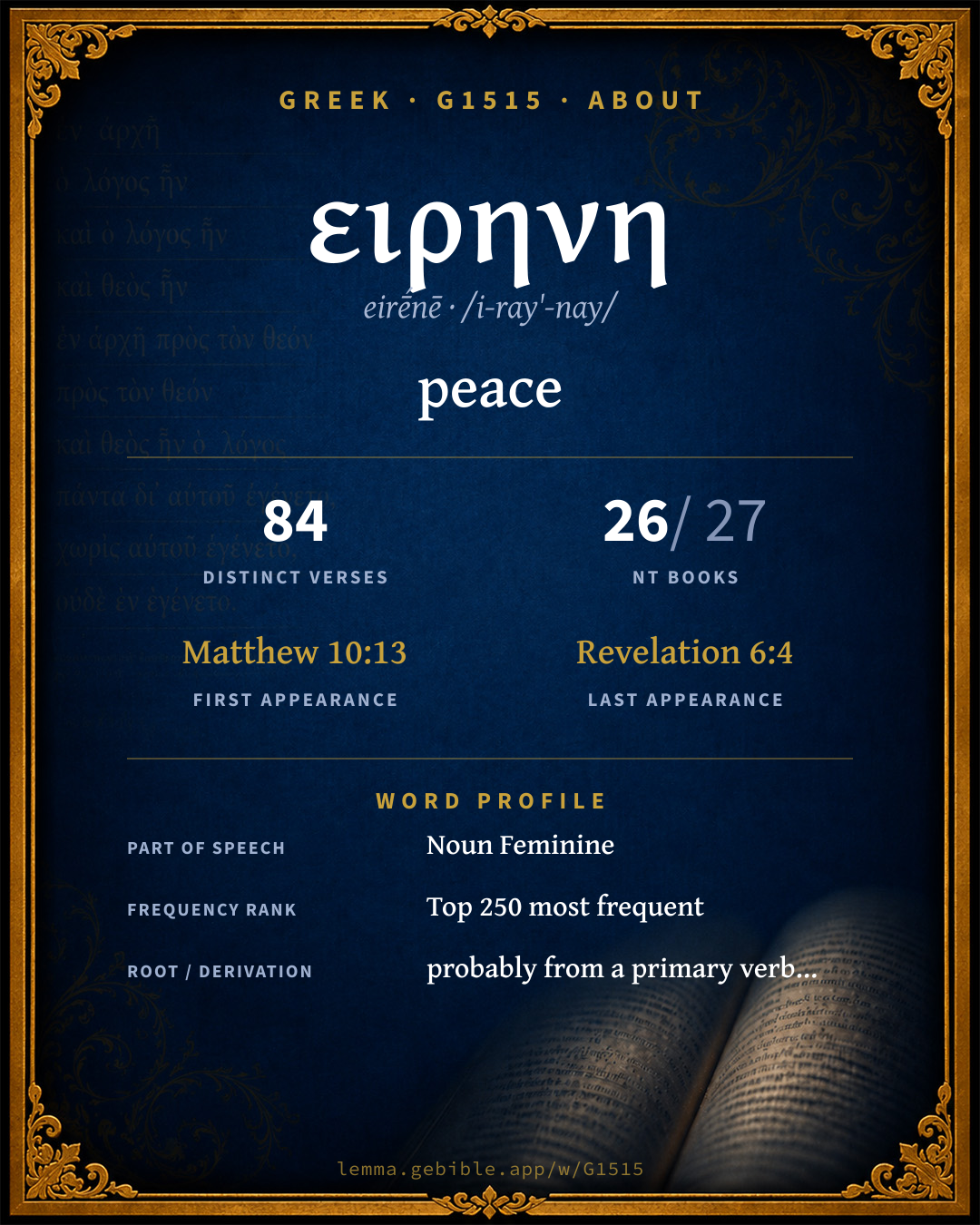
εἰρήνη
peace
‘peace’ is one of 6 main senses fuller range ↓
Full lexicon entry — Thayer's Greek Lexicon
From Thayer's Greek Lexicon
Where this word appears
See every Nominative-case word in the Greek New Testament →
Grammar key — what these labels mean
Part of speech
- Noun
- A naming word — a person, place, thing, or idea.
Case
- Nominative
- The case of the subject (and the predicate nominative).
- Accusative
- The case of the direct object and of extent.
- Genitive
- The case of source, possession, or “of” — answers “whose / from what.”
- Dative
- The case of the indirect object, means, or location — “to / for / with / in.”
Gender
- Feminine
- Grammatically feminine.
Number
- Singular
- One.
2 verses where G1515 appears in the Nominative case in the Book of Philippians. Filtered view — show all forms. Click any verse to open its interlinear word-by-word view. Verse text shown in the World English Bible for context — . Each verse’s Greek form is shown with its reference; the English is not keyword-highlighted, since the data carries no word-level English alignment. Use “Compare translations” on any verse to read it across multiple English versions. This concordance covers the Greek New Testament; Septuagint (Greek Old Testament) occurrences of this word are not indexed here.
Philippians
About this entry
At a glance — auto-summarized from this page’s data, not written by a person. Every figure links to its source below. This summary describes the numbers; it doesn’t interpret them.
ειρηνη (eirḗnē) is a Greek noun most often rendered “peace.” Ranging over 6 senses, it is not a single-sense word. Spanning 84 verses in 26 books, it ranks among the moderately common words of the Greek New Testament. Scripture first uses it in Matthew 10:13. Sharing its root, it stands alongside ειρηνευω and ειρηνικος. For the data behind this summary, explore the sense tree and the renderings breakdown below.
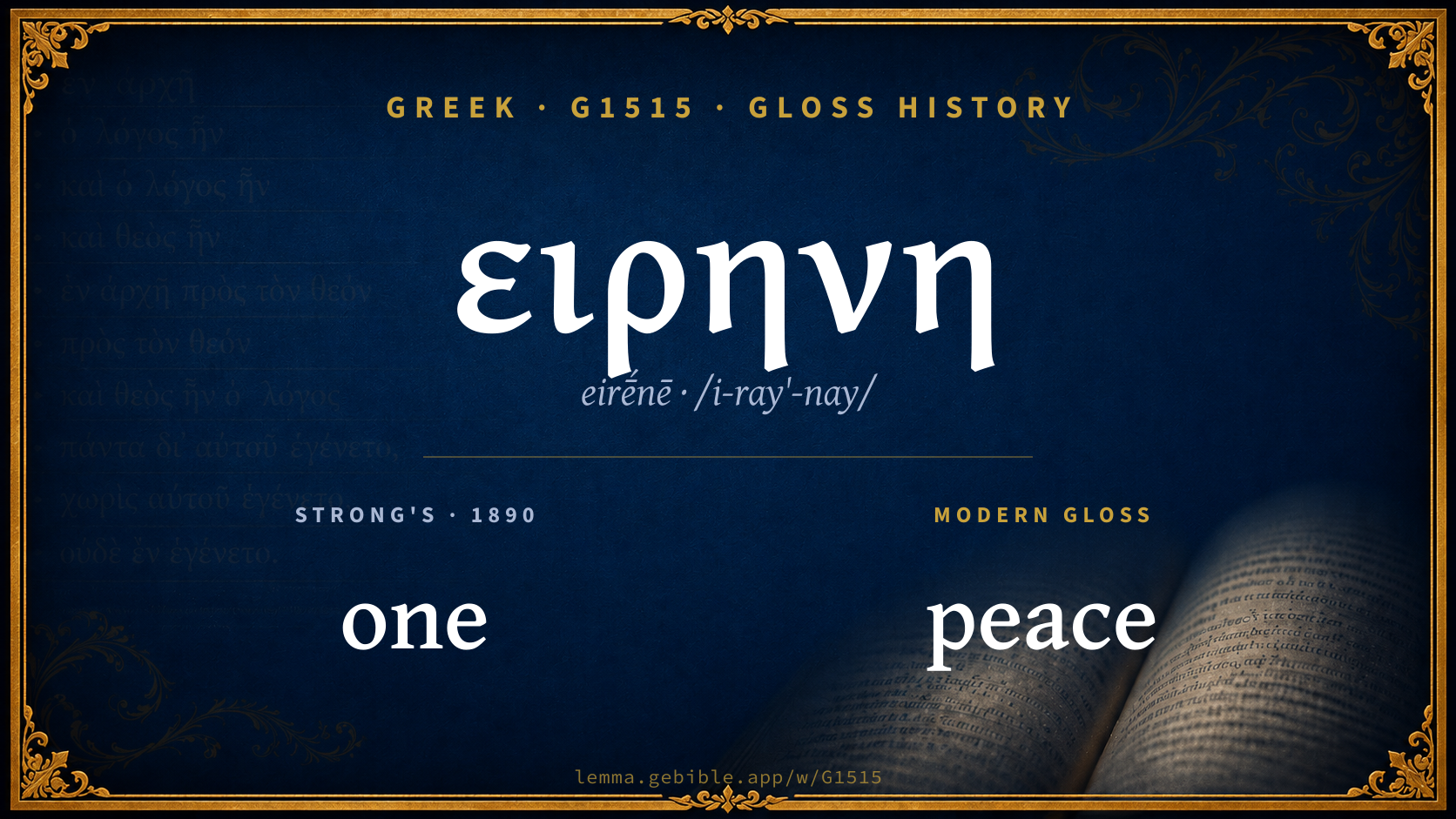
Gloss history
Strong's 1890 vs modern scholarship
About this word
Strong's G1515 catalogs a Greek word from the Greek New Testament.
These counts are not copied from any lexicon or concordance. They are computed here, from the morphology-tagged Greek New Testament. What Lemma adds →
- 84
- distinct verses
- The word appears in 84 distinct verses.
- 26 / 27
- NT books
- The word appears in 26 of 27 New Testament books.
- #191
- by frequency
- Top 250 most frequent Greek words (rank 191 of 5,347 Greek words by occurrence).
View all 84 occurrences in the concordance →
By section of the New Testament
By traditional corpus
Conventional, traditional groupings — biblical authorship is debated, so this is a traditional corpus grouping, not an authorship claim. Some books belong to more than one corpus (Luke is in both the Gospels and the Lukan corpus, and so on), so these shares overlap and need not total 100%. Each figure is a share of the word’s 84 distinct verses.
- Pauline corpus 41 verses · 49%
- Gospels 20 verses · 24%
- Lukan (Luke–Acts) 19 verses · 23%
- General (Catholic) Epistles 10 verses · 12%
- Johannine 9 verses · 11%
- Hebrews 4 verses · 5%
- Revelation 2 verses · 2%
How translations render this word
Counts come from each version’s own published word-to-Strong’s tagging or interlinear alignment — an approximate guide to how each version renders this word, not a word-level alignment the data otherwise carries. Because each total is that version’s own tagged count, the per-version totals vary from one another and need not match the appearance or distinct-verse counts above. These counts may also differ from a printed concordance because Lemma counts each distinctly tagged rendering and does not collapse phrase taggings into a single head-word total. This is a fixed set of word-tagged versions (KJV, ASV, BSB, ULT) and does not change with the reading translation you choose elsewhere. Each version’s license is shown beside its name below (and on Sources).
- King James Version: Peace 89×
- American Standard Version: Peace 84×
- Berean Standard Bible: Peace 88×
- unfoldingWord Literal Text: Peace 92×
King James Version Public Domain
Renders G1515 across 92 tagged occurrences — most commonly:
Plus 3 renderings that appear only once — usually multi-word phrases or single function words the recovered tagging swept in, not distinct renderings.
American Standard Version Public Domain
Renders G1515 across 90 tagged occurrences — most commonly:
Plus 6 renderings that appear only once — usually multi-word phrases or single function words the recovered tagging swept in, not distinct renderings.
Berean Standard Bible Public Domain
Renders G1515 across 91 tagged occurrences — most commonly:
Plus 3 renderings that appear only once — usually multi-word phrases or single function words the recovered tagging swept in, not distinct renderings. Not rendered by a distinct English word in 1 further occurrence.
unfoldingWord Literal Text CC BY-SA 4.0
Renders G1515 across 93 tagged occurrences — most commonly:
Plus 1 rendering that appears only once — usually multi-word phrases or single function words the recovered tagging swept in, not distinct renderings.
Senses in Thayer's
The 6 senses Thayer's distinguishes for this word, in lexicon order (not ranked by frequency or importance). The full entry — with sub-senses — is in the Lexicon Entry tab.
- a state of national tranquillity
- peace between individuals, i.e. harmony, concord
- security, safety, prosperity, felicity, (because peace and harmony make and keep things safe and prosperous)
- the way that leads to peace (salvation)
- of Christianity…
- the blessed state of devout and upright men after death
Word origin
Origin: probably from a primary verb eiro (to join)
Probably from a primary verb εἴρω eirō (to join ); peace (literally or figuratively); by implication prosperity : - one peace quietness rest + set at one again.
— Strong’s Exhaustive Concordance (1890), public domain.
Forms in the corpus
The 5 distinct written forms G1515 takes in the Greek New Testament, most frequent first — each parse links to that case’s occurrences in the concordance.
| Form | Parsing | Example | Uses |
|---|---|---|---|
| εἰρήνη eirḗnē | Noun, Nominative, Singular, Feminine | Matthew 10:13 | 37 |
| εἰρήνην eirḗnēn | Noun, Accusative, Singular, Feminine | Matthew 10:34 | 25 |
| εἰρήνης eirḗnēs | Noun, Genitive, Singular, Feminine | Luke 1:79 | 19 |
| εἰρήνῃ eirḗnē | Noun, Dative, Singular, Feminine | Luke 2:29 | 8 |
| Εἰρήνη Eirḗnē | Noun, Nominative, Singular, Feminine | Ephesians 6:23 | 2 |
Same root — word family
Other Thayer's entries built from the same root as G1515, grouped by Strong’s listed origin. These share a root / origin per the lexicon — not necessarily a shared meaning. Each links to that word’s own entry.
Derived from this word
Compare all same-root words → They share a root, not necessarily a meaning.
Septuagint usage
The same Greek word ειρηνη appears 212 times in the Greek Old Testament (Septuagint), across 188 verses in 29 books.
- 212
- LXX occurrences
- Tagged occurrences of this Greek word in the Septuagint.
- 188
- verses
- Distinct Septuagint verses containing this word.
- 29 / 39
- OT books
- The word appears in 29 of the 39 Old Testament books.
Sample Septuagint occurrences
- Genesis 15:15 εἰρήνη
- Exodus 18:23 εἰρήνη
- Leviticus 26:6 εἰρήνη
- Numbers 6:26 εἰρήνη
- Deuteronomy 20:10 εἰρήνη
- Joshua 9:15 εἰρήνη
- Judges 4:17 εἰρήνη
- 1 Samuel 1:17 εἰρήνη
- 2 Samuel 3:21 εἰρήνη
- 1 Kings 2:5 εἰρήνη
- 2 Kings 4:23 εἰρήνη
- 1 Chronicles 4:40 εἰρήνη
Septuagint occurrences (same lexeme)
Every verse where the same Strong’s number (G1515) appears in the Greek Septuagint — showing the first 50 of 188. Verse text shown in the World English Bible for context; the Greek form is the matched word — the English is not keyword-highlighted.
- Genesis 15:15 εἰρήνη But you will go to your fathers in peace. You will be buried in a good old age.
- Genesis 26:29 εἰρήνη that you will do us no harm, as we have not touched you, and as we have done to you nothing but good, and have sent you away in peace.' You are now the blessed of Yahweh."
- Exodus 18:23 εἰρήνη If you will do this thing, and God commands you so, then you will be able to endure, and all of these people also will go to their place in peace."
- Leviticus 26:6 εἰρήνη "'I will give peace in the land, and you shall lie down, and no one will make you afraid; and I will remove evil animals out of the land, neither shall the sword go through your land.
- Numbers 6:26 εἰρήνη Yahweh lift up his face toward you, And give you peace.'
- Numbers 25:12 εἰρήνη Therefore say, Behold, I give to him my covenant of peace:
- Deuteronomy 20:10 εἰρήνη When you draw near to a city to fight against it, then proclaim peace to it.
- Joshua 9:15 εἰρήνη Joshua made peace with them, and made a covenant with them, to let them live: and the princes of the congregation swore to them.
- Judges 4:17 εἰρήνη However Sisera fled away on his feet to the tent of Jael the wife of Heber the Kenite; for there was peace between Jabin the king of Hazor and the house of Heber the Kenite.
- Judges 6:23 εἰρήνη Yahweh said to him, Peace be to you; don't be afraid: you shall not die.
- Judges 6:24 εἰρήνη Then Gideon built an altar there to Yahweh, and called it Yahweh-shalom: to this day it is yet in Ophrah of the Abiezrites.
- Judges 8:9 εἰρήνη He spoke also to the men of Penuel, saying, When I come again in peace, I will break down this tower.
- Judges 11:13 εἰρήνη The king of the children of Ammon answered to the messengers of Jephthah, Because Israel took away my land, when he came up out of Egypt, from the Arnon even to the Jabbok, and to the Jordan: now therefore restore those [lands] again peaceably.
- Judges 11:31 εἰρήνη then it shall be, that whatever comes forth from the doors of my house to meet me, when I return in peace from the children of Ammon, it shall be Yahweh's, and I will offer it up for a burnt offering.
- Judges 18:6 εἰρήνη The priest said to them, Go in peace: before Yahweh is your way wherein you go.
- Judges 18:15 εἰρήνη They turned aside there, and came to the house of the young man the Levite, even to the house of Micah, and asked him of his welfare.
- Judges 19:20 εἰρήνη The old man said, Peace be to you; howsoever let all your wants lie on me; only don't lodge in the street.
- Judges 21:13 εἰρήνη The whole congregation sent and spoke to the children of Benjamin who were in the rock of Rimmon, and proclaimed peace to them.
- 1 Samuel 1:17 εἰρήνη Then Eli answered, Go in peace; and the God of Israel grant your petition that you have asked of him.
- 1 Samuel 7:14 εἰρήνη The cities which the Philistines had taken from Israel were restored to Israel, from Ekron even to Gath; and the border of it did Israel deliver out of the hand of the Philistines. There was peace between Israel and the Amorites.
- 1 Samuel 10:4 εἰρήνη and they will greet you, and give you two loaves of bread, which you shall receive of their hand.
- 1 Samuel 16:4 εἰρήνη Samuel did that which Yahweh spoke, and came to Bethlehem. The elders of the city came to meet him trembling, and said, Come you peaceably?
- 1 Samuel 16:5 εἰρήνη He said, Peaceably; I am come to sacrifice to Yahweh: sanctify yourselves, and come with me to the sacrifice. He sanctified Jesse and his sons, and called them to the sacrifice.
- 1 Samuel 20:7 εἰρήνη If he says, 'It is well;' your servant shall have peace: but if he be angry, then know that evil is determined by him.
- 1 Samuel 20:13 εἰρήνη Yahweh do so to Jonathan, and more also, should it please my father to do you evil, if I don't disclose it to you, and send you away, that you may go in peace: and Yahweh be with you, as he has been with my father.
- 1 Samuel 20:21 εἰρήνη Behold, I will send the boy, [saying], Go, find the arrows. If I tell the boy, Behold, the arrows are on this side of you; take them, and come; for there is peace to you and no hurt, as Yahweh lives.
- 1 Samuel 20:42 εἰρήνη Jonathan said to David, Go in peace, because we have sworn both of us in the name of Yahweh, saying, Yahweh shall be between me and you, and between my seed and your seed, forever. He arose and departed: and Jonathan went into the city.
- 1 Samuel 25:5 εἰρήνη David sent ten young men, and David said to the young men, Go up to Carmel, and go to Nabal, and greet him in my name:
- 1 Samuel 25:35 εἰρήνη So David received of her hand that which she had brought him: and he said to her, Go up in peace to your house; behold, I have listened to your voice, and have accepted your person.
- 1 Samuel 29:7 εἰρήνη Therefore now return, and go in peace, that you not displease the lords of the Philistines.
- 1 Samuel 30:21 εἰρήνη David came to the two hundred men, who were so faint that they could not follow David, whom also they had made to abide at the brook Besor; and they went forth to meet David, and to meet the people who were with him: and when David came near to the people, he greeted them.
- 2 Samuel 3:21 εἰρήνη Abner said to David, I will arise and go, and will gather all Israel to my lord the king, that they may make a covenant with you, and that you may reign over all that your soul desires. David sent Abner away; and he went in peace.
- 2 Samuel 3:22 εἰρήνη Behold, the servants of David and Joab came from a foray, and brought in a great spoil with them: but Abner was not with David in Hebron; for he had sent him away, and he was gone in peace.
- 2 Samuel 3:23 εἰρήνη When Joab and all the host who was with him had come, they told Joab, saying, Abner the son of Ner came to the king, and he has sent him away, and he is gone in peace.
- 2 Samuel 3:24 εἰρήνη Then Joab came to the king, and said, What have you done? behold, Abner came to you; why is it that you have sent him away, and he is quite gone?
- 2 Samuel 8:10 εἰρήνη then Toi sent Joram his son to king David, to Greet him, and to bless him, because he had fought against Hadadezer and struck him: for Hadadezer had wars with Toi. [Joram] brought with him vessels of silver, and vessels of gold, and vessels of brass:
- 2 Samuel 11:7 εἰρήνη When Uriah was come to him, David asked of him how Joab did, and how the people fared, and how the war prospered.
- 2 Samuel 15:9 εἰρήνη The king said to him, Go in peace. So he arose, and went to Hebron.
- 2 Samuel 15:27 εἰρήνη The king said also to Zadok the priest, "Aren't you a seer? Return into the city in peace, and your two sons with you, Ahimaaz your son, and Jonathan the son of Abiathar.
- 2 Samuel 17:3 εἰρήνη and I will bring back all the people to you: the man whom you seek is as if all returned: [so] all the people shall be in peace.
- 2 Samuel 18:28 εἰρήνη Ahimaaz called, and said to the king, All is well. He bowed himself before the king with his face to the earth, and said, Blessed be Yahweh your God, who has delivered up the men who lifted up their hand against my lord the king.
- 2 Samuel 18:29 εἰρήνη The king said, Is it well with the young man Absalom? Ahimaaz answered, When Joab sent the king's servant, even me your servant, I saw a great tumult, but I don't know what it was.
- 2 Samuel 18:32 εἰρήνη The king said to the Cushite, Is it well with the young man Absalom? The Cushite answered, The enemies of my lord the king, and all who rise up against you to do you hurt, be as that young man is.
- 2 Samuel 19:25 εἰρήνη It happened, when he was come to Jerusalem to meet the king, that the king said to him, Why didn't you go with me, Mephibosheth?
- 2 Samuel 19:31 εἰρήνη Barzillai the Gileadite came down from Rogelim; and he went over the Jordan with the king, to conduct him over the Jordan.
- 1 Kings 2:5 εἰρήνη Moreover you know also what Joab the son of Zeruiah did to me, even what he did to the two captains of the hosts of Israel, to Abner the son of Ner, and to Amasa the son of Jether, whom he killed, and shed the blood of war in peace, and put the blood of war on his sash that was about his loins, and in his shoes that were on his feet.
- 1 Kings 2:6 εἰρήνη Do therefore according to your wisdom, and don't let his gray head go down to Sheol in peace.
- 1 Kings 2:13 εἰρήνη Then Adonijah the son of Haggith came to Bathsheba the mother of Solomon. She said, Come you peaceably? He said, Peaceably.
- 1 Kings 2:33 εἰρήνη So shall their blood return on the head of Joab, and on the head of his seed forever: but to David, and to his seed, and to his house, and to his throne, shall there be peace for ever from Yahweh.
- 1 Kings 2:46 εἰρήνη So the king commanded Benaiah the son of Jehoiada; and he went out, and fell on him, so that he died. The kingdom was established in the hand of Solomon.
These are occurrences of the same Greek lexeme (G1515) in the Septuagint — not a translation of any one Hebrew word. The store carries no word-level Hebrew↔Greek alignment, so no Hebrew original is asserted here. Counts come from the recovered LXX Strong's tagging — high-frequency vocabulary is well covered, while rare or late forms may be untagged — so they reflect tagged occurrences and may slightly undercount.